BL11 Acupuncture Point (Dazhu)
BL3 Acupuncture Point (Meichong)
The Great Shuttle Beside the First Thoracic Vertebra: Anatomy, Mechanism, and Why the Hui-Meeting Point of Bones Anchors Upper Back and Neck-Base Treatment
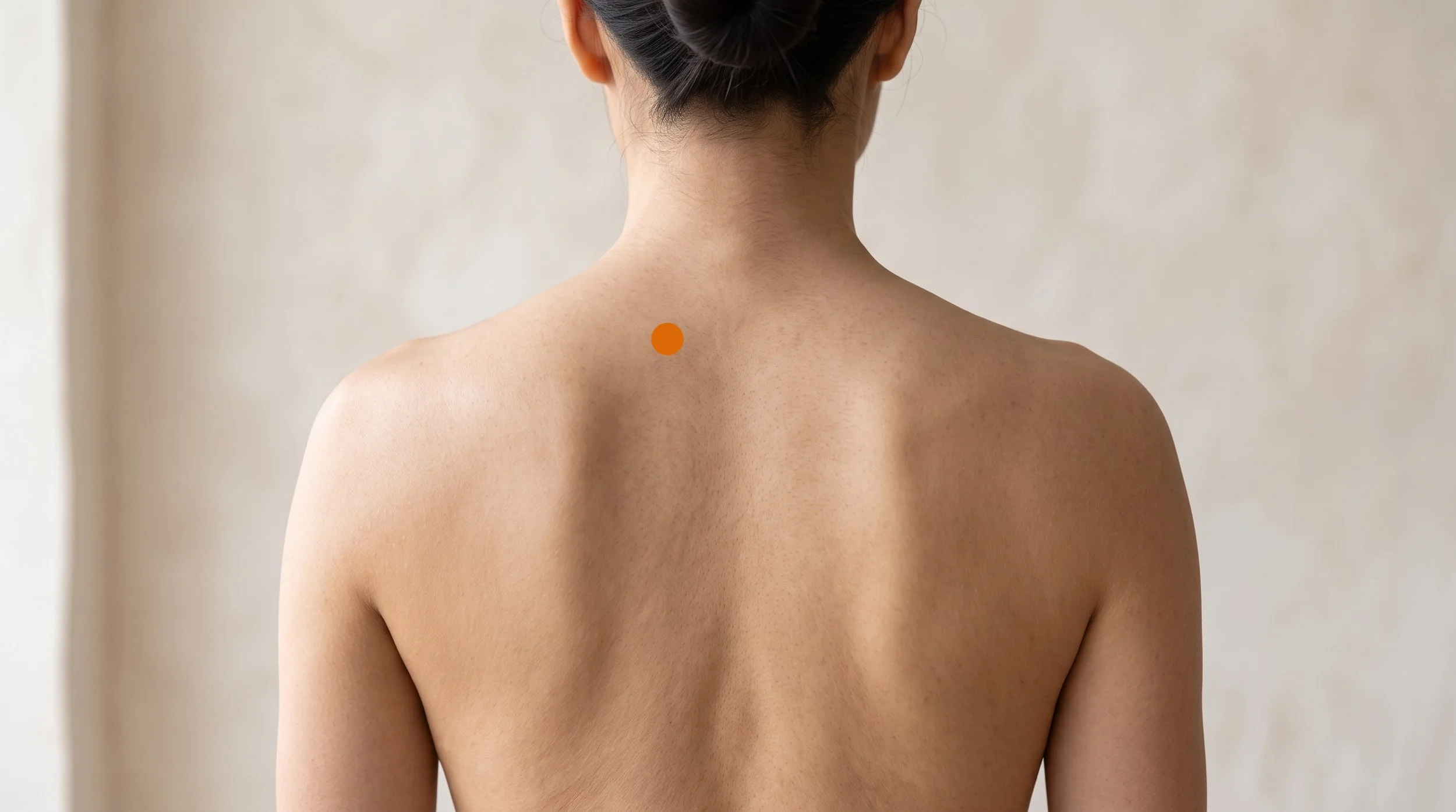
BL11 (Dazhu, often translated as Great Shuttle or Big Reed) is the eleventh point of the Bladder channel and sits on the upper back, 1.5 cun lateral to the lower border of the first thoracic spinous process, right where the paraspinal muscles form their highest visible ridge at the base of the neck (Deadman et al., 2007).
In classical sources it carries an unusual amount of weight for a point most patients have never heard of: it's the hui-meeting (influential) point of Bones, a meeting point of the Bladder and Small Intestine channels with the Governing vessel, and the upper point of what the Spiritual Pivot called the Sea of Blood (Deadman et al., 2007; Kim, 2010).
Anatomically, it's also the exact spot where desk posture, laptop work, and heavy bag carrying pile load onto the upper trapezius, rhomboid, and erector spinae layers, which is why the bl11 acupuncture point shows up so often in treatment plans for neck-base stiffness, interscapular aching, and the shoulder-girdle tension that follows people home from work.
- Location and layers: bladder 11 sits 1.5 cun lateral to the lower edge of the T1 spinous process, level with GV13 (Taodao), and needling passes through skin and fascia into the upper trapezius, then rhomboid territory, then the erector spinae mass at T1 (Deadman et al., 2007; Kim, 2010).
- Traditional categories, read modernly: classical texts assign BL11 the hui meeting bones designation and list it as a meeting point of yang channels with the Governing vessel, which in practice made it a regional command point for spinal and skeletal complaints rather than a point with any demonstrated effect on bone tissue itself (Deadman et al., 2007).
- Nerve story: the tissue here is supplied by the dorsal rami of the upper thoracic spinal nerves, whose input converges in dorsal horn segments that also receive afferents from the lower cervical spine and shoulder girdle, a plausible substrate for segmental modulation of neck-base and interscapular pain (Zhao, 2008).
- Research picture: reviews of acupuncture for neck disorders and of dry needling for trigger points in neck-related muscles report modest short-term reductions in pain and disability, with low to moderate certainty and heterogeneous protocols (Trinh et al., 2016; Navarro-Santana et al., 2020; Fang et al., 2024).
- Clinical framing: BL11 is rarely used alone, and in practice it anchors a local upper-back cluster (GV14, BL12, BL13, SI11) that may be combined with distal points and with dry needling of the trapezius and rhomboids when taut bands reproduce the patient's familiar pain (Simons et al., 1999).
- De qi and safety: most patients describe a dull, heavy, spreading ache toward the medial scapular border or up into the neck, and because the pleural apex sits close beneath the upper thorax, the needle is angled obliquely toward the spine rather than straight in (Deadman et al., 2007; He et al., 2012).
Is Your Neck Pain Ending Right Between Your Shoulder Blades?
That band of tightness at the base of the neck rarely stays put, and it often drags the upper back and shoulder girdle into the pattern. At Morningside Acupuncture we use BL11 as a local anchor beside T1 and pair it with dry needling of the trapezius and rhomboids when taut bands reproduce your familiar ache. Treatment is combined with posture and loading advice so the relief has a chance to hold between visits. Schedule a visit and we'll map exactly where your pain lives.
Schedule NowAnatomy of BL11: Why the T1 Paraspinal Ridge Is Such an Important Location
Finding the bl 11 location is straightforward once you have the landmark. Drop from the prominent vertebra at the base of the neck (C7) to the next spinous process below it (T1), then move 1.5 cun laterally, which for most people lands on the highest visible swell of the paraspinal muscles just inside the medial border of the shoulder blade (Deadman et al., 2007). From the surface inward, a needle here passes through skin and superficial fascia, then the upper trapezius, then rhomboid minor territory, and finally into the erector spinae column as it narrows toward the cervicothoracic junction.
This is precisely the tissue that absorbs sustained forward head posture, keyboard and phone use, backpack and bag straps, and the bracing that happens under stress, so it's commonly tender to firm palpation even in people who don't consider themselves to have an upper back problem.
The muscles and fascia at this level are innervated by the dorsal rami of the upper thoracic spinal nerves, with the overlying trapezius receiving accessory nerve and cervical plexus supply. That matters because needle stimulation here feeds into dorsal horn segments that also receive afferent traffic from the lower cervical spine, the shoulder girdle, and parts of the upper limb.
Converging input at shared segments is one of the more plausible explanations for why local needling can change pain that a patient feels several inches away, and mechanistic reviews describe acupuncture stimulation as engaging both segmental spinal inhibition and supraspinal descending pain control involving endogenous opioid systems (Zhao, 2008). Needling in this region may also produce local vasodilation and reduced resting tone in tender muscle bands, changes that patients typically report as looseness or warmth rather than as anything dramatic (Simons et al., 1999).
Deeper structures make technique non-negotiable here. The apex of the lung rises above the first rib, so the upper thoracic paraspinal region is one of the classic sites where careless perpendicular needling can reach the pleura. Classical and modern texts converge on the same convention: insert obliquely toward the spine to a depth of roughly 0.5 to 1 cun, or use a shallower transverse-oblique angle of 1 to 1.5 cun, and avoid deep perpendicular insertion entirely (Deadman et al., 2007; Kim, 2010).
Reviews of acupuncture adverse events consistently identify pneumothorax as one of the most frequently reported serious complications, and nearly all documented cases trace back to depth and angle errors over the thorax rather than to the technique itself (He et al., 2012). Practitioner training, patient body habitus, and needle length all factor into how this point is approached.
Related Pain Finder Upper Back Shoulder Arm Related Best Acupuncture Points For Neck PainBL11 at a Glance: Classification, Location, and Clinical Use
| Category | Detail |
|---|---|
| Traditional Name | Dazhu (Great Shuttle, also translated Big Reed or Big Shuttle) |
| Channel Classification | Bladder channel (taiyang), point 11 of 67, upper back region |
| Point Categories | Hui-meeting (influential) point of Bones; meeting point of the Bladder and Small Intestine channels with the Governing vessel (Deadman also lists the Sanjiao and Gall Bladder channels among the meeting channels); upper point of the Sea of Blood per the Spiritual Pivot |
| Precise Location | On the upper back, 1.5 cun lateral to the lower border of the T1 spinous process, level with GV13 (Taodao). Classically located at the highest visible point of the paraspinal muscles. |
| Tissue Stimulated | Skin and superficial fascia, upper trapezius, rhomboid territory, and the erector spinae at T1, supplied by dorsal rami of the upper thoracic spinal nerves |
| Needle Depth / Direction | Oblique insertion angled toward the spine, 0.5 to 1 cun, or transverse-oblique 1 to 1.5 cun. Perpendicular needling over the upper thorax is avoided because of pneumothorax risk. |
| De Qi Sensation | A dull, heavy, spreading ache at the neck base that often travels toward the medial scapular border or up into the lower neck. A brief involuntary twitch may occur if a taut band is engaged during dry needling. |
| Primary Clinical Uses | Upper back and neck-base pain, stiff neck extending toward the shoulder blades, interscapular aching, and bone and joint complaints within the classical constitutional framework. Cough and chest fullness appear in classical listings. |
| Common Point Combinations |
|
Deadman's Manual of Acupuncture presents Dazhu with three traditional actions: benefiting the bones and joints, expelling pathogenic factors and firming the exterior, and regulating Lung qi to ease cough. As the hui-meeting point of Bones it was the go-to choice for what classical authors called bone diseases, along with rigidity of the neck and spine, soreness of the back and scapula, lumbar pain, and stiffness of the knee, and later commentators extended it to the deformity-producing form of painful obstruction thought to have penetrated into the bones and joints.
Because taiyang is described as the most exterior of the six channels, and because this point sits high on the back near both the neck and the lungs, classical sources also credited it with releasing exterior wind-cold (fever, chills, absence of sweating, stiff neck and scapulae) and with settling cough, wheezing, and chest fullness, functions it shares closely with its neighbor BL12. The Spiritual Pivot additionally named it the upper point of the Sea of Blood, though Deadman notes those particular indications largely drop out of later literature.
What's striking is the coherence of the pattern: a single point at the cervicothoracic junction became the classical meeting place for structural complaints of the spine, surface-level illness, and breathing trouble, which is exactly the cluster of symptoms that region tends to produce in modern clinical life.
Why BL11 Is Used for Stubborn Neck Pain That Ends Between the Shoulder Blades
Patients regularly describe neck pain that doesn't stop at the neck. It travels down and settles in a spot near the inner edge of the shoulder blade, or it fans across the top of the shoulders and refuses to release with stretching. BL11 sits at the hinge of that pattern. The cervicothoracic junction is where a mobile neck meets a much stiffer thoracic spine, and the muscles crossing that junction carry the load of every hour spent with the head in front of the shoulders.
Needling here delivers input to dorsal horn segments that also receive afferents from the lower cervical spine and shoulder girdle, so the treatment is being applied to the same neurological neighborhood the pain is coming from rather than to an unrelated spot (Zhao, 2008).
Beyond the segment, acupuncture stimulation appears to recruit descending inhibitory pathways from the brainstem that dampen nociceptive signaling more broadly, with endogenous opioid and monoamine systems implicated in animal and human studies (Zhao, 2008). That helps explain why sessions often produce a general settling rather than a purely local change, and why effects tend to build across a course of treatment instead of resolving everything in one visit.
Large individual patient data analyses of chronic pain trials found effects for acupuncture that persisted over months rather than fading immediately after treatment ended (Vickers et al., 2018).
The classical hui-meeting bones designation deserves a plain-language caveat. It's a traditional category, not a claim that needling BL11 alters bone density or heals structural pathology. What it does reflect is that generations of practitioners reached for this point when complaints were spinal, deep, and stiff rather than superficial and muscular.
In modern practice that translates into using it for mechanical neck-base and upper thoracic pain, and as one component of a broader plan for joint pain, where reviews of acupuncture in osteoarthritis report small benefits over sham that may not reach clinical significance thresholds while showing larger differences against waiting list care (Manheimer et al., 2010).
What the Research Shows for BL11
No trial has isolated BL11 on its own, and that's worth stating plainly. Acupuncture research almost always tests multi-point protocols, so the honest way to read the evidence is that BL11 is a frequently included component of upper back and neck protocols rather than an independently validated intervention. The reviews below describe what happens when acupuncture or dry needling is delivered as a package for neck and joint pain, with the usual caveats about study quality, sham design, and heterogeneous point selection. Studies suggest modest, real, and often short-lived benefits, which is a reasonable expectation to bring into treatment.
| Study | Type | Focus | Key Finding |
|---|---|---|---|
| Trinh et al., 2016 | Cochrane systematic review | Acupuncture for neck disorders, 27 trials | Acupuncture performed better than sham or inactive controls for neck pain and disability, though the certainty of evidence was rated low to moderate. |
| Fang et al., 2024 | Systematic review and meta-analysis | Durability of acupuncture effects in chronic neck pain, 18 randomized trials | Acupuncture as an adjunct therapy was associated with pain relief sustained at three and six months, while comparisons against sham did not reach statistical significance. |
| Navarro-Santana et al., 2020 | Systematic review and meta-analysis | Dry needling of trigger points in neck pain, including trapezius | Low to moderate evidence suggested short-term improvements in pain intensity and pain-related disability, without consistent changes in pressure pain sensitivity or range of motion. |
| Vickers et al., 2018 | Individual patient data meta-analysis | Acupuncture across chronic pain conditions including neck and musculoskeletal pain | Acupuncture was superior to sham and to no-acupuncture control, with effects that decreased only modestly over about twelve months. |
| Manheimer et al., 2010 | Cochrane systematic review | Acupuncture for peripheral joint osteoarthritis | Sham-controlled benefits were statistically significant but small and below prespecified clinical relevance thresholds, with larger differences against waiting list controls. |
| He et al., 2012 | Systematic review of adverse events | Acupuncture safety reports in the Chinese literature, 1956 to 2010 | Pneumothorax was among the most frequently reported serious adverse events, reinforcing the importance of oblique angling over the thorax. |
Desk Work, Deadlifts, and the Upper Back That Never Loosens?
Whether your upper back tightens from ten hours at a laptop or from training volume you haven't backed off, the T1 paraspinal ridge takes the load. Our licensed acupuncturists use the bl11 acupuncture point alongside upper thoracic and scapular points, then layer in dry needling and movement work for the muscles that keep re-loading the area. We keep needling conservative in the upper thorax and explain every step before it happens. Book a session and let's get the area moving again.
Schedule NowBL11 in the Context of Trigger Point Work
The tissue under BL11 overlaps directly with muscles that trigger point clinicians treat constantly. The upper trapezius crosses superficially, rhomboid minor attaches nearby, and the upper thoracic erector spinae runs just lateral to the spinous processes. Trigger points in the rhomboids typically produce a local aching along the medial scapular border, while upper trapezius and levator scapulae points refer up into the neck and toward the head, patterns that patients often describe as one continuous problem (Simons et al., 1999).
At Morningside, palpation comes before needle selection: if pressing a taut band reproduces the pain you actually came in with, that band gets treated, and BL11 frequently sits within or immediately adjacent to it.
In a typical session we might use BL11 with oblique medial angulation as a local channel point, add GV14 and SI11 or SI12 for the scapular component, and then dry needle the trapezius, rhomboids, and levator scapulae based on exam findings, always with the same conservative angling over the thorax. Dry needling and acupuncture are not separate medicines here, both use an acupuncture needle and differ mainly in the reasoning that guides placement.
Reviews of trigger point dry needling for neck-related pain report short-term reductions in pain intensity and disability, which fits our clinical experience that manual work, needling, and loading advice together tend to outperform any one of them alone (Navarro-Santana et al., 2020).
BL11 Upper Back and Neck Pain Treatment at NYC's Highest-Rated Acupuncture Clinic
Morningside Acupuncture is the highest-rated acupuncture and dry needling clinic in New York City with over 500 five-star Google reviews. We combine traditional point selection, including classical Bladder channel points such as Dazhu, with modern trigger point needling and rehab-informed care for neck, upper back, and shoulder complaints. Every plan is built around your exam findings, not a template. Schedule your appointment and start with a full assessment.
Schedule NowFrequently Asked Questions
What does BL11 feel like when needled?
Most people feel a dull, heavy, slightly spreading ache at the base of the neck, sometimes traveling toward the inner edge of the shoulder blade or up into the lower neck. That sensation is described traditionally as de qi and shouldn't be sharp, electric, or burning. If a taut muscle band is engaged during dry needling, you may feel a quick involuntary twitch followed by a brief cramping ache that settles within seconds. Many patients notice the area feels looser or warmer for a while after the needles come out, and mild next-day soreness similar to post-workout tenderness is common and not a problem.
Why needle BL11 for pain I feel in my neck or shoulder blade rather than exactly where it hurts?
Because it usually is close to where it hurts, just not always where you point. The tissue at BL11 shares spinal segments with the lower cervical spine and shoulder girdle, so input delivered there reaches dorsal horn levels that process the pain you're reporting a few inches away (Zhao, 2008). Referred pain also plays a role: trigger points in the rhomboids and upper trapezius send pain to areas away from the band itself, so the most tender spot on palpation is often not the spot you'd have circled on a diagram (Simons et al., 1999). Treating the source of the referral tends to work better than chasing the endpoint.
Can I press BL11 myself between sessions?
Yes, acupressure at BL11 is safe and easy to self-apply. Find the bony bump at the base of your neck (C7), drop to the next bump below it, then move about two finger-widths to either side onto the muscular ridge. Reach across with the opposite hand, or use a tennis or lacrosse ball against a wall, and apply steady moderate pressure for 30 to 60 seconds per side, breathing slowly and letting your shoulder drop. Repeat two or three times, up to a few times a day. Pressure should feel like a satisfying ache around a 4 to 6 out of 10, never sharp. Pair it with a few slow chin tucks and shoulder blade squeezes so the area gets movement as well as pressure. Skip it over broken skin, rashes, or unexplained lumps, and stop if pressing reproduces radiating arm symptoms.
Is BL11 safe to needle?
It's safe in trained hands, and technique is what makes it safe. The lung apex rises above the first rib, so BL11 is one of the points where the needling angle genuinely matters: practitioners insert obliquely toward the spine to roughly 0.5 to 1 cun, or use a shallow transverse-oblique angle, rather than perpendicular insertion (Deadman et al., 2007). Reviews of acupuncture adverse events identify pneumothorax as one of the most frequently reported serious complications, and it is overwhelmingly linked to inappropriate depth or angle over the thorax rather than to acupuncture as such (He et al., 2012). Tell your practitioner if you have a bleeding disorder, take anticoagulants, have had thoracic surgery, or have a very lean build, since all of these change the approach. Minor bruising or short-lived soreness are the usual side effects.
Where exactly is BL11 located?
BL11 is on the upper back, 1.5 cun lateral to the lower border of the spinous process of the first thoracic vertebra (T1), level with GV13 (Taodao). In practical terms: flex your neck forward, find the most prominent bump at the base of the neck (C7), move down to the next spinous process (T1), then go about two finger-widths lateral onto the visible high point of the paraspinal muscle mass, roughly halfway between the spine and the inner border of the shoulder blade (Deadman et al., 2007; Kim, 2010). The point is bilateral, and it's usually tender to firm pressure in anyone carrying upper back tension.
References
- Deadman, P., Al-Khafaji, M., & Baker, K. (2009). A manual of acupuncture. Journal of Chinese Medicine Publications.
- Kim, H. (2008). Handbook of Oriental medicine (3rd ed.). Harmony & Balance Press.
- Simons, D. G., Travell, J. G., & Simons, L. S. (1999). Travell & Simons' myofascial pain and dysfunction: The trigger point manual, Vol. 1: Upper half of body (2nd ed.). Williams & Wilkins.
- Trinh, K., Graham, N., Irnich, D., Cameron, I. D., & Forget, M. (2016). Acupuncture for neck disorders. Cochrane Database of Systematic Reviews, 2016(5), CD004870. https://doi.org/10.1002/14651858.CD004870.pub4 [VERIFY BEFORE PUBLISHING]
- Fang, J., Shi, H., Wang, W., Chen, H., Yang, M., Gao, S., Yao, H., Zhu, L., Yan, Y., & Liu, Z. (2024). Durable effect of acupuncture for chronic neck pain: A systematic review and meta-analysis. Current Pain and Headache Reports, 28(9), 957-969. https://doi.org/10.1007/s11916-024-01267-x
- Navarro-Santana, M. J., Sanchez-Infante, J., Fernández-de-las-Peñas, C., Cleland, J. A., Martín-Casas, P., & Plaza-Manzano, G. (2020). Effectiveness of dry needling for myofascial trigger points associated with neck pain symptoms: An updated systematic review and meta-analysis. Journal of Clinical Medicine, 9(10), 3300. https://doi.org/10.3390/jcm9103300
- Manheimer, E., Cheng, K., Linde, K., Lao, L., Yoo, J., Wieland, S., van der Windt, D. A. W. M., Berman, B. M., & Bouter, L. M. (2010). Acupuncture for peripheral joint osteoarthritis. Cochrane Database of Systematic Reviews, 2010(1), CD001977. https://doi.org/10.1002/14651858.CD001977.pub2
- He, W., Zhao, X., Li, Y., Xi, Q., & Guo, Y. (2012). Adverse events following acupuncture: A systematic review of the Chinese literature for the years 1956-2010. Journal of Alternative and Complementary Medicine, 18(10), 892-901. https://doi.org/10.1089/acm.2011.0825
- Vickers, A. J., Vertosick, E. A., Lewith, G., MacPherson, H., Foster, N. E., Sherman, K. J., Irnich, D., Witt, C. M., & Linde, K. (2018). Acupuncture for chronic pain: Update of an individual patient data meta-analysis. Journal of Pain, 19(5), 455-474. https://doi.org/10.1016/j.jpain.2017.11.005
- Zhao, Z. Q. (2008). Neural mechanism underlying acupuncture analgesia. Progress in Neurobiology, 85(4), 355-375. https://doi.org/10.1016/j.pneurobio.2008.05.004
Disclaimer: This web site is intended for educational and informational purposes only. Reading this website does not constitute providing medical advice or any professional services. This information should not be used for diagnosing or treating any health issue or disease. Those seeking medical advice should consult with a licensed physician. Seek the advice of a medical doctor or other qualified health professional for any medical condition. If you think you have a medical emergency, call 911 or go to the emergency room. No acupuncturist-patient relationship is created by reading this website or using the information. Morningside Acupuncture PLLC and its employees and contributors do not make any express or implied representations with respect to the information on this site or its use. For any legal interpretation of scope of practice in your state, consult a licensed attorney or regulatory authority.
Read more from our blog