GB44 Acupuncture Point (Zuqiaoyin)
The Yin Portals of the Foot: Anatomy, Mechanism, and Why the Last Point of the Gallbladder Channel Is Used for One-Sided Headaches, Ear Symptoms, and Restless Sleep
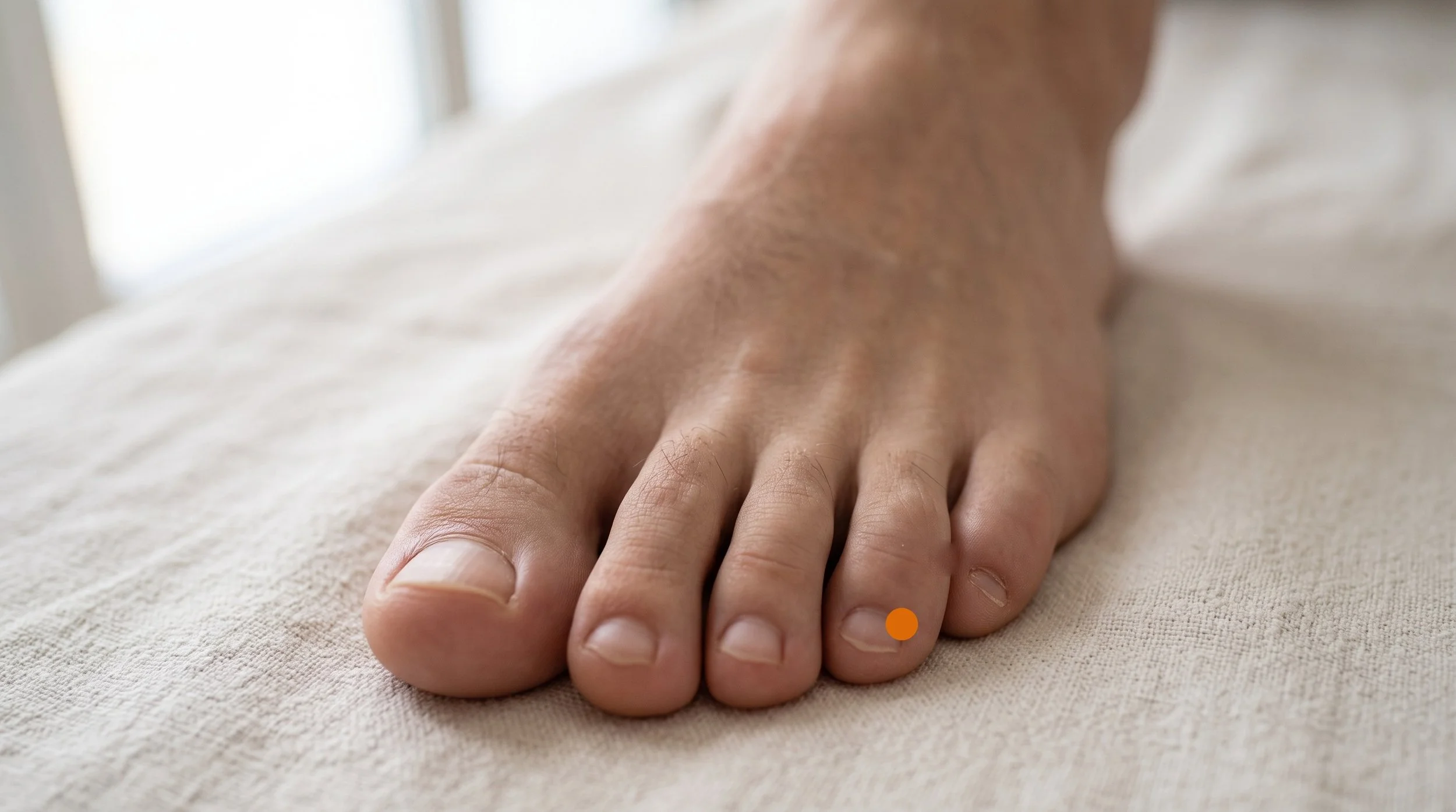
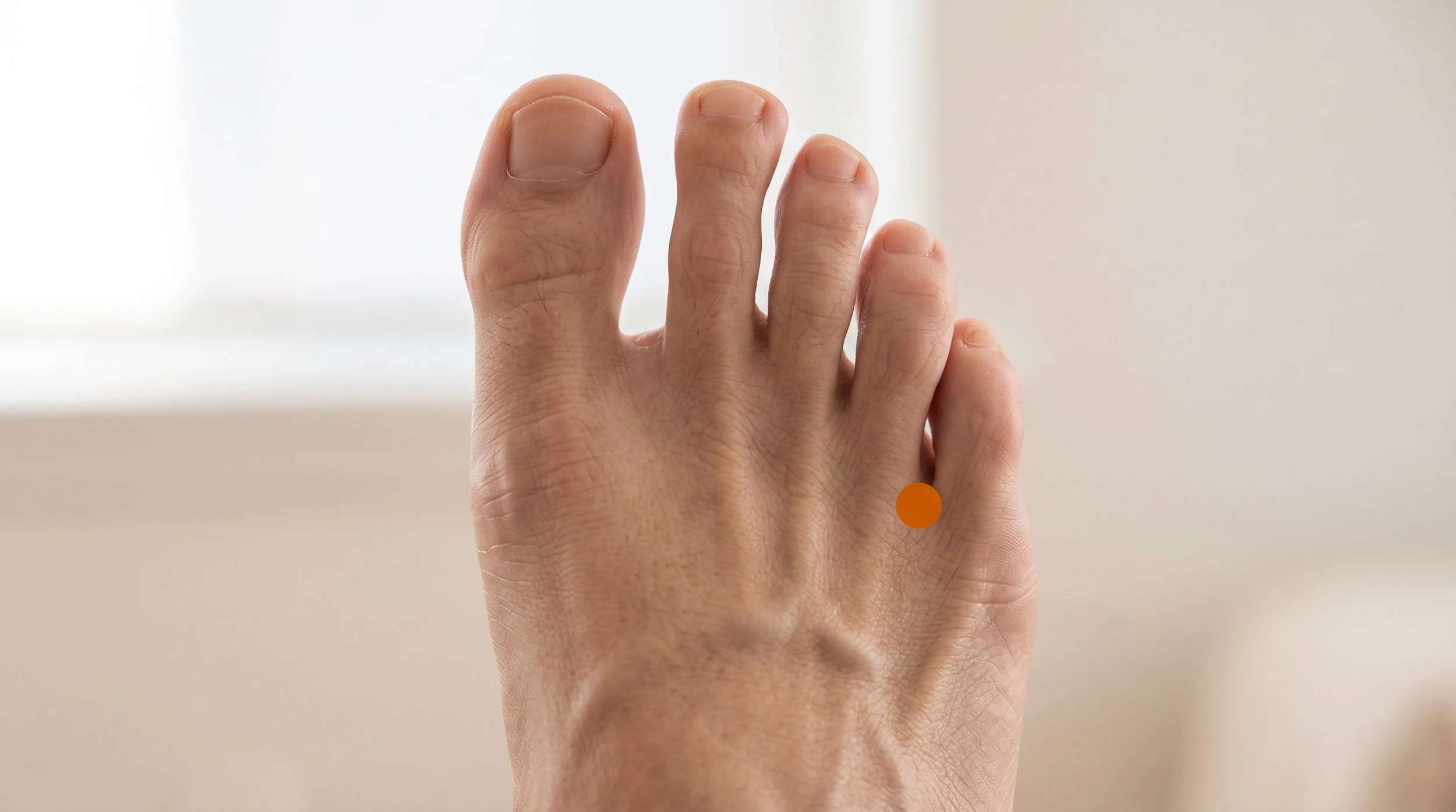
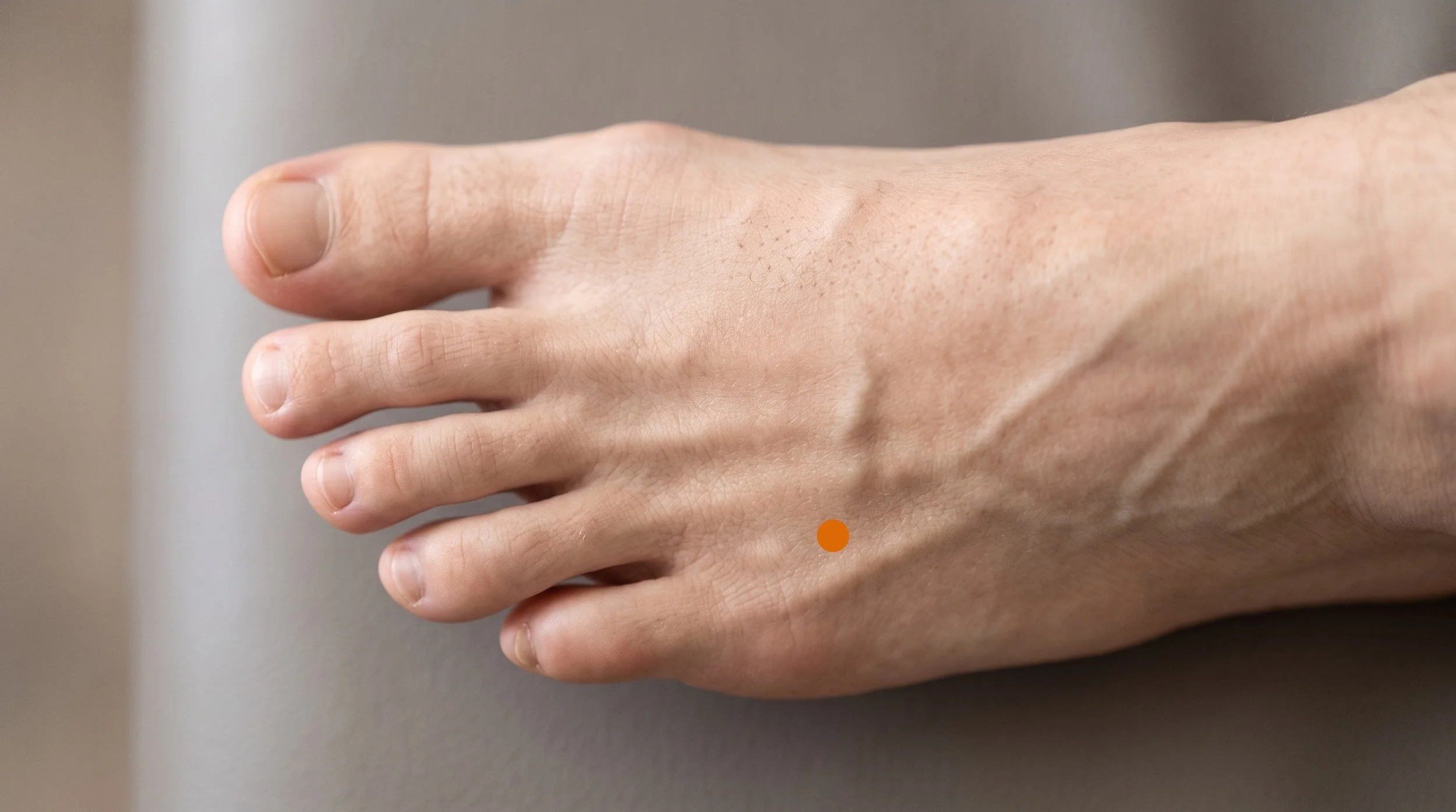
GB44, known in Chinese as Zuqiaoyin and usually translated as Yin Portals of the Foot, sits at the outer corner of the fourth toenail, roughly a nail's width in from the edge and level with the base of the nail. It's the jing-well point and the final point of the Gallbladder channel, which means it's the most distal spot on a pathway that begins at the outer corner of the eye and runs along the temple, the side of the neck, the ribs, the hip, and the outside of the leg.
That geography is the whole point clinically: the gb44 acupuncture point is a tiny, highly innervated target on the foot that practitioners have used for centuries to influence the far end of the same channel, particularly one-sided headaches, red and painful eyes, ringing or sudden loss of hearing, rib-side pain, and agitated sleep. It's rarely a stand-alone treatment, but as a brisk distal point it can change the tone of a session quickly.
- Location and layers: GB44 lies at the lateral corner of the fourth toenail, where thin skin sits over dense dermis, the lateral nail fold, a slip of extensor tendon, and the periosteum of the distal phalanx only a millimeter or two below the surface. Needling is deliberately shallow, 0.1 to 0.2 cun, often angled back toward the toe, and the point may also be pricked to release a drop or two of blood (Deadman et al., 2007).
- Traditional categories, in modern terms: classical texts list GB44 as the jing-well and metal point of the Gallbladder channel and attribute to it the actions of clearing heat from the head, easing the chest and rib-side, and settling the spirit (Deadman et al., 2007; Kim, 2015). Read neurophysiologically, those categories describe a distal, high-intensity skin point used to drive a strong afferent volley into segments L5 and S1 and, from there, into brainstem circuits that modulate pain and arousal (Zhao, 2008).
- Nerve story: the toe tips are among the most densely innervated skin on the body, supplied here by dorsal digital branches of the superficial fibular nerve with a lateral contribution from the sural nerve, so even a shallow insertion recruits a large population of A-delta and C fibers. Experimental work links that afferent input to opioid and monoaminergic descending inhibition rather than to any local effect at the toe (Zhao, 2008).
- Research picture: acupuncture protocols that include distal Gallbladder points have been tested mainly for migraine and tension-type headache, where Cochrane reviews found modest reductions in headache frequency compared with sham and usual care (Linde et al., 2016a; Linde et al., 2016b). Reviews of tinnitus and sudden hearing loss are more mixed and lower in quality (Huang et al., 2021; Zhang et al., 2015).
- Point-specific interest: GB44 has been chosen as the single true-acupuncture point for temporal (shaoyang) migraine in a randomized neuroimaging trial, on the basis of classical root and knot theory, with the investigators reporting earlier work in which jing-well points of the three foot yang channels shifted default mode network connectivity (Jia et al., 2023). That's promising but preliminary, not proof of a specific effect.
- What it feels like: the sensation at GB44 is quick and bright rather than deep and heavy, usually a sharp pinch that fades within seconds, sometimes with a brief zip up the toe. Most patients tolerate it well when the needle goes in fast and shallow, and the point is typically retained only briefly or stimulated and removed.
Struggling With One-Sided Headaches That Sit Above the Ear?
Temporal and behind-the-eye headaches often track the Gallbladder channel, and GB44 is one of the distal points we may use to open a session before working locally around the temple, jaw, and upper neck. Our acupuncturists combine channel-based point selection with dry needling of the temporalis, suboccipitals, and upper trapezius when the exam points that way. Treatment is graded to what you can tolerate, and we track headache days rather than guessing at progress. Schedule a visit and let's map your headache pattern properly.
Schedule NowAnatomy of GB44: Why the Lateral Corner of the Fourth Toenail Is Such an Important Location
GB44 is a surface point in the truest sense. Under the needle there's a thin layer of epidermis, then a dense, tightly anchored dermis packed with sensory endings, the lateral nail fold and the edge of the nail bed, and almost immediately the periosteum of the distal phalanx of the fourth toe. A small slip of the long and short toe extensors passes over the dorsum just proximal to the point, and the flexor and plantar fat pad sit below.
There isn't much soft tissue here to load mechanically, but the region is squeezed constantly by narrow toe boxes, running shoes, and hammertoe or clawtoe posture, which is why the fourth toe can already be tender before a needle ever touches it.
The sensory supply is what makes this location clinically interesting. The dorsal aspect of the fourth toe is served by dorsal digital nerves arising from the intermediate dorsal cutaneous branch of the superficial fibular nerve, with a lateral contribution from the sural nerve, and the plantar surface adds digital branches of the lateral plantar nerve. Receptor density at the digit tips is very high, so a shallow prick recruits a disproportionately large volley of A-delta and C fiber input into the L5 and S1 dorsal horn.
That input doesn't reach the head segmentally, since head and face pain is carried by the trigeminal system, so any effect on headache has to be heterosegmental: brief intense distal stimulation engages spinal and brainstem circuits, including periaqueductal gray and rostral ventromedial medulla pathways, and drives opioid and monoaminergic descending inhibition (Zhao, 2008). Preclinical and clinical work in migraine adds modulation of neuropeptide release, neuroinflammatory signaling, and central sensitization to that picture (Chen et al., 2022).
Vascularly, the toe tip is supplied by dorsal digital arteries from the dorsal metatarsal branches of the arcuate artery, plus plantar digital vessels, and the digital pulp is unusually rich in arteriovenous anastomoses. That's why pricking GB44 yields a drop or two of blood so readily and why the traditional bleeding technique is even possible at this depth. Standard needling is perpendicular or oblique, directed proximally, 0.1 to 0.2 cun, with a single-use sterile needle and clean skin (Deadman et al., 2007; Kim, 2015).
We avoid needling through the nail plate or into the nail matrix, use extra caution or skip the point entirely in people with diabetic neuropathy, peripheral vascular disease, cellulitis, or open lesions of the foot, and we don't use bleeding technique in patients on anticoagulants or with bleeding disorders.
Related Best Acupuncture Points For Headaches Related Gall Bladder ChannelGB44 at a Glance: Classification, Location, and Clinical Use
| Category | Detail |
|---|---|
| Traditional Name | Zuqiaoyin (Yin Portals of the Foot), also translated as Foot Orifice Yin |
| Channel Classification | Gallbladder channel of Foot Shaoyang, the forty-fourth and final point of the channel |
| Point Categories | Jing-well point of the Gallbladder channel; metal point of the Gallbladder channel in five-shu theory; cited in classical root and knot (gen-jie) theory as the origin of the Lesser Yang, with its concentration in the ear |
| Precise Location | On the dorsal aspect of the fourth toe, at the meeting of a line along the lateral border of the nail and a line along the base of the nail, about 0.1 cun from the nail corner |
| Tissue Stimulated | Nail fold skin and dense digital dermis, edge of the nail bed, dorsal digital nerve territory, and periosteum of the distal phalanx; nearby forefoot muscles often addressed in the same session include the dorsal interossei, the interossei of the foot, and the deep intrinsic foot muscles |
| Needle Depth / Direction | Perpendicular or oblique insertion angled proximally, 0.1 to 0.2 cun, or pricked to release one to two drops of blood |
| De Qi Sensation | A brief, sharp, bright pinch rather than a deep ache, occasionally with a quick electric zip along the toe; the sensation typically settles within seconds |
| Primary Clinical Uses | Traditionally used for one-sided and temporal headache with agitation, dizziness, red and painful eyes, sudden deafness and tinnitus, throat and tongue symptoms, rib-side pain with cough, and insomnia with vivid dreams or nightmares |
| Common Point Combinations |
|
Deadman, Al-Khafaji and Baker's A Manual of Acupuncture explains that the name Yin Portals of the Foot is traditionally read as a reference to the sense organ openings linked with the five yin organs, the eyes, ears, tongue, mouth, and nose, and that classical indications for GB44 cover every one of those openings except the nose, making it a lower body counterpart to GB11 on the head.
As the terminal jing-well point of the Gallbladder channel it was invoked under the Spiritual Pivot principle that head disorders can be treated from the feet, and numerous classical sources cite it for patterns described as Gallbladder fire rising or exterior wind-heat striking the head, with sudden deafness, tinnitus, dizziness, swollen red eyes, throat obstruction, and agitated headache.
The Classic of Difficulties assigns jing-well points to fullness below the Heart, and as the metal point of the channel GB44 was singled out in works such as the Systematic Classic and the Great Compendium for rib-side pain with cough and breathlessness, understood as Liver qi or fire invading the Lung. Because the Gallbladder divergent channel was described as linking to the Heart, that same heat was thought to unsettle the spirit, which is why GB44 keeps company with other foot jing-well points in classical listings for insomnia and nightmares.
What's striking is the exception: unlike most jing-well points, GB44 doesn't appear in the major classics as a revival point for loss of consciousness, so its classical reputation rests almost entirely on the head, the ribs, and sleep.
Why GB44 Is Used for One-Sided Headaches That Sit Above the Ear
The most common question about this point is fair: how can a needle at the fourth toenail matter to a headache above the ear? The honest answer is that it isn't a segmental effect. Sensation from the toe enters the spinal cord at L5 and S1, while head and face pain runs through the trigeminal system, so nothing at the toe converges directly with the pain you're feeling at the temple.
What distal points appear to do instead is generate a brief, intense afferent input that engages brainstem pain control machinery, including descending inhibitory pathways that use endogenous opioids, serotonin, and noradrenaline to turn down transmission in sensitized circuits (Zhao, 2008). In migraine specifically, acupuncture has been associated with changes in neuropeptide release, neuroinflammatory signaling, and the peripheral and central sensitization that keeps attacks recurring (Chen et al., 2022).
There's also a small point-specific literature worth knowing about. Investigators in Beijing designed a randomized controlled neuroimaging trial in which patients with temporal, shaoyang-type migraine received true acupuncture at a single point, GB44, chosen on the basis of classical root and knot theory, with functional MRI used to compare brain responses against sham needling. The team reported that their earlier work with jing-well points of the three foot yang channels showed clinical improvement in region-specific migraine along with altered default mode network connectivity (Jia et al., 2023).
That's an interesting signal, but it's a protocol and a small program of research, not a settled finding, and it doesn't establish that GB44 outperforms other point choices.
In practice we treat GB44 as a rapid distal opener rather than the centerpiece of a headache plan. It's quick, it requires almost no needle retention, and it pairs naturally with local work at the temple, jaw, and upper neck. Large individual patient data analyses show acupuncture produces real but moderate effects for chronic pain conditions that persist over time (Vickers et al., 2018), and it's that whole-treatment context, not one toe point, that does the work.
What the Research Shows for GB44
One caution before the table: no high-quality trial has isolated GB44 and compared it head to head against other points in a way that would let anyone claim a unique effect. Systematic reviews test complete protocols, usually eight to fifteen points selected by pattern, delivered over several weeks, and distal Gallbladder points including GB43 and GB44 are frequently among them for temporal headache.
The reasonable reading is that GB44 is a plausible and traditionally well-supported component of protocols that have modest evidence behind them, and that studies suggest benefit for the protocol as a whole rather than for any single needle.
| Study | Type | Focus | Key Finding |
|---|---|---|---|
| Linde et al., 2016a | Cochrane systematic review | Acupuncture for prevention of episodic migraine, 22 trials | Adding acupuncture to usual care reduced headache frequency, with a small additional benefit over sham needling and effects at least comparable to prophylactic drugs. |
| Linde et al., 2016b | Cochrane systematic review | Acupuncture for prevention of tension-type headache | Acupuncture was associated with a modest reduction in headache frequency compared with usual care and a small benefit over sham, with evidence graded moderate at best. |
| Vickers et al., 2018 | Individual patient data meta-analysis | Chronic pain including headache, nearly 21,000 patients | Acupuncture was superior to both sham and no-acupuncture controls, with effects that persisted over about a year, though differences from sham were moderate. |
| Cheuk et al., 2012 | Cochrane systematic review | Acupuncture and related techniques for insomnia | Trials suggested possible improvement in sleep measures, but the evidence was too small and too poorly reported to support firm conclusions. |
| Huang et al., 2021 | Systematic review and meta-analysis | Acupuncture for tinnitus, eight trials with 504 participants | No significant difference was found on the primary loudness outcome, though tinnitus handicap and severity scores favored acupuncture in these low-quality trials. |
| Zhang et al., 2015 | Systematic review and meta-analysis | Acupuncture for sudden sensorineural hearing loss, 12 trials | Acupuncture added to conventional care appeared to improve response rates, but methodological weaknesses mean the result should be treated as preliminary. |
| Jia et al., 2023 | Randomized controlled neuroimaging trial protocol | Single-point needling at GB44 for temporal (shaoyang) migraine with fMRI | Designed to compare true and sham needling at GB44, following earlier work in which foot jing-well points were associated with clinical improvement and altered default mode network connectivity. |
| Zhao, 2008 | Narrative review of mechanism research | Neural mechanisms of acupuncture analgesia | Needle stimulation activates peripheral afferents that recruit spinal and supraspinal circuits and release endogenous opioids and monoamines, supporting distal point effects. |
Ringing Ears, Pressure, or Sleep That Breaks at 3 A.M.?
Classical sources grouped tinnitus, eye irritation, agitation, and vivid dream-disturbed sleep under the same rising-heat picture that GB44 was used to settle, and modern practice still pairs it with points that calm the nervous system. We'll take a full history, screen for anything that belongs with your ENT or primary care provider first, and then build a treatment plan that may include GB44 alongside calming distal and abdominal points. Research on these uses is early, so we set expectations honestly and reassess after a short course. Book an evaluation to see whether acupuncture fits your case.
Schedule NowGB44 in the Context of Trigger Point Work
GB44 isn't a muscular point, so it never substitutes for trigger point needling. What it does well is sit at one end of a session while the other end addresses the muscles that actually refer pain into the head. For temporal and periorbital headaches we most often examine and needle the temporalis, the sternocleidomastoid, the upper trapezius, the suboccipitals, the masseter, and the [lateral pterygoid](https://www.morningsideacupuncturenyc.com/lateral-pterygoid-trigger-points), all of which have well-documented referral patterns into the side of the head, the ear region, and behind the eye (Simons et al., 1999).
Treating those muscles is usually where the measurable change in headache intensity comes from, with GB44 used as a brief distal stimulus at the start or end.
There's a second, more local reason to know the point. Patients who come in for forefoot pain, burning between the toes, or pain that worsens in tight shoes often have involvement of the [dorsal interossei](https://www.morningsideacupuncturenyc.com/dorsal-interossei-trigger-points) and other [intrinsic foot muscles](https://www.morningsideacupuncturenyc.com/deep-intrinsic-foot-muscles-trigger-points), whose referral zones can reach the toes themselves (Simons et al., 1999).
In those cases we're needling the intermetatarsal spaces along the Gallbladder channel anyway, and GB44 becomes a convenient distal endpoint on a pathway we're already treating, which is a good example of how acupuncture point selection and dry needling reasoning overlap rather than compete.
GB44 Headache and Insomnia Treatment at NYC's Highest-Rated Acupuncture Clinic
Morningside Acupuncture is the highest-rated acupuncture and dry needling clinic in New York City with over 500 five-star Google reviews, and our team uses points like GB44 inside structured, evidence-informed treatment plans rather than as isolated tricks. Every session blends classical channel theory with orthopedic assessment, trigger point dry needling, and clear at-home guidance. You'll know what we're treating, why we chose each point, and how we'll measure change. Schedule your appointment on the Upper West Side and get started this week.
Schedule NowFrequently Asked Questions
What does GB44 feel like when needled?
Sharp and quick. Because the point is shallow and the skin of the toe tip is densely innervated, most people feel a brief bright pinch at insertion, sometimes with a small electric zip along the toe, and then very little. The needle is usually inserted fast, only 0.1 to 0.2 cun deep, angled back toward the foot, and either stimulated and removed or retained only briefly. If a bleeding technique is used, you'd feel a single quick prick and see one or two drops of blood, which is over in seconds.
Why treat a headache from the fourth toe instead of the head?
Two reasons, one traditional and one physiological. Traditionally, GB44 is the terminal point of a channel that begins at the outer corner of the eye and crosses the temple, and classical texts explicitly recommend treating head disorders from the feet, with root and knot theory placing the origin of the Lesser Yang at this point (Deadman et al., 2007). Physiologically, a brief intense stimulus at a richly innervated distal site appears to recruit brainstem descending inhibition and endogenous opioid systems that dampen pain transmission well away from the needle (Zhao, 2008). In practice we usually combine distal and local points rather than choosing one.
Can I press GB44 myself between sessions?
Yes, acupressure here is simple and low risk. Find the outer corner of the fourth toenail, then move about a nail's width toward the base of the nail and slightly to the outside. Pinch the corner of the toe between your thumb and the side of your index finger and apply firm, steady pressure for 20 to 30 seconds, then release for 10 seconds, repeating three to five times per foot. Do both sides, and aim for a sensation that's distinctly sharp but tolerable, not painful enough to make you flinch. Many people find it useful at the first sign of a temporal headache or as part of a wind-down routine before bed, alongside slow nasal breathing. Stop if the toe is bruised, numb, infected, or if you have reduced sensation in your feet, and check with your clinician first if you have diabetes or circulatory problems.
Is GB44 safe to needle?
In trained hands it's a very safe point, since insertion is only a millimeter or two deep and there are no organs, joints, or major vessels at risk. The main considerations are hygiene and circulation. We use single-use sterile needles, clean the skin, avoid needling through the nail plate or into the nail matrix, and never use the point over broken skin, an infected nail fold, or an area of cellulitis. Bleeding technique is avoided in people taking anticoagulants or with bleeding disorders, and we're conservative or skip the point entirely with diabetic neuropathy or peripheral arterial disease, where distal foot wounds heal poorly. Minor short-lived tenderness or a tiny bruise is the most common side effect.
Where exactly is GB44 located?
On the top surface of the fourth toe, at the outer corner of the toenail. Picture one line running along the lateral border of the nail and another along the base of the nail: GB44 sits where they meet, roughly 0.1 cun, about a nail's width, from the corner itself. It's the last point of the Gallbladder channel, and its neighbor GB43 sits proximally in the web between the fourth and fifth toes, which is a helpful landmark if you're counting your way down the foot.
References
- Deadman, P., Al-Khafaji, M., & Baker, K. (2009). A manual of acupuncture. Journal of Chinese Medicine Publications.
- Kim, H. (2008). Handbook of Oriental medicine (3rd ed.). Harmony & Balance Press.
- Maciocia, G. (2006). The channels of acupuncture: Clinical use of the secondary channels and eight extraordinary vessels. Churchill Livingstone Elsevier.
- Cunningham, P. M. (2000). Acupuncture points: A practical guide to classical and modern usage. Odyssey Press.
- Simons, D. G., Travell, J. G., & Simons, L. S. (1999). Travell & Simons' myofascial pain and dysfunction: The trigger point manual, Vol. 1: Upper half of body (2nd ed.). Williams & Wilkins.
- Linde, K., Allais, G., Brinkhaus, B., Fei, Y., Mehring, M., Vertosick, E. A., Vickers, A., & White, A. R. (2016a). Acupuncture for the prevention of episodic migraine. Cochrane Database of Systematic Reviews, 2016(6), CD001218. https://doi.org/10.1002/14651858.CD001218.pub3
- Linde, K., Allais, G., Brinkhaus, B., Fei, Y., Mehring, M., Shin, B. C., Vickers, A., & White, A. R. (2016b). Acupuncture for the prevention of tension-type headache. Cochrane Database of Systematic Reviews, 2016(4), CD007587. https://doi.org/10.1002/14651858.CD007587.pub2
- Vickers, A. J., Vertosick, E. A., Lewith, G., MacPherson, H., Foster, N. E., Sherman, K. J., Irnich, D., Witt, C. M., & Linde, K. (2018). Acupuncture for chronic pain: Update of an individual patient data meta-analysis. Journal of Pain, 19(5), 455-474. https://doi.org/10.1016/j.jpain.2017.11.005
- Cheuk, D. K. L., Yeung, W. F., Chung, K. F., & Wong, V. (2012). Acupuncture for insomnia. Cochrane Database of Systematic Reviews, 2012(9), CD005472. https://doi.org/10.1002/14651858.CD005472.pub3
- Huang, K., Liang, S., Chen, L., & Grellet, A. (2021). Acupuncture for tinnitus: A systematic review and meta-analysis of randomized controlled trials. Acupuncture in Medicine, 39(4), 264-271. https://doi.org/10.1177/0964528420938380
- Zhang, X. C., Xu, X. P., Xu, W. T., Hou, W. Z., Cheng, Y. Y., Li, C. X., & Ni, G. X. (2015). Acupuncture therapy for sudden sensorineural hearing loss: A systematic review and meta-analysis of randomized controlled trials. PLoS ONE, 10(4), e0125240. https://doi.org/10.1371/journal.pone.0125240
- Jia, J., Yan, C., Zheng, X., Shi, A., Li, Z., Xu, L., Hui, Z., Chen, Y., Cao, Z., & Wang, J. (2023). Central mechanism of acupuncture treatment in patients with migraine: Study protocol for randomized controlled neuroimaging trial. Journal of Pain Research, 16, 129-140. https://doi.org/10.2147/JPR.S377289
- Chen, Y., Liu, Y., Song, Y., Zhao, S., Li, B., Sun, J., & Liu, L. (2022). Therapeutic applications and potential mechanisms of acupuncture in migraine: A literature review and perspectives. Frontiers in Neuroscience, 16, 1022455. https://doi.org/10.3389/fnins.2022.1022455
- Zhao, Z. Q. (2008). Neural mechanism underlying acupuncture analgesia. Progress in Neurobiology, 85(4), 355-375. https://doi.org/10.1016/j.pneurobio.2008.05.004
Disclaimer: This web site is intended for educational and informational purposes only. Reading this website does not constitute providing medical advice or any professional services. This information should not be used for diagnosing or treating any health issue or disease. Those seeking medical advice should consult with a licensed physician. Seek the advice of a medical doctor or other qualified health professional for any medical condition. If you think you have a medical emergency, call 911 or go to the emergency room. No acupuncturist-patient relationship is created by reading this website or using the information. Morningside Acupuncture PLLC and its employees and contributors do not make any express or implied representations with respect to the information on this site or its use. For any legal interpretation of scope of practice in your state, consult a licensed attorney or regulatory authority.
Read more from our blog