Acupuncture for Jaw Pain
Treating Masticatory Muscle Trigger Points, Bruxism, and the Cervical Connection Behind TMD
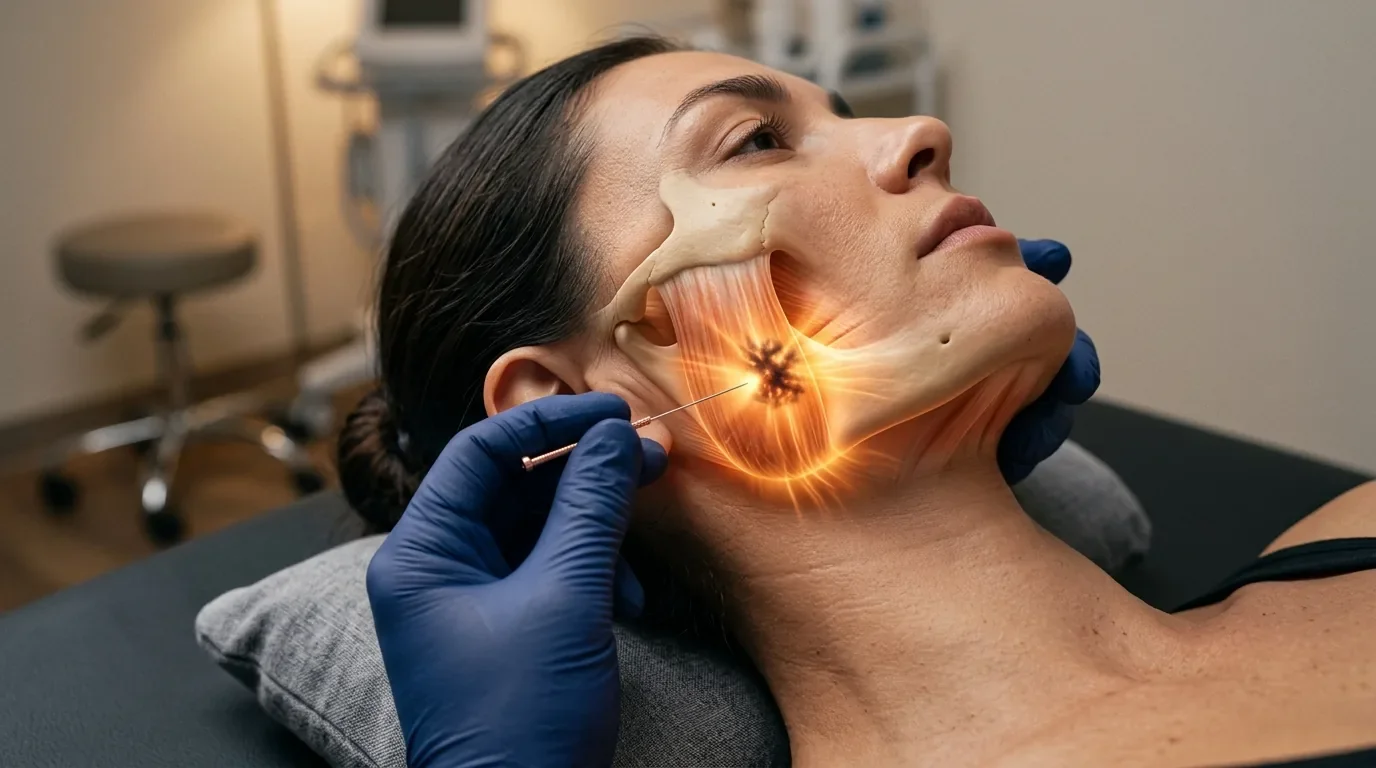
Temporomandibular dysfunction is primarily a condition of the masticatory muscles, with the masseter, lateral pterygoid, and temporalis harboring the trigger points responsible for most jaw pain, headaches, clicking, and ear symptoms attributed to TMD.
- Temporomandibular disorder (TMD) is an umbrella term for pain and dysfunction involving the jaw joint and masticatory muscles; myofascial pain from the masseter and pterygoid muscles is the most prevalent form and the most responsive to dry needling and acupuncture.
- Masseter trigger points produce jaw and cheek pain, upper and lower molar toothache mimicry, tinnitus, and a sensation of blocked or stuffy ears that is frequently misattributed to dental or ear pathology (Simons et al., 1999).
- Lateral pterygoid trigger points reproduce pain directly in the TMJ and produce the jaw deviation and clicking that patients often interpret as mechanical joint damage.
- A systematic review of acupuncture for musculoskeletal TMD found significant evidence supporting its effectiveness, with improvements in pain intensity, maximum mouth opening, and pressure pain threshold compared to controls (La Touche et al., 2010).
- Bruxism (nighttime teeth grinding) and jaw clenching are both a cause and a consequence of masticatory trigger points; the relationship is bidirectional, meaning treating the trigger points reduces bruxism while bruxism prevention reduces trigger point recurrence.
- The upper cervical spine contributes to TMD through shared trigeminal-cervical convergence: upper cervical trigger points in the suboccipitals and SCM directly sensitize the trigeminal nucleus that processes jaw pain, meaning cervical treatment is often necessary for complete TMD resolution (Zhao, 2008).
- Acupuncture's effects on the autonomic nervous system reduce the sympathetic hyperactivation that drives jaw clenching during stress, addressing the primary perpetuating factor for most chronic TMD patients (Vickers et al., 2018).
Jaw Pain, Clicking, or Headaches from Your TMJ?
Masticatory muscle trigger points are the primary driver of most TMD symptoms, and they respond remarkably well to targeted dry needling. At Morningside, our clinicians treat both the jaw muscles directly and the upper cervical contributors that keep TMD symptoms active, providing comprehensive care that dental appliances and anti-inflammatories alone cannot offer.
Schedule NowThe Masticatory Muscles: Primary Pain Generators
The masticatory muscles receive less attention in general pain practice than the postural muscles of the spine, but they are among the most densely innervated muscles in the body and among the most reliably responsive to needling. Their trigger points produce some of the most complex and puzzling referred pain patterns in clinical practice, including symptoms that closely mimic dental pain, ear disease, sinus problems, and TMJ joint pathology.
| Muscle | Referred Pain Pattern | Symptoms Often Misattributed To |
|---|---|---|
| Masseter | Cheek; lower jaw; upper and lower molars; tinnitus; blocked ear sensation; sinus region | Dental caries; tooth abscess; sinusitis; ear infection; TMJ joint disease |
| Lateral Pterygoid | TMJ region; maxillary sinus; cheek (upper molars) | TMJ joint pathology; sinusitis; maxillary molar pain |
| Medial Pterygoid | Inside of the mouth; pharynx; tongue; ear pain; difficulty swallowing | Ear infection; pharyngitis; dysphagia; tonsil pain |
| Temporalis | Temple headache; upper teeth and premolars; eyebrow; behind the eye; top of head | Dental pain (upper premolars/molars); tension headache; migraine; sinusitis |
The masseter deserves particular clinical attention because its trigger points produce tinnitus and blocked ear symptoms through mechanical transmission to the middle ear structures via the mandibular joint and the small muscles that control Eustachian tube opening. Patients who have had audiological evaluations for tinnitus with no findings, or who have had dental work for supposed molar pain with no resolution, frequently have masseter trigger points as their actual diagnosis. These respond directly to dry needling.
The Cervical Connection: Why Neck Treatment Matters for TMD
The trigeminocervical nucleus in the upper cervical spinal cord receives convergent input from both the trigeminal nerve (which innervates the jaw, face, and TMJ) and the upper cervical nerve roots (C1-C3). This means that nociceptive input from the upper cervical muscles can sensitize the same central neurons that process jaw pain, making jaw pain more severe and persistent than the local masticatory pathology alone would explain. Conversely, successful treatment of upper cervical trigger points reduces the sensitization of the trigeminal nucleus and often produces dramatic improvements in TMD symptoms (Zhao, 2008).
Specific cervical contributors to TMD include suboccipital trigger points (which refer pain to the occipital base and behind the eye, adding to TMD-associated headaches), the sternocleidomastoid clavicular and sternal divisions (which refer to the cheek, forehead, and ear in patterns overlapping with masticatory muscle referral), and the splenius capitis (which refers to the top of the head).
Related What Is Cervicogenic Headache? The Neck-to-Head Pain ConnectionTMD Symptoms That Have Not Resolved with a Dental Night Guard?
Dental night guards reduce the mechanical force of bruxism but do not deactivate the trigger points already present in the masseter, pterygoid, and temporalis muscles. At Morningside, we treat both the jaw muscles and the upper cervical contributors to TMD, addressing the myofascial and neural sensitization layers that maintain symptoms even when the bruxism is managed with a splint.
Schedule NowEvidence for Acupuncture in Jaw Pain and TMD
A systematic review of acupuncture for musculoskeletal TMD by La Touche and colleagues examined randomized controlled trials and found significant evidence supporting acupuncture's effectiveness for reducing jaw pain intensity, improving maximum mouth opening, and increasing pressure pain thresholds in the masticatory muscles (La Touche et al., 2010). The review noted that acupuncture's effects were clinically meaningful and consistent across the included studies.
The neurophysiological basis for these results is well-established. Acupuncture needling of the masticatory muscles and remote points activates the periaqueductal gray and descending inhibitory systems that modulate trigeminal nucleus activity, reducing the central sensitization that characterizes chronic TMD (Zhao, 2008). The systemic reduction in sympathetic tone that acupuncture produces also addresses the stress-related jaw clenching that is the primary perpetuating factor in many chronic TMD patients.
In the broader chronic pain evidence base, the Vickers 2018 meta-analysis found durable acupuncture effects on head and neck pain presentations at 12-month follow-up, with the chronic jaw and craniofacial pain associated with TMD among the conditions most relevant to this finding (Vickers et al., 2018).
| Component | Primary Target | Goal |
|---|---|---|
| Masseter dry needling | Superficial and deep masseter trigger points | Eliminate jaw, cheek, molar, and ear referred pain; reduce bite force asymmetry |
| Temporalis dry needling | Temporalis trigger points (anterior, middle, posterior heads) | Resolve temple headache and upper dental referred pain |
| Pterygoid dry needling | Lateral and medial pterygoid trigger points | Reduce jaw clicking and deviation; resolve deep jaw and ear pain |
| Upper cervical treatment | Suboccipitals, SCM, splenius capitis | Reduce trigeminocervical sensitization; address headache components |
| Systemic acupuncture | Sympathetic nervous system; hypothalamus | Reduce stress-related jaw clenching; lower trigeminal nucleus excitability |
Find Relief from Jaw Pain and TMD in New York City
At Morningside Acupuncture, we are the highest-rated acupuncture and dry needling clinic in New York City with over 500 five-star Google reviews. We specialize in TMD and jaw pain treatment, combining dry needling of the masticatory muscles with upper cervical treatment and systemic acupuncture for the autonomic component of chronic jaw clenching and bruxism. Many patients who have struggled with jaw pain, headaches, and unexplained ear and dental symptoms for years find significant relief when the masticatory trigger points are finally addressed. We welcome a consultation to evaluate your specific presentation.
Schedule NowFrequently Asked Questions
What is the best treatment for TMJ disorder?
For myofascial TMD, which is the most common form, dry needling of the masseter, temporalis, and pterygoid muscles combined with acupuncture for the central sensitization and autonomic components is one of the most effective approaches available. Dental night guards prevent bruxism damage to teeth but do not treat the trigger points already present. A comprehensive approach that includes both the dental splint and myofascial treatment typically produces the best outcomes.
Can acupuncture stop jaw clenching?
Acupuncture reduces the sympathetic nervous system hyperactivation that drives jaw clenching during stress, and clinical evidence supports its effectiveness for reducing TMD pain and associated jaw muscle tension. It does not eliminate the behavioral habit of clenching entirely, but it reduces the underlying neurological drive that makes clenching feel involuntary or automatic. Most patients with stress-related jaw clenching notice significant reduction in frequency and intensity with regular acupuncture sessions.
Why does my jaw click, and can dry needling fix it?
Jaw clicking usually results from lateral pterygoid trigger points altering the condyle-disc relationship during opening and closing movements. Deactivating the lateral pterygoid trigger point with dry needling frequently resolves or significantly reduces clicking, since the abnormal muscle tension creating the disc-condyle mismatch is relieved. This is a common and gratifying clinical outcome that occurs within a few sessions in many patients.
Can TMD cause ear ringing (tinnitus)?
Yes. Masseter trigger points produce a characteristic tinnitus through mechanical transmission to the middle ear structures and sensitization of the trigeminal pathways that share central convergence with auditory processing. Many patients with TMD-associated tinnitus experience significant or complete resolution of their tinnitus after masseter dry needling. We always recommend audiology evaluation to rule out primary ear pathology, but when audiological findings are normal and tinnitus coincides with jaw symptoms, masticatory trigger points are a primary suspect.
How many sessions are needed for jaw pain at Morningside?
Most patients with myofascial TMD notice meaningful improvement in jaw pain, headaches, and referred symptoms within four to six sessions over three to four weeks. Patients with significant upper cervical contributions or chronic central sensitization typically require eight to ten sessions for durable results. We structure treatment to assess response every few sessions and adjust the plan accordingly.
References
- La Touche, R., Angulo-Díaz-Parreño, S., de-la-Hoz, J. L., Fernández-Carnero, J., Ge, H. Y., Linares, M. T., Mesa, J., & Sánchez-Gutiérrez, J. (2010). Effectiveness of acupuncture in the treatment of temporomandibular disorders of muscular origin: A systematic review of the last decade. Journal of Alternative and Complementary Medicine, 16(1), 107-112. https://doi.org/10.1089/acm.2008.0496
- Simons, D. G., Travell, J. G., & Simons, L. S. (1999). Travell & Simons' myofascial pain and dysfunction: The trigger point manual (2nd ed.). Williams & Wilkins.
- Vickers, A. J., Vertosick, E. A., Lewith, G., MacPherson, H., Foster, N. E., Sherman, K. J., Irnich, D., Witt, C. M., & Linde, K. (2018). Acupuncture for chronic pain: Update of an individual patient data meta-analysis. JAMA Internal Medicine, 178(11), 1444-1453. https://doi.org/10.1001/jamainternmed.2018.4242
- Zhao, Z. Q. (2008). Neural mechanism underlying acupuncture analgesia. Progress in Neurobiology, 85(4), 355-375. https://doi.org/10.1016/j.pneurobio.2008.05.004
- Kietrys, D. M., Palombaro, K. M., Azzaretto, E., Huber, R., Schaller, B., Schlussel, J. M., & Tucker, M. (2013). Effectiveness of dry needling for upper-quarter myofascial pain: A systematic review and meta-analysis. Journal of Orthopaedic & Sports Physical Therapy, 43(9), 620-634. https://doi.org/10.2519/jospt.2013.4668
Disclaimer: This web site is intended for educational and informational purposes only. Reading this website does not constitute providing medical advice or any professional services. This information should not be used for diagnosing or treating any health issue or disease. Those seeking medical advice should consult with a licensed physician. Seek the advice of a medical doctor or other qualified health professional for any medical condition. If you think you have a medical emergency, call 911 or go to the emergency room. No acupuncturist-patient relationship is created by reading this website or using the information. Morningside Acupuncture PLLC and its employees and contributors do not make any express or implied representations with respect to the information on this site or its use. For any legal interpretation of scope of practice in your state, consult a licensed attorney or regulatory authority.
Read more from our blog