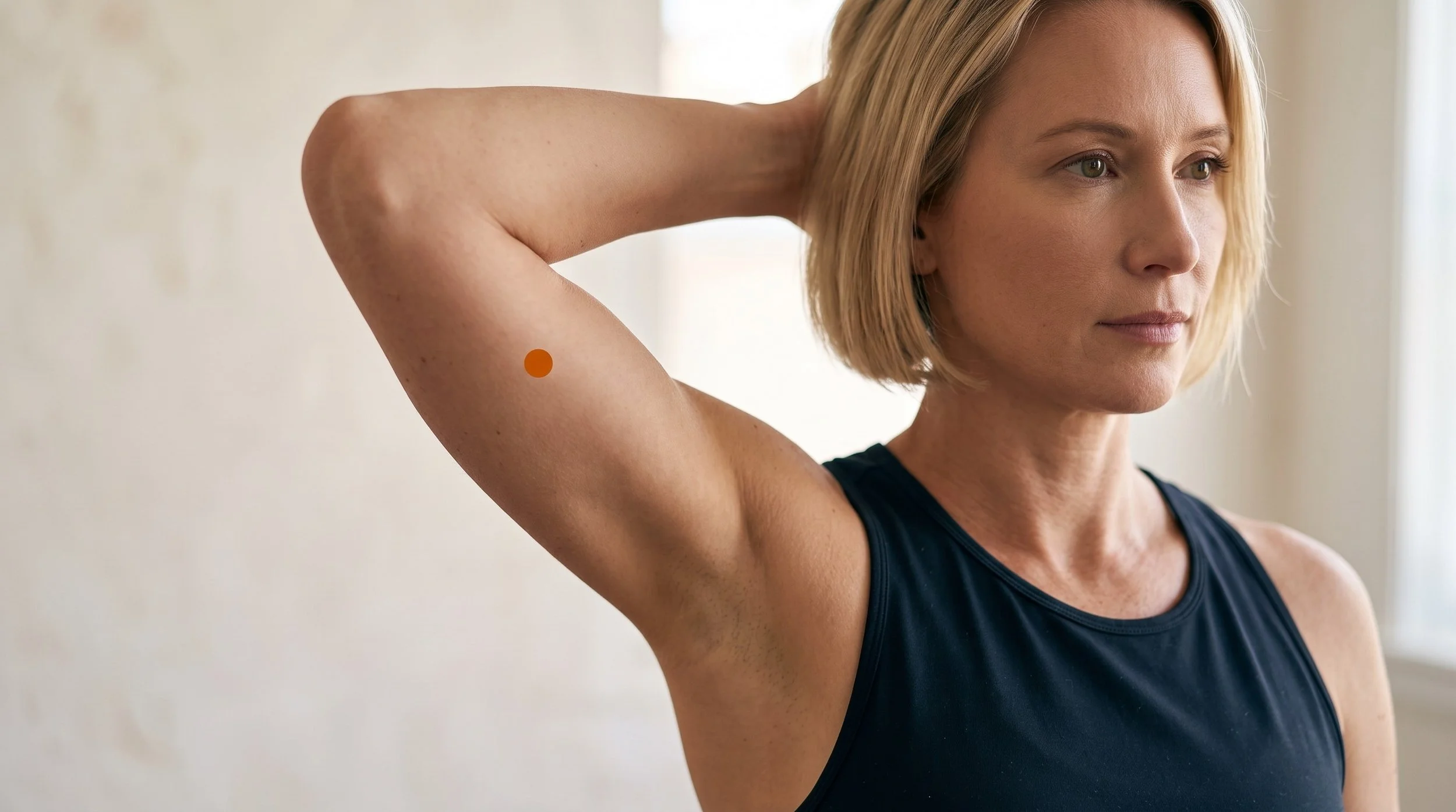
HT2 Acupuncture Point (Qingling)
The Green Spirit Point in the Medial Bicipital Groove: Anatomy, Nerve Corridors, and Why This Upper Arm Point Was Treated Mainly with Moxibustion
HT2 (Qingling), often translated as Green Spirit, is the second point of the Heart channel and sits on the inner upper arm, roughly a handbreadth above the medial end of the elbow crease, in the soft groove along the inner border of the biceps. It's an unusual point in the classical literature: several early texts discussed only moxibustion here, and one Ming dynasty source went further and warned against needling it at all, almost certainly because the brachial artery, median nerve and ulnar nerve all run together through that groove.
Modern practice keeps the technique conservative (shallow, oblique, and placed beside the pulse rather than through it), which makes the ht2 acupuncture point a useful example of how anatomy shapes technique. Clinically, heart 2 is used for pain, heaviness, numbness and tingling along the inner arm, and as a proximal companion to elbow, forearm and hand points when symptoms travel the ulnar and median corridors.
- HT2 lies 3 cun proximal to the medial end of the elbow crease on the line between HT1 in the axilla and HT3 at the elbow, in the groove medial to the biceps brachii; the classical texts advise locating it with the elbow flexed (Deadman et al., 2001).
- The traditional attribution for HT2 is straightforward: it's described as activating the channel and relieving pain, with classical indication lists covering inner arm and shoulder pain, trouble raising the arm, axillary and rib-side pain, and swelling in the region (Deadman et al., 2001).
- Anatomically the point sits over a neurovascular corridor where the brachial artery travels with the median and ulnar nerves, which is the most plausible reason the classics leaned on moxibustion and why needling today stays oblique, shallow, and lateral to a palpated pulse (Deadman et al., 2001).
- Needling in this territory engages C8 and T1 segmental input alongside the medial brachial and medial antebrachial cutaneous nerves, and the analgesic response is best explained by segmental spinal gating plus descending inhibitory pathways from the brainstem (Zhao, 2008).
- The research picture is indirect rather than point-specific: large individual patient data analyses support acupuncture for chronic musculoskeletal pain generally (Vickers et al., 2018), while the shoulder-specific Cochrane review found the evidence base thin and short-term (Green et al., 2005).
- De qi at HT2 is usually a dull, spreading heaviness in the groove; occasionally patients feel a brief electric flick toward the little finger, which is a signal to withdraw slightly and redirect rather than to stimulate further.
- In practice HT2 is rarely a standalone choice; it earns its place as a proximal link in a chain of points along the inner arm, often combined with dry needling of nearby muscle when the presentation is myofascial (Simons et al., 1999).
Inner Arm Pain, Heaviness, or Tingling That Won't Settle?
Arm symptoms rarely come from one spot, and the medial arm is a corridor where nerve, muscle and joint sources overlap. At Morningside Acupuncture we examine the neck, shoulder girdle and arm together, then use points like HT2 alongside elbow, forearm and shoulder points chosen for your specific pattern. Every needle in this region is placed with the brachial pulse palpated first, so treatment stays comfortable and controlled. Schedule a visit and we'll map where your symptoms actually originate.
Schedule NowAnatomy of HT2: Why the Medial Bicipital Groove Is Such an Important Location
With the elbow flexed and the arm turned outward, the inner upper arm reveals a soft channel running lengthwise between the rounded belly of the biceps brachii in front and the medial head of triceps behind. That's the medial bicipital groove, and HT2 sits in it about three cun above the inner end of the elbow crease, roughly a handbreadth up from HT3 (Deadman et al., 2001). Under the needle there's thin skin, a layer of subcutaneous fat that often carries the basilic vein, then the medial intermuscular septum separating the flexor and extensor compartments.
Deeper still lie brachialis and coracobrachialis. This area is loaded by carrying, gripping, pressing and overhead work, and it's also where compression from bag straps, prolonged elbow flexion, or sustained side-lying postures tends to make itself felt.
The nerve geography here is dense. The medial brachial and medial antebrachial cutaneous nerves supply the skin over the point, while the median and ulnar nerves descend just deep to it before diverging toward the elbow. These structures carry C8 and T1 fibers, the same segments that serve the inner forearm and the ring and little fingers, which is why a stimulus placed at the upper arm can be felt as relevant by tissues much further down.
Needle input at this level recruits A-delta and group III afferents that reach the dorsal horn, where they interact with convergent input from muscle, skin and joint, and where they trigger descending inhibitory activity from the periaqueductal gray and rostral ventromedial medulla involving endogenous opioid, serotonergic and noradrenergic signaling (Zhao, 2008).
Peripheral nerve responsiveness matters too: in carpal tunnel syndrome, real acupuncture outperformed sham on objective measures including median sensory conduction latency and cortical finger representation, which suggests needling can influence nerve function and its central mapping rather than only subjective comfort (Maeda et al., 2017).
The safety consideration at HT2 is the brachial artery, which travels through this same groove with the two major nerves. Classical sources handled the risk by favoring moxibustion, and the Introduction to Medicine explicitly discouraged needling here (Deadman et al., 2001). Contemporary technique solves the same problem differently: palpate the artery, place the needle to one side of it, and insert obliquely up or down the line of the channel to a depth of about 0.5 to 1 cun rather than perpendicular and deep (Deadman et al., 2001).
Vigorous lifting and thrusting is avoided, electroacupuncture across the vessel is not used, and extra caution applies with anticoagulant use, prior vascular surgery, or an unusually superficial pulse. Treated this way, HT2 is a low-risk point in trained hands, but it's a poor choice for casual or self-administered needling.
Related Pain Finder Upper Back Shoulder Arm Related Heart ChannelHT2 at a Glance: Classification, Location, and Clinical Use
| Category | Detail |
|---|---|
| Traditional Name | Qingling (Green Spirit), HE-2 in Deadman's numbering, the Green Spirit point of the Heart channel |
| Channel Classification | Second point of the Heart channel of Hand Shaoyin, located on the medial upper arm between HT1 and HT3 (HT2, also written HE2) |
| Point Categories | No five-shu, luo-connecting, xi-cleft, or hui-meeting designation is recorded for this point in the reference sources; it's classified simply as a local Heart channel point of the upper arm, traditionally described as activating the channel and alleviating pain, and historically treated largely by moxibustion |
| Precise Location | On the inner upper arm, 3 cun proximal to the medial end of the transverse elbow crease, on the line joining HT1 in the axilla and HT3 at the elbow, in the groove on the medial side of biceps brachii; located with the elbow flexed |
| Tissue Stimulated | Skin and subcutaneous tissue of the medial arm, the medial intermuscular septum, and the fascial border of biceps brachii with coracobrachialis and the medial head of triceps adjacent; the median and ulnar nerves and brachial artery lie deep and are deliberately avoided |
| Needle Depth / Direction | Oblique insertion proximally or distally along the channel, approximately 0.5 to 1 cun, placed beside a palpated brachial pulse; perpendicular deep needling is avoided, and many classical texts used moxibustion here instead of needling |
| De Qi Sensation | A dull, heavy, spreading ache in the groove that may travel a short distance up or down the inner arm; a sharp electric sensation toward the little finger means the needle is too close to a nerve and should be withdrawn and redirected |
| Primary Clinical Uses | Inner arm pain, heaviness and numbness; difficulty raising the shoulder and arm in classical use; axillary and lateral rib-side pain in classical use; ulnar and medial forearm corridor symptoms in modern practice |
| Common Point Combinations |
|
Deadman's A Manual of Acupuncture gives HT2 a single traditional action, activating the channel and alleviating pain, and its classical indications cluster tightly around the upper limb and the area around the armpit: pain of the shoulder and upper arm, inability to raise the shoulder and arm, swelling and redness of the shoulder, axillary pain, pain in the lateral costal region, plus a handful of systemic entries such as headache with chills, yellowing of the eyes, and scrofula (Deadman et al., 2001).
The classical combination recorded for this point is equally focused, grouping HT2 with LI15 and LI11 for shoulder and upper arm pain (Deadman et al., 2001). These are presented here as traditional attributions rather than verified effects. What's striking is the mismatch between how narrowly the point was defined and how cautiously it was approached: unlike most Heart channel points, which are known for calming and spirit-related uses, Qingling was treated as a regional pain point, and much of the early literature applied heat rather than a needle.
Why HT2 Is Used for Symptoms That Show Up in the Little Finger and Inner Forearm
Patients are often surprised when a point above the elbow is chosen for numbness in the ring and little fingers or an ache along the inner forearm. The reason is segmental rather than mystical. Skin, muscle and nerve tissue at the medial upper arm share C8 and T1 innervation with the ulnar side of the forearm and hand, so their sensory input converges on the same dorsal horn neurons in the lower cervical cord. Stimulating an area that shares a segment with the painful region can dampen how that whole segment reports to the brain, which is why proximal points are frequently used for distal complaints (Zhao, 2008).
Positioning matters as well: HT2 sits where the median and ulnar nerves are still bundled with the artery before diverging, so it's a natural place to influence the corridor as a whole.
Beyond the spinal segment, needling recruits descending inhibitory systems that release endogenous opioids, serotonin and noradrenaline onto dorsal horn circuits, reducing the amplification that keeps chronic arm symptoms going (Zhao, 2008). There's also evidence that needling can shift measurable nerve function rather than perception alone. In a randomized trial in carpal tunnel syndrome, real acupuncture beat sham on median sensory nerve conduction latency and on cortical separation between finger representations, and the cortical change predicted symptom improvement three months later (Maeda et al., 2017).
That study didn't test HT2 specifically, so it can't be read as evidence for this point, but it supports the broader idea that needling along an irritated nerve corridor may influence both peripheral conduction and central mapping.
Practically, this means HT2 tends to be used as one link in a chain. If the exam points to the neck, the neck gets treated. If the shoulder girdle is guarding, we address that. HT2 comes in when the medial arm itself is tender, tight, or symptomatic along the channel line, and when a proximal input seems likely to help the whole corridor settle.
What the Research Shows for HT2
There's no clinical trial of HT2 on its own, and it would be misleading to suggest otherwise. Acupuncture research almost always tests multi-point protocols delivered over a course of sessions, so the honest framing is that HT2 is one possible component of a treatment for arm and shoulder pain rather than an intervention with its own evidence base. The studies below describe the context this point operates in: what's known about acupuncture for chronic musculoskeletal pain, what's known specifically about the shoulder, what needling appears to do physiologically, and how dry needling of nearby muscle performs. Read them as boundaries on reasonable expectations, not as endorsements of a single point.
| Study | Type | Focus | Key Finding |
|---|---|---|---|
| Vickers et al., 2018 | Individual patient data meta-analysis | Acupuncture for chronic musculoskeletal, headache and osteoarthritis pain across roughly 20,000 patients | Acupuncture was associated with modest but statistically significant benefits over both sham and no-acupuncture controls, with effects that persisted over time. |
| Green et al., 2005 | Cochrane systematic review | Acupuncture for shoulder pain in adults | The available trials were too few and too small to draw firm conclusions, though there were signs of short-term improvement in pain and function at two to four weeks. |
| Navarro-Santana et al., 2021 | Systematic review and meta-analysis | Trigger point dry needling for nontraumatic shoulder pain of musculoskeletal origin | Dry needling showed short-term reductions in shoulder pain compared with comparison interventions, with the evidence base limited by trial quality and heterogeneity. |
| Maeda et al., 2017 | Randomized controlled trial with neuroimaging | Local and distal acupuncture in carpal tunnel syndrome | Real acupuncture outperformed sham on median nerve conduction latency and somatosensory cortical measures, suggesting effects on peripheral nerve function and central mapping. |
| Zhao, 2008 | Narrative review of mechanism research | Neural mechanisms underlying acupuncture analgesia | Analgesic effects are attributed to afferent nerve fiber activation, segmental spinal modulation and descending inhibitory pathways using opioid and monoamine signaling. |
Trouble Lifting Your Arm Overhead?
Difficulty raising the shoulder and arm is one of the oldest recorded uses of HT2, traditionally grouped with LI15 and LI11 for the same complaint. We pair that classical framing with an orthopedic shoulder exam, range of motion testing, and dry needling of the rotator cuff and biceps region when trigger points are contributing. Most patients notice changes in comfort and reach across a short series of visits rather than after a single treatment. Book an evaluation to see what's limiting your overhead motion.
Schedule NowHT2 in the Context of Trigger Point Work
The medial upper arm is myofascially busy. Trigger points in the biceps brachii, coracobrachialis and the medial head of triceps can all produce aching that patients describe as deep inner arm pain, and referral from coracobrachialis in particular can extend down the back of the arm toward the hand, which overlaps with the territory classically assigned to HT2 (Simons et al., 1999).
When an exam finds taut bands and reproducible tenderness in those muscles, we treat them directly with dry needling, using the same anatomical caution that governs the point itself: identify the neurovascular groove, work to the side of it, and keep angles tangential rather than driving toward the midline of the arm.
In a typical session, HT2 might be one channel point in a plan that also includes dry needling of the rotator cuff, pectoralis minor, scalenes or levator scapulae depending on where symptoms originate, plus distal points on the forearm and hand. Reviews of dry needling for nontraumatic shoulder pain report short-term pain reductions, though with meaningful limitations in trial quality, so we treat it as one tool among several rather than a standalone answer (Navarro-Santana et al., 2021).
Acupuncture, in our usage, means needling with an acupuncture needle, and that includes both classical point work and trigger point technique; the deciding factor is what the exam shows, not which tradition the point name comes from.
HT2 Arm and Shoulder Pain Treatment at NYC's Highest-Rated Acupuncture Clinic
Morningside Acupuncture is the highest-rated acupuncture and dry needling clinic in New York City with over 500 five-star Google reviews, and our practice is built around musculoskeletal and nerve-related pain. We combine classical point selection with modern anatomy, treating the ht 2 arm region only when the exam supports it and always with careful placement beside the vascular corridor. Treatment plans include home guidance so progress continues between sessions. Schedule your appointment and let's build a plan for your arm and shoulder.
Schedule NowFrequently Asked Questions
What does HT2 feel like when needled?
Most people feel a dull, heavy spreading ache in the groove on the inner arm, sometimes with a mild sense of pressure that travels a short way toward the elbow or shoulder. Because the needle stays shallow and oblique, the sensation is usually milder than at thick muscular points like ST36. If you feel a sharp electric zing shooting toward your little finger, say so immediately; that means the needle is near a nerve, and your acupuncturist will withdraw and reposition it. A brief pinch on insertion is normal, but sustained sharpness is not.
Why treat a point above the elbow for numbness in the hand?
Because the tissues at HT2 share spinal segments (mainly C8 and T1) with the inner forearm and the ulnar side of the hand, and because the median and ulnar nerves pass directly beneath the point before separating lower down. Sensory input from a shared segment converges on the same spinal cord neurons, so stimulation at the upper arm can influence how the whole corridor reports pain, and it also engages descending inhibitory pathways from the brainstem (Zhao, 2008). Proximal points are often chosen when a distal area is too tender or too swollen to needle comfortably, or when the goal is to calm an entire nerve corridor rather than one spot.
Can I press HT2 myself between sessions?
Yes, acupressure here is safe and simple if you do one thing first: find your brachial pulse. Turn your palm up, bend the elbow slightly, and run your fingers up the inner arm from the elbow crease about four finger widths into the soft groove beside the biceps. If you feel a pulse under your fingertip, slide slightly toward the biceps so you're pressing muscle and fascia rather than the vessel. Apply steady, moderate pressure with your thumb for 30 to 60 seconds, breathe normally, then release and repeat two or three times per arm, up to a few times a day. You can also use small circular strokes along the groove for a minute. Stop if you get tingling, numbness, or pins and needles in the hand, and skip self-pressure entirely if you're on blood thinners or have a known vascular condition in the arm.
Is HT2 safe to needle?
It's safe in trained hands, but it's a point that demands respect. The brachial artery runs with the median and ulnar nerves right beneath the site, which is why many classical texts used only moxibustion here and why the Introduction to Medicine advised against needling the point at all (Deadman et al., 2001). Modern technique manages the risk with oblique insertion of about 0.5 to 1 cun along the channel, placed beside a palpated pulse, with no deep perpendicular needling and no heavy manipulation. Extra caution applies for patients on anticoagulants, those with clotting disorders, or anyone with prior vascular surgery in the arm. This isn't a point for self-needling.
Where exactly is HT2 located?
Flex your elbow and turn the palm upward. Find the crease at the front of the elbow and locate its inner end, where HT3 sits. Measure three cun (about four finger widths, or one handbreadth) straight up the arm along the line running from HT3 toward the center of the armpit where HT1 is found. HT2 sits at that level, in the groove on the inner side of the biceps muscle, just in front of the medial head of the triceps (Deadman et al., 2001). The point often feels like a soft valley between two firmer muscle bellies, and it's frequently tender when medial arm symptoms are present.
References
- Deadman, P., Al-Khafaji, M., & Baker, K. (2009). A manual of acupuncture. Journal of Chinese Medicine Publications.
- Simons, D. G., Travell, J. G., & Simons, L. S. (1999). Travell & Simons' myofascial pain and dysfunction: The trigger point manual, Vol. 1: Upper half of body (2nd ed.). Williams & Wilkins.
- Green, S., Buchbinder, R., & Hetrick, S. (2005). Acupuncture for shoulder pain. Cochrane Database of Systematic Reviews, 2005(2), CD005319. https://doi.org/10.1002/14651858.CD005319
- Vickers, A. J., Vertosick, E. A., Lewith, G., MacPherson, H., Foster, N. E., Sherman, K. J., Irnich, D., Witt, C. M., & Linde, K. (2018). Acupuncture for chronic pain: Update of an individual patient data meta-analysis. Journal of Pain, 19(5), 455-474. https://doi.org/10.1016/j.jpain.2017.11.005
- Zhao, Z. Q. (2008). Neural mechanism underlying acupuncture analgesia. Progress in Neurobiology, 85(4), 355-375. https://doi.org/10.1016/j.pneurobio.2008.05.004
- Maeda, Y., Kim, H., Kettner, N., Kim, J., Cina, S., Malatesta, C., Gerber, J., McManus, C., Ong-Sutherland, R., Mezzacappa, P., Libby, A., Mawla, I., Morse, L. R., Kaptchuk, T. J., Audette, J., & Napadow, V. (2017). Rewiring the primary somatosensory cortex in carpal tunnel syndrome with acupuncture. Brain, 140(4), 914-927. https://doi.org/10.1093/brain/awx015
- Navarro-Santana, M. J., Gómez-Chiguano, G. F., Cleland, J. A., Arias-Buría, J. L., Fernández-de-las-Peñas, C., & Plaza-Manzano, G. (2021). Effects of trigger point dry needling for nontraumatic shoulder pain of musculoskeletal origin: A systematic review and meta-analysis. Physical Therapy, 101(2), pzaa216. https://doi.org/10.1093/ptj/pzaa216
Disclaimer: This web site is intended for educational and informational purposes only. Reading this website does not constitute providing medical advice or any professional services. This information should not be used for diagnosing or treating any health issue or disease. Those seeking medical advice should consult with a licensed physician. Seek the advice of a medical doctor or other qualified health professional for any medical condition. If you think you have a medical emergency, call 911 or go to the emergency room. No acupuncturist-patient relationship is created by reading this website or using the information. Morningside Acupuncture PLLC and its employees and contributors do not make any express or implied representations with respect to the information on this site or its use. For any legal interpretation of scope of practice in your state, consult a licensed attorney or regulatory authority.
Read more from our blog



