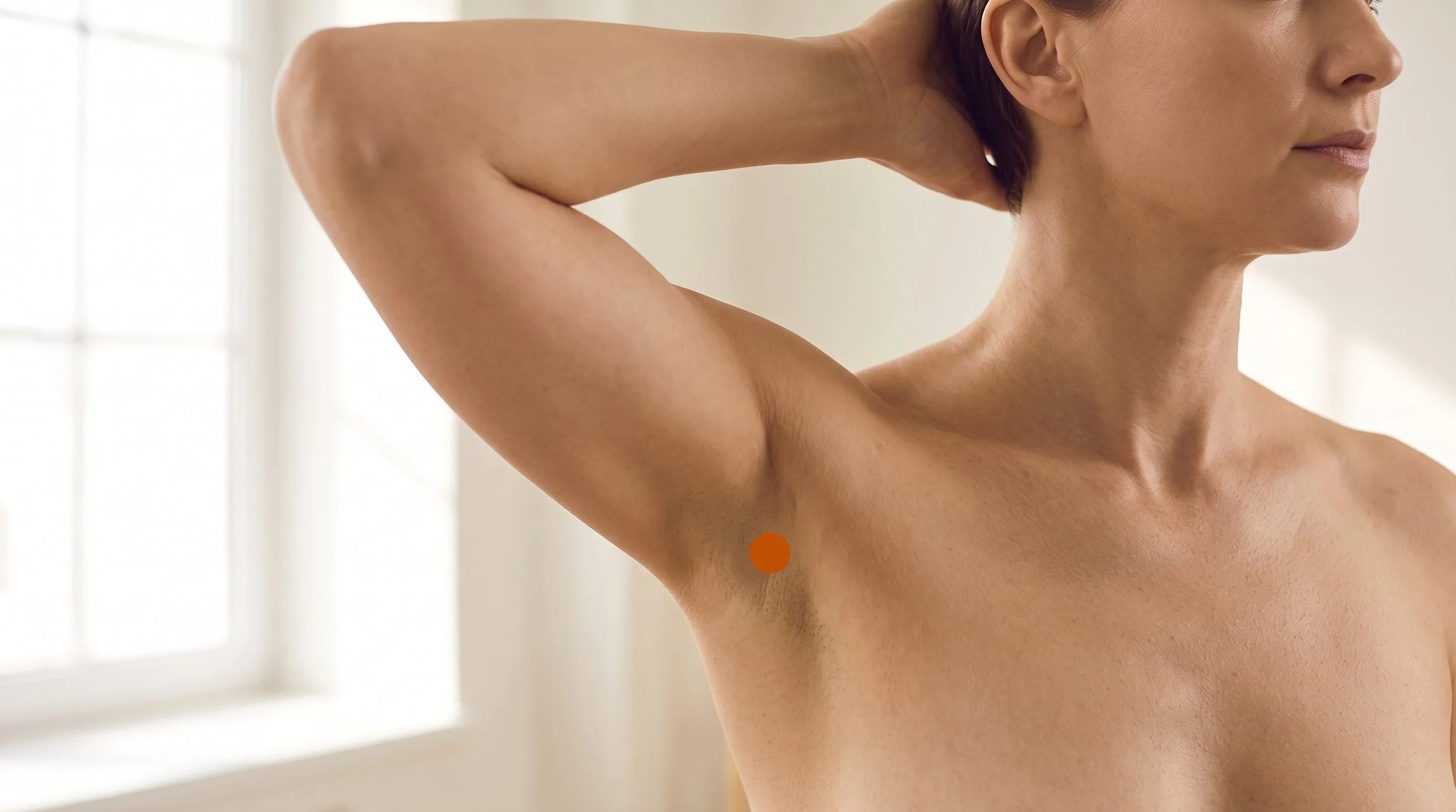
HT1 Acupuncture Point (Jiquan)
The Summit Spring at the Apex of the Armpit: Anatomy, Mechanism, and Why the Heart Channel's First Point Belongs in Shoulder and Inner Arm Treatment
HT1 (Jiquan, often translated as Summit Spring or Highest Spring) is the first point of the Hand Shaoyin Heart channel, and it sits in the deepest hollow of the armpit, at the top of the axillary pyramid between the front wall formed by pectoralis major and the back wall formed by latissimus dorsi and teres major.
It is an unusual point to find on a treatment list, partly because the axilla is a crowded and sensitive corridor where the axillary artery and the cords of the brachial plexus travel from the neck into the arm, and partly because it demands the same pulse-guarding discipline as the other vascular landmark points. Classical sources describe HT1 as the place where the channel emerges from the chest into the limb, which is why the traditional indication list pairs chest and rib-side complaints with numbness, coldness, and pain along the inner arm (Deadman et al., 2007).
In modern practice the ht1 acupuncture point is used mainly for restricted shoulder motion, medial arm symptoms, and axillary region tightness, and it is always needled by a trained clinician rather than at home.
- Location and layers: heart 1 lies at the highest point of the axillary hollow, reached with the arm abducted by sliding a finger up the lateral chest wall between pectoralis major in front and latissimus dorsi behind, so the needle passes thin hair-bearing skin and axillary fascia into fat that houses vessels, nerves, and lymph nodes (Deadman et al., 2007).
- Traditional categories, translated: the classical actions attributed to HT1 are unbinding the chest and activating the channel to benefit the arm, which in neurophysiological terms describes a point that can influence both thoracic wall sensation and upper limb nociception because those regions share overlapping spinal segments (Deadman et al., 2007).
- Mechanism: needling near the axillary apex stimulates T1 to T2 dermatomal territory served by the intercostobrachial and medial brachial cutaneous nerves, and afferent input at these segments recruits spinal gating and descending inhibitory pathways involving endogenous opioid and monoaminergic systems (Zhao, 2008).
- Research picture: no trial isolates HT1, so its evidence sits inside multi-point protocols. Cochrane found the shoulder pain literature too small and heterogeneous to settle the question (Green et al., 2005), while a large individual patient data meta-analysis supports modest, durable effects of acupuncture across chronic pain conditions (Vickers et al., 2018).
- Clinical framing: HT1 appears frequently in hospital protocols for the hemiplegic upper limb, where reviews report added benefit when acupuncture is combined with rehabilitation, though the certainty of that evidence was rated low (Liu et al., 2019).
- De qi: the ht 1 armpit sensation is typically a deep, heavy fullness under the arm, sometimes with a short electrical flicker running down the inner arm toward the little finger. That flicker should be brief; lasting sharpness, burning, or persistent numbness means the needle is repositioned or withdrawn.
Shoulder That Will Not Lift Without a Catch in the Armpit?
When shoulder abduction stalls and the restriction feels like it lives under the arm rather than on top of it, we look at the axillary corridor directly. At Morningside Acupuncture we may use HT1 alongside deltoid, pectoral, and scapular work, always palpating the axillary pulse first and angling away from it. Treatment is paired with graded range of motion so the gains carry into daily movement. Schedule a visit and we will map where your shoulder actually stops.
Schedule NowAnatomy of HT1: Why the Apex of the Axilla Is Such an Important Location
The armpit is best understood as a pyramid rather than a hollow. Its front wall is pectoralis major with pectoralis minor beneath, its back wall is latissimus dorsi, teres major, and subscapularis, its medial wall is the chest wall covered by serratus anterior, and its lateral wall is the humerus with coracobrachialis and the short head of biceps. HT1 sits at the apex where those walls converge.
What loads this region is not one muscle but a habit of posture: rounded shoulders, sustained desk and phone positions, heavy carrying, and protective guarding after a shoulder injury all shorten the anterior wall and stiffen the posterior wall, so the axillary space narrows and the last thirty degrees of abduction become uncomfortable.
Neurologically the axilla is the crossroads of the upper limb. The cords of the brachial plexus travel through it toward the median, ulnar, radial, and musculocutaneous nerves, and the skin of the axillary dome and upper inner arm is supplied largely by the intercostobrachial nerve from T2 along with the medial brachial cutaneous nerve from T1.
That T1 to T2 territory is the same segmental neighborhood that receives visceral afferents from the heart and thoracic wall, which is the plainest explanation for why classical texts grouped chest complaints and inner arm symptoms under one point and why cardiac pain so often refers into the left axilla and medial arm. Needling here produces afferent input that can engage segmental inhibition at the dorsal horn and recruit descending pain-modulating pathways involving endogenous opioids, serotonin, and noradrenaline (Zhao, 2008).
Deep to the fat lies the reason for caution. The axillary artery and vein and the plexus cords run through the axilla, along with a dense cluster of lymph nodes. Standard practice is to palpate the arterial pulse first, move away from it, and insert perpendicularly about 0.5 to 1 cun in the direction of the top of the shoulder, never angling medially toward the ribs, since a medial trajectory toward the chest risks the lung (Deadman et al., 2007).
We avoid needling this region on a side with prior axillary lymph node dissection or lymphedema, and we do not needle it in patients on anticoagulation without careful clinical judgment.
Related Heart Channel Related Acupuncture For Shoulder PainHT1 at a Glance: Classification, Location, and Clinical Use
| Category | Detail |
|---|---|
| Traditional Name | Jiquan, rendered as Summit Spring or Highest Spring |
| Channel Classification | Hand Shaoyin Heart channel, point 1 of 9; the emergence point of the channel from the chest into the arm (HT1, also written HE1) |
| Point Categories | First point of the Heart channel. The reference sources list no five shu, luo-connecting, xi-cleft, or meeting and crossing designations for HT1. Traditional actions given as unbinding the chest and activating the channel to benefit the arm. |
| Precise Location | In the depression at the centre of the armpit, located with the arm abducted by sliding a finger up the lateral chest wall between the anterior pectoral fold and the posterior latissimus fold to the highest point of the axillary hollow, then moving away from the palpable axillary artery pulse |
| Tissue Stimulated | Axillary skin and fascia at the apex of the pyramid formed by pectoralis major and minor in front, latissimus dorsi, teres major, and subscapularis behind, serratus anterior medially, and coracobrachialis with the short head of biceps brachii laterally; sensory field of the intercostobrachial and medial brachial cutaneous nerves (T1 to T2) |
| Needle Depth / Direction | Perpendicular insertion 0.5 to 1 cun angled toward the top of the shoulder, after palpating and avoiding the axillary artery; medial angulation toward the chest is not used because of lung risk |
| De Qi Sensation | Deep heaviness and spreading fullness in the armpit, sometimes with a brief electrical radiation down the inner arm toward the little finger; sharp, burning, or lingering numb sensations are a signal to reposition |
| Primary Clinical Uses | Difficulty raising the shoulder, numbness and pain along the inner arm, axillary and anterior chest wall tension, and chest oppression with anxiety in classical Heart-channel framing |
| Common Point Combinations |
|
In the Deadman manual's commentary, HT1 is presented as the doorway where the Heart channel surfaces from the chest and turns down the arm, which is why its traditional attributions run in two directions at once: inward toward the chest and rib-side, where it was said to move stagnant qi and ease fullness, shortness of breath, and Heart pain with retching, and outward toward the limb, where declining Heart yang with blood stasis was held to leave the arm numb, cold, and aching (Deadman et al., 2007).
The classical indication list therefore mixes what a modern reader would call visceral symptoms (chest oppression, palpitations, sadness and worry, thirst with a dry throat) with what looks purely musculoskeletal (inability to raise the shoulder, axillary pain, painful obstruction of the upper limb, loss of use of the four limbs).
These are traditional attributions rather than tested claims, but the pattern is striking, because the T1 to T2 segmental overlap between cardiac afferents and the skin of the axilla and inner arm is precisely the anatomy that makes such a list coherent to a clinician working from a nerve chart.
Why HT1 Is Used for Chest Tightness and Anxious Breathing, Not Just Arm Pain
Patients are often surprised that a point in the armpit shows up in discussions of chest oppression and anxiety. The reason is convergence. Sensory nerves from the axillary skin, the upper chest wall, and the deep structures of the thorax feed into the same upper thoracic spinal segments, so the nervous system does not keep tidy boundaries between them. That is why cardiac pain can be felt in the left armpit and inner arm, and why a tight, guarded anterior chest can register subjectively as difficulty getting a full breath.
Stimulating the axillary region gives the dorsal horn a strong, competing stream of input at exactly those segments, which is the same gating and descending inhibition mechanism that underlies acupuncture analgesia more broadly (Zhao, 2008).
There is a second, more mechanical part of the story. Chronic bracing shortens pectoralis major and minor and stiffens the posterior axillary fold, which limits how much the ribs and shoulder girdle can expand. Restoring motion at the anterior chest wall often changes breathing mechanics before it changes pain scores. Acupuncture also produces measurable autonomic shifts, and reviews of acupuncture for anxiety report reductions in symptom scores across trials while flagging methodological limitations that keep the conclusions provisional (Yang et al., 2021).
None of this makes HT1 a stand-alone treatment for anxiety or for anything cardiac. Chest pain, breathlessness, or new left arm symptoms need medical evaluation first, and we say so plainly. What HT1 offers, when the workup is clear, is access to a segment and a muscular corridor that most shoulder protocols never touch.
What the Research Shows for HT1
There is no clinical trial that tests Jiquan on its own, and it would be misleading to imply otherwise. Acupuncture research almost always evaluates multi-point prescriptions delivered over a course of sessions, so the honest framing is that HT1 is one component of protocols studied for shoulder pain, upper limb dysfunction, and anxiety. The table below summarizes the reviews most relevant to how this point is actually used, with their limitations stated rather than smoothed over.
| Study | Type | Focus | Key Finding |
|---|---|---|---|
| Green et al., 2005 | Cochrane systematic review | Acupuncture for shoulder pain in adults | The included trials were few and methodologically varied, so the review could neither support nor rule out benefit, though short-term improvements in pain and function were possible. |
| Vickers et al., 2018 | Individual patient data meta-analysis | Chronic musculoskeletal pain, headache, and osteoarthritis across nearly 21,000 patients | Acupuncture outperformed both sham and no-acupuncture controls by modest but statistically robust margins, with effects that persisted over a year. |
| Liu et al., 2019 | Systematic review and meta-analysis | Acupuncture added to rehabilitation for post-stroke shoulder-hand syndrome, a setting where HT1 is commonly included | Adding acupuncture was associated with better upper limb motor scores and lower pain ratings than rehabilitation alone, but the certainty of evidence was graded low. |
| Yang et al., 2021 | Systematic review and meta-analysis | Acupuncture for anxiety disorders across twenty randomized trials | Pooled results favored acupuncture for anxiety symptom reduction, with the authors calling for larger, higher-quality trials before firm conclusions. |
| Zhao, 2008 | Narrative review of laboratory research | Neural mechanisms of acupuncture analgesia | Needle stimulation engages spinal segmental inhibition and descending control involving opioid, serotonergic, and noradrenergic systems. |
Inner Arm Numbness, Tingling, or Aching That Follows the Ulnar Side?
Medial arm symptoms can come from the neck, from the thoracic outlet, from pectoralis minor, or from local nerve irritation, and the plan depends on which. Our clinicians screen for these patterns first, then may add the summit spring point to needling of the pectoral, subscapular, and forearm muscles that reproduce your symptoms. We coordinate with your physician when red flags appear. Book an evaluation to get a clear working diagnosis rather than a generic protocol.
Schedule NowHT1 in the Context of Trigger Point Work
The muscles that form the walls of the axilla are among the most clinically useful dry needling targets in the upper body. Pectoralis major and pectoralis minor refer pain across the front of the chest and down the inner arm, latissimus dorsi and teres major project a nagging ache into the posterior shoulder and the ulnar side of the arm, and subscapularis is a classic source of stubbornly limited external rotation that masquerades as a frozen shoulder (Simons et al., 1999).
Because HT1 sits at the point where all of those walls meet, treating the point and treating the surrounding muscles tend to happen in the same session, and patients often report that a symptom they described as coming from inside the armpit was reproduced when a specific band in pectoralis minor or latissimus was needled.
At Morningside we usually sequence the work rather than crowd it. Palpation identifies which walls are shortened and which taut bands reproduce the familiar symptom, then dry needling is applied to those muscles with the arm supported in a position that keeps the neurovascular bundle slack and identifiable. HT1 itself is added selectively, at a shallow to moderate depth, angled toward the top of the shoulder and well away from the arterial pulse, and it is followed immediately by active abduction and reaching so the newly available range gets used. Serratus anterior and coracobrachialis are checked as well, since both quietly limit overhead motion and both sit within reach of the same corridor.
HT1 Shoulder and Arm Pain Treatment at NYC's Highest-Rated Acupuncture Clinic
Morningside Acupuncture is the highest-rated acupuncture and dry needling clinic in New York City with over 500 five-star Google reviews, and our practice is built around careful anatomical needling of exactly this kind of high-risk, high-value region. Jiquan is used selectively, with pulse palpation, controlled depth, and a lateral needle angle that keeps the lung out of the equation. Every session combines point selection with dry needling, movement retraining, and clear home guidance. Schedule your appointment and let us build a plan for your shoulder and arm.
Schedule NowFrequently Asked Questions
What does HT1 feel like when needled?
Most people describe a deep, heavy, slightly spreading fullness under the arm, sometimes with a warm or aching quality that lingers for a few seconds after the needle stops moving. A brief electrical flicker travelling down the inner arm toward the little finger is common and not a problem, since that territory is served by nerves passing through the axilla. What we do not want is sharp, burning, or persistently numb sensation, or a pulsing feeling, and any of those means the practitioner repositions or removes the needle. The armpit is a sensitive area, so the point is generally used briefly and with light stimulation rather than aggressive manipulation.
Why needle the armpit for a shoulder or inner arm problem instead of the sore spot itself?
Because the armpit often is the sore spot, structurally speaking. The last part of shoulder abduction depends on the anterior and posterior axillary folds lengthening, and when pectoralis major, latissimus dorsi, teres major, or subscapularis are shortened, the restriction is felt at the top of the shoulder while the actual limitation sits under the arm (Simons et al., 1999). HT1 also gives access to the T1 to T2 sensory field that supplies the axilla and inner arm, so input here reaches the same spinal segments that process medial arm pain through segmental gating and descending inhibition (Zhao, 2008). Treating only the point of complaint frequently leaves that corridor untouched.
Can I press HT1 myself between sessions?
Gentle acupressure is reasonable, and it is the only self-application we recommend for this location. Raise your arm to about shoulder height or rest it on the back of a chair, then slide the opposite hand up the side of your chest between the front fold and the back fold of the armpit until you reach the highest soft hollow. Before pressing, feel for a pulse; if you feel one, shift slightly forward or backward until you no longer do. Apply steady, moderate pressure with the pads of two fingers for 30 to 60 seconds, breathe slowly, release, and repeat two or three times per side, once or twice a day. Stop immediately if you feel tingling, electrical shooting, or numbness in the hand, and skip the area entirely if you have had lymph node surgery, lymphedema, unexplained lumps in the armpit, or a bleeding disorder. Do not attempt to needle this point on yourself under any circumstances.
Is HT1 safe to needle?
In trained hands, yes, but it belongs in the category of points that require deliberate technique rather than routine insertion. The axillary artery and the cords of the brachial plexus pass directly through this region, so the pulse is palpated first and the needle is placed away from it, inserted perpendicularly about 0.5 to 1 cun in the direction of the top of the shoulder. Angling medially toward the chest is specifically avoided because of the risk of puncturing the lung (Deadman et al., 2007). We also avoid the point on a side affected by axillary lymph node dissection, lymphedema, active skin infection, or recent axillary surgery, and we use extra caution with anticoagulated patients. This is not a point for self-treatment or for untrained needling.
Where exactly is HT1 located?
Abduct the arm so the armpit opens, then slide a finger up the side of the chest in the groove between the anterior fold formed by pectoralis major and the posterior fold formed by latissimus dorsi. Keep going until your finger reaches the highest point of the hollow, right at the apex of the axilla, and that depression is Jiquan. Practically, the practitioner then palpates for the arterial pulse and positions slightly away from it before needling, which is why the exact insertion site varies a little from person to person. It is the first point of the Heart channel, so everything from HT2 down the inner arm to HT9 at the little finger follows from here.
References
- Deadman, P., Al-Khafaji, M., & Baker, K. (2009). A manual of acupuncture. Journal of Chinese Medicine Publications.
- Simons, D. G., Travell, J. G., & Simons, L. S. (1999). Travell & Simons' myofascial pain and dysfunction: The trigger point manual, Vol. 1: Upper half of body (2nd ed.). Williams & Wilkins.
- Green, S., Buchbinder, R., & Hetrick, S. (2005). Acupuncture for shoulder pain. Cochrane Database of Systematic Reviews, 2005(2), CD005319. https://doi.org/10.1002/14651858.CD005319
- Vickers, A. J., Vertosick, E. A., Lewith, G., MacPherson, H., Foster, N. E., Sherman, K. J., Irnich, D., Witt, C. M., & Linde, K. (2018). Acupuncture for chronic pain: Update of an individual patient data meta-analysis. Journal of Pain, 19(5), 455-474. https://doi.org/10.1016/j.jpain.2017.11.005
- Liu, S., Zhang, C. S., Cai, Y., Guo, X., Zhang, A. L., Xue, C. C., & Lu, C. (2019). Acupuncture for post-stroke shoulder-hand syndrome: A systematic review and meta-analysis. Frontiers in Neurology, 10, 433. https://doi.org/10.3389/fneur.2019.00433
- Yang, X. Y., Yang, N. B., Huang, F. F., Ren, S., & Li, Z. J. (2021). Effectiveness of acupuncture on anxiety disorder: A systematic review and meta-analysis of randomised controlled trials. Annals of General Psychiatry, 20(1), 9. https://doi.org/10.1186/s12991-021-00327-5
- Zhao, Z. Q. (2008). Neural mechanism underlying acupuncture analgesia. Progress in Neurobiology, 85(4), 355-375. https://doi.org/10.1016/j.pneurobio.2008.05.004
Disclaimer: This web site is intended for educational and informational purposes only. Reading this website does not constitute providing medical advice or any professional services. This information should not be used for diagnosing or treating any health issue or disease. Those seeking medical advice should consult with a licensed physician. Seek the advice of a medical doctor or other qualified health professional for any medical condition. If you think you have a medical emergency, call 911 or go to the emergency room. No acupuncturist-patient relationship is created by reading this website or using the information. Morningside Acupuncture PLLC and its employees and contributors do not make any express or implied representations with respect to the information on this site or its use. For any legal interpretation of scope of practice in your state, consult a licensed attorney or regulatory authority.
Read more from our blog



