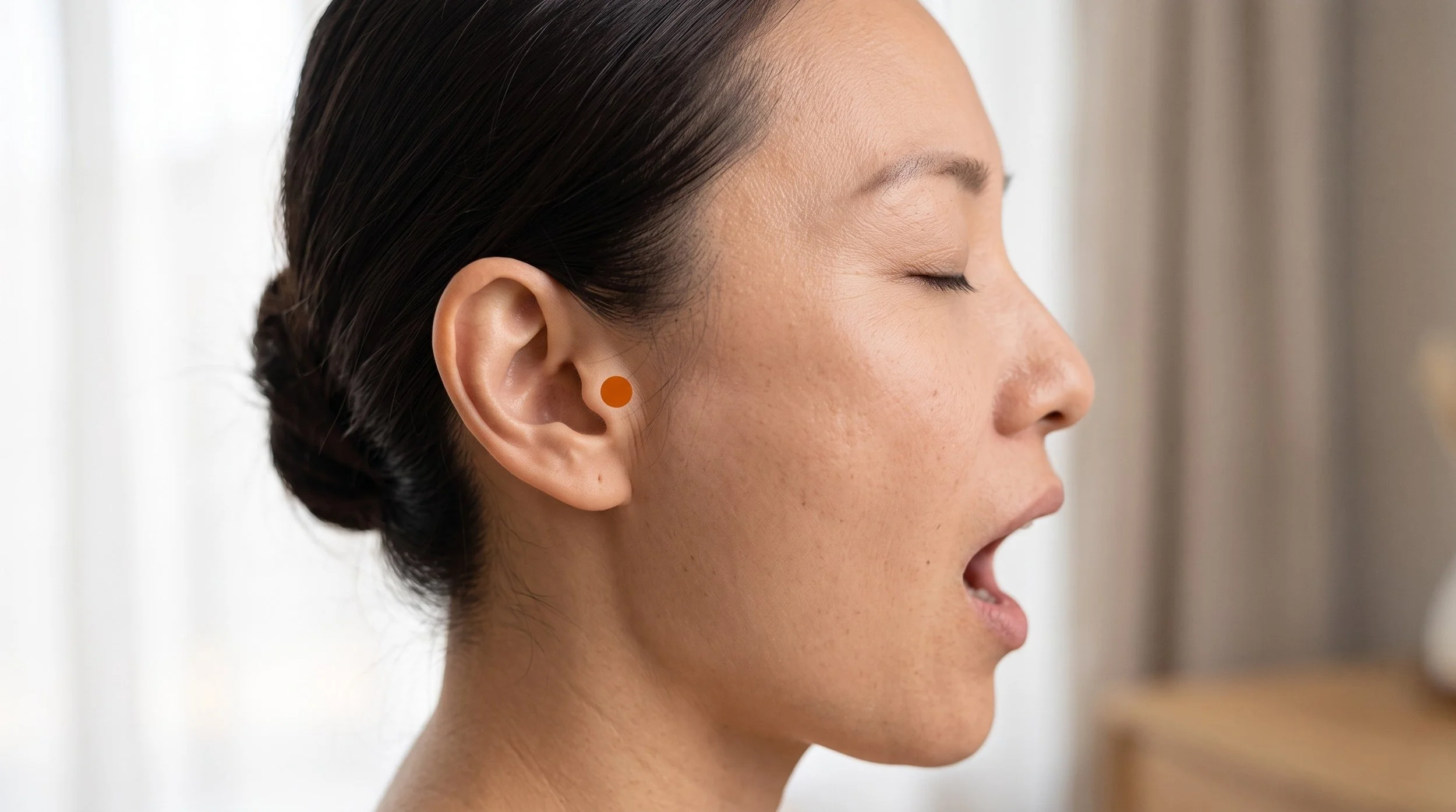
SI19 Acupuncture Point (Tinggong)
The Palace of Hearing in Front of the Tragus: Anatomy, Mechanism, and Why This Point Sits at the Crossroads of Ear and Jaw Complaints
SI19 (Tinggong), usually translated as Palace of Hearing or Listening Palace, is the final point of the Small Intestine channel and the middle member of the three small depressions that sit directly in front of the ear. You find it by asking someone to open the mouth: as the jaw's condyle slides forward, a soft hollow appears between the middle of the tragus and the jaw joint, and that hollow is the si19 acupuncture point. It matters clinically for two reasons that turn out to be closely related.
Classically it's one of the main points for tinnitus, reduced hearing, ear pain and ear discharge, and in modern orthopedic practice the same spot sits directly over the temporomandibular joint capsule, which makes small intestine 19 a practical local point for jaw pain, clicking and limited opening. Because the ear and the jaw share sensory territory through a single nerve, treating one region often influences symptoms in the other.
- Location and layers: with the mouth open, SI19 lies in the depression between the middle of the tragus and the condyle of the mandible, and the needle passes through thin skin and subcutaneous tissue toward the fibrous capsule of the temporomandibular joint. Deadman's A Manual of Acupuncture and Kim's point text both describe perpendicular insertion of roughly 0.5 to 1 cun with the mouth held open.
- Traditional categories, translated: classical sources list SI19 as a meeting point of the Small Intestine, Triple Burner and Gallbladder channels, and its stated actions are to benefit the ears and calm the spirit. In neurophysiological terms, a crossing point simply marks a place where several regional pathways converge on shared nerve territory, and calming actions map onto autonomic and limbic changes rather than movement of energy.
- Mechanism: this spot sits squarely in auriculotemporal nerve territory, a branch of the mandibular division of the trigeminal nerve that supplies the joint capsule, the tragus and part of the ear canal. Needling here recruits small-diameter afferents that feed the trigeminal brainstem complex, engaging segmental inhibition and descending pain modulation (Zhao, 2008), the same broad system implicated in acupuncture's effects on chronic pain (Vickers et al., 2018).
- Research picture: reviews of acupuncture for tinnitus report mixed results, with improvement on tinnitus handicap scales but no clear advantage on loudness ratings and consistently low study quality (Huang et al., 2021; Kim et al., 2012). Evidence in temporomandibular disorders is more encouraging for short-term pain relief, though still limited by small samples and bias (Jung et al., 2011; Di Francesco et al., 2024).
- Point-specific data: SI19 appears by name in imaging research, including a trial in which electroacupuncture delivered at SI19 with GB11 was associated with reduced tinnitus handicap scores and altered insular functional connectivity on resting-state fMRI (Zha et al., 2024). That's suggestive of central modulation rather than a local ear effect, but it's a single small study without a sham arm.
- Clinical framing and de qi: expect a dull, spreading fullness around the ear and jaw joint, sometimes felt inside the ear canal or along the jaw line, rather than sharp pain. Because the three ear-front points share indications, many clinicians rotate SI19, TE21 and GB2 across a course of care instead of needling the same depression every visit.
Jaw Pain, Clicking, or Ringing in the Ears?
At Morningside Acupuncture we treat the jaw and ear region as one functional unit, and SI19 is one of the first points we assess when someone reports clicking, tightness with chewing, or ear symptoms without an ear infection. We combine gentle needling at the joint line with dry needling of the masseter, temporalis and upper cervical muscles that refer pain into the same territory. Treatment is precise, comfortable, and paired with practical advice on clenching, posture and sleep. Schedule a visit and we'll map out where your symptoms are actually coming from.
Schedule NowAnatomy of SI19: Why the Depression in Front of the Tragus Is Such an Important Location
SI19 sits in a small, mobile hollow that only fully appears when the mouth opens and the condyle of the jaw slides forward. Under the needle there's thin pre-auricular skin, a shallow layer of subcutaneous tissue, and then the lateral surface of the temporomandibular joint capsule with its reinforcing ligament. The upper portion of the parotid gland lies just below and behind, and the cartilage of the tragus forms the posterior wall of the depression.
This tissue is loaded constantly: every bite, every swallow, every hour of clenching or grinding, and every long stretch of screen-forward head posture that biases the jaw muscles toward sustained low-level contraction. When that load becomes chronic, patients often describe a deep ache exactly where SI19 sits, sometimes with clicking, catching, or a plugged feeling in the ear.
The nerve geography here explains most of what the point does. The auriculotemporal nerve, a branch of the mandibular division of the trigeminal nerve, supplies the joint capsule, the tragus, part of the external ear canal and the skin over the temple, and it also carries autonomic fibers to the parotid gland. That means a single sensory territory covers both the ear and the jaw joint, and their inputs converge in the trigeminal brainstem nuclear complex, which is why ear pain, jaw pain and toothache so often blur together in clinical presentation and in the classical indication lists.
Needling here activates A-delta and C fiber afferents that trigger segmental inhibition at the brainstem level and recruit descending inhibitory pathways involving endogenous opioids, serotonin and noradrenaline (Zhao, 2008). Pooled patient-level data across chronic pain conditions suggest effects that persist beyond the treatment session itself, which supports the idea that these are neuromodulatory changes rather than momentary distraction (Vickers et al., 2018).
Safety comes down to what runs nearby. The superficial temporal artery and vein ascend just anterior and superficial to the point, the transverse facial vessels cross below, and branches of the facial nerve fan out across the region, so this is an area where bruising is the most common minor event and where careful, shallow-to-moderate perpendicular insertion is the rule. Standard texts describe inserting 0.5 to 1 cun perpendicularly with the mouth open, after which the patient can gently close the mouth with the needle in place.
The needle should never be angled into the ear canal, and Kim's point text notes that moxibustion is contraindicated at this location. We use fine gauge needles, avoid heavy manipulation over the joint capsule, and always warn patients that a small bruise in front of the ear is possible.
Related Small Intestine Channel Related Best Acupuncture Points For HeadachesSI19 at a Glance: Classification, Location, and Clinical Use
| Category | Detail |
|---|---|
| Traditional Name | Tinggong (Palace of Hearing, also translated Listening Palace) |
| Channel Classification | Small Intestine channel of Hand Taiyang; the nineteenth and final point of the channel, where the pathway is classically described as entering the ear |
| Point Categories | Meeting (crossing) point of the Small Intestine, Triple Burner (Sanjiao) and Gallbladder channels; the middle of the three ear-front points, with TE21 above and GB2 below; terminal point of the Small Intestine channel. No five-shu, hui-meeting or extraordinary vessel designation is attributed to this point in the source texts. |
| Precise Location | In front of the ear, in the depression between the middle of the tragus and the condyloid process of the mandible, which opens up when the patient opens the mouth. TE21 lies in the depression just above it and GB2 in the depression just below it. |
| Tissue Stimulated | Pre-auricular skin and subcutaneous tissue over the lateral capsule of the temporomandibular joint, within auriculotemporal nerve territory, with the superficial temporal vessels and the upper parotid immediately adjacent |
| Needle Depth / Direction | Perpendicular insertion 0.5 to 1 cun with the mouth open; the patient may close the mouth once the needle is in place. Angle away from the ear canal. Moxibustion is contraindicated per Kim's point text. |
| De Qi Sensation | A dull, heavy fullness or ache around the joint and tragus, sometimes spreading into the ear canal, up toward the temple, or down along the jaw line; occasionally a sense of pressure that shifts with small jaw movements |
| Primary Clinical Uses | Traditionally used for tinnitus, impaired hearing, ear pain and ear discharge, and toothache; in modern practice used mainly as a local point for TMJ pain, clicking, jaw tightness and limited mouth opening, and as part of multi-point protocols for tinnitus |
| Common Point Combinations |
|
Deadman's A Manual of Acupuncture groups SI19 with its two neighbors and treats them almost as a single clinical territory. Three depressions line up in front of the tragus, TE21 at the top, SI19 in the middle and GB2 at the bottom, and all three are traditionally used for the same broad range of ear complaints: ringing, hearing loss, pain, itching and discharge.
The text is candid that their indications overlap so heavily that separating them in practice is difficult, with two useful distinctions offered as traditional attribution: SI19 carries a secondary action of calming the spirit, while GB2 is regarded as the strongest of the three for local pain in the jaw and teeth. Alongside the ear indications, older sources credit SI19 with effects on mania and seizure disorders, loss of voice, a sense of fullness in the chest and abdomen, and toothache, and it's classified as a meeting point of the Small Intestine, Triple Burner and Gallbladder channels.
What's striking is that a small local point defined by a hearing function also acquired mental-emotional indications, which suggests early clinicians noticed that stimulating this region did something beyond the ear itself.
Why SI19 Is Used for Jaw Pain and Clicking, Not Just Ear Symptoms
Patients are often surprised that a point named for hearing turns out to be one of the most useful spots for a cranky jaw. The anatomy makes it straightforward. The needle sits over the lateral capsule of the temporomandibular joint, in skin supplied by the auriculotemporal nerve, and that nerve supplies both the joint and part of the ear. Sensory input from the joint capsule, the chewing muscles, the teeth and the ear all funnel into the same trigeminal brainstem territory, so stimulating one part of that territory can modulate how the whole region is processed.
This convergence is also the most plausible reason the classical indication lists for SI19 mix ear symptoms with toothache: those complaints aren't separate to the nervous system in the way they are to a specialty clinic.
Beyond the segmental level, needling recruits descending inhibitory pathways from the midbrain and brainstem that dampen nociceptive transmission more broadly (Zhao, 2008), and individual patient data from chronic pain trials suggest these effects are modest but real and durable over months (Vickers et al., 2018). In temporomandibular disorders specifically, sham-controlled work and later meta-analyses point toward short-term reductions in pain of muscular origin, with the usual caveats about small trials and risk of bias (Jung et al., 2011; Di Francesco et al., 2024).
A 2024 randomized trial reported greater pain relief and better physical and emotional function with acupuncture compared with sham in TMD patients, although objective measures such as pressure pain threshold and surface EMG didn't differ between groups (Liu et al., 2024).
On the ear side, the mechanism story looks more central than local. In one imaging study, patients receiving electroacupuncture delivered through SI19 and GB11 showed reduced tinnitus handicap scores alongside changes in resting-state functional connectivity between the insula and frontal regions (Zha et al., 2024). That fits the broader model of tinnitus as a disorder of central auditory and limbic processing rather than a problem confined to the cochlea, and it offers a reasonable explanation for why classical texts attached a spirit-calming action to a hearing point. It doesn't establish that SI19 treats tinnitus, and we're careful to say so.
What the Research Shows for SI19
It's worth being clear about what the research can and can't tell us. Almost every trial that includes SI19 uses it inside a multi-point protocol, typically alongside GB2, TE17, TE3 and distal points, so no study isolates the contribution of this single location. Tinnitus trials are also notoriously hard to control, since patients can feel where a needle goes and outcome measures are entirely subjective. Read the table below as a picture of how the protocols containing SI19 have performed, not as evidence about the point on its own.
| Study | Type | Focus | Key Finding |
|---|---|---|---|
| Huang et al., 2021 | Systematic review and meta-analysis | Acupuncture for tinnitus across eight RCTs (504 participants) | No significant difference from control on the primary loudness outcome, with favorable changes on tinnitus handicap and severity scales, in trials the authors rated as low quality. |
| Kim et al., 2012 | Systematic review of RCTs | Acupuncture for tinnitus | Concluded that the evidence was not convincing, largely because of methodological limitations in the available trials. |
| Zha et al., 2024 | Clinical study with resting-state fMRI | Electroacupuncture at SI19 and GB11 in subjective tinnitus | Reported reduced tinnitus handicap scores with altered insular functional connectivity, though the design lacked a sham comparison. |
| Jung et al., 2011 | Systematic review and meta-analysis of sham-controlled trials | Acupuncture for temporomandibular joint disorders | Found limited but suggestive evidence of symptomatic benefit, based on a small pooled sample. |
| Di Francesco et al., 2024 | Systematic review and meta-analysis | Acupuncture and laser acupuncture in TMD across 11 RCTs | Suggested short-term reductions in TMD pain of muscular origin while describing the overall evidence base as limited. |
| Liu et al., 2024 | Randomized clinical trial | Acupuncture versus sham for temporomandibular disorders | Reported greater pain relief and functional improvement with acupuncture, with no between-group differences in pressure pain threshold or surface EMG. |
| Nowak et al., 2021 | Systematic review of clinical trials | Needling therapies within the masticatory muscles for myofascial pain | Found that dry needling of chewing muscles is widely used with reported pain reduction, while noting variability in technique and study quality. |
| Vickers et al., 2018 | Individual patient data meta-analysis | Acupuncture for chronic pain across 39 trials | Found modest effects over sham and larger effects over no-acupuncture control, with benefit largely maintained at 12 months. |
Looking for Careful, Anatomy-Based Facial Needling in Manhattan?
Needling in front of the ear demands accurate landmarks, a light hand, and respect for the superficial temporal vessels and facial nerve branches nearby. Our licensed acupuncturists use fine needles, clean technique and a mouth-open positioning method so the point is entered exactly where the depression opens. We explain each step before we needle, and we adjust depth and stimulation to your tolerance. Book a session to see what an unhurried, anatomically grounded treatment feels like.
Schedule NowSI19 in the Context of Trigger Point Work
In our clinic, the si 19 ear point rarely works alone for jaw complaints. Palpating around the joint usually turns up taut bands in the masseter, the anterior and middle fibers of temporalis, and the lateral pterygoid, and these muscles have well-described referral patterns that send pain into the teeth, the temple, the joint itself and sometimes into the ear, which is exactly the territory patients point to (Simons et al., 1999).
A typical session combines needling at SI19 and GB2 over the joint line with dry needling of those chewing muscles, plus the upper trapezius and sternocleidomastoid when the neck is contributing. Reviews of needling within the masticatory muscles report pain reduction across a range of protocols, though technique and study quality vary considerably (Nowak et al., 2021).
There's a useful distinction to keep in mind. SI19 is a capsular and neural point: the needle addresses the joint's sensory envelope and the auriculotemporal territory that surrounds it. Trigger point needling of the masseter or temporalis is a muscular intervention aimed at a specific taut band and its local twitch response. Acupuncture, as we define it, is the use of an acupuncture needle, and both approaches qualify, which is why we don't treat them as competing systems.
Choosing between them, or more often layering them, depends on whether your pain is reproduced by pressing the joint line, by clenching against resistance, or by pressing a discrete nodule in the cheek or temple.
SI19 TMJ and Tinnitus Treatment at NYC's Highest-Rated Acupuncture Clinic
Morningside Acupuncture is the highest-rated acupuncture and dry needling clinic in New York City with over 500 five-star Google reviews, and jaw and facial pain is one of the conditions we see most often. Sessions blend classical point selection around SI19 with modern trigger point needling of the chewing muscles and a plan you can follow between visits. We're clear about what acupuncture may and may not do for ear symptoms, and we track your progress session by session. Schedule your first appointment today.
Schedule NowFrequently Asked Questions
What does SI19 feel like when needled?
Most people describe a dull, spreading fullness or heaviness right in front of the ear, sometimes with a sensation that travels into the ear canal, up toward the temple, or down the jaw line. It isn't usually sharp. Because the needle goes in with the mouth open and then the mouth closes, you may notice the sensation shift slightly as the jaw settles, which is normal. Facial points can feel more attention-grabbing than points on the arms or legs, so we use fine needles and light stimulation here, and the feeling generally settles within a minute or two.
Why needle in front of the ear for a jaw problem instead of the muscle that hurts?
Because the depression at SI19 lies directly over the temporomandibular joint capsule, in skin supplied by the auriculotemporal nerve, which also serves the joint itself and part of the ear. Stimulating that territory feeds into the trigeminal brainstem complex where jaw, ear and dental input converge, so it can influence how the whole region is processed rather than just one muscle (Zhao, 2008). In practice we usually do both: local needling at the joint line plus dry needling of the masseter, temporalis or lateral pterygoid when those muscles reproduce your pain.
Can I press SI19 myself between sessions?
Yes, and it's easy to find. Place a fingertip just in front of the middle of the tragus, then open your mouth wide; the hollow that appears under your finger is the palace of hearing point. Close your mouth partway so the finger rests comfortably in the depression, then apply steady, moderate pressure, enough to feel a dull ache but never sharp pain, for 30 to 60 seconds. Repeat two or three times per side, and you can do this a couple of times a day. Small slow circles or a gentle hold while you slowly open and close the jaw both work well. Stop if you get dizziness, sharp pain, or any change in hearing, and skip the area entirely if you have active ear pain, discharge, a suspected ear infection, or recent facial or dental surgery.
Is SI19 safe to needle?
In trained hands, yes. It's a well-established point that texts describe as perpendicular insertion of 0.5 to 1 cun with the mouth open. The main considerations are the superficial temporal artery and vein just anterior to the point and the branches of the facial nerve crossing the region, so bruising is the most common minor side effect and heavy manipulation isn't appropriate over the joint capsule. The needle should never be directed into the ear canal, and Kim's point text lists moxibustion as contraindicated here. Tell your acupuncturist if you take blood thinners, have had ear or jaw surgery, or have an implanted device in the area.
Where exactly is SI19 located?
In front of the ear, in the depression between the middle of the tragus and the condyloid process of the mandible, which becomes obvious when you open your mouth and the condyle slides forward. It's the middle of three points in a vertical line in front of the tragus: TE21 sits in the depression above it and GB2 in the depression below. If you rest a finger there and open and close your mouth a few times, you'll feel the jaw's condyle rolling under your fingertip, which confirms you're on the joint and on the point.
References
- Deadman, P., Al-Khafaji, M., & Baker, K. (2009). A manual of acupuncture. Journal of Chinese Medicine Publications.
- Kim, H. (2008). Handbook of Oriental medicine (3rd ed.). Harmony & Balance Press.
- O'Connor, J., & Bensky, D. (Eds. & Trans.). (1981). Acupuncture: A comprehensive text. Shanghai College of Traditional Medicine. Eastland Press.
- Maciocia, G. (2006). The channels of acupuncture: Clinical use of the secondary channels and eight extraordinary vessels. Churchill Livingstone Elsevier.
- Simons, D. G., Travell, J. G., & Simons, L. S. (1999). Travell & Simons' myofascial pain and dysfunction: The trigger point manual, Vol. 1: Upper half of body (2nd ed.). Williams & Wilkins.
- Huang, K., Liang, S., Chen, L., & Grellet, A. (2021). Acupuncture for tinnitus: A systematic review and meta-analysis of randomized controlled trials. Acupuncture in Medicine, 39(4), 264-271. https://doi.org/10.1177/0964528420938380
- Kim, J. I., Choi, J. Y., Lee, D. H., Choi, T. Y., Lee, M. S., & Ernst, E. (2012). Acupuncture for the treatment of tinnitus: A systematic review of randomized clinical trials. BMC Complementary and Alternative Medicine, 12, 97. https://doi.org/10.1186/1472-6882-12-97
- Zha, B., Zhang, Y., Shi, F., Cheng, L., Rong, Z., Yu, L., Liu, W., Xue, Q., Ye, M., Yang, J., Qiu, B., & Yang, J. (2024). Modulations of resting-static functional connectivity on insular by electroacupuncture in subjective tinnitus. Frontiers in Neurology, 15, 1373390. https://doi.org/10.3389/fneur.2024.1373390
- Jung, A., Shin, B. C., Lee, M. S., Sim, H., & Ernst, E. (2011). Acupuncture for treating temporomandibular joint disorders: A systematic review and meta-analysis of randomized, sham-controlled trials. Journal of Dentistry, 39(5), 341-350. https://doi.org/10.1016/j.jdent.2011.02.006
- Di Francesco, F., Minervini, G., Siurkel, Y., Cicciù, M., & Lanza, A. (2024). Efficacy of acupuncture and laser acupuncture in temporomandibular disorders: A systematic review and meta-analysis of randomized controlled trials. BMC Oral Health, 24(1), 174. https://doi.org/10.1186/s12903-023-03806-1
- Liu, L., Chen, Q., Lyu, T., Zhao, L., Miao, Q., Liu, Y., Nie, L., Fu, F., Li, S., Zeng, C., Zhang, Y., Peng, P., Wang, W., Lin, Y., & Li, B. (2024). Effect of acupuncture for temporomandibular disorders: A randomized clinical trial. QJM: An International Journal of Medicine, 117(9), 647-656. https://doi.org/10.1093/qjmed/hcae094
- Nowak, Z., Chęciński, M., Nitecka-Buchta, A., Bulanda, S., Ilczuk-Rypuła, D., Postek-Stefańska, L., & Baron, S. (2021). Intramuscular injections and dry needling within masticatory muscles in management of myofascial pain: Systematic review of clinical trials. International Journal of Environmental Research and Public Health, 18(18), 9552. https://doi.org/10.3390/ijerph18189552
- Vickers, A. J., Vertosick, E. A., Lewith, G., MacPherson, H., Foster, N. E., Sherman, K. J., Irnich, D., Witt, C. M., & Linde, K. (2018). Acupuncture for chronic pain: Update of an individual patient data meta-analysis. Journal of Pain, 19(5), 455-474. https://doi.org/10.1016/j.jpain.2017.11.005
- Zhao, Z. Q. (2008). Neural mechanism underlying acupuncture analgesia. Progress in Neurobiology, 85(4), 355-375. https://doi.org/10.1016/j.pneurobio.2008.05.004
Disclaimer: This web site is intended for educational and informational purposes only. Reading this website does not constitute providing medical advice or any professional services. This information should not be used for diagnosing or treating any health issue or disease. Those seeking medical advice should consult with a licensed physician. Seek the advice of a medical doctor or other qualified health professional for any medical condition. If you think you have a medical emergency, call 911 or go to the emergency room. No acupuncturist-patient relationship is created by reading this website or using the information. Morningside Acupuncture PLLC and its employees and contributors do not make any express or implied representations with respect to the information on this site or its use. For any legal interpretation of scope of practice in your state, consult a licensed attorney or regulatory authority.
Read more from our blog



