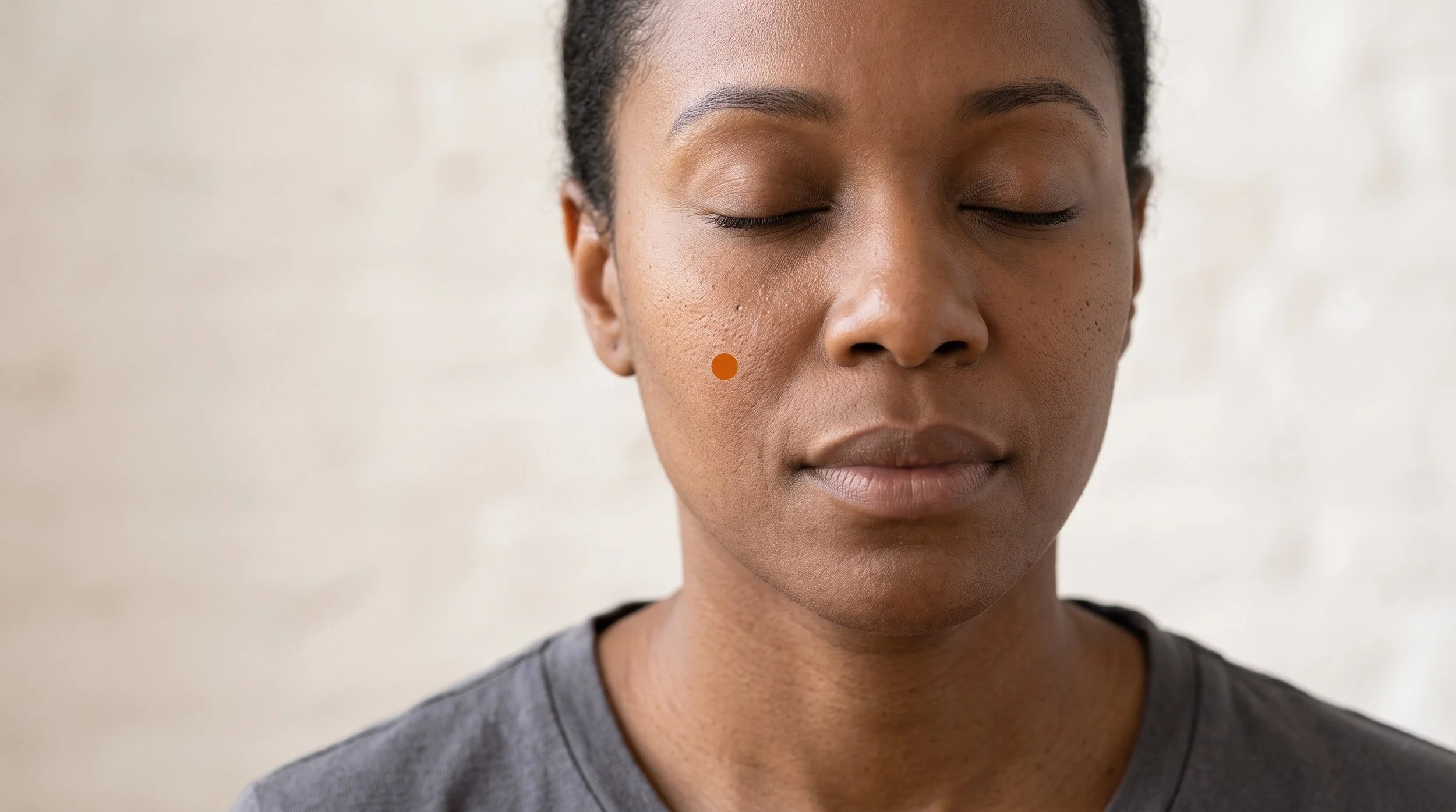
SI18 Acupuncture Point (Quanliao)
The Cheek Bone Crevice Below the Eye: Anatomy, Trigeminal Mechanism, and Why SI18 Anchors Facial Pain and Facial Paralysis Treatment
SI18, called Quanliao in Chinese and usually translated as Cheek Bone Crevice, sits directly below the outer corner of the eye in the soft hollow you can feel along the lower rim of the cheekbone. Classical texts list it as a meeting point of the Small Intestine and Triple Burner channels, and traditional sources credit it with dispersing wind, easing pain, and reducing heat and swelling in the face (Deadman et al., 2007).
In modern clinical terms, the si18 acupuncture point is a precise way to reach the sensory territory of the maxillary division of the trigeminal nerve and the muscle field that lifts the corner of the mouth, which is why small intestine 18 shows up in nearly every well built protocol for facial paralysis, trigeminal-pattern facial pain, eyelid twitching, and upper jaw and cheek discomfort.
- Quanliao point location is straightforward: drop a line straight down from the outer canthus of the eye and stop in the depression at the lower border of the zygomatic bone (Deadman et al., 2007). The needle passes through thin skin and a shallow fat layer into the origin fields of the zygomaticus muscles, with the maxilla and zygoma sitting just underneath.
- Traditional sources classify SI18 as a crossing point of the Small Intestine and Triple Burner channels, and the Small Intestine pathway is described as sending a branch up across the cheek into the infraorbital region (Deadman et al., 2007; Chinese Acupuncture and Moxibustion, 1987). Maciocia also lists SI18 (with ST7) as a meeting point for the three leg yang sinew channels, which in plain terms means the point sits where several facial muscle chains overlap (Maciocia, 2006).
- Mechanistically, needling here stimulates the infraorbital and zygomaticofacial branches of the trigeminal maxillary division, whose input converges in the trigeminal spinal nucleus with afferents from the teeth, jaw, and upper cervical segments. That convergence, together with descending inhibitory pathways recruited by needle stimulation, is the current working explanation for local and regional analgesia (Zhao, 2008).
- The research picture is encouraging but not settled. A Cochrane review of acupuncture for Bell's palsy could not reach a firm conclusion because the included trials were methodologically weak (Chen et al., 2010), while later meta-analyses in facial palsy and trigeminal neuralgia report favorable pooled results alongside low certainty of evidence (Li et al., 2015; Ang et al., 2023).
- Clinically, SI18 is rarely used alone. It is commonly threaded transversely toward ST4, ST7 or LI20 in facial paralysis work, and it is combined with distal points such as LI4 in facial pain protocols, consistent with individual patient data showing acupuncture's modest but durable advantage over sham in chronic pain conditions (Deadman et al., 2007; Vickers et al., 2018).
- De qi at SI18 is usually mild: a dull, slightly heavy fullness that may spread toward the upper teeth, the nose, or under the eye. Because facial skin is vascular and thin, brief pinprick and occasional bruising are the trade-offs patients should expect.
Struggling With Facial Pain, Jaw Tension, or a Twitchy Eyelid?
At Morningside Acupuncture we use SI18 as a cornerstone of facial pain and facial nerve work, pairing it with ST7, ST6, and carefully chosen distal points. Every treatment starts with palpation of the cheekbone, masseter, and temporalis so the needling matches what your tissue actually feels like, not a generic template. We combine gentle facial needling with dry needling of the jaw muscles when clenching is part of the picture. Schedule a visit and let's map out what is driving your symptoms.
Schedule NowAnatomy of SI18: Why the Lower Border of the Cheekbone Is Such an Important Location
The tissue stack at SI18 is shallow and layered. Under thin facial skin sits a modest layer of subcutaneous fat, then the superficial musculoaponeurotic tissue and the origin fibers of zygomaticus major and minor as they leave the lower border of the zygomatic bone. Just deep and behind that lie the upper fibers of the masseter and the buccal fat pad, with the maxilla and zygoma providing a firm bony floor.
What loads this area is not lifting or carrying but repetition and tone: sustained clenching, chewing on one side, guarded expression after facial nerve injury, and the compensatory overuse that appears when one half of the face stops moving normally.
The nerve geography is the reason this point earns its place. Sensation across the cheek here is carried by the infraorbital and zygomaticofacial branches of the maxillary division of the trigeminal nerve, while motor supply to the zygomaticus muscles comes from the zygomatic and buccal branches of the facial nerve. Because trigeminal afferents from the face, upper teeth, jaw joint, and dura converge with upper cervical input in the trigeminal spinal nucleus, a stimulus delivered at the cheekbone enters a pool of neurons that also processes toothache, jaw pain, and referred headache.
Needle stimulation is thought to act on this system through local afferent activation and through descending inhibitory control from the brainstem, along with segmental modulation of nociceptive transmission (Zhao, 2008). This is also why classical sources grouped seemingly unrelated complaints such as upper jaw toothache, eyelid twitching, and cheek swelling under the same point (Deadman et al., 2007).
Vascular structures matter here more than depth. Branches of the transverse facial and infraorbital vessels and a dense network of small facial veins run through this region, so bruising is the most common side effect and is worth mentioning to patients before the first facial treatment. Standard needling conventions are conservative: perpendicular insertion of roughly 0.5 to 0.7 cun, or a shallow transverse thread joined toward points such as ST4, ST7, or LI20 for facial paralysis work (Deadman et al., 2007).
Deep or aggressive angling toward the infraorbital foramen is avoided. Deadman also notes, citing the Illustrated Supplement to the Classic of Categories along with a number of modern texts, that moxibustion is contraindicated at this point.
Related Zygomaticus Trigger Points Related Small Intestine ChannelSI18 at a Glance: Classification, Location, and Clinical Use
| Category | Detail |
|---|---|
| Traditional Name | Quanliao (Cheek Bone Crevice, also translated Zygoma Crevice) |
| Channel Classification | Small Intestine channel, point 18 of 19 (Hand Taiyang) |
| Point Categories | Meeting point of the Small Intestine and Triple Burner (Sanjiao) channels (Deadman et al., 2007); listed by Maciocia, with ST7, as a meeting point of the three leg yang sinew channels (Maciocia, 2006); no five-shu, extraordinary vessel, or hui-meeting designation. Deadman notes moxibustion is contraindicated here. |
| Precise Location | On the si 18 face region: directly below the outer canthus of the eye, in the depression at the lower border of the zygomatic bone. |
| Tissue Stimulated | Skin and subcutaneous tissue, the origin fibers of the zygomaticus major and minor muscles, and the periosteal border of the zygoma; infraorbital and zygomaticofacial sensory branches of the trigeminal maxillary division lie in the field |
| Needle Depth / Direction | Perpendicular 0.5 to 0.7 cun, or shallow transverse insertion threaded toward ST4, ST7, LI20, or ST6; moxibustion contraindicated per classical and many modern sources |
| De Qi Sensation | Mild dull heaviness or spreading fullness across the cheek, sometimes tracking toward the upper teeth, nose, or lower eyelid; sharp sensation usually means the needle should be adjusted |
| Primary Clinical Uses | Facial paralysis with deviation of the mouth and eye, trigeminal-territory facial pain, persistent eyelid twitching, upper jaw toothache with cheek swelling, jaw and cheek tension in TMJ presentations |
| Common Point Combinations |
|
Deadman, Al-Khafaji, and Baker present SI18 as one of the most frequently used facial points in the classical repertoire, indicated for problems attributed to wind arising either from outside the body or from within it. The traditional actions assigned to the point are to expel wind and stop pain, and to clear heat and reduce swelling, with indications that read like a survey of the cheek and orbital region: deviation of the mouth and eye, unrelenting eyelid twitching, facial pain, swollen cheek with toothache, difficulty chewing, sores of the lip, and red face with yellowed eyes (Deadman et al., 2007).
The classical combinations are equally telling. The Systematic Classic pairs SI18 with LI2 for toothache, while the Thousand Ducat Formulas records SI18 with ST6 for jaw pain with a deviated mouth and an inability to chew, and SI18 with PC6 for red and yellow eyes.
What is striking is how tightly this classical cluster maps onto one anatomical territory: everything on the list belongs to the maxillary trigeminal field or to the muscles that the facial nerve drives across the cheek.
Why SI18 Is Used for Eyelid Twitching and Upper Tooth Pain That Seem Far From the Cheekbone
Patients are often puzzled that a point on the cheekbone is chosen for an eyelid that will not stop fluttering, or for a dull ache in the upper molars that a dentist has already cleared. The explanation is segmental. Sensation from the lower eyelid, the cheek, the side of the nose, the upper teeth, and the upper gum all travels back along branches of the maxillary division of the trigeminal nerve, and those fibers converge in the trigeminal spinal nucleus in the brainstem alongside input from the jaw and the upper neck.
When one part of that shared territory becomes sensitized, the whole neighborhood can feel irritable and poorly localized. Needling within that territory delivers a strong, well-defined afferent signal into the same pool of neurons, which is the segmental basis for the analgesia and reduced sensitivity that patients often notice (Zhao, 2008).
The second layer is descending inhibition. Needle stimulation, particularly when de qi is obtained and the needles are retained, is associated with activation of brainstem structures that send inhibitory signals back down onto pain transmission neurons, along with release of endogenous opioid peptides and other neurochemical mediators (Zhao, 2008). That is a system-wide effect rather than a local one, which is why we usually combine SI18 with distal points instead of needling the face alone.
Pooled individual patient data across chronic pain conditions suggests acupuncture produces effects that are modest but larger than sham needling and that persist over time rather than fading immediately after treatment (Vickers et al., 2018).
There is also a straightforward musculoskeletal component. SI18 sits at the origin of the zygomaticus muscles and just above the upper masseter, and taut bands in these muscles refer pain into the nose, upper teeth, and the region beneath the eye (Simons et al., 1999). For a subset of patients, what feels like nerve pain or a dental problem turns out to be a myofascial pattern in the cheek and jaw muscles that responds well to precise needling.
What the Research Shows for SI18
It is worth being clear about what the research does and does not show. No high-quality trial has isolated SI18 as a single intervention, so the honest framing is that this point appears inside multi-point protocols for facial paralysis, trigeminal neuralgia, and temporomandibular pain, and the reviews below evaluate those protocols as a whole. Several of these bodies of literature report favorable pooled results while simultaneously flagging serious methodological limitations, which means the reasonable takeaway is cautious optimism rather than certainty.
| Study | Type | Focus | Key Finding |
|---|---|---|---|
| Chen et al., 2010 | Cochrane systematic review | Acupuncture for Bell's palsy | The reviewers concluded that the quality of the included trials was too low to determine whether acupuncture hastens recovery from Bell's palsy. |
| Li et al., 2015 | Systematic review and meta-analysis (14 RCTs, 1,541 participants) | Acupuncture for Bell's palsy | Pooled results favored acupuncture on recovery outcomes, though the authors emphasized that methodological weaknesses limit how much confidence the estimates deserve. |
| Ang et al., 2023 | Systematic review and meta-analysis (30 RCTs, 2,295 patients) | Acupuncture for trigeminal neuralgia | Acupuncture appeared to reduce pain and attack frequency compared with carbamazepine with a relatively good safety profile, but the certainty of evidence was rated low. |
| Yin et al., 2022 | Systematic review and network meta-analysis | Comparative acupuncture methods for primary trigeminal neuralgia | Different needling approaches were compared for efficacy and safety, with the authors noting that trial quality constrains firm ranking of one method over another. |
| Park et al., 2023 | Systematic review and meta-analysis | Acupuncture for temporomandibular disorder | The review reported benefit for TMD pain outcomes in several comparisons while grading the overall evidence cautiously. |
| Vickers et al., 2018 | Individual patient data meta-analysis (nearly 21,000 patients) | Acupuncture for chronic pain, including headache and musculoskeletal pain | Acupuncture was superior to both sham and no-acupuncture controls, with effects that persisted over about twelve months. |
| Zhao, 2008 | Mechanistic review | Neural mechanisms of acupuncture analgesia | Describes peripheral afferent activation, segmental spinal modulation, and descending inhibitory control as the principal pathways underlying acupuncture analgesia. |
Recovering From Bell's Palsy or Post-Viral Facial Weakness?
Facial paralysis recovery benefits from consistent, thoughtful, and appropriately timed care, and SI18 is one of the points we return to session after session because it sits right over the zygomaticus muscles that lift a smile. We coordinate with your neurologist or ENT, keep stimulation conservative in the early inflammatory phase, and progress as your motor control returns. Studies suggest acupuncture may support recovery, though the evidence base still has real limitations. Book an evaluation to discuss a realistic plan and timeline.
Schedule NowSI18 in the Context of Trigger Point Work
SI18 is one of the clearest examples of a classical point sitting directly on a myofascial target. The point lies at the bony origin of zygomaticus major and minor, and taut bands in these small muscles are associated with referred pain along the nasolabial fold and up toward the side of the nose (Simons et al., 1999). Just deep and posterior to the point, the upper fibers of the masseter refer into the upper molars, the cheek, and occasionally the eyebrow, a pattern that regularly gets mistaken for a dental problem.
When we palpate before needling and the patient's familiar pain reproduces under the finger at the lower cheekbone, that is a strong signal that the myofascial layer deserves attention rather than facial needling alone.
In practice, we treat SI18 as the anchor and build outward. A typical session might use a shallow perpendicular needle at SI18 or a transverse thread toward ST4, then dry needling of the masseter and temporalis for clenching-driven jaw and temple pain, then distal points such as LI4 to support broader pain modulation. For facial paralysis cases, the emphasis shifts from releasing taut bands to gentle stimulation of the zygomaticus field so the muscles that lift the corner of the mouth receive consistent input while the nerve recovers. Dosage in the face is deliberately light: fewer needles, less manipulation, and more attention to how the tissue responds between visits.
SI18 Facial Pain Treatment at NYC's Highest-Rated Acupuncture Clinic
Morningside Acupuncture is the highest-rated acupuncture and dry needling clinic in New York City with over 500 five-star Google reviews, and facial pain, TMJ, and facial nerve cases are a core part of our practice. We combine classical point selection like SI18 and ST6 with modern trigger point needling of the masseter, temporalis, and zygomaticus. Treatments are precise, well explained, and paced to how your face responds. Schedule your first session and start working on the problem directly.
Schedule NowFrequently Asked Questions
What does SI18 feel like when needled?
Most people feel a brief pinch as the needle passes through facial skin, followed by a mild dull heaviness or spreading fullness across the cheek. The sensation may travel toward the upper teeth, the side of the nose, or under the lower eyelid, which is expected given the trigeminal branches in the area. Facial points are generally more sensitive than points on the limbs, but the intensity is usually described as manageable and short-lived. Sharp, electric, or persistent burning sensations are not the goal and mean the needle should be repositioned.
Why needle the cheekbone for a toothache or jaw problem instead of the tooth itself?
Because the cheekbone, the upper teeth, the gum, and the lower eyelid all sit within the same trigeminal sensory territory and their signals converge on the same brainstem neurons. Stimulating within that shared territory can influence how the whole region is processed, which is the segmental logic behind the classical pairing of SI18 with LI2 for toothache and with ST6 for jaw pain and difficulty chewing (Deadman et al., 2007; Zhao, 2008). Dental pain should always be evaluated by a dentist first, since acupuncture does not treat infection or structural tooth damage. Where a dental cause has been ruled out and the pain is myofascial or neuropathic, local and regional needling becomes a reasonable option.
Can I press SI18 myself between sessions?
Yes, and acupressure at this point is easy to self-administer. Find the quanliao point location by drawing an imaginary vertical line down from the outer corner of your eye and following it to the soft hollow just under the lower edge of your cheekbone. Use the pad of your index or middle finger, press straight in with light to moderate pressure, and hold for 30 to 60 seconds while breathing slowly, or use small circular movements for about a minute. Repeat two or three times per side, once or twice daily. Keep the pressure gentle since facial tissue bruises easily, stop if you feel sharp or shooting pain, and avoid pressing on broken skin, active infection, or a recently injured area.
Is SI18 safe to needle?
In trained hands it is a safe point, and it is used routinely in facial treatment. The main considerations are cosmetic and vascular: the face is richly supplied with small vessels, so bruising is the most common side effect and should be mentioned before treatment, especially for patients on blood thinners. Insertion is kept shallow, either perpendicular to about 0.5 to 0.7 cun or threaded transversely toward neighboring points, and deep angling toward the infraorbital foramen is avoided (Deadman et al., 2007). Classical sources and many modern texts also contraindicate moxibustion at this point, which we follow. As with any facial needling, tell your practitioner about recent facial surgery, dermal fillers, active skin infection, or bleeding disorders.
Where exactly is SI18 located?
SI18 is on the face, directly below the outer canthus (the outer corner of the eye), in the depression at the lower border of the zygomatic bone. To find it, look straight ahead, trace a vertical line down from the outer corner of the eye, and slide your fingertip along the underside of the cheekbone until it settles into a small hollow that often feels slightly tender. It sits above and in front of ST7 and above ST4 and ST6, and in facial protocols these points are frequently connected by transverse needling. Compare both sides: the tender or tighter side is usually the one that matters clinically.
References
- Deadman, P., Al-Khafaji, M., & Baker, K. (2009). A manual of acupuncture. Journal of Chinese Medicine Publications.
- Maciocia, G. (2006). The channels of acupuncture: Clinical use of the secondary channels and eight extraordinary vessels. Churchill Livingstone Elsevier.
- Cheng, X. (Ed.). (1999). Chinese acupuncture and moxibustion (Rev. ed.). Foreign Languages Press.
- Kim, H. (2008). Handbook of Oriental medicine (3rd ed.). Harmony & Balance Press.
- Simons, D. G., Travell, J. G., & Simons, L. S. (1999). Travell & Simons' myofascial pain and dysfunction: The trigger point manual, Vol. 1: Upper half of body (2nd ed.). Williams & Wilkins.
- Chen, N., Zhou, M., He, L., Zhou, D., & Li, N. (2010). Acupuncture for Bell's palsy. Cochrane Database of Systematic Reviews, 2010(8), CD002914. https://doi.org/10.1002/14651858.CD002914.pub5
- Li, P., Qiu, T., & Qin, C. (2015). Efficacy of acupuncture for Bell's palsy: A systematic review and meta-analysis of randomized controlled trials. PLOS ONE, 10(5), e0121880. https://doi.org/10.1371/journal.pone.0121880
- Ang, L., Kim, H. J., Heo, J. W., Choi, T. Y., Lee, H. W., Kim, J. I., & Lee, M. S. (2023). Acupuncture for the treatment of trigeminal neuralgia: A systematic review and meta-analysis. Complementary Therapies in Clinical Practice, 52, 101763. https://doi.org/10.1016/j.ctcp.2023.101763
- Yin, Z., Wang, F., Sun, M., Zhao, L., & Liang, F. (2022). Acupuncture methods for primary trigeminal neuralgia: A systematic review and network meta-analysis of randomized controlled trials. Evidence-Based Complementary and Alternative Medicine, 2022, 3178154. https://doi.org/10.1155/2022/3178154
- Park, E. Y., Cho, J. H., Lee, S. H., Kim, K. W., Ha, I. H., & Lee, Y. J. (2023). Is acupuncture an effective treatment for temporomandibular disorder? A systematic review and meta-analysis of randomized controlled trials. Medicine, 102(38), e34950. https://doi.org/10.1097/MD.0000000000034950
- Vickers, A. J., Vertosick, E. A., Lewith, G., MacPherson, H., Foster, N. E., Sherman, K. J., Irnich, D., Witt, C. M., & Linde, K. (2018). Acupuncture for chronic pain: Update of an individual patient data meta-analysis. Journal of Pain, 19(5), 455-474. https://doi.org/10.1016/j.jpain.2017.11.005
- Zhao, Z. Q. (2008). Neural mechanism underlying acupuncture analgesia. Progress in Neurobiology, 85(4), 355-375. https://doi.org/10.1016/j.pneurobio.2008.05.004
Disclaimer: This web site is intended for educational and informational purposes only. Reading this website does not constitute providing medical advice or any professional services. This information should not be used for diagnosing or treating any health issue or disease. Those seeking medical advice should consult with a licensed physician. Seek the advice of a medical doctor or other qualified health professional for any medical condition. If you think you have a medical emergency, call 911 or go to the emergency room. No acupuncturist-patient relationship is created by reading this website or using the information. Morningside Acupuncture PLLC and its employees and contributors do not make any express or implied representations with respect to the information on this site or its use. For any legal interpretation of scope of practice in your state, consult a licensed attorney or regulatory authority.
Read more from our blog



