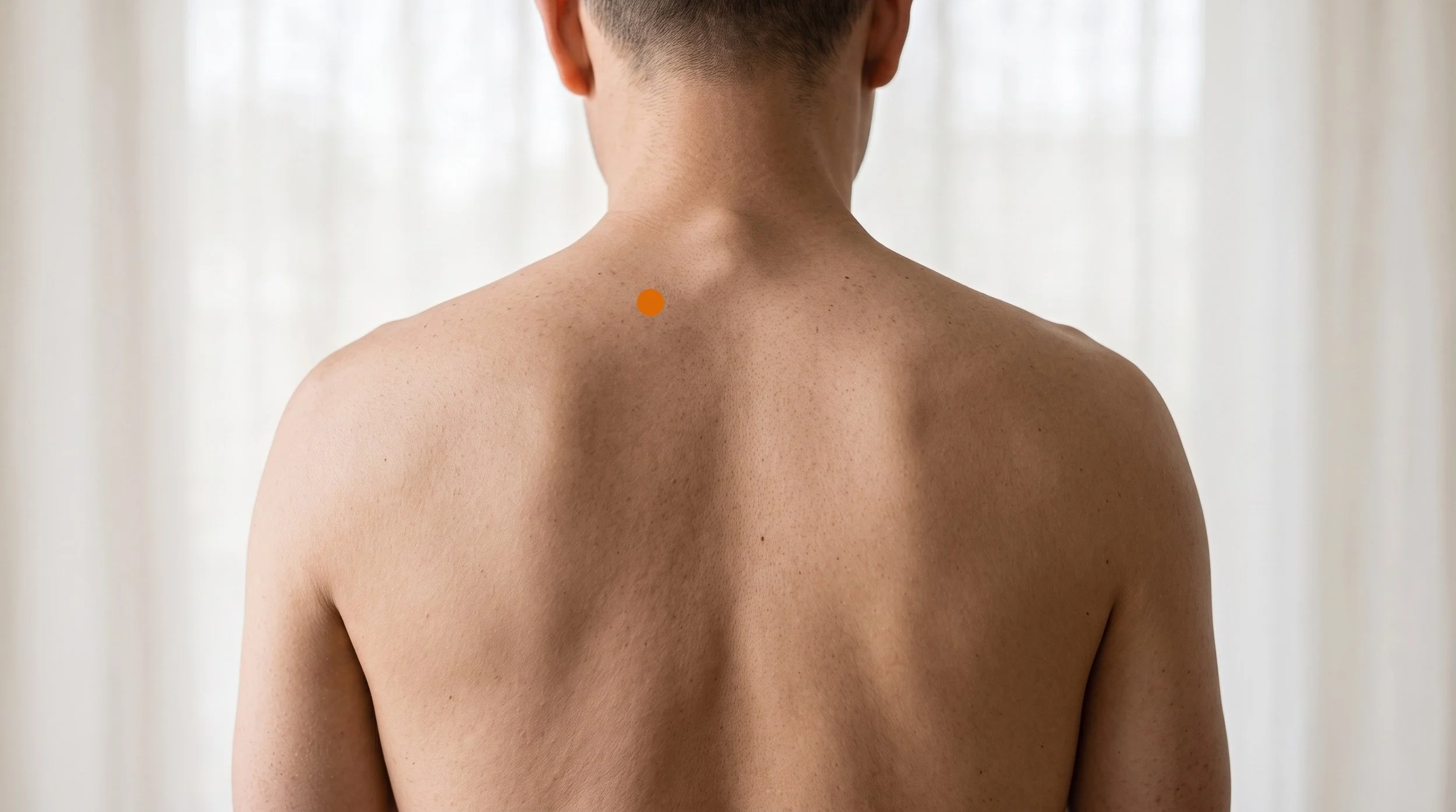
SI15 Acupuncture Point (Jianzhongzhu)
Middle Shoulder Shu Beside C7: Anatomy, Mechanism, and Why This Cervicothoracic Point Belongs in Neck and Upper Back Treatment
SI15 (Jianzhongzhu, also transliterated Jianzhongshu and usually rendered in English as Middle Shoulder Shu) sits 2 cun to the side of the lower edge of the C7 spinous process, roughly two thirds of the way from the spine out toward the inner edge of the shoulder blade when the arms hang relaxed. That places small intestine 15 right at the cervicothoracic junction, in the thick shelf of upper trapezius with levator scapulae underneath, exactly where the mobile neck meets the far stiffer upper thorax.
Clinically the si15 acupuncture point earns its keep as a local point for base-of-neck stiffness, shoulder blade pain, and the deep ache that desk workers describe as a bar across the top of the back, and it carries a striking classical reputation for cough as well. It is also one of the points that demands respect on angle and depth, because the apex of the lung is not far below.
- SI15 lies 2 cun lateral to the lower border of the C7 spinous process, level with GV14, and passes through skin, superficial fascia, and upper trapezius before reaching levator scapulae in the deeper layer (Deadman et al., 2001; O'Connor & Bensky, 1981).
- Classical texts attribute two actions to SI15: descending Lung qi and moving the channel to relieve pain. Read in modern terms, these describe a point that sits in the C7 to T1 segmental field, where somatic and visceral afferents from the neck, upper back, and chest wall converge in the same spinal cord territory (Deadman et al., 2001; Zhao, 2008).
- Needling here stimulates receptors supplied by the medial branches of the upper thoracic dorsal rami, near the dorsal scapular and accessory nerve fields, which may recruit segmental gating and descending inhibitory pathways that damp nociceptive signaling from the neck and shoulder girdle (Zhao, 2008; O'Connor & Bensky, 1981).
- Trial evidence is not point-specific. A Cochrane review of acupuncture for neck disorders reported benefit over sham for pain in the short term with low to moderate certainty (Trinh et al., 2016), and an individual patient data meta-analysis of chronic pain trials found effects that persisted over time (Vickers et al., 2018).
- The needling convention matters more here than at most upper back points: oblique insertion medially toward the spine at 0.5 to 1 cun, never deep or angled downward, since the lung apex rises above the first rib and pneumothorax is the classic serious acupuncture complication (Deadman et al., 2001; White, 2004).
- De qi at SI15 is usually a dense, heavy ache under the needle that may spread laterally toward the shoulder blade or up into the base of the neck, and in tight trapezius or levator scapulae fibers a brief twitch response is common (Simons et al., 1999).
Stiff at the Base of Your Neck Every Afternoon?
That band of tightness where the neck meets the upper back is one of the most common complaints we see, and SI15 sits directly in it. At Morningside Acupuncture we combine careful needling of small intestine 15 with dry needling of the upper trapezius and levator scapulae, then add movement and posture work so the relief holds between visits. Every treatment starts with an exam, not a template. Schedule a visit and let's see what is actually driving your neck tension.
Schedule NowAnatomy of SI15: Why the C7 Shelf Is Such an Important Location
Run your fingers down the back of the neck with the chin tucked and the most prominent bump you meet is usually C7. Move about 2 cun sideways from the lower edge of that spinous process, staying on the fleshy shelf before the inner border of the shoulder blade, and you are at SI15. The needle passes through skin and superficial fascia into upper trapezius, and deeper in this region lies levator scapulae as it descends toward the superior angle of the scapula, near the transverse process level of the first thoracic vertebra (O'Connor & Bensky, 1981).
These are the tissues that hold a laptop-height head all day, that carry a shoulder bag, and that brace during stress, so it is unsurprising that the area becomes thick, tender, and slow to release.
The sensory supply here comes largely from the medial branches of the upper thoracic dorsal rami, with the dorsal scapular and accessory nerves supplying nearby motor territory (O'Connor & Bensky, 1981). Needling recruits A-delta and group III afferents in muscle and fascia, and those inputs feed into the same C7 to T1 dorsal horn segments that receive nociceptive traffic from the lower cervical joints, the upper thoracic paraspinals, and the shoulder girdle. That shared address is what makes a local point useful beyond the millimeter it occupies.
Experimental work on acupuncture analgesia describes both segmental modulation at the spinal level and activation of descending inhibitory pathways from the midbrain and brainstem, with endogenous opioid and monoaminergic signaling involved (Zhao, 2008). Locally, needling also appears to change tissue behavior: shear wave elastography after a single dry needling session at active upper trapezius trigger points showed measurable shifts in stiffness compared with sham (Valera-Calero et al., 2023).
Below the muscular layers, the transverse cervical vessels cross the region, and further deep the apex of the lung rises above the level of the first rib (O'Connor & Bensky, 1981). This is the reason the standard technique is oblique insertion angled medially toward the spine at 0.5 to 1 cun, with an explicit caution against deep or downward-angled insertion, particularly in thin patients (Deadman et al., 2001). Pneumothorax remains the trauma complication most often reported in acupuncture safety literature, even though serious events overall are rare when practitioners are trained (White, 2004).
At Morningside we treat angle discipline at SI15 the same way we treat it at GB21 and the upper back shu points: shallow, medially oriented, and never rushed.
Related Acupuncture For Neck Pain Related Small Intestine ChannelSI15 at a Glance: Classification, Location, and Clinical Use
| Category | Detail |
|---|---|
| Traditional Name | Jianzhongzhu (also written Jianzhongshu), commonly translated as Middle Shoulder Shu or Mid-Shoulder Hollow |
| Channel Classification | Small Intestine channel, point 15 of 19, on the upper back at the cervicothoracic junction. Channel texts place SI15 on the primary Small Intestine pathway as it travels from SI14 toward GV14 (Sterman) |
| Point Categories | No five-shu, hui-meeting, or extraordinary vessel designation is recorded for this point in the standard references. Unlike its neighbor SI16, it is not a Window of Heaven point. It is classified simply as a local Small Intestine channel point beside C7, with traditional actions of descending Lung qi and activating the channel to relieve pain (Deadman) |
| Precise Location | On the upper back, 2 cun lateral to the lower border of the C7 spinous process, level with GV14; alternatively located about two thirds of the distance from the midline to the medial border of the scapula with the shoulder relaxed |
| Tissue Stimulated | Skin and superficial fascia over the upper trapezius, with levator scapulae in the deeper layer near the T1 transverse process region |
| Needle Depth / Direction | Oblique insertion angled medially toward the spine, 0.5 to 1 cun. Deep or inferiorly directed insertion is avoided because of the underlying lung apex, and depth is reduced further in thin patients |
| De Qi Sensation | A heavy, distending ache under the needle that often spreads toward the shoulder blade or the base of the neck; a brief involuntary twitch may occur when taut trapezius or levator scapulae fibers are engaged |
| Primary Clinical Uses | Neck and shoulder junction pain, stiffness at the base of the neck, upper back and shoulder blade pain, and, in classical use, cough and chest fullness attributed to Lung qi failing to descend |
| Common Point Combinations |
|
In A Manual of Acupuncture, Deadman and colleagues credit SI15 with two traditional actions: descending Lung qi and activating the channel to relieve pain. The indication list that follows is a mix of respiratory and local complaints, including cough, coughing of blood, alternating chills and fever, dimness of vision, and pain of the shoulder and scapula. The Shanghai text adds a similar picture from modern Chinese hospital practice, listing bronchial conditions and asthma alongside stiff neck and upper back pain (O'Connor & Bensky, 1981).
Presented as traditional attribution rather than physiology, the combination is striking: a point that sits squarely in the muscles of the neck and shoulder was nevertheless assigned a chest-clearing role, and the classical formula preserved in Supplementing Life pairs it with points on the front of the chest and throat rather than with other back points (Deadman et al., 2001). Whatever one makes of the theory, the pattern tells us that early clinicians noticed something about this segment of the body that linked the upper back to the breath.
Why SI15 Is Used for Cough and Chest Tightness as Well as Neck Pain
The classical assignment of a respiratory role to a point on the upper back makes more sense once you look at segmental anatomy. SI15 sits in the C7 to T1 field, and the upper thoracic segments carry afferent traffic from the chest wall, the intercostal musculature, and the accessory muscles of breathing as well as from the neck and scapular region. Inputs that converge on shared dorsal horn neurons can be modulated together, so needling in this territory may influence how the nervous system processes signals from more than one structure at a time (Zhao, 2008).
None of this means a needle at SI15 treats lung disease, and we do not present it that way. It means the classical pairing of a neck-base point with breathing complaints is not arbitrary.
For the musculoskeletal side, the mechanism is more direct. Needling here stimulates mechanically sensitive afferents in trapezius and levator scapulae, which can engage spinal gating and recruit descending inhibition from brainstem structures using opioid and monoamine signaling (Zhao, 2008). There may be a local component too, since needling active trigger points in the upper trapezius has been associated with short-term changes in tissue stiffness measured by elastography (Valera-Calero et al., 2023).
Patients often report that breathing feels easier after upper back and neck work, which is likely a combination of reduced guarding in accessory respiratory muscles and a general shift toward parasympathetic tone during a quiet needle retention period.
In practice, we frame SI15 as a local and segmental point first. If a patient's chief complaint is cough or asthma, they need appropriate medical care, and acupuncture is at best an adjunct. If the chief complaint is a stiff, aching band at the base of the neck that worsens with screen time, SI15 is often one of the first points we consider.
What the Research Shows for SI15
There is no clinical trial that isolates SI15, and it would be misleading to imply otherwise. Reviews test whole protocols, and this point appears inside multi-point prescriptions for neck and upper back pain rather than on its own. What the literature supports is the broader claim that needling protocols including local cervicothoracic points may reduce neck pain and disability in the short term, with effect sizes that are modest and certainty that is generally low to moderate. The table below summarizes the reviews we lean on and the safety data that shapes how this particular point is needled.
| Study | Type | Focus | Key Finding |
|---|---|---|---|
| Trinh et al., 2016 | Cochrane systematic review | Acupuncture for acute, subacute, and chronic neck disorders across 27 trials | Acupuncture was more effective than sham or inactive comparators for pain in the short term, though the certainty of evidence was low to moderate. |
| Vickers et al., 2018 | Individual patient data meta-analysis | Chronic pain conditions including neck and shoulder pain, roughly 20,000 patients | Acupuncture outperformed both sham and no-acupuncture controls, with benefit that decayed only modestly over about twelve months. |
| Fang et al., 2024 | Systematic review and meta-analysis | Durability of acupuncture effects in chronic neck pain across 18 randomized trials | Acupuncture used as an adjunct was associated with sustained pain relief at three and six months, although differences versus sham were not statistically significant. |
| Navarro-Santana et al., 2020 | Systematic review and meta-analysis | Dry needling of trigger points associated with neck pain, including upper trapezius | Low to moderate quality evidence suggested short-term improvement in pain intensity and related disability. |
| Valera-Calero et al., 2023 | Randomized sham-controlled trial | Shear wave elastography of upper trapezius trigger points after one dry needling session | A single session produced measurable local tissue changes compared with sham, suggesting a mechanical component alongside neural effects. |
| White, 2004 | Cumulative safety review | Range and incidence of significant adverse events across more than a million treatments | Serious adverse events were estimated at well under one per 10,000 treatments, with pneumothorax among the most frequently reported trauma events. |
Shoulder Blade Pain That Will Not Let Go?
Pain along the inner border of the scapula often travels with restriction at the cervicothoracic junction, which is why we frequently treat SI15 alongside neighboring points and myofascial targets rather than chasing the sore spot alone. We use precise, shallow oblique angling at this location and explain each step so you know what to expect. Most patients feel a spreading ache, then a noticeable drop in tension. Book a session and we'll map the pattern together.
Schedule NowSI15 in the Context of Trigger Point Work
The location of SI15 overlaps closely with two of the most clinically busy muscles in the upper quarter. Upper trapezius fibers cross the point superficially, and levator scapulae runs beneath as it heads for the superior angle of the scapula (O'Connor & Bensky, 1981). Trigger points in these muscles produce familiar referral patterns, with upper trapezius sending pain up the side of the neck toward the temple and levator scapulae producing the classic stiff neck with pain at the angle of the neck and shoulder (Simons et al., 1999).
When a patient points at the SI15 region and describes referred symptoms rather than purely local soreness, we treat that as a signal to palpate for taut bands rather than to needle the textbook coordinate and stop there.
At Morningside we usually combine the classical point with dry needling of the specific bands we find, keeping the same oblique, medially directed angle that safety requires at this level of the thorax. Reviews of dry needling for neck-related trigger points report short-term reductions in pain and disability with low to moderate quality evidence (Navarro-Santana et al., 2020), and a controlled trial using elastography found local stiffness changes after a single session at active upper trapezius trigger points (Valera-Calero et al., 2023).
Needling is then paired with loading work for the deep neck flexors and lower scapular stabilizers, because the tissue tends to reload if nothing changes about how the shoulder girdle is used all day.
SI15 Neck and Upper Back Treatment at NYC's Highest-Rated Acupuncture Clinic
Morningside Acupuncture is the highest-rated acupuncture and dry needling clinic in New York City with over 500 five-star Google reviews, and points like SI15 are part of our everyday toolkit for neck and upper back complaints. Our approach blends classical point selection with orthopedic assessment and trigger point needling of the trapezius and levator scapulae. Sessions are unhurried, safety-conscious, and built around your goals. Schedule your appointment and get started.
Schedule NowFrequently Asked Questions
What does SI15 feel like when needled?
Most people feel a dull, heavy, spreading ache rather than anything sharp. Because the point sits in dense upper trapezius with levator scapulae underneath, the sensation often travels outward toward the shoulder blade or upward into the base of the neck. If a taut band is engaged, you may notice a quick, involuntary twitch of the muscle, which is normal and usually followed by a sense of the area softening. Mild post-treatment soreness for a day is common.
Why needle beside C7 for shoulder blade pain instead of the sore spot itself?
Pain felt along the inner border of the scapula frequently originates higher up, in muscles and joints at the cervicothoracic junction that share spinal segments with the area you feel. Inputs from the neck, upper back, and shoulder girdle converge in the same dorsal horn territory, so treating at SI15 can modulate signaling from a broader field than its footprint suggests (Zhao, 2008). We usually treat both: the segmental point beside C7 and any tender myofascial targets closer to where you feel the pain.
Can I press SI15 myself between sessions?
Yes, acupressure at this location is straightforward and low risk since pressure cannot reach the structures that make needling here technical. Reach across your body with the opposite hand, find the prominent C7 bump, then slide about two finger widths sideways onto the muscular shelf. Press with the pads of two fingers, angling slightly inward toward the spine rather than straight down, using firm but tolerable pressure. Hold for 30 to 60 seconds, breathe slowly, then release and repeat two or three times per side. Adding a few slow chin tucks and shoulder blade retractions afterward tends to extend the effect. Stop if pressure produces sharp pain, numbness, or tingling down the arm, and check in with a clinician.
Is SI15 safe to needle?
It is safe in trained hands, and it is a point where technique genuinely matters. The apex of the lung sits below this region, so the standard is oblique insertion angled medially toward the spine at 0.5 to 1 cun, with deep or downward-angled insertion avoided, especially in thin patients (Deadman et al., 2001). Safety reviews estimate serious adverse events from acupuncture at well under one per 10,000 treatments, with pneumothorax being the trauma event most often reported when depth and angle conventions are ignored (White, 2004). Expect a practitioner to palpate carefully, use a conservative angle, and check in with you during insertion.
Where exactly is SI15 located?
Bend your neck forward and locate the most prominent spinous process at the base of the neck, which is generally C7. From the lower border of that process, measure 2 cun laterally, using your own thumb width as roughly 1 cun. A useful cross-check is that with the shoulder relaxed, the point falls about two thirds of the way from the midline to the medial border of the shoulder blade. It sits level with GV14 and just medial to the region where GB21 is found on the upper trapezius.
References
- Deadman, P., Al-Khafaji, M., & Baker, K. (2009). A manual of acupuncture. Journal of Chinese Medicine Publications.
- O'Connor, J., & Bensky, D. (Eds. & Trans.). (1981). Acupuncture: A comprehensive text. Shanghai College of Traditional Medicine. Eastland Press.
- Cecil-Sterman, A. (2012). Advanced acupuncture: A clinic manual. Classical Wellness Press.
- Simons, D. G., Travell, J. G., & Simons, L. S. (1999). Travell & Simons' myofascial pain and dysfunction: The trigger point manual, Vol. 1: Upper half of body (2nd ed.). Williams & Wilkins.
- Trinh, K., Graham, N., Irnich, D., Cameron, I. D., & Forget, M. (2016). Acupuncture for neck disorders. Cochrane Database of Systematic Reviews, 2016(5), CD004870. https://doi.org/10.1002/14651858.CD004870.pub4
- Vickers, A. J., Vertosick, E. A., Lewith, G., MacPherson, H., Foster, N. E., Sherman, K. J., Irnich, D., Witt, C. M., & Linde, K. (2018). Acupuncture for chronic pain: Update of an individual patient data meta-analysis. Journal of Pain, 19(5), 455-474. https://doi.org/10.1016/j.jpain.2017.11.005
- Fang, J., Shi, H., Wang, W., Chen, H., Yang, M., Gao, S., Yao, H., Zhu, L., Yan, Y., & Liu, Z. (2024). Durable effect of acupuncture for chronic neck pain: A systematic review and meta-analysis. Current Pain and Headache Reports, 28(9), 957-969. https://doi.org/10.1007/s11916-024-01267-x
- Navarro-Santana, M. J., Sanchez-Infante, J., Fernandez-de-las-Penas, C., Cleland, J. A., Martin-Casas, P., & Plaza-Manzano, G. (2020). Effectiveness of dry needling for myofascial trigger points associated with neck pain symptoms: An updated systematic review and meta-analysis. Journal of Clinical Medicine, 9(10), 3300. https://doi.org/10.3390/jcm9103300
- Valera-Calero, J. A., Sanchez-Jorge, S., Buffet-Garcia, J., Varol, U., Fernandez-de-las-Penas, C., & Alvarez-Gonzalez, J. (2023). Changes in stiffness at active myofascial trigger points of the upper trapezius after dry needling in patients with chronic neck pain: A randomized controlled trial. Acupuncture in Medicine, 41(3), 121-129. https://doi.org/10.1177/09645284221104831
- White, A. (2004). A cumulative review of the range and incidence of significant adverse events associated with acupuncture. Acupuncture in Medicine, 22(3), 122-133. https://doi.org/10.1136/aim.22.3.122
- Zhao, Z. Q. (2008). Neural mechanism underlying acupuncture analgesia. Progress in Neurobiology, 85(4), 355-375. https://doi.org/10.1016/j.pneurobio.2008.05.004
Disclaimer: This web site is intended for educational and informational purposes only. Reading this website does not constitute providing medical advice or any professional services. This information should not be used for diagnosing or treating any health issue or disease. Those seeking medical advice should consult with a licensed physician. Seek the advice of a medical doctor or other qualified health professional for any medical condition. If you think you have a medical emergency, call 911 or go to the emergency room. No acupuncturist-patient relationship is created by reading this website or using the information. Morningside Acupuncture PLLC and its employees and contributors do not make any express or implied representations with respect to the information on this site or its use. For any legal interpretation of scope of practice in your state, consult a licensed attorney or regulatory authority.
Read more from our blog



