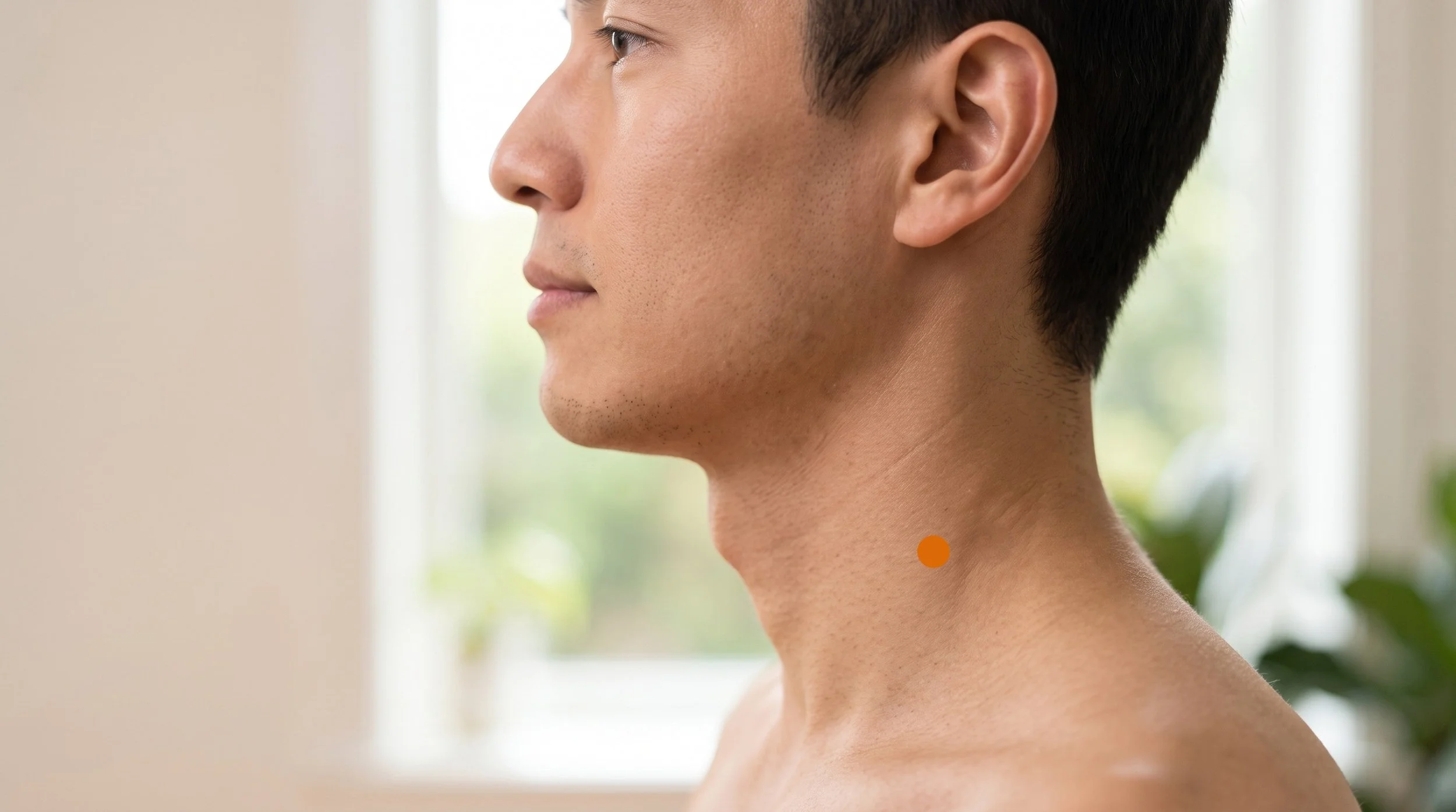
SI16 Acupuncture Point (Tianchuang)
The Heavenly Window on the Side of the Neck: Anatomy, Mechanism, and Why This Sternocleidomastoid Border Point Serves Neck, Ear, and Throat Complaints
SI16 (Tianchuang, often translated as Heavenly Window) sits on the side of the neck at the rear edge of the sternocleidomastoid muscle, level with the laryngeal prominence (the Adam's apple). It is one of the small group of neck points that classical texts gathered together as Windows of Heaven, points traditionally described as governing the traffic of qi between the body and the head (Deadman et al., 2007; Maciocia, 2015).
In modern terms, the si16 acupuncture point is interesting for a much more concrete reason: it lands almost exactly where the cutaneous branches of the cervical plexus surface from behind the sternocleidomastoid, which is why a point classically listed for ear, throat, and voice complaints is also a practical option for stiff, rotation-limited necks.
- Location and layers: small intestine 16 is found at the posterior border of the sternocleidomastoid, level with the laryngeal prominence, and the border is easiest to define when the patient turns the head away from the treatment side against light resistance from the practitioner's hand (Deadman et al., 2007). Needling passes through skin, subcutaneous tissue, platysma, and superficial cervical fascia at the muscle's edge.
- Traditional categories, translated: classical sources group SI16 with the Window of Heaven points and credit it with benefiting the ears, throat, and voice, calming the spirit, and freeing the local channel (Deadman et al., 2007). Read neurophysiologically, that cluster describes a point sitting on a dense cervical sensory field with wide referral to the ear, jaw, and head.
- Nerve story: the great auricular and lesser occipital nerves surface at the posterior sternocleidomastoid border, and the great auricular exit site is a predictable, well-mapped landmark in cadaveric study (Raikos et al., 2017). Needling here recruits C2 and C3 cutaneous afferents that share segmental territory with structures the patient experiences as ear, jaw, and upper neck.
- Mechanism: needle stimulation of somatic afferents at this level engages spinal segmental inhibition and brainstem descending pain control involving endogenous opioid and monoamine systems, the best-characterized model of acupuncture analgesia (Zhao, 2008).
- Research picture: pooled trial data support acupuncture for chronic pain generally (Vickers et al., 2018) and a Cochrane review found moderate-quality evidence of short-term benefit for mechanical neck pain (Trinh et al., 2016), while trials for tinnitus remain small and inconsistent (Huang et al., 2021). No trial has isolated SI16 on its own.
- De qi and practice framing: patients usually report a dull, spreading heaviness at the muscle border, sometimes with a light band of sensation toward the ear or angle of the jaw. Insertion is shallow and perpendicular, 0.5 to 0.8 cun, behind the great vessels rather than over them (Deadman et al., 2007).
Neck Stiffness That Limits Turning Your Head?
If checking a blind spot or holding a phone to your ear reproduces your pain, the sternocleidomastoid border where SI16 sits is often part of the picture. Our licensed acupuncturists assess cervical rotation, palpate the muscle edges, and use SI16 alongside local and distal points to reduce guarding and restore comfortable range. Treatment is paired with simple mobility work you can repeat at home. Schedule a visit at Morningside Acupuncture and we'll map exactly which tissues are driving your stiffness.
Schedule NowAnatomy of SI16: Why the Rear Border of the Sternocleidomastoid Is Such an Important Location
The si 16 neck location is defined by a single palpable landmark: the rear edge of the sternocleidomastoid, taken at the height of the laryngeal prominence (Deadman et al., 2007). Under the fingertip there is skin, a thin layer of subcutaneous fat, the platysma, and the superficial cervical fascia before the needle meets the muscle's posterior margin. Behind that margin lies the floor of the posterior triangle, with levator scapulae and the scalene group deeper still.
This border is mechanically busy. Sustained forward-head posture, long hours of screen or phone use, and repeated head rotation load the sternocleidomastoid and its fascial connections, which is why patients often describe a ropey, tender edge here long before they report a specific injury.
The reason this spot behaves so distinctively is neural rather than muscular. The cutaneous branches of the cervical plexus, including the great auricular and lesser occipital nerves, wrap around the posterior sternocleidomastoid border and become superficial at what anatomists call the nerve point of the neck, and cadaveric mapping shows the great auricular exit site to be reasonably predictable relative to the mastoid process and the length of the muscle (Raikos et al., 2017).
These are C2 and C3 fibers supplying skin over the jaw angle, the parotid region, the mastoid, and the lower ear. When a needle stimulates afferents in this field, the input converges in upper cervical segments that also receive traffic from the trigeminocervical complex, which helps explain why a neck point has classical indications reaching the ear, cheek, and jaw. The wider analgesic effect follows the standard model: segmental inhibition at the dorsal horn plus recruitment of descending inhibitory pathways using endogenous opioids and monoamines (Zhao, 2008).
Safety is mostly a matter of staying behind the vessels. The carotid sheath and internal jugular vein lie anterior and deep to this level, the external jugular vein crosses the sternocleidomastoid nearby, and a pulse is often palpable in this region during examination (Maciocia, 2006).
Classical texts specify perpendicular insertion of 0.5 to 0.8 cun, with other standard references giving a similar shallow range (Deadman et al., 2007; Shanghai College of Traditional Chinese Medicine, 1981).
In practice that means palpating first, needling at the muscle border rather than over any pulsation, keeping the angle straight rather than angling anteriorly, and treating the great auricular exit zone with respect, since the same landmark is used surgically to locate the spinal accessory nerve (Raikos et al., 2017).
Related Acupuncture For Neck Pain Related Best Acupuncture Points For Neck PainSI16 at a Glance: Classification, Location, and Clinical Use
| Category | Detail |
|---|---|
| Traditional Name | Tianchuang, commonly rendered as Heavenly Window or Celestial Window |
| Channel Classification | Small Intestine channel (Hand Taiyang), 16th point of the channel; a branch of the Small Intestine primary channel passes through this region on its way to the cheek and ear |
| Point Categories | Window of Heaven point, one of the ten neck and upper body points listed in Chapter 2 of the Spiritual Pivot and traditionally credited with regulating rebellious qi between the body and the head; the reference sources attribute no five-shu, luo-connecting, xi-cleft, hui-meeting, or extraordinary vessel role to this point |
| Precise Location | On the lateral neck at the posterior border of the sternocleidomastoid muscle, level with the laryngeal prominence, roughly 3.5 cun lateral to the midline and just behind LI18; ask the patient to rotate the head away against light resistance to define the muscle edge |
| Tissue Stimulated | Skin, subcutaneous tissue, platysma, superficial cervical fascia and the posterior border of the sternocleidomastoid, overlying the emergence of the great auricular and lesser occipital branches of the cervical plexus |
| Needle Depth / Direction | Perpendicular insertion 0.5 to 0.8 cun at the muscle border, behind the great vessels; some texts allow up to 1 cun with a slightly oblique angle. Palpate for pulsation before inserting and avoid angling anteriorly |
| De Qi Sensation | A dull, spreading heaviness or fullness at the edge of the muscle, occasionally with a light travelling sensation toward the ear, mastoid, or jaw angle; sharp electric sensation means the needle should be withdrawn and redirected |
| Primary Clinical Uses | Neck pain and stiffness with limited rotation, shoulder pain radiating into the neck, sternocleidomastoid-related tension in modern practice, and the classical group of ear, throat, and voice complaints including tinnitus, ear pain, sore throat, and sudden voice loss |
| Common Point Combinations |
|
Deadman's commentary presents SI16 as a small but revealing example of the Window of Heaven group.
Traditional attributions credit it with benefiting the ears, throat, and voice, regulating qi and settling the spirit, and opening the local channel to ease pain, and the classical indication lists cluster into four themes: ear complaints such as tinnitus, hearing loss, and earache; throat and voice problems including hoarseness, sore throat, sudden speechlessness, and clenched jaw; heat, redness, and swelling of the face and cheek; and shoulder pain that travels into the neck and locks head rotation (Deadman et al., 2007).
Other standard texts list the same core: sore throat, tinnitus, deafness, and stiff neck (Shanghai College of Traditional Chinese Medicine, 1981). The historical record also assigns SI16 a role in severe disturbances of the mind, described in the older language of possession and mania, and notes that the 7th century physician Sun Simiao favored heavy moxibustion here for loss of speech and one-sided weakness (Deadman et al., 2007).
What makes the classical pattern striking is how tightly it maps onto the sensory territory of the cervical plexus branches that surface at this exact border, a correspondence the classical authors could observe clinically without any concept of a cutaneous nerve field.
Why SI16 Is Used for Ear, Jaw, and Voice Symptoms and Not Just Neck Pain
Patients are sometimes surprised that a point on the side of the neck is chosen for symptoms they feel in the ear or jaw. The explanation is convergence. The skin over the jaw angle, the parotid region, the mastoid, and the lower ear is supplied by branches of the cervical plexus that emerge at the posterior sternocleidomastoid border, precisely where SI16 sits (Raikos et al., 2017). Those C2 and C3 afferents share dorsal horn territory with upper cervical structures and with input from the trigeminal system, so the nervous system can blur where a signal originated.
That same blurring is why upper neck problems so often present as ear fullness, jaw ache, or one-sided head pain, and why treating the neck may change how those symptoms feel.
Beyond the local segment, needling recruits a broader control system. Repeated needle stimulation activates descending inhibitory pathways from the brainstem that release endogenous opioids, serotonin, and noradrenaline at the spinal cord, dampening how strongly nociceptive signals are relayed upward (Zhao, 2008). This is a general property of needling rather than something unique to SI16, but it is the reason a shallow needle at one muscle border can influence pain reported across a wider region. In the clinic we combine that non-specific effect with the very specific local one: reducing guarding in a muscle that limits rotation.
It is worth being clear about limits. There is no trial showing that SI16 alone changes tinnitus, hoarseness, or ear pain, and the tinnitus literature as a whole is small and mixed (Huang et al., 2021). What the anatomy justifies is including SI16 as one component of a regional treatment plan, particularly when examination finds a tender, restricted sternocleidomastoid border alongside the symptom the patient came in for.
What the Research Shows for SI16
Almost all acupuncture trials test multi-point protocols rather than single points, so the honest framing is that SI16 has been studied as part of neck and head treatment strategies rather than on its own. The reviews below tell us something about how the whole approach performs for the conditions SI16 is typically used within, and about the mechanisms that make a neck border point a reasonable choice, not about the point in isolation.
| Study | Type | Focus | Key Finding |
|---|---|---|---|
| Trinh et al., 2016 | Cochrane systematic review | Acupuncture for acute, subacute, and chronic neck disorders across 27 randomized trials | Reviewers reported moderate-quality evidence of short-term pain relief for mechanical neck pain compared with sham, with benefits often modest and follow-up limited. |
| Vickers et al., 2018 | Individual patient data meta-analysis | Nearly 21,000 patients across chronic pain conditions including chronic neck and shoulder pain | Acupuncture outperformed both sham and no-acupuncture controls, with effects that persisted over time, suggesting the benefit is not entirely attributable to expectation. |
| Hernández-Secorún et al., 2023 | Systematic review and meta-analysis | Dry needling for pain and function in chronic neck pain | Dry needling showed benefits for pain and function, particularly when combined with physical therapy, though trial quality and comparison groups varied considerably. |
| Huang et al., 2021 | Systematic review and meta-analysis | Acupuncture for tinnitus across eight randomized trials | No significant effect appeared on the primary loudness measure, while handicap and severity scores improved, and the authors judged the overall evidence too weak for firm conclusions. |
| Zhao, 2008 | Narrative review of mechanisms | Neural pathways underlying acupuncture analgesia | Needle stimulation of somatic afferents engages segmental spinal inhibition and descending opioid and monoamine pathways, providing a plausible physiological basis for local and regional pain relief. |
| Raikos et al., 2017 | Cadaveric anatomical study | Topography of the great auricular nerve exit at the posterior sternocleidomastoid border | The nerve's emergence point was found in a predictable position relative to the mastoid process and muscle length, supporting careful landmark-based needling in this region. |
Ear Pressure, Jaw Tension, and Neck Pain Traveling Together?
Ear-region symptoms, jaw tightness, and upper neck pain frequently share the same C2 and C3 sensory territory, which is one reason classical texts listed SI16 for both neck and ear complaints. We treat the whole region rather than a single symptom, combining SI16 with points around the jaw, upper cervical spine, and shoulder girdle. Every plan is built around your history, imaging where relevant, and a clear conversation about what acupuncture may and may not help. Book an evaluation and we'll give you an honest assessment at your first visit.
Schedule NowSI16 in the Context of Trigger Point Work
The heavenly window point sits directly on a muscle that trigger point clinicians pay close attention to. Travell and Simons described the sternocleidomastoid as a source of referred pain into the ear, the cheek and jaw, the forehead, and the top of the head, sometimes accompanied by dizziness and ear symptoms rather than by pain in the neck itself (Simons et al., 1999). That referral map overlaps remarkably well with the classical indication list for SI16, which is one of the more interesting convergences between a Song dynasty point description and 20th century myofascial mapping. At Morningside we treat the point and the muscle as one clinical problem, not two competing systems.
In practice, a session for a patient with rotation-limited neck pain might include SI16 at the posterior border along with careful pincer-grip needling of the sternocleidomastoid, plus dry needling of levator scapulae, upper trapezius, and the scalenes when examination implicates them. Because dry needling is simply another style of using an acupuncture needle, these approaches sit comfortably in the same treatment. Needling in this region is always shallow and landmark-guided, and it is followed by range of motion work and postural loading so the change in muscle tone has something to hold onto between visits.
SI16 Neck Pain Treatment at NYC's Highest-Rated Acupuncture Clinic
Morningside Acupuncture is the highest-rated acupuncture and dry needling clinic in New York City with over 500 five-star Google reviews, and neck pain is one of the most common reasons patients come through our door. We integrate classical point selection such as SI16 with orthopedic assessment, trigger point dry needling of the sternocleidomastoid and neighboring muscles, and graded exercise. You get a clear plan, measurable goals, and a clinician who explains the anatomy behind every needle. Schedule your appointment online and start with a full neck evaluation.
Schedule NowFrequently Asked Questions
What does SI16 feel like when needled?
Most people feel a dull, slightly heavy fullness right at the edge of the muscle, sometimes with a mild spreading sensation toward the ear, mastoid, or angle of the jaw. Because the needle is shallow, the sensation is usually modest rather than intense. A brief sharp or electric feeling can occur if the needle nears a cutaneous nerve branch; tell your practitioner, and the needle is withdrawn slightly or repositioned. Lingering tenderness at the site for a few hours is normal, and light bruising is possible on the neck.
Why needle the side of the neck for ear or throat symptoms?
Because the skin over the lower ear, mastoid, and jaw angle is supplied by cervical plexus branches that surface at exactly this muscle border (Raikos et al., 2017). Those C2 and C3 nerves share spinal territory with upper cervical structures and with trigeminal input, so sensations arising in the neck are often experienced in the ear or jaw. Classical texts arrived at the same clinical pairing through observation, listing SI16 for both neck stiffness and ear, throat, and voice complaints (Deadman et al., 2007). It is worth saying plainly that acupuncture is not a treatment for the underlying causes of hearing loss, and persistent ear or voice symptoms need medical evaluation.
Can I press SI16 myself between sessions?
Yes, with a light touch. Turn your head away from the side you want to treat so the sternocleidomastoid stands out, then let the head return to neutral and slide your fingertip just behind the rear edge of the muscle at the height of your Adam's apple. Use flat, gentle pressure with one or two fingerpads, never a pinch or a dig, and hold for 20 to 30 seconds at a time, repeating two or three times per side. Keep total time under a couple of minutes per side, once or twice daily. Stop immediately if you feel a pulse under your finger, get lightheaded, notice visual changes, or feel any sharp shooting sensation, and skip self-pressure entirely if you have carotid disease, a history of stroke or TIA, or a lump in the neck that has not been evaluated.
Is SI16 safe to needle?
In trained hands, yes. The point is needled perpendicularly at a shallow depth of about 0.5 to 0.8 cun, positioned behind the great vessels rather than over them (Deadman et al., 2007). Practitioners palpate for arterial pulsation first, keep the angle straight instead of directing it anteriorly toward the carotid sheath, and use appropriate caution near the great auricular nerve exit and the external jugular vein. This is not a point for aggressive deep technique or for self-needling. Tell your acupuncturist if you take anticoagulants, have had neck surgery, or have a known vascular condition.
Where exactly is SI16 located?
On the side of the neck at the posterior border of the sternocleidomastoid, level with the laryngeal prominence, roughly 3.5 cun from the midline and just behind LI18 (Shanghai College of Traditional Chinese Medicine, 1981). To find the muscle edge, turn your head away from the side you are locating while someone applies gentle resistance at your chin; the sternocleidomastoid will stand out clearly, and SI16 lies at its rear margin (Deadman et al., 2007). If the laryngeal prominence is hard to identify, find the notch between the lower edge of the hyoid bone and the upper edge of the thyroid cartilage at the midline; the prominence sits just below it.
References
- Deadman, P., Al-Khafaji, M., & Baker, K. (2009). A manual of acupuncture. Journal of Chinese Medicine Publications.
- Maciocia, G. (2005). The foundations of Chinese medicine: A comprehensive text for acupuncturists and herbalists (2nd ed.). Elsevier Churchill Livingstone.
- Maciocia, G. (2006). The channels of acupuncture: Clinical use of the secondary channels and eight extraordinary vessels. Churchill Livingstone Elsevier.
- O'Connor, J., & Bensky, D. (Eds. & Trans.). (1981). Acupuncture: A comprehensive text. Shanghai College of Traditional Medicine. Eastland Press.
- Cunningham, P. M. (2000). Acupuncture points: A practical guide to classical and modern usage. Odyssey Press.
- Simons, D. G., Travell, J. G., & Simons, L. S. (1999). Travell & Simons' myofascial pain and dysfunction: The trigger point manual, Vol. 1: Upper half of body (2nd ed.). Williams & Wilkins.
- Trinh, K., Graham, N., Irnich, D., Cameron, I. D., & Forget, M. (2016). Acupuncture for neck disorders. Cochrane Database of Systematic Reviews, 2016(5), CD004870. https://doi.org/10.1002/14651858.CD004870.pub4
- Vickers, A. J., Vertosick, E. A., Lewith, G., MacPherson, H., Foster, N. E., Sherman, K. J., Irnich, D., Witt, C. M., & Linde, K. (2018). Acupuncture for chronic pain: Update of an individual patient data meta-analysis. Journal of Pain, 19(5), 455-474. https://doi.org/10.1016/j.jpain.2017.11.005
- Zhao, Z. Q. (2008). Neural mechanism underlying acupuncture analgesia. Progress in Neurobiology, 85(4), 355-375. https://doi.org/10.1016/j.pneurobio.2008.05.004
- Huang, K., Liang, S., Chen, L., & Grellet, A. (2021). Acupuncture for tinnitus: A systematic review and meta-analysis of randomized controlled trials. Acupuncture in Medicine, 39(4), 264-271. https://doi.org/10.1177/0964528420938380
- Hernández-Secorún, M., Abenia-Benedí, H., Borrella-Andrés, S., Marqués-García, I., Lucha-López, M. O., Herrero, P., Iguacel, I., Tricás-Moreno, J. M., & Hidalgo-García, C. (2023). Effectiveness of dry needling in improving pain and function in comparison with other techniques in patients with chronic neck pain: A systematic review and meta-analysis. Pain Research and Management, 2023, 1523834. https://doi.org/10.1155/2023/1523834
- Raikos, A., English, T., Yousif, O. K., Sandhu, M., & Stirling, A. (2017). Topographic anatomy of the great auricular point: Landmarks for its localization and classification. Surgical and Radiologic Anatomy, 39(5), 535-540. https://doi.org/10.1007/s00276-016-1758-y
Disclaimer: This web site is intended for educational and informational purposes only. Reading this website does not constitute providing medical advice or any professional services. This information should not be used for diagnosing or treating any health issue or disease. Those seeking medical advice should consult with a licensed physician. Seek the advice of a medical doctor or other qualified health professional for any medical condition. If you think you have a medical emergency, call 911 or go to the emergency room. No acupuncturist-patient relationship is created by reading this website or using the information. Morningside Acupuncture PLLC and its employees and contributors do not make any express or implied representations with respect to the information on this site or its use. For any legal interpretation of scope of practice in your state, consult a licensed attorney or regulatory authority.
Read more from our blog



