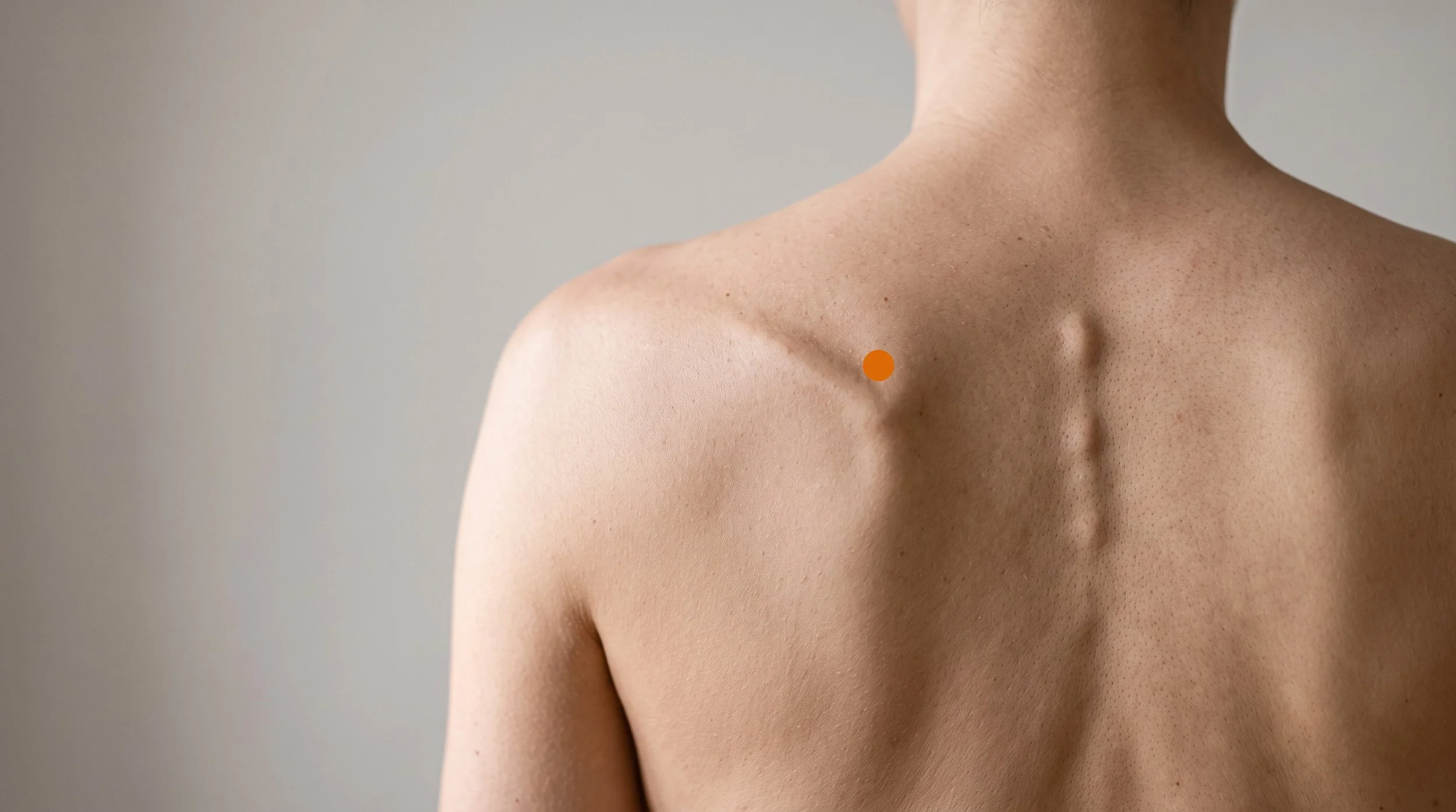
SI13 Acupuncture Point (Quyuan)
The Crooked Wall Above the Shoulder Blade: Anatomy, Mechanism, and Why This Scapular Point Belongs in Almost Every Shoulder Girdle Treatment
SI13, called Quyuan (Crooked Wall), is the Small Intestine channel point that sits in the tender hollow just above the inner end of the scapular spine, about halfway between SI10 and the spinous process of T2 (Deadman et al., 2001). In plain words, it's the sore spot most people find when they reach over the opposite shoulder and press along the top edge of the shoulder blade toward the spine.
Small Intestine 13 matters clinically because that hollow sits over the medial origin field of supraspinatus, under trapezius, and close to the nerve corridor that runs along the medial scapular border, which is exactly the tissue that gets loaded by hours of keyboard work, overhead lifting, and one-sided carrying.
Classical texts describe the crooked wall point almost entirely in terms of stubborn shoulder and scapular pain, and modern practice uses the si13 acupuncture point in much the same way: as a reliable, reproducibly tender local target in si 13 shoulder girdle presentations.
- Location and layers: SI13 lies in the depression above the medial end of the scapular spine, roughly midway between SI10 and T2, with the needle passing through skin, subcutaneous tissue, trapezius, and then the medial supraspinous fossa where supraspinatus originates (Deadman et al., 2001; O'Connor & Bensky, 1981).
- Traditional attribution: classical sources credit Quyuan with benefiting the shoulder and scapula, and list its indications as painful obstruction patterns, including shoulder pain described as hot, contracted, and oppressive (Deadman et al., 2001). Older Chinese clinical texts also record it for supraspinatus tendon problems and soft tissue disorders around the shoulder joint (O'Connor & Bensky, 1981).
- Nerve geography: the region is supplied by the medial branch of the T2 dorsal ramus superficially, the accessory nerve to trapezius, and deeper muscular branches of the suprascapular nerve, so needling here recruits both thoracic segmental input and cervically innervated rotator cuff tissue (O'Connor & Bensky, 1981).
- Mechanism: needle stimulation at this depth activates A-delta and C fiber afferents that engage spinal segmental gating and descending inhibitory pathways from the midbrain and brainstem, alongside local tissue responses such as increased interstitial adenosine acting on A1 receptors (Zhao, 2008; Goldman et al., 2010).
- Research picture: reviews rarely test SI13 alone, but large pooled data support acupuncture for chronic musculoskeletal pain including the shoulder, and needling of scapular and shoulder girdle trigger points has shown short to medium term pain benefit (Vickers et al., 2018; Liu et al., 2015).
- De qi and safety: patients usually report a deep, heavy ache that spreads across the supraspinous fossa and sometimes toward the shoulder tip, and because the medial scapular border is close by, insertion is kept perpendicular and shallow or angled laterally rather than medially (Deadman et al., 2001).
Is Your Shoulder Blade Pain Worse By the End of the Workday?
That deep, gnawing ache between the spine and the top of the shoulder blade rarely responds to stretching alone. At Morningside Acupuncture, we palpate the SI13 region carefully and treat it alongside the trapezius, supraspinatus, levator scapulae, and rhomboids that load it, using acupuncture needles with or without electrical stimulation. Treatment is paired with simple posture and loading strategies you can use at your desk. Schedule a visit and let's find the tissue actually driving your pain.
Schedule NowAnatomy of SI13: Why the Medial Supraspinous Fossa Is Such an Important Location
Slide a fingertip along the upper border of the scapular spine, moving inward toward the spinal column, and it will drop into a small hollow just before reaching the medial border of the scapula. That hollow is SI13. Under the skin lies the upper and middle trapezius, and beneath that sits the medial portion of the supraspinous fossa where supraspinatus takes its origin (O'Connor & Bensky, 1981). Levator scapulae and the rhomboids attach nearby along the superior angle and medial border, so the point sits at a convergence of muscles that stabilize and rotate the scapula.
Sustained desk posture, laptop work, phone cradling, heavy bag carrying, and repeated overhead reaching all load this exact junction, which is why the crooked wall point is one of the most consistently tender spots found on examination in chronic shoulder girdle presentations.
The nerve supply here is layered in a clinically useful way. Superficially, the area is served by the medial branch of the second thoracic dorsal ramus, trapezius is innervated by the accessory nerve, and deeper structures receive muscular branches of the suprascapular nerve (O'Connor & Bensky, 1981). The dorsal scapular nerve runs along the medial scapular border in the same neighborhood. Because supraspinatus is a C5 and C6 muscle while the overlying skin and superficial fascia report to T2, stimulation at SI13 feeds into more than one spinal level at once.
Nociceptive and mechanosensitive afferents recruited by the needle converge in the dorsal horn, where segmental inhibition dampens transmission from neighboring inputs, while ascending signals recruit descending inhibitory pathways that release endogenous opioids, serotonin, and noradrenaline back down onto the spinal cord (Zhao, 2008). Locally, needling appears to raise interstitial adenosine, which acts on A1 receptors on peripheral sensory terminals and contributes to reduced nociceptive signaling near the needle (Goldman et al., 2010).
The vascular picture includes descending branches of the transverse cervical artery and vein superficially, with branches of the suprascapular vessels deeper in the fossa (O'Connor & Bensky, 1981). The more important safety consideration is bony rather than vascular: SI13 sits close to the medial border of the scapula, and just medial to that border the chest wall is protected only by thin muscle and intercostal tissue. Standard technique is perpendicular insertion of roughly 0.3 to 0.5 cun, or oblique insertion directed laterally of roughly 0.5 to 1 cun, keeping the shaft angled away from the midline.
Deep medial or medially angled needling in this area carries a risk of lung puncture and is avoided (Deadman et al., 2001). In practice, the scapula itself is a useful backstop when the angle stays lateral and the depth stays modest.
Related Muscles That Cause Shoulder Pain Related Supraspinatus Trigger PointsSI13 at a Glance: Classification, Location, and Clinical Use
| Category | Detail |
|---|---|
| Traditional Name | Quyuan (Crooked Wall), also translated as Curved Wall or Bent Wall |
| Channel Classification | Small Intestine channel of Hand Taiyang, thirteenth point, scapular group |
| Point Categories | No five-shu, luo-connecting, xi-cleft, or extraordinary vessel designations are recorded for this point in the classical sources consulted. Deadman lists a single traditional action, benefiting the shoulder and scapula, and its classical indications are confined to painful obstruction patterns of the shoulder region (Deadman et al., 2001). |
| Precise Location | In the tender depression above the medial end of the scapular spine, midway between SI10 and the spinous process of T2, just lateral to the medial border of the scapula. Locate it by sliding a fingertip inward along the upper border of the scapular spine until it drops into the hollow. |
| Tissue Stimulated | Skin and subcutaneous fascia, upper and middle trapezius, then the medial supraspinous fossa over the origin field of supraspinatus, with levator scapulae and rhomboid attachments nearby along the superior angle and medial border |
| Needle Depth / Direction | Perpendicular insertion 0.3 to 0.5 cun, or oblique insertion directed laterally 0.5 to 1 cun. The angle stays lateral: deep or medially angled needling near the medial scapular border risks the lung |
| De Qi Sensation | A deep, heavy, spreading ache across the supraspinous fossa, often with a dull radiation toward the shoulder tip or upper arm; frequently a strongly tender point that reproduces the patient's familiar scapular pain |
| Primary Clinical Uses | Chronic shoulder and shoulder blade pain, shoulder girdle stiffness and contraction, upper scapular tenderness in desk-work and overhead-loading presentations, supraspinatus-related shoulder complaints, and traditional painful obstruction (bi) patterns of the shoulder |
| Common Point Combinations |
|
Deadman's Manual of Acupuncture gives SI13 a narrow but vivid classical profile: its single traditional action is to benefit the shoulder and scapula, and its indications are all versions of painful obstruction, including generalized bi patterns and shoulder pain accompanied by contraction and an oppressive, heavy sensation (Deadman et al., 2001). What makes the entry distinctive is the emphasis, attributed to the Great Compendium of Acupuncture and Moxibustion, on shoulder obstruction that has lingered long enough to take on a heat quality.
In classical theory, wind, cold, and damp lodged in the channels were understood to change character over time, a principle of transformation associated with Liu Wan-su, so a shoulder that began as cold and achy could later present as hot, tight, and oppressive. These are traditional attributions rather than physiological descriptions, but the clinical picture they encode is recognizable: a shoulder that has been sore for months, feels bound rather than merely stiff, and no longer responds to warmth the way it did early on.
That a point with such a small indication list was singled out for the chronic, transformed presentation rather than the acute one is what makes the classical pattern worth noticing.
Why SI13 Is Used for Desk-Work Shoulder Blade Pain That Patients Rarely Call Shoulder Pain
Many people who describe pain between the shoulder blade and the spine do not consider themselves to have a shoulder problem at all. They point to a spot near the upper inner corner of the scapula, describe a deep ache after long computer sessions, and report that pressing on it feels both painful and oddly satisfying. SI13 sits almost exactly there.
Needling it stimulates tissue innervated at both thoracic and cervical levels, and that overlapping input matters: afferent traffic from the needle converges in the dorsal horn with signals arriving from muscles, joints, and connective tissue in the same and nearby segments, where inhibitory interneurons can reduce onward transmission (Zhao, 2008). This is one reason a point sitting over supraspinatus and trapezius can influence a symptom the patient localizes to the space beside the spine.
Beyond the segmental level, needling engages descending pain control. Ascending signals reach the periaqueductal gray and rostral ventromedial medulla, which project back to the spinal cord and release endogenous opioids, serotonin, and noradrenaline that dampen nociceptive transmission over a wider area than the needle itself (Zhao, 2008). Locally, experimental work has shown that needle stimulation raises interstitial adenosine, which acts at A1 receptors on peripheral sensory terminals and reduces nociceptive signaling near the insertion site (Goldman et al., 2010).
Practically, this combination helps explain why patients often report both an immediate local softening and a more diffuse easing across the whole shoulder girdle after treatment.
There is also a straightforward mechanical layer. Persistently tender points in trapezius and supraspinatus can refer pain into the scapular region and the arm, and needling taut bands in these muscles is associated with reduced local tenderness and improved motion (Simons et al., 1999; Liu et al., 2015). Because SI13 overlaps the medial part of the supraspinatus field, the same insertion often serves both the classical point and the myofascial target, which is one reason it appears so consistently in shoulder girdle treatment plans.
What the Research Shows for SI13
Research on acupuncture almost never isolates a single point, and SI13 is no exception. Trials of shoulder pain use multi-point protocols in which Quyuan may be one of several local scapular and shoulder points, often combined with distal points and sometimes with electrical stimulation, so the honest framing is that the evidence speaks to the approach rather than to the point.
The overall picture is mixed but reasonable: large pooled patient-level data support acupuncture for chronic musculoskeletal pain, disease-specific reviews of shoulder conditions remain limited by small trials and variable quality, and reviews of trigger point needling in the neck and shoulder region suggest short to medium term pain benefit. Expect modest, cumulative improvements over a course of treatment rather than a single dramatic change.
| Study | Type | Focus | Key Finding |
|---|---|---|---|
| Green et al., 2005 | Cochrane systematic review | Acupuncture for shoulder pain in adults, nine trials | The review found some short-term benefit for pain and function in rotator cuff disease but concluded that trials were small and of limited quality, so firm conclusions were not possible. |
| Vickers et al., 2018 | Individual patient data meta-analysis | Chronic musculoskeletal pain including shoulder pain, 39 trials and over 20,000 patients | Acupuncture was superior to both sham and no-acupuncture controls for chronic pain conditions, with effects that persisted over time rather than disappearing immediately after treatment. |
| Liu et al., 2015 | Systematic review and meta-analysis | Dry needling of myofascial trigger points associated with neck and shoulder pain | The authors concluded that trigger point needling may relieve neck and shoulder trigger point pain in the short and medium term, while noting comparison-dependent differences. |
| Para-García et al., 2022 | Systematic review and meta-analysis | Dry needling alone or with exercise therapy in subacromial pain syndrome | Pooled results suggested possible pain reduction, but evidence for disability outcomes in the short and mid term was judged very uncertain. |
| Heo et al., 2022 | Systematic review and meta-analysis | Electroacupuncture for frozen shoulder | Electroacupuncture added to control treatments was associated with improved shoulder pain scores, though the authors cautioned that study quality and sample sizes limit confidence. |
| Goldman et al., 2010 | Experimental mechanistic study in mice | Local biochemical response to needle stimulation | Needling raised interstitial adenosine, and the anti-nociceptive effect depended on adenosine A1 receptor expression, suggesting a local peripheral mechanism alongside central ones. |
| Zhao, 2008 | Narrative review of neurophysiology | Neural mechanisms of acupuncture analgesia | Analgesic effects are attributed to afferent fiber activation, spinal segmental inhibition, and descending modulatory pathways involving endogenous opioids and monoamines. |
Shoulder Pain That Limits Overhead Reaching?
Restricted overhead motion often involves supraspinatus and the surrounding girdle muscles, and SI13 sits directly over the medial part of that field. Our licensed acupuncturists combine Quyuan with SI11, SI9, and GB21 for shoulder girdle tension, plus targeted dry needling when a taut band reproduces your familiar pain. We track range of motion visit to visit so progress is measurable, not guesswork. Book an evaluation to get started.
Schedule NowSI13 in the Context of Trigger Point Work
At Morningside Acupuncture, the SI13 region is frequently treated in the same session as the muscles that surround it. The point overlies the medial supraspinous fossa, so a needle placed here can engage the medial fibers of supraspinatus, while a fingertip shifted slightly superficially and superiorly reaches the upper and middle trapezius.
Supraspinatus trigger points classically refer a deep ache into the shoulder and down the lateral arm, and upper trapezius points refer up the side of the neck and toward the temple, so mapping a patient's referral pattern before needling helps decide whether Quyuan is the primary target or a supporting one (Simons et al., 1999). Levator scapulae and the rhomboids, attaching just medial to the point, are checked in the same pass because they commonly co-occur in desk-work presentations.
Dry needling and acupuncture are the same act at this location: an acupuncture needle placed into tissue that is tender, taut, and reproduces the patient's symptoms. What changes is the reasoning used to select the spot, which may be channel-based, segmental, or myofascial. Reviews of trigger point needling in the neck and shoulder region report short to medium term pain reduction, and pooled shoulder-specific data remain more uncertain, so we treat needling as one component alongside loading, scapular control work, and workstation adjustments (Liu et al., 2015; Para-García et al., 2022).
Because the medial scapular border is close by, we keep the angle lateral and the depth conservative, using the scapula itself as a backstop rather than needling toward the chest wall.
SI13 Shoulder and Scapular Pain Treatment at NYC's Highest-Rated Acupuncture Clinic
Morningside Acupuncture is the highest-rated acupuncture and dry needling clinic in New York City with over 500 five-star Google reviews, and shoulder girdle pain is one of the most common reasons patients come to us. We treat SI13 as part of a full assessment of the scapula, cervical spine, and rotator cuff rather than as an isolated point. Sessions are calm, precise, and built around what your exam actually shows. Schedule your appointment and let's get your shoulder moving comfortably again.
Schedule NowFrequently Asked Questions
What does SI13 feel like when needled?
Most patients describe a deep, heavy, spreading ache in the hollow above the shoulder blade, sometimes with a dull sense of pressure moving toward the shoulder tip or upper arm. This sensation, traditionally called de qi, usually builds over a few seconds and then settles. If the needle contacts a taut band in trapezius or supraspinatus, there may be a brief twitch and a stronger cramping feeling that fades quickly. Sharp, electric, or radiating pain is not the goal, and the needle is repositioned if it occurs.
Why treat a point on the shoulder blade when my pain feels like it's in my neck or arm?
Because the tissue under SI13 does not report to a single spinal level. Supraspinatus is innervated from the C5 and C6 levels, trapezius receives the accessory nerve, and the overlying skin and fascia are supplied by the T2 dorsal ramus (O'Connor & Bensky, 1981). Input from these sources converges in the dorsal horn, where it can influence transmission from neighboring structures, and needling also recruits descending inhibitory pathways that act more broadly than the needle site itself (Zhao, 2008). Trigger points in these same muscles are also known to refer pain into the neck and arm rather than staying local (Simons et al., 1999).
Can I press SI13 myself between sessions?
Yes, and it's one of the easier points to self-treat. Reach across your chest with the opposite hand, find the top edge of your shoulder blade, and slide your fingertips inward along that ridge until they drop into a tender hollow before you reach the spine. Press with the pads of two fingers at a pressure you would rate about a four to six out of ten, hold steady for 30 to 60 seconds, and breathe normally. Repeat two or three times per side, once or twice a day. A tennis ball or lacrosse ball against a wall works well if reaching is awkward: lean into the ball, hold for up to 60 seconds, then move slightly and repeat. Stop if pressure creates numbness, tingling, or sharp pain, and skip self-pressure over bruised, inflamed, or recently injured tissue.
Is SI13 safe to needle?
It is safe in trained hands, with one specific caution. SI13 sits close to the medial border of the scapula, and needling too medially or angling deeply toward the midline can reach the lung, so practitioners insert perpendicularly at a shallow depth or angle the needle laterally away from the spine (Deadman et al., 2001). Depths of roughly 0.3 to 0.5 cun perpendicular, or 0.5 to 1 cun obliquely and laterally, are standard. This is not a point for self-needling. As with acupuncture generally, expected effects are limited to brief soreness, a small bruise, or transient tiredness after treatment. Tell your practitioner if you take anticoagulants, have had chest surgery, or have any lung condition.
Where exactly is SI13 located?
SI13 is found in the tender depression just above the medial end of the scapular spine, roughly midway between SI10 (above the posterior shoulder) and the spinous process of T2, and just lateral to the medial border of the scapula (Deadman et al., 2001). The practical way to locate it is to place a fingertip on the upper border of the scapular spine and slide inward toward the spine until the finger falls into a small hollow that is usually noticeably tender. In most desk-work patients with shoulder girdle complaints, the tenderness makes the point easy to confirm.
References
- Deadman, P., Al-Khafaji, M., & Baker, K. (2009). A manual of acupuncture. Journal of Chinese Medicine Publications.
- O'Connor, J., & Bensky, D. (Eds. & Trans.). (1981). Acupuncture: A comprehensive text. Shanghai College of Traditional Medicine. Eastland Press.
- Cunningham, P. M. (2000). Acupuncture points: A practical guide to classical and modern usage. Odyssey Press.
- Simons, D. G., Travell, J. G., & Simons, L. S. (1999). Travell & Simons' myofascial pain and dysfunction: The trigger point manual, Vol. 1: Upper half of body (2nd ed.). Williams & Wilkins.
- Green, S., Buchbinder, R., & Hetrick, S. (2005). Acupuncture for shoulder pain. Cochrane Database of Systematic Reviews, 2005(2), CD005319. https://doi.org/10.1002/14651858.CD005319
- Vickers, A. J., Vertosick, E. A., Lewith, G., MacPherson, H., Foster, N. E., Sherman, K. J., Irnich, D., Witt, C. M., & Linde, K. (2018). Acupuncture for chronic pain: Update of an individual patient data meta-analysis. Journal of Pain, 19(5), 455-474. https://doi.org/10.1016/j.jpain.2017.11.005
- Liu, L., Huang, Q. M., Liu, Q. G., Ye, G., Bo, C. Z., Chen, M. J., & Li, P. (2015). Effectiveness of dry needling for myofascial trigger points associated with neck and shoulder pain: A systematic review and meta-analysis. Archives of Physical Medicine and Rehabilitation, 96(5), 944-955. https://doi.org/10.1016/j.apmr.2014.12.015
- Para-García, G., García-Muñoz, A. M., López-Gil, J. F., Ruiz-Cárdenas, J. D., García-Guillén, A. I., López-Román, F. J., Pérez-Piñero, S., Abellán-Ruiz, M. S., Cánovas, F., & Victoria-Montesinos, D. (2022). Dry needling alone or in combination with exercise therapy versus other interventions for reducing pain and disability in subacromial pain syndrome: A systematic review and meta-analysis. International Journal of Environmental Research and Public Health, 19(17), 10961. https://doi.org/10.3390/ijerph191710961
- Heo, J. W., Jo, J. H., Lee, J. J., Kang, H., Choi, T. Y., Lee, M. S., & Kim, J. I. (2022). Electroacupuncture for the treatment of frozen shoulder: A systematic review and meta-analysis. Frontiers in Medicine, 9, 928823. https://doi.org/10.3389/fmed.2022.928823
- Goldman, N., Chen, M., Fujita, T., Xu, Q., Peng, W., Liu, W., Jensen, T. K., Pei, Y., Wang, F., Han, X., Chen, J. F., Schnermann, J., Takano, T., Bekar, L., Tieu, K., & Nedergaard, M. (2010). Adenosine A1 receptors mediate local anti-nociceptive effects of acupuncture. Nature Neuroscience, 13(7), 883-888. https://doi.org/10.1038/nn.2562
- Zhao, Z. Q. (2008). Neural mechanism underlying acupuncture analgesia. Progress in Neurobiology, 85(4), 355-375. https://doi.org/10.1016/j.pneurobio.2008.05.004
Disclaimer: This web site is intended for educational and informational purposes only. Reading this website does not constitute providing medical advice or any professional services. This information should not be used for diagnosing or treating any health issue or disease. Those seeking medical advice should consult with a licensed physician. Seek the advice of a medical doctor or other qualified health professional for any medical condition. If you think you have a medical emergency, call 911 or go to the emergency room. No acupuncturist-patient relationship is created by reading this website or using the information. Morningside Acupuncture PLLC and its employees and contributors do not make any express or implied representations with respect to the information on this site or its use. For any legal interpretation of scope of practice in your state, consult a licensed attorney or regulatory authority.
Read more from our blog



