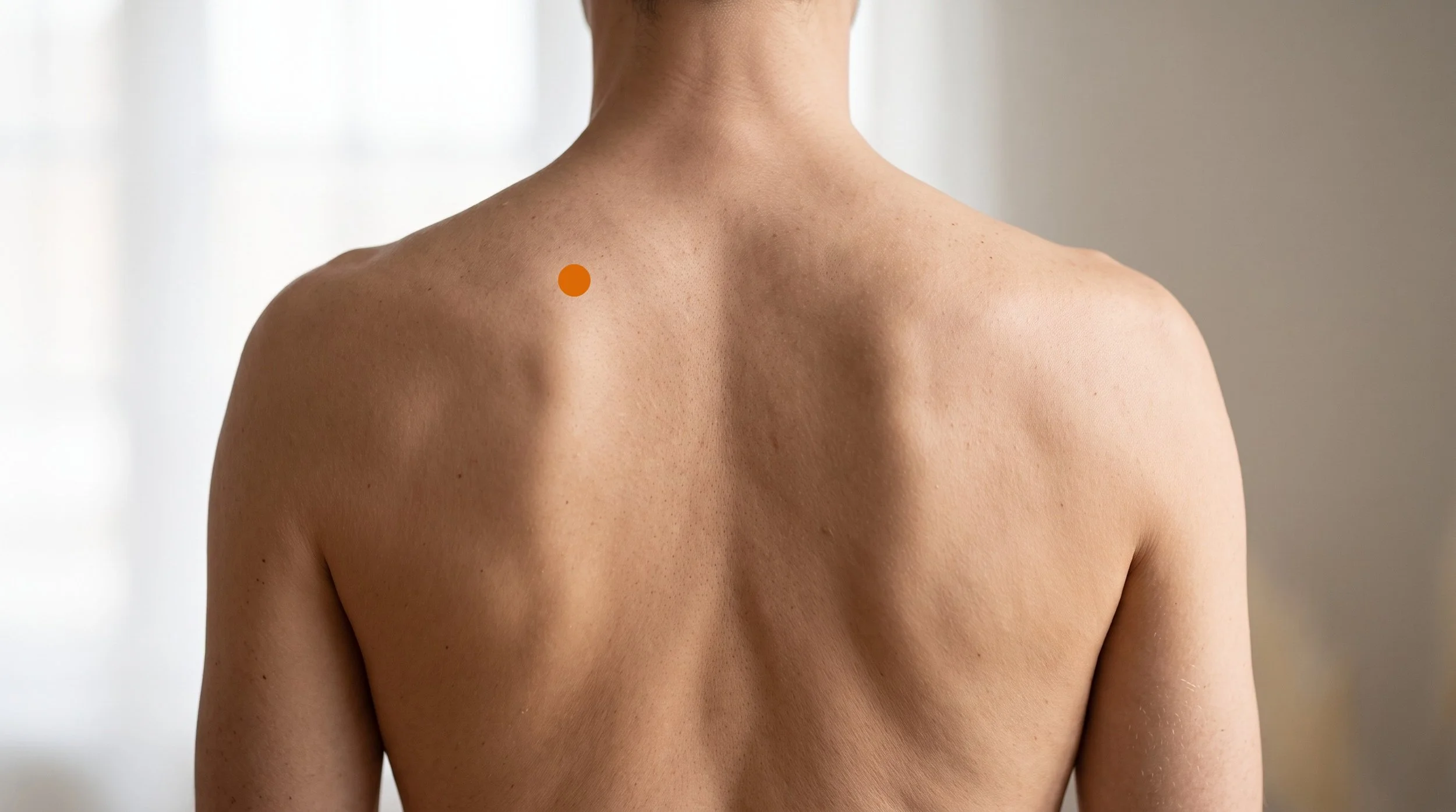
SI14 Acupuncture Point (Jianwaishu)
The Outer Shoulder Shu at the Corner of the Shoulder Blade: Anatomy, Mechanism, and Why SI14 Anchors Neck and Upper Back Treatment
SI14 (Jianwaishu, often translated as Outer Shoulder Shu) sits on the upper back at the inner corner of the shoulder blade, three cun out from the lower border of the first thoracic spinous process and level with GV13.
In plain terms, if you drop your shoulders and trace the inner edge of the scapula to its highest point, you're on it. The si14 acupuncture point matters clinically because that small patch of tissue is where the levator scapulae anchors and the upper rhomboids attach, which makes it one of the most reliably tender spots we find in people who spend their days at a keyboard, in a car, or holding a phone to one ear.
Classical texts list Small Intestine 14 for shoulder blade pain and a neck that won't turn, and modern practice uses it for much the same picture, with the important caveat that the pleura lies deep to this region and the needle stays shallow and angled.
- SI14 is located 3 cun lateral to the lower border of the T1 spinous process, level with GV13, and with the shoulder relaxed that measurement lands on the medial border of the scapula (Deadman, 2000). The needle passes through skin and upper trapezius into the levator scapulae insertion and the upper rhomboid fibers.
- Traditional texts attribute two main actions to this point: moving the channel to relieve pain, and dispelling wind and cold from the shoulder and scapula (Deadman, 2000; Maciocia, 2015). Read neurophysiologically, those descriptions describe a local point sitting over muscles that commonly become stiff, cold-sensitive, and painful under sustained postural load.
- Standard point anatomy texts place superficial innervation here in the medial cutaneous branches of the posterior rami of the first and second thoracic nerves, with the dorsal scapular nerve deeper and the transverse cervical vessels nearby. Needling this tissue activates small-diameter afferents that recruit segmental gating and descending inhibitory pathways from the brainstem (Zhao, 2008).
- The research picture supports the region rather than the single point: individual patient data meta-analysis finds acupuncture is better than sham and no-acupuncture control for chronic musculoskeletal pain including neck and shoulder pain (Vickers et al., 2018), and needling of trigger points in the neck and upper back muscles reduces pain and disability in the short to medium term (Lew et al., 2021).
- In clinic, SI14 is a point to palpate before you needle. Classical commentary advises checking it for tenderness in any shoulder presentation and needling with the patient seated (Maciocia, 2015), and in our experience the tender spot at the scapular corner usually reproduces the familiar ache patients point to when they describe their neck pain.
- De qi here tends to be a deep, heavy, spreading ache under the corner of the shoulder blade, sometimes with a brief muscle twitch if a taut band is engaged. Needling is oblique and medial, 0.5 to 1 cun, because perpendicular insertion over the upper back carries a real pneumothorax risk, especially in thin patients (Deadman, 2000; White, 2004).
Aching Between the Shoulder Blade and Neck After Long Desk Days?
That deep, gripping soreness at the top inner corner of the shoulder blade is one of the most common complaints we treat, and SI14 sits right on top of it. At Morningside Acupuncture, we palpate the scapular corner, needle SI14 obliquely along with the levator scapulae and upper trapezius, and pair it with neck and distal points so the whole shoulder girdle settles rather than just the sore spot. Most patients feel a heavy release during the session and looser rotation the next morning. Schedule a visit and let's find out how much of that stiffness is actually treatable.
Schedule NowAnatomy of SI14: Why the Upper Inner Corner of the Shoulder Blade Is Such an Important Location
SI14 sits three cun lateral to the lower border of the T1 spinous process, which places it at or very near the superior medial angle of the scapula when the shoulder is relaxed (Deadman, 2000). Under the skin and subcutaneous tissue lies the upper trapezius, and beneath that the tendinous insertion of levator scapulae along with the uppermost rhomboid fibers. This is a load-bearing corner. Levator scapulae works constantly to hold the shoulder blade up against gravity, especially when arms are unsupported at a desk, when a bag hangs from one shoulder, or when the head sits forward of the trunk.
Over months of that, the insertion becomes thickened and exquisitely tender, which is exactly why this spot shows up on palpation so consistently in office workers, musicians, students, and new parents.
The nerve geography explains why a needle here can influence more than the immediate soreness. Superficially, the area is supplied by medial cutaneous branches of the posterior rami of the first and second thoracic nerves, with the dorsal scapular nerve running deeper to supply the rhomboids and contributing to levator scapulae, which also receives direct branches from the third and fourth cervical nerves. That means SI14 sits at a crossroads where lower cervical and upper thoracic segments converge.
Stimulating nociceptive and mechanoreceptive afferents in this tissue feeds into dorsal horn segments that also receive input from the neck, and the resulting activity recruits segmental inhibition plus descending pain-modulating pathways involving endogenous opioid, serotonergic, and noradrenergic systems (Zhao, 2008). Local effects matter too: needling produces a small controlled tissue response with increased local blood flow, which may help tissue that has been held in sustained low-level contraction.
Safety shapes technique here more than at almost any other shoulder point. The pleural dome and the lung lie deep to the interspaces of the upper back, so perpendicular insertion at SI14 carries a substantial risk of pneumothorax, particularly in thin patients (Deadman, 2000). Standard practice is oblique medial insertion of 0.5 to 1 cun, keeping the needle angled toward the spine and within muscle rather than heading toward the chest wall.
Pneumothorax remains the most frequently reported serious adverse event in the acupuncture literature, and prospective safety data suggest serious events are rare overall, on the order of a handful per million treatments, with the great majority of reported cases traced to inappropriate depth or angle rather than to acupuncture itself (White, 2004; Bäumler et al., 2021). The transverse cervical artery and vein also run deep in this region, another reason depth discipline matters.
Related Acupuncture For Levator Scapulae Pain Related Pain Finder Upper Back Shoulder ArmSI14 at a Glance: Classification, Location, and Clinical Use
| Category | Detail |
|---|---|
| Traditional Name | Jianwaishu (Outer Shoulder Shu), also translated as Transporting Point of the Outside of the Shoulder |
| Channel Classification | Small Intestine channel (Hand Taiyang), upper back region, level with T1 |
| Point Categories | No five-shu, luo-connecting, xi-cleft, back-shu, hui-meeting, or extraordinary vessel designations are recorded for this point in the classical literature consulted. It's classified simply as a local Small Intestine channel point of the upper back, described in channel texts as lying along the internal course of the Small Intestine pathway as it circles the scapula toward GV14. |
| Precise Location | On the upper back, 3 cun lateral to the lower border of the T1 spinous process (level with GV13). With the shoulder relaxed, the 3 cun line corresponds to the medial (inner) border of the scapula, placing the point at its superior medial corner. |
| Tissue Stimulated | Upper trapezius superficially, then the insertion of levator scapulae and upper rhomboid fibers; see our Levator Scapulae Trigger Points and Trapezius Trigger Points references for the referred pain maps |
| Needle Depth / Direction | Oblique medial insertion, 0.5 to 1 cun. Perpendicular needling is avoided: over the upper back, especially in thin patients, it carries a substantial pneumothorax risk. Moxibustion is traditionally considered applicable here. |
| De Qi Sensation | Deep, heavy, spreading ache at the corner of the shoulder blade, often described as the familiar knot being pressed from the inside; may radiate toward the neck or along the inner scapular border, and a brief local twitch response can occur when a taut band is engaged |
| Primary Clinical Uses | Upper back and shoulder blade pain, levator scapulae insertional tension, neck stiffness with restricted rotation, postural neck and shoulder girdle pain from desk and device use; traditionally used for wind-cold pattern aches of the shoulder girdle and for shoulder blade pain with a cold sensation extending toward the elbow |
| Common Point Combinations |
|
Deadman's point compendium attributes two actions to SI14: activating the channel to relieve pain, and expelling wind and cold to benefit the shoulder and scapula (Deadman, 2000). Its listed indications are worth reading closely, because they're unusually specific. Traditional sources describe pain of the shoulder and scapula accompanied by a cold sensation that travels toward the elbow, chills and fever with neck rigidity and an inability to turn the head, and generalized painful obstruction.
Maciocia's text adds that SI14 should always be checked for tenderness on pressure in shoulder complaints and that it was regarded as able to expel wind from the joints generally, which is why it appears as a point for widespread wind painful obstruction rather than only local pain (Maciocia, 2015). What's striking about the classical pattern is how modern it sounds when you strip away the terminology: a cold, aching shoulder blade, referral toward the arm, a neck that won't rotate, and symptoms that flare with weather and drafts. That's a recognizable clinical picture, and it's still the picture that brings people to this point today.
Why SI14 Is Used for a Neck That Won't Turn, Not Just for Shoulder Blade Pain
The classical claim that a point at the corner of the shoulder blade treats neck rigidity looks odd until you follow the anatomy. Levator scapulae runs from the upper cervical transverse processes down to precisely this corner of the scapula, so a taut, irritable insertion here is mechanically and neurologically continuous with the neck. Trigger points in this muscle are well described as producing a stiff neck with painful rotation and an ache at the angle of the neck that spreads along the inner scapular border (Simons et al., 1999).
Add to that the segmental picture: input from SI14 enters the dorsal horn at lower cervical and upper thoracic levels, the same segments receiving input from the cervical spine and shoulder girdle, so needling the scapular corner can influence how the whole region reports pain rather than only the spot under the needle.
Beyond the segment, needling recruits broader pain-control machinery. Experimental work on acupuncture analgesia describes activation of small-diameter afferents leading to release of endogenous opioid peptides and engagement of descending serotonergic and noradrenergic inhibition from the brainstem, alongside local changes at the needled tissue (Zhao, 2008). Clinically, that helps explain why patients often report improvement in movement quality, not just less soreness, and why a session that includes distal points frequently outperforms local needling alone.
None of this means SI14 is a stand-alone solution. It's a well-placed local point over tissue that carries a lot of postural load, and it works best inside a plan that also addresses the trapezius, the deep neck flexors, workstation setup, and how often you actually move during the day. We treat it as a reliable anchor rather than a magic spot.
What the Research Shows for SI14
There's no trial that isolates SI14 on its own, and that's the honest starting point. Acupuncture research almost always tests multi-point protocols for a condition, so the fair question is whether treatment for neck, shoulder, and upper back pain that routinely includes points like this one performs better than sham or usual care. The evidence there is reasonably encouraging but not uniform: effect sizes are modest, many trials are small, and short-term follow-up dominates.
Studies of dry needling into the same muscles this point overlies give a useful parallel line of evidence, since the needle target is essentially identical whichever framework you use to describe it.
| Study | Type | Focus | Key Finding |
|---|---|---|---|
| Vickers et al., 2018 | Individual patient data meta-analysis | Acupuncture for chronic pain including neck and shoulder pain, roughly 20,800 patients across 39 trials | Acupuncture was more effective than both sham and no-acupuncture control for chronic musculoskeletal pain, with effects that persisted over time, though differences from sham were modest. |
| Trinh et al., 2016 | Cochrane systematic review (27 trials, later withdrawn from the library pending update) | Acupuncture for acute, subacute, and chronic neck disorders | For mechanical neck pain, acupuncture showed benefit over sham and inactive controls at immediate and short-term follow-up, with low to moderate quality evidence; readers should note the review's withdrawn status. |
| Lew et al., 2021 | Systematic review and meta-analysis | Dry needling versus trigger point manual therapy for neck and upper back myofascial pain | Both approaches improved pain and function in the short to medium term, with no clear superiority of one over the other in the pooled data. |
| Velázquez Saornil et al., 2023 | Randomized clinical trial | Dry needling of levator scapulae trigger points in chronic neck pain, the muscle directly under SI14 | Needling the levator scapulae produced short-term improvements in pain intensity and pressure pain threshold, supporting the value of targeting this specific insertion. |
| Bäumler et al., 2021 | Systematic review and meta-analysis of prospective safety studies | Adverse events across roughly 22 prospective studies of needle acupuncture | Serious adverse events were rare, estimated at about eight per million treatments, with most reported reactions being minor bleeding or soreness at the needle site. |
| Zhao, 2008 | Narrative review of experimental mechanism research | Neural pathways underlying acupuncture analgesia | Analgesic effects appear to involve afferent activation, endogenous opioid release, and descending inhibitory control rather than any single local mechanism. |
Can't Turn Your Head Without Wincing?
Neck rigidity with limited rotation is one of the oldest recorded uses of Jianwaishu, and it lines up neatly with what the levator scapulae does when it's overloaded. We combine SI14 with SI3, GB21, and cervical points, then add dry needling of the muscles that refer pain into the neck angle. Treatment is comfortable, precise, and tailored to how your neck actually moves. Book an appointment and we'll assess your rotation before and after.
Schedule NowSI14 in the Context of Trigger Point Work
Acupuncture means the use of an acupuncture needle, and that covers hundreds of styles including dry needling, so at Morningside we don't treat SI14 and levator scapulae needling as competing techniques. They frequently land in the same tissue. The classic levator scapulae trigger point sits near the muscle's scapular attachment and refers pain to the angle of the neck, down along the medial scapular border, and sometimes toward the back of the shoulder, producing the stiff, hard-to-rotate neck that patients describe as a crick (Simons et al., 1999).
That referral map overlaps closely with the classical indication list for Jianwaishu, which is one of the more satisfying convergences between the two traditions.
A typical session at our clinic layers the approaches. We'll needle SI14 obliquely at the scapular corner, then work the levator scapulae belly higher in the neck, the upper trapezius, and often the rhomboids and posterior scalenes depending on what palpation and movement testing suggest. Electrical stimulation may be added across the upper back when tone is high, and we finish with cervical range of motion work and one or two things you can do at your desk.
Depth discipline applies throughout: over the ribcage and interspaces, the needle stays angled and shallow, and we adjust technique for body composition rather than using a fixed depth for everyone.
SI14 Neck and Shoulder Pain Treatment at NYC's Highest-Rated Acupuncture Clinic
Morningside Acupuncture is the highest-rated acupuncture and dry needling clinic in New York City with over 500 five-star Google reviews, and upper back, neck, and shoulder pain is the bulk of what we do. Our approach blends careful point selection like SI14 with modern trigger point needling, movement assessment, and simple between-session self-care. You'll always know what we're needling and why. Schedule your first session and start with a full assessment of the neck and shoulder girdle.
Schedule NowFrequently Asked Questions
What does SI14 feel like when needled?
Most people feel a deep, heavy ache spreading under the top inner corner of the shoulder blade, and it often reproduces the exact soreness they came in with. That recognition response is a good sign. If the needle engages a taut band in levator scapulae or the upper rhomboids, you may feel a quick involuntary twitch, which is brief and not painful in the way patients expect. Afterward the area can feel warm, loose, or mildly tender for a day, similar to post-exercise soreness.
Why needle the shoulder blade for a neck problem?
Because the muscle under SI14 starts in your neck. Levator scapulae runs from the upper cervical vertebrae down to the corner of the scapula, so an irritable insertion there can keep the neck stiff and make rotation painful (Simons et al., 1999). Neurologically, input from this area enters spinal segments that also receive input from the cervical spine and shoulder, so treating the scapular corner can change how the whole region behaves (Zhao, 2008). Classical texts arrived at the same conclusion from observation, listing this point for neck rigidity and inability to turn the head.
Can I press SI14 myself between sessions?
Yes, and it's an easy one to reach. Drop your shoulders, run your fingers from the spine outward at about the level of the top of your shoulder blade, and find the tender corner where the blade begins. Press with your opposite hand's fingertips or a massage ball against a wall, using firm but tolerable pressure at roughly a 6 out of 10. Hold for 30 to 60 seconds while breathing slowly, release, then repeat two or three times. Follow it with slow neck rotations and a few shoulder blade squeezes. Two or three short rounds a day is plenty. Ease off if you feel sharp pain, numbness, or tingling into the arm, and mention it at your next visit.
Is SI14 safe to needle?
It's safe in trained hands, but it's a point that demands respect for depth. The lung and pleura lie deep to the upper back, so perpendicular insertion here carries a substantial pneumothorax risk, especially in thin patients, and the standard technique is oblique medial insertion of 0.5 to 1 cun (Deadman, 2000). Pneumothorax is the most commonly reported serious complication in the acupuncture literature, though prospective data put serious events at roughly eight per million treatments overall, with most reported cases attributed to inappropriate angle or depth (White, 2004; Bäumler et al., 2021). Choose a licensed practitioner, and tell them if you have a lung condition, use blood thinners, or have had chest surgery.
Where exactly is SI14 located?
On the upper back, 3 cun lateral to the lower border of the first thoracic spinous process, level with GV13 (Deadman, 2000). The practical shortcut: sit or stand with your shoulders fully relaxed, find the top inner corner of your shoulder blade, and the point is right there at the medial scapular border. It's usually the spot that makes you flinch first when someone presses along that edge, which is why it's checked routinely in neck and shoulder assessments.
References
- Deadman, P., Al-Khafaji, M., & Baker, K. (2009). A manual of acupuncture. Journal of Chinese Medicine Publications.
- Maciocia, G. (2005). The foundations of Chinese medicine: A comprehensive text for acupuncturists and herbalists (2nd ed.). Elsevier Churchill Livingstone.
- Cheng, X. (Ed.). (1999). Chinese acupuncture and moxibustion (Rev. ed.). Foreign Languages Press.
- Simons, D. G., Travell, J. G., & Simons, L. S. (1999). Travell & Simons' myofascial pain and dysfunction: The trigger point manual, Vol. 1: Upper half of body (2nd ed.). Williams & Wilkins.
- Vickers, A. J., Vertosick, E. A., Lewith, G., MacPherson, H., Foster, N. E., Sherman, K. J., Irnich, D., Witt, C. M., & Linde, K. (2018). Acupuncture for chronic pain: Update of an individual patient data meta-analysis. Journal of Pain, 19(5), 455-474. https://doi.org/10.1016/j.jpain.2017.11.005
- Zhao, Z. Q. (2008). Neural mechanism underlying acupuncture analgesia. Progress in Neurobiology, 85(4), 355-375. https://doi.org/10.1016/j.pneurobio.2008.05.004
- Trinh, K., Graham, N., Irnich, D., Cameron, I. D., & Forget, M. (2016). Acupuncture for neck disorders. Cochrane Database of Systematic Reviews, 2016(5), CD004870. https://doi.org/10.1002/14651858.CD004870.pub4
- Lew, J., Kim, J., & Nair, P. (2021). Comparison of dry needling and trigger point manual therapy in patients with neck and upper back myofascial pain syndrome: A systematic review and meta-analysis. Journal of Manual & Manipulative Therapy, 29(3), 136-146. https://doi.org/10.1080/10669817.2020.1822618
- Velázquez Saornil, J., Sánchez Milá, Z., Campón Chekroun, A., Barragán Casas, J. M., Frutos Llanes, R., & Rodríguez Sanz, D. (2023). Effectiveness of dry needling and ischaemic trigger point compression of the levator scapulae in patients with chronic neck pain: A short-term randomized clinical trial. Journal of Clinical Medicine, 12(19), 6136. https://doi.org/10.3390/jcm12196136
- Bäumler, P., Zhang, W., Stübinger, T., & Irnich, D. (2021). Acupuncture-related adverse events: Systematic review and meta-analyses of prospective clinical studies. BMJ Open, 11(9), e045961. https://doi.org/10.1136/bmjopen-2020-045961
- White, A. (2004). A cumulative review of the range and incidence of significant adverse events associated with acupuncture. Acupuncture in Medicine, 22(3), 122-133. https://doi.org/10.1136/aim.22.3.122
Disclaimer: This web site is intended for educational and informational purposes only. Reading this website does not constitute providing medical advice or any professional services. This information should not be used for diagnosing or treating any health issue or disease. Those seeking medical advice should consult with a licensed physician. Seek the advice of a medical doctor or other qualified health professional for any medical condition. If you think you have a medical emergency, call 911 or go to the emergency room. No acupuncturist-patient relationship is created by reading this website or using the information. Morningside Acupuncture PLLC and its employees and contributors do not make any express or implied representations with respect to the information on this site or its use. For any legal interpretation of scope of practice in your state, consult a licensed attorney or regulatory authority.
Read more from our blog



