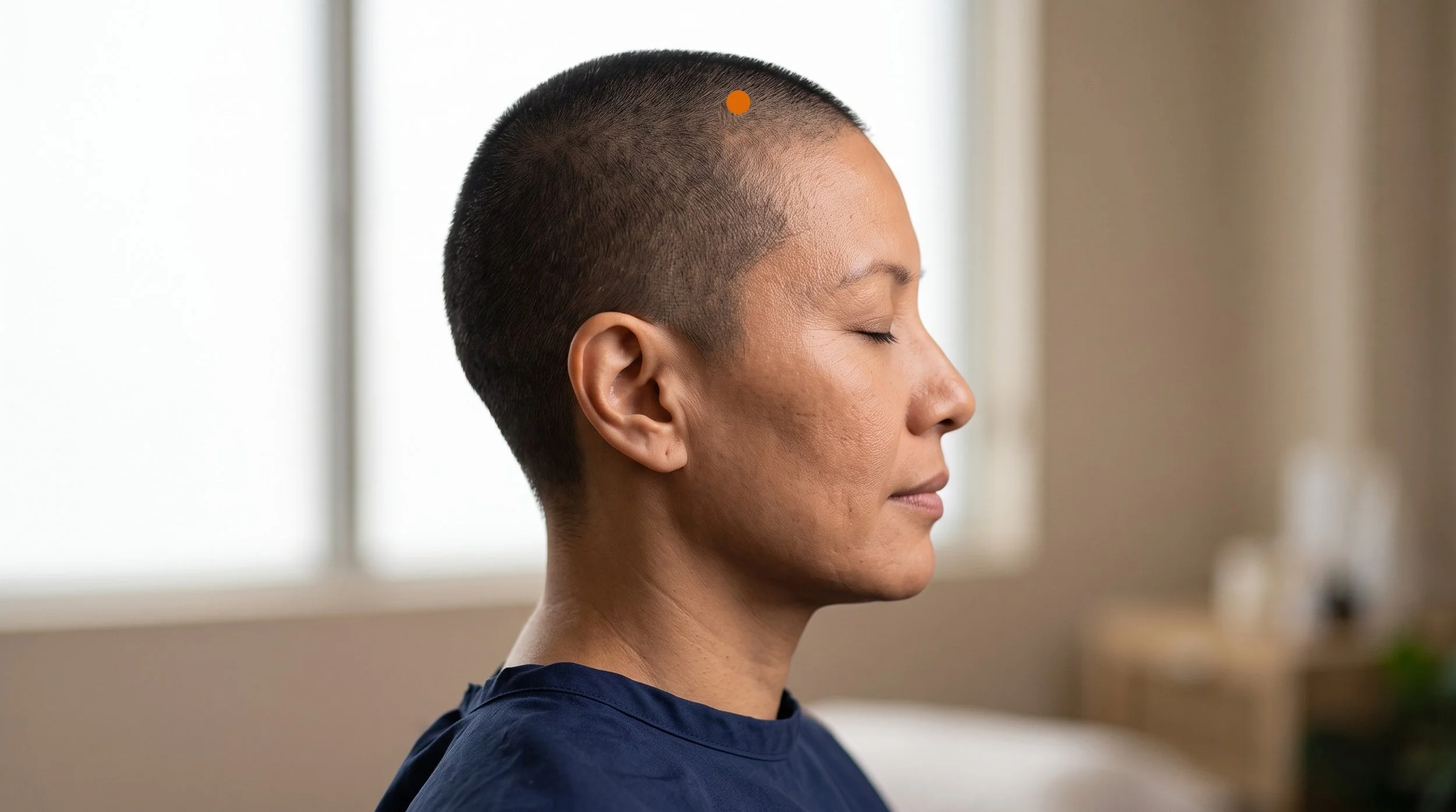
GB16 Acupuncture Point (Muchuang)
The Window of the Eye on the Gallbladder Scalp Line: Anatomy, Mechanism, and Why This Quiet Point Sits Between Classical Eye Care and Modern Headache Work
GB16, known in Chinese as Muchuang and usually translated as Window of the Eye, sits on the scalp a little behind the front hairline, on the Gallbladder channel line that runs back from above the pupil toward the base of the skull. You'll find it roughly 1.5 cun behind GB15, following the curve of the skull rather than a straight line (Deadman et al., 2009).
The name comes from an old and expansive reputation for eye complaints, but in contemporary practice the GB16 acupuncture point earns its place for a more grounded reason: it lies in trigeminal nerve territory on a tender, often stiff band of scalp fascia, which makes it useful within needling strategies for headaches that spread across the top and front of the head.
- Location and layers: GB16 lies on the scalp above the pupil line, about 1.5 cun posterior to GB15 along the curved Gallbladder line toward GB20, which places it roughly one third of the way from GB15 to GB18 (Deadman et al., 2009; Kim, 2008). The needle passes through skin, fibrous subcutaneous tissue, and the galea, with bone directly underneath, so insertion is transverse rather than perpendicular.
- Traditional categories, read neurophysiologically: classical texts list GB16 as a meeting point of the Gallbladder channel with the Yang Linking vessel and credit it with benefiting the eyes, dispelling wind, and easing pain (Deadman et al., 2009; Maciocia, 2005). In modern language, that reads as a scalp site whose stimulation feeds into trigeminal and upper cervical pathways involved in head pain and facial sensation.
- Mechanism: needling here recruits A-delta and C fiber afferents in supraorbital nerve territory, and acupuncture analgesia research describes spinal and supraspinal gating plus endogenous opioid and monoamine involvement as the core of that effect (Zhao, 2008). Experimental work also links scalp acupoints innervated by the trigeminal nerve to meningeal and cerebral blood flow responses, which offers a plausible route for scalp needling in headache (Wang et al., 2017; Jin et al., 2023).
- Research picture: no trial has isolated gallbladder 16 on its own. Cochrane reviews of acupuncture for tension-type headache and episodic migraine report modest benefits over sham and comparable performance to standard preventive care, using multi-point protocols that regularly include local scalp and head points (Linde et al., 2016a; Linde et al., 2016b).
- Clinical framing: Deadman's commentary notes that despite a broad classical reputation, GB16 is used infrequently today (Deadman et al., 2009). We treat it as a supporting local point within scalp line work rather than a headline choice, added when palpation finds tenderness or a taut band right along that pupil line.
- De qi and comfort: because the needle travels along the galea, patients usually report a spreading dull pressure, a tugging or stretching feeling across the scalp, and sometimes a wave of local heaviness. Sharp or electric sensations aren't the goal and mean the angle needs adjusting.
Headaches That Sit Across the Top and Front of Your Head?
Scalp line tenderness is one of the most commonly missed findings in stubborn head pain, and it's one of the first things we palpate. At Morningside Acupuncture we use GB 16 head needling alongside GB15, GB20, and distal points as part of a full headache strategy, not as an isolated trick. We pair that with dry needling of the temporalis, frontalis, and upper neck muscles when the pattern calls for it. Schedule a visit and we'll map exactly where your headache lives.
Schedule NowAnatomy of GB16: Why the Galea Above the Pupil Line Is Such an Important Location
GB16 sits on the scalp proper, and the scalp is a layered structure worth understanding before a needle goes in. Under the hair-bearing skin lies a dense subcutaneous layer packed with fibrous septa that tether the skin to the layer below and carry blood vessels and small nerve branches through it. Beneath that runs the galea aponeurotica, the tough sheet that connects the frontalis muscle in front with the occipitalis behind, then a loose areolar plane, the pericranium, and finally the frontal and parietal bones of the skull.
This region gets loaded by sustained frontal muscle activity, jaw clenching that transmits through the temporalis, and hours of forward head posture at a screen, all of which leave the scalp fascia and pericranial tissues sore to press. Palpable pericranial tenderness is a recognized feature in many people with recurrent tension-type headache, which is exactly the finding that makes a point like this worth needling.
The nerve geography here matters more than the muscle. GB16 falls within the sensory distribution of the supraorbital nerve, a branch of the ophthalmic division of the trigeminal nerve, whose terminal fibers sweep well back over the front and top of the scalp. Stimulating these afferents matters clinically because trigeminal input converges with upper cervical input in the trigeminocervical complex, the same relay implicated in why neck problems can generate frontal head and eye-region pain.
Acupuncture's analgesic effect is best explained through this kind of afferent recruitment, with segmental inhibition at the dorsal horn joined by descending modulation from the midbrain and brainstem and by endogenous opioid and monoamine signaling (Zhao, 2008). There's also experimental evidence that scalp acupoints supplied by the trigeminal nerve connect functionally with the meninges and can shift cerebral blood flow measures, a mechanism proposed specifically to explain why scalp needling affects brain-related symptoms (Wang et al., 2017; Jin et al., 2023).
Safety at GB16 is mostly about respecting the bone underneath and the vascularity above it. Because the skull sits directly beneath the galea, needling is transverse only, threaded along the scalp for roughly 0.5 to 1.5 cun, with shallower subcutaneous insertion of 0.3 to 0.5 cun also described (Deadman et al., 2009; Kim, 2008). The scalp is richly supplied with small arteries and veins, so brief bleeding or a small bruise on withdrawal is the most common minor event and is easily managed with a few seconds of pressure.
Needling is avoided over unclosed fontanelles in infants, over surgical hardware, cranial defects, or shunts, and caution applies for anyone on anticoagulant therapy. Moxibustion is described as applicable at this point in classical sources, though in practice hair makes it awkward (Kim, 2008).
Related Best Acupuncture Points For Headaches Related Acupuncture Tension Headache ResearchGB16 at a Glance: Classification, Location, and Clinical Use
| Category | Detail |
|---|---|
| Traditional Name | Muchuang (Window of the Eye, also translated Eye Window) |
| Channel Classification | Gallbladder channel of Foot Shaoyang, scalp portion. See the Gall Bladder Channel overview. |
| Point Categories | Meeting point of the Gallbladder channel with the Yang Linking vessel (Yang Wei Mai), one of the string of Gallbladder scalp points (GB13 through GB20) listed among that vessel's intersections. No five-shu, hui-meeting, or command point status. |
| Precise Location | On the scalp above the forehead, 1.5 cun posterior to GB15 along the curved line from GB15 toward GB20 that follows the contour of the skull, which places it about one third of the distance from GB15 to GB18. GB15 itself is located 0.5 cun behind the anterior hairline, directly above the pupil. |
| Tissue Stimulated | Hair-bearing scalp skin, fibrous subcutaneous layer, and the galea aponeurotica over the frontal-parietal junction, in supraorbital nerve territory. Related head and neck complaints are mapped on our Pain Finder Head Neck page. |
| Needle Depth / Direction | Transverse (threaded) insertion along the scalp, 0.5 to 1.5 cun, often directed posteriorly toward GB17 or anteriorly toward GB15; shallower subcutaneous insertion of 0.3 to 0.5 cun is also standard. Never perpendicular, since bone lies immediately beneath. |
| De Qi Sensation | Spreading dull pressure, a tugging or stretching sensation across the scalp, sometimes local heaviness or warmth. Sharp, burning, or electric sensations indicate the needle needs repositioning. |
| Primary Clinical Uses | Headache across the top and front of the head, scalp line tenderness, and screen-related forehead and eye fatigue in modern practice; eye redness, swelling, blurred vision, upper jaw toothache, and nasal congestion in classical use. |
| Common Point Combinations |
|
Deadman, Al-Khafaji, and Baker record an unusually wide classical remit for Muchuang, grouping its indications into eye complaints (visual dizziness, redness, swelling and pain, short sightedness, and clouding of vision), head and face complaints (headache, facial and head swelling, upper jaw toothache, swollen gums, and blocked nose), and exterior patterns with chills, fever, and absent sweating.
They also cite the Ming dynasty author Yan Zhen-shi, whose Investigation into Points Along the Channels credited this point with treating eye disorders of all kinds, while noting frankly that the point is rarely reached for in modern clinics (Deadman et al., 2009). Other texts echo the same traditional actions of brightening the eyes, moving the channel, and settling internal wind (Cunningham, 2000).
What makes the pattern striking is the mismatch: a point with one of the broadest ophthalmic reputations in the classical literature has quietly narrowed, in contemporary use, to a supporting role in scalp headache work.
Why GB16 Is Used for Headaches When Its Name Points to the Eyes
The apparent contradiction resolves once you look at innervation instead of nomenclature. GB16 sits in supraorbital nerve territory, and that nerve is a branch of the ophthalmic division of the trigeminal nerve, the same division that carries sensation from the eye, the forehead, and the dura. Trigeminal afferents and upper cervical afferents converge on shared second-order neurons in the trigeminocervical complex, which is why a person with a tight, tender scalp and neck can experience symptoms as pressure behind the eyes. A point named for the eye that treats the forehead and scalp isn't an inconsistency, it's a description of one continuous sensory territory.
Once the needle recruits those afferents, the effect isn't limited to the spot being needled. Acupuncture stimulation activates spinal gating mechanisms and descending pain-modulating pathways from the periaqueductal gray and rostral ventromedial medulla, with opioid, serotonergic, and noradrenergic signaling all implicated in the resulting analgesia (Zhao, 2008).
Scalp points add a second consideration: experimental work in animals proposes a trigeminal nerve to meninges route for scalp needling and documents cerebral blood flow changes after electroacupuncture at scalp sites, including GB15, the point immediately in front of GB16 (Wang et al., 2017). A related review argues that neural control of cerebral perfusion is a more scientifically defensible basis for scalp acupuncture than older explanatory models (Jin et al., 2023).
Practically, this means we don't ask GB16 to carry a treatment. We ask it to contribute local input in a region that's often tender, while distal points, neck work, and dry needling handle the rest. For most patients, the noticeable change after scalp line needling is a loosening of the surface tightness and a reduction in that band-like squeeze, which may make the underlying headache pattern easier to manage over a course of care.
What the Research Shows for GB16
It's worth being direct about the evidence: there are no clinical trials that test GB16 by itself, and there likely never will be. Headache research evaluates whole protocols, typically combining local head and scalp points with distal points on the arms and legs, and results tell us about the package rather than any single needle. Studies on the eye indications tend to use periocular points rather than scalp points.
So the fair way to read the research below is that it supports acupuncture as a reasonable option for recurrent headache, and that GB16 is one of the local scalp points practitioners may include within that approach when examination suggests it.
| Study | Type | Focus | Key Finding |
|---|---|---|---|
| Linde et al., 2016a | Cochrane systematic review | Acupuncture for prevention of tension-type headache | Acupuncture added to usual care was associated with more people halving their headache frequency than usual care alone, with a smaller but measurable advantage over sham needling. |
| Linde et al., 2016b | Cochrane systematic review | Acupuncture for prevention of episodic migraine | Moderate quality evidence suggested acupuncture performs at least as well as standard preventive drug therapy for reducing migraine frequency, with fewer dropouts due to side effects. |
| Vickers et al., 2018 | Individual patient data meta-analysis | Acupuncture for chronic pain including headache | Acupuncture outperformed both sham and no-acupuncture controls for chronic pain conditions, with effects that persisted over follow-up rather than fading immediately. |
| Wang et al., 2017 | Experimental animal study | Trigeminal pathway from scalp acupoints to the meninges, with electroacupuncture at GB15 | The authors reported connections between scalp acupoints and meningeal structures along with cerebral blood flow changes, proposing a neural route for scalp acupuncture effects. |
| Jin et al., 2023 | Narrative review | Neural control of cerebral blood flow as a basis for scalp acupuncture | The review argues that scalp needling effects may be best explained through neurovascular control mechanisms, while acknowledging that clinical confirmation is still limited. |
| Na et al., 2021 | Systematic review and meta-analysis | Acupuncture for typical dry eye syndrome | Pooled results favored acupuncture over artificial tears on tear film measures, though protocols relied mainly on periocular points and study quality varied. |
| Zhao, 2008 | Mechanistic review | Neural mechanisms of acupuncture analgesia | Analgesic effects are attributed to afferent stimulation engaging spinal gating and descending inhibitory pathways involving opioid and monoamine signaling. |
Screen Fatigue, Eye Strain, and Tight Forehead Tension?
Long hours at a monitor tend to leave the forehead, temples, and scalp fascia loaded and tender, and that load often shows up as eye heaviness rather than obvious muscle pain. The window of the eye point sits right in that territory, which is why we often include it in treatments for people who work long days on screens. Our licensed acupuncturists combine scalp needling with neck, jaw, and postural work so the relief lasts past the treatment table. Book a session and let's take pressure off the whole chain.
Schedule NowGB16 in the Context of Trigger Point Work
GB16 isn't a muscle belly point, so it doesn't correspond to a classic trigger point the way ST36 or GB21 do. What it does share is territory with the referral zones of several head and neck muscles. Trigger points in the sternocleidomastoid, upper trapezius, splenius capitis, suboccipital group, temporalis, and frontalis are described as projecting pain into the forehead, the top of the head, the temple, and behind the eye (Simons et al., 1999).
That means the same scalp region a patient points to when describing their headache is frequently receiving referred input from muscles located elsewhere, which is why treating only the scalp tends to give short-lived results.
At Morningside, we generally use GB16 as part of the local layer and address the drivers separately. A typical session might thread the Gallbladder scalp line through GB15, GB16, and GB17, then move to dry needling of the temporalis and upper trapezius, the suboccipitals, and the cervical paraspinals, finishing with distal points chosen for the overall pattern.
Acupuncture and dry needling are the same act of inserting a filiform needle, differing in reasoning and target selection rather than in tool, and combining the classical scalp line with a myofascial exam usually produces a more complete picture than either approach used alone.
GB16 Headache Treatment at NYC's Highest-Rated Acupuncture Clinic
Morningside Acupuncture is the highest-rated acupuncture and dry needling clinic in New York City with over 500 five-star Google reviews. We treat head pain with a blend of classical point selection, careful palpation, and evidence-informed dry needling, and points like GB16 fit into that plan when the exam supports them. Every treatment is built around your presentation, not a template. Schedule your appointment today.
Schedule NowFrequently Asked Questions
What does GB16 feel like when needled?
Because the needle is threaded flat along the scalp rather than pushed inward, most people feel a brief pinch at insertion followed by a spreading dull pressure or a tugging sensation across the surface of the head. Some describe mild heaviness, warmth, or a slow ache that drifts toward the forehead or temple. That's the de qi response, and it typically settles within a minute. Sharp, burning, or electric feelings aren't expected here and should be reported right away so the angle can be adjusted.
Why needle the scalp for a headache instead of just the neck?
The neck is often the driver, but it isn't the only place the problem lives. GB16 sits in trigeminal sensory territory, and trigeminal afferents converge with upper cervical afferents on shared neurons in the brainstem, which is part of why neck tension gets felt as frontal or behind-the-eye pain. Needling local scalp tissue adds direct input into that convergent system and also addresses the tender, thickened galea and pericranial tissue that many headache patients have on palpation. Most treatment plans use both regions, plus distal points, rather than choosing between them.
Can I press GB16 myself between sessions?
Yes, and it's an easy one to reach. Find the spot by tracing straight up from the center of your pupil to just behind your hairline (that's roughly GB15), then move back another two finger-widths along the curve of your skull. Press with the pad of your index or middle finger using steady, moderate pressure, and add small circles for 30 to 60 seconds. Repeat two or three times per side, up to a few times daily. It should feel like a satisfying, dull soreness, not sharp pain. Stop if you get lightheaded, if the pressure worsens a headache, or if you have any scalp injury, wound, or surgical hardware in the area.
Is GB16 safe to needle?
In trained hands, yes. The skull sits directly beneath the point, so needling is transverse along the scalp only, never perpendicular, which removes any deep organ risk. The main considerations are minor: the scalp bleeds readily, so a small bead of blood or a temporary bruise on withdrawal is common and controlled with brief pressure. Extra caution applies for people on blood thinners, and needling is avoided over cranial defects, shunts, surgical plates, unhealed scalp lesions, or unclosed fontanelles in infants. Always work with a licensed acupuncturist who uses single-use sterile needles.
Where exactly is GB16 located?
GB16 is on the scalp, on the Gallbladder channel line that runs from above the pupil back toward the base of the skull. Start at GB15, which is 0.5 cun behind the front hairline directly above the pupil, then measure 1.5 cun posteriorly along the curve of the skull rather than in a straight line through the air. Another way to check the same spot is to locate GB18 (level with DU20 on the Gallbladder line) and place GB16 one third of the way along from GB15 to GB18. GB17 sits a further 1.5 cun behind GB16 on the same line.
References
- Deadman, P., Al-Khafaji, M., & Baker, K. (2009). A manual of acupuncture. Journal of Chinese Medicine Publications.
- Kim, H. (2008). Handbook of Oriental medicine (3rd ed.). Harmony & Balance Press.
- Cunningham, P. M. (2000). Acupuncture points: A practical guide to classical and modern usage. Odyssey Press.
- Maciocia, G. (2005). The foundations of Chinese medicine: A comprehensive text for acupuncturists and herbalists (2nd ed.). Elsevier Churchill Livingstone.
- Simons, D. G., Travell, J. G., & Simons, L. S. (1999). Travell & Simons' myofascial pain and dysfunction: The trigger point manual, Vol. 1: Upper half of body (2nd ed.). Williams & Wilkins.
- Linde, K., Allais, G., Brinkhaus, B., Fei, Y., Mehring, M., Shin, B.-C., Vickers, A., & White, A. R. (2016a). Acupuncture for the prevention of tension-type headache. Cochrane Database of Systematic Reviews, 2016(4), CD007587. https://doi.org/10.1002/14651858.CD007587.pub2
- Linde, K., Allais, G., Brinkhaus, B., Fei, Y., Mehring, M., Vertosick, E. A., Vickers, A., & White, A. R. (2016b). Acupuncture for the prevention of episodic migraine. Cochrane Database of Systematic Reviews, 2016(6), CD001218. https://doi.org/10.1002/14651858.CD001218.pub3
- Vickers, A. J., Vertosick, E. A., Lewith, G., MacPherson, H., Foster, N. E., Sherman, K. J., Irnich, D., Witt, C. M., & Linde, K. (2018). Acupuncture for chronic pain: Update of an individual patient data meta-analysis. Journal of Pain, 19(5), 455-474. https://doi.org/10.1016/j.jpain.2017.11.005
- Zhao, Z. Q. (2008). Neural mechanism underlying acupuncture analgesia. Progress in Neurobiology, 85(4), 355-375. https://doi.org/10.1016/j.pneurobio.2008.05.004
- Wang, S., Liu, K., Wang, Y., Wang, S., He, X., Cui, X., Gao, X., & Zhu, B. (2017). A proposed neurologic pathway for scalp acupuncture: Trigeminal nerve-meninges-cerebrospinal fluid-contacting neurons-brain. Medical Acupuncture, 29(5), 322-326. https://doi.org/10.1089/acu.2017.1231
- Jin, G.-Y., Jin, L. L., Jin, B. X., Zheng, J., He, B. J., & Li, S.-J. (2023). Neural control of cerebral blood flow: Scientific basis of scalp acupuncture in treating brain diseases. Frontiers in Neuroscience, 17, 1210537. https://doi.org/10.3389/fnins.2023.1210537
- Na, J.-H., Jung, J.-H., Park, J.-G., Song, P. H., & Song, C.-H. (2021). Therapeutic effects of acupuncture in typical dry eye: A systematic review and meta-analysis. Acta Ophthalmologica, 99(5), 489-498. https://doi.org/10.1111/aos.14651
Disclaimer: This web site is intended for educational and informational purposes only. Reading this website does not constitute providing medical advice or any professional services. This information should not be used for diagnosing or treating any health issue or disease. Those seeking medical advice should consult with a licensed physician. Seek the advice of a medical doctor or other qualified health professional for any medical condition. If you think you have a medical emergency, call 911 or go to the emergency room. No acupuncturist-patient relationship is created by reading this website or using the information. Morningside Acupuncture PLLC and its employees and contributors do not make any express or implied representations with respect to the information on this site or its use. For any legal interpretation of scope of practice in your state, consult a licensed attorney or regulatory authority.
Read more from our blog



