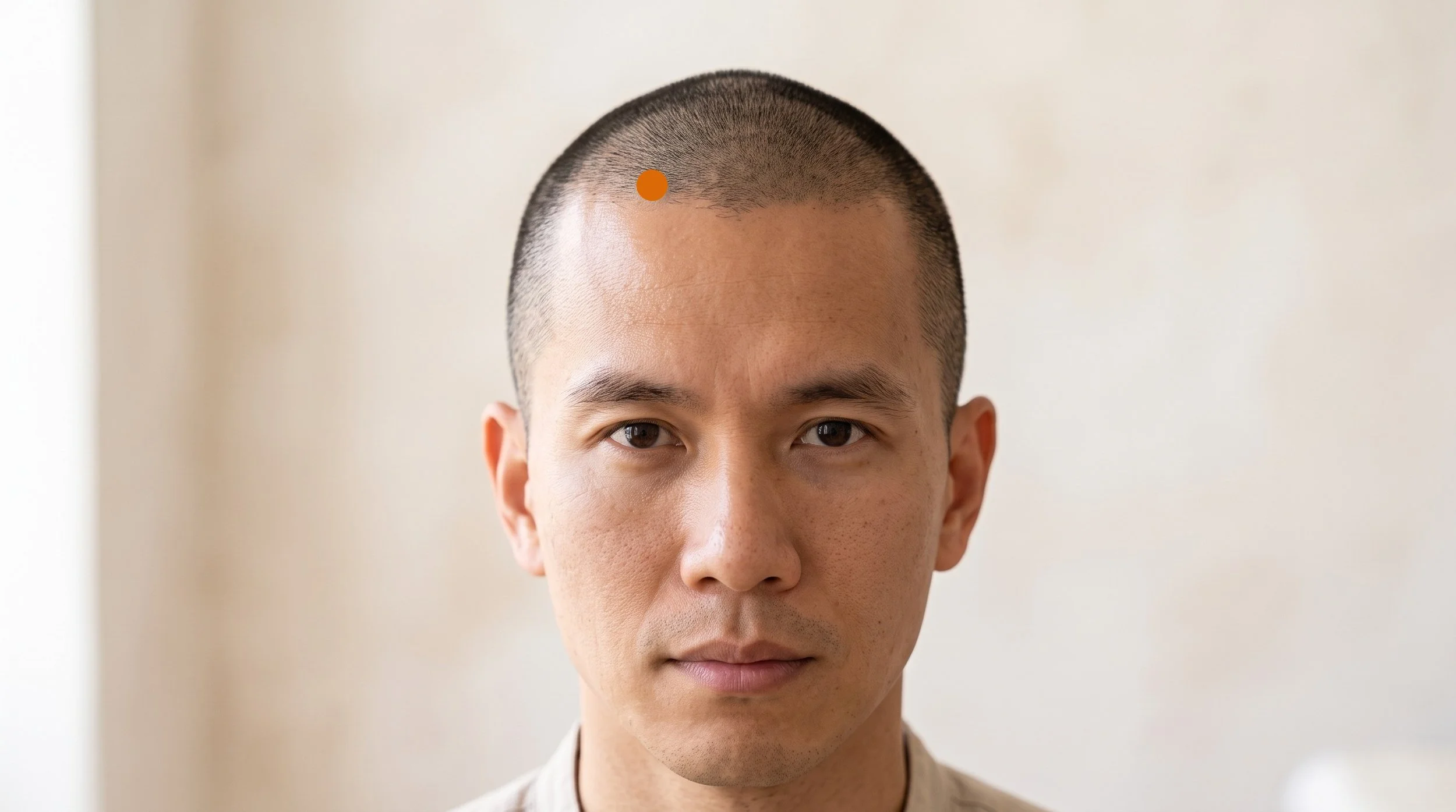
GB15 Acupuncture Point (Toulinqi)
The Head Governor of Tears at the Frontal Hairline: Anatomy, Mechanism, and Why This Gallbladder Point Anchors Frontal Headache, Eye Strain, and Nasal Congestion Treatment
GB15 (Toulinqi, often translated as Head Governor of Tears) sits right where the forehead becomes the scalp, half a cun inside the front hairline on a vertical line drawn up from the pupil, directly above GB14 and midway between DU24 and ST8.
It's one of the most useful points on the anterior scalp because a single transverse needle there sits in the tissue plane where frontalis muscle, galea, and the branches of the supraorbital nerve all meet, which is exactly the territory that gets loaded by squinting at screens, brow-raising tension, sinus pressure, and the front-of-head band that so many headache patients describe.
Classically, the gallbladder 15 point was given a governing role over tearing, mirroring its foot-level namesake GB41, and traditional texts also credit it with clearing the nose and easing pain across the brow ridge. In modern practice, the GB 15 head point is used less for anything mystical about tears and more for what it can reach: a dense field of trigeminal cutaneous afferents sitting on a hard bony backstop that makes shallow needling both easy and safe.
- Location and layers: GB15 lies 0.5 cun inside the anterior hairline on the pupil line, directly above GB14, midway between DU24 and ST8 (Deadman et al., 2009). The needle passes through thin forehead skin, subcutaneous fat, and the galea just above the upper border of frontalis, with the frontal bone underneath as a natural depth limit.
- Traditional categories, translated: classical sources list GB15 as a meeting point of the Gallbladder and Bladder channels with the Yang Linking vessel (Deadman et al., 2009). Read neurophysiologically, that intersection describes a convergence zone on the forehead where trigeminal and upper cervical territories overlap, which is exactly why a local point can influence pain felt across the whole front of the head.
- Nerve story: the point sits in the distribution of the supraorbital nerve, a V1 branch that fans up over the forehead into the scalp (Deadman et al., 2009). Stimulating this same nerve field has measurable clinical effects, since supraorbital transcutaneous neurostimulation reduced monthly migraine days compared with sham in a randomized trial (Schoenen et al., 2013).
- Mechanism: needling recruits A-delta and C fibers whose input engages segmental inhibition and descending pain control through brainstem circuits that release endogenous opioids, serotonin, and norepinephrine (Zhao, 2008). Local needling also produces vasodilation and axon reflex changes in the tissue immediately around the needle, which may explain part of the relief patients report in the brow and forehead.
- Research picture: no trial isolates GB15 by itself, but Cochrane reviews of the multi-point protocols it belongs to found acupuncture reduced headache frequency in episodic migraine and in frequent episodic or chronic tension-type headache (Linde et al., 2016a; Linde et al., 2016b), and individual patient data show effects persist beyond the treatment course (Vickers et al., 2018).
- De qi and practice: because the needle is threaded flat under the scalp, the sensation is usually a dull spreading heaviness or a faint tug toward the eyebrow rather than a sharp prick. Most patients tolerate scalp threading well, and needles are typically retained 15 to 25 minutes while distal points are added.
Frontal Headaches That Sit Right Above Your Eyes?
Pain across the brow and forehead often involves both the supraorbital nerve field and chronically overworked frontalis and temporalis muscles. At Morningside Acupuncture, we thread GB15 along the scalp above the pupil, pair it with GB14 and distal points, and add dry needling to the muscles that refer into the same band. Most patients feel the forehead soften within the first few visits. Schedule a visit and let's map where your headache actually starts.
Schedule NowAnatomy of GB15: Why the Frontal Hairline Above the Pupil Is Such an Important Location
GB15 is located on the head, half a cun inside the front hairline, on the vertical line that runs up from the pupil when the eyes look straight ahead, which places it directly above GB14 and at the midpoint between DU24 and ST8 (Deadman et al., 2009). The tissue stack here is shallow and layered: thin skin, a modest subcutaneous fat pad, then the galea aponeurotica sitting just superior to the upper edge of frontalis, a loose areolar plane that lets the scalp glide, pericranium, and the frontal bone.
What loads this region is rarely dramatic. It's sustained low-level work: raising the eyebrows to compensate for heavy lids, squinting against glare, holding a furrowed brow through stressful hours, and clenching the jaw, which tugs the whole epicranial sheet through its temporal attachments. Over time that produces the tight, tender, slightly thickened forehead tissue clinicians palpate at this point.
The nerve geography is the reason GB15 punches above its weight. The point sits in supraorbital nerve territory, the ophthalmic division of the trigeminal nerve, whose lateral branch climbs from the supraorbital notch up across the forehead and into the hairy scalp (Deadman et al., 2009). Trigeminal input from this region converges centrally with input from the upper cervical segments, which is why forehead symptoms, eye discomfort, and neck tension so often travel together.
Stimulating this nerve field is not a theoretical idea: a randomized sham-controlled trial of supraorbital transcutaneous neurostimulation found fewer monthly migraine days in the active group (Schoenen et al., 2013), and analyses of point selection in dry eye trials have highlighted the periocular acupoints tied to the supra-orbital and supra-trochlear branches (Park et al., 2023).
Needling adds a further layer, since afferent activation from needle stimulation engages descending inhibitory pathways and endogenous opioid, serotonergic, and noradrenergic mechanisms that turn down pain signaling well beyond the needle site (Zhao, 2008).
Deep to the point there's no cavity to worry about, only periosteum and the flat frontal bone, which is precisely why the standard technique is transverse insertion of 0.5 to 1.5 cun along the scalp rather than perpendicular needling (Deadman et al., 2009). The relevant safety structures are vascular and superficial: branches of the frontal artery and vein run through this plane, and the forehead is generously supplied, so a small bruise is the most common minor event.
Practitioners typically thread the needle just under the skin, angle it toward the affected side (forward toward the brow for supraorbital pain, posteriorly for pain that runs back over the scalp), avoid heavy manipulation, and apply brief pressure with a clean cotton ball on withdrawal. Patients on blood thinners or with fragile skin are needled more gently, and moxibustion is traditionally described as applicable here, though it's used with care so close to the hair and eyes.
Related Best Acupuncture Points For Headaches Related Frontalis Trigger PointsGB15 at a Glance: Classification, Location, and Clinical Use
| Category | Detail |
|---|---|
| Traditional Name | Toulinqi, commonly rendered as Head Governor of Tears or Head Falling Tears; the head counterpart to GB41 Zulinqi at the foot |
| Channel Classification | Gallbladder channel of Foot Shaoyang, on the anterior scalp segment that runs from GB15 back to GB19 |
| Point Categories | Meeting point of the Gallbladder and Bladder channels with the Yang Linking vessel (Yang Wei Mai); listed among the scalp points along the classical Yang Linking trajectory; not a five-shu, source, or hui-meeting point |
| Precise Location | On the forehead, 0.5 cun inside the anterior hairline on the vertical line above the pupil with the eyes looking straight ahead, directly above GB14, midway between DU24 and ST8. Note that the hairline curves back as it moves laterally, so measure from the midline carefully |
| Tissue Stimulated | Forehead skin and subcutaneous layer, galea aponeurotica just above the upper border of the frontalis muscle, and the cutaneous field of the supraorbital nerve; frontal artery and vein branches run in the same plane |
| Needle Depth / Direction | Transverse (subcutaneous) insertion 0.5 to 1.5 cun along the scalp, threaded forward toward the brow, posteriorly, or laterally depending on where symptoms sit; never perpendicular to depth. Moxibustion is traditionally described as applicable |
| De Qi Sensation | A dull, spreading heaviness or pressure under the scalp, sometimes a mild tugging that travels toward the eyebrow or temple; scalp threading rarely produces the strong ache typical of limb points |
| Primary Clinical Uses | Frontal headache and brow-ridge pain, eye strain with tearing or irritation in classical use, nasal congestion and sinus pressure, and dizziness in classical use |
| Common Point Combinations |
|
In A Manual of Acupuncture, Deadman and colleagues present GB15 as a point traditionally credited with dispelling wind, easing pain in the head, and benefiting the nose and eyes, and they group its classical indications into a few recognizable clusters: nasal blockage (sometimes with sensitivity to cold), pain across the forehead, supraorbital ridge, and occiput along with head wind and visual dizziness, red or painful eyes with hazy vision, tearing on exposure to wind, and outer canthus pain, plus a set of more dramatic historical entries such as windstroke, seizure disorders, loss of consciousness, malaria, and swelling in the axilla and supraclavicular area.
These are traditional attributions from the classical record, not modern claims about what the point treats. What stands out is the internal logic of the name: Toulinqi at the hairline and Zulinqi at the foot were given the same governing-of-tears role at opposite ends of the Gallbladder channel, and the text also notes that GB15 sits among a family of upper-head points, like BL7 and DU23, that were consistently trusted for nasal symptoms.
That a single forehead location was expected to serve the eyes, the nose, and the front of the head at once looks less mysterious once you notice that all three share trigeminal innervation.
Why GB15 Is Used for Watery Eyes and a Blocked Nose, Not Just Headache
Patients are often surprised that a point in the hairline gets used for symptoms in the eyes and nose. The anatomy explains most of it. The forehead, the upper eyelid and brow, the cornea and conjunctiva, and much of the nasal lining all send sensory information into the ophthalmic and maxillary divisions of the trigeminal nerve, and those signals converge on shared second-order neurons in the brainstem alongside input from the upper neck.
When the brainstem receives strong, novel input from a needle in supraorbital territory, it doesn't process that input in isolation, it processes it in a pool that already contains traffic from the eye, brow, and nose. That convergence is the plain-language version of what classical texts described as one channel intersection serving several regions at once.
On top of that segmental effect, needling drives descending inhibition. Afferent activation from acupuncture needles recruits brainstem circuits that release endogenous opioids and monoamines and dampen nociceptive transmission at the spinal and trigeminal level, which is why effects aren't limited to the square inch of skin being needled (Zhao, 2008).
There's also direct evidence that this specific nerve field is clinically responsive: a randomized sham-controlled trial found supraorbital transcutaneous neurostimulation reduced monthly migraine days (Schoenen et al., 2013), and reviews of acupoint selection in dry eye trials have drawn attention to the periocular points supplied by the supra-orbital and supra-trochlear nerves (Park et al., 2023).
The autonomic side is worth mentioning too, cautiously. Nasal congestion involves vascular engorgement of the nasal mucosa under autonomic control, and reviews of acupuncture for allergic rhinitis report improvements in symptom scores, with the authors proposing autonomic and neuroimmune modulation as plausible mechanisms while noting variability across trials (He et al., 2022). None of this means a needle at GB15 clears a sinus infection. It means the point sits in a nerve field with credible links to the eye and nose, which is a reasonable modern reading of an old indication list.
What the Research Shows for GB15
A caution before the table: there's no clinical trial that tests GB15 on its own. Acupuncture research almost always evaluates full protocols of eight to fifteen points chosen for a condition, and GB15 appears inside head and face prescriptions rather than as the variable under study. So the honest framing is that the evidence supports the treatment approach GB15 belongs to, not the point in isolation. The studies below are the ones most relevant to how this point is actually used, with the strongest data coming from headache research and the weakest from small, heterogeneous trials in eye and nasal conditions.
| Study | Type | Focus | Key Finding |
|---|---|---|---|
| Linde et al., 2016a | Cochrane systematic review | Acupuncture for prevention of episodic migraine | Adding acupuncture to usual care reduced headache frequency, with effects that were at least comparable to prophylactic drug treatment in the trials reviewed. |
| Linde et al., 2016b | Cochrane systematic review | Acupuncture for prevention of tension-type headache | The authors concluded acupuncture appears effective for frequent episodic or chronic tension-type headache, while calling for more comparisons against other treatments. |
| Vickers et al., 2018 | Individual patient data meta-analysis | Chronic pain including headache and migraine | Acupuncture outperformed both sham and no-acupuncture controls, and benefits declined only modestly over about a year. |
| Schoenen et al., 2013 | Randomized sham-controlled trial | Supraorbital transcutaneous neurostimulation for migraine prevention | Monthly migraine days fell significantly with active stimulation of the supraorbital nerve field but not with sham, supporting the responsiveness of this nerve territory. |
| He et al., 2022 | Systematic review and meta-analysis | Acupuncture for allergic rhinitis | Pooled results favored acupuncture for symptom and quality-of-life scores, though the authors urge caution given trial quality and heterogeneity. |
| Park et al., 2023 | Systematic review and meta-analysis | Acupoint protocols in dry eye syndrome | Certain periocular points supplied by trigeminal branches were associated with improvements in tear film breakup time and Schirmer testing, though protocols varied widely. |
| Zhao, 2008 | Narrative review of mechanisms | Neural basis of acupuncture analgesia | Needle stimulation activates peripheral afferents that engage segmental inhibition and descending control involving endogenous opioid and monoamine systems. |
Watery, Irritated, Screen-Strained Eyes?
Classical texts gave Toulinqi a governing role over tearing and eye discomfort, and modern practice uses the same location for the brow tension and periorbital ache that build over a long workday. We combine GB15 with periocular and distal points, plus practical guidance on screen setup, blink habits, and light exposure. Book an evaluation and we'll build a plan around your eyes, not a generic protocol.
Schedule NowGB15 in the Context of Trigger Point Work
At Morningside Acupuncture, GB15 is rarely used alone. The point sits directly over the upper edge of the frontalis muscle and the galea it blends into, and frontalis trigger points refer pain up and across the forehead in a pattern patients describe as pressure behind or above the eye (Simons et al., 1999). When we thread a needle transversely at GB15, we're often treating that same tissue: the flat scalp plane where frontalis, galea, and supraorbital cutaneous branches sit within a few millimeters of one another.
Palpating the forehead before needling usually reveals whether the problem is a discrete taut band, a diffusely tight epicranial sheet, or something coming from elsewhere entirely.
The elsewhere matters, because forehead pain is one of the most common referral destinations in the head. Trigger points in the sternocleidomastoid, semispinalis capitis, temporalis, and upper trapezius can all project into the forehead, brow, and eye region (Simons et al., 1999). A typical session may combine GB15 and GB14 on the forehead with dry needling of temporalis and masseter for jaw-driven cases, or suboccipital and cervical work when the pattern climbs from the neck.
Dry needling and acupuncture use the same solid filiform needle, so pairing a classical Gallbladder channel point with muscle-specific needling isn't mixing two systems, it's choosing targets based on what the exam shows.
GB15 Headache and Eye Strain Treatment at NYC's Highest-Rated Acupuncture Clinic
Morningside Acupuncture is the highest-rated acupuncture and dry needling clinic in New York City with over 500 five-star Google reviews, and head and face pain is one of the conditions we treat most. Our licensed acupuncturists use GB15 as part of a full assessment that includes the neck, jaw, and scalp fascia rather than treating the forehead in isolation. Every session is one-on-one, unhurried, and explained in plain language. Schedule your appointment and get a clear picture of what's driving your symptoms.
Schedule NowFrequently Asked Questions
What does GB15 feel like when needled?
Most people feel a brief pinch as the needle passes the skin, then a dull, spreading heaviness or a mild pressure under the scalp. Because the needle is threaded flat rather than pushed downward, you may notice a faint tugging sensation traveling toward the eyebrow or the side of the head. It's usually a gentler sensation than points on the hands or legs. Some patients feel the forehead soften or warm during retention, and a small number get slightly drowsy, which is a common response to head and face needling.
Why needle the hairline for pain that I feel above my eyes?
Because it's the same nerve field. The lateral branch of the supraorbital nerve travels up from the brow across the forehead and into the scalp, so a point 0.5 cun inside the hairline still sits in territory that shares sensory pathways with the brow, upper eyelid, and eye region. Needling slightly above the painful area lets the practitioner thread along the tissue plane toward the symptoms rather than needling straight into an already irritated spot. It also gives a safer bony backstop and avoids the more vascular, more sensitive skin right over the brow ridge.
Can I press GB15 myself between sessions?
Yes, and it's an easy one to find. Look straight ahead, run a finger up from the center of your pupil to your hairline, then move about a fingertip width into the hair. Use your index or middle finger pad and press with steady, moderate pressure straight toward the skull for 30 to 60 seconds, then add small circles for another 30 seconds. You can also sweep from GB14 (about one cun above the mid-eyebrow) up to GB15 with firm gliding pressure for 10 to 15 passes. Do both sides, one to three times a day, and stop if the area becomes tender or if you get lightheaded. Pair it with a screen break: 20 seconds of looking at something far away tends to make the forehead release more easily.
Is GB15 safe to needle?
In trained hands, yes. The frontal bone lies immediately beneath the point, so with the standard transverse insertion of 0.5 to 1.5 cun there's no risk of reaching an organ or cavity. The main considerations are cosmetic and vascular: branches of the frontal artery and vein run through this plane, so a small bruise is possible, and firm pressure with a clean cotton ball after withdrawal reduces that risk. Practitioners take extra care with patients on anticoagulants, those with fragile or broken skin, and anyone prone to fainting with head needling. Tell your acupuncturist about bleeding disorders, blood thinners, recent facial procedures, or any history of feeling faint during treatment.
Where exactly is GB15 located?
GB15 is on the forehead at the front hairline, 0.5 cun (roughly half a thumb width) inside the hairline, on a vertical line running up through the center of the pupil with the eyes looking straight ahead. It sits directly above GB14 and at the midpoint of a line connecting DU24 in the midline and ST8 at the corner of the forehead. One practical note from the classical location guidance: the hairline curves backward as it moves toward the temple, so measure the midline landmarks first rather than eyeballing the point from the side. If your hairline is receded or indistinct, an experienced practitioner will use the proportional measurements between the glabella and the back of the head instead.
References
- Deadman, P., Al-Khafaji, M., & Baker, K. (2009). A manual of acupuncture. Journal of Chinese Medicine Publications.
- Cheng, X. (Ed.). (1999). Chinese acupuncture and moxibustion (Rev. ed.). Foreign Languages Press.
- Cunningham, P. M. (2000). Acupuncture points: A practical guide to classical and modern usage. Odyssey Press.
- Simons, D. G., Travell, J. G., & Simons, L. S. (1999). Travell & Simons' myofascial pain and dysfunction: The trigger point manual, Vol. 1: Upper half of body (2nd ed.). Williams & Wilkins.
- Linde, K., Allais, G., Brinkhaus, B., Fei, Y., Mehring, M., Vertosick, E. A., Vickers, A., & White, A. R. (2016a). Acupuncture for the prevention of episodic migraine. Cochrane Database of Systematic Reviews, 2016(6), CD001218. https://doi.org/10.1002/14651858.CD001218.pub3
- Linde, K., Allais, G., Brinkhaus, B., Fei, Y., Mehring, M., Shin, B.-C., Vickers, A., & White, A. R. (2016b). Acupuncture for the prevention of tension-type headache. Cochrane Database of Systematic Reviews, 2016(4), CD007587. https://doi.org/10.1002/14651858.CD007587.pub2
- Vickers, A. J., Vertosick, E. A., Lewith, G., MacPherson, H., Foster, N. E., Sherman, K. J., Irnich, D., Witt, C. M., & Linde, K. (2018). Acupuncture for chronic pain: Update of an individual patient data meta-analysis. Journal of Pain, 19(5), 455-474. https://doi.org/10.1016/j.jpain.2017.11.005
- Zhao, Z. Q. (2008). Neural mechanism underlying acupuncture analgesia. Progress in Neurobiology, 85(4), 355-375. https://doi.org/10.1016/j.pneurobio.2008.05.004
- Schoenen, J., Vandersmissen, B., Jeangette, S., Herroelen, L., Vandenheede, M., Gerard, P., & Magis, D. (2013). Migraine prevention with a supraorbital transcutaneous stimulator: A randomized controlled trial. Neurology, 80(8), 697-704. https://doi.org/10.1212/WNL.0b013e3182825055
- He, M., Qin, W., Qin, Z., & Zhao, C. (2022). Acupuncture for allergic rhinitis: A systematic review and meta-analysis. European Journal of Medical Research, 27(1), 58. https://doi.org/10.1186/s40001-022-00682-3
- Park, J.-G., Lee, B. H., Na, J.-H., Jung, J.-H., & Song, C.-H. (2023). Optimal acupuncture protocol improving symptoms of typical dry eye syndrome: Meta-analysis and systematic review. Heliyon, 9(7), e18226. https://doi.org/10.1016/j.heliyon.2023.e18226
Disclaimer: This web site is intended for educational and informational purposes only. Reading this website does not constitute providing medical advice or any professional services. This information should not be used for diagnosing or treating any health issue or disease. Those seeking medical advice should consult with a licensed physician. Seek the advice of a medical doctor or other qualified health professional for any medical condition. If you think you have a medical emergency, call 911 or go to the emergency room. No acupuncturist-patient relationship is created by reading this website or using the information. Morningside Acupuncture PLLC and its employees and contributors do not make any express or implied representations with respect to the information on this site or its use. For any legal interpretation of scope of practice in your state, consult a licensed attorney or regulatory authority.
Read more from our blog



