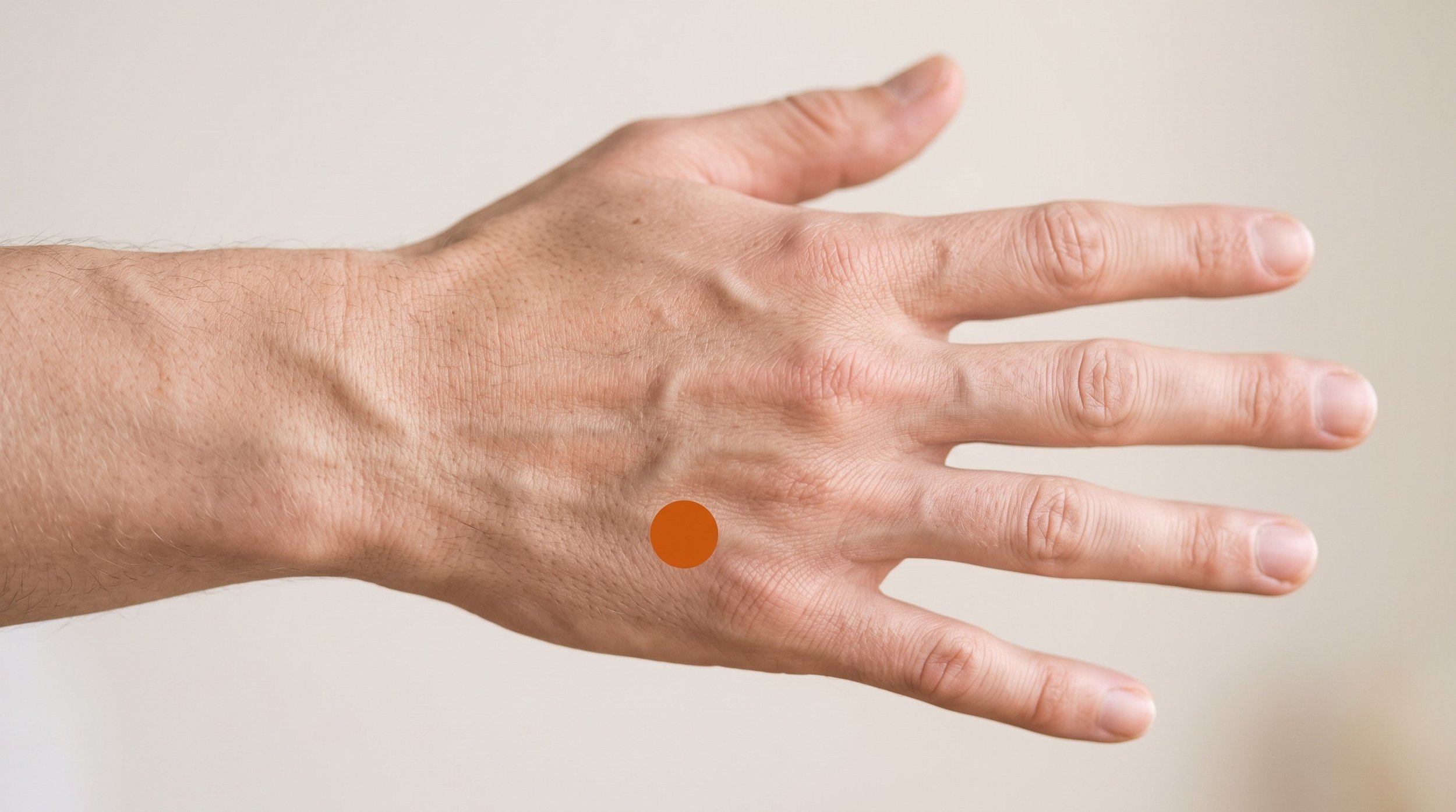
SJ3 Acupuncture Point (Zhongzhu)
The Central Islet Between the Hand Bones: Anatomy, Mechanism, and Why a Small Point on the Back of the Hand Became a Leading Distal Choice for the Ears
SJ3 (Zhongzhu, often translated as Central Islet or Middle Islet), also written TE3, sits on the back of the hand in the small hollow just behind the knuckles of the ring and little fingers, in the valley between the fourth and fifth metacarpal bones. It is the shu-stream and wood point of the Triple Burner (Sanjiao) channel, and in the classical literature it is one of the most heavily used distal points for the ears, the temples and the sides of the head (Deadman et al., 2007).
Clinically the te3 acupuncture point earns its place twice over: locally it sits directly over the dorsal interossei and the small joints that stiffen with gripping, typing and arthritis, and distally it is chosen for tinnitus, blocked or aching ears, one-sided head pain and sore throat. It is easy to find, easy to needle with the hand resting in a loose fist, and it gives strong, spreading de qi for such a small piece of anatomical real estate.
- Location and layers: SJ3 lies in the depression just proximal to the fourth and fifth metacarpophalangeal joints, between the two metacarpal shafts, with the needle passing through thin dorsal skin and the extensor tendon plane into the fourth dorsal interosseous muscle (Deadman et al., 2007).
- Traditional categories, translated: as the shu-stream and wood point of the Triple Burner channel it was classically used for joint pain and heaviness and for clearing heat upward along the channel (Deadman et al., 2007; Maciocia, 2015). In modern terms these are descriptions of a distal point that reliably produces strong afferent input and is used for both local hand problems and referred symptoms in the head.
- Nerve story: the site is served by dorsal digital branches of the ulnar nerve with superficial radial nerve territory nearby, and the deep branch of the ulnar nerve supplies the interossei beneath it, placing SJ3 in the C8 and T1 segments. Strong stimulation here recruits spinal and brainstem pain-modulating pathways rather than anything travelling up the arm as a literal current (Zhao, 2008).
- Ear connection: the Triple Burner channel is described in the classics as encircling and entering the ear, and Deadman ranks the zhongzhu ear point among the most important distal points for ear disorders of any pattern (Deadman et al., 2007). An animal study using electroacupuncture at SJ3 reported shifts in auditory evoked potential latencies, which suggests central auditory pathway effects rather than anything happening in the hand itself (Chang et al., 2022).
- Research picture: reviews of acupuncture for tinnitus report improvements on tinnitus handicap and severity scales but not consistently on visual analogue ratings, and reviewers describe the trial quality as low (Huang et al., 2021; Liu et al., 2016). Headache evidence is stronger, with Cochrane reviews supporting acupuncture for migraine prevention and tension-type headache (Linde et al., 2016a; Linde et al., 2016b).
- In practice and de qi: triple burner 3 is usually needled with the hand in a loose fist, 0.5 to 1 cun, angled proximally along the space between the metacarpals (Deadman et al., 2007). Patients typically feel a heavy, spreading ache between the bones that may travel toward the ring and little fingers or up the back of the hand, and it is often distinctly stronger than expected for a point this small.
Dealing With Ringing Ears, Ear Fullness or One-Sided Head Pain?
At Morningside Acupuncture we use SJ3 as a distal anchor in treatments for tinnitus, ear fullness and temple-dominant headaches, usually paired with local points around the ear and jaw and with hands-on work through the neck and masseter. Your acupuncturist will screen your history first, since ear symptoms deserve proper medical evaluation before anyone starts needling. Sessions are calm, precise and built around what your exam actually shows. Schedule a visit and let's map out a plan together.
Schedule NowAnatomy of SJ3: Why the Space Between the Fourth and Fifth Metacarpals Is Such an Important Location
Slide a fingertip back from the knuckles of the ring and little fingers and you drop into a shallow trough between two bones. That trough is SJ3. The tissue layers are thin and quickly interesting: loose dorsal skin, the superficial venous network of the hand, then the extensor digitorum tendons heading out to the fourth and fifth digits with their connecting bands, and beneath them the fourth dorsal interosseous muscle filling the intermetacarpal space (Deadman et al., 2007).
These small intrinsic muscles spread and stabilize the fingers during every pinch, grip and typing stroke, and they are loaded constantly by phone use, instrument playing, climbing, tool work and racket sports. Add arthritic or swollen metacarpophalangeal joints and the whole compartment becomes tender, which is one reason the zhongzhu hand point so often feels reactive on palpation.
The nerve geography explains much of what this point can and cannot do. Sensation over this part of the hand dorsum comes from dorsal digital branches of the ulnar nerve, with superficial radial nerve territory adjacent on the radial side of the space, while the deep branch of the ulnar nerve runs deeper in the palm to supply the interossei. That places SJ3 squarely in the C8 and T1 segments, the same neurological neighborhood as the lower cervical spine and the ulnar side of the forearm, which is why needling here can feel relevant in people whose hand symptoms actually originate higher up.
For symptoms in the head and ears there is no segmental link at all, so the plausible mechanism is heterosegmental: strong afferent input from a distal site engages spinal and brainstem circuits, including descending inhibitory pathways and endogenous opioid signaling, that dampen pain transmission more broadly (Zhao, 2008). Pooled patient data from chronic pain trials suggest effects that persist beyond the treatment session rather than fading immediately, which is consistent with a modulatory rather than a purely distracting mechanism (Vickers et al., 2018).
Deep to the muscle lie the dorsal metacarpal artery and its accompanying veins, and the visible dorsal venous arch sits just under the skin, so the practical caution here is vascular rather than visceral. There is no organ, lung or major nerve trunk at risk, and the main adverse event is a small bruise. Standard technique is to locate and needle with the hand in a loose fist, then insert perpendicularly or obliquely with the needle directed proximally along the intermetacarpal space to a depth of roughly 0.5 to 1 cun, with shallower insertion in thin or bony hands (Deadman et al., 2007). Clinicians avoid obvious surface veins, use fine gauge needles because dorsal skin is sensitive, and reduce depth if a patient is on anticoagulants.
Related Dorsal Interossei Trigger Points Related Pain Finder Forearm HandSJ3 (TE3) at a Glance: Classification, Location, and Clinical Use
| Category | Detail |
|---|---|
| Traditional Name | Zhongzhu, usually rendered as Central Islet or Middle Islet |
| Channel Classification | Triple Burner (Sanjiao) channel of the hand shaoyang, third point of the channel (SJ3, also written TE3 or TB3; also called the Triple Energizer, the Triple Heater or Triple Warmer) |
| Point Categories | Shu-stream point and wood point of the Triple Burner channel, one of the five transporting (shu) points of the channel; no meeting, crossing, hui-meeting or extraordinary vessel designations are attributed to this point in the classical sources consulted |
| Precise Location | On the dorsum of the hand, in the depression just proximal to the fourth and fifth metacarpophalangeal joints, between the fourth and fifth metacarpal bones; located and needled with the hand resting in a loose fist |
| Tissue Stimulated | Dorsal skin and superficial venous plane, extensor tendons of the ring and little fingers, and the fourth dorsal interosseous muscle, in ulnar and radial dorsal cutaneous nerve territory (C8 to T1) |
| Needle Depth / Direction | Perpendicular or oblique insertion angled proximally along the intermetacarpal space, 0.5 to 1 cun, shallower in thin hands |
| De Qi Sensation | A heavy, distending ache between the metacarpals that often spreads toward the ring and little fingers or proximally toward the wrist; frequently sharper on entry than expected because dorsal hand skin is sensitive |
| Primary Clinical Uses | Tinnitus, reduced hearing, earache and blocked ears after colds or air travel; one-sided headache and temple pain; red, sore eyes and throat pain; stiffness and pain of the fingers, hand, elbow and shoulder |
| Common Point Combinations |
|
Deadman's Manual of Acupuncture presents SJ3 as a point whose reputation rests on the described course of the Triple Burner channel, which is said to wind around and enter the ear, and it ranks the point among the most important distal choices for ear complaints of essentially any presentation (Deadman et al., 2007).
Traditionally, ringing and hearing loss were sorted into several recognized patterns, ranging from an external wind invasion or rising heat from the Liver, through phlegm obstruction, to depletion states and damage from trauma or loud noise, and SJ3 was considered especially fitting for the first two because distal shaoyang points were thought to release exterior pathogens while the wood point of the channel was thought to draw excess downward. The same commentary extends the point to earache, middle ear inflammation and ears that block during or after a cold.
When heat was said to harass the upper channel, the classical picture included one-sided head pain, temple pain, dizziness, red painful eyes, throat obstruction and a flushed face, and SJ3 was used to clear it. As a shu-stream point it was also indicated, following the Classic of Difficulties, for heaviness of the body and aching joints, hence its long use for stiff fingers, elbow and shoulder pain.
What is striking is the consistency: across a thousand years of formularies, the same small hollow on the back of the hand keeps reappearing whenever the problem sits in the ear or the side of the head.
Why SJ3 Is Used for Tinnitus, Blocked Ears and Temple Headaches When It Sits on the Back of the Hand
The honest answer is that nothing travels from your hand to your ear. What happens instead is neurological. SJ3 sits in C8 and T1 territory, so the local effects on stiff fingers, aching knuckles and ulnar-sided hand pain are straightforwardly segmental: the needle stimulates the same spinal segments that serve the painful tissue, which can reduce the excitability of those dorsal horn neurons and quiet local muscle guarding. That segmental logic also explains why the sj 3 hand point often gets combined with neck and shoulder treatment in people whose hand symptoms are partly driven from above.
For symptoms in the head, the mechanism has to be heterosegmental. Strong distal stimulation recruits ascending pathways to the brainstem and activates descending inhibitory systems that use serotonin, noradrenaline and endogenous opioids to reduce pain signaling at the spinal and trigeminal levels (Zhao, 2008). Practically, that is why distal points on the limbs have been used for centuries to treat the head, and why individual patient data from chronic pain trials show effects that outlast the session (Vickers et al., 2018).
There are also plausible autonomic contributions: needling can shift sympathetic tone and local blood flow, which matters for symptoms tied to circulation around the inner ear and to muscular tension around the temples and jaw.
Point-specific work on SJ3 is limited but interesting. An animal study applying low-frequency electroacupuncture at SJ3 reported changes in auditory brainstem response and long latency evoked potential timings compared with untreated controls, with the authors interpreting the findings as evidence of plasticity along the central auditory pathway (Chang et al., 2022). That is a long way from proving anything about human tinnitus, and it should be read as mechanistic hypothesis rather than clinical proof.
Still, it does suggest that stimulation at this location may reach auditory processing centrally, which is a more testable idea than the traditional explanation and one that fits the point's long clinical reputation.
What the Research Shows for SJ3 (TE3)
One note on naming before the evidence: in the research literature this point appears as TE3, the WHO standard code, and also as SJ3 or TB3 depending on the authors, so it is worth searching all three if you want to read the studies below in full.
It is worth setting expectations carefully. Almost no clinical trial tests SJ3 on its own, so the evidence below concerns multi-point acupuncture protocols in which SJ3 is one component, often combined with local ear points such as SI19, GB2 and SJ17 and with SJ5 on the forearm. Reviews of acupuncture for tinnitus are cautiously mixed and consistently flag small samples and methodological weaknesses, while the headache literature is considerably more developed.
Where SJ3 appears, it functions as a distal contributor to a wider prescription, not as a standalone treatment, and results from these reviews should not be read as evidence about any single point.
| Study | Type | Focus | Key Finding |
|---|---|---|---|
| Huang et al., 2021 | Systematic review and meta-analysis of randomized controlled trials | Acupuncture for tinnitus, eight trials with 504 participants | Tinnitus handicap and severity index scores improved with acupuncture while visual analogue scores did not differ significantly, and the authors judged the overall evidence insufficient for firm conclusions. |
| Liu et al., 2016 | Systematic review and meta-analysis | Acupuncture in the treatment of tinnitus | The review found no convincing evidence of benefit and emphasized that trial quality limited any conclusion, which is why ear-focused treatment is offered as a trial of care rather than a promise. |
| He et al., 2016 | Systematic review | Electroacupuncture for tinnitus | Reported possible symptomatic improvement in some trials but concluded that the evidence base was too weak and heterogeneous to support strong recommendations. |
| Linde et al., 2016b | Cochrane systematic review | Acupuncture for the prevention of episodic migraine | Adding acupuncture to usual care roughly doubled the proportion of people whose headache frequency at least halved compared with usual care alone, with small additional benefits over sham. |
| Linde et al., 2016a | Cochrane systematic review | Acupuncture for the prevention of tension-type headache | Acupuncture added to routine care reduced headache frequency, with the reviewers describing the evidence as reasonably consistent though effect sizes over sham were modest. |
| Vickers et al., 2018 | Individual patient data meta-analysis | Acupuncture for chronic musculoskeletal, headache and osteoarthritis pain | Acupuncture outperformed both sham and no-acupuncture controls, and the benefit persisted at twelve months, supporting the use of distal points within multi-point protocols. |
| Chang et al., 2022 | Controlled animal study of auditory evoked potentials | Electroacupuncture applied specifically at SJ3 | Stimulation at SJ3 altered auditory brainstem and long latency response timings relative to controls, which the authors interpreted as evidence of central auditory plasticity. |
| Zhao, 2008 | Narrative review of neurophysiology | Mechanisms of acupuncture analgesia | Describes how needle stimulation engages spinal, brainstem and endogenous opioid mechanisms, the most plausible framework for a distal hand point influencing head symptoms. |
Stiff Hands, Aching Knuckles or Grip Pain That Will Not Settle?
SJ3 sits directly over the dorsal interossei, which makes it a natural target when the back of the hand feels tight, the knuckles ache after long keyboard days, or the fingers no longer open and close cleanly. We combine needling here with dry needling of the intrinsic hand muscles and forearm extensors, plus loading advice so the tissue tolerates more over time. Most patients notice how much freer the hand feels within the first few sessions. Book an appointment and we'll assess the whole chain from neck to fingertips.
Schedule NowSJ3 in the Context of Trigger Point Work
SJ3 sits directly over the fourth dorsal interosseous muscle, and the dorsal interossei are well-described trigger point sites that can refer pain along the side of the adjacent finger and across the back of the hand, sometimes with stiffness and a sense of clumsiness rather than pure pain (Simons et al., 1999). Because acupuncture is defined by the use of an acupuncture needle across many styles, including dry needling, the same insertion can be framed either as needling triple burner 3 or as treating a taut band in the interosseous compartment.
In practice the palpation finding decides the technique: a discretely tender nodule invites a more targeted approach with brief needle manipulation, while a diffusely achy hand does better with gentler stimulation and shorter retention.
At Morningside we rarely treat the hand in isolation. A typical session for grip pain, knuckle stiffness or ulnar-sided hand symptoms combines SJ3 with dry needling of the other interossei, adductor pollicis, the forearm extensor group and, when the exam points that way, the scalenes and infraspinatus, since referral from the neck and shoulder girdle can masquerade as a hand problem.
For patients whose symptoms are ear or head dominant, SJ3 is used as the distal anchor alongside local needling around the ear and jaw and manual work through the suboccipitals and masseter. Follow-up is guided by function, meaning grip comfort, finger range and headache or tinnitus diaries rather than how tender the point felt on day one.
SJ3 Ear and Headache Treatment at NYC's Highest-Rated Acupuncture Clinic
Morningside Acupuncture is the highest-rated acupuncture and dry needling clinic in New York City with over 500 five-star Google reviews, and points like the sj 3 hand point are part of how we build treatments for tinnitus, ear discomfort, migraines and neck-driven head pain. Every plan is individualized, explained in plain language, and grounded in both classical point selection and current pain science. You will always know why a given needle is going where it goes. Schedule your first session and see what a thoughtful, thorough treatment feels like.
Schedule NowFrequently Asked Questions
Is SJ3 the same point as TE3 or TB3?
Yes. SJ3, TE3, and TB3 are all codes for the same point, Zhongzhu. SJ stands for San Jiao, the Chinese name of the channel. TE (Triple Energizer) is the WHO standard abbreviation and the one you will see in most Western textbooks and research papers. TB (Triple Burner) and TW (Triple Warmer) are older English renderings of the same name that still appear in many books. You will also come across it written as San Jiao 3 or Triple Energizer 3. Whichever code is used, the location and the uses are the same.
What does SJ3 feel like when needled?
Most people describe a heavy, distending ache that fills the space between the ring and little finger metacarpals, sometimes spreading toward those fingers or proximally up the back of the hand toward the wrist. The initial pinprick can be sharper than at points on thicker tissue, because the skin on the dorsum of the hand is thin and well supplied with nerve endings. That sensation, traditionally called de qi, usually settles within a few seconds and often gives way to a warm, slightly numb heaviness. If the sensation is electric, radiating and unpleasant, tell your acupuncturist so the needle can be adjusted.
Why would a point on the hand be used for a problem in the ear or the temple?
Because the effect is neurological rather than anything travelling up the arm. Strong stimulation at a distal site sends afferent input into the spinal cord and brainstem and engages descending pathways that reduce pain signaling elsewhere, including in the trigeminal system that serves the face and head (Zhao, 2008). Classically, the Triple Burner channel was described as encircling and entering the ear, which is why SJ3 became a leading distal point for ear symptoms (Deadman et al., 2007). The traditional map and the modern mechanism arrive at similar clinical choices from very different starting points.
Can I press SJ3 myself between sessions?
Yes, and it is one of the easier points to self-treat. Rest the hand in a loose fist, then use the thumb or a knuckle of the opposite hand to press into the hollow just behind the knuckles of the ring and little fingers, angling slightly toward the wrist and into the groove between the bones. Apply firm, steady pressure that registers as a strong ache but never as sharp pain, hold for 30 to 60 seconds, release, and repeat two or three times per hand. Small circular pressure for a minute or two also works well. Two or three rounds a day is plenty, and for blocked ears after a flight some people combine pressure here with gentle swallowing or a soft nose-pinch exhale. Stop if the area bruises, feels numb or becomes more painful afterward.
Is SJ3 safe to needle?
It is considered a low-risk point. There is no organ, lung or major nerve trunk beneath it, so the practical cautions are minor: the superficial veins on the back of the hand can bruise, and the skin is sensitive, so fine needles and careful insertion matter. Practitioners avoid needling through visible veins, reduce depth in thin hands, and use extra care in people taking blood thinners or with local infection, open skin or significant swelling of the hand. Standard depth is roughly 0.5 to 1 cun with the needle angled proximally (Deadman et al., 2007). As with any point, tell your acupuncturist about bleeding disorders, medications and recent hand injuries.
Where exactly is SJ3 located?
Make a loose fist and look at the back of your hand. Find the knuckles of your ring and little fingers, then slide a fingertip about a thumb's width back from them into the valley between the fourth and fifth metacarpal bones. The depression you fall into just proximal to those two knuckles is SJ3 (Deadman et al., 2007). A useful check is that the point sits at the apex of a roughly equal-sided triangle formed with the two knuckle prominences. One naming note worth knowing: the zhongzhu hand point shares its pinyin name with KI15 on the abdomen, so when reading older texts, confirm which Zhongzhu is meant.
References
- Deadman, P., Al-Khafaji, M., & Baker, K. (2009). A manual of acupuncture. Journal of Chinese Medicine Publications.
- Maciocia, G. (2005). The foundations of Chinese medicine: A comprehensive text for acupuncturists and herbalists (2nd ed.). Elsevier Churchill Livingstone.
- Simons, D. G., Travell, J. G., & Simons, L. S. (1999). Travell & Simons' myofascial pain and dysfunction: The trigger point manual, Vol. 1: Upper half of body (2nd ed.). Williams & Wilkins.
- Zhao, Z. Q. (2008). Neural mechanism underlying acupuncture analgesia. Progress in Neurobiology, 85(4), 355-375. https://doi.org/10.1016/j.pneurobio.2008.05.004
- Vickers, A. J., Vertosick, E. A., Lewith, G., MacPherson, H., Foster, N. E., Sherman, K. J., Irnich, D., Witt, C. M., & Linde, K. (2018). Acupuncture for chronic pain: Update of an individual patient data meta-analysis. Journal of Pain, 19(5), 455-474. https://doi.org/10.1016/j.jpain.2017.11.005
- Linde, K., Allais, G., Brinkhaus, B., Fei, Y., Mehring, M., Shin, B. C., Vickers, A., & White, A. R. (2016a). Acupuncture for the prevention of tension-type headache. Cochrane Database of Systematic Reviews, 2016(4), CD007587. https://doi.org/10.1002/14651858.CD007587.pub2
- Linde, K., Allais, G., Brinkhaus, B., Fei, Y., Mehring, M., Vertosick, E. A., Vickers, A., & White, A. R. (2016b). Acupuncture for the prevention of episodic migraine. Cochrane Database of Systematic Reviews, 2016(6), CD001218. https://doi.org/10.1002/14651858.CD001218.pub3
- Huang, K., Liang, S., Chen, L., & Grellet, A. (2021). Acupuncture for tinnitus: A systematic review and meta-analysis of randomized controlled trials. Acupuncture in Medicine, 39(4), 264-271. https://doi.org/10.1177/0964528420938380
- Liu, F., Han, X., Li, Y., & Yu, S. (2016). Acupuncture in the treatment of tinnitus: A systematic review and meta-analysis. European Archives of Oto-Rhino-Laryngology, 273(2), 285-294. https://doi.org/10.1007/s00405-014-3341-7
- He, M., Li, X., Liu, Y., Zhong, J., Jiang, L., Liu, Y., Xu, S., & Feng, S. (2016). Electroacupuncture for tinnitus: A systematic review. PLoS ONE, 11(3), e0150600. https://doi.org/10.1371/journal.pone.0150600
- Chang, C. H., Lin, C. D., & Hsieh, C. L. (2022). Electroacupuncture promotes neuroplasticity of central auditory pathway: An auditory evoked potentials study. Evidence-Based Complementary and Alternative Medicine, 2022, 6855775. https://doi.org/10.1155/2022/6855775
Disclaimer: This web site is intended for educational and informational purposes only. Reading this website does not constitute providing medical advice or any professional services. This information should not be used for diagnosing or treating any health issue or disease. Those seeking medical advice should consult with a licensed physician. Seek the advice of a medical doctor or other qualified health professional for any medical condition. If you think you have a medical emergency, call 911 or go to the emergency room. No acupuncturist-patient relationship is created by reading this website or using the information. Morningside Acupuncture PLLC and its employees and contributors do not make any express or implied representations with respect to the information on this site or its use. For any legal interpretation of scope of practice in your state, consult a licensed attorney or regulatory authority.
Read more from our blog



