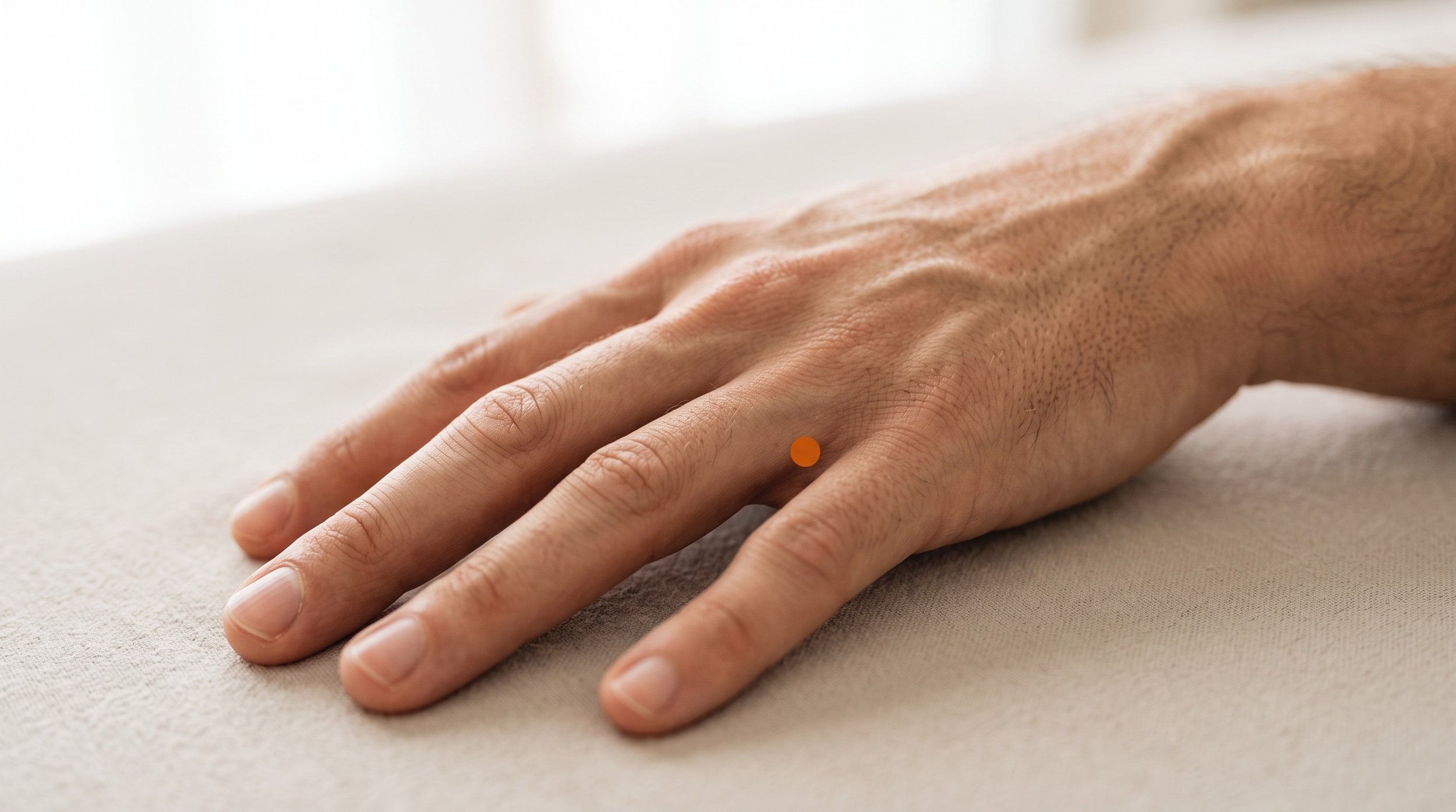
SJ2 Acupuncture Point (Yemen)
The Fluid Gate in the Web of the Hand: Anatomy, Mechanism, and Why This Small Triple Burner Point Is Used for the Ears, the Throat, and the Hand Itself
SJ2 (Yemen, usually translated as Fluid Gate or Fluid Door), also written TE2, sits in the soft web between the ring finger and the little finger, about half a cun back from the free edge of the webbing, and it is easiest to find and needle with the hand relaxed into a loose fist. It is the ying-spring point and the water point of the Triple Burner channel, which in classical five-shu theory makes it one of the small distal points reached for when symptoms cluster in the head, and specifically in the ears, eyes, throat, gums and temples.
Modern clinics also use the te2 acupuncture point far more locally, since the needle enters tissue directly over the fourth dorsal interosseous muscle, in territory that matters for grip fatigue, keyboard and instrument overuse, and ulnar-sided hand ache. That double identity, a distal point for the head and a local point for the hand, is what makes triple burner 2 worth understanding rather than skipping over on the way to more famous points.
- Location and layers: SJ2 lies between the fourth and fifth fingers, roughly 0.5 cun proximal to the web margin at the junction of the paler palmar skin and the darker dorsal skin, and the needle passes through thin skin and loose web tissue onto the fourth dorsal interosseous muscle. The hand is held in a loose fist so the web crease becomes visible.
- Traditional categories, translated: classical texts assign Yemen to the ying-spring class and to water within the five-phase scheme of the Triple Burner channel, and the Classic of Difficulties groups ying-spring points with heat in the body. In neurophysiological language, that traditional heat category maps onto the modern use of distal points to modulate inflammatory, congestive and irritable symptoms in the head rather than to any measurable change in body temperature.
- Nerve story: the point sits in dorsal digital nerve territory from the ulnar nerve, with segmental input arriving at the lower cervical and upper thoracic cord. Effects felt in the head are best explained by brainstem and spinal modulation rather than by anything travelling up the arm, since needle-evoked afferent input recruits descending inhibitory pathways involving the periaqueductal gray and medullary relays (Zhao, 2008).
- Research picture: the strongest ear-related evidence is for sudden sensorineural hearing loss, where acupuncture added to standard medical care performed better than standard care alone, though the trials were small and at high risk of bias (Zhang et al., 2015; Ren et al., 2024). Tinnitus evidence is weaker and inconsistent (Huang et al., 2021).
- Clinical framing: SJ2 is rarely the whole treatment. It is typically added to local ear, jaw and neck points, or used on the opposite side while the affected area is being palpated, and its distal analgesic contribution is consistent with the pooled effects seen for acupuncture in chronic pain conditions (Vickers et al., 2018).
- De qi: patients usually report a brief sharp pinch as the thin web skin is crossed, followed by a heavy, spreading ache or fullness that may travel toward the wrist or along the ulnar border of the hand. A light tingle toward the ring and little fingers is common and settles quickly.
Struggling With Ear Fullness, Tinnitus, or Jaw Tension in NYC?
At Morningside Acupuncture we treat ear and jaw complaints as a regional problem, not a single point problem, which means SJ2 is usually paired with local needling around the ear, the temporalis and masseter, and the upper cervical muscles. Yemen acupuncture gives us a comfortable distal option when the head and jaw are too tender to work on aggressively in a first session. We will map what reproduces your symptoms before a single needle goes in. Schedule an evaluation and let's build a plan around what your exam actually shows.
Schedule NowAnatomy of SJ2: Why the Web Between the Ring and Little Fingers Is Such an Important Location
Start with the hand relaxed into a loose fist so the web between the ring and little fingers folds into a visible crease. SJ2 is at the proximal end of that crease, about half a cun back from the free margin of the web, right where the paler palmar skin meets the darker skin of the hand's back. The layers are shallow and few: thin mobile skin, a small pad of loose subcutaneous tissue, and then the fascia over the fourth dorsal interosseous muscle running between the fourth and fifth metacarpals.
This is working tissue. The interossei spread and draw together the fingers and stabilize them during pinch and grip, so they accumulate load in anyone who types all day, carries bags across the city, climbs, plays a stringed instrument, or grips tools.
The sensory supply here comes from dorsal digital branches of the ulnar nerve, with contributions from the surrounding dorsal metacarpal network, and those fibers report back to the lower cervical and upper thoracic segments of the spinal cord. Needling produces a mixed afferent barrage from skin, fascia and muscle that changes how those segments process incoming signals, which is the plain-language version of segmental modulation.
Effects reported in the head cannot be explained segmentally, since the ear and jaw are supplied by trigeminal and upper cervical territory, so the more plausible account is heterosegmental: needle input engages brainstem circuits, including the periaqueductal gray and rostral ventromedial medulla, that broadcast descending inhibition well beyond the segment stimulated (Zhao, 2008). Imaging work in ear-symptom populations is early but consistent with acupuncture altering cortical activity rather than acting only at the needle site (Yu et al., 2023).
Deep to the point run the dorsal digital arteries and their small accompanying veins, part of the dorsal metacarpal supply, and beneath those sit the interosseous muscles and the metacarpal shafts. There are no organs, no lung field and no large vessels at risk, which makes SJ2 a low-hazard location, but the tissue is thin and vascular enough that a small bruise is the most common side effect. Standard needling is perpendicular to a depth of 0.3 to 0.5 cun, and several classical and modern texts describe angling slightly toward the space between the metacarpal bones instead of straight down. Clean technique, a fine gauge needle, and firm brief pressure on withdrawal keep bruising rare.
Related Dorsal Interossei Trigger Points Related Pain Finder Forearm HandSJ2 (TE2) at a Glance: Classification, Location, and Clinical Use
| Category | Detail |
|---|---|
| Traditional Name | Yemen, commonly translated as Fluid Gate or Fluid Door |
| Channel Classification | Point 2 of the Triple Burner (Sanjiao) channel of the hand shaoyang, also written TB-2, SJ2 or Triple Energizer 2 (also called the Triple Heater or Triple Warmer) |
| Point Categories | Ying-spring point of the Triple Burner channel and the water point of that channel in the five-shu five-phase system. The Classic of Difficulties places ying-spring points in the class traditionally indicated for heat in the body. No meeting, hui-meeting or extraordinary vessel designations are attributed to this point. |
| Precise Location | On the back of the hand between the ring and little fingers, about 0.5 cun proximal to the margin of the web, at the junction of the paler and darker skin. Locate and needle with the hand resting in a loose fist, at the proximal end of the visible web crease. |
| Tissue Stimulated | Thin dorsal web skin, loose subcutaneous tissue, and fascia over the fourth dorsal interosseous muscle, in dorsal digital nerve territory from the ulnar nerve, adjacent to the abductor digiti minimi |
| Needle Depth / Direction | Perpendicular insertion 0.3 to 0.5 cun, or angled slightly proximally toward the space between the fourth and fifth metacarpals; moxibustion is described as applicable in several classical sources |
| De Qi Sensation | A brief sharp pinch as the thin web skin is crossed, then a spreading heaviness, ache or fullness that may run toward the wrist or along the ulnar side of the hand, sometimes with a short-lived tingle toward the ring and little fingers |
| Primary Clinical Uses | Traditionally used for ear complaints (deafness, sudden deafness, tinnitus, earache), red or dry eyes, sore throat, painful or bleeding gums and toothache, fright palpitations and agitation, temporal headache, and local pain, swelling or weakness of the wrist, hand and fingers |
| Common Point Combinations |
|
In the Deadman text, Yemen is presented as a point that clears heat from the upper reaches of the Triple Burner channel, and the reasoning given is anatomical in a traditional sense: the channel is described as ascending around and into the ear, toward the outer corner of the eye and the area below it, and through the cheek.
Because the ying-spring points are traditionally the class assigned to heat, a distal point on this particular channel is presented as a natural choice for hot, irritable symptoms in exactly those regions, which is why the classical indication lists cluster so tightly around ears, eyes, throat, gums and teeth.
A second traditional line of reasoning runs through the interior and exterior relationship between the Triple Burner and the Pericardium, the wrapping of the Heart, which is how the same point acquires its reputation for calming fright, palpitations and agitated mental states.
Deadman also contrasts it with its neighbor SJ1, describing Yemen as the weaker choice for fever and for shoulder and elbow problems but the stronger choice for settling the spirit and for local complaints of the wrist, hand and fingers.
What is striking is the internal consistency of the classical pattern: one small web-space point, three very different symptom domains, and a single traditional logic that ties them together.
Why SJ2 Is Used for Ear, Throat, and Jaw Symptoms That Are Nowhere Near the Hand
The honest answer is that the classical explanation and the neurophysiological explanation are different, and only the second one can be tested. The web of the hand is supplied by dorsal digital branches of the ulnar nerve, feeding into the lower cervical and upper thoracic spinal segments, while the ear, throat and jaw are supplied by trigeminal, facial, glossopharyngeal and upper cervical inputs. There is no shared segment, so nothing about needling here should locally change tissue in the ear. What can change is central processing.
Needle stimulation strong enough to produce de qi recruits small-diameter afferents that engage brainstem circuits, including the periaqueductal gray and rostral ventromedial medulla, which then send inhibitory signals downward and influence how widely separated regions are represented centrally (Zhao, 2008). This is the same machinery invoked to explain why distal needling helps pain that is not near the needle, and pooled patient-level data across chronic pain conditions show effects that are modest but consistent and durable (Vickers et al., 2018).
Early imaging work in people with tinnitus, using functional near-infrared spectroscopy, has found changes in cortical activation following acupuncture, which supports a central rather than local mechanism even though it does not establish clinical benefit (Yu et al., 2023).
Practically, that reframes what SJ2 is for. It is a low-discomfort distal input that may help downshift an irritable system while local work is done at the ear, jaw and neck, and it gives the clinician somewhere to needle when the head itself is too sensitive to touch. It is not a substitute for an ENT evaluation. Sudden hearing loss in particular is a time-sensitive medical problem and needs urgent assessment first.
What the Research Shows for SJ2 (TE2)
One note on naming before the evidence: in the research literature this point appears as TE2, the WHO standard code, and also as SJ2 or TB2 depending on the authors, so it is worth searching all three if you want to read the studies below in full.
A caution before the table: no trial has isolated SJ2. Studies test multi-point protocols selected by pattern or by convention, and a hand shaoyang point like Yemen is one of several needles in a session that also includes local ear, jaw or neck points. What the literature can tell us is whether the protocols that commonly contain points like this one outperform their comparators, and the answer varies sharply by condition. Sudden sensorineural hearing loss has the most supportive data, tinnitus the least, and anxiety-related outcomes sit somewhere in between with real methodological limits.
| Study | Type | Focus | Key Finding |
|---|---|---|---|
| Zhang et al., 2015 | Systematic review and meta-analysis of RCTs | Acupuncture for sudden sensorineural hearing loss, 12 trials, 863 patients | Acupuncture added to comprehensive medical treatment outperformed medical treatment alone, but the authors graded the evidence as low or very low certainty and found insufficient support for acupuncture used by itself. |
| Ren et al., 2024 | Systematic review and meta-analysis of RCTs | Acupuncture for sudden sensorineural hearing loss, 28 trials, 2,456 patients | Combining acupuncture with standard medical care was associated with better effective and cure rates and greater hearing threshold change than standard care alone, though trial quality remained a limitation. |
| Huang et al., 2021 | Systematic review and meta-analysis of RCTs | Acupuncture for tinnitus, 8 trials, 504 participants | No statistically significant difference in tinnitus visual analogue scores was found, and the authors judged the evidence insufficient for firm conclusions given small samples and low study quality. |
| Yang et al., 2021 | Systematic review and meta-analysis of RCTs | Acupuncture for anxiety disorder, 20 trials | Pooled results favored acupuncture over control conditions for anxiety symptoms with a small to moderate effect size, though most included trials had methodological weaknesses. |
| Vickers et al., 2018 | Individual patient data meta-analysis | Acupuncture across chronic pain conditions, roughly 20,800 patients | Acupuncture was superior to both sham and no-acupuncture controls, with effects that persisted over about a year, supporting a genuine but moderate treatment effect. |
| Yu et al., 2023 | Functional near-infrared spectroscopy study | Cortical activation during acupuncture in patients with tinnitus | Acupuncture was associated with measurable changes in cortical activation patterns, consistent with central modulation rather than a purely local effect. |
| Zhao, 2008 | Narrative review of mechanism research | Neural mechanisms of acupuncture analgesia | Describes needle-evoked afferent input engaging spinal, brainstem and cortical circuits, providing the framework for how a distal hand point can influence symptoms in the head. |
Hand Ache, Grip Fatigue, or Ulnar-Sided Tightness From Long Work Days?
The sj 2 hand location sits directly over the fourth dorsal interosseous, one of the small hand muscles that quietly loads up during hours of typing, gripping, lifting and playing an instrument. We combine gentle needling at SJ2 with dry needling of the interossei and forearm extensors, plus grip and wrist mechanics you can actually maintain. Most patients notice the difference in how the hand feels at the end of a workday rather than in a single dramatic moment. Book a session and we will assess your hand, wrist and forearm together.
Schedule NowSJ2 in the Context of Trigger Point Work
Because acupuncture is defined by the use of an acupuncture needle across hundreds of styles, including dry needling, there is no conflict between choosing SJ2 by channel theory and choosing the fourth dorsal interosseous by palpation. They are often the same needle. The Travell and Simons manual describes the interossei of the hand as a source of aching along the corresponding finger and the adjacent side of the hand, sometimes with stiffness and a sense of clumsiness, and taut bands here are common in people whose work involves sustained grip or repetitive pinch (Simons, Travell, & Simons, 1999).
At Morningside we palpate the web spaces directly, and when a tender band reproduces the patient's familiar ache we treat it, using the same shallow angle described for SJ2.
In practice the hand is rarely treated in isolation. Sessions for ulnar-sided hand pain or grip fatigue usually combine SJ2 and the interossei with dry needling of the abductor digiti minimi, the forearm extensor group and, where the exam points that way, structures higher up in the forearm and shoulder girdle. For ear and jaw presentations the pairing runs the other way, with SJ2 used as a distal input while the masseter, temporalis and suboccipital muscles receive the local work. Needles at this location are fine gauge and briefly retained, and we always give patients the option of lighter stimulation on a first visit.
SJ2 Ear, Jaw, and Hand Treatment at NYC's Highest-Rated Acupuncture Clinic
Morningside Acupuncture is the highest-rated acupuncture and dry needling clinic in New York City with over 500 five-star Google reviews, and our approach blends classical point selection with modern pain science. We use the te2 acupuncture point as part of structured protocols for ear symptoms, jaw tension and hand overuse, always alongside a clear explanation of what we expect and how long it should take. You will leave knowing what we treated, why we chose it, and what to do between visits. Schedule your first appointment on the Upper West Side today.
Schedule NowFrequently Asked Questions
Is SJ2 the same point as TE2 or TB2?
Yes. SJ2, TE2, and TB2 are all codes for the same point, Yemen. SJ stands for San Jiao, the Chinese name of the channel. TE (Triple Energizer) is the WHO standard abbreviation and the one you will see in most Western textbooks and research papers. TB (Triple Burner) and TW (Triple Warmer) are older English renderings of the same name that still appear in many books. You will also come across it written as San Jiao 2 or Triple Energizer 2. Whichever code is used, the location and the uses are the same.
What does SJ2 feel like when needled?
Most people feel a quick sharp pinch as the needle crosses the thin skin of the web, and then that fades into a duller sensation: heaviness, ache, or a spreading fullness that may travel toward the wrist or along the little finger side of the hand. Some patients notice a brief tingle running out toward the ring and little fingers, which settles within a few seconds. It should never feel like a sustained electric jolt. If it does, we withdraw slightly and redirect. The web space is more sensitive than most forearm points, so we usually use a fine needle and moderate stimulation.
Why needle a point on the hand for ear or jaw symptoms instead of treating the ear directly?
Usually we do both, but distal points give us useful options. Needling at a distance recruits descending inhibitory pathways from the brainstem that influence how the nervous system processes input from regions far from the needle (Zhao, 2008), which is why distal points appear in nearly every classical formula for the head. Practically, a distal point also lets us begin treatment when the ear, jaw or temple is too irritable to needle locally, and it gives us something to work with on the opposite side while we reassess the painful area. Classical sources took the same approach: the ear formulas that include Yemen almost always pair it with points near the ear itself.
Can I press SJ2 myself between sessions?
Yes, and it is one of the easier points to self-treat because you can see and feel it. Rest the hand in a loose fist, find the crease in the web between your ring and little fingers, and slide your opposite thumb about half a thumb-width back from the free edge of the web. Squeeze the web between your thumb and index finger with firm, steady pressure until you feel a dull ache rather than a sharp pain, hold for 30 to 60 seconds, release, and repeat two or three times per hand. Two or three short rounds a day is plenty. Stop if you notice numbness, increasing sharpness or any lasting tenderness, and skip it entirely over broken skin, an active infection or a recent hand injury. Acupressure here may take the edge off tension, but it is a supplement to treatment rather than a replacement for it.
Is SJ2 safe to needle?
In trained hands, yes. There are no organs, lung fields or major vessels near this location, and needling is shallow at 0.3 to 0.5 cun. The realistic risks are small bruising from the dorsal digital vessels, brief post-needle soreness, and momentary nerve tingling from the dorsal digital branches of the ulnar nerve, all of which resolve quickly. We use single-use sterile needles, avoid the point over broken or infected skin, take extra care with anyone on anticoagulants or with fragile skin, and apply brief pressure after withdrawal. Anyone with sudden hearing loss, new severe ear pain, or unexplained facial numbness should be evaluated medically first, since acupuncture is an adjunct in those situations and not a substitute for urgent care.
Where exactly is SJ2 located?
On the back of the hand, in the web between the ring finger and the little finger, roughly 0.5 cun proximal to the free margin of the web, at the junction between the paler palm-side skin and the darker skin of the hand's back. The reliable way to find it is to let the hand fall into a loose fist so the web bunches into a visible crease, then take the point at the proximal end of that crease, in the depression between the fourth and fifth metacarpals. In modern anatomical terms you are sitting over the fourth dorsal interosseous muscle, in the sensory territory of dorsal digital branches of the ulnar nerve.
References
- Deadman, P., Al-Khafaji, M., & Baker, K. (2009). A manual of acupuncture. Journal of Chinese Medicine Publications.
- Cheng, X. (Ed.). (1999). Chinese acupuncture and moxibustion (Rev. ed.). Foreign Languages Press.
- Kim, H. (2008). Handbook of Oriental medicine (3rd ed.). Harmony & Balance Press.
- Maciocia, G. (2005). The foundations of Chinese medicine: A comprehensive text for acupuncturists and herbalists (2nd ed.). Elsevier Churchill Livingstone.
- Maciocia, G. (2006). The channels of acupuncture: Clinical use of the secondary channels and eight extraordinary vessels. Churchill Livingstone Elsevier.
- Simons, D. G., Travell, J. G., & Simons, L. S. (1999). Travell & Simons' myofascial pain and dysfunction: The trigger point manual, Vol. 1: Upper half of body (2nd ed.). Williams & Wilkins.
- Zhang, X.-C., Xu, X.-P., Xu, W.-T., Hou, W.-Z., Cheng, Y.-Y., Li, C.-X., & Ni, G.-X. (2015). Acupuncture therapy for sudden sensorineural hearing loss: A systematic review and meta-analysis of randomized controlled trials. PLoS ONE, 10(4), e0125240. https://doi.org/10.1371/journal.pone.0125240
- Ren, W., Tao, B., & Deng, H. (2024). The efficacy and safety of acupuncture in the treatment of sudden sensorineural hearing loss: A systematic review and meta-analysis. Integrative Medicine Research, 13(4), 101087. https://doi.org/10.1016/j.imr.2024.101087
- Huang, K., Liang, S., Chen, L., & Grellet, A. (2021). Acupuncture for tinnitus: A systematic review and meta-analysis of randomized controlled trials. Acupuncture in Medicine, 39(4), 264-271. https://doi.org/10.1177/0964528420938380
- Yang, X.-Y., Yang, N.-B., Huang, F.-F., Ren, S., & Li, Z.-J. (2021). Effectiveness of acupuncture on anxiety disorder: A systematic review and meta-analysis of randomised controlled trials. Annals of General Psychiatry, 20, 9. https://doi.org/10.1186/s12991-021-00327-5
- Yu, X., Gong, B., Yang, H., Wang, Z., Qi, G., Sun, J., et al. (2023). Effect of acupuncture treatment on cortical activation in patients with tinnitus: A functional near-infrared spectroscopy study. IEEE Transactions on Neural Systems and Rehabilitation Engineering, 31, 729-737. https://doi.org/10.1109/TNSRE.2022.3231899
- Vickers, A. J., Vertosick, E. A., Lewith, G., MacPherson, H., Foster, N. E., Sherman, K. J., Irnich, D., Witt, C. M., & Linde, K. (2018). Acupuncture for chronic pain: Update of an individual patient data meta-analysis. Journal of Pain, 19(5), 455-474. https://doi.org/10.1016/j.jpain.2017.11.005
- Zhao, Z. Q. (2008). Neural mechanism underlying acupuncture analgesia. Progress in Neurobiology, 85(4), 355-375. https://doi.org/10.1016/j.pneurobio.2008.05.004
Disclaimer: This web site is intended for educational and informational purposes only. Reading this website does not constitute providing medical advice or any professional services. This information should not be used for diagnosing or treating any health issue or disease. Those seeking medical advice should consult with a licensed physician. Seek the advice of a medical doctor or other qualified health professional for any medical condition. If you think you have a medical emergency, call 911 or go to the emergency room. No acupuncturist-patient relationship is created by reading this website or using the information. Morningside Acupuncture PLLC and its employees and contributors do not make any express or implied representations with respect to the information on this site or its use. For any legal interpretation of scope of practice in your state, consult a licensed attorney or regulatory authority.
Read more from our blog



