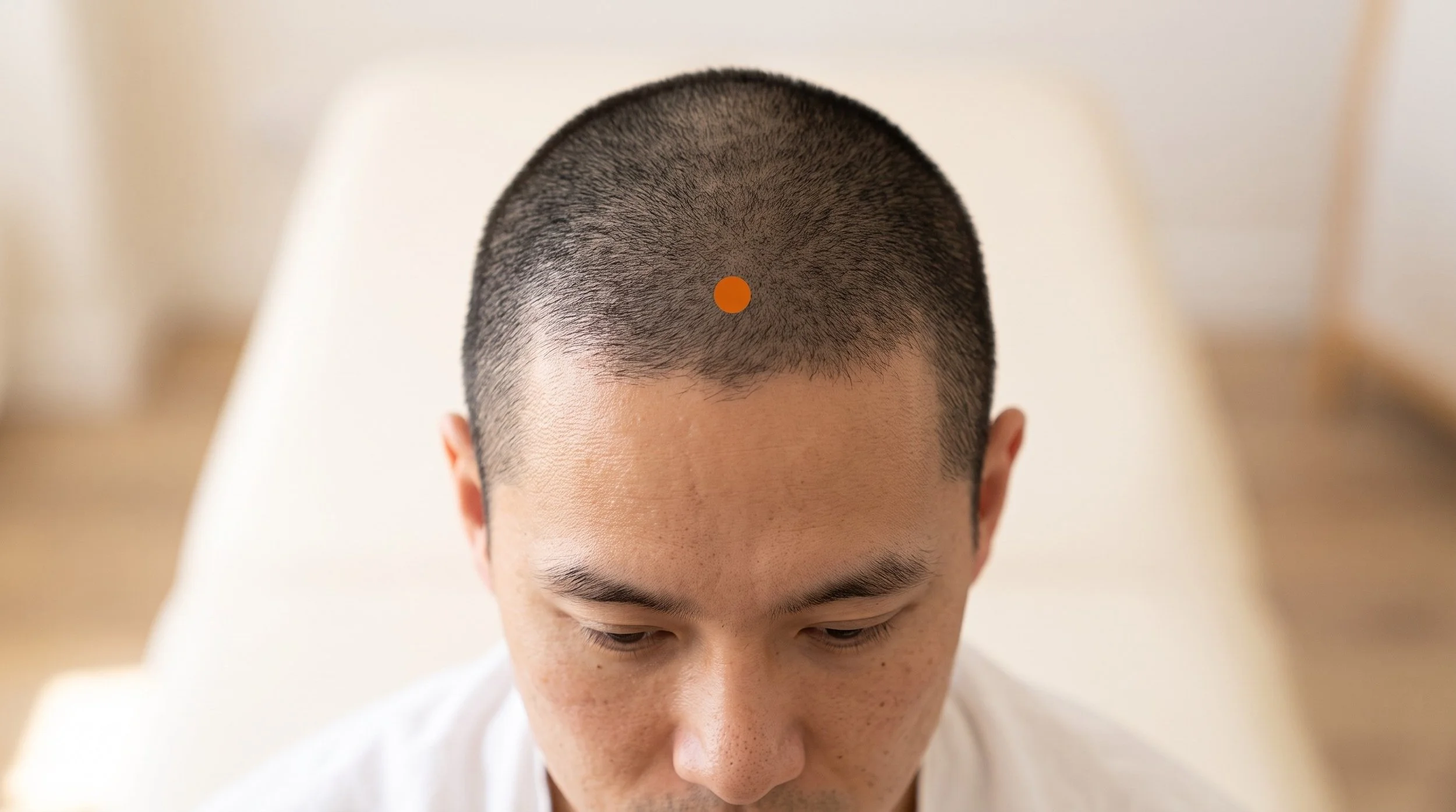
DU23 Acupuncture Point (Shangxing)
The Upper Star Above the Forehead: Anatomy, Mechanism, and Why a Point on the Scalp Is Traditionally the Command Point for the Nose
DU23 (Shangxing, "Upper Star"), also written GV23, sits on the midline of the front of the scalp, about one thumb-width behind the front hairline and just behind DU24, directly above the bridge of the nose. It is one of the most frequently chosen head points for nasal complaints in classical acupuncture, and the reason is partly geographic: the Governing vessel is described as running over the vertex and then down the forehead into the nose, so this GV23 acupuncture point sits at the top of that line, in what Deadman's Manual of Acupuncture calls a commanding position for nasal disorders.
In modern terms, governing vessel 23 sits in trigeminal territory shared with the frontal sinus and the upper nasal cavity, which gives a plausible neurological reason why a needle placed on the forehead scalp can change how a congested nose and a heavy sinus headache feel.
- Location and layers: DU23 is on the midline 1 cun behind the anterior hairline and 0.5 cun behind DU24, where the left and right frontal bellies of occipitofrontalis meet the galea aponeurotica over the frontal bone. Needling is transverse (subcutaneous) at 0.5 to 1 cun, since there is no muscle belly of any depth to enter here.
- Traditional categories, translated: classical texts group Shangxing under points that open the nose, clear wind heat from the head and face, brighten the eyes and settle the spirit, and list it among Sun Si-miao's thirteen ghost points. Read neurophysiologically, that cluster describes a point used for trigeminally mediated head and face symptoms and for the arousal and autonomic changes that ride along with them.
- Mechanism: the skin here is supplied by the supratrochlear and supraorbital branches of the frontal nerve (V1), the same trigeminal division that carries sensation from the frontal sinus, the ethmoid air cells and the upper nasal mucosa, so scalp and sinus afferents converge in the trigeminal brainstem. Needling also recruits descending inhibitory pathways that dampen central pain processing (Zhao, 2008).
- Research picture: reviews of acupuncture for allergic rhinitis report improvements in nasal symptom scores and rhinitis quality of life, though trial quality is mixed (He et al., 2022; Yin et al., 2020), and a large multicenter randomized trial found acupuncture outperformed sham and rescue medication alone for seasonal allergic rhinitis (Brinkhaus et al., 2013).
- Physiology worth knowing: needling in and around the nasal region can shift measurable nasal airway resistance and autonomic markers in nasal secretions (Wang et al., 2016; Sertel et al., 2009), which fits the clinical impression that congestion sometimes eases within a single session even though the underlying inflammation takes longer to settle.
- What it feels like and how it is used: DU23 is almost always part of a multi-point plan rather than a solo treatment, and patients typically describe a dull spreading pressure across the forehead rather than a sharp sensation. For pain-driven presentations, the general evidence base for acupuncture in chronic pain supports its use as one component of care (Vickers et al., 2018).
Stuffy Nose, Sinus Pressure, or Post-Nasal Drip That Will Not Quit?
Chronic congestion is exhausting in a city that swings from pollen to radiator heat in a matter of weeks. At Morningside Acupuncture we combine DU23 with local nasal points, distal points on the hands and legs, and gentle facial technique to address both the stuffiness and the frontal pressure that comes with it. Treatment is comfortable, needles are hair-thin, and most people notice something change in the first two or three visits. Schedule a session and let's build a plan around your pattern.
Schedule NowAnatomy of DU23: Why the Midline of the Frontal Scalp Is Such an Important Location
DU23 sits on the midline of the frontal scalp, roughly a thumb-width behind the front hairline and half that distance behind DU24. The tissue here is thin and layered in a very specific way: hair-bearing skin, a dense subcutaneous layer criss-crossed by fibrous septa that tether skin to the layer beneath, the frontal bellies of occipitofrontalis meeting at their midline seam, and the galea aponeurotica, the tough sheet that links the frontal and occipital muscles across the top of the skull.
Beneath the galea is a loose areolar plane, then pericranium, then the frontal bone. What loads this region is not heavy lifting but sustained low-grade activity: chronic brow raising, squinting at screens, jaw clenching that recruits the temporalis and frontalis together, and the constant tug transmitted forward from tight suboccipital and posterior scalp tissue through the galea.
The nerve geography is what makes this point clinically interesting. Sensation at DU23 comes from the supratrochlear and supraorbital nerves, terminal branches of the frontal nerve within the ophthalmic division of the trigeminal nerve. That same V1 division supplies the frontal sinus, the ethmoid air cells and the upper nasal mucosa by way of the anterior ethmoidal nerve, so the scalp at DU23 and the nasal roof send their signals into the same trigeminal nucleus in the brainstem.
Convergence of that kind is the standard explanation for why stimulating one part of a territory can alter perception and reflex activity in another part of it. Needling also engages descending inhibitory systems that modulate pain transmission at the level of the spinal cord and brainstem, involving endogenous opioid and monoamine pathways (Zhao, 2008), and the clinical pain literature supports acupuncture as a useful component of care for persistent pain conditions (Vickers et al., 2018).
There is also an autonomic layer: the nasal mucosa is a highly vascular tissue whose congestion is governed by sympathetic vasoconstrictor tone and parasympathetic secretomotor drive from the sphenopalatine ganglion, and acupuncture in this region has been shown to shift nasal airway resistance and neuropeptide markers of autonomic activity (Wang et al., 2016; Sertel et al., 2009).
Vascular anatomy here is superficial and generous. The supratrochlear and supraorbital arteries ascend from the orbital rim and anastomose freely with branches of the superficial temporal artery within the subcutaneous layer above the galea, which means small bleeds and a brief bruise are the most common (and entirely minor) side effect. Because these vessels sit in a fibrous layer that resists collapse, clinicians press the site firmly for several seconds after withdrawing the needle.
The frontal bone directly underneath eliminates any risk to deeper organs, but it also dictates technique: the needle is threaded transversely under the skin, angled toward the nose or back toward the vertex, to a depth of about 0.5 to 1 cun rather than pushed straight in. In infants and very young children, whose anterior fontanelle has not yet closed, midline frontal points are approached with extra caution or avoided. Classical sources also warn against heavy moxibustion at this point, cautioning that overheating here clouds the vision.
Related Governing Vessel Related Pain Finder Head NeckDU23 (GV23) at a Glance: Classification, Location, and Clinical Use
| Category | Detail |
|---|---|
| Traditional Name | Shangxing (Upper Star), also recorded under alternative names including Mingtang (Hall of Brightness), Guitang (Ghost Hall) and Shentang (Hall of the Spirit) |
| Channel Classification | Governing Vessel, point 23 of 28 (Du Mai), on the frontal scalp (DU23, also written GV23) |
| Point Categories | Governing vessel point; one of Sun Si-miao's thirteen ghost points; traditionally regarded as a principal (command) point for nasal disorders because the Governing vessel is described as descending from the vertex through the nose; no five-shu, hui-meeting or extraordinary vessel confluence designation |
| Precise Location | On the midline of the head, 1 cun posterior to the anterior hairline and 0.5 cun posterior to DU24. If the hairline is receded or indistinct, locate it 3 cun above the glabella and 5 cun anterior to DU20. |
| Tissue Stimulated | Frontal scalp skin and subcutaneous fibrous layer, the midline junction of the frontal bellies of occipitofrontalis, and the galea aponeurotica over the frontal bone; clinically relevant to head and face referral patterns mapped on our Pain Finder Head Neck page |
| Needle Depth / Direction | Transverse (subcutaneous) insertion 0.5 to 1 cun, threaded anteriorly toward the nose or posteriorly toward the vertex; classical texts caution against excessive moxibustion at this point |
| De Qi Sensation | A dull, spreading pressure or fullness across the forehead, sometimes with a mild tugging at the scalp or a faint sensation traveling toward the brow, eyes or bridge of the nose; sharp or burning sensation is not expected |
| Primary Clinical Uses | Nasal congestion, nasal discharge and sinus-type frontal pressure; reduced sense of smell; nosebleed and nasal polyps in classical listings; eye pain and visual dizziness; frontal headache and facial swelling described in classical texts as head wind |
| Common Point Combinations |
|
Deadman's Manual of Acupuncture presents Shangxing as the Governing vessel's forward outpost over the nose, and the traditional actions attributed to it follow that position: benefiting the nose and eyes, dispersing wind from the head and face, reducing swelling in the upper body, and calming the spirit.
The classical indication lists cluster into four groups: nasal complaints of every description (blockage, discharge, loss of smell, polyps, bleeding), eye and vision complaints (eye pain, dimness, visual dizziness, short sightedness), swelling and heat signs of the face and scalp, and disturbances of mind such as mania and depression that earned the point its place among Sun Si-miao's thirteen ghost points.
The Shanghai text summarizes its traditional function more compactly as dispersing wind heat and clearing the nasal passages, and adds severe headache, facial swelling and febrile disease without sweating to the classical list. What stands out is the consistency across centuries and across texts: whatever the theoretical language, the same point kept being reached for whenever the nose, the eyes and the front of the head were the problem, which is exactly the territory that a single division of the trigeminal nerve happens to cover.
Why DU23 Is Used for a Blocked Nose When It Sits on Top of the Head
Patients are often surprised that a point for nasal symptoms sits on the scalp rather than beside the nostril. The anatomical answer is convergence. The skin at DU23 is innervated by the supratrochlear and supraorbital nerves, both branches of the ophthalmic division of the trigeminal nerve, and that same division carries sensation from the frontal sinus and the roof of the nasal cavity. Signals from both territories arrive at the same brainstem relay, so a needle in the forehead scalp is not addressing a distant region at all; it is addressing the same neurological neighborhood from a different door. This is also why frontal sinus pressure so often feels like a headache in exactly the area where DU23 is located.
On top of that segmental story, needling activates descending inhibitory control from the midbrain and brainstem, involving endogenous opioids and monoamine transmitters, which reduces the gain on incoming nociceptive traffic (Zhao, 2008). The nose adds an autonomic dimension. Nasal patency depends on the filling and emptying of venous sinusoids in the mucosa, which are under sympathetic vasoconstrictor control, while glandular secretion is largely parasympathetic.
A randomized study of needling near the sphenopalatine ganglion in healthy volunteers found measurable reductions in nasal airway resistance along with a rise in neuropeptide Y, a marker associated with sympathetic vasoconstriction (Wang et al., 2016), and an earlier controlled pilot using rhinomanometry demonstrated that acupuncture effects on nasal airflow can be recorded objectively (Sertel et al., 2009).
None of this means DU23 alone clears a sinus infection or reverses an allergy. It does mean that a plausible physiological route exists for the symptom changes patients report, and it explains why acupuncturists across very different traditions and centuries kept selecting this spot on the frontal midline for nasal and frontal head complaints.
What the Research Shows for DU23 (GV23)
One note on naming before the evidence: in the research literature this point is almost always listed as GV23, the WHO standard code, so GV23 is the term to search if you want to read the studies below in full.
Almost no clinical trial isolates a single acupuncture point, and DU23 is no exception. The studies below tested multi-point protocols for nasal and sinus conditions in which forehead, nose and distal points were used together, so the fair reading is that DU23 is a commonly included component of protocols that have been studied, not an independently proven intervention. Trial quality varies considerably, blinding is difficult, and sham comparisons in this field are contested, so the sensible expectation is meaningful symptom and quality of life improvement for some patients rather than a uniform result.
| Study | Type | Focus | Key Finding |
|---|---|---|---|
| Brinkhaus et al., 2013 | Randomized multicenter trial (ACUSAR, n = 422) | Acupuncture plus rescue medication versus sham acupuncture plus rescue medication versus rescue medication alone in seasonal allergic rhinitis | Acupuncture was associated with greater improvement in rhinitis quality of life and lower rescue medication use than both comparison groups, though the size of the difference was modest and its clinical importance was debated. |
| He et al., 2022 | Systematic review and meta-analysis (30 trials, 4,413 participants) | Acupuncture for allergic rhinitis, with trial sequential analysis | Pooled results suggested improvement in total nasal symptom scores and rhinoconjunctivitis quality of life in adults, with the authors noting limitations in comparisons against standard medical therapy. |
| Yin et al., 2020 | Systematic review and Bayesian network meta-analysis | Comparison of different acupuncture methods for allergic rhinitis | Several acupuncture approaches ranked favorably for symptom outcomes, but the authors emphasized that the underlying evidence base was of limited methodological quality. |
| Lee, Kwon, & Park, 2022 | PRISMA-compliant systematic review and meta-analysis (10 RCTs) | Acupuncture alone or added to conventional care for chronic rhinosinusitis | Acupuncture was associated with improved symptom scores and quality of life without serious adverse events, though the certainty of evidence was low. |
| Wang et al., 2016 | Randomized controlled physiological study (39 healthy volunteers) | Needling at the sphenopalatine ganglion, with nasal airway resistance, nasal cavity volume and neuropeptide measures | Active needling reduced nasal airway resistance and raised neuropeptide Y compared with sham, suggesting an autonomic route for changes in nasal patency. |
| Sertel et al., 2009 | Randomized, double-blind, placebo-controlled pilot | Acupuncture for nasal congestion assessed by rhinomanometry and visual analog scale | Nasal airflow changes after needling were measurable in vivo, supporting the feasibility of objective outcome measurement in this area. |
| Vickers et al., 2018 | Individual patient data meta-analysis (~20,000 patients) | Acupuncture for chronic pain including headache | Acupuncture was superior to both sham and no-acupuncture controls, with effects persisting over time, supporting its use as a component of care for persistent head pain. |
Frontal Headaches and Heavy Pressure Behind the Eyes?
Forehead headaches often blend sinus congestion, jaw and neck muscle tension, and screen fatigue, which is why single-fix approaches disappoint. We use DU23 alongside dry needling of the neck and jaw muscles that refer pain into the forehead, plus distal points selected for your presentation. The goal is fewer headache days and a head that feels lighter between sessions. Book an evaluation and we'll map out where your headaches are actually coming from.
Schedule NowDU23 in the Context of Trigger Point Work
Forehead symptoms are rarely one thing. Myofascial trigger points in the frontal belly of occipitofrontalis refer pain up and across the forehead, the clavicular division of sternocleidomastoid can produce frontal and periorbital pain that mimics sinus pressure, and temporalis and suboccipital trigger points project into the temple and around the head in a band (Simons et al., 1999). Because the galea aponeurotica physically links the frontal and occipital muscles, tension at the back of the head is transmitted forward, which is why treating only the forehead often gives short-lived relief.
At Morningside Acupuncture, DU23 is typically one element of a broader plan. A session for frontal headache with sinus congestion might combine transverse needling at DU23 and nearby Governing vessel points with dry needling of the sternocleidomastoid, upper trapezius, suboccipital group, temporalis and masseter, plus distal points selected for the presentation. The point itself is not a classic muscular trigger point target, since there is little muscle bulk on the frontal midline, but it overlaps with the referral zone those muscles feed, which makes it a useful local anchor for treatment. As with all our work, technique is graded to what the patient tolerates, and we reassess after two or three visits.
DU23 Sinus and Headache Treatment at NYC's Highest-Rated Acupuncture Clinic
Morningside Acupuncture is the highest-rated acupuncture and dry needling clinic in New York City with over 500 five-star Google reviews, and our licensed acupuncturists treat nasal congestion, sinus pressure and headaches every week. We blend classical point selection like Shangxing with modern trigger point needling and clear, jargon-free explanations of what we're doing and why. You'll leave each visit knowing what to expect next. Schedule your first appointment at our Upper West Side clinic today.
Schedule NowFrequently Asked Questions
Is DU23 the same point as GV23?
Yes. DU23 and GV23 are two codes for the same point, Shangxing. DU comes from Du Mai, the Chinese name of the Governing Vessel, and it is the code used in most Chinese texts and many acupuncture schools. GV is the WHO standard abbreviation and the one you will see in most Western textbooks and research papers. You will also come across it written as Du 23, GV-23, or Governing Vessel 23. Whichever code is used, the location and the uses are the same.
What does DU23 feel like when needled?
Because the needle is threaded flat under the skin rather than inserted straight down, most people feel a brief pinch at the scalp followed by a mild tugging or pressure sensation. The de qi at DU23 is usually described as a dull, spreading fullness across the forehead, and some patients notice a faint sensation traveling toward the brow, eyes or bridge of the nose. A few people report that their nose feels looser or that they can breathe a little more easily while the needles are in. Sharp, burning or electric sensations are not expected, and you should tell your acupuncturist if you feel one so the needle can be adjusted.
Why needle the top of the head for a nose problem instead of the nose itself?
Both approaches are used, and often together. The reason a DU 23 head point can influence nasal symptoms is that the frontal scalp and the upper nasal cavity share innervation from the ophthalmic division of the trigeminal nerve, so their signals converge in the same brainstem region. Classically, the Governing vessel was described as running over the vertex and down the forehead into the nose, which places the Shangxing nose point at the top of that pathway. In practice we usually pair DU23 with local points beside the nostril such as LI20 and with distal points on the hands and feet, which is how the classical formulas were written as well.
Can I press DU23 myself between sessions?
Yes, and it is an easy point to find on yourself. Place a fingertip on the midline of your scalp about one thumb-width behind your front hairline, directly in line with the bridge of your nose. Apply steady, moderate pressure with the pad of your index or middle finger, or make small circles, for 30 to 60 seconds, then rest and repeat two or three times. Many people combine it with light pressure at the inner brow and beside the nostrils for a couple of minutes total, once or twice a day during a congested spell. Keep the pressure comfortable, stop if you feel lightheaded or if the area is tender or inflamed, and remember that acupressure is a between-session support rather than a substitute for treatment or medical care for a suspected sinus infection.
Is DU23 safe to needle?
In trained hands it is a low-risk point. There are no organs or major vessels beneath it, only the frontal bone, and the needle is inserted transversely just under the skin to about 0.5 to 1 cun. The scalp is richly vascular, so a small bleed or a temporary bruise is the most common side effect, which is why practitioners apply firm pressure with a cotton ball after withdrawing the needle. People taking blood thinners should mention it, and the point is approached cautiously or avoided in infants whose anterior fontanelle has not closed. Classical texts also warn against heavy moxibustion here, and contemporary clinicians generally keep any heat at this point minimal.
Where exactly is DU23 located?
DU23 lies on the midline of the head, 1 cun (about one thumb-width) posterior to the anterior hairline and 0.5 cun posterior to DU24. If your hairline is receded or hard to define, the standard alternative measurement places it 3 cun above the glabella (the smooth area between the eyebrows) and 5 cun anterior to DU20 at the vertex. A practical way to locate it is to run a finger straight up the midline from the bridge of the nose and stop just inside the hair-bearing scalp; that shallow spot on the frontal midline is Shangxing.
References
- Deadman, P., Al-Khafaji, M., & Baker, K. (2009). A manual of acupuncture. Journal of Chinese Medicine Publications.
- O'Connor, J., & Bensky, D. (Eds. & Trans.). (1981). Acupuncture: A comprehensive text. Shanghai College of Traditional Medicine. Eastland Press.
- Cunningham, P. M. (2000). Acupuncture points: A practical guide to classical and modern usage. Odyssey Press.
- Cheng, X. (Ed.). (1999). Chinese acupuncture and moxibustion (Rev. ed.). Foreign Languages Press.
- Maciocia, G. (2005). The foundations of Chinese medicine: A comprehensive text for acupuncturists and herbalists (2nd ed.). Elsevier Churchill Livingstone.
- Simons, D. G., Travell, J. G., & Simons, L. S. (1999). Travell & Simons' myofascial pain and dysfunction: The trigger point manual, Vol. 1: Upper half of body (2nd ed.). Williams & Wilkins.
- Brinkhaus, B., Ortiz, M., Witt, C. M., Roll, S., Linde, K., Pfab, F., Niggemann, B., Hummelsberger, J., Treszl, A., Ring, J., Zuberbier, T., Wegscheider, K., & Willich, S. N. (2013). Acupuncture in patients with seasonal allergic rhinitis: A randomized trial. Annals of Internal Medicine, 158(4), 225-234. https://doi.org/10.7326/0003-4819-158-4-201302190-00002
- He, M., Qin, W., Qin, Z., & Zhao, C. (2022). Acupuncture for allergic rhinitis: A systematic review and meta-analysis. European Journal of Medical Research, 27(1), 58. https://doi.org/10.1186/s40001-022-00682-3
- Yin, Z., Geng, G., Xu, G., Zhao, L., & Liang, F. (2020). Acupuncture methods for allergic rhinitis: A systematic review and Bayesian meta-analysis of randomized controlled trials. Chinese Medicine, 15, 109. https://doi.org/10.1186/s13020-020-00389-9
- Lee, B., Kwon, C. Y., & Park, M. Y. (2022). Acupuncture for the treatment of chronic rhinosinusitis: A PRISMA-compliant systematic review and meta-analysis. Evidence-Based Complementary and Alternative Medicine, 2022, 6429836. https://doi.org/10.1155/2022/6429836
- Wang, K., Chen, L., Wang, Y., Wang, C., & Zhang, L. (2016). Sphenopalatine ganglion acupuncture improves nasal ventilation and modulates autonomic nervous activity in healthy volunteers: A randomized controlled study. Scientific Reports, 6, 29947. https://doi.org/10.1038/srep29947
- Sertel, S., Bergmann, Z., Ratzlaff, K., Baumann, I., Greten, H. J., & Plinkert, P. K. (2009). Acupuncture for nasal congestion: A prospective, randomized, double-blind, placebo-controlled clinical pilot study. American Journal of Rhinology & Allergy, 23(6), e23-e28. https://doi.org/10.2500/ajra.2009.23.3380
- Zhao, Z. Q. (2008). Neural mechanism underlying acupuncture analgesia. Progress in Neurobiology, 85(4), 355-375. https://doi.org/10.1016/j.pneurobio.2008.05.004
- Vickers, A. J., Vertosick, E. A., Lewith, G., MacPherson, H., Foster, N. E., Sherman, K. J., Irnich, D., Witt, C. M., & Linde, K. (2018). Acupuncture for chronic pain: Update of an individual patient data meta-analysis. Journal of Pain, 19(5), 455-474. https://doi.org/10.1016/j.jpain.2017.11.005
Disclaimer: This web site is intended for educational and informational purposes only. Reading this website does not constitute providing medical advice or any professional services. This information should not be used for diagnosing or treating any health issue or disease. Those seeking medical advice should consult with a licensed physician. Seek the advice of a medical doctor or other qualified health professional for any medical condition. If you think you have a medical emergency, call 911 or go to the emergency room. No acupuncturist-patient relationship is created by reading this website or using the information. Morningside Acupuncture PLLC and its employees and contributors do not make any express or implied representations with respect to the information on this site or its use. For any legal interpretation of scope of practice in your state, consult a licensed attorney or regulatory authority.
Read more from our blog



