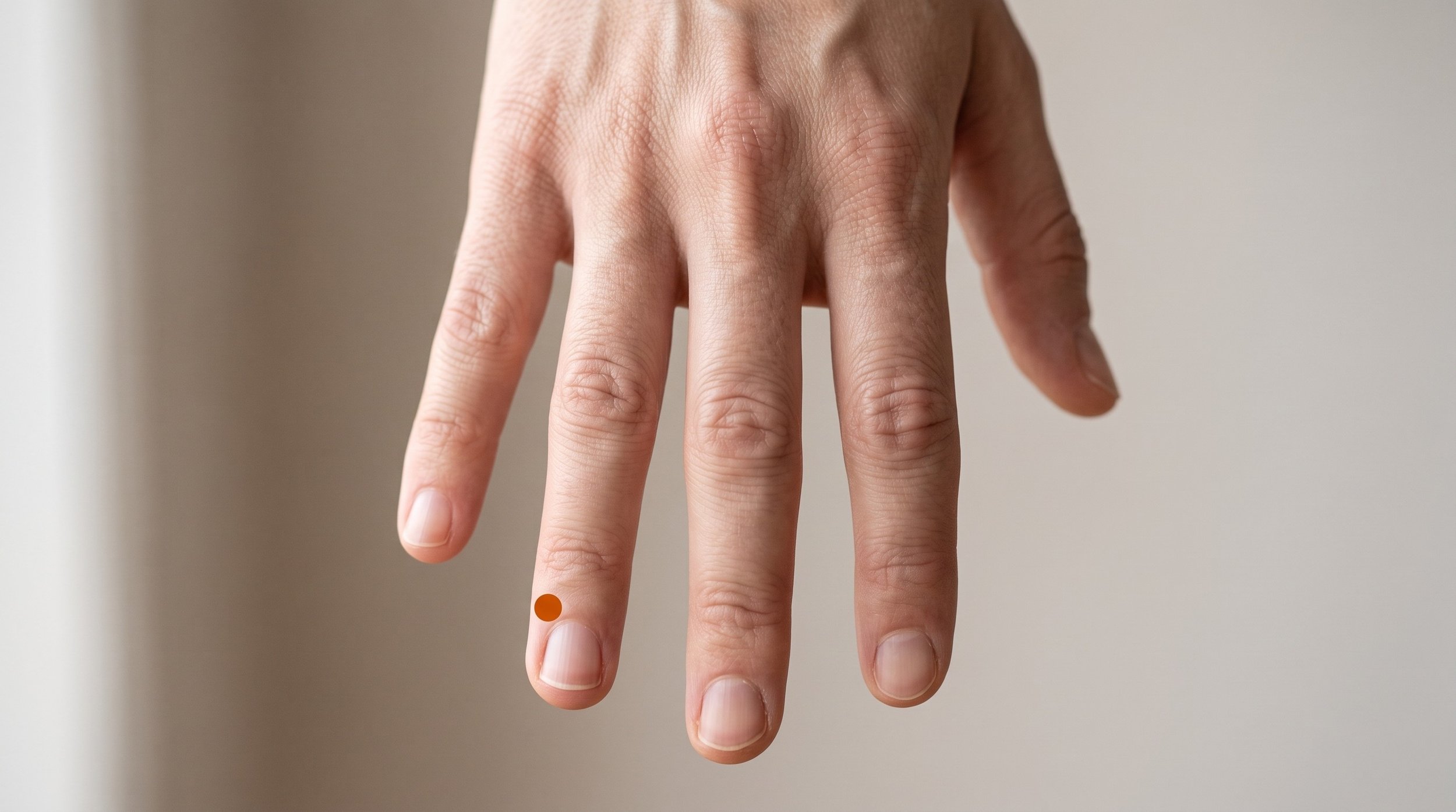
SJ1 Acupuncture Point (Guanchong)
The Rushing Pass at the Ring Fingernail: Anatomy, Mechanism, and Why the Smallest Point on the Triple Burner Channel Is Used for Ear, Throat, and Shoulder Complaints
SJ1 (Guanchong, often translated as Rushing Pass), also written TE1, sits at the very tip of the hand, on the back of the ring finger at the outer corner of the nail, roughly a nail's width away from the edge on the side facing the little finger. It is the jing-well point and the metal point of the Triple Burner channel, which means it marks the terminal end of a channel that runs up the arm, over the shoulder, around the ear, and onto the side of the face.
That geography explains why a point on a fingertip has been used for centuries for ear, throat, tongue, and shoulder complaints rather than for finger problems, and why the te1 acupuncture point is usually needled very shallowly or pricked for a drop or two of blood rather than treated with a standard insertion.
- Location and layers: SJ1 lies at the ulnar corner of the ring fingernail, where the tissue is little more than skin, nail fold, and a dense subcutaneous nerve and capillary bed, with no muscle to engage. That anatomy dictates the technique, which is a 0.1 to 0.2 cun shallow insertion angled toward the wrist or a quick prick to bleed.
- Traditional categories, read in modern terms: classical texts class Guanchong as a jing-well and metal point whose traditional actions are described as clearing heat from the upper burner, benefiting the ears and tongue, and moving the channel to relieve pain. Translated into physiology, that describes a short, intense cutaneous stimulus used for acute presentations rather than a slow, sedating treatment.
- Nerve story: the ulnar side of the ring finger is served by digital branches of the ulnar nerve, which carry input into the C8 and T1 spinal segments, and fingertip skin has among the highest densities of small-diameter afferents in the body. Brief, strong small-fiber input of this kind is one of the better characterized triggers for brainstem-mediated descending inhibition (Zhao, 2008).
- Research picture: reviews of acupuncture for tinnitus report mixed results, with improvement on some handicap questionnaires but not on all pain-style rating scales, and low study quality throughout (Huang et al., 2021; Liu et al., 2016; Xu et al., 2022). Preclinical and hospital-based work on bleeding the twelve hand jing-well points, SJ1 among them, is interesting but far from a clinical recommendation (Li et al., 2020; Yu et al., 2021).
- Clinical framing: at Morningside, SJ1 is a supporting point used inside a larger plan, most often alongside points on the forearm and neck and, for shoulder and upper back complaints, alongside dry needling of the muscles that actually reproduce a patient's pain (Simons et al., 1999). Broader chronic pain data support acupuncture as a whole rather than any single point (Vickers et al., 2018).
- De qi: this point does not produce the heavy, spreading ache typical of a forearm or leg point. Expect a brief, bright, sharp sensation at the nail corner that fades within seconds, which is exactly what a densely innervated jing-well point is expected to feel like.
Dealing With Ringing Ears, Ear Fullness, or Jaw and Neck Tension?
Ear symptoms rarely come from one place, so our clinicians assess the neck, jaw, and upper trapezius as carefully as they assess the channel points themselves. SJ1 may be added as a brief distal stimulus within a treatment that also addresses the muscles and joints around the ear and cervical spine. We are careful to set realistic expectations, because the research on acupuncture for tinnitus is genuinely mixed. Schedule an evaluation and we will tell you honestly whether we think we can help.
Schedule NowAnatomy of SJ1: Why the Ulnar Corner of the Ring Fingernail Is Such an Important Location
Find SJ1 by drawing two imaginary lines: one straight along the side border of the ring fingernail on the side nearest the little finger, and one across the base of that nail. The point sits where those lines cross, about 0.1 cun (roughly a tenth of the width of the finger) from the nail corner. What lies under the needle is thin, tightly bound skin, the lateral nail fold, a small amount of fibrous subcutaneous tissue, and periosteum of the distal phalanx not far below.
There is no muscle belly here and no fascial plane to speak of, so unlike a forearm or gluteal point, nothing about SJ1 is about needling into tissue. The whole effect depends on stimulating skin that happens to be extraordinarily well wired.
That wiring is the interesting part. The ulnar aspect of the ring finger receives digital branches of the ulnar nerve, whose sensory traffic enters the spinal cord at the C8 and T1 levels, and fingertip and nail fold skin carries a very high density of small-diameter A-delta and C fibers relative to its surface area. A brief, sharp stimulus in that territory produces a disproportionately large volley of afferent input for a very small needle contact.
Experimental work on acupuncture analgesia describes how input of this type recruits brainstem structures including the periaqueductal gray and rostral ventromedial medulla and engages endogenous opioid and monoaminergic descending pathways that dampen nociceptive transmission well beyond the segment stimulated (Zhao, 2008). That heterosegmental reach matters here, because the shoulder is supplied by very different spinal levels than the ring finger, and yet classical practice sends practitioners to the fingertip for shoulder complaints.
Vascular structures at this level are the terminal branches of the proper digital arteries and their small dorsal branches supplying the nail bed, plus an accompanying venous plexus. That is precisely why the point bleeds readily and why the classical instruction to prick it works so easily in practice. Standard needling is perpendicular or oblique with the needle angled proximally, 0.1 to 0.2 cun, using a fine gauge and a fast insertion, since slow insertion here is unnecessarily uncomfortable.
If bleeding is intended, a single-use lancet or a sterile filiform needle is used to release one to a few drops, followed by clean pressure. We avoid bleeding technique in patients on anticoagulants, in anyone with fragile circulation in the hands (including significant Raynaud phenomenon or peripheral vascular disease), around any nail fold infection or paronychia, and in patients who are needle-anxious or lightheaded, where a fingertip prick can provoke a vasovagal response.
Related Best Acupuncture Points For Headaches Related Best Acupuncture Points For Neck PainSJ1 (TE1) at a Glance: Classification, Location, and Clinical Use
| Category | Detail |
|---|---|
| Traditional Name | Guanchong (Rushing Pass), Triple Burner 1, also written SJ 1 or TB-1 |
| Channel Classification | First and terminal point of the Triple Burner (Sanjiao) channel of the hand shaoyang (SJ1, also written TE1 or TB1; also called the Triple Energizer, the Triple Heater or Triple Warmer) |
| Point Categories | Jing-well point of the Triple Burner channel; metal point in the five-shu (five-phase) system; the point where a branch of the Pericardium channel running along the ring finger is described as linking with the Triple Burner channel; no meeting, hui-meeting, or extraordinary vessel designations |
| Precise Location | Dorsal aspect of the ring finger at the junction of a line along the ulnar border of the nail and a line along the base of the nail, approximately 0.1 cun proximal and lateral to the nail corner |
| Tissue Stimulated | Skin of the dorsal distal ring finger, lateral nail fold, subcutaneous connective tissue with dense digital nerve endings and a terminal capillary and venous plexus; periosteum of the distal phalanx lies immediately deep. No muscle is engaged, though adjacent hand needling at Morningside often targets the dorsal interossei |
| Needle Depth / Direction | Perpendicular or oblique with the tip angled proximally, 0.1 to 0.2 cun, fine gauge, rapid insertion and short retention; alternatively pricked with a sterile lancet to release one to a few drops of blood |
| De Qi Sensation | A brief, sharp, bright pinprick localized to the nail corner, sometimes with a quick flick of sensation up the finger, rather than the heavy distending ache typical of proximal points; the sensation usually settles within seconds |
| Primary Clinical Uses | Traditionally used for tinnitus, hearing difficulty and earache; sore throat, dry mouth and tongue stiffness in classical listings; acute febrile presentations with restlessness; and pain of the shoulder and elbow. In modern practice it is a brief adjunct within multi-point treatment, not a standalone therapy |
| Common Point Combinations |
|
Deadman's A Manual of Acupuncture attributes three traditional actions to Guanchong: clearing heat from the upper burner, benefiting the ears and tongue, and freeing the channel to relieve pain. The commentary explains the logic of jing-well points generally, which is that the terminal point of a channel is held to exert its strongest influence at the channel's opposite end, so a point at the ring fingernail is expected to act on the ear, temple, throat, and outer eye region that the upper Triple Burner pathway reaches.
Classical indication lists gathered under this point cluster into four rough groups: ear and head symptoms (ringing, hearing difficulty, earache, headache, dizziness, red eyes), mouth and tongue symptoms (stiff or curled tongue, dryness, bitter taste, throat pain), acute febrile patterns with restlessness and absence of sweating, and pain of the shoulder, elbow, and upper back. Two smaller traditional themes appear as well, acute digestive upset with vomiting, and the old category of wasting and thirsting disorder with intense thirst.
The Song of the Jade Dragon is quoted as recommending the point specifically for congested heat of the upper burner and endorsing bleeding it. What is striking about the classical pattern is its consistency: across many centuries and several source texts, this point is reserved almost entirely for acute, hot, upper-body presentations, and almost never for chronic depletion.
Why SJ1 Is Used for Ear, Throat, and Shoulder Symptoms That Are Nowhere Near the Hand
The first thing to say plainly is that there is no nerve running from your ring finger to your ear. The traditional rationale is channel-based, and the honest modern explanation is different. Sensory fibers from the ulnar side of the ring finger enter the spinal cord at C8 and T1, where they converge in the dorsal horn with input from the forearm, the medial arm, and, through interneuronal networks, with segments above and below.
Convergence of this kind is the standard explanation for why stimulation at one site can change how the nervous system processes signals from another, and it accounts reasonably well for the elbow and shoulder indications listed in the classical texts, since cervical and upper thoracic segments communicate extensively.
The second mechanism is less local and probably more important for a point like this. Fingertip skin is densely innervated with small-diameter fibers, so a brief sharp stimulus there generates a strong, well-timed afferent volley. Experimental work indicates that input of this type engages brainstem circuits and endogenous opioid and monoaminergic systems that produce descending inhibition of nociceptive transmission, an effect that is not restricted to the segment stimulated (Zhao, 2008).
This general, whole-system dampening is a plausible reason why intensely stimulated distal points have been valued for symptoms far from the needle, and why the effect tends to be short-lived rather than structural.
There is also a modest autonomic component, since sharp fingertip stimulation reliably produces measurable changes in cutaneous vasomotor tone and arousal, which may relate to the classical descriptions of restlessness and heat.
For ear symptoms specifically, we would rather be careful than confident. Reviews of acupuncture for tinnitus have found improvement on handicap and severity questionnaires while failing to show a significant advantage on visual analogue ratings, with the included trials generally small and methodologically weak (Huang et al., 2021), and an overview of the review literature itself concluded that reporting and evidence quality remain limited (Xu et al., 2022).
A separate meta-analysis noted that results tended to split along the language and origin of the trials, which is a familiar warning sign in this field (Liu et al., 2016). None of that means SJ1 is useless. It means it should be offered as one part of a considered plan, with clear discussion about what is and is not likely.
What the Research Shows for SJ1 (TE1)
One note on naming before the evidence: in the research literature this point appears as TE1, the WHO standard code, and also as SJ1 or TB1 depending on the authors, so it is worth searching all three if you want to read the studies below in full.
No trial has ever tested Guanchong on its own, and it would be misleading to imply otherwise. What exists is research on acupuncture protocols that may include this point among others, research on the jing-well points as a group (particularly bleeding technique), and general mechanistic work on how needling modulates pain processing. Read the table below as context for a clinical decision rather than as proof of a point-specific effect, and keep in mind that several of the entries are preclinical or come from hospital settings quite different from outpatient care.
| Study | Type | Focus | Key Finding |
|---|---|---|---|
| Huang et al., 2021 | Systematic review and meta-analysis of RCTs | Acupuncture for tinnitus, 8 trials, 504 participants | No significant advantage on the primary visual analogue outcome, though tinnitus handicap and severity scores favored acupuncture, with the authors cautioning that trial quality was low. |
| Liu et al., 2016 | Systematic review and meta-analysis | Acupuncture and electroacupuncture for tinnitus | Results diverged sharply by trial origin, with most Chinese-language studies positive and most English-language studies negative, which argues for interpreting pooled estimates cautiously. |
| Xu et al., 2022 | Overview of systematic reviews | Methodological and evidence quality of tinnitus acupuncture reviews | The existing review literature was judged limited in methodological and reporting quality, so confident conclusions about effectiveness are not yet supportable. |
| Li et al., 2020 | Controlled animal (mouse) mechanistic study | Bloodletting puncture at the twelve hand jing-well points, which include SJ1, after experimental brain injury | The authors proposed that peripheral nerve stimulation plus small-volume blood loss influenced perfusion and coagulation measures, a preclinical finding that cannot be extended to clinical practice. |
| Yu et al., 2021 | Multicenter randomized controlled trial | Bloodletting puncture at the twelve hand jing-well points in acute stroke patients | Reported an arousal-promoting effect in an emergency hospital setting, which is a highly specific indication and not a rationale for routine outpatient use. |
| Zhan et al., 2023 | Systematic review and meta-analysis of RCTs | Acupuncture compared with rehabilitation therapy for post-stroke shoulder pain | Acupuncture performed at least comparably for shoulder pain outcomes, though the underlying trials were of limited quality and the population is specific. |
| Vickers et al., 2018 | Individual patient data meta-analysis, roughly 20,000 patients | Acupuncture for chronic musculoskeletal, headache, and osteoarthritis pain | Acupuncture was modestly superior to both sham and no-acupuncture controls, with effects persisting over about a year, supporting the approach rather than any individual point. |
| Zhao, 2008 | Narrative mechanistic review | Neural mechanisms of acupuncture analgesia | Describes how afferent input from needling engages spinal and supraspinal circuits, endogenous opioids, and descending inhibitory pathways, the framework used to explain distal point effects. |
Shoulder and Upper Arm Pain That Will Not Settle?
Classical sources list SJ1 for shoulder and elbow pain and for a stiff shoulder that will not let you turn and look behind you, and modern practice pairs that distal stimulus with local work. At Morningside we combine channel points with dry needling of the rotator cuff, scapular stabilizers, and forearm extensors, then send you home with loading exercises that keep the change. Most patients notice something within two or three visits. Book a session and we will map out a short, testable plan.
Schedule NowSJ1 in the Context of Trigger Point Work
SJ1 has no myofascial counterpart, because there is no muscle at the ulnar corner of the ring fingernail. That makes it one of the few points in this series where classical channel logic and trigger point mapping simply do not overlap.
When a patient presents with the shoulder and upper back complaints listed under Guanchong in the classical sources, the muscles that most often reproduce those symptoms are elsewhere: infraspinatus, supraspinatus, subscapularis, upper trapezius, levator scapulae, and the scalenes, all of which have well-documented referral patterns into the shoulder, arm, and sometimes the hand (Simons et al., 1999). Our clinicians identify those first through palpation and movement testing, then decide whether a distal point adds anything.
In practice at Morningside, a treatment that uses SJ1 usually looks like this: dry needling of the muscles actually generating the pain, channel points on the forearm and neck to broaden the response, and then a very brief stimulation or single prick at SJ1 as a distal accent, sometimes at the end of the session. Hand and finger complaints are handled differently again, with the dorsal interossei and adductor pollicis needled directly when grip strain, keyboard work, or gripping sports are involved.
Acupuncture here simply means the use of an acupuncture needle, so whether a given insertion is called a channel point or dry needling is a matter of reasoning and target, not a difference in tool.
SJ1 Ear, Throat, and Shoulder Treatment at NYC's Highest-Rated Acupuncture Clinic
Morningside Acupuncture is the highest-rated acupuncture and dry needling clinic in New York City with over 500 five-star Google reviews, and our approach blends classical point selection with orthopedic assessment and current pain science. Points like Guanchong are used deliberately and briefly, never as a gimmick, and always inside a treatment plan built around your presentation. Every visit is one on one with a licensed acupuncturist in our Upper West Side office. Schedule your first appointment and see how the two approaches fit together.
Schedule NowFrequently Asked Questions
Is SJ1 the same point as TE1 or TB1?
Yes. SJ1, TE1, and TB1 are all codes for the same point, Guanchong. SJ stands for San Jiao, the Chinese name of the channel. TE (Triple Energizer) is the WHO standard abbreviation and the one you will see in most Western textbooks and research papers. TB (Triple Burner) and TW (Triple Warmer) are older English renderings of the same name that still appear in many books. You will also come across it written as San Jiao 1 or Triple Energizer 1. Whichever code is used, the location and the uses are the same.
What does SJ1 feel like when needled?
Sharper and briefer than most points. Fingertip skin is densely innervated, so you feel a quick bright pinprick right at the nail corner, occasionally with a small flick of sensation running up the finger, and it usually fades within a few seconds. You should not feel the deep, heavy, spreading ache that points like ST36 or LI4 produce, because there is no muscle here to generate it. If the point is pricked to bleed, the sensation is similar in character and equally short, followed by a drop or two of blood and light pressure with clean gauze. Most patients find it very manageable, though we always ask first and skip it entirely for anyone who is needle-anxious or prone to feeling faint.
Why would a point on the ring finger be used for ear or throat symptoms?
The traditional answer is channel logic: SJ1 is the terminal point of the Triple Burner channel, which continues up the arm and neck to the ear, temple, and outer eye, and classical theory holds that a jing-well point exerts its strongest influence at the far end of its own channel. The modern answer is different and more modest. There is no direct nerve from the finger to the ear, but a brief, intense stimulus in densely innervated fingertip skin generates a strong small-fiber volley that engages brainstem circuits and descending inhibitory pathways with effects reaching well beyond the stimulated segment (Zhao, 2008). That gives a plausible mechanism for a general dampening effect, not for a targeted action on the ear itself, which is why we treat SJ1 as one contributing element rather than the reason a treatment works.
Can I press SJ1 myself between sessions?
Yes, and acupressure is the only home version we recommend, since bleeding technique should never be attempted at home. Find the ulnar corner of your ring fingernail, meaning the side facing your little finger, then move about a nail's width down toward the knuckle and slightly to the side. Pinch that corner between your thumbnail and index finger with firm, distinctly noticeable pressure, hold for 10 to 20 seconds, release for a few seconds, and repeat 5 to 8 times, for one to two minutes total per hand. Because jing-well points respond to brief, sharp input rather than sustained deep pressure, short repeated squeezes work better than a long steady hold. Doing this two or three times a day during an acute episode is reasonable. Stop if the nail fold becomes sore, red, or swollen, and skip it entirely if you have any infection or injury around the nail.
Is SJ1 safe to needle?
In trained hands, yes, with a few sensible precautions. The needling depth is only 0.1 to 0.2 cun and there are no organs, large vessels, or nerve trunks at risk, so the main considerations are comfort, bleeding, and hygiene. We avoid bleeding technique in patients taking anticoagulant or antiplatelet medication or with clotting disorders, in anyone with compromised circulation in the hands such as significant Raynaud phenomenon or peripheral vascular disease, and around any paronychia, cellulitis, or broken skin at the nail fold. Because fingertip stimulation can occasionally provoke a vasovagal response, we needle patients lying down and check in as we go. Sterile single-use needles or lancets are used every time, with clean pressure afterward. Mild transient soreness or a tiny bruise at the nail corner is the usual worst case.
Where exactly is SJ1 located?
On the back of the ring finger, at the outer corner of the nail on the side facing the little finger. To find it, picture one line running straight down the side edge of the nail and another running across the base of the nail where it meets skin. SJ1 sits where those lines meet, about 0.1 cun (roughly one tenth of the finger's width, or about a nail's thickness) away from the corner itself. A useful cross-check is symmetry: SI1 sits at the same relative position on the little finger, and LI1 at the same position on the index finger, so all three jing-well points on the hand share the same relationship to the nail corner. If you are pressing directly on the nail plate or on the pad of the fingertip, you have drifted off the point.
References
- Deadman, P., Al-Khafaji, M., & Baker, K. (2009). A manual of acupuncture. Journal of Chinese Medicine Publications.
- Maciocia, G. (2006). The channels of acupuncture: Clinical use of the secondary channels and eight extraordinary vessels. Churchill Livingstone Elsevier.
- Cheng, X. (Ed.). (1999). Chinese acupuncture and moxibustion (Rev. ed.). Foreign Languages Press.
- Simons, D. G., Travell, J. G., & Simons, L. S. (1999). Travell & Simons' myofascial pain and dysfunction: The trigger point manual, Vol. 1: Upper half of body (2nd ed.). Williams & Wilkins.
- Zhao, Z. Q. (2008). Neural mechanism underlying acupuncture analgesia. Progress in Neurobiology, 85(4), 355-375. https://doi.org/10.1016/j.pneurobio.2008.05.004
- Vickers, A. J., Vertosick, E. A., Lewith, G., MacPherson, H., Foster, N. E., Sherman, K. J., Irnich, D., Witt, C. M., & Linde, K. (2018). Acupuncture for chronic pain: Update of an individual patient data meta-analysis. Journal of Pain, 19(5), 455-474. https://doi.org/10.1016/j.jpain.2017.11.005
- Huang, K., Liang, S., Chen, L., & Grellet, A. (2021). Acupuncture for tinnitus: A systematic review and meta-analysis of randomized controlled trials. Acupuncture in Medicine, 39(4), 264-271. https://doi.org/10.1177/0964528420938380
- Liu, F., Han, X., Li, Y., & Yu, S. (2016). Acupuncture in the treatment of tinnitus: A systematic review and meta-analysis. European Archives of Oto-Rhino-Laryngology, 273(2), 285-294. https://doi.org/10.1007/s00405-014-3341-7
- Xu, X., Xie, H., Liu, Z., Guo, T., & Zhang, Y. (2022). Effects of acupuncture on the outcome of tinnitus: An overview of systematic reviews. Frontiers in Neurology, 13, 1061431. https://doi.org/10.3389/fneur.2022.1061431
- Li, B., Zhou, X., Yi, T. L., Xu, Z. W., Peng, D. W., Guo, Y., Guo, Y. M., Cao, Y. L., Zhu, L., Zhang, S., & Cheng, S. X. (2020). Bloodletting puncture at hand twelve jing-well points improves neurological recovery by ameliorating acute traumatic brain injury-induced coagulopathy in mice. Frontiers in Neuroscience, 14, 403. https://doi.org/10.3389/fnins.2020.00403
- Yu, N. N., Xu, Z. F., Gao, Y., Zhou, Z. L., Zhao, X., Zhou, D., et al. (2021). Wake-promoting effect of bloodletting puncture at hand twelve jing-well points in acute stroke patients: A multi-center randomized controlled trial. Chinese Journal of Integrative Medicine, 27(8), 570-577. https://doi.org/10.1007/s11655-020-3093-8
- Zhan, J., Luo, Y., Mao, W., et al. (2023). Efficacy of acupuncture versus rehabilitation therapy on post-stroke shoulder pain: A systematic review and meta-analysis of randomized controlled trials. Medicine, 102(29), e34266. https://doi.org/10.1097/MD.0000000000034266
Disclaimer: This web site is intended for educational and informational purposes only. Reading this website does not constitute providing medical advice or any professional services. This information should not be used for diagnosing or treating any health issue or disease. Those seeking medical advice should consult with a licensed physician. Seek the advice of a medical doctor or other qualified health professional for any medical condition. If you think you have a medical emergency, call 911 or go to the emergency room. No acupuncturist-patient relationship is created by reading this website or using the information. Morningside Acupuncture PLLC and its employees and contributors do not make any express or implied representations with respect to the information on this site or its use. For any legal interpretation of scope of practice in your state, consult a licensed attorney or regulatory authority.
Read more from our blog



