KI8 Acupuncture Point (Jiaoxin)
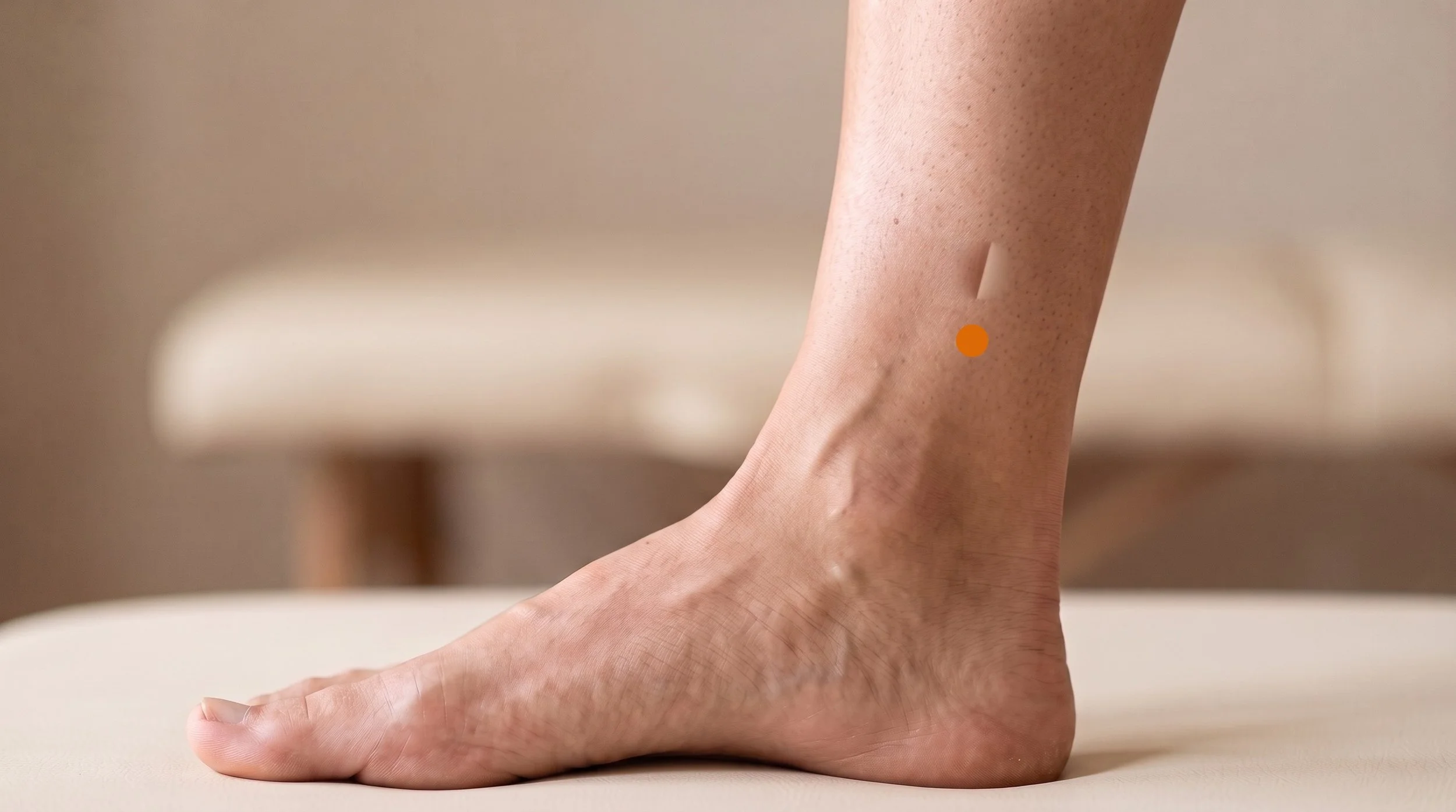
KI8 Acupuncture Point (Jiaoxin)
The Xi-Cleft Point of the Yin Motility Vessel: Anatomy, Mechanism, and Why a Point Two Cun Above the Inner Ankle Belongs in Menstrual and Pelvic Treatment Plans
KI8 (Jiaoxin, often translated as Exchange Belief or Crossing Faith) sits on the inner lower leg, about two thumb widths above the prominence of the inner ankle bone and just behind the back edge of the shinbone, roughly half a finger width in front of KI7. It's the xi-cleft (accumulation) point of the Yin Motility vessel, also called the Yin Qiao or Yin Stepping vessel, and that single designation explains most of how the point has been used for centuries: xi-cleft points on yin channels were traditionally reserved for acute problems and for disorders of blood, above all bleeding.
In modern practice the ki8 acupuncture point earns its place for two reasons. It sits in the same medial lower leg territory that pelvic and bladder neuromodulation research has focused on, and it's an easy, low-risk site to needle when the treatment goal involves the menstrual cycle, pelvic discomfort, urinary symptoms, or pain along the inner shin and heel.
- Location and layers: kidney 8 lies 2 cun above KI3 and 0.5 cun anterior to KI7, just posterior to the medial border of the tibia, where the needle passes through thin skin and subcutaneous tissue into the deep posterior compartment near tibialis posterior and flexor digitorum longus.
- Traditional categories translated: classical texts class Jiaoxin as the xi-cleft point of the Yin Motility vessel and as a meeting site of that vessel with the Kidney channel, and the xi-cleft points of yin channels were used for acute presentations and bleeding, a category we now read as a marker of urgency and of strong regional autonomic and vascular influence rather than as a literal reservoir of qi.
- Mechanism: the skin here is supplied by the saphenous nerve while deeper tissue sits in tibial nerve territory (roughly L4 to S3), which overlaps segmentally with the sacral outflow to the bladder and pelvic organs, and needling recruits A-delta and C fibers that engage spinal gating and descending inhibitory pathways from the brainstem (Zhao, 2008).
- Research picture: reviews of acupuncture for period pain report mixed and generally low-certainty findings (Smith et al., 2016; Woo et al., 2018), while Doppler studies of nearby medial leg points suggest measurable short-term reductions in uterine artery resistance (Ma et al., 2010; Stener-Victorin et al., 1996), and tibial nerve stimulation reviews suggest symptom benefit for overactive bladder (Booth et al., 2018).
- Clinical framing: KI8 is almost never used alone, and the individual patient data analysis of acupuncture for chronic pain supports treatment effects for multi-point courses of care rather than for any single site (Vickers et al., 2018), so we use ki 8 leg needling as one component of a plan that may also include abdominal, lumbar, and distal points.
- De qi: most patients describe a deep, dull, slightly heavy ache at the point that may spread down toward the inner ankle or up along the inner shin, distinct from the brief sharp sensation of insertion, and it usually settles within a minute of needle placement.
Struggling With Painful, Irregular, or Heavy Periods in NYC?
Menstrual complaints rarely respond to one point or one session, so we build a cycle-aware plan that may include KI8 alongside SP6, LV3, and abdominal points, timed to where you are in your cycle. Our licensed acupuncturists coordinate with your gynecologist rather than replacing that care, and we always ask you to have significant bleeding changes medically evaluated first. Treatment is gentle, needles are single use, and most people find the medial leg points comfortable. Schedule a visit at Morningside Acupuncture to start a plan built around your cycle.
Schedule NowAnatomy of KI8: Why the Posterior Border of the Tibia Is Such an Important Location
KI8 sits on the medial aspect of the lower leg, 2 cun above KI3 and 0.5 cun anterior to KI7, tucked just behind the back edge of the shinbone. The tissue here is shallow and layered in a predictable way: thin skin, a modest layer of subcutaneous fat with superficial veins running nearby, then dense fascia that blends into the medial tibial periosteum, and beneath that the deep posterior compartment containing tibialis posterior and flexor digitorum longus.
Those two muscles control the inner arch and help decelerate pronation with every step, which is why runners, dancers, and people who log long walking miles on hard city sidewalks often feel tenderness along this exact strip of leg. Repetitive loading, sudden increases in mileage, and worn footwear all concentrate strain at the medial tibial border.
The nerve geography here matters more than most patients expect. Skin sensation over the medial leg comes from the saphenous nerve, a branch of the femoral nerve carrying roughly L3 and L4 input, while the deep muscles are supplied by the tibial nerve, which draws from about L4 through S3. That sacral component is the interesting part, because the pelvic organs receive parasympathetic supply from the S2 to S4 segments and sympathetic supply from the lower thoracic and upper lumbar levels.
Needling in this territory feeds afferent input into spinal segments that already process pelvic and bladder information, which is the plain-language version of segmental convergence. Once that input arrives, it engages local spinal inhibition and recruits descending pathways from the periaqueductal gray and rostral ventromedial medulla that dampen the transmission of nociceptive signals and release endogenous opioids (Zhao, 2008).
The same anatomical logic underlies transcutaneous tibial nerve stimulation, an approach reviewed for overactive bladder symptoms with cautiously encouraging results (Booth et al., 2018).
Deeper and slightly posterior to the point lies the posterior tibial neurovascular bundle, carrying the posterior tibial artery, its accompanying veins, and the tibial nerve, along with the great saphenous vein running superficially in the region. None of these are at meaningful risk with standard technique, but they explain the conventions: perpendicular insertion of 0.5 to 1 cun, no aggressive posterior angulation, and no deep hunting for a nerve response.
Practitioners keep the needle close to the plane just behind the tibial border, use a light manual technique to elicit de qi, and take extra care with patients on anticoagulants or with significant lower leg edema. Moxibustion is traditionally described as appropriate here, and clinicians who use it apply it indirectly with attention to skin sensitivity.
Related Kidney Channel Related Acupuncture For Tibialis Posterior PainKI8 at a Glance: Classification, Location, and Clinical Use
| Category | Detail |
|---|---|
| Traditional Name | Jiaoxin (KI8), commonly rendered as Exchange Belief or Crossing Faith; older English texts also translate the name as Meeting the Spleen Channel |
| Channel Classification | Kidney channel of the foot shaoyin, lower leg segment on the Kidney Channel |
| Point Categories | Xi-cleft (accumulation) point of the Yin Motility vessel (Yin Qiao Mai); listed with KI6 as a meeting or coalescent point where the Yin Motility vessel intersects the Kidney channel; not a five-shu or hui-meeting point |
| Precise Location | Medial lower leg, 2 cun superior to KI3 and 0.5 cun anterior to KI7, immediately posterior to the medial border of the tibia |
| Tissue Stimulated | Skin and subcutaneous tissue over the medial tibial border, deep fascia, and the deep posterior compartment including tibialis posterior and flexor digitorum longus |
| Needle Depth / Direction | Perpendicular insertion 0.5 to 1 cun, angled straight in just behind the tibial border rather than posteriorly toward the neurovascular bundle |
| De Qi Sensation | Deep dull ache or heaviness at the point, sometimes spreading toward the inner ankle or upward along the inner shin |
| Primary Clinical Uses | Traditionally used for uterine bleeding, irregular or painful menstruation and amenorrhea, damp heat patterns affecting the genital region, difficult urination and urinary discomfort, diarrhea and dysenteric patterns, and pain of the low back and inner leg; used in modern clinics for medial shin, ankle, and heel complaints |
| Common Point Combinations |
|
Deadman, Al-Khafaji, and Baker's point compendium presents Jiaoxin as a point that traditionally regulates the Conception and Penetrating vessels, settles the menstrual cycle, checks uterine bleeding, and drains damp heat from the lower burner. Those are traditional attributions rather than physiological descriptions, and they follow a coherent internal logic: classical writers linked the Kidneys to the vessel of the uterus and to the containment of blood, and xi-cleft points on yin channels were the category reached for when bleeding needed to stop.
The classical indication lists that follow cluster into four groups, menstrual irregularity and bleeding, genital swelling, itching or sweating attributed to damp heat, urinary difficulty and retention, and bowel patterns including diarrhea and dysenteric disorders, with low back and inner leg pain appearing at the end. Cunningham's point text adds a nice detail about the name, connecting faith, one of the classical five virtues associated with the Spleen, to the fact that the Kidney channel goes on to meet the Spleen channel just above at SP6.
What's striking is the consistency: across texts separated by centuries, a small point above the inner ankle keeps being assigned to problems in the pelvis, and modern segmental anatomy offers a plausible reason why that association survived.
Why KI8 Is Used for Pelvic and Menstrual Complaints From a Spot Above the Ankle
Patients reasonably ask how needling the inner shin could influence anything happening in the pelvis. The answer starts with spinal segments. The deep tissue at KI8 sits in tibial nerve territory drawing from roughly L4 through S3, and the sacral segments that carry that input are the same ones that receive and process signals from the bladder, uterus, and pelvic floor. When sensory neurons from different tissues converge on shared spinal neurons, stimulating one input can change how the cord handles the other.
This is why the medial lower leg has become a standard target for pelvic neuromodulation, and reviews of transcutaneous tibial nerve stimulation for overactive bladder suggest that repeated stimulation in this territory may improve urgency and frequency symptoms, though the trials are small and varied in quality (Booth et al., 2018).
On top of that segmental story sits a whole-nervous-system response. Needling recruits small-diameter afferents that trigger release of endogenous opioids and engage descending inhibitory control from the midbrain and brainstem, which reduces the gain on incoming nociceptive traffic and can change pain perception well beyond the needled segment (Zhao, 2008). There's also a vascular and autonomic layer that's directly relevant to menstrual complaints.
Doppler studies of medial leg points have measured short-term reductions in uterine artery resistance and pulsatility indices after needling, alongside reported drops in menstrual pain scores (Ma et al., 2010), and earlier work found reduced uterine artery blood flow impedance after a course of electroacupuncture (Stener-Victorin et al., 1996). Since cramping pain is partly an ischemic phenomenon driven by prostaglandin-mediated contraction, lower vascular resistance is a plausible route to less pain.
None of this makes KI8 a stand-alone answer to menstrual or urinary problems. The realistic framing is that Jiaoxin is a well-located, safely needled site in a segment with meaningful pelvic overlap, used inside a broader protocol. Heavy, prolonged, or unexpected uterine bleeding always warrants medical evaluation first, because acupuncture is supportive care and not a substitute for diagnosing fibroids, polyps, thyroid disease, clotting disorders, or other causes.
What the Research Shows for KI8
Almost no clinical trial isolates KI8, so the honest way to read the evidence is indirect. Trials test multi-point protocols for conditions this point is traditionally used within, and physiological studies test nearby medial leg points in the same nerve territory.
Taken together, the picture is cautiously positive for symptom relief in period pain and for tibial nerve territory stimulation in bladder symptoms, with real limitations: small samples, difficulty blinding, and heterogeneous protocols. The findings below describe what happened in specific studies, not what will happen for any one patient.
| Study | Type | Focus | Key Finding |
|---|---|---|---|
| Smith et al., 2016 | Cochrane systematic review | Acupuncture and acupressure for primary dysmenorrhea | The reviewers judged the available evidence insufficient to determine whether acupuncture or acupressure reduce period pain, with limited adverse event reporting across trials. |
| Woo et al., 2018 | Systematic review and meta-analysis | Acupuncture in women with primary dysmenorrhea | Pooled results suggested reductions in menstrual pain intensity compared with control conditions, though the authors flagged methodological weaknesses in the included trials. |
| Ma et al., 2010 | Randomized controlled trial with Doppler imaging | Electroacupuncture at SP6 versus GB39 and a non-channel point in primary dysmenorrhea | Needling in the medial lower leg was associated with short-term reductions in uterine artery resistance measures and in reported menstrual pain. |
| Stener-Victorin et al., 1996 | Prospective clinical study | Electroacupuncture and uterine artery blood flow impedance | Pulsatility index in the uterine arteries decreased over a course of treatment in a small sample of women with high baseline impedance. |
| Booth et al., 2018 | Systematic review | Transcutaneous tibial nerve stimulation for overactive bladder | Stimulation in tibial nerve territory was associated with improvement in urgency and frequency outcomes, with the authors noting variable study quality. |
| Vickers et al., 2018 | Individual patient data meta-analysis | Acupuncture for chronic pain across roughly 20,000 patients | Acupuncture outperformed both sham and no-acupuncture controls for chronic pain conditions, supporting multi-session protocols rather than single-point effects. |
| Zhao, 2008 | Mechanistic review | Neural mechanisms of acupuncture analgesia | Analgesic effects are attributed to afferent fiber recruitment, spinal segmental inhibition, and descending control involving endogenous opioid systems. |
Inner Shin, Medial Ankle, or Heel Pain That Won't Settle?
The tissue around KI8 belongs to the deep flexor compartment, which is exactly where medial shin and posterior tibialis pain tends to live. We combine channel points like KI8, KI7, and KI3 with precise dry needling of tibialis posterior, flexor digitorum longus, and soleus, then layer in loading strategy so the tissue tolerates running and walking again. Every session includes an assessment of gait, footwear, and training load. Book an evaluation and let's find out what's actually driving the pain.
Schedule NowKI8 in the Context of Trigger Point Work
Acupuncture, as we define it, is the use of an acupuncture needle, and that includes the hundreds of styles practiced worldwide as well as dry needling. At Morningside we frequently treat the KI8 region from both angles in the same session. Channel-based needling at Jiaoxin, KI7, and KI3 addresses the medial leg as a functional unit, while dry needling targets specific taut bands in tibialis posterior, flexor digitorum longus, and soleus.
Trigger points in tibialis posterior are described as referring pain toward the Achilles region and the sole, and flexor digitorum longus can contribute to arch and toe discomfort, patterns that overlap with the medial leg complaints classical texts assigned to this stretch of the Kidney channel (Simons et al., 1999).
Practically, the ki8 acupuncture point and the deep flexor compartment sit close enough that a single needle placement can reasonably be described either way. What changes is intent. When we're treating a runner with medial tibial stress symptoms, we needle for local tissue response and pair it with calf and foot loading work. When we're supporting a patient with menstrual or urinary symptoms, we needle the same territory with a lighter technique, add points elsewhere on the body, and let the segmental and descending mechanisms do the work. Both approaches respect the same anatomy.
KI8 Menstrual and Pelvic Treatment at NYC's Highest-Rated Acupuncture Clinic
Morningside Acupuncture is the highest-rated acupuncture and dry needling clinic in New York City with over 500 five-star Google reviews, and we treat menstrual, pelvic, and lower leg complaints every week. We use points such as Jiaoxin within evidence-informed treatment plans that respect what research does and does not show. You'll get a clear explanation of why each point is chosen and what a reasonable course of care looks like. Schedule your appointment online today.
Schedule NowFrequently Asked Questions
What does KI8 feel like when needled?
Most people feel a quick pinch as the needle passes the skin, then a spreading dull ache or heaviness at the point that may travel toward the inner ankle or up the inner shin. That deep sensation is de qi, and it's typically mild here because the tissue is shallow. If the leg is already sore from running or standing, the point can feel more tender, and your acupuncturist can reduce stimulation. The needle usually stays in for 15 to 30 minutes, and it's normal for the sensation to fade after the first minute or two.
Why needle a point on the leg for menstrual or pelvic symptoms?
Because of how the nervous system is wired. The deep tissue at KI8 is supplied by the tibial nerve, drawing from spinal segments that also serve the bladder and pelvic organs, so sensory input from the medial lower leg reaches parts of the spinal cord that already handle pelvic signals (Zhao, 2008). This is the same rationale behind tibial nerve stimulation approaches used for bladder symptoms (Booth et al., 2018). Distal points are also comfortable, easy to access, and simple to combine with abdominal or lumbar points in one session.
Can I press KI8 myself between sessions?
Yes, acupressure at this point is safe for most people. Find the tip of the inner ankle bone, move about three finger widths up the leg, then feel for the soft groove just behind the back edge of the shinbone. Use your thumb or index finger to press firmly enough to feel a dull ache but not sharp pain, hold steady pressure for 30 to 60 seconds, then release. Repeat two or three times per side, once or twice daily, and you can add slow circular pressure or gentle ankle pumps while you hold. Skip it over broken skin, varicose veins, or recent injury, and stop if pressure produces numbness, tingling, or shooting sensations.
Is KI8 safe to needle?
It's considered a low-risk point when standard technique is used. The convention is perpendicular insertion of 0.5 to 1 cun, kept just behind the tibial border rather than angled backward toward the posterior tibial artery, vein, and tibial nerve. Superficial veins in the region mean occasional minor bruising, which is the most common side effect. Extra caution applies with anticoagulant use, significant lower leg swelling, active skin infection, or known vascular disease in the leg, and any point should be needled only by a licensed practitioner using sterile single-use needles.
Where exactly is KI8 located?
KI8 is on the medial aspect of the lower leg, 2 cun above KI3 and 0.5 cun anterior to KI7, immediately posterior to the medial border of the tibia. In practical terms, locate KI3 in the hollow between the tip of the inner ankle bone and the Achilles tendon, measure two thumb widths straight up, then slide slightly forward toward the shinbone until your finger drops just behind its rear edge. That small groove is the jiaoxin xi cleft point. KI7 sits at the same height but half a finger width behind it, closer to the Achilles.
References
- Deadman, P., Al-Khafaji, M., & Baker, K. (2009). A manual of acupuncture. Journal of Chinese Medicine Publications.
- Cunningham, P. M. (2000). Acupuncture points: A practical guide to classical and modern usage. Odyssey Press.
- Maciocia, G. (2005). The foundations of Chinese medicine: A comprehensive text for acupuncturists and herbalists (2nd ed.). Elsevier Churchill Livingstone.
- Maciocia, G. (2006). The channels of acupuncture: Clinical use of the secondary channels and eight extraordinary vessels. Churchill Livingstone Elsevier.
- Simons, D. G., Travell, J. G., & Simons, L. S. (1999). Travell & Simons' myofascial pain and dysfunction: The trigger point manual, Vol. 1: Upper half of body (2nd ed.). Williams & Wilkins.
- Smith, C. A., Armour, M., Zhu, X., Li, X., Lu, Z. Y., & Song, J. (2016). Acupuncture for dysmenorrhoea. Cochrane Database of Systematic Reviews, 2016(4), CD007854. https://doi.org/10.1002/14651858.CD007854.pub3 [VERIFY BEFORE PUBLISHING]
- Woo, H. L., Ji, H. R., Pak, Y. K., Lee, H., Heo, S. J., Lee, J. M., & Park, K. S. (2018). The efficacy and safety of acupuncture in women with primary dysmenorrhea: A systematic review and meta-analysis. Medicine, 97(23), e11007. https://doi.org/10.1097/MD.0000000000011007
- Ma, Y. X., Ma, L. X., Liu, X. L., Ma, Y. X., Lv, K., Wang, D., Liu, J. P., Xing, J. M., Cao, H. J., Gao, S. Z., & Zhu, J. (2010). A comparative study on the immediate effects of electroacupuncture at Sanyinjiao (SP6), Xuanzhong (GB39) and a non-meridian point, on menstrual pain and uterine arterial blood flow, in primary dysmenorrhea patients. Pain Medicine, 11(10), 1564-1575. https://doi.org/10.1111/j.1526-4637.2010.00949.x
- Stener-Victorin, E., Waldenström, U., Andersson, S. A., & Wikland, M. (1996). Reduction of blood flow impedance in the uterine arteries of infertile women with electro-acupuncture. Human Reproduction, 11(6), 1314-1317. https://doi.org/10.1093/oxfordjournals.humrep.a019378
- Booth, J., Connelly, L., Dickson, S., Duncan, F., & Lawrence, M. (2018). The effectiveness of transcutaneous tibial nerve stimulation (TTNS) for adults with overactive bladder syndrome: A systematic review. Neurourology and Urodynamics, 37(2), 528-541. https://doi.org/10.1002/nau.23351 [VERIFY BEFORE PUBLISHING]
- Vickers, A. J., Vertosick, E. A., Lewith, G., MacPherson, H., Foster, N. E., Sherman, K. J., Irnich, D., Witt, C. M., & Linde, K. (2018). Acupuncture for chronic pain: Update of an individual patient data meta-analysis. Journal of Pain, 19(5), 455-474. https://doi.org/10.1016/j.jpain.2017.11.005
- Zhao, Z. Q. (2008). Neural mechanism underlying acupuncture analgesia. Progress in Neurobiology, 85(4), 355-375. https://doi.org/10.1016/j.pneurobio.2008.05.004
Disclaimer: This web site is intended for educational and informational purposes only. Reading this website does not constitute providing medical advice or any professional services. This information should not be used for diagnosing or treating any health issue or disease. Those seeking medical advice should consult with a licensed physician. Seek the advice of a medical doctor or other qualified health professional for any medical condition. If you think you have a medical emergency, call 911 or go to the emergency room. No acupuncturist-patient relationship is created by reading this website or using the information. Morningside Acupuncture PLLC and its employees and contributors do not make any express or implied representations with respect to the information on this site or its use. For any legal interpretation of scope of practice in your state, consult a licensed attorney or regulatory authority.
Read more from our blog



