KI7 Acupuncture Point (Fuliu)
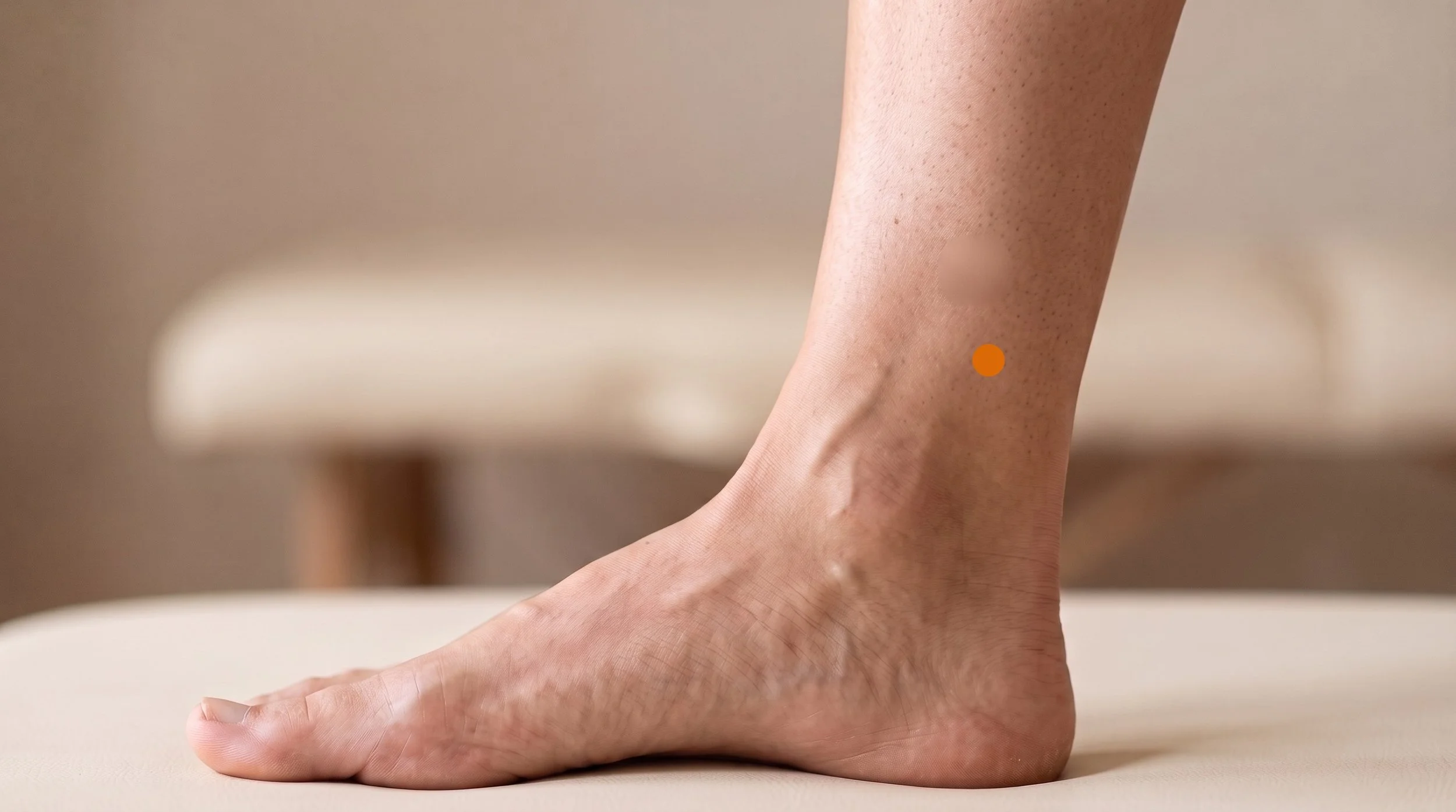
KI7 Acupuncture Point (Fuliu)
Returning Current Above the Inner Ankle: Anatomy, Mechanism, and Why This Kidney Channel Point Became the Classical Point for Sweating and Fluids
KI7, known in Chinese as Fuliu and usually translated as Returning Current, sits on the inner lower leg two cun above KI3, tucked into the soft groove along the front edge of the Achilles tendon. In plain terms, if you slide a finger up from the hollow behind the inner ankle bone about two thumb widths, you land in a narrow valley between the tendon behind and the deep calf muscles in front.
Classically it's the jing-river and metal point of the Kidney channel and its tonification (mother) point, which made it the point of choice in the old texts for regulating sweating and body fluids (Deadman et al., 2007). Anatomically it sits in tibial nerve territory over the deep flexor compartment, the same medial ankle zone modern neuromodulation targets, which is one reason the ki7 acupuncture point stays interesting to clinicians who think in nerves rather than metaphors.
- Location and layers: KI7 lies 2 cun superior to KI3 on the anterior border of the Achilles tendon, so the needle passes skin and subcutaneous tissue, then the deep crural fascia, toward the deep flexor compartment (flexor hallucis longus, flexor digitorum longus, tibialis posterior) rather than into the tendon itself (Deadman et al., 2007).
- Traditional categories: classical sources list Fuliu as the jing-river and metal point of the Kidney channel, and because metal is the mother of water it became the channel's tonification point, traditionally credited with benefiting the Kidneys, regulating the water passages, controlling sweating, draining damp-heat, and strengthening the lumbar region (Deadman et al., 2007).
- Mechanism: needling here recruits deep somatic afferents in tibial nerve territory, and somatic input of this kind can shift autonomic output through spinal and brainstem reflex pathways, which is a plausible modern reading of the classical sweat and urination claims (Uchida et al., 2017; Liu et al., 2020).
- Pain relief pathway: like other distal points, KI7 engages segmental inhibition and descending modulation involving endogenous opioid and monoamine systems, the best characterized mechanism behind acupuncture analgesia (Zhao, 2008), and individual patient data show modest but persistent benefits of acupuncture for chronic musculoskeletal pain (Vickers et al., 2018).
- Research picture: trials never test KI7 alone, but kidney 7 appears in menopause and vasomotor protocols where reviews report reductions in hot flash frequency compared with no treatment while differences against sham are less clear (Dodin et al., 2013; Ee et al., 2016; Mao et al., 2015).
- Practice and sensation: we usually needle perpendicularly 0.5 to 1 cun, angling slightly away from the pulse of the posterior tibial artery, and patients typically report a heavy, spreading ache along the inner ankle that may travel toward the heel or arch rather than a sharp pain.
Struggling With Night Sweats, Hot Flashes, or Sweating You Can't Explain?
At Morningside Acupuncture, KI7 is one of the points we reach for when sweating patterns dominate the picture, whether that's drenching night sweats, daytime sweating with fatigue, or vasomotor symptoms during the menopause transition. We pair it with points on the wrist, chest, and low back, and we adjust stimulation based on how your body responds between visits. Nobody can promise these symptoms will disappear, but many patients find the pattern becomes less intense and less disruptive to sleep. Schedule a visit and we'll build a plan around your specific presentation.
Schedule NowAnatomy of KI7: Why the Space Between the Achilles Tendon and the Deep Flexors Is Such an Important Location
KI7 sits in a genuine anatomical corridor rather than on a landmark you can see. Two cun above KI3, the Achilles tendon narrows and its anterior border forms a soft depression that separates the tendon from the deep posterior compartment of the leg. Under the skin and a thin layer of subcutaneous fat lies the deep crural fascia, and behind that sit flexor hallucis longus, flexor digitorum longus, and tibialis posterior as they converge toward the tarsal tunnel.
This corridor is loaded every time you push off, control pronation, or stand for long stretches, which is why the tissue here often feels dense and tender in runners, dancers, and people who spend the day on hard floors.
The nerve geography explains most of what makes this point useful. The tibial nerve and its branches supply the deep flexor compartment and carry both sensory and sudomotor fibers toward the foot, while the saphenous nerve covers the overlying skin on the medial side. Needling into deep tissue here generates strong afferent input that projects into lumbosacral spinal segments, where it can dampen nociceptive transmission locally and recruit descending inhibitory pathways involving endogenous opioids and monoamines (Zhao, 2008).
Deep somatic input also feeds spinal and supraspinal reflex loops that adjust autonomic outflow, and experimental work shows these effects vary with where on the body you stimulate and how intensely (Uchida et al., 2017; Liu et al., 2020). Clinicians will also recognize this stretch of the medial ankle as the region targeted by percutaneous tibial nerve stimulation, an established neuromodulation approach for bladder symptoms, which is a striking modern echo of the classical urinary indications.
Deep and slightly anterior to the point run the posterior tibial artery and veins alongside the tibial nerve, so the needling convention matters. Standard technique is perpendicular insertion 0.5 to 1 cun, with some texts preferring a shallower 0.5 to 0.7 cun, staying in the groove and avoiding a directly anterior push toward the pulse (Deadman et al., 2007). We palpate for the arterial pulse first, angle away from it, and stop advancing if a patient reports a sharp electric sensation shooting into the sole.
Moxibustion is traditionally applied here, and the area tolerates gentle warmth well. Varicosities, fragile skin, and anticoagulant use all call for a lighter hand.
Related Kidney Channel Related 2025 Achilles Tendinopathy ResearchKI7 at a Glance: Classification, Location, and Clinical Use
| Category | Detail |
|---|---|
| Traditional Name | Fuliu (Returning Current), also translated as Recover Flow |
| Channel Classification | Kidney channel of the foot shaoyin, point 7 |
| Point Categories | Jing-river point of the Kidney channel; metal point of the five-shu series; classical tonification (mother) point of the water channel |
| Precise Location | Medial aspect of the lower leg, in the depression 2 cun directly superior to KI3, on the anterior border of the Achilles tendon |
| Tissue Stimulated | Skin and subcutaneous tissue of the medial ankle, deep crural fascia, and the anterior border of the Achilles tendon overlying the deep flexor compartment, including flexor hallucis longus and flexor digitorum longus, in tibial nerve territory |
| Needle Depth / Direction | Perpendicular insertion 0.5 to 1 cun into the groove, angled slightly posteriorly away from the posterior tibial pulse; moxibustion is traditionally used here |
| De Qi Sensation | Heavy, dull, spreading ache along the inner ankle, sometimes radiating toward the heel, arch, or up the medial calf; occasional warmth |
| Primary Clinical Uses | Sweating disorders including spontaneous daytime sweating and night sweats, lower limb edema and difficult urination, diarrhea and damp-heat patterns in classical listings, and lumbar pain with underlying deficiency |
| Common Point Combinations |
|
In the classical literature summarized in A Manual of Acupuncture, Fuliu is described as benefiting the Kidneys, regulating the water passages, controlling sweating, draining damp and damp-heat, and strengthening the low back (Deadman et al., 2007). These are traditional attributions, framed in the physiology of their era rather than modern terms. The reasoning behind them is tidy: because the Classic of Difficulties advises reinforcing the mother in deficiency, and metal is the mother of water, the metal point of the Kidney channel became the go-to point for supporting Kidney function.
From that premise the old sources built a long indication list that clusters into a few themes: fluid accumulation (edema of the limbs and trunk, difficult or dark urination, painful urinary dysfunction), sweating in every direction (spontaneous sweating, night sweating, ceaseless sweating, and fever without sweating), damp-heat in the intestines (diarrhea, dysenteric disorders, blood in the stool), dryness of the mouth and tongue with speech changes, and various patterns of bleeding.
Lumbar pain appears throughout, both from deficiency and, in the Golden Mirror of Medicine, specifically from qi stagnation. What's striking is the internal consistency: a single ankle point was expected to open the pores or close them, promote urination or astringe leakage, depending entirely on the pattern and the technique, which is a very early articulation of the idea that the same input can push a system in either direction.
Why KI7 Is Used for Night Sweats, Hot Flashes, and Heavy, Swollen Legs
The obvious question is how a point at the inner ankle would have anything to do with sweating or fluid balance. The segmental answer starts with the tibial nerve. Afferents from this corridor enter the lower lumbar and sacral spinal segments, where they converge with input from the pelvis, bladder, and lower limb. Sympathetic sudomotor fibers destined for the foot travel in this same nerve, so the tissue you're needling sits inside a functioning autonomic circuit rather than beside one.
Experimental physiology shows that somatic stimulation reliably alters autonomic output through spinal and brainstem reflex arcs, and that the direction and magnitude of the response depend on the body region stimulated and the intensity used (Uchida et al., 2017; Liu et al., 2020). That's a very different explanation from the classical one, but it makes the classical observation less mysterious.
The second layer is central. Repeated needling engages descending inhibitory systems in the brainstem that use endogenous opioids, serotonin, and noradrenaline, and these same systems interact with the hypothalamic circuitry involved in thermoregulation and stress responses (Zhao, 2008). Hot flashes and night sweats involve a narrowed thermoneutral zone and heightened sympathetic reactivity, which is why a treatment that shifts autonomic tone is at least biologically plausible for them, even though plausibility is not proof.
For lower limb swelling, the honest framing is more modest: needling may influence local blood flow and sympathetic vasomotor tone in the leg, but it doesn't replace evaluation for cardiac, renal, venous, or lymphatic causes of edema, and any new or one-sided leg swelling needs a medical workup first.
For low back pain, KI7 earns its place through better established routes. Acupuncture produces small to moderate improvements in chronic musculoskeletal pain that persist beyond the treatment course (Vickers et al., 2018), and Cochrane analyses of chronic low back pain report improvements in pain and function compared with no treatment, with weaker evidence against sham (Mu et al., 2020; Rizzo et al., 2025).
In practice, we use ki 7 sweating and fluid indications and lumbar indications together, because the patient who comes in with night sweats and an aching low back is common, and this point sits at the intersection of both classical pattern groups.
What the Research Shows for KI7
A caution before the table: no clinical trial has ever tested KI7 by itself. Acupuncture research studies protocols, and kidney 7 typically appears as one point among eight to twelve in menopause, vasomotor, and low back pain formulas, so the evidence below tells you about the treatments that include it, not about the point in isolation. The literature on sweating and hot flashes is also genuinely mixed, with acupuncture generally outperforming no treatment or usual care while showing smaller and less consistent differences against sham needling. Read the findings as reasons for cautious optimism rather than confirmation of any single point's action.
| Study | Type | Focus | Key Finding |
|---|---|---|---|
| Dodin et al., 2013 | Cochrane systematic review | Acupuncture for menopausal hot flushes, 16 randomized trials with 1,155 women | Reviewers found insufficient evidence overall, with no clear difference between acupuncture and sham while acupuncture outperformed no treatment. |
| Ee et al., 2016 | Randomized sham-controlled trial | Standardized Chinese medicine acupuncture for menopausal hot flashes over 8 weeks | Both real and noninsertive sham acupuncture reduced hot flash scores, with no significant difference between the two arms. |
| Mao et al., 2015 | Randomized placebo-controlled trial | Electroacupuncture versus gabapentin for hot flashes in breast cancer survivors | Electroacupuncture was associated with larger placebo and smaller nocebo responses than gabapentin, suggesting it may be a reasonable option when hormone therapy isn't appropriate. |
| Mu et al., 2020 | Cochrane systematic review | Acupuncture for chronic nonspecific low back pain, 33 trials with 8,270 participants | Moderate-certainty evidence suggested acupuncture improves pain compared with no treatment, though differences versus sham and usual care were smaller and less certain. |
| Rizzo et al., 2025 | Overview of Cochrane reviews | Non-pharmacological and non-surgical treatments for low back pain in adults | Acupuncture was among the non-drug options with supportive evidence for chronic low back pain, alongside a favorable safety profile. |
| Vickers et al., 2018 | Individual patient data meta-analysis | Nearly 21,000 patients across chronic pain conditions | Acupuncture outperformed both sham and no-acupuncture controls, with effects that decayed only modestly over 12 months. |
| Uchida et al., 2017 | Narrative physiology review | Somatoautonomic reflex pathways underlying acupuncture and related therapies | Somatic stimulation can alter visceral and autonomic function through spinal and supraspinal reflex arcs, offering a mechanism framework for non-pain indications. |
| Liu et al., 2020 | Experimental neuroscience study | Electroacupuncture at hindlimb versus abdominal sites in mice | Autonomic pathway recruitment depended on both body region and stimulation intensity, supporting the idea that limb points engage distinct circuits. |
| Zhao, 2008 | Mechanistic review | Neural mechanisms of acupuncture analgesia | Analgesia is mediated by segmental spinal inhibition plus descending opioid and monoaminergic pathways, not by local tissue effects alone. |
Puffy Ankles, Heavy Legs, and Low Back Pain That Won't Settle?
Fuliu acupuncture has been used for centuries for lower limb swelling, difficult urination, and lumbar pain tied to deficiency patterns, and the location gives us a practical way to work the medial ankle and deep calf at the same time. Our licensed acupuncturists combine KI7 with local low back needling, dry needling of the deep flexors and soleus when they're involved, and simple loading advice you can do at home. Treatment is precise, comfortable, and paced to your tolerance. Book an evaluation and we'll map what's driving your symptoms.
Schedule NowKI7 in the Context of Trigger Point Work
The groove that holds KI7 is also a practical access point for the deep posterior compartment. Flexor digitorum longus, flexor hallucis longus, and tibialis posterior all funnel through this region on their way to the tarsal tunnel, and trigger points in these muscles refer pain into the arch, the heel, the toes, and up the medial calf (Simons et al., 1999). When a patient's medial ankle feels thick and ropey, or when calf tightness keeps returning after stretching, we'll often needle the classical point and then work the muscle bellies higher in the calf where the taut bands actually live. Same needle, different intent: one insertion is chosen by pattern and channel logic, the other by palpation of the muscle.
At Morningside, KI7 frequently shows up in treatments that also include soleus and gastrocnemius dry needling for calf and Achilles complaints, tibialis posterior for medial arch and shin symptoms, and the deep intrinsic foot muscles when heel pain persists. For low back presentations we'll pair distal needling at KI7 and BL40 with local lumbar and gluteal work, since distal points contribute descending inhibition while local needling addresses the tissue that hurts (Zhao, 2008; Vickers et al., 2018). Patients tend to find the combination more useful than either approach alone.
KI7 Sweating and Low Back Pain Treatment at NYC's Highest-Rated Acupuncture Clinic
Morningside Acupuncture is the highest-rated acupuncture and dry needling clinic in New York City with over 500 five-star Google reviews, and our approach blends classical point selection with current pain science. We use KI7 within full treatment plans for sweating disorders, fluid retention, and stubborn lower back pain, always explaining what we're doing and why. Sessions run in a calm, private room in Midtown Manhattan with a licensed acupuncturist who's also a certified myofascial trigger point therapist. Schedule your first appointment and let's get started.
Schedule NowFrequently Asked Questions
What does KI7 feel like when needled?
Most people feel a heavy, dull, spreading ache right at the inner ankle once the needle reaches the deep tissue, and that sensation often travels toward the heel, the arch, or upward along the medial calf. Some patients describe warmth or a mild pulling feeling along the tendon border. It shouldn't feel sharp, burning, or electric. If you get a shooting sensation into the sole, tell your acupuncturist, because it means the needle is close to the tibial nerve and simply needs to be repositioned.
Why would a point at the ankle help with sweating or hot flashes rather than something local?
Classically, KI7 was chosen for sweating because it's the metal point of the water channel and was thought to govern the opening and closing of the pores (Deadman et al., 2007). The modern reading is different: the point sits in tibial nerve territory, and needling deep tissue there generates afferent input that reaches spinal and brainstem circuits capable of shifting autonomic output, including sympathetic activity relevant to sweating and thermoregulation (Uchida et al., 2017; Zhao, 2008). Sweating isn't produced at the skin in isolation, it's driven by central and autonomic signals, so a distal point that reaches those circuits is a reasonable target. Clinical evidence for hot flashes remains mixed, with acupuncture generally beating no treatment but not consistently beating sham (Dodin et al., 2013; Ee et al., 2016).
Can I press KI7 myself between sessions?
Yes, acupressure here is easy and low risk. Find the hollow behind your inner ankle bone (KI3), then slide two thumb widths straight up along the front edge of the Achilles tendon until you feel a soft groove. Press with your thumb at moderate pressure, enough to feel a dull ache but not enough to make you wince, and hold for 30 to 60 seconds while breathing slowly. You can add small circular movements and repeat two or three times per side, once or twice a day. Skip it over broken skin, varicose veins, or areas of recent injury, and if you feel a sharp electric sensation into the foot, ease off the pressure and move slightly further back toward the tendon.
Is KI7 safe to needle?
It's a safe point in trained hands. The main structures to respect are the posterior tibial artery, veins, and tibial nerve, which run deep and slightly anterior to the point, so we palpate for the pulse and angle away from it, keeping insertion to the standard 0.5 to 1 cun (Deadman et al., 2007). Practitioners take extra care with patients on blood thinners, with visible varicosities, with peripheral neuropathy, or with fragile skin or swelling in the ankle. Common side effects are minor and short-lived: a small bruise, brief soreness, or a lingering heavy feeling for a few hours. New, painful, or one-sided leg swelling should be evaluated medically before treatment, since it can signal a clot or another condition that needs urgent care.
Where exactly is KI7 located?
KI7 is on the medial side of the lower leg, in the depression 2 cun directly above KI3, on the anterior border of the Achilles tendon (Deadman et al., 2007). To find it, first locate KI3 in the hollow midway between the tip of the medial malleolus and the Achilles tendon. From there, measure two cun straight up (roughly the width of your index and middle fingers together, using your own hand as the ruler) and stay in the soft groove just in front of the tendon rather than on the tendon itself. The point usually feels slightly boggy or tender compared with the tissue above and below it. KI8 sits about half a cun anterior to KI7 at the same height, closer to the back edge of the tibia, so keep your finger in the tendon groove to distinguish them.
References
- Deadman, P., Al-Khafaji, M., & Baker, K. (2009). A manual of acupuncture. Journal of Chinese Medicine Publications.
- Simons, D. G., Travell, J. G., & Simons, L. S. (1999). Travell & Simons' myofascial pain and dysfunction: The trigger point manual, Vol. 1: Upper half of body (2nd ed.). Williams & Wilkins.
- Dodin, S., Blanchet, C., Marc, I., Ernst, E., Wu, T., Vaillancourt, C., Paquette, J., & Maunsell, E. (2013). Acupuncture for menopausal hot flushes. Cochrane Database of Systematic Reviews, 2013(7), CD007410. https://doi.org/10.1002/14651858.CD007410.pub2
- Ee, C., Xue, C., Chondros, P., Myers, S. P., French, S. D., Teede, H., & Pirotta, M. (2016). Acupuncture for menopausal hot flashes: A randomized trial. Annals of Internal Medicine, 164(3), 146-154. https://doi.org/10.7326/M15-1380
- Mao, J. J., Bowman, M. A., Xie, S. X., Bruner, D., DeMichele, A., & Farrar, J. T. (2015). Electroacupuncture versus gabapentin for hot flashes among breast cancer survivors: A randomized placebo-controlled trial. Journal of Clinical Oncology, 33(31), 3615-3620. https://doi.org/10.1200/JCO.2015.60.9412
- Mu, J., Furlan, A. D., Lam, W. Y., Hsu, M. Y., Ning, Z., & Lao, L. (2020). Acupuncture for chronic nonspecific low back pain. Cochrane Database of Systematic Reviews, 2020(12), CD013814. https://doi.org/10.1002/14651858.CD013814
- Rizzo, R. R. N., Cashin, A. G., Wand, B. M., Ferraro, M. C., Sharma, S., Lee, H., O'Hagan, E., Maher, C. G., Furlan, A. D., van Tulder, M. W., & McAuley, J. H. (2025). Non-pharmacological and non-surgical treatments for low back pain in adults: An overview of Cochrane reviews. Cochrane Database of Systematic Reviews, 2025(3), CD014691. https://doi.org/10.1002/14651858.CD014691.pub2
- Uchida, S., Kagitani, F., & Sato-Suzuki, I. (2017). Somatoautonomic reflexes in acupuncture therapy: A review. Autonomic Neuroscience, 203, 1-8. https://doi.org/10.1016/j.autneu.2016.11.001
- Liu, S., Wang, Z.-F., Su, Y.-S., Ray, R. S., Jing, X.-H., Wang, Y.-Q., & Ma, Q. (2020). Somatotopic organization and intensity dependence in driving distinct NPY-expressing sympathetic pathways by electroacupuncture. Neuron, 108(3), 436-450.e7. https://doi.org/10.1016/j.neuron.2020.07.015
- Zhao, Z. Q. (2008). Neural mechanism underlying acupuncture analgesia. Progress in Neurobiology, 85(4), 355-375. https://doi.org/10.1016/j.pneurobio.2008.05.004
- Vickers, A. J., Vertosick, E. A., Lewith, G., MacPherson, H., Foster, N. E., Sherman, K. J., Irnich, D., Witt, C. M., & Linde, K. (2018). Acupuncture for chronic pain: Update of an individual patient data meta-analysis. Journal of Pain, 19(5), 455-474. https://doi.org/10.1016/j.jpain.2017.11.005
Disclaimer: This web site is intended for educational and informational purposes only. Reading this website does not constitute providing medical advice or any professional services. This information should not be used for diagnosing or treating any health issue or disease. Those seeking medical advice should consult with a licensed physician. Seek the advice of a medical doctor or other qualified health professional for any medical condition. If you think you have a medical emergency, call 911 or go to the emergency room. No acupuncturist-patient relationship is created by reading this website or using the information. Morningside Acupuncture PLLC and its employees and contributors do not make any express or implied representations with respect to the information on this site or its use. For any legal interpretation of scope of practice in your state, consult a licensed attorney or regulatory authority.
Read more from our blog



