KI6 Acupuncture Point (Zhaohai)
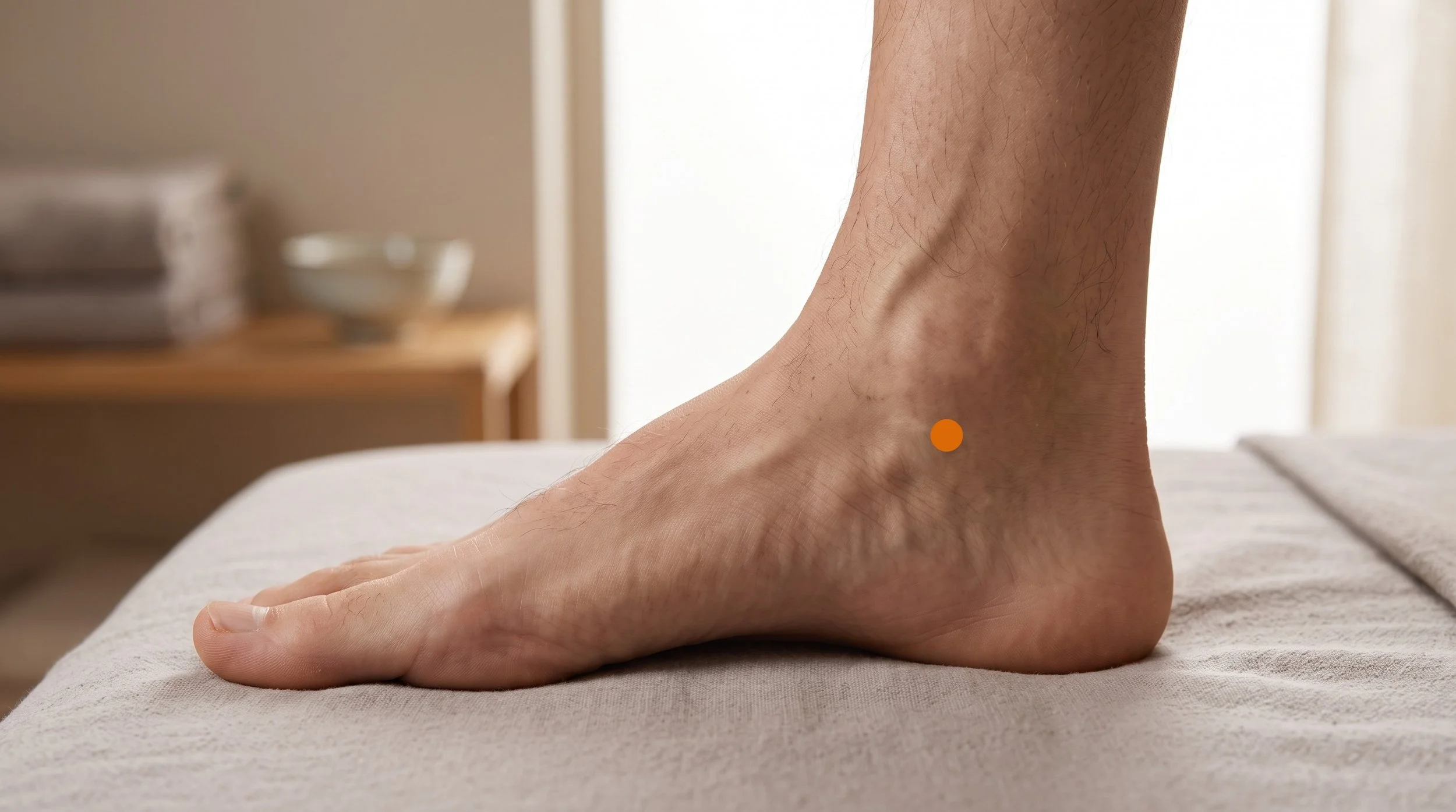
KI6 Acupuncture Point (Zhaohai)
The Shining Sea Below the Inner Ankle: Anatomy, Mechanism, and Why This Kidney Channel Point Anchors Treatment for the Throat, Sleep, and the Menstrual Cycle
KI6 (Zhaohai, translated as Shining Sea) sits in the small hollow just under the bony bump on the inside of your ankle, roughly a thumb's width below the tip of the medial malleolus, in the groove framed by two tendons that you can feel snap into relief when you flex and turn the foot inward. It is the sixth point of the Kidney channel and the confluent (opening) point of the Yin Motility vessel, one of the eight confluent points of the extraordinary vessels, classically paired with LU7 (Deadman et al., 2001).
Clinicians reach for the ki6 acupuncture point far more often than its modest ankle location suggests, because the traditional literature assigns it a strikingly wide brief: a lingering dry throat that worsens at night, restless sleep and vivid dreams, irregular or painful periods, and stubborn constipation. Understood in modern terms, kidney 6 is a low-risk distal point in richly innervated tissue, used within multi-point protocols rather than as a standalone remedy.
- Location and layers: KI6 lies about 1 cun below the prominence of the medial malleolus, in the depression between the tendon of tibialis posterior in front and flexor digitorum longus behind, under the flexor retinaculum (Deadman et al., 2001; Chen, 1999). Some modern texts place it slightly higher, right at the lower border of the malleolus, so palpation of the groove matters more than measuring (Kim, 2011).
- Traditional categories, translated: the classical texts describe KI6 as the confluent point of the Yin Motility vessel and, in one passage of the Great Compendium, its luo-connecting point (Deadman et al., 2001). In neurophysiological language, those designations mark it as a distal point whose effects are expected in the throat, chest, pelvis and sleep-wake state rather than only at the ankle.
- Mechanism: the needle engages skin and fascia supplied by medial malleolar branches of the saphenous nerve and calcaneal branches of the tibial nerve, feeding into lumbosacral segments that also serve the pelvic viscera and pelvic floor, which offers a plausible route for the point's traditional pelvic indications through somato-autonomic reflexes (Zhao, 2008).
- Distant effects on the throat, sleep and gut are best explained by supraspinal processing rather than local segmental overlap, since acupuncture stimulation recruits descending inhibitory pathways and brainstem and hypothalamic circuitry that modulate pain and autonomic tone (Zhao, 2008), with experimental work suggesting parasympathetic shifts after acupoint stimulation in people with throat lump sensations (Zhou et al., 2020).
- Research picture: KI6 is rarely tested alone. It appears inside insomnia protocols, usually alongside BL62, where meta-analyses report improvements over sham on sleep questionnaires while cautioning about study quality (Zhang, J. et al., 2020), and Cochrane reviews of related conditions remain guarded (Smith et al., 2016; Ma et al., 2025).
- Clinical framing and de qi: at Morningside we use kidney 6 as a supporting distal point in sleep, throat and menstrual treatments, and as an adjunct when the medial ankle itself is irritable. Most people feel a dull, spreading ache or heaviness around the inner ankle, sometimes travelling into the arch or up the inner calf, rather than sharpness.
Tired of a Dry, Scratchy Throat That Gets Worse Every Evening?
A throat that feels raw at night, clears in the morning, and never quite settles is one of the oldest indications for the ki6 acupuncture point. We combine KI6 with LU7 and local neck points, and we assess breathing, reflux habits, voice use and sleep before building a plan. Treatment is gentle and the ankle point itself is quick and easy to tolerate. Schedule a visit and let's look at the whole picture rather than the symptom alone.
Schedule NowAnatomy of KI6: Why the Groove Below the Medial Malleolus Is Such an Important Location
Find the ki 6 ankle location by resting a fingertip on the tip of the inner ankle bone and sliding straight down about a thumb's width into the soft hollow beneath it. Flexing the foot and turning the sole inward makes two firm cords stand out: the tibialis posterior tendon in front and the flexor digitorum longus tendon behind, with KI6 sitting in the groove between them (Deadman et al., 2001). The needle passes through thin skin and subcutaneous fascia into the connective tissue around the flexor retinaculum and the tendon sheaths, with the deltoid ligament and the talus forming the floor.
This is loaded territory: the two tendons work hard during the push-off phase of walking, in single-leg balance, and in anyone who runs on cambered roads or spends long hours in unsupportive shoes, so the tissue here is often tender before you ever place a needle.
The skin over the medial ankle is supplied mainly by medial malleolar branches of the saphenous nerve, with medial calcaneal branches of the tibial nerve covering the region toward the heel. These fibers feed into lumbar and sacral spinal segments that also receive input from the pelvic viscera and pelvic floor, which is one reason a foot and ankle point can plausibly influence bladder, bowel and menstrual symptoms through somato-autonomic reflex pathways rather than anything mystical (Zhao, 2008).
Needling also drives a barrage of small-diameter afferent activity that engages descending inhibitory control from the midbrain and brainstem, damping pain transmission at multiple levels and altering autonomic balance (Zhao, 2008). Local effects matter too: needling in and around irritable tendon sheaths and adjacent muscle may reduce mechanical sensitivity and improve tolerance to loading (Simons et al., 1999).
Just behind and slightly above KI6 lies the tarsal tunnel, carrying the posterior tibial artery and vein and the tibial nerve. Those structures are the reason for conservative technique. The classical convention is an oblique insertion angled upward to a depth of about 0.3 to 0.5 cun (Deadman et al., 2001), while other modern texts describe a shallow perpendicular insertion in the same depth range with moxibustion permitted (Kim, 2011).
Practitioners palpate for the pulse before inserting, stay in the groove rather than drifting posteriorly, and withdraw and redirect if a patient reports a sharp electric sensation shooting into the sole. Brief soreness and occasional small bruises are the usual side effects, and the point should be avoided through broken or infected skin or over significant swelling.
Related Tibialis Posterior Trigger Points Related Kidney ChannelKI6 at a Glance: Classification, Location, and Clinical Use
| Category | Detail |
|---|---|
| Traditional Name | Zhaohai (Shining Sea), KI6, also written kidney 6 or KID-6 |
| Channel Classification | Sixth point of the Kidney channel of the foot, lower leg and medial ankle region |
| Point Categories | Confluent (opening) point of the Yin Motility vessel and one of the eight confluent points of the extraordinary vessels, classically paired with LU7 of the Conception vessel; described in a passage of the Great Compendium as the luo-connecting point of the Yin Motility vessel (Deadman et al., 2001); listed with KI8 as a coalescent point of the Yin Motility vessel (Chen, 1999) |
| Precise Location | On the medial ankle, approximately 1 cun below the prominence of the medial malleolus, in the depression between two tendinous bundles; some texts describe the point at the lower border of the malleolus itself |
| Tissue Stimulated | Skin and subcutaneous fascia of the medial ankle, flexor retinaculum, and the tendon sheaths of tibialis posterior and flexor digitorum longus, with the deltoid ligament and talus forming the deep boundary |
| Needle Depth / Direction | Oblique insertion angled superiorly, 0.3 to 0.5 cun; some texts describe shallow perpendicular insertion at the same depth, and moxibustion is traditionally permitted |
| De Qi Sensation | A dull, spreading ache, heaviness or fullness around the inner ankle, sometimes radiating into the arch of the foot or up the inner calf; brief sharp or electric sensations mean the needle should be withdrawn and redirected |
| Primary Clinical Uses | Chronic dry or sore throat that worsens in the evening, throat lump sensation, insomnia and disturbed dreaming, irregular or painful menstruation and fertility support, constipation, and urinary frequency; also used for medial ankle and inner leg tension |
| Common Point Combinations |
|
In the classical literature summarized by Deadman and colleagues, KI6 is credited with benefiting the throat, nourishing the Kidneys and clearing deficiency heat, regulating the Yin Motility vessel, calming the spirit, and regulating the lower burner, and these are presented here as traditional attributions rather than physiological claims.
The reasoning behind that list is internally consistent: both the Kidney channel and the Yin Motility vessel were described as reaching the throat, which is why the Ode of the Obstructed River names KI6 among the eight therapeutic methods for throat wind, meaning painful swelling with difficulty swallowing. The pattern the classics single out is a lingering, dry, evening-worse sore throat rather than an acute infectious one, though the texts allow the point for sore throats of any type.
The Yin and Yang Motility vessels were said to meet at the inner corner of the eye, and a passage in the Spiritual Pivot linking abundant yang to eyes held open and abundant yin to eyes held shut became the traditional rationale for using KI6 in insomnia and its partner BL62 in excessive sleepiness, with night-time seizure activity assigned to KI6 and daytime activity to BL62. The lower burner indications, covering menstruation, fertility, childbirth recovery, genital itching, urinary frequency and constipation, follow from the classical claim that the vessel of the uterus connects with the Kidneys.
What is striking is how a single ankle point was organized around one coherent idea, that a channel reaching from the inner ankle through the pelvis and chest to the throat and eye should treat everything along that line, and how durably that idea has survived into contemporary point prescriptions.
Why KI6 Is Used for a Sore Throat and Restless Sleep When It Sits at the Ankle
The first question patients ask is fair: how can a needle at the inner ankle touch the throat or the small hours of the night? Part of the answer is segmental. The medial ankle is served by saphenous and tibial nerve branches feeding lumbosacral spinal segments that also receive input from the pelvis, which gives a straightforward reflex account of the point's traditional pelvic and bowel indications, since stimulating a somatic field can alter autonomic outflow to organs sharing those segments (Zhao, 2008).
The throat and sleep effects are heterosegmental, meaning they cannot be explained by shared spinal levels, and they are attributed instead to what happens above the spinal cord. Needle stimulation activates small-diameter afferents that recruit descending inhibitory pathways from the midbrain and brainstem and engage hypothalamic and limbic structures involved in arousal, pain modulation and autonomic tone (Zhao, 2008).
Related experimental work on people with a persistent lump-in-the-throat sensation found that stimulating acupuncture points produced measurable shifts in autonomic markers alongside symptom improvement, which is consistent with a nervous system explanation rather than a local one (Zhou et al., 2020).
In practice this means KI6 is used as a distal contributor to a state change, not as a switch for a specific organ. When we add the zhaohai insomnia point to a sleep treatment, we are stacking it with scalp, forearm and abdominal points chosen to reduce sympathetic arousal, and the same logic applies when we use it alongside neck and chest points for throat irritation.
The individual patient data analyses of acupuncture for chronic pain suggest effects that are real but modest and dependent on an adequate course of treatment (Vickers et al., 2018), and that expectation transfers sensibly to the non-pain uses of this point.
What the Research Shows for KI6
Almost no clinical trial isolates a single acupuncture point, and KI6 is no exception. It appears inside multi-point protocols for insomnia, sore throat, period pain and constipation, so the honest reading of the literature is that KI6 is a common ingredient in prescriptions that have been tested, not an independently validated treatment. The reviews below also vary widely in quality, and several of the strongest cautions come from Cochrane authors who found the underlying trials too heterogeneous or too biased to support firm conclusions.
We share this evidence so you can set realistic expectations: acupuncture including KI6 may help with these complaints, the size and durability of any benefit is uncertain, and serious adverse events with shallow ankle needling are rare.
| Study | Type | Focus | Key Finding |
|---|---|---|---|
| Zhang, J. et al., 2020 | Systematic review and meta-analysis | Acupuncture versus sham or placebo acupuncture for insomnia, in protocols that commonly include KI6 with BL62 | Pooled results favored real acupuncture on sleep quality and related measures, though the authors flagged methodological limits across the included trials. |
| Ma et al., 2025 | Cochrane systematic review | Acupuncture for insomnia in people with cancer | Acupuncture appeared better than inactive control for insomnia severity and sleep quality but similar to sham, and the review authors expressed little confidence in the evidence. |
| Smith et al., 2016 | Cochrane systematic review | Acupuncture and acupressure for primary dysmenorrhoea | The review concluded there was insufficient evidence to say whether acupuncture or acupressure reduce period pain, with low or very low certainty across comparisons. |
| Woo et al., 2018 | Systematic review and meta-analysis | Acupuncture for pain and symptoms in women with primary dysmenorrhea | The analysis reported reductions in menstrual pain with acupuncture and a favorable safety profile, while noting variable trial quality. |
| Zhang, S. et al., 2023 | Systematic review and meta-analysis | Acupuncture for acute pharyngeal infections, the modern counterpart of the classical throat indication | Across 19 randomized trials, acupuncture was associated with better response rates and fewer adverse events than antibiotic comparators, although the trials were largely from a single region. |
| Zhou et al., 2020 | Randomized single-blind crossover trial | Transcutaneous electroacupuncture for globus pharyngeus, the throat lump sensation traditionally treated with KI6 | Point stimulation improved globus symptoms and was accompanied by changes in autonomic and neuropeptide markers, suggesting a nervous system mechanism. |
| Liu et al., 2016 | Large multicenter randomized sham-controlled trial | Electroacupuncture for chronic severe functional constipation | Electroacupuncture increased complete spontaneous bowel movements more than sham over eight weeks, with benefits persisting through follow-up, though the protocol used abdominal and leg points rather than KI6 specifically. |
| Vickers et al., 2018 | Individual patient data meta-analysis | Acupuncture for chronic pain conditions | Acupuncture was superior to both sham and no-acupuncture controls for chronic pain, with effects that were modest in size but persistent over time. |
Lying Awake at 3 A.M. With a Mind That Will Not Switch Off?
The zhaohai insomnia point is one of the most frequently used distal points in modern sleep protocols, typically paired with BL62 at the outer ankle. Our acupuncturists build sessions around sleep timing, stress load and nervous system regulation, and studies suggest acupuncture may improve sleep quality scores when delivered as a course of care rather than a single session. We also coach practical sleep habits between visits. Book a consultation and start working on your nights.
Schedule NowKI6 in the Context of Trigger Point Work
Because acupuncture at Morningside means the use of an acupuncture needle across many styles, including dry needling, KI6 often sits in a treatment that also targets muscle. The point lives directly between the tendons of tibialis posterior and flexor digitorum longus, and both of those muscles refer pain into the Achilles region, the medial ankle and the sole when they harbor taut bands and trigger points (Simons et al., 1999). Runners, dancers, and anyone with a collapsed medial arch frequently present with tenderness that spans the KI6 groove and the deep posterior compartment above it.
In those cases we needle the point itself superficially and treat the muscle bellies higher in the calf, where the tissue is thicker and safer to work.
The clinical logic is layered rather than either-or. Dry needling of [tibialis posterior](https://www.morningsideacupuncturenyc.com/blog/dry-needling-for-tibialis-posterior-trigger-points) and flexor digitorum longus addresses the mechanical source of medial ankle and arch pain, while KI6 contributes its classical distal roles for sleep, throat and pelvic complaints in the same session. We combine this with foot intrinsic strengthening, calf loading, and footwear review, since needling alone rarely resolves a tendon that is being overloaded every day.
If your medial ankle pain is the main problem rather than a side note, our [pain finder for the leg, ankle and foot](https://www.morningsideacupuncturenyc.com/pain-finder-leg-ankle-foot) is a good starting point for understanding which structures are likely involved.
KI6 Sleep, Throat and Menstrual Treatment at NYC's Highest-Rated Acupuncture Clinic
Morningside Acupuncture is the highest-rated acupuncture and dry needling clinic in New York City with over 500 five-star Google reviews, and our licensed acupuncturists use KI6 within tailored protocols for insomnia, chronic throat irritation, period pain and sluggish digestion. Every session blends traditional point selection with orthopedic assessment and, where useful, dry needling of the deep calf and ankle muscles. You get clear explanations, conservative needling, and a plan you can follow. Schedule your appointment today.
Schedule NowFrequently Asked Questions
What does KI6 feel like when needled?
Most people describe a dull, spreading ache, a sense of heaviness, or a mild fullness in the hollow below the inner ankle bone. That sensation is called de qi, and it can travel into the arch of the foot or a short distance up the inner calf. Because the skin here is thin, the initial tap can feel brisk for a second before it settles. A sharp, electric sensation shooting into the sole is not the goal and means your acupuncturist should withdraw the needle slightly and redirect it away from tibial nerve branches. Some patients feel pleasantly heavy or drowsy after the point is stimulated, especially in evening sessions.
Why treat the ankle for a throat problem or for sleep?
Distal points work through the nervous system rather than through anything travelling under the skin. Needle stimulation at the ankle recruits small-diameter sensory fibers that engage descending inhibitory pathways and brainstem and hypothalamic circuits involved in pain processing and arousal, which is how a point far from the symptom can influence it (Zhao, 2008). The traditional explanation is different in language but similar in structure: the Kidney channel and the Yin Motility vessel were described as running from the inner ankle up through the pelvis and chest to the throat and the inner corner of the eye, so KI6 was assigned the whole territory (Deadman et al., 2001). Distal points are also practical, since they can be needled while you lie comfortably and they avoid working directly on an inflamed or tender area.
Can I press KI6 myself between sessions?
Yes, and it is one of the easier points to self-treat. Sit with one ankle crossed over the opposite knee, find the tip of the inner ankle bone, then slide your thumb straight down about a thumb's width into the soft depression underneath. Flexing your foot and turning the sole inward will make the two tendons stand out and help you land in the groove between them. Press with steady, moderate pressure that feels like a firm ache rather than a sharp pain, hold for 30 to 60 seconds, release, and repeat three to five times per side. Small circular pressure works equally well. For sleep, many people prefer to do this for two to three minutes per ankle while already in bed; for throat dryness or period cramps, once or twice daily is reasonable. Stop if you feel tingling or electric sensations into the foot, and skip the area entirely if the skin is broken or the ankle is swollen.
Is KI6 safe to needle?
In trained hands it is a low-risk point, needled shallowly at about 0.3 to 0.5 cun with either an upward oblique angle or a shallow perpendicular insertion (Deadman et al., 2001; Kim, 2011). The main anatomical caution is the tarsal tunnel just behind and above the point, which carries the posterior tibial artery and vein and the tibial nerve, so practitioners palpate for the pulse and stay in the tendon groove rather than drifting backward. Expected side effects are minor: brief soreness, occasional small bruising, and rarely a short-lived tingle. We take extra care in patients on blood thinners, with diabetic neuropathy or poor circulation in the feet, with active skin infection or cellulitis, or with significant ankle swelling. Tell your acupuncturist about any prior ankle surgery, hardware, or diagnosed tarsal tunnel syndrome.
Where exactly is KI6 located?
KI6 is on the inner side of the ankle, approximately 1 cun (about one thumb width) below the prominence of the medial malleolus, in the depression formed between two tendinous bundles, the tibialis posterior tendon in front and the flexor digitorum longus tendon behind (Deadman et al., 2001). Flexing the foot and inverting it makes those tendons easier to identify. Be aware that texts differ slightly: some modern references describe the point in the depression right at the lower border of the malleolus, and at least one older text places it further below, so palpating for the tender hollow is more reliable than measuring alone (Kim, 2011). If you are locating it on yourself, the correct spot usually feels distinctly more tender and slightly softer than the tissue on either side.
References
- Deadman, P., Al-Khafaji, M., & Baker, K. (2009). A manual of acupuncture. Journal of Chinese Medicine Publications.
- Kim, H. (2008). Handbook of Oriental medicine (3rd ed.). Harmony & Balance Press.
- Cheng, X. (Ed.). (1999). Chinese acupuncture and moxibustion (Rev. ed.). Foreign Languages Press.
- Simons, D. G., Travell, J. G., & Simons, L. S. (1999). Travell & Simons' myofascial pain and dysfunction: The trigger point manual, Vol. 1: Upper half of body (2nd ed.). Williams & Wilkins.
- Zhao, Z. Q. (2008). Neural mechanism underlying acupuncture analgesia. Progress in Neurobiology, 85(4), 355-375. https://doi.org/10.1016/j.pneurobio.2008.05.004
- Vickers, A. J., Vertosick, E. A., Lewith, G., MacPherson, H., Foster, N. E., Sherman, K. J., Irnich, D., Witt, C. M., & Linde, K. (2018). Acupuncture for chronic pain: Update of an individual patient data meta-analysis. Journal of Pain, 19(5), 455-474. https://doi.org/10.1016/j.jpain.2017.11.005
- Zhang, J., He, Y., Huang, X., Liu, Y., & Yu, H. (2020). The effects of acupuncture versus sham/placebo acupuncture for insomnia: A systematic review and meta-analysis of randomized controlled trials. Complementary Therapies in Clinical Practice, 41, 101253. https://doi.org/10.1016/j.ctcp.2020.101253
- Ma, Q., Liu, C., Zhao, G., Guo, S., Li, H., Zhang, B., Li, B., & Cai, Z. (2025). Acupuncture for insomnia in people with cancer. Cochrane Database of Systematic Reviews, 2025(12), CD015177. https://doi.org/10.1002/14651858.CD015177.pub2
- Smith, C. A., Armour, M., Zhu, X., Li, X., Lu, Z. Y., & Song, J. (2016). Acupuncture for dysmenorrhoea. Cochrane Database of Systematic Reviews, 2016(4), CD007854. https://doi.org/10.1002/14651858.CD007854.pub3 [VERIFY BEFORE PUBLISHING]
- Woo, H. L., Ji, H. R., Pak, Y. K., Lee, H., Heo, S. J., Lee, J. M., & Park, K. S. (2018). The efficacy and safety of acupuncture in women with primary dysmenorrhea: A systematic review and meta-analysis. Medicine, 97(23), e11007. https://doi.org/10.1097/MD.0000000000011007
- Zhang, S., Cui, Y., Zhou, X., Wang, D., Yin, J., Meng, X., Cao, Y., Li, Q., & Yin, H. (2023). Efficacy of acupuncture on acute pharynx infections: A systematic review and meta-analysis. Medicine, 102(25), e34124. https://doi.org/10.1097/MD.0000000000034124
- Zhou, W., Deng, Q., Jia, L., Zhao, H., Yang, M., Dou, G., He, Z., & Guo, W. (2020). Acute effect of transcutaneous electroacupuncture on globus pharyngeus: A randomized, single-blind, crossover trial. Frontiers in Medicine, 7, 179. https://doi.org/10.3389/fmed.2020.00179
- Liu, Z., Yan, S., Wu, J., He, L., Li, N., Dong, G., Fang, J., Fu, W., Fu, L., Sun, J., Wang, L., Wang, S., Yang, J., Zhang, H., Zhang, J., Zhao, J., Zhou, W., Zhou, Z., Ai, Y., ... Liu, B. (2016). Acupuncture for chronic severe functional constipation: A randomized trial. Annals of Internal Medicine, 165(11), 761-769. https://doi.org/10.7326/M15-3118
Disclaimer: This web site is intended for educational and informational purposes only. Reading this website does not constitute providing medical advice or any professional services. This information should not be used for diagnosing or treating any health issue or disease. Those seeking medical advice should consult with a licensed physician. Seek the advice of a medical doctor or other qualified health professional for any medical condition. If you think you have a medical emergency, call 911 or go to the emergency room. No acupuncturist-patient relationship is created by reading this website or using the information. Morningside Acupuncture PLLC and its employees and contributors do not make any express or implied representations with respect to the information on this site or its use. For any legal interpretation of scope of practice in your state, consult a licensed attorney or regulatory authority.
Read more from our blog



