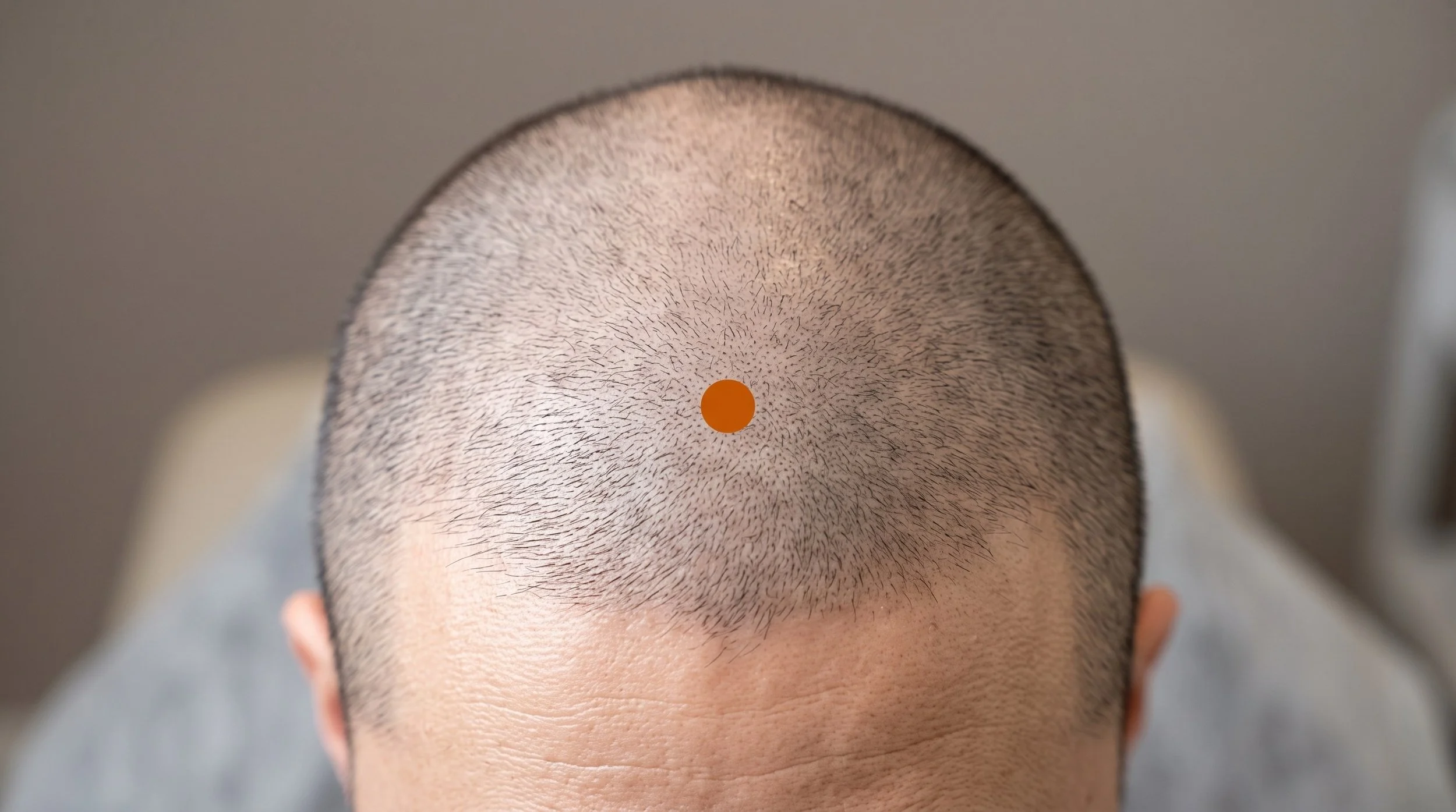
DU22 Acupuncture Point (Xinhui)
The Fontanelle Meeting on the Frontal Midline: Anatomy, Mechanism, and Why This Forgotten Scalp Point Still Earns a Place in Headache and Sinus Treatment
DU22 (Xinhui, often translated as Fontanelle Meeting), also written GV22, is a Governing vessel point on the midline of the scalp, 2 cun behind the front hairline and 1 cun behind DU23. Its name is literal: the point sits over the region of the anterior fontanelle, the soft membranous gap in an infant's skull that later closes to become bregma, where the frontal bone meets the two parietal bones. In classical writing DU22 was used far more than it is today, mostly for nasal blockage, discharge and nosebleed, for chronic and frontal headache, for dizziness, and for the heavy head that follows a night of drinking.
Anatomically it is a shallow point on the galea in the territory of the supratrochlear and supraorbital nerves, which makes it a useful frontal anchor when the presenting complaint is pressure across the forehead and the crown rather than pain at the back of the head.
- DU22 sits on the scalp midline about 2 cun posterior to the anterior hairline, roughly midway between the hairline and DU20 and 1 cun behind DU23. If the hairline is hard to read, measuring 3 cun up from the glabella gives a reliable alternative for Xinhui point location.
- The needle passes through skin, a fibrous fat layer and the galea aponeurotica, the tendinous sheet that links frontalis and occipitalis, so insertion is transverse and shallow (0.5 to 1 cun) rather than perpendicular.
- Traditional sources describe DU22 as a point that benefits the nose and eliminates wind from the head, and Cunningham's text adds calming internal wind, clearing heat and swelling, and opening the nose. These are traditional attributions, and modern reasoning translates them as segmental input from trigeminal V1 branches plus autonomic and vascular effects on scalp and nasal tissue.
- DU22 lies in supratrochlear and supraorbital nerve territory, the same branches targeted by external trigeminal neurostimulation devices, which reduced monthly migraine days compared with sham in a randomized trial (Schoenen et al., 2013). Needling that same territory plausibly recruits comparable trigeminal afferents (Zhao, 2008).
- The research picture is indirect but supportive at the whole-treatment level: Cochrane reviews found acupuncture added to usual care reduced tension-type headache and episodic migraine frequency (Linde et al., 2016a; Linde et al., 2016b), and a large individual patient data analysis reported effects on chronic pain that persisted over time (Vickers et al., 2018). For nasal symptoms, a meta-analysis of allergic rhinitis trials reported modest improvements in symptom and quality of life scores (He et al., 2022).
- De qi at DU22 is usually a broad, dull heaviness or spreading tightness across the front of the scalp rather than a sharp sensation, and many patients notice a mild wave of forehead pressure that eases within a minute or two of needle placement.
Frontal Headaches and Forehead Pressure That Will Not Lift?
Pain that sits across the brow, behind the eyes and over the crown often responds to a treatment that addresses the scalp, the neck and the sinuses together rather than one at a time. At Morningside Acupuncture we use DU22 alongside adjacent midline points and dry needling of the neck and jaw muscles that refer pain to the forehead. Sessions are calm, precise and built around what your headache pattern actually looks like week to week. Schedule a visit and let's map your pattern before the next flare.
Schedule NowAnatomy of DU22: Why the Anterior Fontanelle Region Is Such an Important Location
DU22 sits on the scalp midline over the area that was the anterior fontanelle in infancy and becomes bregma in the adult skull, where the frontal bone meets the two parietal bones. Below the skin is a dense, fibrous subcutaneous layer that is tethered by connective septa, and beneath that lies the galea aponeurotica, the flat tendinous sheet that joins the frontal and occipital bellies of the occipitofrontalis muscle.
Because the galea is a tension-bearing sheet rather than a contractile belly, it takes load from both directions: sustained frontalis activity from squinting, screen strain or bracing against pain pulls forward, while occipital and suboccipital tightness pulls back. Patients with frequent headaches often report that the whole scalp feels tender or tight to the touch, and this layer is a large part of why.
The nerve geography here is trigeminal. DU22 falls in the distribution of the supratrochlear and supraorbital branches of the frontal nerve, the ophthalmic division of the trigeminal nerve, which supply the forehead and carry sensation back over the vertex. These fibers terminate in the trigeminocervical complex, the same brainstem region where upper cervical afferents converge, which is the accepted explanation for why forehead pain, scalp tenderness and neck tightness so often travel together.
Stimulating this territory has measurable clinical effects: a randomized sham-controlled trial of transcutaneous supraorbital neurostimulation reported fewer monthly migraine days in the active group (Schoenen et al., 2013). Needle stimulation of the same afferents is thought to engage segmental gating and descending inhibitory pathways involving endogenous opioid, serotonergic and noradrenergic systems (Zhao, 2008), which offers a plausible mechanism for the classical claim that this region calms head wind.
Vascularly, the scalp at DU22 sits in a rich anastomotic network fed by the supratrochlear and supraorbital vessels with contributions from the superficial temporal system, and scalp vessels are held open by fibrous attachments, so oozing after needle removal is common and easily managed with brief pressure. The bone underneath is solid in adults, but the convention here is unambiguous: transverse insertion along the scalp, 0.5 to 1 cun, never perpendicular. Classical and modern texts both flag the same caution, which is that DU22 is not needled in infants whose fontanelle has not closed.
Moxibustion has traditionally been applied at this point in some lineages, though we rarely use it at the vertex in a clinical setting where hair makes it impractical.
Related Best Acupuncture Points For Headaches Related Governing VesselDU22 (GV22) at a Glance: Classification, Location, and Clinical Use
| Category | Detail |
|---|---|
| Traditional Name | Xinhui (Fontanelle Meeting), Governing Vessel 22, Deadman code DU22 |
| Channel Classification | Governing vessel (Du Mai), frontal midline of the scalp (DU22, also written GV22) |
| Point Categories | No five-shu, hui-meeting, or extraordinary vessel intersection status is recorded for this point in the reference texts. It is classified simply as a Governing vessel point of the frontal scalp midline, sited over the region of the anterior fontanelle (bregma), grouped in classical practice with DU23 and DU24 for the nose and with DU20 and DU21 for the head. |
| Precise Location | On the midline at the top of the head, 2 cun posterior to the anterior hairline and 1 cun posterior to DU23, approximately 3 cun anterior to DU20. If the hairline is indistinct, measure 3 cun superior to the glabella between the eyebrows. |
| Tissue Stimulated | Scalp skin, fibrous subcutaneous layer, galea aponeurotica linking frontalis and occipitalis, over the bregmatic region of the skull; supratrochlear and supraorbital (trigeminal V1) sensory territory |
| Needle Depth / Direction | Transverse (subcutaneous) insertion 0.5 to 1 cun along the scalp, usually directed posteriorly or anteriorly depending on the treatment intent. Never needled perpendicularly, and not needled in infants whose fontanelle has not closed. |
| De Qi Sensation | A dull, spreading heaviness or tight pressure across the front of the scalp, sometimes a brief warm or fuzzy band toward the forehead. Sharp or stinging sensation means the needle should be adjusted. |
| Primary Clinical Uses | Chronic and frontal headache, nasal congestion and discharge, dizziness, heavy or foggy head, and traditionally the bursting head heaviness that follows excess alcohol |
| Common Point Combinations |
|
The Deadman text is candid about DU22: it is a point of minimal importance in most modern clinics, yet the classical record gives it a long list of indications and an unusual number of named formulas.
Traditionally it was credited with benefiting the nose and dispersing wind from the head, and the indication lists cluster into four groups: nasal problems (blockage, discharge, bleeding, loss of smell, growths in the nose), head symptoms (chronic headache, wind headache, dizziness, the bursting head after heavy drinking, childhood convulsive patterns), surface changes of the face and scalp (redness, swelling, flaking), and a small set of mind-related entries such as sleepiness and fright palpitations, which Maciocia groups with the deficiency-type Governing vessel points.
Deadman also notes that DU22's nose role was eventually eclipsed by DU23 and its headache and dizziness role by DU20, which is a fair summary of how the point is used today. What is striking is the coherence of the classical picture: a single frontal midline point that classical authors kept reaching for whenever the head felt blocked, heavy and pressurized from the front, which is a description most sinus headache patients would recognize immediately.
Why DU22 Is Used for Nasal Congestion as Well as Headache
The link between a point on top of the scalp and symptoms in the nose looks strange until you follow the nerve supply. DU22 sits in the territory of the supratrochlear and supraorbital nerves, branches of the ophthalmic division of the trigeminal nerve, which is the same division that supplies the frontal sinus lining, the upper nasal cavity and the skin over the brow. Input from these branches converges in the trigeminocervical complex in the brainstem, so a stimulus at the scalp arrives at the same processing region that handles frontal sinus pressure, forehead pain and upper neck input.
That shared address is the mainstream explanation for why frontal points are chosen for nasal and sinus complaints, and it is also why the classical texts kept DU22, DU23 and DU24 together in one nose-and-head cluster.
Beyond the segmental story, needling appears to recruit descending inhibitory control from the midbrain and brainstem, involving endogenous opioid, serotonergic and noradrenergic signaling, which raises pain thresholds more broadly rather than only at the needled spot (Zhao, 2008).
There is also an autonomic component that matters for congestion, since nasal patency is under vasomotor control and trigeminal afferent stimulation can shift local blood flow and secretion. Direct evidence for supraorbital-territory stimulation comes from neuromodulation research: a randomized sham-controlled trial of a transcutaneous supraorbital stimulator reported a significant reduction in monthly migraine days in the active group (Schoenen et al., 2013). DU22 is not that device, and no trial has isolated this point, but the anatomy the two approaches share is worth noting.
In practice we treat DU22 as a frontal anchor rather than a headliner. When a patient describes pressure that starts above the brow and spreads over the crown, when the scalp itself is tender, or when headache and congestion track each other, DU22 earns a place in the prescription. When pain is clearly occipital, unilateral and temporal, or clearly cervicogenic, other points and dry needling targets take priority.
What the Research Shows for DU22 (GV22)
One note on naming before the evidence: in the research literature this point is almost always listed as GV22, the WHO standard code, so GV22 is the term to search if you want to read the studies below in full.
No clinical trial has tested DU22 on its own, and it would be misleading to present any study as evidence for this single point. What the literature evaluates is whole acupuncture protocols using multiple points, usually including scalp, neck, face and distal points, and DU22 is one of the local frontal options a clinician may include within such a protocol.
The reviews below set reasonable expectations: effects on headache frequency and nasal symptoms tend to be modest but consistent, comparisons against sham are narrower than comparisons against usual care, and studies suggest benefit accumulates over a course of treatment rather than a single visit.
| Study | Type | Focus | Key Finding |
|---|---|---|---|
| Linde et al., 2016a | Cochrane systematic review | Acupuncture for prevention of tension-type headache | Adding acupuncture to usual care was associated with a greater proportion of participants reporting at least a halving of headache frequency, though sham comparisons showed smaller differences. |
| Linde et al., 2016b | Cochrane systematic review | Acupuncture for prevention of episodic migraine | Acupuncture reduced migraine frequency compared with no prophylactic treatment and compared with sham, with effects broadly comparable to prophylactic drug therapy in the included trials. |
| Vickers et al., 2018 | Individual patient data meta-analysis | Acupuncture for chronic pain including headache | Acupuncture outperformed both sham and no-acupuncture controls for chronic pain, with benefit that declined only modestly over twelve months. |
| He et al., 2022 | Systematic review and meta-analysis with trial sequential analysis | Acupuncture for allergic rhinitis (30 trials, 4,413 participants) | Acupuncture improved nasal symptom scores and quality of life compared with no intervention, with smaller but measurable differences against sham acupuncture. |
| Schoenen et al., 2013 | Randomized sham-controlled trial | Transcutaneous supraorbital nerve stimulation for migraine prevention | Active stimulation of the supraorbital and supratrochlear territory reduced monthly migraine days versus sham, supporting the relevance of this nerve field in headache care. |
| Zhao, 2008 | Narrative mechanism review | Neural mechanisms of acupuncture analgesia | Needle stimulation engages segmental spinal gating and descending inhibitory systems using opioid, serotonergic and noradrenergic signaling, which may explain effects beyond the needled site. |
Congested, Stuffy and Foggy Through Allergy Season?
Nasal blockage rarely stays in the nose: it drags along facial pressure, dull frontal headache and that heavy, slowed-down feeling by mid-afternoon. DU22 has been used for centuries as part of a nose-and-head grouping, and we pair it with local points around the nostrils and cheeks plus neck release for the muscles that tighten when you are congested. Treatment is gentle, and most patients feel some clearing before they leave the table. Book a session and see how your season goes with support in place.
Schedule NowDU22 in the Context of Trigger Point Work
DU22 does not sit over a muscle belly, so it is not a trigger point target in the usual sense. It sits on the galea, the tendinous sheet that transmits tension between frontalis in front and occipitalis behind, which means it is downstream of muscles that do harbor trigger points. Frontalis and occipitalis refer pain across the forehead and into the scalp, and sternocleidomastoid, upper trapezius, suboccipital and temporalis trigger points are well documented sources of referred pain to the forehead, temple and vertex (Simons et al., 1999).
When a patient's frontal headache reproduces on palpation of the neck, the neck is where the mechanical work belongs, and DU22 becomes a complementary frontal input rather than the main event.
At Morningside Acupuncture we routinely combine a shallow transverse needle at DU22 with dry needling of the suboccipital group, upper trapezius, splenius capitis, temporalis and sternocleidomastoid, chosen from what reproduces the patient's pattern on exam. Acupuncture in this context simply means the use of an acupuncture needle, whether the reasoning is channel-based or myofascial, and both approaches share the same tool and much of the same neurophysiology.
The practical advantage of pairing them is coverage: the neck work addresses the mechanical driver, while the scalp point addresses the trigeminal field where the patient actually feels the pressure.
DU22 Headache and Sinus Pressure Treatment at NYC's Highest-Rated Acupuncture Clinic
Morningside Acupuncture is the highest-rated acupuncture and dry needling clinic in New York City with over 500 five-star Google reviews, and headache care is one of the things we do most. Every plan is built on a physical exam, palpation of the scalp, neck and jaw, and a clear discussion of what the research does and does not show. DU22 is one tool within a larger strategy, not a standalone fix. Schedule your first visit and start with a plan you can actually follow.
Schedule NowFrequently Asked Questions
Is DU22 the same point as GV22?
Yes. DU22 and GV22 are two codes for the same point, Xinhui. DU comes from Du Mai, the Chinese name of the Governing Vessel, and it is the code used in most Chinese texts and many acupuncture schools. GV is the WHO standard abbreviation and the one you will see in most Western textbooks and research papers. You will also come across it written as Du 22, GV-22, or Governing Vessel 22. Whichever code is used, the location and the uses are the same.
What does DU22 feel like when needled?
Because the needle lies almost flat under the scalp, most people feel a brief pinch at the skin followed by a dull, spreading heaviness or a band of tight pressure across the front of the head. Some patients describe a warm or fuzzy sensation moving toward the forehead, and a few notice their sinuses feel slightly more open within the first few minutes. It should not be sharp, burning or electric. Scalp points can bleed a drop or two on removal, which is normal and stops with a few seconds of pressure.
Why needle the top of the head for a stuffy nose or a headache behind the eyes?
DU22 lies in the sensory territory of the supratrochlear and supraorbital nerves, branches of the trigeminal nerve that also supply the forehead, brow and upper nasal region. Those fibers converge in the trigeminocervical complex, so scalp input reaches the same processing hub that handles frontal sinus pressure and forehead pain, and needle stimulation is thought to recruit descending pain-modulating systems as well (Zhao, 2008). Classical texts arrived at the same grouping empirically, pairing DU22 with DU23 and DU24 for nose and head complaints long before the anatomy was described.
Can I press DU22 myself between sessions?
Yes, and it is easy to find. Trace the midline from between your eyebrows straight up over the hairline and stop about two finger-widths (roughly 2 cun) behind where the hair begins, or about three hand-widths up from the glabella if your hairline is receded. Use the pad of your thumb or two fingertips and press with steady, moderate pressure for 30 to 60 seconds, then release, repeating three to five times. Small circular movements over the scalp work well too, since the goal is to load the galea rather than to jab a single spot. Two or three sessions a day during a congested or headachy stretch is reasonable. Stop if pressure sharpens the headache, and skip self-pressure on any area of broken skin, recent scalp surgery or unexplained scalp swelling.
Is DU22 safe to needle?
In adults it is a low-risk point when the standard conventions are followed: transverse insertion 0.5 to 1 cun along the scalp, never perpendicular, with the skull acting as a firm backstop. The main practical issue is minor bleeding or a small bruise, since the scalp is well vascularized. The one firm contraindication in both classical and modern texts is needling this point in infants whose anterior fontanelle has not yet closed, because the underlying bone is not continuous. Patients on anticoagulants, with scalp lesions, recent head surgery or cranial hardware should tell their acupuncturist, since local point selection may change.
Where exactly is DU22 located?
DU22 is on the midline at the top of the head, 2 cun posterior to the anterior hairline and 1 cun posterior to DU23, which places it roughly 3 cun in front of DU20 at the vertex. A simple check is to find the midpoint between DU20 and the front hairline, then move about half a cun forward. If the hairline is unclear, measure 3 cun straight up from the glabella between the eyebrows. Landmark-wise, the point overlies the region of the anterior fontanelle, known in the adult skull as bregma, where the frontal and parietal bones meet.
References
- Deadman, P., Al-Khafaji, M., & Baker, K. (2009). A manual of acupuncture. Journal of Chinese Medicine Publications.
- Cunningham, P. M. (2000). Acupuncture points: A practical guide to classical and modern usage. Odyssey Press.
- Cheng, X. (Ed.). (1999). Chinese acupuncture and moxibustion (Rev. ed.). Foreign Languages Press.
- Maciocia, G. (2005). The foundations of Chinese medicine: A comprehensive text for acupuncturists and herbalists (2nd ed.). Elsevier Churchill Livingstone.
- O'Connor, J., & Bensky, D. (Eds. & Trans.). (1981). Acupuncture: A comprehensive text. Shanghai College of Traditional Medicine. Eastland Press.
- Simons, D. G., Travell, J. G., & Simons, L. S. (1999). Travell & Simons' myofascial pain and dysfunction: The trigger point manual, Vol. 1: Upper half of body (2nd ed.). Williams & Wilkins.
- Linde, K., Allais, G., Brinkhaus, B., Fei, Y., Mehring, M., Shin, B. C., Vickers, A., & White, A. R. (2016a). Acupuncture for the prevention of tension-type headache. Cochrane Database of Systematic Reviews, 2016(4), CD007587. https://doi.org/10.1002/14651858.CD007587.pub2
- Linde, K., Allais, G., Brinkhaus, B., Fei, Y., Mehring, M., Vertosick, E. A., Vickers, A., & White, A. R. (2016b). Acupuncture for the prevention of episodic migraine. Cochrane Database of Systematic Reviews, 2016(6), CD001218. https://doi.org/10.1002/14651858.CD001218.pub3
- Vickers, A. J., Vertosick, E. A., Lewith, G., MacPherson, H., Foster, N. E., Sherman, K. J., Irnich, D., Witt, C. M., & Linde, K. (2018). Acupuncture for chronic pain: Update of an individual patient data meta-analysis. Journal of Pain, 19(5), 455-474. https://doi.org/10.1016/j.jpain.2017.11.005
- He, M., Qin, W., Qin, Z., & Zhao, C. (2022). Acupuncture for allergic rhinitis: A systematic review and meta-analysis. European Journal of Medical Research, 27(1), 58. https://doi.org/10.1186/s40001-022-00682-3
- Schoenen, J., Vandersmissen, B., Jeangette, S., Herroelen, L., Vandenheede, M., Gérard, P., & Magis, D. (2013). Migraine prevention with a supraorbital transcutaneous stimulator: A randomized controlled trial. Neurology, 80(8), 697-704. https://doi.org/10.1212/WNL.0b013e3182825055
- Zhao, Z. Q. (2008). Neural mechanism underlying acupuncture analgesia. Progress in Neurobiology, 85(4), 355-375. https://doi.org/10.1016/j.pneurobio.2008.05.004
Disclaimer: This web site is intended for educational and informational purposes only. Reading this website does not constitute providing medical advice or any professional services. This information should not be used for diagnosing or treating any health issue or disease. Those seeking medical advice should consult with a licensed physician. Seek the advice of a medical doctor or other qualified health professional for any medical condition. If you think you have a medical emergency, call 911 or go to the emergency room. No acupuncturist-patient relationship is created by reading this website or using the information. Morningside Acupuncture PLLC and its employees and contributors do not make any express or implied representations with respect to the information on this site or its use. For any legal interpretation of scope of practice in your state, consult a licensed attorney or regulatory authority.
Read more from our blog



