Yin Tang Acupuncture Point
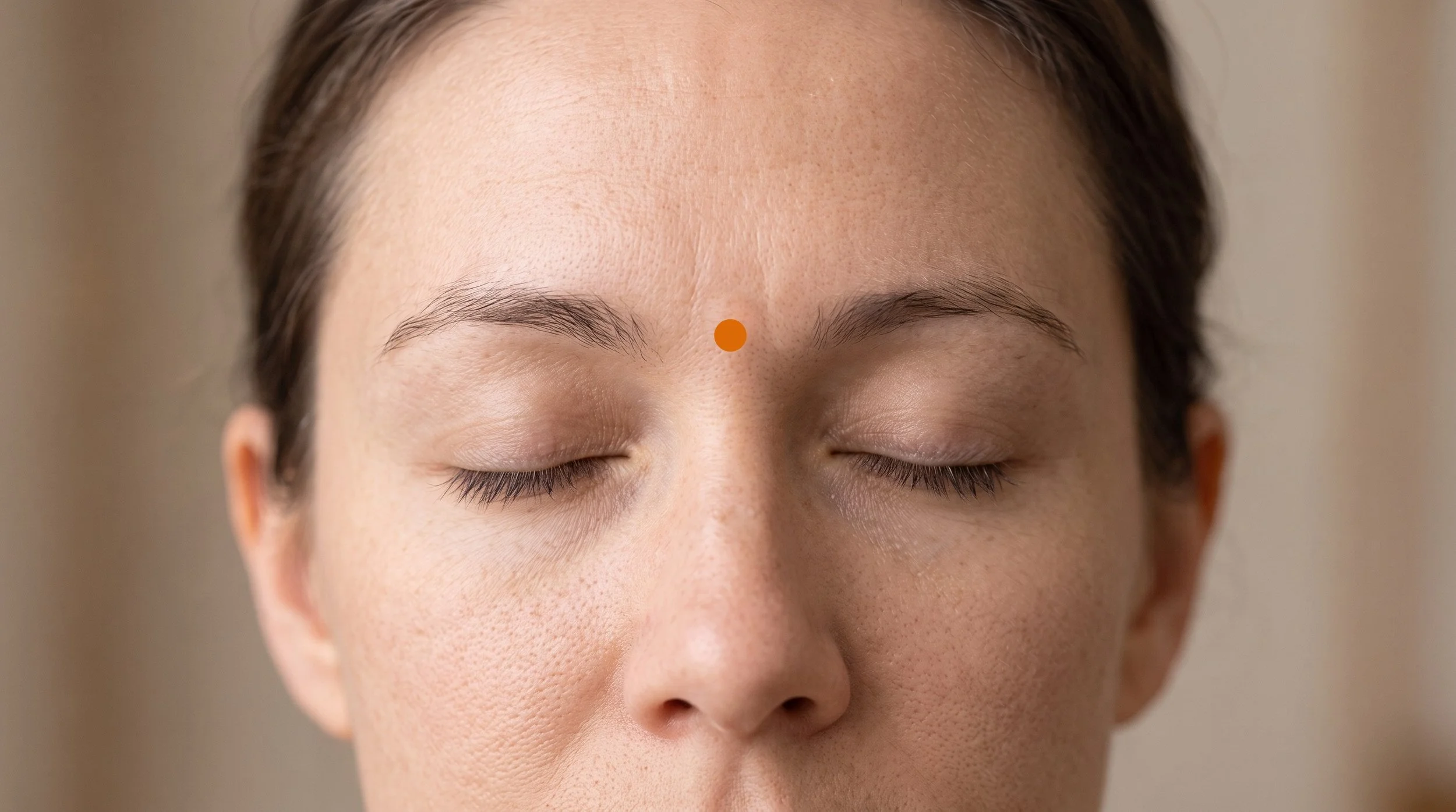
Yin Tang Acupuncture Point
The Hall of Impression Between the Eyebrows: Anatomy, Trigeminal Mechanism, and Why This Single Midline Point Anchors Stress, Sleep, and Sinus Treatment
Yintang or Yin Tang, translated as Hall of Impression and catalogued as extra point M-HN-3 (also written EX-HN3), sits exactly at the midpoint between the medial ends of the eyebrows on the glabella, the small flat area of bone just above the bridge of the nose. It is one of the few points that patients can find on themselves within seconds, which is part of why the yintang acupuncture point has become the best known calming point in modern practice. Classically it is grouped with the extraordinary points of the head rather than with a numbered channel, and it is traditionally described as calming the shen, benefiting the nose, and easing frontal head pain. In a contemporary clinic those three traditional headings map onto the reasons we reach for it every day: stress and anxiety, difficulty falling asleep, frontal headache, and sinus pressure.
- Yintang location is simple and reliable: the midline point between the medial ends of the eyebrows, over the glabella. Under the skin lie a thin subcutaneous layer, the procerus muscle, the medial edges of the frontalis, and then the periosteum of the frontal bone, which is why the point is needled transversely with the skin pinched up rather than straight down.
- Traditional sources classify Yintang as an extra point of the head with three attributed actions: pacifying wind and calming the shen, benefiting the nose, and moving the local channel to relieve pain. Read neurophysiologically, those categories describe autonomic settling, effects on nasal mucosal tone and airflow perception, and modulation of trigeminal afferents from the forehead.
- The sensory supply comes from supratrochlear and infratrochlear branches of the ophthalmic division of the trigeminal nerve. These first division afferents converge with upper cervical input in the trigeminocervical complex, which gives a plausible segmental route by which a glabellar needle may influence frontal headache and periorbital pressure, alongside descending inhibitory and opioid mediated mechanisms described for acupuncture generally (Zhao, 2008).
- Yintang is unusual among acupuncture points in having been studied on its own. Volunteer studies report reduced bispectral index and lower verbal stress scores after glabellar stimulation compared with sham (Fassoulaki et al., 2007), and reduced EEG spectral entropy consistent with a mild sedative shift (Arai et al., 2011), while a cohort study found no measurable change in middle cerebral artery pulsatility, suggesting the effect is not a gross cerebral blood flow phenomenon (Fassoulaki et al., 2018).
- Clinical trials cluster around anxiety before surgery. Sham controlled needling at Yintang reduced state anxiety and bispectral index values in adult surgical patients (Acar et al., 2013), a larger randomized trial in neurosurgical patients found anxiety scores fell after needling this point (Wiles et al., 2017), and a review of studies using Yintang alone reported consistent reductions in self-reported anxiety in preoperative populations while calling for more rigorous work (Kwon & Lee, 2018).
- De qi at Yintang is distinctive. Because the needle stays subcutaneous, patients usually report a dull spreading heaviness or pressure between the eyebrows rather than a sharp sensation, sometimes with mild eye watering, a sinking feeling behind the forehead, and frequently drowsiness within a minute or two of insertion.
Stuck in Fight or Flight and Struggling to Switch Off?
Stress that lives in the jaw, brow, and breath rarely responds to willpower alone. At Morningside Acupuncture we use Yintang alongside points like GV20, HT7, and PC6 as part of a treatment designed to shift you out of a sympathetic dominant state, and most patients notice the change on the table. Our acupuncturists pair that calming work with hands on treatment of the forehead, temple, and jaw muscles that hold tension all day. Schedule a visit and let us build a plan around how your stress actually shows up.
Schedule NowAnatomy of YINTANG: Why the Glabella Is Such an Important Location
The glabella is a small, flat, bony platform with very little padding over it. From the surface down, a needle at Yintang passes through thin skin, a loose subcutaneous layer, and then the procerus, a short vertical muscle that runs from the nasal bridge up into the medial fibers of the frontalis. Procerus and the neighboring corrugators are the muscles that pull the brow down and inward, which is exactly what happens during hours of squinting at a screen, chronic worry, bright light sensitivity, and nasal congestion. Below that thin muscular sheet sits the periosteum of the frontal bone, so there is no meaningful depth here, and that anatomy dictates the technique: pinch the skin up and thread the needle transversely rather than driving it perpendicular toward bone.
Sensory innervation of this patch of forehead comes from the supratrochlear nerve with contributions from the infratrochlear nerve, both branches of the ophthalmic division of the trigeminal nerve. That detail matters clinically, because first division trigeminal afferents synapse in the trigeminocervical complex, where input from the face and forehead converges with input from the upper cervical segments. Convergence of this kind is the accepted explanation for why frontal and periorbital pain, upper neck tension, and sinus type pressure so often blur together, and it offers a segmental route by which stimulating the glabella may influence how those second order neurons behave. On top of any segmental effect, needling recruits the broader descending inhibitory systems and opioid mediated pathways characterized in acupuncture analgesia research (Zhao, 2008). Point specific work also suggests a measurable autonomic and cortical shift: glabellar stimulation has been associated with lower bispectral index and stress ratings (Fassoulaki et al., 2007) and with reduced EEG spectral entropy relative to sham (Arai et al., 2011).
The vascular neighborhood is superficial rather than deep. Supratrochlear vessels and the rich anastomotic network of the forehead and nasal root sit close to the skin, and facial tissue bruises easily, so a small bruise between the eyebrows is the most common minor event after treatment and is worth mentioning to patients who have events coming up. There is no cavity, organ, or large artery at risk at this location, which is one reason the point is used so freely in hospital based research. Standard needling is transverse insertion of 0.3 to 0.5 cun directed inferiorly toward the nose, with the skin pinched between the fingers of the other hand; some practitioners angle laterally toward one eyebrow instead. Fine gauge needles, gentle stimulation, and firm pressure with a clean cotton ball on withdrawal keep the technique comfortable and cosmetically uneventful.
Related Best Acupuncture Points For Anxiety Related Best Acupuncture Points For HeadachesYINTANG at a Glance: Classification, Location, and Clinical Use
| Category | Detail |
|---|---|
| Traditional Name | Yintang (Hall of Impression), also written Yin Tang, commonly called the third eye acupuncture point |
| Channel Classification | Extra point, M-HN-3 (EX-HN3), lying on the pathway of the Governing vessel without being numbered on it |
| Point Categories | Extraordinary point of the head; no five-shu, mu, luo, or hui-meeting designation; traditionally attributed the actions of pacifying wind and calming the shen, benefiting the nose, and activating the channel to relieve pain; considered by some qigong authorities to mark the upper dantian |
| Precise Location | On the midline of the face at the glabella, at the midpoint between the medial ends of the two eyebrows |
| Tissue Stimulated | Skin and subcutaneous tissue of the glabella, the procerus and medial frontalis fibers, and supratrochlear and infratrochlear nerve branches of the ophthalmic division of the trigeminal nerve |
| Needle Depth / Direction | Transverse insertion of 0.3 to 0.5 cun directed inferiorly toward the nose (or laterally), with the skin pinched up; fine gauge needle, no perpendicular needling to periosteum |
| De Qi Sensation | A dull, spreading heaviness or pressure between the eyebrows that may radiate into the forehead or nasal root; often accompanied by softening of the brow, slower breathing, and noticeable drowsiness |
| Primary Clinical Uses | Stress and anxiety, difficulty falling asleep, frontal headache, sinus congestion and rhinitis, brow tension and eye strain |
| Common Point Combinations |
|
According to A Manual of Acupuncture, Yintang was first mentioned in the Essential Questions, and the commentary there flags something genuinely odd: although the point sits squarely on the course of the Governing vessel, it was never given a Governing vessel number and remained an extra point. Traditional writers also place it in the region many cultures call the third eye, and some qigong authorities identify it as the site of the upper dantian. The classical literature reduces its use to four practical situations, framed as traditional attributions rather than physiology: settling the spirit in insomnia, anxiety, and agitation; moving the local channel for frontal headache; benefiting the nose in congestion, discharge, rhinitis, sinus pain, and nosebleed; and pacifying wind in the acute and chronic fright wind of children. What is striking is how tightly that centuries old shortlist matches the reasons a modern clinic reaches for the point, which is unusual for a location with no channel number at all.
Why YINTANG Is Used for Anxiety and Insomnia When Nothing About It Touches the Brain
Patients often ask how a needle resting just under the skin between the eyebrows can change how they feel. The first part of the answer is anatomical. The glabella is dense in first division trigeminal afferents, and those fibers project to the trigeminocervical complex and onward to brainstem regions involved in arousal, autonomic tone, and pain modulation. Input from the face and forehead converges with upper cervical input at that relay, which is why frontal headache, brow tension, and neck tightness so often present as a single problem, and why a local needle here can influence a symptom that feels much bigger than the tiny area being treated.
The second part involves systems that operate well beyond the segment. Needling recruits descending inhibition from midbrain and brainstem structures along with opioid and monoamine mediated mechanisms that dampen how readily pain signals ascend (Zhao, 2008). Yintang also happens to be one of the few points with dedicated physiological studies attached to it. Volunteers receiving glabellar stimulation showed reduced bispectral index values and lower verbal stress scores compared with sham stimulation and with no stimulation at all, without any change in melatonin or beta endorphin levels (Fassoulaki et al., 2007). A separate randomized volunteer study found lower EEG spectral entropy in the Yintang group than in the sham group, a pattern consistent with a mild sedative shift, alongside a fall in the LF to HF ratio of heart rate variability in both groups (Arai et al., 2011).
It is equally useful to know what the point does not appear to do. When the same research group measured middle cerebral artery flow using the pulsatility index, neither acupressure nor needling at Yintang produced a detectable change in regional cerebral blood flow (Fassoulaki et al., 2018). That negative result is helpful rather than discouraging: it points away from a crude circulatory explanation and toward neural modulation of arousal and autonomic tone. In plain terms, Yintang looks less like a switch that alters brain blood supply and more like a reliable sensory input that helps a wound up nervous system downshift.
What the Research Shows for YINTANG
A caveat applies to almost every acupuncture review: trials test multi-point protocols, so the evidence usually speaks to a whole treatment rather than to one location. Yintang is a partial exception, because its accessibility made it attractive to anesthesiologists who wanted to test a single point in a controlled hospital setting. That gives us a small but genuinely point-specific literature on anxiety and sedation, plus broader reviews of acupuncture for headache and insomnia in which frontal and calming points like this one commonly appear. The trials are mostly small, short term, and often unblinded, so results should be read as encouraging rather than definitive.
| Study | Type | Focus | Key Finding |
|---|---|---|---|
| Kwon & Lee, 2018 | Preliminary review of Yintang-only studies | Acupuncture or acupressure at EX-HN3 alone for anxiety | Five randomized trials, mostly in preoperative patients, reported consistent reductions in self-reported anxiety, though the authors called for more rigorous trials and mechanistic work. |
| Acar et al., 2013 | Randomized, single-blind, sham-controlled trial | Press needle at Yintang before surgery in 52 adults | State anxiety scores and bispectral index values fell in the Yintang group but not in the sham point group, suggesting a point-specific calming effect in this setting. |
| Wiles et al., 2017 | Randomized controlled trial | Needling EX-HN3 for preoperative anxiety in 128 neurosurgical patients | Anxiety inventory scores decreased significantly after needling with no change in the untreated control group, although participants were not blinded. |
| Fassoulaki et al., 2007 | Controlled volunteer study | Glabellar acupressure versus sham point and no intervention | Bispectral index and verbal stress scores decreased after Yintang acupressure, while serum melatonin and plasma beta endorphin were unchanged. |
| Arai et al., 2011 | Randomized volunteer study | EEG spectral entropy and heart rate variability during Yintang acupressure | Spectral entropy values were lower in the Yintang group than the sham group, and the LF to HF ratio fell in both groups, hinting at a sedative and autonomic shift. |
| Fassoulaki et al., 2018 | Cohort observational study | Regional cerebral blood flow with acupuncture and acupressure at Extra-1 | No detectable change in middle cerebral artery pulsatility index, which argues against a gross cerebral blood flow explanation for the point's effects. |
| Linde et al., 2016a | Cochrane systematic review | Acupuncture for prevention of tension-type headache | Courses of at least six sessions may be a worthwhile option for people with frequent tension-type headache, with modest benefit over sham in pooled analyses. |
| Kim et al., 2021 | Systematic review and meta-analysis | Acupuncture for insomnia across 24 randomized trials | Pooled results favored acupuncture over pharmacotherapy on the Pittsburgh Sleep Quality Index, but heterogeneity was high and methodological quality varied. |
Yintang for Anxiety and Sleep: How the Third Eye Acupuncture Point Became the Best Known Pressure Point for Calm
Ask most people to name a pressure point for anxiety and they will point between their eyebrows, often without knowing that the yin tang point has a formal designation (M-HN-3, also written EX-HN3) and a documented place in classical texts. Its popularity is not accidental. The location is symmetrical, easy to find, painless to press, and socially invisible, so it can be used in a waiting room, on a subway platform, or in bed at 2 a.m. Traditional sources describe it as calming the shen, and in clinic that maps onto the patient who arrives with a clenched brow, shallow breathing, and a mind that will not stop rehearsing tomorrow.
The research picture on this particular use is unusually specific for a single point. Sham controlled needling at Yintang reduced state anxiety and bispectral index values in surgical patients (Acar et al., 2013), a larger randomized trial found lower anxiety scores after needling the point before neurosurgery (Wiles et al., 2017), and a review of studies using Yintang alone found consistent reductions in self-reported preoperative anxiety while stressing that the trials were small (Kwon & Lee, 2018). Volunteer work adds a physiological correlate in the form of reduced cortical arousal measures during glabellar stimulation (Fassoulaki et al., 2007; Arai et al., 2011).
For sleep, we treat Yintang as one element of a plan rather than as a stand-alone answer. It pairs classically with HT7 and SP6 for insomnia, and broader reviews suggest acupuncture protocols may improve subjective sleep quality, with the usual caveats about heterogeneity and trial quality (Kim et al., 2021). In practice, patients who struggle mainly with sleep onset, racing thoughts, and a wired but tired feeling tend to respond best, particularly when treatment is combined with a consistent wind down routine and self-applied acupressure at home.
Frontal Headaches and Sinus Pressure That Never Fully Clear?
Pressure across the brow, a heavy forehead, and congestion behind the nose often travel together, and Yintang sits directly over the tissue that generates and refers those sensations. We combine it with LI4, LI20, GB20, and dry needling of the frontalis, procerus, and upper cervical muscles to address both the local source and the referral pattern. Treatment is precise, hygienic, and adjusted at every session based on your response. Book an evaluation and we will map the pattern before we needle it.
Schedule NowYINTANG in the Context of Trigger Point Work
Yintang sits directly over the procerus, and the procerus and corrugator group is a classic source of the tight, pressing band across the brow that patients describe as a headache behind the eyes. Travell and Simons' trigger point manual documents referral from the muscles of the forehead and brow into the frontal and periorbital region, which is the same territory the classical texts assign to this point. At Morningside we frequently start with a fine transverse needle at Yintang to settle the whole area, then treat the procerus and medial frontalis fibers directly if palpation reveals taut, tender bands. Because acupuncture is defined by the use of an acupuncture needle, this is a single continuum of technique rather than two competing systems: the same needle can be used for a traditional point prescription, a local myofascial target, or both in one visit.
Frontal headache and brow tension rarely live in the forehead alone. Clenching and bruxing patients often have irritable medial pterygoid and masseter muscles, and upper cervical and suboccipital tissue routinely feeds the same trigeminocervical convergence discussed above. A typical Morningside session for this pattern might combine Yintang with GB20, LI4, and dry needling of the jaw and upper neck muscles, chosen by palpation rather than by protocol. We keep needle counts on the face conservative, use the finest appropriate gauge, and apply firm pressure afterward, since the main downside of needling here is a small bruise rather than anything more serious.
YINTANG Anxiety and Insomnia Treatment at NYC's Highest-Rated Acupuncture Clinic
Morningside Acupuncture is the highest-rated acupuncture and dry needling clinic in New York City with over 500 five-star Google reviews, and Yintang appears in more of our treatment plans than almost any other point. We use it as an anchor for anxiety, racing thoughts at bedtime, and stress driven headaches, then layer in body points and myofascial needling to hold the effect between visits. Every plan includes practical acupressure and breathing homework you can use on your own. Schedule your appointment and start with one quiet needle between the eyebrows.
Schedule NowFrequently Asked Questions
What does YINTANG feel like when needled?
Most patients feel a brief pinch as the needle passes the skin, then a dull, spreading heaviness or pressure sitting between and just above the eyebrows. Because the needle is threaded transversely under the skin rather than pushed toward bone, the sensation is usually mild and diffuse rather than sharp. Some people notice their eyes watering slightly, a sinking sensation behind the forehead, or a deep breath arriving on its own. Drowsiness within a minute or two is common enough that we often needle this point first, and a few patients fall asleep for the rest of the session.
Why needle a point on the forehead for anxiety and sleep instead of a point on the arms or legs?
We often do both, and the classical insomnia combination pairs Yintang with HT7 on the wrist and SP6 on the leg. The reason the forehead earns a place is that the glabella is densely supplied by first division trigeminal afferents that project into brainstem circuitry involved in arousal and autonomic regulation, and that region is also where anxiety physically shows up for many people as a clenched, furrowed brow. Point-specific studies of Yintang have measured reductions in cortical arousal indices and stress ratings during glabellar stimulation (Fassoulaki et al., 2007; Arai et al., 2011). Distal points are used for a different purpose, extending the effect and addressing the whole pattern rather than the face alone.
Can I press YINTANG myself between sessions?
Yes, and this is one of the few points we routinely teach as homework because it is safe, easy to locate, and hard to get wrong. Find the midpoint between the inner ends of your eyebrows, then use the pad of your middle finger or the knuckle of your index finger to apply steady, firm but comfortable pressure straight back toward the bone. Hold for 30 to 60 seconds while breathing slowly, with the exhale about twice as long as the inhale, then release and repeat two or three times for a total of about two to five minutes. Small circular or gentle downward stroking motions toward the nose work equally well and can help with congestion. Studies of glabellar acupressure typically used 5 to 10 minutes of stimulation, so a session in that range is reasonable, and it can be repeated several times a day, including at bedtime. Stop if you have any pain, broken skin, active infection, or recent cosmetic injection in the area.
Is YINTANG safe to needle?
It is one of the safer points on the body when needled correctly. There is no cavity, organ, or major vessel at risk, which is part of why hospital researchers chose it for controlled trials. The technique matters: the skin is pinched up and the needle is threaded transversely 0.3 to 0.5 cun, so it never approaches the periosteum in a way that would be painful. The most common minor effect is a small bruise, since facial tissue is thin and well supplied with superficial vessels, and we mention this to anyone with a photo shoot, wedding, or presentation coming up. We take extra care with patients on blood thinners, avoid needling through broken or infected skin, and modify the plan for anyone with recent facial cosmetic procedures. Needles should always be sterile, single use, and placed by a licensed practitioner.
Where exactly is YINTANG located?
Yintang is on the facial midline at the glabella, at the exact midpoint between the medial ends of the two eyebrows, just above the bridge of the nose. To find it, run a fingertip up the bridge of the nose until the bone flattens out, then check that you are level with the inner ends of both brows. It is one of the landmark based points that can be located directly rather than measured in cun, which is why texts describe it simply as lying between the eyebrows. Formally it is catalogued as extra point M-HN-3, also written EX-HN3, and although it sits on the pathway of the Governing vessel it was never assigned a number on that channel.
Is the yintang point actually useful for anxiety, or is it just relaxing because someone is touching my face?
Both effects are probably at work, and that is fine clinically, but the trials were designed to separate them. In sham controlled studies, patients who received stimulation at Yintang showed larger reductions in anxiety and cortical arousal measures than patients who received identical contact at a nearby non-point (Acar et al., 2013; Fassoulaki et al., 2007), which suggests something beyond general touch and attention. That said, the effects measured were short lived in several studies, the trials were small, and comforting contact in a quiet room genuinely helps. Our position is that Yintang is a dependable, low risk tool for downshifting arousal, not a replacement for treatment of a diagnosed anxiety disorder.
References
- Deadman, P., Al-Khafaji, M., & Baker, K. (2009). A manual of acupuncture. Journal of Chinese Medicine Publications.
- Cheng, X. (Ed.). (1999). Chinese acupuncture and moxibustion (Rev. ed.). Foreign Languages Press.
- O'Connor, J., & Bensky, D. (Eds. & Trans.). (1981). Acupuncture: A comprehensive text. Shanghai College of Traditional Medicine. Eastland Press.
- Maciocia, G. (2005). The foundations of Chinese medicine: A comprehensive text for acupuncturists and herbalists (2nd ed.). Elsevier Churchill Livingstone.
- Maciocia, G. (2006). The channels of acupuncture: Clinical use of the secondary channels and eight extraordinary vessels. Churchill Livingstone Elsevier.
- White, A., Cummings, M., & Filshie, J. (2008). An introduction to Western medical acupuncture. Churchill Livingstone Elsevier.
- Filshie, J., White, A., & Cummings, M. (Eds.). (2016). Medical acupuncture: A Western scientific approach (2nd ed.). Elsevier.
- Simons, D. G., Travell, J. G., & Simons, L. S. (1999). Travell & Simons' myofascial pain and dysfunction: The trigger point manual, Vol. 1: Upper half of body (2nd ed.). Williams & Wilkins.
- Fassoulaki, A., Paraskeva, A., Kostopanagiotou, G., Tsakalozou, E., & Markantonis, S. (2007). Acupressure on the extra 1 acupoint: The effect on bispectral index, serum melatonin, plasma beta-endorphin, and stress. Anesthesia & Analgesia, 104(2), 312-317. https://doi.org/10.1213/01.ane.0000250911.43942.4e
- Arai, Y. C. P., Ushida, T., Matsubara, T., Shimo, K., Ito, H., Sato, Y., Wakao, Y., & Komatsu, T. (2011). The influence of acupressure at extra 1 acupuncture point on the spectral entropy of the EEG and the LF/HF ratio of heart rate variability. Evidence-Based Complementary and Alternative Medicine, 2011, 503698. https://doi.org/10.1093/ecam/nen061
- Acar, H. V., Cuvas, O., Ceyhan, A., & Dikmen, B. (2013). Acupuncture on Yintang point decreases preoperative anxiety. Journal of Alternative and Complementary Medicine, 19(5), 420-424. https://doi.org/10.1089/acm.2012.0494
- Wiles, M. D., Mamdani, J., Pullman, M., & Andrzejowski, J. C. (2017). A randomised controlled trial examining the effect of acupuncture at the EX-HN3 (Yintang) point on pre-operative anxiety levels in neurosurgical patients. Anaesthesia, 72(3), 335-342. https://doi.org/10.1111/anae.13785
- Kwon, C. Y., & Lee, B. (2018). Acupuncture or acupressure on Yintang (EX-HN 3) for anxiety: A preliminary review. Medical Acupuncture, 30(2), 73-79. https://doi.org/10.1089/acu.2017.1268
- Fassoulaki, A., Paraskeva, A., & Tsaroucha, A. (2018). Acupuncture and acupressure applied on the Extra-1 (Yintang) acupoint in healthy volunteers do not affect regional cerebral blood flow as assessed by the pulsatility index: A cohort observational study. Medical Acupuncture, 30(6), 313-318. https://doi.org/10.1089/acu.2018.1282
- Linde, K., Allais, G., Brinkhaus, B., Fei, Y., Mehring, M., Shin, B. C., Vickers, A., & White, A. R. (2016a). Acupuncture for the prevention of tension-type headache. Cochrane Database of Systematic Reviews, 2016(4), CD007587. https://doi.org/10.1002/14651858.CD007587.pub2
- Kim, S. A., Lee, S. H., Kim, J. H., van den Noort, M., Bosch, P., Won, T., Yeo, S., & Lim, S. (2021). Efficacy of acupuncture for insomnia: A systematic review and meta-analysis. American Journal of Chinese Medicine, 49(5), 1135-1150. https://doi.org/10.1142/S0192415X21500543
- Zhao, Z. Q. (2008). Neural mechanism underlying acupuncture analgesia. Progress in Neurobiology, 85(4), 355-375. https://doi.org/10.1016/j.pneurobio.2008.05.004
Disclaimer: This web site is intended for educational and informational purposes only. Reading this website does not constitute providing medical advice or any professional services. This information should not be used for diagnosing or treating any health issue or disease. Those seeking medical advice should consult with a licensed physician. Seek the advice of a medical doctor or other qualified health professional for any medical condition. If you think you have a medical emergency, call 911 or go to the emergency room. No acupuncturist-patient relationship is created by reading this website or using the information. Morningside Acupuncture PLLC and its employees and contributors do not make any express or implied representations with respect to the information on this site or its use.
Read more from our blog