DU20 Acupuncture Point (Baihui)
The Hundred Meetings at the Crown of the Head: Anatomy, Mechanism, and Why This Vertex Point Anchors Stress, Headache, and Mental Clarity Treatment
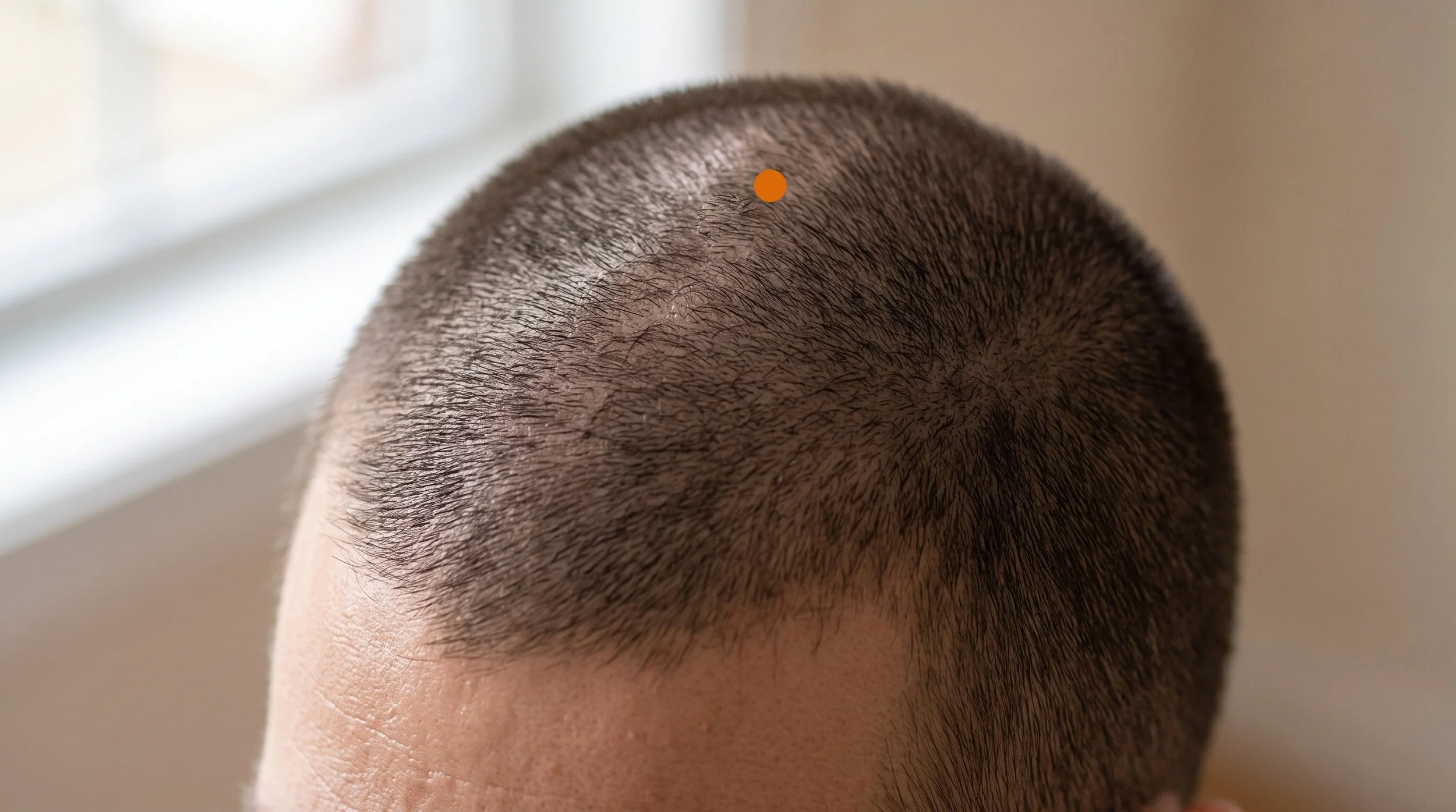
DU20, known in Chinese as Baihui (Hundred Meetings) and coded GV20 in most Western textbooks, sits at the very top of the head: on the midline, level with the tops of the ears, about 5 cun behind the front hairline. It is the highest point on the body, and in classical theory it is where the Governing Vessel meets the Bladder, Gall Bladder, Sanjiao, and Liver channels, which is exactly what the name refers to (Deadman et al., 2009).
Clinically, the GV20 acupuncture point is one of the most frequently used points in the entire system, appearing in protocols for stress, headache, dizziness, mood support, and difficulty concentrating. The needle goes in flat under the scalp rather than down, and patients often describe the effect as feeling settled and quieter within a few minutes, which is a large part of why governing vessel 20 shows up in so many modern research protocols for headache and mood.
- DU20 (Baihui, also written GV20) is located at the vertex on the midline, at the midpoint of a line drawn between the apexes of the ears, roughly 5 cun posterior to the anterior hairline (Deadman et al., 2009). The needle passes through skin and dense subcutaneous tissue into the galea aponeurotica over the sagittal suture region, so it is a flat, shallow insertion rather than a deep one.
- Classical texts categorize DU20 as the meeting of the Governing Vessel with the Bladder, Gall Bladder, Sanjiao, and Liver channels, and as a point of the Sea of Marrow, with traditional actions described as subduing rising yang, raising sinking yang, benefiting the head and sense organs, and calming the spirit (Deadman et al., 2009). Read neurophysiologically, that cluster maps onto a scalp site with unusually broad trigeminal and cervical nerve coverage and a reliable autonomic response.
- The vertex receives converging input from the greater occipital nerve (C2) behind and from supraorbital and supratrochlear branches of the trigeminal nerve in front, and cervical and trigeminal afferents share second order neurons in the trigeminocervical complex. That convergence is the standard explanation for why scalp and upper neck stimulation can influence headache patterns, and needling at such sites also recruits spinal and supraspinal inhibitory pathways along with endogenous opioid release (Zhao, 2008).
- An MRI mapping study reconstructed the scalp position of DU20 in three dimensions and localized it near the central and precentral sulcus region of the cortex, which helps explain why the point has traditionally been favored in neurologic and psychiatric applications even though the needle never approaches the brain (Shen et al., 2011).
- The research picture is about protocols, not single points: Cochrane reviews support acupuncture for reducing episodic migraine and tension-type headache frequency (Linde et al., 2016a; Linde et al., 2016b), a large individual patient data meta-analysis found modest but persisting effects for chronic pain (Vickers et al., 2018), and reviews of mood and anxiety report benefit with low certainty evidence (Smith et al., 2018; Amorim et al., 2018). DU20 appears in many of these protocols, but its independent contribution has not been isolated.
- De qi at DU20 is distinctive: instead of the deep muscular ache typical of limb points, most patients report a spreading pressure, warmth, or heaviness across the crown, sometimes with a sense of the shoulders dropping. A small study of manual needling at Baihui recorded a significant decrease in heart rate and changes in heart rate variability, consistent with a measurable autonomic shift during treatment (Litscher et al., 2012).
Tension Headaches That Sit On Top Of Your Head?
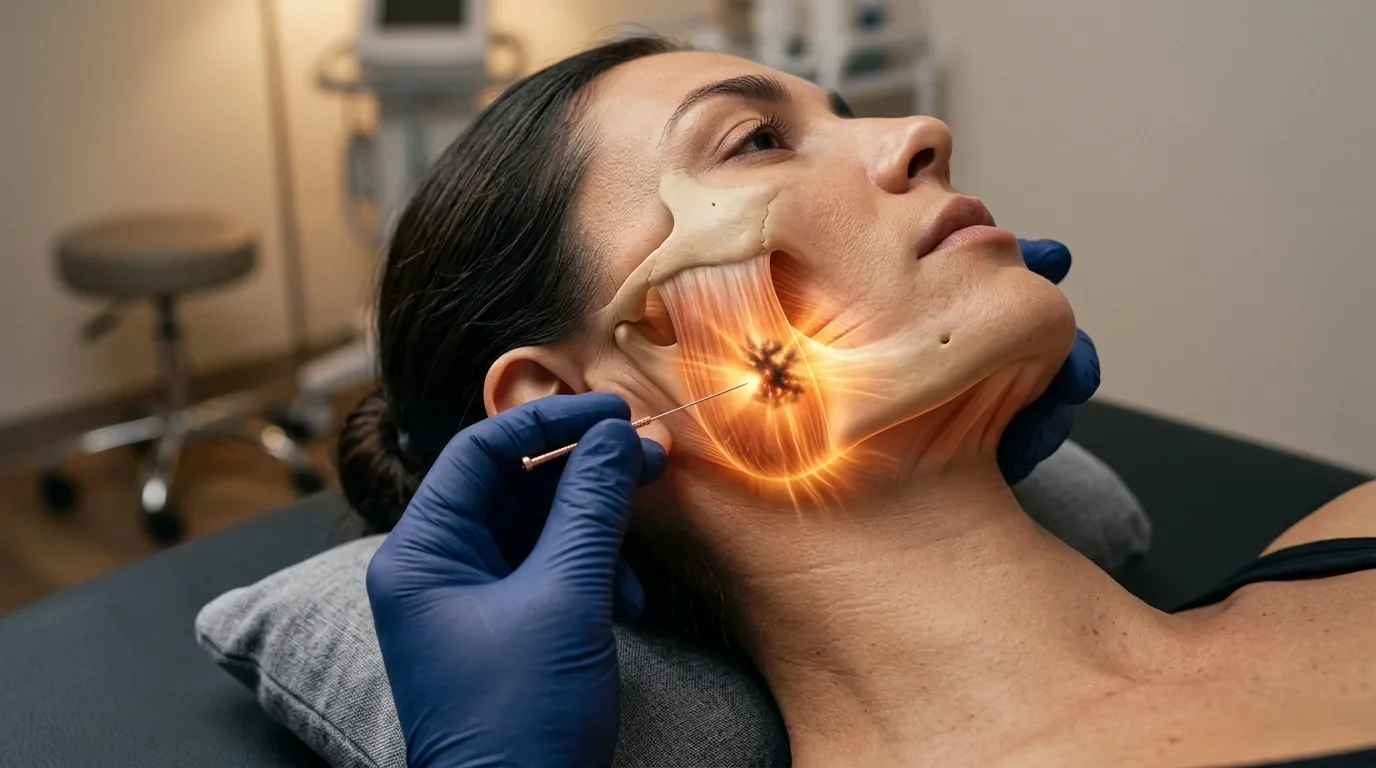
Vertex pressure, a band-like ache, and a scalp that feels tender to touch usually involve more than one structure, and DU20 is often the anchor point we start from. At Morningside Acupuncture we pair it with cervical and trigeminal region points, then treat the muscular drivers in the neck and jaw with dry needling in the same visit. Most patients notice the pressure ease during the session itself. Schedule a visit and we will map the pattern before we needle anything.
Schedule NowAnatomy of DU20: Why the Vertex of the Scalp Is Such an Important Location
From the surface down, DU20 passes through hair-bearing skin, then a dense subcutaneous layer packed with small arteries, veins, and sensory nerve branches, then the galea aponeurotica: the tough tendinous sheet that connects the frontalis muscle in front to the occipitalis behind. Below that lies a loose areolar plane, the pericranium, and the parietal bones near the sagittal suture. Because the galea is a continuous strap between two muscles, sustained frontal and occipital muscle tone, habitual brow raising, jaw clenching, and a chronically forward head position all load this tissue from opposite ends.
That is one reason so many people with tension-type headache report that the top of the scalp itself feels tight or sore, even though there is no large muscle there.
The nerve geography at the vertex is what makes DU20 clinically interesting. Sensory supply arrives from two directions: the greater occipital nerve, from the C2 dorsal ramus, travels up the back of the scalp toward the crown, while the supraorbital and supratrochlear branches of the trigeminal nerve come forward from the orbit; auriculotemporal branches cover the lateral scalp. Cervical and trigeminal afferents converge onto shared second order neurons in the trigeminocervical complex, which explains why neck and scalp input can modify head pain that feels frontal or one-sided.
Needling in these territories has also been shown to engage descending inhibitory control and endogenous opioid mechanisms rather than acting purely locally (Zhao, 2008). A three dimensional MRI mapping study placed the scalp position of DU20 over the central and precentral sulcus region, which is a useful anatomic reference for why this site has long been chosen for neurologic and mood-related complaints (Shen et al., 2011).
Deep to the point is bone, not soft tissue, and beneath the midline sagittal suture runs the superior sagittal sinus inside the skull. With an intact adult skull this is not accessible, and the standard convention is transverse insertion of 0.5 to 1 cun along the scalp, angled forward or backward, which keeps the needle in the aponeurotic plane (Deadman et al., 2009). Caution applies in specific situations: infants with an open fontanelle, patients with cranial defects, craniotomy sites, or shunt hardware, and anyone on anticoagulants, since the scalp is highly vascular and can bleed or bruise more than expected. Traditional practice also used moxibustion at this point, particularly where the intent was to raise sinking qi (Maciocia, 2005).
Related Best Acupuncture Points For Headaches Related Best Acupuncture Points For StressDU20 (GV20) at a Glance: Classification, Location, and Clinical Use
| Category | Detail |
|---|---|
| Traditional Name | Baihui (Hundred Meetings), coded DU20 in classical manuals and GV20 in WHO nomenclature |
| Channel Classification | Governing Vessel (Du Mai), the midline yang vessel of the back and head (DU20, also written GV20) |
| Point Categories | Meeting point of the Governing Vessel with the Bladder, Gall Bladder, Sanjiao, and Liver channels; point of the Sea of Marrow; the highest point on the body. Classical and modern texts vary in how many channels they list as intersecting here. |
| Precise Location | At the vertex of the head, on the midline, 5 cun posterior to the anterior hairline, at the midpoint of a line connecting the apexes of the ears |
| Tissue Stimulated | Scalp skin and dense subcutaneous tissue, then the galea aponeurotica over the sagittal suture region, with branches of the greater occipital and supraorbital nerves in the field |
| Needle Depth / Direction | Transverse insertion 0.5 to 1 cun, angled anteriorly or posteriorly along the scalp; traditionally also treated with moxibustion |
| De Qi Sensation | A spreading pressure, fullness, warmth, or heaviness across the crown rather than a deep muscular ache; some patients report a light, settled, or slightly drowsy feeling |
| Primary Clinical Uses | Stress, headache (including vertex and one-sided patterns), dizziness, focus and mental clarity, and mood support |
| Common Point Combinations |
|
Deadman's manual describes Baihui as the point where all the yang qi of the body converges, and notes that classical sources credited it with such wide influence that one text tied it to the treatment of a hundred diseases; alternative names in the older literature emphasize different facets, including its status as the meeting of several yang channels with the Liver channel, its role as the location of the upper dantian in qigong theory, its position as the highest point of the body, and its reputation for psycho-emotional conditions (Deadman et al., 2009).
Traditionally it was said to work in two opposite directions: descending excess yang and interior wind in patterns like dizziness, tinnitus, vertex pain, and loss of consciousness, and raising sinking yang in patterns like rectal or uterine prolapse and chronic diarrhea, the latter usually treated with moxa cones rather than needles (Deadman et al., 2009; Maciocia, 2005).
The classical indication list is also striking for how much of it concerns the mind: palpitations with a sense of oppression, poor memory, disorientation, and persistent sadness sit alongside the headache and dizziness entries, which reflects the older debate over whether the spirit resides in the Heart or the brain. That a single point at the top of the scalp was asked to address both head symptoms and symptoms at the opposite end of the torso is what makes the traditional pattern so distinctive, and it is presented here as traditional attribution rather than physiology.
Why DU20 Is Used for Dizziness, Focus, and Symptoms Far Below the Head
The most direct explanation for DU20's effect on head symptoms is convergence. The vertex is supplied from behind by the greater occipital nerve out of C2 and from the front by trigeminal branches, and those two systems share second order neurons in the trigeminocervical complex. When input from the scalp enters that shared pool, it can change how head pain is processed regardless of whether the pain feels frontal, temporal, or on top.
This is the same convergence that explains why upper neck problems produce headaches that feel like they belong to the front of the head, and it is why a needle in the scalp is not as far from the problem as it looks.
Beyond segmental convergence, needling recruits descending inhibitory pathways from the brainstem and drives endogenous opioid and monoaminergic mechanisms that reduce the gain of pain signaling more broadly (Zhao, 2008).
There is also a measurable autonomic component: in a study of manual needling at Baihui, heart rate dropped significantly during and after stimulation and total heart rate variability increased, which is the kind of parasympathetic shift patients experience as calm (Litscher et al., 2012). An MRI reconstruction study localized the scalp point over the central and precentral sulcus region, which is a helpful anatomic reference when discussing why this site was historically chosen for neurologic and mood complaints, though it does not mean the needle affects the cortex directly (Shen et al., 2011).
The traditional use of DU20 for symptoms far below the head, including prolapse and chronic loose stools, is best understood as a classical attribution based on the principle of treating below by selecting above, and it was usually delivered with moxibustion rather than needling (Deadman et al., 2009; Maciocia, 2005). We do not present that as a mechanism claim. What we can say is that the point reliably produces a global autonomic and subjective shift, which is why it is useful for the diffuse presentations (fogginess, low drive, feeling scattered) that resist point-for-symptom thinking.
What the Research Shows for DU20 (GV20)
One note on naming before the evidence: in the research literature this point is almost always listed as GV20, the WHO standard code, so GV20 is the term to search if you want to read the studies below in full.
A realistic reading of the evidence starts with a caveat: clinical trials test whole treatment protocols, not individual points, so no study has isolated what DU20 contributes on its own. What the literature supports is that acupuncture protocols that commonly include DU20 have been tested for headache, mood, and chronic pain with mixed but generally favorable results, often with modest effect sizes and variable certainty of evidence. The reviews below give a fair picture of both the support and the limits.
| Study | Type | Focus | Key Finding |
|---|---|---|---|
| Linde et al., 2016a | Cochrane systematic review | Acupuncture for the prevention of episodic migraine | Acupuncture was associated with reduced migraine frequency compared with no prophylactic treatment and sham, and appeared at least comparable to prophylactic drugs, though evidence quality varied across comparisons. |
| Linde et al., 2016b | Cochrane systematic review | Acupuncture for the prevention of tension-type headache | Acupuncture may reduce headache frequency in people with frequent episodic or chronic tension-type headache, with small effects over sham and limited long-term data. |
| Vickers et al., 2018 | Individual patient data meta-analysis | Chronic pain including chronic headache | Acupuncture showed statistically significant effects over sham and no-acupuncture control, with benefit that decayed only modestly over about 12 months. |
| Smith et al., 2018 | Cochrane systematic review | Acupuncture for depression | Acupuncture may reduce depression severity compared with usual care or control acupuncture, but the certainty of evidence was low and study quality limited firm conclusions. |
| Amorim et al., 2018 | Systematic review | Acupuncture and electroacupuncture for anxiety disorders | Reviewed trials generally reported reductions in anxiety symptoms with few adverse effects, though methodological limitations mean results should be read cautiously. |
| Shen et al., 2011 | MRI anatomic mapping study | Position of Baihui (DU20) relative to underlying cortex | Three dimensional reconstruction localized the DU20 scalp site near the central and precentral sulcus region in both adults and children. |
| Litscher et al., 2012 | Clinical physiological study | Heart rate and heart rate variability during needling at Baihui (DU20) | Mean heart rate fell significantly during and after stimulation and total heart rate variability increased, suggesting a measurable autonomic response in a small sample. |
Wired, Overloaded, And Unable To Focus?
Stress rarely presents as one symptom; it shows up as a busy head, shallow sleep, jaw tension, and a mind that will not settle enough to work. DU20 with Yintang is one of the most reliable calming combinations we use, and many patients describe the shift as being turned down rather than turned off. We build the rest of the protocol around your sleep, workload, and pain pattern. Book a session and start with one treatment to see how your system responds.
Schedule NowDU20 in the Context of Trigger Point Work
DU20 is not a muscle trigger point; there is no contractile tissue at the vertex, only the galea aponeurotica between the frontalis and occipitalis. That said, the headaches patients bring to us are usually driven by muscles that refer pain into exactly this territory. Trigger points in the suboccipital group, upper trapezius, splenius capitis, sternocleidomastoid, and temporalis all have referral patterns that reach the scalp, temple, or behind the eye (Simons et al., 1999).
In practice we use DU20 as the central regulating point of the treatment and dry needle the muscular sources separately, so the session addresses both the pain processing and the mechanical input feeding it.
Acupuncture is defined by the tool, an acupuncture needle, which is why dry needling of trigger points and classical point needling belong in the same treatment rather than in competing categories. A typical Morningside visit for vertex or band-like headache might combine transverse needling at DU20, distal points such as LI4, and precise dry needling of the suboccipitals and upper trapezius, with the neck and jaw assessed by palpation first.
When the scalp itself is tender and the galea feels tight, gentle needling through the aponeurotic plane at the vertex is often better tolerated than deeper work, and it gives us a way to treat the region without aggravating an already sensitized scalp.
DU20 Stress And Headache Treatment at NYC's Highest-Rated Acupuncture Clinic
Morningside Acupuncture is the highest-rated acupuncture and dry needling clinic in New York City with over 500 five-star Google reviews, and DU20 is part of our standard toolkit for headache, stress, and mood support. Every treatment is built around your exam findings, combining scalp and distal points with trigger point dry needling where the muscles are clearly involved. We explain what each needle is for and what to expect between visits. Schedule your appointment at our Upper West Side office today.
Schedule NowFrequently Asked Questions
Is DU20 the same point as GV20?
Yes. DU20 and GV20 are two codes for the same point, Baihui. DU comes from Du Mai, the Chinese name of the Governing Vessel, and it is the code used in most Chinese texts and many acupuncture schools. GV is the WHO standard abbreviation and the one you will see in most Western textbooks and research papers. You will also come across it written as Du 20, GV-20, or Governing Vessel 20. Whichever code is used, the location and the uses are the same.
What does DU20 feel like when needled?
Because the needle lies flat under the scalp, DU20 rarely produces the deep muscular ache people associate with points in the leg or shoulder. Most patients describe a spreading pressure or fullness across the crown, sometimes warmth, occasionally a brief pinch at insertion since scalp skin is well supplied with nerve endings. Many people also report a global settling: slower breathing, heavier limbs, sometimes drowsiness within a few minutes. That subjective calm lines up with the measurable drop in heart rate recorded during needling at this point (Litscher et al., 2012).
Why needle the top of the head for stress or a headache that is behind my eyes?
The vertex is supplied by nerves coming from two different systems: cervical nerves from behind (the greater occipital nerve out of C2) and trigeminal branches from the front. Those inputs converge on shared neurons in the trigeminocervical complex, so stimulating the scalp can influence how pain in the frontal or temporal region is processed (Zhao, 2008). For stress, the relevant effect is autonomic rather than segmental: needling here has been associated with a shift toward parasympathetic dominance during treatment (Litscher et al., 2012). Traditionally, this same point was described as the meeting of the yang channels and used for both head symptoms and mental restlessness (Deadman et al., 2009).
Can I press DU20 myself between sessions?
Yes, and it is one of the easier points to self-treat because you can find it without a mirror. Put both index fingers at the top of your ears and slide them straight up to the midline of your scalp; the point sits where those lines meet the center line, often in a slight depression. Use the pad of your thumb or the tips of two fingers and press straight down with steady, moderate pressure for 30 to 60 seconds, then release, and repeat two or three times. Small circular massage of the surrounding scalp for one to two minutes also works well. Keep pressure firm but comfortable, breathe slowly while you hold, and stop if it triggers pain, dizziness, or nausea. This is a reasonable daily habit during stressful stretches, but it is a supplement to treatment rather than a substitute.
Is DU20 safe to needle?
In the hands of a licensed practitioner, yes. The point is needled transversely 0.5 to 1 cun into the plane of the galea aponeurotica, and the adult skull sits between the needle and anything intracranial (Deadman et al., 2009). The main practical considerations are cosmetic and vascular: the scalp is richly supplied with small vessels, so minor bleeding or a small bruise is possible, and clean technique matters in hair-bearing skin. We take extra care or avoid the site entirely with infants who have an open fontanelle, patients with cranial defects, craniotomy sites, or implanted shunt hardware, and we adjust for anyone on blood thinners. Tell your practitioner about any of these before treatment.
Where exactly is DU20 located?
For bai hui point location, work from two landmarks at once. DU20 lies on the midline of the head at the vertex, 5 cun posterior to the anterior hairline, and it falls at the midpoint of a line connecting the apexes of the two ears (Deadman et al., 2009). A quick clinical check is to trace up from the tops of both ears until you reach the midline; the point is usually in or just behind a subtle depression there. If the front hairline is receded or indistinct, practitioners use bony landmarks instead, measuring from the glabella and the external occipital protuberance to find the midpoint of the scalp and then adjusting slightly posteriorly.
References
- Deadman, P., Al-Khafaji, M., & Baker, K. (2009). A manual of acupuncture. Journal of Chinese Medicine Publications.
- Maciocia, G. (2005). The foundations of Chinese medicine: A comprehensive text for acupuncturists and herbalists (2nd ed.). Elsevier Churchill Livingstone.
- Simons, D. G., Travell, J. G., & Simons, L. S. (1999). Travell & Simons' myofascial pain and dysfunction: The trigger point manual, Vol. 1: Upper half of body (2nd ed.). Williams & Wilkins.
- Linde, K., Allais, G., Brinkhaus, B., Fei, Y., Mehring, M., Vertosick, E. A., Vickers, A., & White, A. R. (2016a). Acupuncture for the prevention of episodic migraine. Cochrane Database of Systematic Reviews, 2016(6), CD001218. https://doi.org/10.1002/14651858.CD001218.pub3
- Linde, K., Allais, G., Brinkhaus, B., Fei, Y., Mehring, M., Shin, B. C., Vickers, A., & White, A. R. (2016b). Acupuncture for the prevention of tension-type headache. Cochrane Database of Systematic Reviews, 2016(4), CD007587. https://doi.org/10.1002/14651858.CD007587.pub2
- Vickers, A. J., Vertosick, E. A., Lewith, G., MacPherson, H., Foster, N. E., Sherman, K. J., Irnich, D., Witt, C. M., & Linde, K. (2018). Acupuncture for chronic pain: Update of an individual patient data meta-analysis. Journal of Pain, 19(5), 455-474. https://doi.org/10.1016/j.jpain.2017.11.005
- Smith, C. A., Armour, M., Lee, M. S., Wang, L. Q., & Hay, P. J. (2018). Acupuncture for depression. Cochrane Database of Systematic Reviews, 2018(3), CD004046. https://doi.org/10.1002/14651858.CD004046.pub4
- Amorim, D., Amado, J., Brito, I., Fiuza, S. M., Amorim, N., Costeira, C., & Machado, J. (2018). Acupuncture and electroacupuncture for anxiety disorders: A systematic review of the clinical research. Complementary Therapies in Clinical Practice, 31, 31-37. https://doi.org/10.1016/j.ctcp.2018.01.008
- Shen, E. Y., Chen, F. J., Chen, Y. Y., & Lin, M. F. (2011). Locating the acupoint Baihui (GV20) beneath the cerebral cortex with MRI reconstructed 3D neuroimages. Evidence-Based Complementary and Alternative Medicine, 2011, 362494. https://doi.org/10.1093/ecam/neq047
- Litscher, G., Cheng, G., Wang, L., Cheng, W., Su, H., Niu, Q., Zou, T., Wang, Y., Feng, X., Gaischek, I., Sheng, Z., & Kuang, H. (2012). Biomedical teleacupuncture between China and Austria using heart rate variability, part 2: Patients with depression. Evidence-Based Complementary and Alternative Medicine, 2012, 145904. https://doi.org/10.1155/2012/145904
- Zhao, Z. Q. (2008). Neural mechanism underlying acupuncture analgesia. Progress in Neurobiology, 85(4), 355-375. https://doi.org/10.1016/j.pneurobio.2008.05.004
Disclaimer: This web site is intended for educational and informational purposes only. Reading this website does not constitute providing medical advice or any professional services. This information should not be used for diagnosing or treating any health issue or disease. Those seeking medical advice should consult with a licensed physician. Seek the advice of a medical doctor or other qualified health professional for any medical condition. If you think you have a medical emergency, call 911 or go to the emergency room. No acupuncturist-patient relationship is created by reading this website or using the information. Morningside Acupuncture PLLC and its employees and contributors do not make any express or implied representations with respect to the information on this site or its use. For any legal interpretation of scope of practice in your state, consult a licensed attorney or regulatory authority.
Read more from our blog