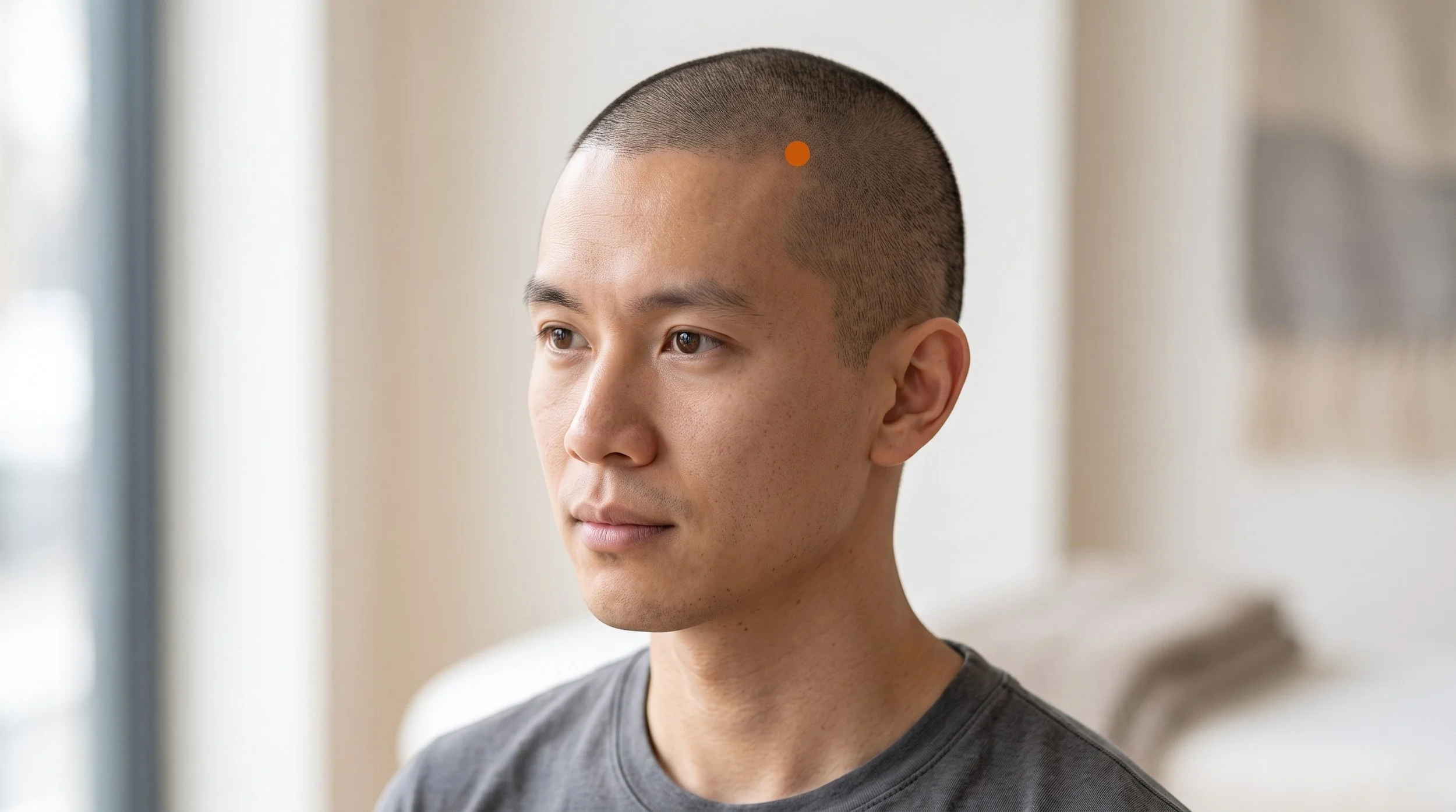
ST8 Acupuncture Point (Touwei)
The Corner of the Forehead: Anatomy, Mechanism, and Why This Hairline Point Anchors Frontal Headache and Migraine Treatment
ST8 (Touwei), whose name is usually rendered as Head's Binding or Head Corner, sits at the front upper corner of the forehead, just inside the hairline where the flat frontal region turns the corner into the temple.
In plain terms, if you slide a fingertip up from the outer end of the eyebrow to the hairline and then move slightly toward the temple, you are in the neighborhood. Classical sources treat it as a crossing point where Stomach and Gallbladder pathways meet the Yang Linking vessel, and clinically it earns its place for one reason: it is the single scalp point that lets a practitioner reach both the frontal and temporal pain zones from one insertion. That makes the st8 acupuncture point a workhorse for frontal headache, one-sided migraine, temple tension, and the eye strain that so often travels with them.
- Location and layers: ST8 lies about 4.5 cun lateral to the front midline and 0.5 cun inside the anterior hairline, just above where the upper fibers of temporalis take origin (Deadman et al., 2007). The needle passes through skin, dense subcutaneous tissue, and fascia, staying flat over bone rather than entering any deep space.
- Traditional categories, read anatomically: texts classify it as a meeting point of the Stomach and Gallbladder channels with the Yang Linking vessel (Deadman et al., 2007), and Maciocia's channel material places it as the Concentration area of the Bright Yang channels in the head (Maciocia, 2006). Translated into modern terms, this is simply the anatomical seam between forehead and temple innervation.
- Mechanism: the site sits in territory served by branches of the auriculotemporal nerve and the temporal branch of the facial nerve, with supraorbital fibers just medial (Beijing College of TCM, 1980). Input from both V1 and V3 territory converges in the trigeminocervical complex, which is the same relay involved in migraine and frontal headache pain.
- Research picture: reviews consistently test multi-point protocols rather than single points, but headache and migraine protocols that include ST8 have been examined in Cochrane reviews and in point-selection trials (Linde et al., 2016a; Li et al., 2012). Findings suggest meaningful reductions in headache days, with the contribution of any one point still uncertain.
- Clinical framing: this is one of the few points where needle direction changes the target, since the same insertion can be angled forward toward the forehead, backward toward the temple, or upward toward the vertex (Deadman et al., 2007). We choose the angle from where the patient actually reports the pain.
- De qi at ST8 is subtle and superficial: most people describe a dull spreading pressure or a band-like tightness under the scalp rather than the deep ache felt at limb points, and the sensation often tracks along the direction the needle is laid.
Frontal Headaches That Sit Behind the Eyes and Temples?
Pain that starts at the forehead and wraps into the temple usually involves both trigeminal branches and the upper temporalis, which is exactly the territory ST8 covers. At Morningside Acupuncture, we combine ST8 with local temple points and, when the exam supports it, dry needling of the temporalis and suboccipital muscles. Treatment is planned around your headache pattern rather than a fixed formula. Schedule a visit and let us map where your headache actually lives.
Schedule NowAnatomy of ST8: Why the Corner of the Forehead Is Such an Important Location
From the surface down, ST8 is a thin point. Beneath the hair-bearing skin sits a fibrous subcutaneous layer, then the fascial sheet that connects the frontalis muscle forward with the temporoparietal fascia laterally, then the uppermost fibers of the temporalis muscle as they take origin from the skull, and immediately under that, bone. There is no cavity to enter and no organ to reach, which is why the needle is laid flat rather than pushed in.
What loads this area is mechanical and habitual: sustained jaw clenching and grinding pull on temporalis, prolonged frowning and squinting recruit frontalis and corrugator, and hours of near-focus screen work keep both groups working at low intensity for long stretches. That combination makes the corner of the forehead a common site of tenderness in people who describe their headache as a band or a vise.
The nerve geography is the reason this location does so much. Sensory supply here comes from branches of the auriculotemporal nerve with the temporal branch of the facial nerve running nearby, and the supraorbital territory begins just medially (Beijing College of TCM, 1980). Auriculotemporal fibers arise from the mandibular division of the trigeminal nerve and supraorbital fibers from the ophthalmic division, so a single point sits at the border of two trigeminal territories.
Both feed into the trigeminocervical complex in the brainstem, where trigeminal afferents converge with upper cervical input, and this convergence is a well described substrate for referred head pain and for the overlap between neck-driven and migraine-type headaches. Needling in this zone provides a strong, well localized afferent barrage into that relay, and experimental work indicates that such input engages spinal and supraspinal pain-modulating circuits rather than simply numbing tissue (Zhao, 2008).
The vascular structure that matters most is the frontal branch of the superficial temporal artery with its accompanying vein, which runs through this region close to the surface (Beijing College of TCM, 1980). Scalp tissue is highly vascular and holds little space for bleeding to disperse, so nicking a small vessel can produce a visible bump or bruise that is harmless but cosmetically annoying. For that reason, and because bone lies directly beneath, the conventional technique is transverse insertion of roughly 0.5 to 1 cun along the scalp plane, angled toward the symptomatic region (Deadman et al., 2007).
Several classical texts also list this point as one where moxibustion should not be applied, a caution repeated in later commentary on head points (Deadman et al., 2007; O'Connor & Bensky, 1981). Firm pressure with a clean cotton ball on withdrawal is standard practice.
Related Acupuncture For Temporalis Muscle Pain Related Temporalis Trigger PointsST8 at a Glance: Classification, Location, and Clinical Use
| Category | Detail |
|---|---|
| Traditional Name | Touwei (Head's Binding, also translated Head Corner), Stomach 8 |
| Channel Classification | Stomach channel of Foot Yangming, point 8 of 45 |
| Point Categories | Meeting (crossing) point of the Stomach and Gallbladder channels with the Yang Linking vessel (Yang Wei Mai); described in the Spiritual Axis material on Origins and Concentrations as the Concentration area of the Bright Yang channels in the head |
| Precise Location | At the corner of the forehead, 4.5 cun lateral to the anterior midline (level with GV24) and 0.5 cun inside the front hairline, just above the upper origin line of the temporalis muscle and slightly posterior to a vertical line above Taiyang |
| Tissue Stimulated | Scalp skin and subcutaneous fascia, the junction of the frontalis and temporoparietal fascial sheet, and the uppermost fibers of the temporalis muscle at its origin |
| Needle Depth / Direction | Transverse (subcutaneous) insertion 0.5 to 1 cun along the scalp, angled forward for frontal pain, backward for temporal pain, or upward toward the vertex; not needled perpendicularly, and several classical texts contraindicate moxibustion here |
| De Qi Sensation | A dull spreading pressure or band-like tightness under the scalp, sometimes a mild warmth or heaviness that follows the direction of the needle; deep aching is uncommon at this point |
| Primary Clinical Uses | Frontal and splitting headache, one-sided migraine involving forehead and temple, dizziness with headache, and traditionally bursting eye pain, wind-induced tearing, blurred vision, and eyelid twitching |
| Common Point Combinations |
|
Deadman, Al-Khafaji and Baker's point compendium presents ST8 as a major headache point whose traditional actions are described as dispelling wind, relieving pain, and benefiting the eyes. The reasoning offered is architectural: the Stomach channel is said to govern the forehead, the Gallbladder channel the temple, and the Yang Linking vessel to tie together the yang channels including those that reach the vertex, so a point where all three converge is positioned to influence the whole front and side of the head.
Its classical indication list clusters into two families, headache (frontal, splitting, one-sided, with chills and fever, dizziness, or vomiting) and eye complaints (dim vision, bursting eye pain, tearing in wind, twitching lids), with the two frequently appearing together in the same prescription.
What is striking is how stable one pairing remained across centuries: ST8 with BL2 shows up in the Ode of the Jade Dragon, the Golden Mirror and the Great Compendium for essentially the same picture of head pain plus eye symptoms, which is a remarkably durable clinical observation about a single anatomical corridor from brow to temple.
Why ST8 Is Used for Eye Strain and Twitching Eyelids, Not Just Headaches
Patients are often surprised that a point at the hairline is chosen for something happening around the eye. The explanation is convergence. Sensation from the forehead, brow and upper eyelid travels in the ophthalmic division of the trigeminal nerve, sensation from the temple travels largely in mandibular division branches, and both sets of fibers terminate on shared second order neurons in the trigeminocervical complex.
When those neurons become sensitized, the nervous system loses precision about where the signal originated, which is why forehead pain, eye pressure, and temple tightness so often arrive as a single package. Needling within that shared territory delivers a clear, controlled sensory signal into the same relay, and clinically it is common for the eye symptoms to ease along with the head pain.
The second layer is descending modulation. Sustained needle input activates brainstem circuits, including periaqueductal grey and rostral ventromedial medulla projections, that dampen incoming nociceptive traffic, with endogenous opioid and monoamine signaling implicated in the effect (Zhao, 2008). This is a systemic response rather than a local one, which is part of why acupuncture trials for chronic pain show benefits that persist between sessions and decay only gradually after a course of care (Vickers et al., 2018).
Imaging work adds a further wrinkle: in migraine patients, electroacupuncture at different point sets, including one group in which ST8 was needled, produced pain reduction along with distinguishable patterns of cerebral glucose metabolism in pain-processing regions (Yang et al., 2012). That study was small and its authors framed it as preliminary, so it is best read as evidence that point location influences central response, not as proof that any single point is uniquely powerful.
There is also a straightforward mechanical component. The upper fibers of temporalis begin at this level, and in habitual clenchers that tissue is chronically loaded. Reducing tone and tenderness in the temple region can lower the background input that keeps a headache pattern running, which is why we usually assess the jaw and neck at the same visit rather than treating the forehead in isolation (Simons et al., 1999).
What the Research Shows for ST8
A fair reading of the evidence starts with a caveat: clinical trials almost never test ST8 by itself. Headache and migraine studies use multi-point protocols, often with electrical stimulation and several sessions per week, and ST8 typically appears as a local point added when pain occupies the forehead or temple. So the research below tells us about acupuncture protocols that include this point, not about the point in isolation.
Findings are also mixed in an instructive way, since some of the strongest trials show clear benefit over usual care while differences from carefully constructed sham needling are smaller. That pattern argues for realistic expectations: a course of treatment, tracked with a headache diary, rather than a single dramatic session.
| Study | Type | Focus | Key Finding |
|---|---|---|---|
| Linde et al., 2016a | Cochrane systematic review | Acupuncture for prevention of episodic migraine, 22 trials | Adding acupuncture to usual care reduced migraine frequency, and effects were at least comparable to prophylactic drug treatment, though advantages over sham needling were modest. |
| Linde et al., 2016b | Cochrane systematic review | Acupuncture for prevention of tension-type headache, 12 trials with 2349 adults | Acupuncture appeared to reduce headache frequency compared with usual care and showed a small benefit over sham, with the authors rating evidence quality as moderate to low. |
| Vickers et al., 2018 | Individual patient data meta-analysis | Chronic pain conditions including chronic headache, roughly 20,800 patients | Acupuncture outperformed both sham and no-acupuncture controls, with treatment effects persisting over about a year rather than disappearing immediately. |
| Li et al., 2012 | Multicentre randomized controlled trial | 480 migraine patients, comparing point-selection strategies including a Yangming group in which ST8 was needled | All acupuncture arms reduced migraine days relative to sham at several time points, but differences between the point-selection strategies were limited, so point choice alone did not explain the results. |
| Yang et al., 2012 | PET-CT imaging study | 30 migraine patients, electroacupuncture at differing point sets including ST8, LI6 and ST36 | Both point sets reduced pain and altered cerebral glucose metabolism in pain-related regions, with different activation patterns, though the sample was small and preliminary. |
| Gildir et al., 2019 | Randomized double-blind trial | Trigger point dry needling versus sham needling in chronic tension-type headache | Dry needling of head and neck trigger points was associated with improvements in headache frequency, intensity and duration compared with sham, supporting the myofascial layer of care. |
Screen Fatigue, Eye Strain, and Twitching Eyelids?
Long hours at a monitor load the muscles of the brow and temple and keep the trigeminal system in a state of low grade irritation. ST8 is traditionally used for bursting eye pain, tearing, and eyelid twitching, and modern clinics use it alongside brow and orbital points for the same complaints. We pair it with practical ergonomic and visual break strategies you can use at your desk. Book an appointment to address the strain before it turns into a headache pattern.
Schedule NowST8 in the Context of Trigger Point Work
ST8 sits directly over the upper origin of the temporalis, which is one of the most clinically relevant muscles in head pain. Trigger points in temporalis characteristically refer pain into the temple, along the eyebrow, and into the upper teeth, a distribution that overlaps almost exactly with what patients call a frontal or one-sided headache (Simons et al., 1999).
At Morningside, when palpation reproduces a patient's familiar headache from a taut band in temporalis, we will often needle the muscle directly rather than only using the point location, and the two approaches are not in conflict. Acupuncture is defined by the use of an acupuncture needle, and dry needling of a trigger point is one of hundreds of needling styles that share the same tool and much of the same neurophysiology.
In practice, ST8 tends to be a starting anchor and the myofascial work fills in around it. A typical session for a clenching-driven frontal headache might combine transverse needling at ST8 angled toward the symptomatic zone, trigger point needling of temporalis and masseter, attention to the lateral pterygoid when jaw mechanics are involved, and suboccipital release for the cervical contribution to trigeminocervical convergence. Randomized work on dry needling in chronic tension-type headache supports the value of treating these muscles rather than the head alone (Gildir et al., 2019; Monti-Ballano et al., 2024). We then reassess tenderness and headache frequency across a few sessions before deciding whether to continue, adjust the point selection, or refer.
ST8 Headache and Migraine Treatment at NYC's Highest-Rated Acupuncture Clinic
Morningside Acupuncture is the highest-rated acupuncture and dry needling clinic in New York City with over 500 five-star Google reviews, and headaches are among the most common reasons patients come to see us. Our approach blends classical point selection such as ST8 with orthopedic assessment and myofascial needling of the jaw, temple, and neck muscles. Every plan includes clear expectations about how many sessions are reasonable before we reassess. Schedule your visit and start tracking real change in your headache days.
Schedule NowFrequently Asked Questions
What does ST8 feel like when needled?
Because the needle is laid flat under the scalp rather than pushed straight in, the sensation is usually mild. Most people report a brief pinch as the needle passes the skin, then a dull spreading pressure or a tight band-like feeling that follows the direction the needle is angled. Some notice a light warmth or heaviness across the temple. Scalp points can feel more sensitive than limb points at the moment of insertion, so we typically use a fine gauge needle and a fast insertion technique. If the sensation is sharp or burning rather than dull, tell your practitioner, since the needle can be adjusted in a second.
Why needle the hairline for pain that I feel behind my eye?
The corner of the forehead sits at the boundary between two trigeminal territories, with supraorbital fibers covering the brow and forehead and auriculotemporal fibers covering the temple. Both converge onto shared neurons in the trigeminocervical complex, so the brain does not always distinguish precisely where the signal came from. Needling in that shared corridor sends a clear afferent signal into the same relay and may engage descending pain-modulating pathways (Zhao, 2008). Classical texts arrived at a similar clinical conclusion long before that anatomy was mapped, pairing ST8 with brow points for headache accompanied by eye pain.
Can I press ST8 myself between sessions?
Yes, acupressure at this location is simple and low risk. Find the spot by placing a fingertip at the outer end of your eyebrow, tracing straight up to the hairline, then moving about a finger's width toward the temple, just inside the hair. Use the pad of your index or middle finger and apply steady, moderate pressure with small circular movements for 30 to 60 seconds per side, breathing slowly. Repeat two or three times, and feel free to do this two or three times a day during a headache-prone stretch. Many people find it more effective when combined with gentle massage down into the temple, since the temporalis muscle lies just below. Stop if pressure sharply worsens the headache, and do not press hard over broken skin, a recent head injury, or an area of unexplained new pain.
Is ST8 safe to needle?
In trained hands it is a low-risk point. Insertion is transverse and superficial, bone lies immediately beneath, and there is no cavity or organ nearby, so the serious risks associated with chest or neck points do not apply. The most common issue is minor bleeding or a small bruise, because the frontal branch of the superficial temporal artery runs close to the surface here (Beijing College of TCM, 1980). Firm pressure on withdrawal usually prevents it. Several classical sources also advise against moxibustion at this point (Deadman et al., 2007). Tell your practitioner if you take blood thinners, have had recent scalp or cranial surgery, or have any skin condition in the area.
Where exactly is ST8 located?
ST8 is at the corner of the forehead, 4.5 cun lateral to the front midline and 0.5 cun inside the anterior hairline, sitting just above the upper origin line of the temporalis muscle (Deadman et al., 2007). A practical way to find it is to locate the point where the flat front of the forehead begins to curve into the temple, then move about half a thumb width up into the hair. If your hairline has receded, use the muscle instead: clench your teeth, feel the temporalis bulge, and trace its upper front border to where it meets the forehead. For anyone searching st 8 head or stomach 8, this is the same location, and the touwei headache point is simply the traditional name for the same spot.
References
- Deadman, P., Al-Khafaji, M., & Baker, K. (2009). A manual of acupuncture. Journal of Chinese Medicine Publications.
- Cheng, X. (Ed.). (1999). Chinese acupuncture and moxibustion (Rev. ed.). Foreign Languages Press.
- Maciocia, G. (2006). The channels of acupuncture: Clinical use of the secondary channels and eight extraordinary vessels. Churchill Livingstone Elsevier.
- O'Connor, J., & Bensky, D. (Eds. & Trans.). (1981). Acupuncture: A comprehensive text. Shanghai College of Traditional Medicine. Eastland Press.
- Simons, D. G., Travell, J. G., & Simons, L. S. (1999). Travell & Simons' myofascial pain and dysfunction: The trigger point manual, Vol. 1: Upper half of body (2nd ed.). Williams & Wilkins.
- Linde, K., Allais, G., Brinkhaus, B., Fei, Y., Mehring, M., Vertosick, E. A., Vickers, A., & White, A. R. (2016a). Acupuncture for the prevention of episodic migraine. Cochrane Database of Systematic Reviews, 2016(6), CD001218. https://doi.org/10.1002/14651858.CD001218.pub3
- Linde, K., Allais, G., Brinkhaus, B., Fei, Y., Mehring, M., Shin, B. C., Vickers, A., & White, A. R. (2016b). Acupuncture for the prevention of tension-type headache. Cochrane Database of Systematic Reviews, 2016(4), CD007587. https://doi.org/10.1002/14651858.CD007587.pub2
- Vickers, A. J., Vertosick, E. A., Lewith, G., MacPherson, H., Foster, N. E., Sherman, K. J., Irnich, D., Witt, C. M., & Linde, K. (2018). Acupuncture for chronic pain: Update of an individual patient data meta-analysis. Journal of Pain, 19(5), 455-474. https://doi.org/10.1016/j.jpain.2017.11.005
- Zhao, Z. Q. (2008). Neural mechanism underlying acupuncture analgesia. Progress in Neurobiology, 85(4), 355-375. https://doi.org/10.1016/j.pneurobio.2008.05.004
- Li, Y., Zheng, H., Witt, C. M., Roll, S., Yu, S. G., Yan, J., Sun, G. J., Zhao, L., Huang, W. J., Chang, X. R., Zhang, H. X., Wang, D. J., Lan, L., Zou, R., & Liang, F. R. (2012). Acupuncture for migraine prophylaxis: A randomized controlled trial. CMAJ, 184(4), 401-410. https://doi.org/10.1503/cmaj.110551
- Yang, J., Zeng, F., Feng, Y., Fang, L., Qin, W., Liu, X., Song, W., Xie, H., Chen, J., & Liang, F. (2012). A PET-CT study on the specificity of acupoints through acupuncture treatment in migraine patients. BMC Complementary and Alternative Medicine, 12, 123. https://doi.org/10.1186/1472-6882-12-123
- Gildir, S., Tüzün, E. H., Eroğlu, G., & Eker, L. (2019). A randomized trial of trigger point dry needling versus sham needling for chronic tension-type headache. Medicine, 98(8), e14520. https://doi.org/10.1097/MD.0000000000014520
- Monti-Ballano, S., Márquez-Gonzalvo, S., Lucha-López, M. O., Ferrández-Laliena, L., Vicente-Pina, L., Sánchez-Rodríguez, R., Tricás-Vidal, H. J., & Tricás-Moreno, J. M. (2024). Effects of dry needling on active myofascial trigger points and pain intensity in tension-type headache: A randomized controlled study. Journal of Personalized Medicine, 14(4), 332. https://doi.org/10.3390/jpm14040332
Disclaimer: This web site is intended for educational and informational purposes only. Reading this website does not constitute providing medical advice or any professional services. This information should not be used for diagnosing or treating any health issue or disease. Those seeking medical advice should consult with a licensed physician. Seek the advice of a medical doctor or other qualified health professional for any medical condition. If you think you have a medical emergency, call 911 or go to the emergency room. No acupuncturist-patient relationship is created by reading this website or using the information. Morningside Acupuncture PLLC and its employees and contributors do not make any express or implied representations with respect to the information on this site or its use. For any legal interpretation of scope of practice in your state, consult a licensed attorney or regulatory authority.
Read more from our blog



