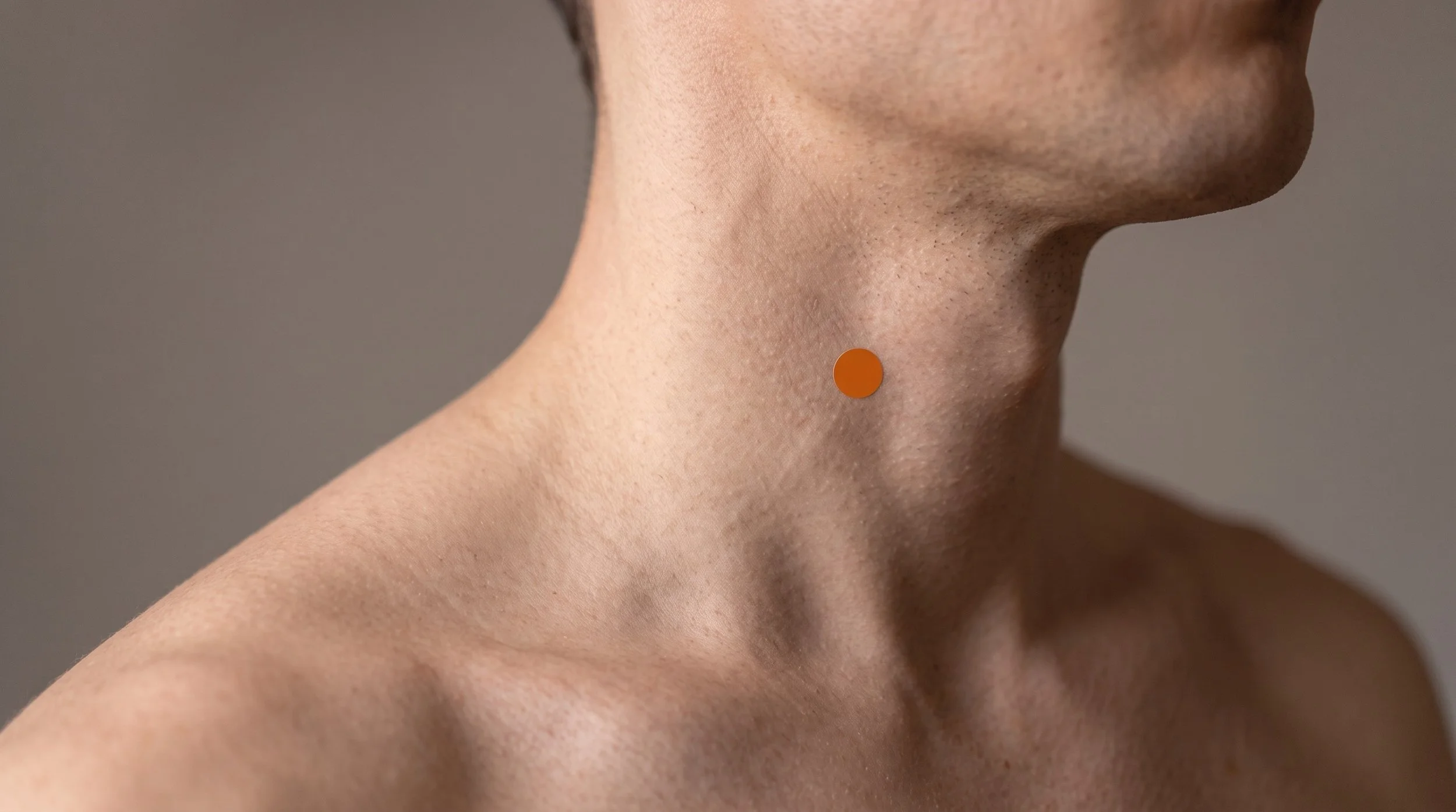
ST9 Acupuncture Point (Renying)
The Point Beside the Carotid Pulse: Anatomy, Autonomic Mechanism, and Why Renying Is the Most Precisely Needled Point on the Stomach Channel
ST9, known as Renying (Man's Welcome), sits on the front of the neck level with the tip of the laryngeal prominence, roughly 1.5 cun to the side of the midline, in the narrow gap between the outer border of the thyroid cartilage and the anterior edge of the sternocleidomastoid. Put your fingertips there and you will feel the carotid pulse just lateral to the spot, which is exactly why the st9 acupuncture point has always been treated as a precision location rather than a routine one.
Classical sources group Renying among the Window of Heaven points and the points of the Sea of Qi, and traditionally credit it with regulating qi and blood, settling rebellious upward movement, benefiting the throat and neck, and relieving pain. In modern terms, this is a point sitting directly over the carotid triangle, adjacent to the carotid sinus baroreceptors, in a segment (C2 to C3) that also serves the upper neck and head, which explains both its studied effects on blood pressure regulation and the strict, shallow, guarded needling technique it requires.
- ST9 lies in a defined corridor between the lateral border of the thyroid cartilage and the palpable common carotid artery, level with the laryngeal prominence, with the needle passing through skin, platysma and superficial cervical fascia only (Deadman et al., 2007).
- Classical texts list Renying as a Window of Heaven point and a point of the Sea of Qi, traditionally used for headache, dizziness, red face, chest fullness, breathlessness, throat swelling, goitre, difficulty swallowing and lumbar pain, all framed as disordered qi moving upward rather than as a modern diagnosis (Deadman et al., 2007).
- Neurophysiologically, the area is supplied by branches of the cervical plexus (C2 to C3) with the carotid sinus and its glossopharyngeal afferents lying immediately deep and lateral, so stimulation here engages both somatic cervical afferents and autonomic reflex circuitry (Cheng et al., 2015).
- Animal work needling ST9 in spontaneously hypertensive rats reported lower blood pressure alongside changes in hypothalamic gene expression related to vascular smooth muscle, inflammation and neurotransmitters, which is suggestive mechanistic data rather than clinical proof (Guo et al., 2018).
- The clinical evidence for acupuncture and blood pressure remains mixed: a Cochrane review found no evidence of a sustained blood pressure lowering effect, while mechanistic and trial work from other groups suggests slow-onset, modest changes in selected patients (Yang et al., 2018; Li et al., 2015).
- De qi at ST9 is usually a mild local distension or heaviness around the throat, sometimes spreading toward the shoulder or upper chest, with an awareness of nearby pulsation; sharp, radiating or unpleasant sensations mean the needle is repositioned or removed immediately (Deadman et al., 2007).
Neck Tension, Throat Tightness, or a Constant Sense of Pressure in Your Throat?
Many patients describe a band of tightness across the front of the neck, a lump-like sensation when swallowing, or jaw and throat tension that flares with stress. At Morningside Acupuncture we assess the anterior neck carefully, use ST9 only when it is clinically indicated and only with guarded, shallow technique, and pair it with safer surrounding work on the sternocleidomastoid, scalenes and suprahyoid muscles. Treatment is built around what your exam shows, not a template. Schedule an evaluation and we will map out a plan for your neck.
Schedule NowAnatomy of ST9: Why the Carotid Triangle Is Such an Important Location
From the surface down, ST9 sits over thin skin and the sheet-like platysma, then the superficial layer of the deep cervical fascia at the front edge of the sternocleidomastoid. Just medial is the firm shelf of the thyroid cartilage; just lateral is the pulsating common carotid artery inside the carotid sheath. The infrahyoid strap muscles run vertically nearby, and the hyoid and larynx glide up and down beneath your fingers as the patient swallows.
This is a small, mobile, layered corridor, and it loads with every swallow, every voice effort, and every hour spent with the head carried forward, which is part of why chronic forward-head posture so often produces a vague tightness across the front of the throat (Deadman et al., 2007).
The skin and superficial tissues here are supplied by the transverse cervical nerve from the cervical plexus, carrying C2 to C3 fibers, while the ansa cervicalis supplies the strap muscles just below. That segmental level matters: C2 and C3 afferents converge in the upper cervical dorsal horn with input from the trigeminal system, which is one reason anterior and lateral neck structures can feature in head, jaw and ear symptoms rather than staying local.
Needling somatic afferents in a painful region is understood to trigger spinal segmental inhibition plus descending pain modulation from brainstem structures using endogenous opioid, serotonergic and noradrenergic pathways (Zhao, 2008). Deep and lateral to the point, the carotid bifurcation carries the carotid sinus and its stretch-sensitive baroreceptors, which report to the brainstem via glossopharyngeal afferents and participate in reflex control of heart rate and vascular tone (Cheng et al., 2015).
That same deep anatomy is the reason ST9 is needled conservatively. The common carotid artery, its bifurcation, the internal jugular vein and the vagus nerve all lie within a finger's width, and the point has appeared in published case series of serious acupuncture complications linked to neck needling (Filshie et al., 2016).
Standard practice is to have the patient lie flat, palpate the artery, hold it laterally with the fingers of the non-needling hand above and below the site, and insert perpendicularly into the guarded space between artery and thyroid cartilage to a shallow depth of about 0.3 to 0.8 cun, with no lifting, thrusting or rotation directed toward the vessel. Most classical texts also list this point as contraindicated to moxibustion. It is not needled bilaterally at depth, and it belongs only in the hands of a clinician who has been trained and supervised in the technique (Deadman et al., 2007).
Related Acupuncture For Neck Pain Related Stomach ChannelST9 at a Glance: Classification, Location, and Clinical Use
| Category | Detail |
|---|---|
| Traditional Name | Renying (Man's Welcome), also recorded under the alternative name Tianwuhui (Heaven's Five Meetings) |
| Channel Classification | Stomach channel (Foot Yangming), ninth point of the channel, in the anterior neck region |
| Point Categories | Meeting point of the Stomach and Gallbladder channels; Window of Heaven point; point of the Sea of Qi (with GV15, GV14 and CV17); historically a pulse-taking site in early diagnostic methods |
| Precise Location | Level with the tip of the laryngeal prominence and about 1.5 cun lateral to it, in the depression between the anterior border of the sternocleidomastoid and the lateral border of the thyroid cartilage, medial to the palpable carotid pulse. Best located with the patient lying flat and the pillow removed. In women, where the laryngeal prominence can be indistinct, find the notch between the lower hyoid and upper thyroid cartilage at the midline and drop just below it. |
| Tissue Stimulated | Skin, platysma and superficial cervical fascia over the carotid triangle, at the anterior border of the sternocleidomastoid, adjacent to the thyroid cartilage and the infrahyoid strap muscles, with the carotid sheath and carotid sinus lying deep and lateral |
| Needle Depth / Direction | Perpendicular, 0.3 to 0.8 cun, into the guarded space between the thyroid cartilage and the carotid artery, with the artery palpated and held laterally throughout; shallow only, no vigorous manipulation, not needled bilaterally at depth, and moxibustion avoided per most classical sources |
| De Qi Sensation | Mild local distension, heaviness or soreness around the throat, occasionally spreading toward the shoulder or upper chest, sometimes with awareness of nearby pulsation; sharp, electric or radiating sensations are not acceptable and prompt immediate needle withdrawal |
| Primary Clinical Uses | Studied in modern research settings for blood pressure regulation under professional care; traditionally used for throat swelling and pain, difficulty swallowing and globus sensation, goitre and neck swellings, headache and dizziness attributed to rebellious qi, chest fullness and breathlessness, and acute lumbar sprain in distal-needling protocols |
| Common Point Combinations |
|
Deadman, Al-Khafaji and Baker note that Renying is one of the five points the Spiritual Pivot lists as Windows of Heaven, a small group traditionally understood to restore orderly communication of qi between the trunk and the head, and the classic specifically names ST9 for headache from rebellious yang and for chest fullness with labored breathing.
In traditional theory, when qi in the lower body becomes chaotic and surges upward, it was said to produce headache, dizziness and a flushed face above, to stagnate in the neck as swellings and goitre, and to disturb the normal downward movement of Stomach and Lung qi in the chest, giving vomiting, wheezing and oppression. The same commentary tradition links this disordered, counterflowing qi with sudden severe pain, which is the classical rationale behind the modern habit of using ST9 as a distal point in acute lumbar sprain.
Renying is also listed as a point of the Sea of Qi, and the Spiritual Pivot's descriptions of excess and deficiency in that Sea (chest fullness, urgent breathing and a red face versus a voice too weak to speak) overlap neatly with its Window of Heaven indications.
What is striking is how consistently the classical picture centers on the neck as a regulating gateway, in the same anatomical territory that modern physiology assigns to the carotid baroreceptors.
Why ST9 Is Used for Acute Low Back Pain and Sudden Sprain
It looks strange on paper: a point on the front of the neck used for a low back that seized up while lifting a suitcase. The classical rationale is that sudden acute pain was considered one expression of chaotic, counterflowing qi, the same pattern the Window of Heaven points were said to reorder, and Renying was accordingly recorded for lumbar pain (Deadman et al., 2007). The modern reading is less exotic.
Needling any strongly innervated site produces sensory input that reaches the spinal cord and brainstem, and in acute muscle guarding the immediate goal is to interrupt the pain and spasm loop long enough for the patient to move again. Distal needling combined with active movement is a standard approach in acute lumbar sprain protocols precisely because it lets the low back be treated without provoking the sore tissue directly.
Mechanistically, acupuncture stimulation activates descending pain modulation from the periaqueductal gray and rostral ventromedial medulla, recruiting endogenous opioid, serotonergic and noradrenergic systems that reduce dorsal horn transmission, effects that are not restricted to the segment being needled (Zhao, 2008). Anterior neck input may also engage autonomic circuitry, since the region sits over baroreceptor territory that projects to brainstem nuclei involved in both cardiovascular control and pain modulation (Cheng et al., 2015).
On the clinical side, a systematic review of acupuncture for acute low back pain found greater pain score reductions than control conditions in the trials analyzed, including a subgroup using distal point selection, though the trials were heterogeneous and generally of modest quality (Su et al., 2021). Our honest framing for patients is that distal points can help acute low back pain, that ST9 is only one of several options and rarely the first, and that we choose safer distal points when they will do the same job.
What the Research Shows for ST9
Research on ST9 sits in an unusual position. It has more point-specific physiological literature than most points, mostly around blood pressure, and less high-quality clinical trial evidence isolating it than that literature might suggest. Reviews of acupuncture for hypertension test multi-point protocols in which Renying is sometimes the lead point and often absent altogether, so no trial tells us what this single point does on its own.
The most cautious reading is that acupuncture has shown short-term blood pressure changes in some trials without convincing evidence of sustained effect, that mechanistic work provides a plausible autonomic explanation, and that acupuncture is an adjunct to medical management rather than a replacement for it. Anyone with high blood pressure should stay under the care of their physician and continue prescribed medication and monitoring.
| Study | Type | Focus | Key Finding |
|---|---|---|---|
| Yang et al., 2018 | Cochrane systematic review | Acupuncture for primary hypertension in adults | The review found no evidence of a sustained blood pressure lowering effect from acupuncture, with most included trials at high risk of bias. |
| Cheng et al., 2015 | Narrative mechanistic review | Clinical and laboratory studies of acupuncture and blood pressure regulation | Summarizes evidence that acupuncture stimulation can modulate sympathoexcitatory brainstem circuits, offering a plausible autonomic mechanism for slow-onset blood pressure changes. |
| Li et al., 2015 | Randomized controlled trial | Electroacupuncture in patients with mild to moderate hypertension | Reported modest, slow-onset blood pressure reductions in a subset of patients, which suggests responsiveness may vary considerably between individuals. |
| Guo et al., 2018 | Animal mechanistic study | Acupuncture at ST9 in spontaneously hypertensive rats | Needling ST9 lowered blood pressure in the rat model and altered hypothalamic gene expression linked to vascular tone, inflammation and neurotransmitters, findings that do not translate directly to patients. |
| Su et al., 2021 | Systematic review and meta-analysis | Acupuncture for acute low back pain, including distal point protocols | Reported greater pain score improvement with acupuncture than control conditions, though heterogeneity was substantial and trial quality limited confidence. |
| Vickers et al., 2018 | Individual patient data meta-analysis | Acupuncture for chronic pain conditions including neck and back pain | Found statistically significant effects over both sham and no-acupuncture controls, supporting acupuncture as a reasonable option within a broader pain care plan. |
Stress, Blood Pressure, and an Overdriven Nervous System?
If you feel wired, tense through the neck and shoulders, and notice your pulse and breathing running high, acupuncture can be a useful adjunct to the care your physician already provides. We use points that engage autonomic regulation, including distal choices like ST36 and LI11, and we discuss the research on ST9 honestly, including its limits. Acupuncture is never a substitute for prescribed blood pressure medication or monitoring. Book a session and we will build a plan alongside your medical team.
Schedule NowST9 in the Context of Trigger Point Work
ST9 sits at the front edge of the sternocleidomastoid, the same muscle that generates some of the most misleading referral patterns in the upper body. Trigger points in the sternal and clavicular divisions of the sternocleidomastoid are described as referring pain into the forehead, around the eye and ear, into the cheek and occiput, and as contributing to dizziness, altered balance and a heavy, foggy head, none of which feels like neck pain to the patient (Simons et al., 1999).
When someone arrives with frontal headache, ear fullness and a tight throat, the classical indications listed for Renying and the referral map of the sternocleidomastoid overlap more than coincidence would predict. In practice, that overlap is often best addressed by working the muscle itself rather than the point beside the artery.
At Morningside, our usual sequence for anterior neck presentations is to treat the sternocleidomastoid, scalenes, suprahyoid group and upper trapezius with careful dry needling and manual work first, then add channel points as the picture requires. Dry needling of the sternocleidomastoid is done with a pincer grip that lifts the muscle away from the underlying vessels, which is a fundamentally different and safer procedure than needling into the carotid triangle.
ST9 is reserved for cases where its specific indications apply, needled shallowly with the artery guarded, on one side, and only after the patient understands what we are doing and why. Most patients get where they need to go without it, and we are comfortable saying so.
ST9 Neck and Throat Tension Treatment at NYC's Highest-Rated Acupuncture Clinic
Morningside Acupuncture is the highest-rated acupuncture and dry needling clinic in New York City with over 500 five-star Google reviews, and our approach blends classical point knowledge with modern anatomy and pain science. Points like ST9 demand precise palpation, conservative depth and clear communication, and that is exactly how we practice. Every session includes assessment, treatment and a plan you can follow between visits. Schedule your visit at our Upper West Side clinic today.
Schedule NowFrequently Asked Questions
What does ST9 feel like when needled?
Most patients report a mild, spreading distension or heaviness in the front of the throat, sometimes with a soft ache that drifts toward the shoulder or upper chest, and often an awareness of the nearby pulse. It should not be sharp, electric or alarming. Because the point sits in a sensitive area, we insert slowly, use a fine needle at shallow depth, and check in with you immediately. Sharp or radiating sensations mean the needle comes out and gets repositioned, and dizziness, lightheadedness or a change in how you feel are reasons to stop entirely.
Why would a point on my neck be used for low back pain or dizziness rather than something closer?
Two reasons. Classically, Renying belongs to the Window of Heaven group, points said to reorder qi that has surged upward and become chaotic, a pattern traditionally linked to headache, dizziness, chest oppression and sudden severe pain including lumbar pain (Deadman et al., 2007). Physiologically, needling anywhere with strong innervation recruits descending pain modulation from the brainstem, which reduces pain transmission well beyond the segment stimulated (Zhao, 2008). Distal needling with active movement is a mainstream approach in acute low back protocols for the practical reason that it lets us calm the pain while the sore tissue is left alone (Su et al., 2021). That said, several distal points do this job with far fewer anatomical constraints, and we usually choose those first.
Can I press ST9 myself between sessions?
We advise against self-acupressure at ST9. This point sits directly beside the carotid artery and carotid sinus, and firm or sustained pressure there can trigger reflex slowing of the heart, a drop in blood pressure, lightheadedness or fainting. It is one of the few points where the standard 'press for a minute or two' advice does not apply. If you want to work on anterior neck tension yourself, use gentle sternocleidomastoid self-massage instead: turn your head to one side, pinch the rope-like muscle lightly between thumb and fingers well away from any pulse, and hold or gently roll for 20 to 30 seconds per spot, two or three spots per side, once or twice a day, stopping if you feel dizzy. Slow nasal breathing with a longer exhale for 3 to 5 minutes is a safer way to work on the autonomic side of things. Ask your practitioner to show you the technique in person.
Is ST9 safe to needle?
It is safe in trained hands and inappropriate in untrained ones. The common carotid artery, its bifurcation, the internal jugular vein and the vagus nerve all lie within a very short distance of the insertion site, and neck points including ST9 have appeared in published reviews of serious acupuncture complications (Filshie et al., 2016). The accepted technique requires the patient lying flat, the artery palpated and held laterally above and below the point, perpendicular insertion of about 0.3 to 0.8 cun into the guarded space, no manipulation toward the vessel, and needling on one side rather than bilaterally at depth. Most classical texts also treat the point as contraindicated to moxibustion. We avoid it in patients with known carotid disease, on anticoagulation, or with a history of fainting during needling, and we substitute other points whenever the clinical goal can be met another way.
Where exactly is ST9 located?
Lie flat with the pillow removed. Find the tip of the laryngeal prominence (the Adam's apple) at the midline, then slide your fingers sideways about 1.5 cun to the lateral border of the thyroid cartilage. Slightly further lateral you will feel the carotid pulse at the front edge of the sternocleidomastoid. ST9 sits in the narrow depression between those two landmarks: medial to the pulse, lateral to the cartilage. If the laryngeal prominence is hard to identify, which is common in women, feel for the midline dip between the lower edge of the hyoid bone and the upper edge of the thyroid cartilage; the prominence sits just below that.
References
- Deadman, P., Al-Khafaji, M., & Baker, K. (2009). A manual of acupuncture. Journal of Chinese Medicine Publications.
- Kim, H. (2008). Handbook of Oriental medicine (3rd ed.). Harmony & Balance Press.
- Filshie, J., White, A., & Cummings, M. (Eds.). (2016). Medical acupuncture: A Western scientific approach (2nd ed.). Elsevier.
- Simons, D. G., Travell, J. G., & Simons, L. S. (1999). Travell & Simons' myofascial pain and dysfunction: The trigger point manual, Vol. 1: Upper half of body (2nd ed.). Williams & Wilkins.
- Yang, J., Chen, J., Yang, M., Yu, S., Ying, L., Liu, G. J., Ren, Y. L., Wright, J. M., & Liang, F. R. (2018). Acupuncture for hypertension. Cochrane Database of Systematic Reviews, 11(11), CD008821. https://doi.org/10.1002/14651858.CD008821.pub2
- Guo, Y., Park, K., Lu, J., Liang, J., Zhao, R., Xu, J., Zhang, W., Ma, L., Zhu, S., & Chen, H. (2018). Effect of acupuncture at Renying (ST 9) on gene expression profile of hypothalamus in spontaneously hypertensive rats. Journal of Traditional Chinese Medicine, 38(2), 227-241. https://pubmed.ncbi.nlm.nih.gov/32186062/
- Cheng, L., Li, P., Tjen-A-Looi, S. C., & Longhurst, J. C. (2015). What do we understand from clinical and mechanistic studies on acupuncture treatment for hypertension?. Chinese Medicine, 10, 36. https://doi.org/10.1186/s13020-015-0070-9
- Li, P., Tjen-A-Looi, S. C., Cheng, L., Liu, D., Painovich, J., Vinjamury, S., & Longhurst, J. C. (2015). Long-lasting reduction of blood pressure by electroacupuncture in patients with hypertension: Randomized controlled trial. Medical Acupuncture, 27(4), 253-266. https://doi.org/10.1089/acu.2015.1106
- Su, X., Qian, H., Chen, B., Fan, W., Xu, D., Tang, C., & Lu, L. (2021). Acupuncture for acute low back pain: A systematic review and meta-analysis. Annals of Palliative Medicine, 10(4), 3924-3936. https://doi.org/10.21037/apm-20-1998
- Vickers, A. J., Vertosick, E. A., Lewith, G., MacPherson, H., Foster, N. E., Sherman, K. J., Irnich, D., Witt, C. M., & Linde, K. (2018). Acupuncture for chronic pain: Update of an individual patient data meta-analysis. Journal of Pain, 19(5), 455-474. https://doi.org/10.1016/j.jpain.2017.11.005
- Zhao, Z. Q. (2008). Neural mechanism underlying acupuncture analgesia. Progress in Neurobiology, 85(4), 355-375. https://doi.org/10.1016/j.pneurobio.2008.05.004
Disclaimer: This web site is intended for educational and informational purposes only. Reading this website does not constitute providing medical advice or any professional services. This information should not be used for diagnosing or treating any health issue or disease. Those seeking medical advice should consult with a licensed physician. Seek the advice of a medical doctor or other qualified health professional for any medical condition. If you think you have a medical emergency, call 911 or go to the emergency room. No acupuncturist-patient relationship is created by reading this website or using the information. Morningside Acupuncture PLLC and its employees and contributors do not make any express or implied representations with respect to the information on this site or its use. For any legal interpretation of scope of practice in your state, consult a licensed attorney or regulatory authority.
Read more from our blog



