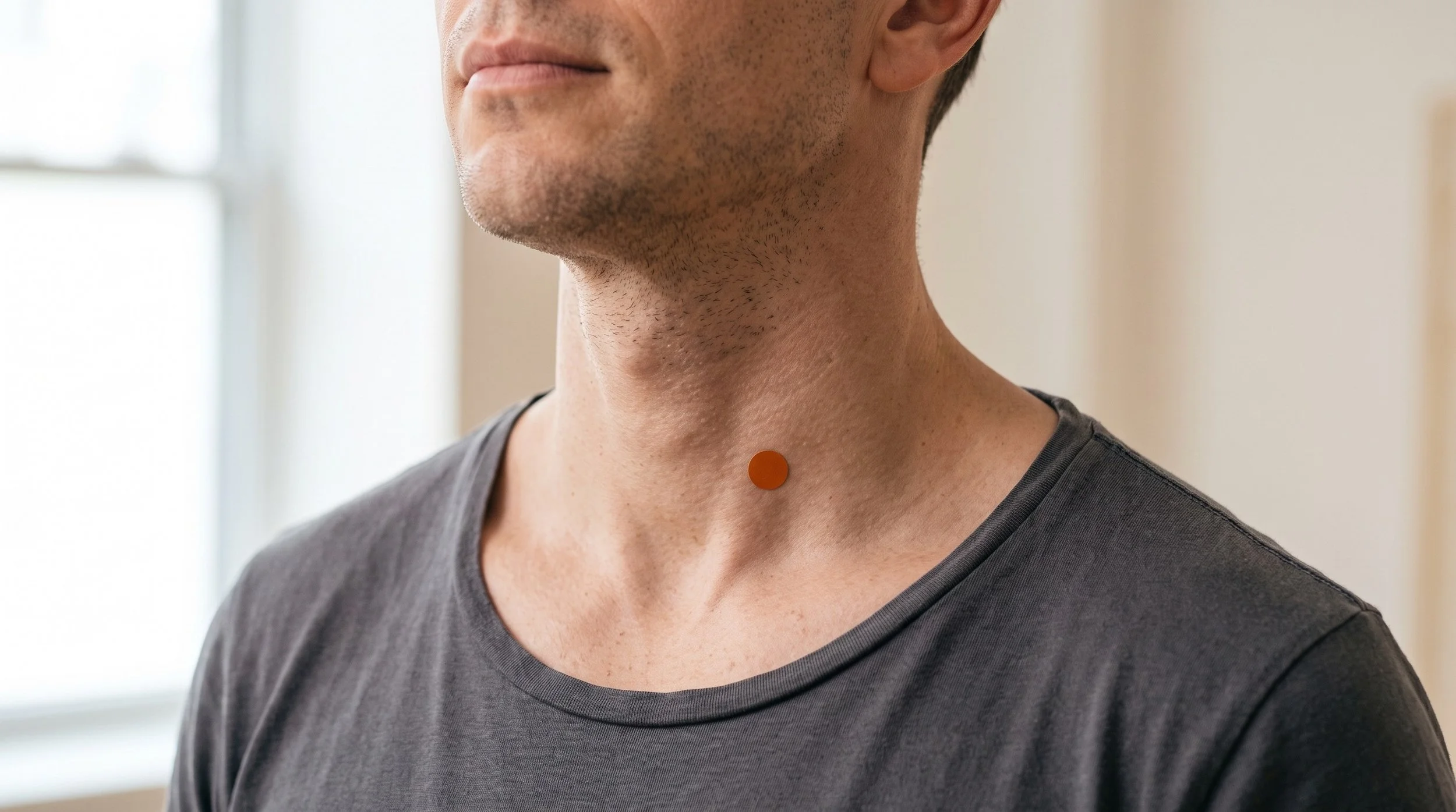
ST10 Acupuncture Point (Shuitu)
Water Prominence on the Front of the Neck: Anatomy, Mechanism, and Why ST10 Sits at the Crossroads of Throat Complaints and Sternocleidomastoid Tension
ST10, known in Chinese as Shuitu and usually translated as Water Prominence, is a Stomach channel point on the front of the neck, sitting on the leading edge of the sternocleidomastoid muscle midway between ST9 above and ST11 down at the collarbone.
Classical texts group it with the throat points and credit it with benefiting the throat and neck and directing Lung qi downward, which in modern language means it was used for sore, swollen throats, neck lumps, coughing, and breathlessness (Deadman et al., 2007). It matters clinically for two reasons: it sits over a segmentally rich strip of the anterior neck where cervical plexus branches, the strap muscle layer, and the sternocleidomastoid all converge, and it sits close to the carotid sheath, so it is a point that rewards precise landmarking and conservative technique rather than casual needling.
- Location and layers: ST10 lies at the front border of the sternocleidomastoid on the mid neck, midway between ST9 and ST11, with skin, platysma, and the superficial cervical fascia above the muscle border, the thyroid gland lying medially and the carotid sheath deep and lateral (Deadman et al., 2007; O'Connor & Bensky, 1981).
- Traditional categories, translated: the classical actions of benefiting the throat and neck and descending Lung qi map onto a modern reading of local cervical soft tissue input plus autonomic and airway-related reflex effects, not a literal flow of energy (Deadman et al., 2007; Cunningham, 2003).
- Mechanism: needling here recruits A-delta and group II/III afferents that enter the C2 to C4 spinal segments, where convergence in the dorsal horn and activation of descending inhibitory pathways can modulate how neck and throat inputs are processed (Zhao, 2008; White et al., 2008).
- Research picture: no trial has isolated ST10 on its own, so the evidence base is indirect, drawn from neck pain reviews of multi-point protocols and from individual patient data meta-analysis showing modest but persistent benefits of acupuncture for chronic pain (Vickers et al., 2018; Fang et al., 2024).
- Clinical framing: at Morningside we treat ST10 as a precision point rather than a routine one, using it selectively for anterior neck tightness, throat discomfort, and voice-related tension, often alongside dry needling of the sternocleidomastoid, which has been studied in neck pain and headache populations (Martín-Rodríguez et al., 2019; Rezaeian et al., 2020).
- De qi: patients typically report a mild, spreading heaviness or a swallow-triggering awareness in the throat rather than sharp pain, and the needle is angled medially and kept shallow, since ultrasound work on the sternocleidomastoid region has mapped how narrow the safe corridor can be (Kang et al., 2023).
Anterior Neck Tightness or a Throat That Never Feels Clear?
Front-of-neck tension is easy to miss because most people only stretch and rub the back of the neck. At Morningside Acupuncture we assess the sternocleidomastoid line, the scalenes, and the jaw before deciding whether ST10 belongs in your treatment, and we needle it conservatively with medial angulation away from the vessels. Sessions usually pair local neck work with distal points and simple breathing and posture homework. Schedule a visit and we'll map where your neck is actually loading.
Schedule NowAnatomy of ST10: Why the Anterior Sternocleidomastoid Border Is Such an Important Location
Run your fingers down the front edge of the big diagonal neck muscle and you have found the line ST10 lives on. To make the border obvious, turn the head away from the side you want to treat while a light resistance is applied at the chin, which brings the sternocleidomastoid into relief (Deadman et al., 2007). Under the skin at this level sit the platysma, the investing layer of deep cervical fascia, and the anterior fibers of the sternocleidomastoid, with the strap muscles and the thyroid gland lying more medially and the carotid sheath deeper and slightly lateral (O'Connor & Bensky, 1981).
This is a region loaded by forward head posture, prolonged phone and laptop use, heavy voice use, chronic throat clearing, and breathing patterns dominated by accessory muscles rather than the diaphragm.
Sensory supply to the skin here comes from the transverse cervical nerve, a cervical plexus branch carrying C2 and C3 fibers, while the sternocleidomastoid receives motor supply from the accessory nerve with proprioceptive contributions from the same upper cervical roots. That segmental address explains a lot. Needle input from the anterior neck arrives in dorsal horn segments that also receive convergent input from deeper cervical structures and, through the trigeminocervical complex, from head and jaw territory, so local stimulation can influence how a wider region is processed (Zhao, 2008).
Needling also engages descending inhibitory control from the brainstem, which is one of the better characterized mechanisms behind acupuncture analgesia (White et al., 2008; Zhao, 2008). Trigger points in the sternocleidomastoid are separately known to refer pain into the face, ear, and forehead, which is why anterior neck work sometimes changes symptoms patients had filed under headache (Simons et al., 1999).
The safety story here is straightforward and non-negotiable. The carotid sheath, holding the common carotid artery, internal jugular vein, and vagus nerve, sits deep and lateral to the point, and the thyroid gland sits medial, so the standard convention is a perpendicular-to-oblique insertion angled medially, away from the artery, to a depth of roughly 0.5 to 1 cun, with the same cautions that apply at ST9 (Deadman et al., 2007). Some texts recommend a shallower 0.3 to 0.5 cun (Cunningham, 2003; Kim, 2010).
Ultrasound studies of invasive procedures in the sternocleidomastoid region have shown that the safe corridor varies considerably between individuals and along the muscle, which supports palpating the carotid pulse first, staying superficial, and using thin needles (Kang et al., 2023).
Related Acupuncture For Neck Pain Related Sternocleidomastoid Trigger PointsST10 at a Glance: Classification, Location, and Clinical Use
| Category | Detail |
|---|---|
| Traditional Name | Shuitu (Water Prominence), also translated as Water Passing |
| Channel Classification | Stomach channel of Foot Yangming, tenth point of the channel, in the anterior neck group between ST9 and ST11 |
| Point Categories | No five-shu, yuan-source, luo-connecting, xi-cleft, or hui-meeting designation, and no extraordinary vessel intersection is recorded for this point in the classical sources consulted. It is described functionally as a throat and neck point whose traditional actions are benefiting the throat and neck and descending Lung qi (Deadman et al., 2007), with some authors adding the transformation of phlegm (Cunningham, 2003). |
| Precise Location | On the front of the neck, at the anterior border of the sternocleidomastoid muscle, at the midpoint of a line drawn between ST9 (level with the laryngeal prominence) and ST11 (at the medial end of the collarbone). Turning the head away against light resistance at the chin defines the muscle border. |
| Tissue Stimulated | Skin and platysma, superficial and investing cervical fascia, and the anterior fibers and border of the sternocleidomastoid, with the strap muscle layer medial. Innervation is largely cervical plexus (C2 to C3) for skin, with accessory nerve supply to the muscle itself. |
| Needle Depth / Direction | Perpendicular to oblique, angled deliberately medially away from the carotid artery, 0.5 to 1 cun in classical sources and 0.3 to 0.5 cun in more conservative modern texts. Palpate and avoid the carotid pulse, use a thin needle, avoid deep or vigorous manipulation, and avoid electrical stimulation across the anterior neck. |
| De Qi Sensation | Usually a light, spreading heaviness or fullness in the throat, sometimes with an urge to swallow or a mild warm sensation traveling toward the jaw or collarbone. Sharp, electric, or pulsing sensations mean the needle should be withdrawn and repositioned. |
| Primary Clinical Uses | Traditionally used for throat swelling and soreness, neck swellings, cough, wheezing, and shortness of breath; in modern clinical use, anterior neck and sternocleidomastoid-line tension, voice-related neck tightness, and adjunctive care for globus-type throat discomfort alongside appropriate medical evaluation. |
| Common Point Combinations |
|
Deadman, Al-Khafaji, and Baker present ST10 as a compact throat and neck point with two traditional actions: benefiting the throat and neck, and descending Lung qi. Its recorded indications cluster tightly, covering painful swollen throats, goitre and scrofula (older terms for thyroid enlargement and chronic neck lymph node swellings), cough including whooping cough, shortness of breath and labored breathing, and shoulder swelling and pain. The Supplementing Life tradition preserves a minimal two-point formula for throat swelling, pairing ST10 with its neighbor ST11 (Deadman et al., 2007).
The Shanghai text adds vocal cord disorders and asthma to the modern indication list, and Cunningham notes its use for vocal clarity in professional singers (O'Connor & Bensky, 1981; Cunningham, 2003). What stands out is the coherence of the picture: everything attributed to this point sits in the column of air and swallowing that runs behind it, which is exactly what you would predict from a point placed at the front edge of the neck. These are traditional attributions, not clinical claims.
Why ST10 Is Used for Front-of-Neck Tightness and Throat Discomfort Rather Than Back-of-Neck Pain
Most people think of neck pain as a back-of-the-neck problem, so a point on the throat side can seem out of place. The anatomy explains it. The sternocleidomastoid, the scalenes, and the strap muscles form the anterior column of the neck, and they get loaded every time the head drifts forward, every time someone breathes into the upper chest rather than the belly, and every time a person spends hours projecting their voice. Trigger points in this muscle refer symptoms into the face, ear, forehead, and sometimes produce dizziness or a sense of pressure that does not read as neck pain at all (Simons et al., 1999).
ST10 sits directly on that border, so needling it delivers input into the C2 to C4 segments that serve this whole territory, where convergence in the dorsal horn allows a local stimulus to change the processing of a wider area (Zhao, 2008).
The second layer is descending inhibition. Needle stimulation activates brainstem systems that dampen nociceptive transmission at the spinal level, an effect mediated in part by endogenous opioid and monoaminergic pathways and characterized across decades of animal and human work (Zhao, 2008; White et al., 2008). This is why the effects of a well-placed needle are rarely confined to the square inch under it.
There is also an autonomic dimension to the anterior neck worth acknowledging carefully. Research on the neighboring point ST9 has examined blood pressure regulation and central gene expression changes in hypertensive rat models, work motivated by that point's proximity to carotid baroreceptor territory (Guo et al., 2018). ST10 sits below ST9 and is needled with deliberate medial angulation to stay away from those structures, so autonomic effects are best described as a reason for caution and precision here rather than a therapeutic goal.
In practice, that means we use ST10 for a narrow set of presentations: tightness and tenderness along the front border of the sternocleidomastoid, throat discomfort with a muscular or tension component after medical causes have been assessed, and voice-related neck strain. It is not a first-line point for stiff necks that hurt when turning, and it is never a substitute for evaluating a persistent sore throat, a new neck lump, a voice change lasting more than a couple of weeks, or difficulty swallowing. Those need a physician.
What the Research Shows for ST10
Research on individual acupuncture points is limited almost everywhere, and ST10 is no exception: there is no randomized trial testing this point in isolation. What exists is evidence about acupuncture protocols for neck pain that may include anterior neck points, evidence about dry needling of the sternocleidomastoid muscle that ST10 overlies, and basic science on how needle stimulation modulates pain processing. Read the table below as context for a clinical decision, not as proof that one point does one thing.
| Study | Type | Focus | Key Finding |
|---|---|---|---|
| Trinh et al., 2016 | Cochrane systematic review | Acupuncture for neck disorders, including chronic mechanical neck pain | Reported moderate-quality evidence of short-term pain relief compared with sham for chronic neck pain, though the review was subsequently withdrawn from the Cochrane Library pending an update, so its conclusions should be treated as provisional. |
| Fang et al., 2024 | Systematic review and meta-analysis | Durability of acupuncture effects in chronic neck pain across 18 randomized trials | Suggested that acupuncture used as an adjunct may provide pain relief sustained at three and six months after treatment, with the usual caveats about heterogeneity and trial quality. |
| Vickers et al., 2018 | Individual patient data meta-analysis | Chronic pain including neck and shoulder pain, roughly 21,000 patients | Found acupuncture superior to both sham and no-acupuncture controls with modest effect sizes, and effects that persisted over twelve months. |
| Martín-Rodríguez et al., 2019 | Randomized clinical trial | Trigger point dry needling of the sternocleidomastoid in non-specific neck pain | Reported reduced neck pain at one week and improved cervical motor control at one month, with no clear difference between needling inside versus near the trigger point in this small sample. |
| Rezaeian et al., 2020 | Randomized controlled trial | Dry needling of sternocleidomastoid trigger points in migraine | Reported improvements in headache measures and pressure pain thresholds after three sessions, indicating that anterior neck muscle input can influence head symptoms. |
| Guo et al., 2018 | Animal experimental study | Needling the adjacent point ST9 in spontaneously hypertensive rats | Observed blood pressure reduction and altered hypothalamic gene expression, illustrating why anterior neck points near carotid structures are treated with technical caution. |
| Kang et al., 2023 | Ultrasonographic anatomical study | Safe zones for invasive procedures in the sternocleidomastoid muscle | Demonstrated substantial individual variation in the depth of safe needle placement, supporting shallow, carefully angled technique in this region. |
| Zhao, 2008 | Narrative review of mechanisms | Neural basis of acupuncture analgesia | Summarizes segmental dorsal horn modulation and descending inhibitory control as the principal explanatory pathways for needle-induced analgesia. |
Singers, Speakers, and Anyone Who Uses Their Voice All Day?
Voice-heavy work loads the neck in a way that ordinary desk posture does not, and classical sources placed ST10 squarely among the throat points for that reason. We combine gentle needling near the sternocleidomastoid border with jaw, suboccipital, and breathing work so the whole vocal mechanism gets addressed, not just the sore spot. Everything is done with thin needles and light stimulation. Book a session and let's look at your voice-use pattern together.
Schedule NowST10 in the Context of Trigger Point Work
Because ST10 sits on the front border of the sternocleidomastoid, it overlaps directly with a muscle that trigger point clinicians treat often. The sternal and clavicular divisions of this muscle can refer symptoms into the forehead, cheek, ear, and behind the eye, and can contribute to postural dizziness and a heavy-headed feeling, patterns that were documented in detail by Travell and Simons (Simons et al., 1999).
At Morningside we frequently find that a patient whose complaint is described as headache or facial pressure has significant tenderness along this border. When that is the case, the point location and the myofascial target are essentially the same real estate, approached with different reasoning.
Our usual approach is to combine gentle needling at or near ST10 with pincer-grip dry needling of the sternocleidomastoid, plus the scalenes, suboccipitals, upper trapezius, and jaw muscles as the examination dictates. Randomized trials of sternocleidomastoid dry needling have reported reduced neck pain and improved cervical motor control, and improvements in headache measures in migraine populations, which supports treating this muscle deliberately rather than incidentally (Martín-Rodríguez et al., 2019; Rezaeian et al., 2020).
Technique here is conservative by design: the muscle is lifted away from underlying structures where appropriate, needles stay shallow, and ultrasound-based anatomical work reminds us that the safe corridor differs from person to person (Kang et al., 2023).
ST10 Neck and Throat Treatment at NYC's Highest-Rated Acupuncture Clinic
Morningside Acupuncture is the highest-rated acupuncture and dry needling clinic in New York City with over 500 five-star Google reviews, and our approach blends classical point knowledge with modern pain science and orthopedic assessment. For neck and throat complaints we combine carefully placed channel points like ST10 with trigger point dry needling, manual therapy, and rehab-style movement. Every plan is built around your history, your anatomy, and your goals. Schedule your appointment on the Upper West Side and start with a full assessment.
Schedule NowFrequently Asked Questions
What does ST10 feel like when needled?
Most patients feel a light pressure at the skin followed by a mild spreading heaviness or fullness in the throat, sometimes with an urge to swallow or a faint warmth traveling toward the jaw or collarbone. Because the needle is kept thin, shallow, and angled medially, the sensation is usually gentler than at points on the limbs. Sharp, electric, or throbbing sensations are not the goal and mean the needle should be withdrawn and repositioned. Many people also notice the front of the neck feels looser and breathing feels a little easier afterward.
Why needle the front of the neck when my pain is at the back or in my head?
The front and back of the neck share spinal segments. Sensory input from the anterior neck enters the C2 to C4 dorsal horn, where it converges with input from deeper cervical structures and, via the trigeminocervical complex, from the head and jaw, which is why treating one side of the neck can change symptoms on the other (Zhao, 2008). The sternocleidomastoid itself refers pain into the forehead, ear, and around the eye rather than into its own belly, so a patient with facial or frontal symptoms may have a genuine anterior neck driver (Simons et al., 1999). Treating the neck as a cylinder rather than a back surface tends to produce better results.
Can I press ST10 myself between sessions?
Yes, with more care than at most points. Sit comfortably, turn your head slightly away from the side you are working on to bring the sternocleidomastoid border into view, then find the midpoint between the level of your Adam's apple and your collarbone along that front edge. Before pressing anything, feel for your carotid pulse and stay off it: your fingers should rest on the muscle border, not on any pulsing vessel. Use very light pressure with one or two fingertips, roughly the pressure you would use on a closed eyelid, for 20 to 30 seconds at a time, with slow nasal breathing, and repeat two or three times. Never press both sides at once, never press hard, and stop immediately if you feel lightheaded, notice a pulse under your finger, or feel any change in vision or heart rate. Skip self-massage here entirely if you have carotid artery disease, a history of fainting, an unexplained neck lump, or take blood thinners, and check with your clinician first.
Is ST10 safe to needle?
It is safe in trained hands and should be left alone by everyone else. The carotid sheath containing the carotid artery, internal jugular vein, and vagus nerve lies deep and lateral to the point, and the thyroid gland lies medially, which is why the standard technique is a shallow insertion angled medially away from the artery, with the same precautions that apply at ST9 (Deadman et al., 2007). Practitioners palpate the carotid pulse first, use thin needles, avoid strong manipulation, avoid electrical stimulation across the anterior neck, and monitor the patient throughout. Ultrasound work in this region has shown that the depth of the safe corridor varies from person to person, which is another reason for conservative depth (Kang et al., 2023). We generally avoid this point in patients with carotid disease, bleeding disorders or anticoagulant therapy, significant thyroid enlargement, or any undiagnosed neck mass.
Where exactly is ST10 located?
On the front of the neck, at the anterior border of the sternocleidomastoid muscle, at the midpoint of the line connecting ST9 and ST11. ST9 is level with the tip of the laryngeal prominence and ST11 is down at the medial end of the collarbone, so ST10 sits roughly halfway between the Adam's apple level and the collarbone along that muscle edge. The easiest way to define the border is to turn the head away from the side being located while light resistance is applied at the chin, which makes the muscle stand out (Deadman et al., 2007). Locating it is one thing; needling it is a job for a licensed practitioner.
References
- Deadman, P., Al-Khafaji, M., & Baker, K. (2009). A manual of acupuncture. Journal of Chinese Medicine Publications.
- O'Connor, J., & Bensky, D. (Eds. & Trans.). (1981). Acupuncture: A comprehensive text. Shanghai College of Traditional Medicine. Eastland Press.
- Cunningham, P. M. (2000). Acupuncture points: A practical guide to classical and modern usage. Odyssey Press.
- Kim, H. (2008). Handbook of Oriental medicine (3rd ed.). Harmony & Balance Press.
- White, A., Cummings, M., & Filshie, J. (2008). An introduction to Western medical acupuncture. Churchill Livingstone Elsevier.
- Simons, D. G., Travell, J. G., & Simons, L. S. (1999). Travell & Simons' myofascial pain and dysfunction: The trigger point manual, Vol. 1: Upper half of body (2nd ed.). Williams & Wilkins.
- Trinh, K., Graham, N., Irnich, D., Cameron, I. D., & Forget, M. (2016). Acupuncture for neck disorders. Cochrane Database of Systematic Reviews, 2016(5), CD004870. https://doi.org/10.1002/14651858.CD004870.pub4
- Fang, J., Shi, H., Wang, W., Chen, H., Yang, M., Gao, S., Yao, H., Zhu, L., Yan, Y., & Liu, Z. (2024). Durable effect of acupuncture for chronic neck pain: A systematic review and meta-analysis. Current Pain and Headache Reports, 28. https://doi.org/10.1007/s11916-024-01267-x
- Vickers, A. J., Vertosick, E. A., Lewith, G., MacPherson, H., Foster, N. E., Sherman, K. J., Irnich, D., Witt, C. M., & Linde, K. (2018). Acupuncture for chronic pain: Update of an individual patient data meta-analysis. Journal of Pain, 19(5), 455-474. https://doi.org/10.1016/j.jpain.2017.11.005
- Zhao, Z. Q. (2008). Neural mechanism underlying acupuncture analgesia. Progress in Neurobiology, 85(4), 355-375. https://doi.org/10.1016/j.pneurobio.2008.05.004
- Martin-Rodriguez, A., Saez-Olmo, E., Pecos-Martin, D., & Calvo-Lobo, C. (2019). Effects of dry needling in the sternocleidomastoid muscle on cervical motor control in patients with neck pain: A randomised clinical trial. Acupuncture in Medicine, 37(3), 151-163. https://doi.org/10.1177/0964528419843913
- Rezaeian, T., Mosallanezhad, Z., Nourbakhsh, M. R., Noroozi, M., & Sajedi, F. (2020). Effects of dry needling technique into trigger points of the sternocleidomastoid muscle in migraine headache: A randomized controlled trial. American Journal of Physical Medicine & Rehabilitation, 99(12), 1129-1137. https://doi.org/10.1097/PHM.0000000000001504
- Kang, B. H., Park, S. H., Kang, S., & Yoon, J. S. (2023). Identifying safety zone of invasive procedures in the sternocleidomastoid muscle using ultrasonography. Medicine, 102(8), e33021. https://doi.org/10.1097/MD.0000000000033021
- Guo, Y., Park, K., Lu, J., Liang, J., Zhao, R., & Xu, J. (2018). Effect of acupuncture at Renying (ST 9) on gene expression profile of hypothalamus in spontaneously hypertensive rats. Journal of Traditional Chinese Medicine, 38(2), 227-241. https://pubmed.ncbi.nlm.nih.gov/32186062/
Disclaimer: This web site is intended for educational and informational purposes only. Reading this website does not constitute providing medical advice or any professional services. This information should not be used for diagnosing or treating any health issue or disease. Those seeking medical advice should consult with a licensed physician. Seek the advice of a medical doctor or other qualified health professional for any medical condition. If you think you have a medical emergency, call 911 or go to the emergency room. No acupuncturist-patient relationship is created by reading this website or using the information. Morningside Acupuncture PLLC and its employees and contributors do not make any express or implied representations with respect to the information on this site or its use. For any legal interpretation of scope of practice in your state, consult a licensed attorney or regulatory authority.
Read more from our blog



