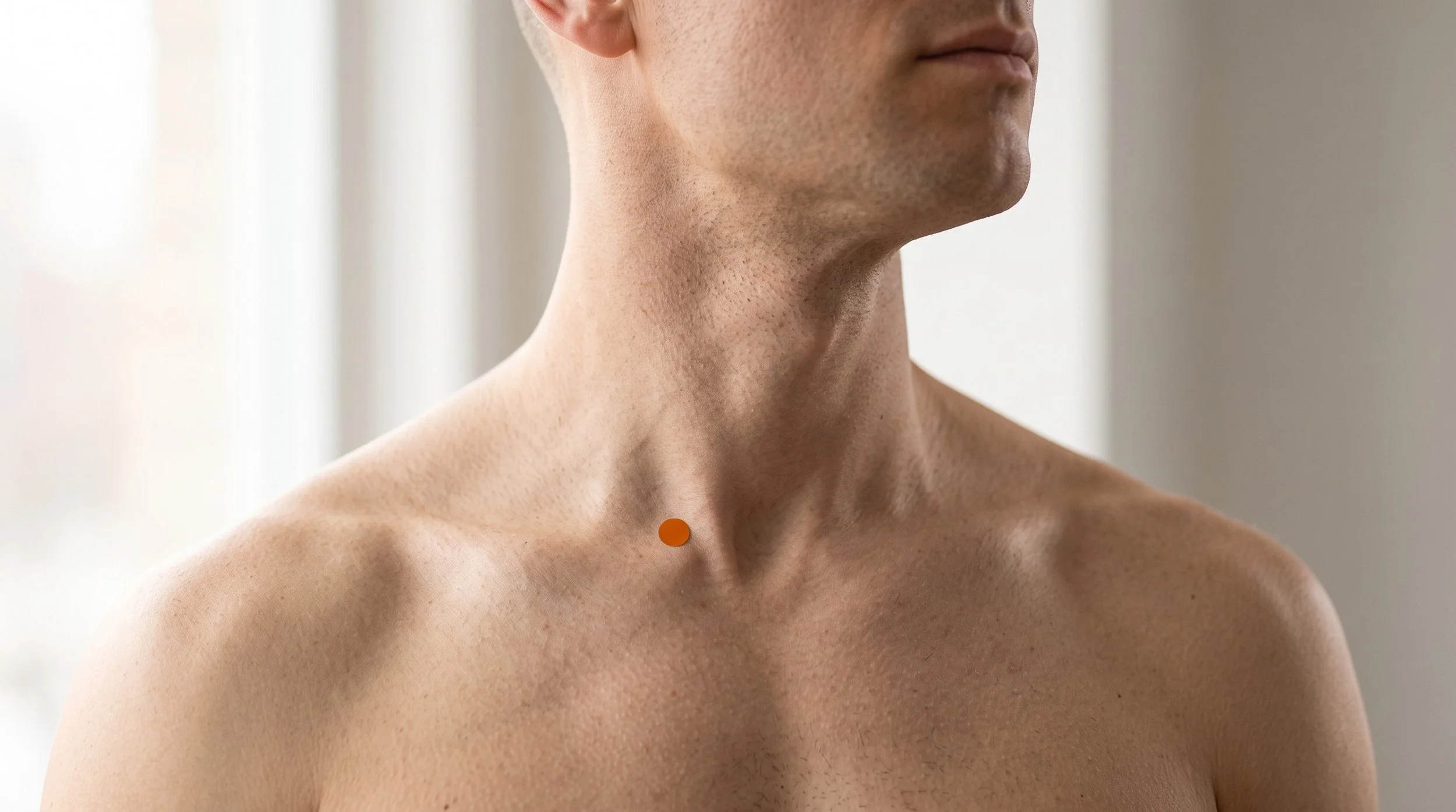
ST11 Acupuncture Point (Qishe)
The Abode of Qi at the Root of the Neck: Anatomy, Mechanism, and Why This Small Notch Between the Two Heads of the Sternocleidomastoid Matters
ST11, known in Chinese as Qishe and usually translated as Abode of Qi, is the lowest of the Stomach channel's neck points. You find it right at the base of the neck, just above the inner end of the collarbone, in the small notch between the two attachments of the sternocleidomastoid (the sternal head onto the breastbone and the clavicular head onto the collarbone), directly below ST9.
Classical texts group it with the throat and neck points and describe it as benefiting the throat and descending rebellious qi, which in modern terms maps onto a small, densely innervated window over the lower SCM attachments, the cervical plexus territory, and the neurovascular corridor of the root of the neck.
It matters clinically because the lower SCM is a common source of neck stiffness, restricted rotation, and throat tightness, and because this is one of the few upper-body points where shallow needling is not a stylistic preference but a hard anatomical rule, since the apex of the lung and the great vessels sit close beneath.
- Location and layers: the st11 acupuncture point sits at the root of the neck above the medial clavicle, in the depression between the sternal and clavicular heads of the sternocleidomastoid, directly inferior to ST9 (Deadman et al., 2000). Needle contact is skin, platysma, superficial cervical fascia, and the tendinous lower attachments of the SCM.
- Traditional categories, read neurophysiologically: classical sources assign Qishe the actions of benefiting the throat and neck and descending qi, with indications for throat swelling and pain, neck stiffness with difficulty turning the head, goitre and neck nodules, difficult swallowing, hiccup, and breathlessness (Deadman et al., 2000). Rather than movement of energy, these overlap with structures sharing C2 to C4 segmental input: the SCM, the infrahyoid muscles, the pharynx, and the phrenic nerve roots.
- Nerve geography: the region is supplied superficially by the medial supraclavicular nerve from the cervical plexus, with a muscular branch of the ansa cervicalis nearby, so needling here recruits cutaneous and deep somatic afferents that converge in the upper cervical dorsal horn, where segmental inhibition and diffuse descending control can modulate pain reporting (Zhao, 2008).
- Research picture: no trial has tested Qishe alone. The evidence base is for acupuncture as a whole in neck pain, where a Cochrane review found benefit for mechanical neck pain in the short term (Trinh et al., 2016) and a large individual patient data meta-analysis found modest, durable effects across chronic pain conditions (Vickers et al., 2018).
- Clinical practice framing: stomach 11 is most often chosen when the lower SCM is tender and shortened, when rotation away from the painful side is limited, or when a patient describes a band of tightness low in the front of the neck; a randomized trial of dry needling into SCM trigger points reported improvements in pain and cervical motor control over the following weeks, though it did not separate from its control condition (Martín-Rodríguez et al., 2019).
- De qi and depth: the accepted depth is 0.3 to 0.5 cun perpendicular, and deep insertion risks puncturing the lung, so the needle stays strictly shallow (Deadman et al., 2000). Sensation is usually a local heaviness or pressure at the notch, sometimes a mild spreading fullness toward the throat or collarbone, and it should never be sharp or radiating down the arm.
Neck Stiffness That Makes Turning Your Head Difficult?
When patients cannot rotate comfortably to check a blind spot or turn toward a colleague, the lower sternocleidomastoid attachments are often part of the picture. At Morningside Acupuncture we palpate the SCM heads carefully, use st 11 neck needling at a shallow, controlled depth when the notch is reactive, and pair it with distal points and targeted dry needling of the surrounding cervical muscles. Treatment is always matched to what your exam shows rather than to a fixed template. Schedule a visit to get your neck assessed properly.
Schedule NowAnatomy of ST11: Why the Notch Between the Two SCM Heads Is Such an Important Location
At the base of the neck the sternocleidomastoid splits into two distinct attachments: a rounded, tendinous sternal head that anchors onto the manubrium, and a flatter clavicular head that spreads onto the inner third of the collarbone. ST11 occupies the small triangular depression between them, just above the sternoclavicular joint (Deadman et al., 2000). The tissue you engage here is thin: skin, platysma, superficial fascia, and the dense tendinous ends of the muscle.
These lower attachments take load every time the head is lifted from a pillow, held forward over a laptop, or braced during effortful breathing, and they are among the more consistently tender spots in patients with forward head posture. Palpation is far easier if the patient turns the head away from the side being examined while you apply light resistance at the chin, which makes both heads stand out clearly.
The nerve story is why this small area punches above its weight. Superficially the skin here is supplied by the medial supraclavicular nerve from the cervical plexus, while deeper the SCM receives motor supply from the accessory nerve with sensory and proprioceptive contribution through cervical roots, and a muscular branch of the ansa cervicalis runs nearby.
Those inputs enter the cord at the same upper cervical levels that serve the throat, the strap muscles, the upper trapezius, and the phrenic nerve roots, so a needle here feeds afferent traffic into a segment shared by structures that patients often experience as one problem. Convergence at that level offers a plausible explanation for how a local point can influence sensations reported in the throat and jaw as well as the neck itself, and needle stimulation also engages descending inhibitory pathways from the brainstem that dampen dorsal horn transmission more broadly (Zhao, 2008).
The SCM is also a well-documented source of referred pain into the face, ear, and forehead, which is why the muscle is treated so often even when the patient's complaint is not the neck (Simons et al., 1999).
Deep to the point is exactly why the depth rule is non-negotiable. The anterior jugular vein runs superficially in this region, the common carotid artery and internal jugular vein lie deeper, the cervical sympathetic chain and phrenic nerve are in the vicinity, and the apex of the lung rises above the level of the first rib into the root of the neck. Standard technique is perpendicular insertion of 0.3 to 0.5 cun, with the explicit caution that deep needling may puncture the lung (Deadman et al., 2000).
In practice that means a short needle, a shallow angle of intent, no deep manipulation, and no aggressive lifting and thrusting. Pneumothorax remains the most frequently reported serious adverse event in the acupuncture safety literature, and virtually all of it is attributable to needling too deeply over the thorax and lower neck (He et al., 2012).
Related Sternocleidomastoid Trigger Points Related Muscles That Cause Neck PainST11 at a Glance: Classification, Location, and Clinical Use
| Category | Detail |
|---|---|
| Traditional Name | Qishe (Abode of Qi, also rendered Qi Residence) |
| Channel Classification | Eleventh point of the Stomach channel of Foot Yangming; the lowest of the Stomach channel's neck points |
| Point Categories | No five-shu, yuan-source, luo-connecting, xi-cleft, or hui-meeting designation, and no extraordinary vessel intersection is recorded in the standard references. Classical actions are limited to benefiting the throat and neck and descending qi (Deadman et al., 2000; Kim, 2012). It is, however, named along the trajectory of the Heart luo vessel in classical channel descriptions, where it is associated with rebellious throat and stomach qi and neck swellings (Sterman, 2011). |
| Precise Location | At the root of the neck, above the medial end of the clavicle, in the depression between the sternal and clavicular heads of the sternocleidomastoid, directly below ST9. Turning the head away against light resistance at the chin makes both heads easy to identify. |
| Tissue Stimulated | Skin, platysma, superficial cervical fascia, and the tendinous sternal and clavicular attachments of the sternocleidomastoid |
| Needle Depth / Direction | Perpendicular, 0.3 to 0.5 cun only. Deep insertion risks the lung apex and the great vessels, so depth stays strictly shallow and manipulation stays gentle. Moxibustion is described as applicable in several texts. |
| De Qi Sensation | Local heaviness, pressure, or dull fullness at the notch, occasionally spreading a short distance toward the throat or collarbone. Sharp pain, pulsing, or radiating sensation means the needle should be withdrawn and repositioned. |
| Primary Clinical Uses | Traditionally used for throat swelling and pain, neck stiffness with inability to turn the head, goitre and neck nodules, hiccup, difficult swallowing, and breathlessness. In modern practice it is used mainly for lower sternocleidomastoid tension, restricted cervical rotation, and anterior neck tightness. |
| Common Point Combinations |
|
Deadman, Al-Khafaji and Baker record Qishe with a compact set of traditional attributions: it benefits the throat and neck and descends qi, and its indications cluster into two groups. The first is regional and structural, covering swelling and pain of the throat, goitre, scrofulous neck nodules, and stiffness of the neck with an inability to turn the head.
The second is a descending group, covering breathlessness, difficulty getting food down, and hiccup. Classical combinations follow the same logic: Supplementing Life pairs it with LU3 and TE13 for neck swellings, the Systematic Classic pairs it with BL42 for coughing with rebellious qi, and the Thousand Ducat Formulas builds a larger throat and chest formula around it with LI18, SI17, CV23, BL42, and BL45. What stands out is the coherence of the pattern.
Every one of those indications involves something that should move downward or turn freely and does not, whether that is swallowed food, the breath, or the head itself, and the point sits precisely at the anatomical hinge where the neck meets the thorax.
Why ST11 Is Used for Neck Stiffness, Throat Tightness, and Even Hiccup
The most useful way to understand this point is segmentally. Sensory input from the skin and deep tissue at the root of the neck enters the spinal cord at roughly the C3 and C4 levels, and those same levels receive input from the sternocleidomastoid, the strap muscles of the throat, parts of the pharynx, and the roots of the phrenic nerve. When several structures report into a shared pool of dorsal horn neurons, the brain's map of where a problem lives becomes imprecise, which is one reason patients describe neck and throat symptoms as a single blurred complaint.
Needling into that shared segment provides a strong, clean afferent signal that competes with the ongoing nociceptive traffic, and the classical use of Qishe for hiccup becomes more intelligible once you notice that the phrenic nerve arises from the same cervical levels the point overlies (Zhao, 2008).
Beyond the segment, needling engages descending inhibitory systems that run from the midbrain and brainstem back down to the dorsal horn, using serotonergic, noradrenergic, and endogenous opioid signaling to reduce transmission. This is the mechanism most often invoked to explain why effects can outlast the session and why they are not strictly limited to the needled segment (Zhao, 2008).
There is also a local mechanical and vascular component: a needle placed into a taut tendinous attachment can produce a local twitch response and change how that tissue tolerates stretch, which matters when the limitation is rotation rather than pain at rest (Simons et al., 1999).
None of this means ST11 is a stand-alone answer. In our clinic the abode of qi point is one input within a treatment that usually also addresses the upper trapezius, levator scapulae, scalenes, and suboccipitals, plus whatever postural or breathing pattern keeps reloading the front of the neck. The point earns its place when the notch itself is tender and the patient's restriction is genuinely anterior and low, not when it is simply on a list.
What the Research Shows for ST11
There is no clinical trial of Qishe by itself, and it would be misleading to imply otherwise. Acupuncture research overwhelmingly tests multi-point protocols against sham or usual care, so what the evidence can tell us is whether treatments that include lower cervical points like this one tend to help, not what any single point contributes. The studies below are the most relevant to how ST11 is actually used: neck pain reviews, the large chronic pain dataset, trials of needling the sternocleidomastoid specifically, work on swallowing, and the safety literature that underlies the shallow-depth rule.
| Study | Type | Focus | Key Finding |
|---|---|---|---|
| Trinh et al., 2016 | Cochrane systematic review (27 trials) | Acupuncture for acute, subacute, and chronic neck disorders | For mechanical neck pain the review reported benefit for pain intensity and disability at immediate and short-term follow-up compared with sham, inactive, or wait-list control, though the review version was subsequently withdrawn for updating and the certainty of evidence was moderate at best. |
| Vickers et al., 2018 | Individual patient data meta-analysis (39 trials, roughly 20,000 patients) | Acupuncture for chronic musculoskeletal pain including neck pain | Acupuncture was associated with modest but statistically significant reductions in pain compared with both sham and no-acupuncture controls, with effects that decayed only slowly over 12 months. |
| Martín-Rodríguez et al., 2019 | Randomized double-blind clinical trial (34 participants) | Trigger point dry needling of the sternocleidomastoid in non-specific neck pain | Pain decreased at one week and cervical motor control improved at one month within the treated group, but no statistically significant differences emerged between the trigger point and adjacent-needling comparison groups. |
| Li et al., 2024 | Systematic review and meta-analysis | Acupuncture for aspiration related to post-stroke dysphagia | Pooled results suggested acupuncture added to rehabilitation may improve swallowing-related outcomes, though the included trials were mostly small and at risk of bias, so the finding is suggestive rather than conclusive. |
| He et al., 2012 | Systematic review of adverse event case reports | Safety of acupuncture in the Chinese literature, 1956 to 2010 | Pneumothorax was among the most frequently reported serious adverse events, which is the direct rationale for restricting needling depth at points over the lung apex such as ST11. |
| Zhao, 2008 | Narrative review of mechanism research | Neural mechanisms of acupuncture analgesia | Analgesic effects are attributed to afferent stimulation producing segmental inhibition and activation of descending opioid, serotonergic, and noradrenergic pathways rather than to any point-specific property. |
Throat Tightness, Globus Sensation, or a Neck That Feels Constricted?
Traditional texts placed the abode of qi point squarely in the throat and neck group, and modern practice still uses this region when patients report a low anterior band of tightness or a swallowing that feels effortful. We combine gentle needling at Qishe with midline and distal points, breathing work, and manual assessment of the hyoid and jaw musculature. Medical causes are always ruled out first with your physician. Book an evaluation to talk through what is driving your symptoms.
Schedule NowST11 in the Context of Trigger Point Work
ST11 lands directly on the lower attachments of the sternocleidomastoid, which is one of the most clinically important muscles in the neck for referred symptoms. Trigger points in the sternal division are associated with referral into the forehead, the cheek, and behind the eye, while the clavicular division is more often linked to frontal headache, ear symptoms, and disequilibrium (Simons et al., 1999). That overlap means the same spot can be described as a traditional Stomach channel point or as a myofascial target, and the needle does not know the difference.
What changes is how you reason about it: the point selection is regional and classical, the muscle selection is based on palpation, provocation, and where the patient's symptoms actually refer.
In practice at Morningside, treatment of this region rarely stops at one location. If the lower SCM is reactive we typically also examine the scalenes, the upper trapezius, the levator scapulae, and the suboccipital group, since those muscles fail together in patients with sustained forward head posture.
Dry needling of SCM trigger points has been studied in isolation with modest results, improving pain and cervical motor control within treated groups but not reliably outperforming its control condition (Martín-Rodríguez et al., 2019), which is a fair argument for combining needling with loaded exercise and postural retraining rather than relying on it alone. Depth discipline applies in every case: at the root of the neck the technique is shallow, deliberate, and anatomically informed, with the lung apex and carotid sheath always accounted for.
ST11 Neck and Throat Treatment at NYC's Highest-Rated Acupuncture Clinic
Morningside Acupuncture is the highest-rated acupuncture and dry needling clinic in New York City with over 500 five-star Google reviews, and our clinicians treat the cervical region every single day. Points like stomach 11 are used with strict depth discipline, clean technique, and a clear explanation of what we are doing and why. You will leave with a plan that includes home care, not just needles. Schedule your appointment to get started.
Schedule NowFrequently Asked Questions
What does ST11 feel like when needled?
Most people feel a dull, heavy pressure right in the notch above the collarbone, sometimes with a mild sense of fullness spreading toward the throat or along the collarbone. Because the needle stays shallow, the sensation is usually milder than at thicker muscular points like ST36 or GB21. Some patients notice a brief swallowing reflex or the urge to clear the throat, which typically settles within seconds. Sharp, burning, electrical, or pulsing sensation is not normal here and means the needle should be withdrawn and repositioned immediately.
Why needle a point on the throat for neck stiffness rather than the back of the neck?
Because rotation limitation is frequently an anterior problem. The sternocleidomastoid turns the head to the opposite side, and when its lower attachments are shortened and tender, turning becomes stiff and often painful even though the patient points to the back of the neck. Classical sources listed neck stiffness with inability to turn the head as a Qishe indication centuries before anyone described SCM referral patterns (Deadman et al., 2000). Modern practice usually treats both, with the posterior muscles handled alongside the anterior ones rather than instead of them.
Can I press ST11 myself between sessions?
Yes, with care. Turn your head away from the side you want to work on to make the two SCM attachments stand out, then find the small dip between them just above the inner end of your collarbone. Use one fingertip, press gently straight inward with light to moderate pressure, and hold for about 20 to 30 seconds, breathing slowly. Repeat two or three times per side, once or twice a day. Keep the pressure light and stay on the muscle attachment itself. Do not press hard, do not press on anything that pulses, and do not press on both sides at once. Stop if you feel dizzy, lightheaded, short of breath, or if the pressure produces pain rather than a tolerable ache. Anyone with carotid disease, a history of fainting, a thyroid condition, or an unexplained neck lump should skip self-pressure here and check with a clinician first.
Is ST11 safe to needle?
It is safe in trained hands and only in trained hands. The standard depth is 0.3 to 0.5 cun perpendicular, with an explicit caution that deep insertion may puncture the lung (Deadman et al., 2000), and pneumothorax is consistently identified as one of the most frequently reported serious adverse events in acupuncture (He et al., 2012). The common carotid artery, internal jugular vein, anterior jugular vein, and cervical sympathetic structures are also nearby. This is not a point for self-needling, and it is not one where extra depth buys anything useful. A licensed acupuncturist will use a short needle, gentle technique, and no deep manipulation.
Where exactly is ST11 located?
At the root of the neck, immediately above the medial end of the clavicle, in the depression between the sternal head and the clavicular head of the sternocleidomastoid, directly below ST9 (Deadman et al., 2000). To find it, place a finger on the inner end of your collarbone where it meets the breastbone, then move upward slightly onto the small triangular gap between the two cords of the SCM. Turning your head away from that side while lightly resisting at the chin makes both cords pop out and the notch between them obvious.
References
- Deadman, P., Al-Khafaji, M., & Baker, K. (2009). A manual of acupuncture. Journal of Chinese Medicine Publications.
- Kim, H. (2008). Handbook of Oriental medicine (3rd ed.). Harmony & Balance Press.
- Maciocia, G. (2006). The channels of acupuncture: Clinical use of the secondary channels and eight extraordinary vessels. Churchill Livingstone Elsevier.
- Cecil-Sterman, A. (2012). Advanced acupuncture: A clinic manual. Classical Wellness Press.
- Simons, D. G., Travell, J. G., & Simons, L. S. (1999). Travell & Simons' myofascial pain and dysfunction: The trigger point manual, Vol. 1: Upper half of body (2nd ed.). Williams & Wilkins.
- Trinh, K., Graham, N., Irnich, D., Cameron, I. D., & Forget, M. (2016). Acupuncture for neck disorders. Cochrane Database of Systematic Reviews, 2016(5), CD004870. https://doi.org/10.1002/14651858.CD004870.pub4
- Vickers, A. J., Vertosick, E. A., Lewith, G., MacPherson, H., Foster, N. E., Sherman, K. J., Irnich, D., Witt, C. M., & Linde, K. (2018). Acupuncture for chronic pain: Update of an individual patient data meta-analysis. Journal of Pain, 19(5), 455-474. https://doi.org/10.1016/j.jpain.2017.11.005
- Martín-Rodríguez, A., Sáez-Olmo, E., Pecos-Martín, D., & Calvo-Lobo, C. (2019). Effects of dry needling in the sternocleidomastoid muscle on cervical motor control in patients with neck pain: A randomised clinical trial. Acupuncture in Medicine, 37(3), 151-163. https://doi.org/10.1177/0964528419843913
- Li, H., Li, J., Wang, X., & Zhang, Z. (2024). A systematic review and meta-analysis of acupuncture in aspiration caused by post-stroke dysphagia. Frontiers in Neurology, 15, 1305056. https://doi.org/10.3389/fneur.2024.1305056
- He, W., Zhao, X., Li, Y., Xi, Q., & Guo, Y. (2012). Adverse events following acupuncture: A systematic review of the Chinese literature for the years 1956-2010. Journal of Alternative and Complementary Medicine, 18(10), 892-901. https://doi.org/10.1089/acm.2011.0825
- Zhao, Z. Q. (2008). Neural mechanism underlying acupuncture analgesia. Progress in Neurobiology, 85(4), 355-375. https://doi.org/10.1016/j.pneurobio.2008.05.004
Disclaimer: This web site is intended for educational and informational purposes only. Reading this website does not constitute providing medical advice or any professional services. This information should not be used for diagnosing or treating any health issue or disease. Those seeking medical advice should consult with a licensed physician. Seek the advice of a medical doctor or other qualified health professional for any medical condition. If you think you have a medical emergency, call 911 or go to the emergency room. No acupuncturist-patient relationship is created by reading this website or using the information. Morningside Acupuncture PLLC and its employees and contributors do not make any express or implied representations with respect to the information on this site or its use. For any legal interpretation of scope of practice in your state, consult a licensed attorney or regulatory authority.
Read more from our blog



