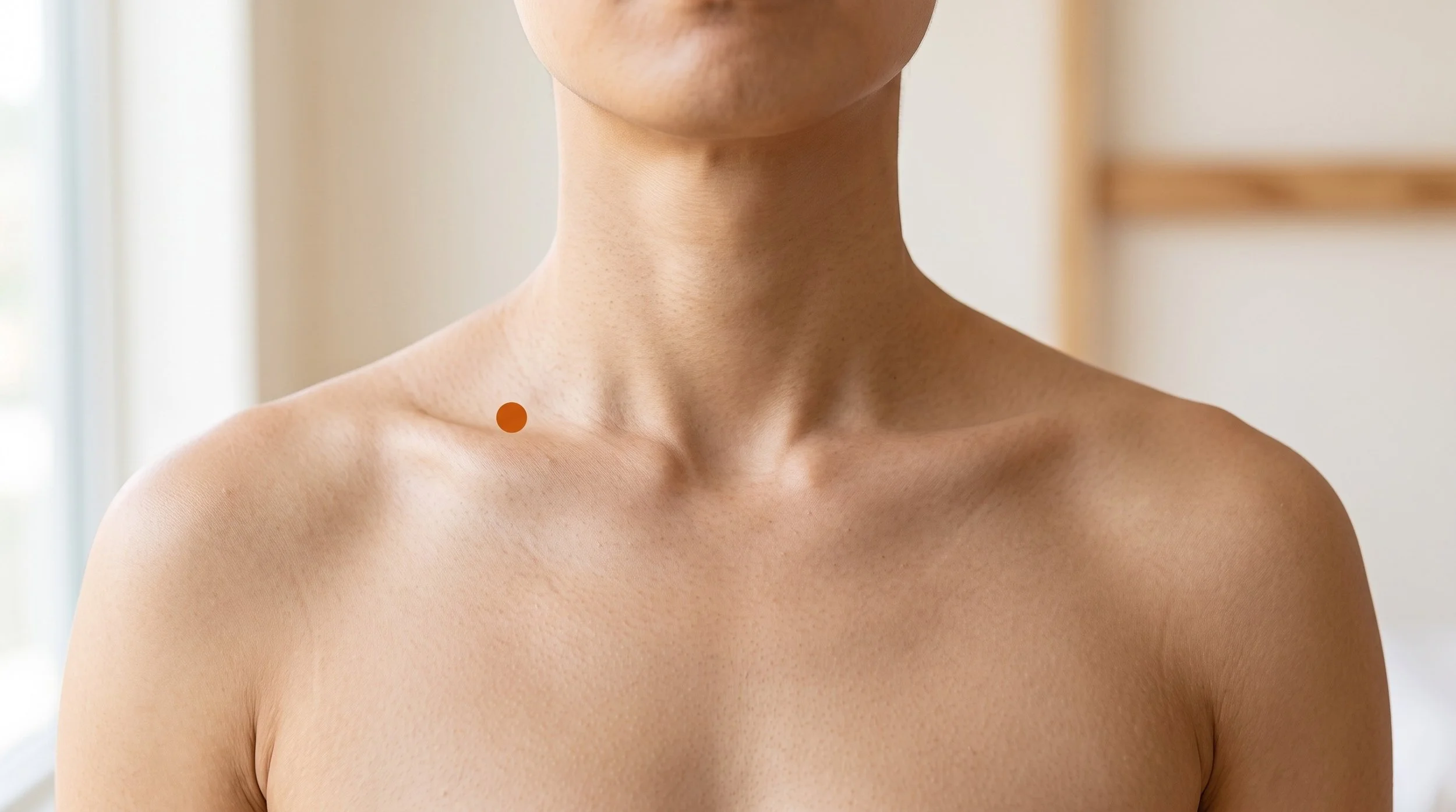
ST12 Acupuncture Point (Quepen)
The Empty Basin Above the Collarbone: Anatomy, Mechanism, and Why This Supraclavicular Point Links the Neck, Shoulder, and Arm
ST12 (Quepen, translated as Empty Basin) sits in the soft hollow just behind the upper edge of the collarbone, roughly halfway along its length and about 4 cun out from the midline of the chest on the nipple line. The name is descriptive rather than poetic: the supraclavicular fossa really does look like a shallow bowl, and in classical texts this bowl is where the Stomach channel meets the Large Intestine, Small Intestine, Triple Burner, and Gallbladder channels (Deadman, 2000).
Clinically it matters for two reasons. First, this small patch of skin sits directly above the crossroads where the trunks of the brachial plexus and the subclavian vessels leave the neck for the arm, which explains its long classical reputation for shoulder pain that travels into the neck and for numbness and aching of the upper limb.
Second, that same anatomy makes it one of the most safety-sensitive points on the body, because the apex of the lung rises just beneath it, so ST12 is a strictly shallow, carefully angled point in skilled hands and never a place for deep or backward needling.
- Location and layers: ST12 lies in the supraclavicular fossa behind the midpoint of the clavicle, 4 cun lateral to the midline, and the needle passes only through skin, platysma, and the supraclavicular fat pad before reaching the fascia over the scalene and omohyoid region (Deadman, 2000).
- Traditional categories, read in modern terms: classically described as a meeting point of the Stomach channel with the Large Intestine, Small Intestine, Triple Burner, and Gallbladder channels, and as one of the points listed for clearing heat from the chest, ST12 was traditionally credited with directing rebellious qi downward (Deadman, 2000). We describe those attributions as history, and explain effects through nerves, muscles, and autonomic reflexes.
- Mechanism: stimulation here engages supraclavicular cutaneous branches of the cervical plexus and connective tissue overlying the lower cervical and upper thoracic segments, giving it segmental overlap with the neck, shoulder girdle, and upper limb, alongside the descending inhibitory and endogenous opioid pathways that acupuncture needling recruits more generally (Zhao, 2008).
- Research picture: no trial has isolated ST12, so the honest framing is indirect. Individual patient data meta-analysis supports modest, durable benefits of acupuncture for chronic musculoskeletal pain (Vickers et al., 2018), while a Cochrane review of shoulder pain found the evidence limited and short-term at best (Green et al., 2005).
- Clinical practice framing: at Morningside we tend to use ST12 as a shallow, adjunctive point in neck, shoulder, and arm presentations, especially the tight supraclavicular and scalene region common in desk workers, and combine it with dry needling of larger muscles that reproduce a patient's referred pattern (Simons et al., 1999).
- Safety and de qi: needling is shallow, 0.3 to 0.5 cun kept along the back border of the clavicle, and deep or posterior angling risks the subclavian vessels and the lung apex (Deadman, 2000). Expect a mild local ache or spreading heaviness toward the shoulder; a sharp electric sensation into the arm signals proximity to the brachial plexus and prompts immediate withdrawal. Serious events are rare but documented in the literature, which is precisely why depth discipline matters here (Zhang et al., 2010).
Shoulder Pain That Travels Into Your Neck and Arm?
When shoulder pain refers up into the neck or down into the arm, treating one region alone rarely holds. Our acupuncturists assess the whole shoulder girdle, then use points like ST12 shallowly alongside dry needling of the upper trapezius, levator scapulae, and scalenes to reduce tone in the tissues that generate the referral. Most patients notice easier reach and rotation within the first few visits. Schedule a visit and let us map your pattern before we needle anything.
Schedule NowAnatomy of ST12: Why the Supraclavicular Fossa Is Such an Important Location
The tissue at ST12 is thin and layered. Under the skin sits the platysma, a broad sheet of muscle that tenses with jaw clenching, guarded breathing, and startle responses, then a small fat pad and the fascia of the lower neck. Just deep and lateral to the point run the inferior belly of the omohyoid and the anterior and middle scalene muscles, whose fibers pull the first ribs upward every time someone breathes into the top of the chest rather than the lower ribs.
This is why so many desk-bound patients arrive with an oddly tender, congested feeling right above the collarbone: hours of forward head posture, mouse-hand reaching, and shallow breathing load the scalene and omohyoid region continuously, while the shoulder girdle sits elevated and never fully rests.
The nerve geography here is what makes ST12 interesting rather than merely tender. Supraclavicular cutaneous nerves from the cervical plexus (C3 and C4) supply the skin over the fossa, and immediately deeper the trunks of the brachial plexus, carrying C5 through T1, pass between the scalenes on their way to the arm.
Needling superficial tissue in a region that shares spinal segments with the neck, shoulder girdle, and upper limb gives a plausible route for segmental convergence: input from the needled area reaches the same dorsal horn neurons that receive input from painful deeper structures, where it can modulate their excitability. On top of that local effect, needling recruits descending inhibitory pathways from the brainstem and endogenous opioid systems that reduce pain sensitivity more broadly (Zhao, 2008).
Trigger points in the scalenes are also well described as referring pain into the shoulder, upper arm, and even the hand, which overlaps neatly with the classical indication list for this point (Simons et al., 1999).
Deeper still is the reason ST12 is treated with such respect. The subclavian artery and vein cross the fossa, and the cupola of the pleura with the apex of the lung rises above the level of the clavicle, so the safe working space is measured in millimeters rather than inches. Classical needling convention is perpendicular insertion of 0.3 to 0.5 cun kept close along the back border of the clavicle, with deep or posteriorly angled insertion explicitly cautioned against because of the vessels and lung, and older texts also list the point as contraindicated in pregnancy (Deadman, 2000).
Modern authors are, if anything, more conservative, favoring very shallow needling in this fossa. Ultrasound work at the neighboring GB21 region has shown how thin the safe margin above the pleura can be and how much it varies between individuals, a useful reminder that surface landmarks alone should not dictate depth (Chen et al., 2018). Serious adverse events from acupuncture are uncommon, but reviews of reported cases place pneumothorax among the most frequently documented ones, almost always after needling that went deeper than intended over the chest or upper back (Zhang et al., 2010).
Related Best Acupuncture Points For Shoulder Pain Related Muscles That Cause Neck PainST12 at a Glance: Classification, Location, and Clinical Use
| Category | Detail |
|---|---|
| Traditional Name | Quepen (Empty Basin) |
| Channel Classification | Point 12 of the Stomach Channel (Foot Yang Ming) |
| Point Categories | Meeting point of the Stomach channel with the Large Intestine, Small Intestine, Triple Burner, and Gallbladder channels; included among the classical group of eight points cited for clearing heat from the chest; described in later channel literature as a point along the Yin Stepping Vessel (Yin Qiao Mai) trajectory and as a supraclavicular meeting site in divergent and sinew channel systems |
| Precise Location | In the supraclavicular fossa, just behind the upper border of the clavicle at its midpoint, 4 cun lateral to the anterior midline on the nipple line |
| Tissue Stimulated | Skin and supraclavicular cutaneous nerve territory, platysma, supraclavicular fat pad, and the fascia overlying the omohyoid and scalene region; related myofascial targets in shoulder and neck presentations are described in our guides to muscles that cause neck pain and muscles that cause shoulder pain |
| Needle Depth / Direction | Shallow perpendicular insertion of about 0.3 to 0.5 cun, kept along the posterior border of the clavicle; deep or backward angling is avoided because of the subclavian vessels and the lung apex, and classical sources contraindicate the point in pregnancy |
| De Qi Sensation | A mild local ache, pressure, or heaviness at the top of the collarbone that may spread toward the shoulder or upper trapezius; a sharp electric sensation running into the arm means the needle is too near the brachial plexus and should be withdrawn |
| Primary Clinical Uses | Shoulder pain radiating into the neck, supraclavicular tension in desk-posture presentations, and, in classical use, numbness and aching of the arm along with cough and fullness of the chest |
| Common Point Combinations |
|
In A Manual of Acupuncture, Deadman and Al-Khafaji present ST12 as a meeting point of the Stomach channel with every primary yang channel except the Bladder, and describe its traditional function as sending rebellious qi downward.
That single organizing idea, framed here as traditional attribution rather than physiology, ties its two apparently unrelated indication groups together: on one side cough, breathlessness, and fullness or heat in the chest, patterns attributed to Lung qi rising rather than descending; on the other side pain of the supraclavicular fossa, shoulder pain radiating into the neck, numbness and painful obstruction of the arm, and difficulty raising the arm. The same downward-directing quality is why classical texts flagged the point as contraindicated in pregnancy, a caution that has traveled with it for centuries.
The Essential Questions also lists bilateral ST12, together with BL11, LU1, and BL12, among eight points used to clear heat from the chest. What is striking is how well the traditional list maps onto the anatomy: a point sitting over the passage of the brachial plexus and the apex of the lung was credited, long before that anatomy was described in modern terms, with treating both arm symptoms and breathing symptoms.
Why ST12 Is Used for Arm Numbness and Chest Tightness, Not Just Local Neck Pain
The simplest explanation for the arm indications is segmental. The skin and fascia at ST12 are supplied by nerves from the mid-cervical levels, and the deeper structures of the fossa share spinal segments with the shoulder girdle and the entire upper limb. When sensory input from needling enters the spinal cord at those levels, it converges on the same neurons that carry pain signals from irritated deeper tissues, and that convergence can dampen how loudly those signals are transmitted.
Add the muscular story and the picture gets more practical: the scalenes and omohyoid crowd this space, and scalene trigger points are classically mapped as referring pain into the shoulder, down the arm, and sometimes into the hand (Simons et al., 1999). Patients who describe a heavy, achy arm with a tender, congested feeling above the collarbone often have both a segmental and a myofascial contribution.
Beyond the local segment, needling anywhere on the body recruits descending inhibitory pathways from the brainstem and increases activity in endogenous opioid and monoaminergic systems, which is part of why acupuncture effects are not confined to the treated area (Zhao, 2008). This region also sits close to autonomic territory.
Slow, shallow needling around the supraclavicular fossa and upper chest often coincides with the shift patients describe as their breath dropping lower and their shoulders letting go, which may reflect reduced muscle guarding and a calmer autonomic state rather than any direct effect on the lungs.
It is worth saying plainly what ST12 is not. It is not a point that treats asthma, coughing blood, or any respiratory disease in the modern sense, even though classical sources list those indications, and it is not a substitute for medical assessment of chest symptoms or of new neurological signs in the arm. In our clinic it functions as a well-chosen supporting point in mechanical neck, shoulder, and arm presentations, used shallowly, with the heavier lifting done by muscles that palpation identifies as the actual generators of pain.
What the Research Shows for ST12
There is no controlled trial of ST12 on its own, and that is true of nearly every individual acupuncture point. Reviews test whole protocols, typically six to twelve points chosen for a condition, so the fair question is not whether ST12 works in isolation but whether needling protocols that include supraclavicular and shoulder girdle points help the conditions it is traditionally used for.
The evidence there is mixed and mostly short-term, stronger for chronic musculoskeletal pain broadly than for shoulder pain specifically, and the safety literature is worth reading alongside the efficacy literature because this location carries real anatomical risk when depth is not respected.
| Study | Type | Focus | Key Finding |
|---|---|---|---|
| Vickers et al., 2018 | Individual patient data meta-analysis | Acupuncture for chronic pain, including musculoskeletal and neck or shoulder pain | Acupuncture was associated with modest but statistically significant benefits over both sham and no-acupuncture controls, with effects that appeared to persist over about a year. |
| Green et al., 2005 | Cochrane systematic review | Acupuncture for shoulder pain in adults | The reviewers found too few adequate trials to draw firm conclusions, with limited evidence suggesting possible short-term improvement in pain and function over roughly two to four weeks. |
| Navarro-Santana et al., 2020 | Systematic review and meta-analysis | Dry needling of myofascial trigger points in neck pain, including muscles of the shoulder girdle | Low to moderate quality evidence suggested improvements in pain intensity and related disability immediately after treatment and at short-term follow-up, with less clear effects at later follow-up. |
| Lin et al., 2024 | Network meta-analysis | Acupuncture-based therapies for cervical spondylotic radiculopathy, a common cause of arm pain and numbness | Several needling approaches performed better than control comparisons for pain and function, though the authors noted heterogeneity and methodological limitations among included trials. |
| Chen et al., 2018 | Ultrasonographic measurement study | Safe needling depth over the pleura at the neighboring GB21 region | Measured distance from the skin to the pleura varied substantially between individuals, supporting conservative depth and individualized judgment when needling above the clavicle. |
| Zhang et al., 2010 | Systematic review of reported adverse events | Acupuncture-related adverse events in the Chinese literature | Serious events were uncommon overall, but pneumothorax was among the most frequently reported, underlining the importance of shallow technique over the chest and supraclavicular region. |
Numbness, Tingling, or Heaviness in the Arm?
Arm numbness has many possible drivers, from cervical nerve root irritation to myofascial tension around the supraclavicular region, and classical texts long associated ST12 with exactly this territory. We start with a careful screen, refer out when imaging or medical workup is indicated, and treat conservatively with acupuncture and dry needling when the presentation is mechanical. Book an evaluation to find out which category your symptoms fall into.
Schedule NowST12 in the Context of Trigger Point Work
Acupuncture, in our definition, is the use of an acupuncture needle, and that includes the hundreds of needling styles practiced today, dry needling among them. At ST12 the practical consequence is that we rarely treat the fossa aggressively.
Instead, shallow needling of the point sits alongside dry needling of the muscles that actually reproduce a patient's pain when palpated: upper trapezius and levator scapulae for pain climbing the neck, infraspinatus and posterior deltoid for deep shoulder ache, subscapularis for restricted rotation, and the scalenes when the complaint includes arm heaviness or vague tingling. Scalene involvement is particularly relevant here, since referral from these muscles can mimic patterns patients describe as nerve symptoms (Simons et al., 1999).
The overlap between point and muscle is real but shallow, so technique discipline matters more than at almost any other site. Needling near the supraclavicular fossa is done with short needles, minimal depth, and no deep exploratory angling toward the chest, and we position and communicate carefully so a patient can report any sudden electric sensation into the arm immediately. Scalene work, when indicated, is performed by clinicians trained specifically for that region using flat, controlled angles away from the pleura.
Reported cases of pneumothorax after needling in the neck and shoulder region are rare relative to how often these treatments are performed, but they exist and nearly all involve depth rather than location alone (Zhang et al., 2010). Conservative handling here costs nothing in results, since the therapeutic work in the shoulder girdle can be done in muscles that are far safer to needle.
ST12 Shoulder and Neck Pain Treatment at NYC's Highest-Rated Acupuncture Clinic
Morningside Acupuncture is the highest-rated acupuncture and dry needling clinic in New York City with over 500 five-star Google reviews, and we treat neck, shoulder, and arm pain every day. Sensitive locations like ST12 demand precise anatomy, conservative depth, and clear communication about what you should and should not feel. Our licensed acupuncturists combine channel-based point selection with modern trigger point needling and simple loading strategies you can carry between visits. Schedule your appointment on the Upper West Side and start with a plan built around your presentation.
Schedule NowFrequently Asked Questions
What does ST12 feel like when needled?
Most people feel a light pinch as the needle passes the skin, followed by a mild ache, fullness, or pressure right above the collarbone that may spread toward the shoulder or the top of the trapezius. Because the point is needled shallowly, the sensation is usually gentler than at thicker muscular points. A brief, sharp, electric feeling shooting into the arm is not the goal and is not de qi: it indicates the needle is close to the brachial plexus, and your acupuncturist should withdraw or reposition immediately. Tell your practitioner right away if that happens.
Why needle above the collarbone for shoulder or arm pain instead of the painful spot itself?
Two reasons. Anatomically, the supraclavicular fossa is the corridor through which the nerves supplying the whole arm leave the neck, so it shares spinal segments with the shoulder girdle and upper limb and gives a route for segmental modulation of pain signals (Zhao, 2008). Practically, tissues in this region, particularly the scalenes and omohyoid, are frequently overworked in forward-head, high-shoulder desk postures, and their trigger points refer pain into exactly the areas patients point to (Simons et al., 1999). We usually treat both: the fossa region shallowly and the specific muscles reproducing your pain more directly.
Can I press ST12 myself between sessions?
Yes, gentle acupressure here is reasonable for most people, and it is a good self-care option precisely because pressing carries none of the depth risk of needling. Find the hollow just above the middle of your collarbone, then use the pad of your index or middle finger with light to moderate pressure, angled downward toward the collarbone rather than straight back into the neck. Hold for 20 to 30 seconds while breathing slowly into your lower ribs, release, and repeat two or three times per side, up to a few times a day. Stop if you feel any tingling or electric sensation into the arm, any lightheadedness, or pulsing under your finger, since an artery runs through this area. Skip it during pregnancy given the classical contraindication for needling this point, and ask your clinician first if you have a pacemaker, a central line, a history of neck surgery, or a bleeding disorder.
Is ST12 safe to needle?
In trained hands, yes, but it requires more care than most points. The apex of the lung and the subclavian vessels lie beneath the fossa, so needling is kept very shallow, roughly 0.3 to 0.5 cun, and directed close along the back border of the clavicle rather than angled backward or downward into the chest (Deadman, 2000). Ultrasound studies of nearby points show that the distance from skin to pleura differs meaningfully from person to person, so depth should be judged individually rather than from a textbook number (Chen et al., 2018). Serious complications such as pneumothorax are rare but documented in the acupuncture safety literature, and almost always relate to excessive depth (Zhang et al., 2010). Classical texts also list the point as contraindicated in pregnancy, a convention most practitioners still follow.
Where exactly is ST12 located?
Trace your collarbone from the breastbone outward to about its midpoint, then feel for the soft hollow just above and behind the bone's upper edge. That hollow is the supraclavicular fossa, and the point sits within it about 4 cun lateral to the front midline, roughly on the vertical nipple line. If you are searching for quepen point location or st 12 clavicle landmarks online, the key detail is that stomach 12 is behind the clavicle in the fossa, not on top of the bone and not up in the side of the neck.
References
- Deadman, P., Al-Khafaji, M., & Baker, K. (2009). A manual of acupuncture. Journal of Chinese Medicine Publications.
- Maciocia, G. (2006). The channels of acupuncture: Clinical use of the secondary channels and eight extraordinary vessels. Churchill Livingstone Elsevier.
- Cunningham, P. M. (2000). Acupuncture points: A practical guide to classical and modern usage. Odyssey Press.
- Cecil-Sterman, A. (2012). Advanced acupuncture: A clinic manual. Classical Wellness Press.
- O'Connor, J., & Bensky, D. (Eds. & Trans.). (1981). Acupuncture: A comprehensive text. Shanghai College of Traditional Medicine. Eastland Press.
- Simons, D. G., Travell, J. G., & Simons, L. S. (1999). Travell & Simons' myofascial pain and dysfunction: The trigger point manual, Vol. 1: Upper half of body (2nd ed.). Williams & Wilkins.
- Zhao, Z. Q. (2008). Neural mechanism underlying acupuncture analgesia. Progress in Neurobiology, 85(4), 355-375. https://doi.org/10.1016/j.pneurobio.2008.05.004
- Vickers, A. J., Vertosick, E. A., Lewith, G., MacPherson, H., Foster, N. E., Sherman, K. J., Irnich, D., Witt, C. M., & Linde, K. (2018). Acupuncture for chronic pain: Update of an individual patient data meta-analysis. Journal of Pain, 19(5), 455-474. https://doi.org/10.1016/j.jpain.2017.11.005
- Green, S., Buchbinder, R., & Hetrick, S. (2005). Acupuncture for shoulder pain. Cochrane Database of Systematic Reviews, 2005(2), CD005319. https://doi.org/10.1002/14651858.CD005319
- Navarro-Santana, M. J., Sanchez-Infante, J., Fernández-de-las-Peñas, C., Cleland, J. A., Martín-Casas, P., & Plaza-Manzano, G. (2020). Effectiveness of dry needling for myofascial trigger points associated with neck pain symptoms: An updated systematic review and meta-analysis. Journal of Clinical Medicine, 9(10), 3300. https://doi.org/10.3390/jcm9103300
- Lin, Y., Zhong, S., Huang, C., et al. (2024). The efficacy of acupuncture therapies in cervical spondylotic radiculopathy: A network meta-analysis. Heliyon, 10(11), e31793. https://doi.org/10.1016/j.heliyon.2024.e31793
- Chen, H. N., Chang, C. Y., Chen, L. Z., et al. (2018). Using ultrasonography measurements to determine the depth of the GB 21 acupoint to prevent pneumothorax. Journal of Acupuncture and Meridian Studies, 11(6), 355-360. https://doi.org/10.1016/j.jams.2018.06.004
- Zhang, J., Shang, H., Gao, X., & Ernst, E. (2010). Acupuncture-related adverse events: A systematic review of the Chinese literature. Bulletin of the World Health Organization, 88(12), 915-921C. https://doi.org/10.2471/BLT.10.076737
Disclaimer: This web site is intended for educational and informational purposes only. Reading this website does not constitute providing medical advice or any professional services. This information should not be used for diagnosing or treating any health issue or disease. Those seeking medical advice should consult with a licensed physician. Seek the advice of a medical doctor or other qualified health professional for any medical condition. If you think you have a medical emergency, call 911 or go to the emergency room. No acupuncturist-patient relationship is created by reading this website or using the information. Morningside Acupuncture PLLC and its employees and contributors do not make any express or implied representations with respect to the information on this site or its use. For any legal interpretation of scope of practice in your state, consult a licensed attorney or regulatory authority.
Read more from our blog



