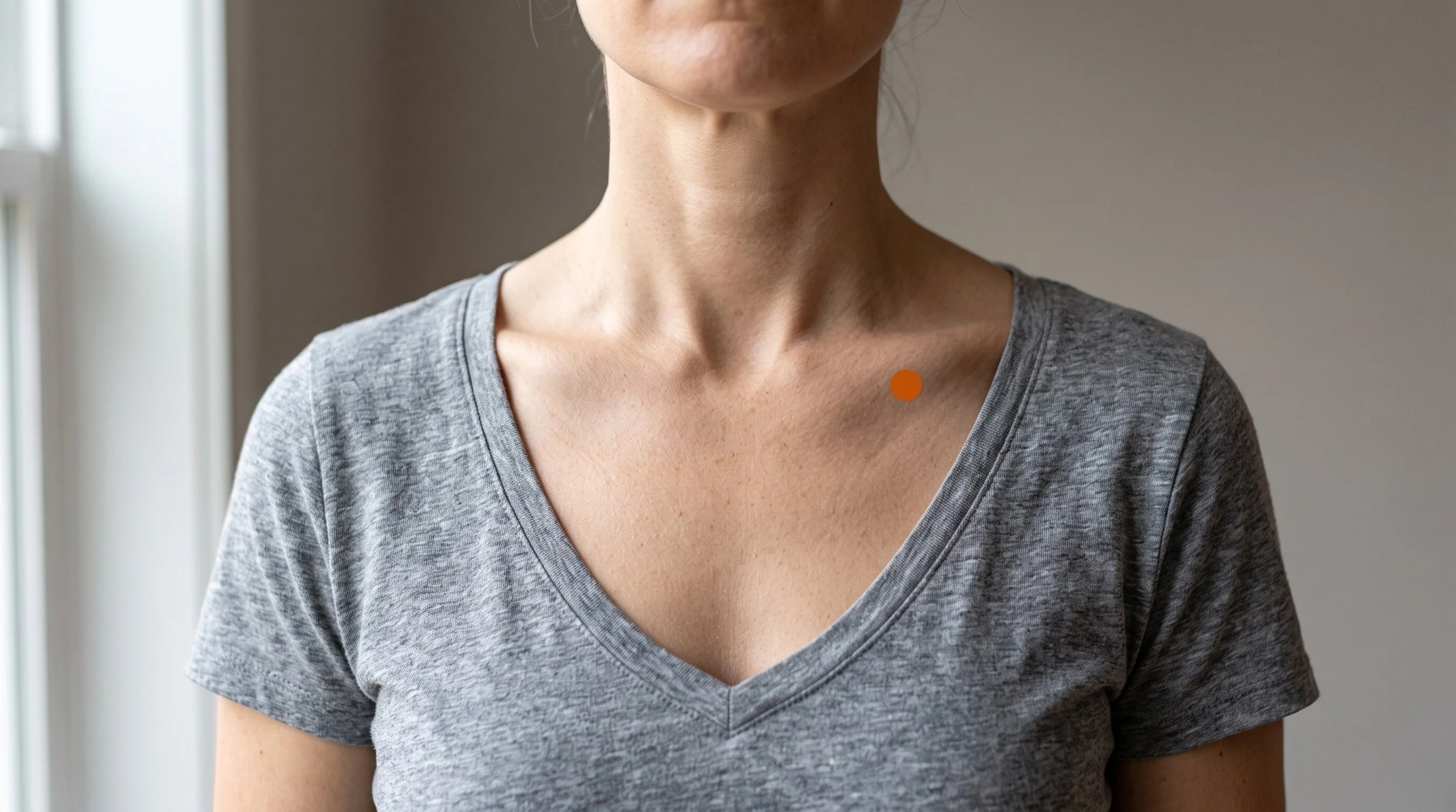
ST13 Acupuncture Point (Qihu)
The Qi Door Below the Collarbone: Anatomy, Mechanism, and Why This Subclavicular Stomach Point Belongs in Chest and Breathing Work
ST13, called Qihu in pinyin and usually translated as Qi Door, is the first of the Stomach channel's chest points and sits in the soft hollow just under the middle of the collarbone, roughly 4 cun out from the midline of the sternum on the nipple line. Its name points to what classical writers thought it governed: the doorway through which breath moves in and out of the upper chest.
Anatomically it is a narrow, layered spot, resting on the clavicular fibers of pectoralis major with subclavius tucked under the bone and the dome of the lung not far beneath, which is exactly why the st13 acupuncture point is needled flat and shallow rather than straight in. Clinically it matters most for people whose breathing lives high in the chest: tight, guarded, shallow patterns with a band of pressure across the upper ribs, often paired with stiff neck and upper back muscles that never seem to let go.
- Location and layers: stomach 13 lies at the lower edge of the clavicle directly below ST12, about 4 cun lateral to the midline, over skin, superficial fascia, the clavicular head of pectoralis major, and subclavius, with the first rib, the first intercostal space, and the pleural apex deeper still (Deadman et al., 2007).
- Traditional attributions translated: classical sources credit ST13 with directing rebellious qi downward and freeing constraint in the chest, and list chest and rib-side fullness, cough, wheezing, hiccup, chest and upper back pain, and neck stiffness with limited turning (Deadman et al., 2007). In modern terms these describe a cluster of accessory-muscle breathing, chest wall guarding, and cervicothoracic tension.
- Nerve geography: the overlying skin is supplied by the supraclavicular nerves (C3 to C4), pectoralis major's clavicular head by the lateral pectoral nerve, and subclavius by its own small branch, so needling here recruits afferents from the same upper cervical and upper thoracic segments that serve the chest wall and neck (Deadman et al., 2007).
- Mechanism: needle stimulation of these afferents engages spinal gating and descending inhibitory pathways involving endogenous opioids and monoamines, which is the current framework for how a local chest point can reduce pain and muscular guarding well beyond the needle site (Zhao, 2008).
- Research picture: no trial isolates ST13, but individual patient data meta-analysis supports modest, durable benefit of acupuncture for chronic musculoskeletal pain (Vickers et al., 2018), a placebo-controlled trial found improvement in exertional breathlessness in COPD with a multi-point protocol (Suzuki et al., 2012), while Cochrane's asthma review concluded the evidence remains insufficient (McCarney et al., 2004).
- Sensation and safety: correct technique produces a dull, spreading heaviness under the collarbone, never sharp pain, coughing, or breathlessness; because pneumothorax is among the most frequently reported serious acupuncture events, the needle stays transverse or oblique at 0.5 to 0.8 cun and never perpendicular (He et al., 2012; Peuker et al., 1999).
Does Your Breathing Feel Stuck High in Your Chest?
Shallow, upper-chest breathing patterns tend to travel with tight scalenes, a locked-up upper back, and shoulders that sit near your ears. At Morningside Acupuncture we use ST13 with nearby chest and neck points, gentle flat-angle technique, and breathing retraining so the ribs and diaphragm can share the work again. Sessions are individualized, and most patients notice the difference in how the first few breaths feel afterward. Schedule a visit and let's look at how you actually breathe.
Schedule NowAnatomy of ST13: Why the Space Just Below the Collarbone Is Such an Important Location
Working from the surface down, the qihu point location passes through thin skin and superficial fascia, then into the clavicular fibers of pectoralis major, with subclavius sitting in the groove on the underside of the clavicle and the first rib and first intercostal space below that. This small stack of tissue is loaded constantly by ordinary modern life: hours at a keyboard with the shoulders rolled forward, backpack and bag straps compressing the area, heavy pressing and overhead work in the gym, and habitual breathing that lifts the collarbones instead of expanding the lower ribs.
When the clavicular pectoralis fibers and subclavius shorten, the upper chest feels braced, and patients often describe it as a strap across the top of the chest rather than as pain in a single spot.
The nerve geography explains why one small point can influence both the chest and the neck. Skin over ST13 is supplied by the supraclavicular nerves from the C3 and C4 roots, the clavicular head of pectoralis major by the lateral pectoral nerve, and subclavius by a short branch from the upper trunk of the brachial plexus (Deadman et al., 2007). That means needling here feeds sensory input into upper cervical and upper thoracic spinal segments, the same segments that receive input from the cervical spine, the shoulder girdle, and the chest wall.
Convergence of these inputs in the dorsal horn is a plausible substrate for the classical pairing of chest fullness with neck stiffness, and needle stimulation of muscle and skin afferents is known to recruit segmental inhibition along with descending control from the brainstem, including opioid and monoaminergic pathways (Zhao, 2008). Clinically, that framework matches what we see: reduced guarding, easier rib motion, and a quieter chest wall rather than any change in the lungs themselves.
Deeper again, the subclavian artery and vein cross the first rib just behind and medial to this point, the trunks of the brachial plexus pass close by, and the dome of the pleura rises above the level of the first rib. Those structures dictate technique rather than making the point off limits. Standard practice is transverse or oblique insertion along or beneath the clavicle, or transversely downward along the channel, to a depth of about 0.5 to 0.8 cun, with perpendicular or deep needling avoided entirely (Deadman et al., 2007).
Reviews of acupuncture-related injury place pneumothorax among the most commonly reported serious events, and anatomical analyses conclude that appropriate angle, depth, and knowledge of local anatomy are the main protective factors (He et al., 2012; Peuker et al., 1999).
Related Subclavius Trigger Points Related Pectoralis Major Trigger PointsST13 at a Glance: Classification, Location, and Clinical Use
| Category | Detail |
|---|---|
| Traditional Name | Qihu (Qi Door), Stomach 13 |
| Channel Classification | Thirteenth point of the Stomach channel of Foot Yangming, the first of the channel's line of chest points |
| Point Categories | The reference sources record no five-shu, meeting, crossing, or extraordinary vessel designations for ST13. It is classified simply as a subclavicular chest point of the Stomach channel, with traditional actions of directing rebellious qi downward and releasing constraint in the chest (Deadman et al., 2007). |
| Precise Location | At the top of the chest on the lower border of the clavicle, directly below ST12 (Quepen), 4 cun lateral to the anterior midline on the nipple line |
| Tissue Stimulated | Skin and superficial fascia over the clavicular head of pectoralis major, with subclavius deep to the clavicle and the first rib interspace below; supraclavicular nerve territory over the pleural apex |
| Needle Depth / Direction | Transverse or oblique insertion 0.5 to 0.8 cun, directed medially or laterally along the clavicle or transversely downward along the channel. Perpendicular and deep needling are avoided because of the lung and subclavian vessels |
| De Qi Sensation | A dull, mildly heavy or spreading sensation under the collarbone, sometimes drifting toward the shoulder or upper chest. Sharp pain, coughing, or any breathlessness means the needle should come out |
| Primary Clinical Uses | Chest fullness and upper-chest breathing patterns, cough and wheezing in classical use, chest and upper back pain, rib-side discomfort, and neck stiffness with restricted turning |
| Common Point Combinations |
|
Deadman, Al-Khafaji and Baker's A Manual of Acupuncture presents ST13 in traditional terms as a point that sends rebellious qi downward and releases a bound-up chest, and the indication list that follows is broader than most patients would expect from a spot under the collarbone: fullness and distention across the chest and ribs, pain of the chest and upper back, cough, wheezing and difficult breathing, hiccup, vomiting of blood, loss of the sense of taste, and stiffness of the neck with an inability to turn the head.
The compilers also record two classical combinations, one from the Song of the One Hundred Symptoms pairing ST13 with CV20 for stubborn rib-side pain, and one from the Thousand Ducat Formulas grouping ST13 with LU2, LU3 and HT7 for laboured breathing in which the shoulders rise with every inhalation.
These are traditional attributions rather than tested claims, but the pattern they sketch is strikingly coherent: the older writers were describing, in their own vocabulary, the person who breathes with the neck and upper chest instead of the diaphragm, and who pays for it in the ribs, the upper back, and the ability to turn the head.
Why ST13 Is Used for Neck Stiffness and Breathing That Never Feels Deep Enough
Patients who come in for chest tightness rarely have a chest problem in isolation. More often the whole cervicothoracic unit is involved: scalenes and sternocleidomastoid doing the work of the diaphragm, the clavicular pectoralis fibers holding the shoulder girdle forward, and the upper thoracic segments stiff from hours of sustained posture. The skin and muscle at ST13 report to upper cervical and upper thoracic segments, so needle input here arrives in the same spinal neighborhood that receives signals from the neck, the shoulder girdle, and the chest wall.
That segmental convergence is the most straightforward explanation for why a subclavicular point shows up in classical lists next to neck stiffness and upper back pain rather than only next to cough.
Beyond the segment, needling engages broader control systems. Experimental work summarized by Zhao (2008) describes activation of small-diameter afferents leading to release of endogenous opioids, serotonin, and noradrenaline within descending pathways that dampen dorsal horn transmission, along with autonomic and local vascular responses at the needle site. In practical terms, that combination can lower the resting tone of guarded chest wall muscles and reduce the protective bracing that keeps breathing shallow. Clinically, the change patients report first is usually not less pain but more room: the inhale gets a little wider before it stops.
The breathing side of the picture has some direct trial support, though not for ST13 alone. A placebo-controlled trial in COPD found greater improvement in exertional breathlessness with real needling than with placebo needling over twelve weeks (Suzuki et al., 2012), while the Cochrane review of acupuncture for chronic asthma concluded that the trials were too small and too varied to support a recommendation (McCarney et al., 2004).
We treat ST13 accordingly: as a musculoskeletal and comfort-oriented point within a breathing-focused plan, not as a respiratory treatment in its own right, and always alongside appropriate medical care.
What the Research Shows for ST13
There is no clinical trial that tests ST13 by itself, and it would be surprising if there were. Acupuncture research almost always evaluates multi-point protocols selected for a diagnosis, so the honest way to read the literature is to ask what it says about acupuncture for the problems ST13 is traditionally used within, and then to place this point inside those protocols. The strongest evidence sits on the musculoskeletal side, the respiratory evidence is mixed and modest, and the safety literature is directly relevant here because of what lies beneath the clavicle.
| Study | Type | Focus | Key Finding |
|---|---|---|---|
| Vickers et al., 2018 | Individual patient data meta-analysis | Chronic musculoskeletal pain, including neck and shoulder pain | Acupuncture outperformed both sham and no-acupuncture controls by a modest margin, with effects that persisted over a year. |
| Suzuki et al., 2012 | Randomized placebo-controlled trial | Dyspnea on exertion in COPD | Participants receiving real needling reported greater improvement in breathlessness than those receiving placebo needling, though this is a single multi-point protocol trial. |
| McCarney et al., 2004 | Cochrane systematic review | Acupuncture for chronic asthma | Reviewers judged the trials too small and heterogeneous to support any recommendation for or against acupuncture. |
| Zhao, 2008 | Mechanistic review | Neural mechanisms of acupuncture analgesia | Needle stimulation of peripheral afferents engages segmental inhibition and descending opioid and monoaminergic pathways. |
| He et al., 2012 | Systematic review of adverse events | Safety reports from the Chinese literature, 1956 to 2010 | Pneumothorax was among the most frequently reported serious events, most often linked to needling technique over the thorax. |
| Peuker et al., 1999 | Anatomical safety review | Traumatic complications of needling | Authors concluded that knowledge of local anatomy with conservative angle and depth is the main safeguard near the pleura and great vessels. |
Chest Tightness and Neck Stiffness That Travel Together?
When the collarbone region, pectoralis major, and subclavius stay short, turning your head and taking a full breath can both feel restricted. We combine ST13 with dry needling of the pec and subclavius region, cervical and upper thoracic points, and simple mobility work you can repeat at home. The goal is measurable change in rotation, breath depth, and how long the relief lasts. Book an appointment to get started.
Schedule NowST13 in the Context of Trigger Point Work
The territory around ST13 is prime myofascial real estate. Trigger points in the clavicular division of pectoralis major refer pain across the front of the shoulder and upper chest, and subclavius, tucked under the collarbone, can send symptoms down the front of the arm toward the thumb side of the hand (Simons et al., 1999). Patients frequently arrive convinced the problem is in the shoulder joint or the neck when the tender, ropy tissue actually sits within a few centimeters of the qihu point location. Palpating along the underside of the clavicle before needling tells us quickly whether we are treating a channel point, a taut band, or both.
At Morningside we treat this region with the same flat-angle discipline regardless of the label on the technique, since acupuncture and dry needling both mean placing an acupuncture needle in tissue. That usually looks like ST13 needled transversely along the clavicle, careful subclavius and clavicular pectoralis work under the bone, and additional dry needling of pectoralis minor, scalenes, or upper thoracic paraspinals depending on findings. We then reinforce the change with breathing drills and thoracic mobility so the tissue has a reason to stay long. Because of the pleura, we never needle deeply here and we stop immediately if a patient coughs or feels short of breath.
ST13 Chest and Breathing Treatment at NYC's Highest-Rated Acupuncture Clinic
Morningside Acupuncture is the highest-rated acupuncture and dry needling clinic in New York City with over 500 five-star Google reviews. Our licensed acupuncturists treat the st 13 chest region with careful, anatomy-first technique, pairing it with trigger point needling and rehabilitative advice for chest wall tension, upper back pain, and restricted breathing. You get a clear plan, not an open-ended series of visits. Schedule your first session on the Upper West Side today.
Schedule NowFrequently Asked Questions
What does ST13 feel like when needled?
Because the needle travels flat under the skin and along the clavicle rather than into deep tissue, most people feel a light pinch on insertion followed by a dull, spreading heaviness or mild ache under the collarbone. Some notice the sensation drifting toward the shoulder or across the top of the chest, and many report that the next few breaths feel roomier. Sharp, electric, or radiating arm pain is not the goal, and any cough or shortness of breath means the needle is removed right away.
Why needle a point below the collarbone for neck stiffness instead of the neck itself?
We usually do both, but ST13 has a specific role. The tissue at this point reports to upper cervical and upper thoracic spinal segments, the same segments that serve the neck and shoulder girdle, so input here can influence muscular guarding in the whole cervicothoracic unit through segmental and descending inhibitory mechanisms (Zhao, 2008). There is also a mechanical logic: if the clavicular pectoralis fibers and subclavius hold the shoulder girdle forward, the neck extensors and rotators work against a shortened front. Classical sources noticed the association long before the anatomy was described, listing neck stiffness with limited turning right alongside chest fullness for this point (Deadman et al., 2007).
Can I press ST13 myself between sessions?
Yes, acupressure here is safe because fingertip pressure cannot reach the lung. Find the middle of your collarbone, slide your fingertip just below the lower edge of the bone, and search for the tender spot about four finger-widths out from the center of your breastbone. Press with the pad of one finger at a moderate, comfortable intensity, angling slightly up under the clavicle rather than straight down into the chest, and hold for 30 to 60 seconds while you exhale slowly. Repeat two or three times per side, once or twice a day, and pair it with a few slow diaphragmatic breaths so the tissue release has a movement to attach to. Skip it if the area is bruised, inflamed, or recently injured, and stop if pressure produces radiating arm symptoms.
Is ST13 safe to needle?
It is safe in trained hands and specifically unsafe with careless technique. The lung apex and the subclavian vessels lie beneath this point, so classical and modern texts alike restrict needling to transverse or oblique insertion of about 0.5 to 0.8 cun along the clavicle, never perpendicular or deep (Deadman et al., 2007). Reviews of adverse events identify pneumothorax as one of the most frequently reported serious complications of acupuncture, and anatomical analyses attribute it largely to inappropriate angle and depth over the thorax (He et al., 2012; Peuker et al., 1999). Practitioners should also take extra care with very thin patients, people with emphysema or prior chest surgery, and anyone on anticoagulants.
Where exactly is ST13 located?
ST13 sits at the top of the chest on the lower border of the clavicle, directly below ST12 in the supraclavicular fossa, and 4 cun lateral to the anterior midline, which places it roughly on the nipple line. A practical way to find it is to trace along the underside of your collarbone to about its midpoint, then feel for the small hollow just beneath the bone; this is the first of the Stomach channel's chest points, with ST14 sitting one interspace below it.
References
- Deadman, P., Al-Khafaji, M., & Baker, K. (2009). A manual of acupuncture. Journal of Chinese Medicine Publications.
- O'Connor, J., & Bensky, D. (Eds. & Trans.). (1981). Acupuncture: A comprehensive text. Shanghai College of Traditional Medicine. Eastland Press.
- Cunningham, P. M. (2000). Acupuncture points: A practical guide to classical and modern usage. Odyssey Press.
- Simons, D. G., Travell, J. G., & Simons, L. S. (1999). Travell & Simons' myofascial pain and dysfunction: The trigger point manual, Vol. 1: Upper half of body (2nd ed.). Williams & Wilkins.
- Zhao, Z. Q. (2008). Neural mechanism underlying acupuncture analgesia. Progress in Neurobiology, 85(4), 355-375. https://doi.org/10.1016/j.pneurobio.2008.05.004
- Vickers, A. J., Vertosick, E. A., Lewith, G., MacPherson, H., Foster, N. E., Sherman, K. J., Irnich, D., Witt, C. M., & Linde, K. (2018). Acupuncture for chronic pain: Update of an individual patient data meta-analysis. Journal of Pain, 19(5), 455-474. https://doi.org/10.1016/j.jpain.2017.11.005
- Suzuki, M., Muro, S., Ando, Y., Omori, T., Shiota, T., Endo, K., Sato, S., Aihara, K., Matsumoto, M., Suzuki, S., Itotani, R., Ishitoko, M., Hara, Y., Takemura, M., Ueda, T., Kagioka, H., Hirabayashi, M., Fukui, M., & Mishima, M. (2012). A randomized, placebo-controlled trial of acupuncture in patients with chronic obstructive pulmonary disease (COPD): The COPD-acupuncture trial (CAT). Archives of Internal Medicine, 172(11), 878-886. https://doi.org/10.1001/archinternmed.2012.1233
- McCarney, R. W., Brinkhaus, B., Lasserson, T. J., & Linde, K. (2004). Acupuncture for chronic asthma. Cochrane Database of Systematic Reviews, 2004(1), CD000008. https://doi.org/10.1002/14651858.CD000008.pub2
- He, W., Zhao, X., Li, Y., Xi, Q., & Guo, Y. (2012). Adverse events following acupuncture: A systematic review of the Chinese literature for the years 1956-2010. The Journal of Alternative and Complementary Medicine, 18(10), 892-901. https://doi.org/10.1089/acm.2011.0825
- Peuker, E. T., White, A., Ernst, E., Pera, F., & Filler, T. J. (1999). Traumatic complications of acupuncture: Therapists need to know human anatomy. Archives of Family Medicine, 8(6), 553-558. https://doi.org/10.1001/archfami.8.6.553
Disclaimer: This web site is intended for educational and informational purposes only. Reading this website does not constitute providing medical advice or any professional services. This information should not be used for diagnosing or treating any health issue or disease. Those seeking medical advice should consult with a licensed physician. Seek the advice of a medical doctor or other qualified health professional for any medical condition. If you think you have a medical emergency, call 911 or go to the emergency room. No acupuncturist-patient relationship is created by reading this website or using the information. Morningside Acupuncture PLLC and its employees and contributors do not make any express or implied representations with respect to the information on this site or its use. For any legal interpretation of scope of practice in your state, consult a licensed attorney or regulatory authority.
Read more from our blog



