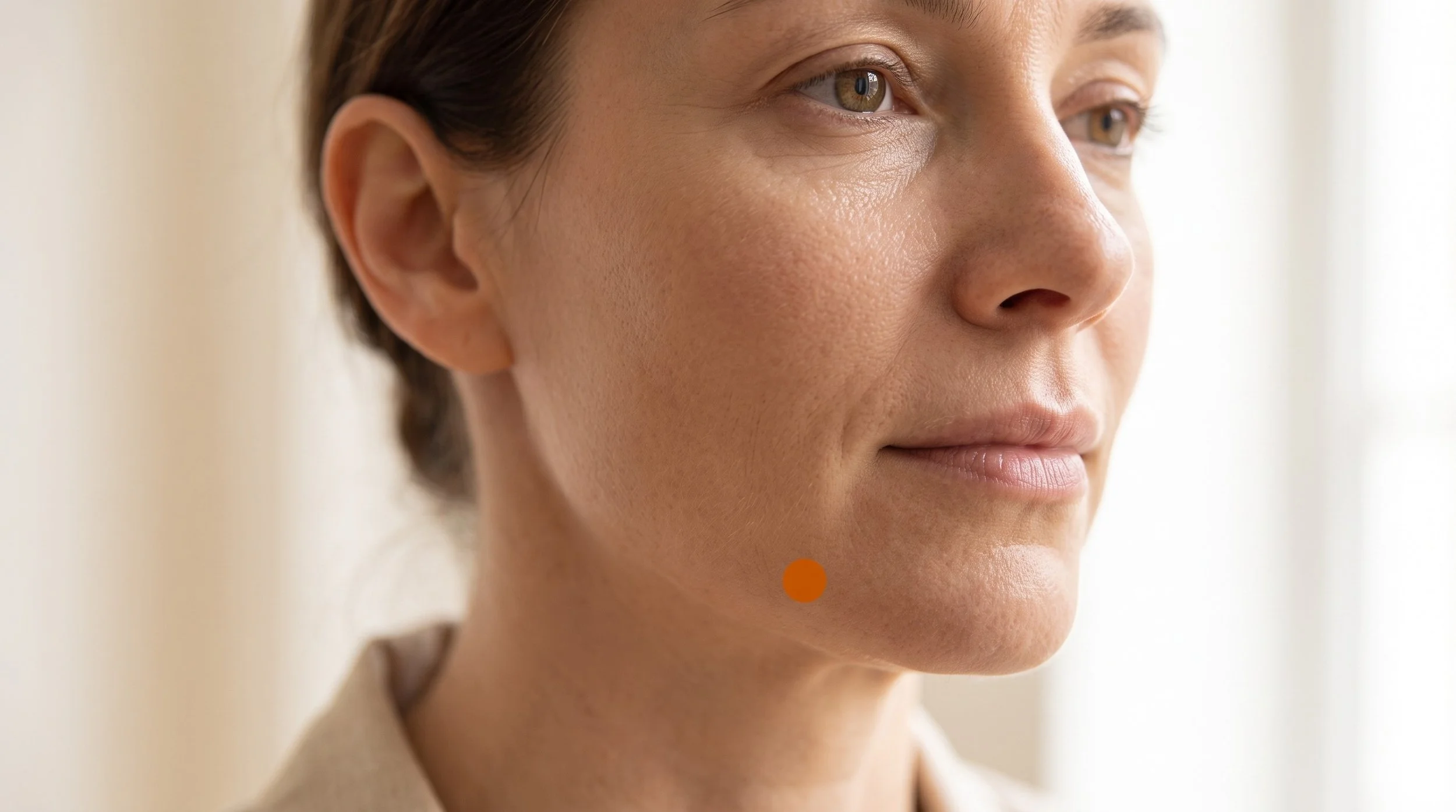
ST5 Acupuncture Point (Daying)
The Great Welcome at the Edge of the Masseter: Anatomy, Mechanism, and Why This Jaw Point Belongs in Facial Pain Treatment
ST5 (Daying, translated as Great Welcome) is the Stomach channel point that sits on the lower border of the jaw, just in front of the angle of the mandible, in the soft notch at the leading edge of the masseter muscle. If you clench your teeth, the muscle's front border pops into view, and the small groove just ahead of it is where the facial artery climbs over the jawbone, which is why a pulse can often be felt right at the st5 acupuncture point.
That combination of features (chewing muscle, mandibular bone, dental nerve territory, and a superficial artery) makes stomach 5 a compact and clinically useful location for jaw tension, lower-jaw dental pain, facial swelling, and facial nerve weakness, and it also makes it a point that rewards careful, gentle needling rather than aggressive technique.
- Location and layers: the daying point location is directly anterior to the angle of the jaw in the depression at the front border of the masseter, best found by asking the patient to clench (Deadman, Al-Khafaji & Baker, 2007). Under the skin sit thin platysma fibers, the anterior masseter margin, the mandibular bone, and the facial artery and vein as they cross the jaw.
- Traditional attributions: classical sources credit ST5 with dispelling wind and reducing swelling, and list lower-jaw toothache, lockjaw and jaw rigidity, deviation of the mouth, twitching lips, and swelling of the face and lower cheek (Deadman, Al-Khafaji & Baker, 2007; Kim, 2011). We treat these as historical indication categories, not as claims about energy movement.
- Mechanism in modern terms: the skin, masseter, and lower teeth here all report to the trigeminal system, so needling this region feeds input into the same brainstem relay that processes dental and temporomandibular pain, while broader analgesia depends on segmental gating, endogenous opioid release, and descending inhibitory pathways (Zhao, 2008).
- Research picture: reviews of acupuncture for temporomandibular disorders report short-term pain reduction with acknowledged risk of bias (La Touche et al., 2010; Di Francesco et al., 2024), dental pain reviews describe a possible analgesic role with methodological limits (Müller et al., 2023), and large chronic pain data show modest but persisting effects over sham (Vickers et al., 2018).
- Clinical framing: ST5 is rarely used alone. It's a local anchor combined with neighboring jaw points, distal yangming points, and trigger point needling of the masticatory muscles, and the classical formulas that include it are consistently dental and facial in scope (Deadman, Al-Khafaji & Baker, 2007).
- De qi and safety: needling here should produce a mild dull, spreading ache across the jaw line rather than sharpness. Standard technique is shallow oblique insertion of about 0.3 to 0.5 cun or a transverse thread toward ST4 or ST6, and vigorous manipulation is specifically avoided because of the facial artery and vein (Deadman, Al-Khafaji & Baker, 2007).
Is Jaw Tightness or Clenching Making It Hard to Chew?
Jaw pain rarely comes from one structure, so we assess the masseter, temporalis, and cervical muscles along with the way you clench, chew, and breathe. ST5 is one of the local points we may use at the front edge of the masseter, combined with neighboring jaw points and gentle trigger point work when the exam supports it. Treatments are shallow, precise, and adjusted to how your jaw responds week to week. Schedule a visit and we'll build a plan around your specific pattern.
Schedule NowAnatomy of ST5: Why the Notch at the Masseter's Front Border Is Such an Important Location
Run a finger along the lower edge of your jaw from the chin backward and you'll meet a small dip just before the jaw angle, right where the masseter's leading edge attaches. That dip is the antegonial notch, and it's the surface landmark for ST5. From the outside in, the needle would meet skin, a thin layer of subcutaneous fat and platysma, then the front margin of the masseter where it grips the mandible, with the bone itself as the floor. Everything that loads this spot is a chewing task: sustained clenching, nighttime grinding, gum chewing, long dental appointments, and the guarding that follows a jaw injury.
Because the masseter is one of the strongest muscles in the body for its size, its anterior border often becomes tender and ropy in people who clench, which is exactly why the daying point location so often reproduces a familiar ache on palpation.
The sensory story here is trigeminal. Skin over the lower jaw, the masseter itself, the temporomandibular joint, and the lower teeth are all supplied by branches of the mandibular division of the trigeminal nerve, and those branches converge on the same brainstem nucleus. That convergence is the reason a jaw muscle problem can feel like a toothache, and why a tooth problem can leave the masseter sore, and it's the same anatomical logic that supports treating dental and jaw complaints with local needling in this territory (Zhao, 2008).
Needle input in this zone recruits small-diameter afferents that engage segmental inhibition and descending pain control from the brainstem, along with endogenous opioid mechanisms that have been mapped in detail in acupuncture analgesia research (Zhao, 2008). Motor anatomy matters too: the marginal mandibular branch of the facial nerve runs near the lower jaw border on its way to the muscles of the lower lip, which is part of why classical texts associated this region with deviation of the mouth and lip twitching (Deadman, Al-Khafaji & Baker, 2007).
The structure that defines needling technique here is vascular. The facial artery, with its accompanying vein, hooks over the mandible at this notch on its way up to the cheek and lip, and its pulse is usually palpable. Classical and modern texts therefore agree on restraint: shallow oblique insertion of roughly 0.3 to 0.5 cun, or a transverse thread directed toward ST4 or ST6, with vigorous manipulation avoided to protect the artery and vein (Deadman, Al-Khafaji & Baker, 2007; Kim, 2011).
Some texts describe slightly deeper slanted insertion, but the safer convention in a face this vascular is to palpate first, angle away from the pulse, use a fine needle, and apply pressure after removal. Bruising is the most common minor consequence when technique is careless, which is a good reason to keep the needling light and the intent local.
Related Masseter Muscle Pain Treatment Related Masseter Trigger PointsST5 at a Glance: Classification, Location, and Clinical Use
| Category | Detail |
|---|---|
| Traditional Name | Daying (Great Welcome), ST5, also written Stomach 5 |
| Channel Classification | Stomach channel of Foot Yangming, a facial point on the mandible |
| Point Categories | The reference sources list no five-shu, source, luo, or extraordinary vessel designation for ST5. It is described as a local Stomach channel point on the jaw, and channel pathway texts place ST5 on the course of the Stomach channel as it crosses the lower cheek before winding to ST6, with a branch descending from ST5 toward ST9 and the throat (Maciocia, 2006). Sterman's collateral summary also routes the Large Intestine luo trajectory through the ST5 region (Sterman, 2011). |
| Precise Location | On the lower jaw, directly in front of the angle of the mandible, in the depression at the anterior border of the masseter muscle. Ask the patient to clench to define the muscle border; the facial artery pulse is usually palpable in the same notch. |
| Tissue Stimulated | Skin, subcutaneous tissue and platysma, the anterior border of the masseter at its mandibular attachment, and periosteum of the jaw. Related myofascial targets include masseter trigger points. |
| Needle Depth / Direction | Oblique insertion 0.3 to 0.5 cun, or transverse insertion threaded toward ST4 or ST6. Palpate and avoid the facial artery; vigorous manipulation is avoided (Deadman, Al-Khafaji & Baker, 2007). |
| De Qi Sensation | A mild dull, heavy, spreading ache along the jaw line, sometimes with a sense of pressure toward the lower teeth or cheek. Sharp, pulsing, or radiating electric sensations mean the needle should be adjusted. |
| Primary Clinical Uses | Jaw and lower cheek swelling and pain, lower-jaw toothache, masseter tension and clenching, jaw stiffness and limited opening, and facial paralysis involving the mouth and lips (traditionally attributed indications). |
| Common Point Combinations |
|
Deadman, Al-Khafaji and Baker's A Manual of Acupuncture assigns ST5 a compact traditional action, described as dispelling wind and reducing swelling, and the indication list that follows stays remarkably close to the jaw itself: rigidity and clenching of the jaw, deviation of the mouth, twitching of the lips, toothache in the lower jaw, stiffness of the tongue with loss of speech, frequent yawning, and swelling of the face and lower cheek, extending to mumps, nodular swellings of the neck, and neck pain with chills and fever.
Read as a traditional attribution rather than a physiological claim, the list divides neatly into two clusters: motor problems of the jaw and mouth, and swelling of the lower face. What's striking is how tightly the classical picture maps onto what a modern clinician can palpate at the same spot, since the masseter's front border governs jaw closing and opening range, the mandibular nerve supplies the lower teeth, the facial nerve's lower branch animates the lip, and the artery crossing the bone is the region's main blood supply. Centuries before any of that anatomy was described, the point had already been organized around jaw motion, dental pain, and facial swelling.
Why ST5 Is Used for Lower Jaw Toothache and Lockjaw, Not Just Local Soreness
The reason a point on the jawline can influence a toothache has less to do with distance than with wiring. Sensation from the lower teeth, the gums, the temporomandibular joint, the masseter, and the skin over the mandible all travels in branches of the same trigeminal nerve and converges on shared second-order neurons in the brainstem. When those neurons are sensitized, input from any one of those tissues can be misread as coming from another, which is how a clenching habit produces a tooth that feels bruised, and how an inflamed tooth leaves the whole side of the jaw aching.
Needling into that convergent territory delivers a controlled, non-threatening stimulus into the same pool of neurons, which can raise the threshold for the painful input arriving alongside it (Zhao, 2008).
Beyond the segment, needle stimulation recruits systems that turn pain down from above. Research on acupuncture analgesia describes activation of small-diameter afferents, release of endogenous opioid peptides, and engagement of descending inhibitory pathways from the midbrain and brainstem, effects that outlast the needling session itself (Zhao, 2008).
Locally, the notch at the masseter's edge also gives access to a muscle attachment that commonly holds tender, taut tissue in people who clench, and needling into masticatory trigger points has produced short-term reductions in pain and improved pressure pain thresholds in controlled trials (García-de la-Banda-García et al., 2023).
The classical use for lockjaw and deviation of the mouth reads differently through this lens. Reduced mouth opening after a flare is usually protective muscle guarding rather than a joint blockage, and reducing nociceptive drive from the masseter's attachment can allow that guarding to ease. For facial nerve weakness the framing has to stay conservative: Bell's palsy needs prompt medical assessment, and the Cochrane review of acupuncture for this condition found the trial evidence too poor in quality to support firm conclusions (Chen et al., 2010). ST5 may be used as one local point within a supportive facial protocol, alongside standard medical care, not in place of it.
What the Research Shows for ST5
There is no clinical trial that isolates ST5 on its own, and it would be misleading to suggest otherwise. What exists are reviews of multi-point protocols for jaw pain, dental pain, and facial nerve conditions, where points along the mandible and masseter are frequently among those used. Those reviews generally report short-term benefit with meaningful methodological limitations, so the honest way to read them is as support for treating this anatomical region, not as proof of a single point's effect. Below is a summary of the evidence most relevant to how ST5 is actually used in clinic.
| Study | Type | Focus | Key Finding |
|---|---|---|---|
| La Touche et al., 2010 | Systematic review and meta-analysis of RCTs | Acupuncture for pain in temporomandibular disorders | The authors concluded that acupuncture is a reasonable adjunct for short-term pain relief in painful TMD, while noting substantial bias in the included trials. |
| Di Francesco et al., 2024 | Systematic review and meta-analysis | Acupuncture and laser acupuncture for TMD | Pooled results favored acupuncture over placebo for muscle-origin TMD pain in the short term, though the authors described the overall evidence base as limited. |
| Müller et al., 2023 | Systematic review and meta-analysis | Acupuncture for acute dental pain | The review suggested a potential role for acupuncture in acute dental pain management, with conclusions constrained by inconsistent reporting of randomization and blinding. |
| Chen et al., 2010 | Cochrane systematic review | Acupuncture for Bell's palsy | The available trials were judged too low in methodological quality to determine whether acupuncture helps recovery from Bell's palsy. |
| García-de la-Banda-García et al., 2023 | Single-blind randomized controlled trial | Dry needling versus manual therapy for myofascial TMD | Both approaches improved pain, mouth opening, and pressure pain thresholds over three sessions, with no significant difference between groups. |
| Vickers et al., 2018 | Individual patient data meta-analysis | Acupuncture for chronic pain across conditions | Acupuncture outperformed both sham and no-acupuncture controls for chronic pain, with modest effect sizes that persisted over about a year. |
Dealing With Lower Jaw Toothache, Facial Swelling, or Facial Nerve Weakness?
Dental pain always needs a dental diagnosis first, and facial nerve symptoms need medical evaluation, but acupuncture can sit alongside that care as supportive treatment. Classical formulas for lower-jaw toothache and deviation of the mouth repeatedly include the st 5 jaw point together with points around the cheek, ear, and hand.
At Morningside we use those groupings as a starting map, then refine based on where your tissue is actually tender and restricted. Reach out and we'll coordinate with the rest of your care team.
Schedule NowST5 in the Context of Trigger Point Work
Acupuncture, defined by the use of an acupuncture needle, includes hundreds of styles, and trigger point dry needling is one of them. At ST5 the two approaches share the same real estate: the point sits at the anterior border of the masseter, and the superficial and deep layers of that muscle are classic sources of referred pain into the lower molars, the jaw, the ear region, and the eyebrow, which is well documented in the myofascial literature (Simons, Travell & Simons, 1999).
When a patient's chief complaint is clenching, morning jaw fatigue, or a tooth that a dentist has already cleared, we palpate along the masseter's border and body for taut bands and reproduce the referral before deciding where to needle.
In practice, ST5 is usually one part of a regional plan rather than the whole treatment. We may use the point itself with shallow oblique or transverse technique, then needle masseter and temporalis trigger points more directly where the exam calls for it, and add cervical work when neck posture and head-forward loading are feeding the jaw. Controlled trials of needling the masticatory muscles report short-term pain reduction and improved pressure pain thresholds, with mild soreness and occasional minor bleeding as the typical side effects (García-de la-Banda-García et al., 2023).
Around the facial artery we stay conservative, keeping the needling near ST5 light and reserving deeper muscle work for the safer, more posterior body of the masseter.
ST5 Jaw and Facial Pain Treatment at NYC's Highest-Rated Acupuncture Clinic
Morningside Acupuncture is the highest-rated acupuncture and dry needling clinic in New York City with over 500 five-star Google reviews, and jaw and facial pain is one of the areas we treat most often. We combine channel-based point selection like ST5 with orthopedic assessment and targeted needling of the masseter and temporalis. You'll leave each visit knowing what we found, what we treated, and what to do between sessions. Book an appointment to get started.
Schedule NowFrequently Asked Questions
What does ST5 feel like when needled?
Most people describe a mild, dull, spreading heaviness along the jaw line, sometimes with a faint sense of pressure toward the lower teeth or the cheek. Because the needle is shallow and the manipulation is deliberately gentle here, the sensation is usually softer than at points on the arms or legs. Sharp pain, a strong pulsing feeling, or an electric zing means the needle needs adjusting, and you should say so right away. Some tenderness for a day afterward is normal, especially if the masseter's border was already reactive.
Why needle the jaw for a toothache instead of just treating the tooth?
ST5 doesn't replace dental care, and any persistent toothache needs a dentist's diagnosis first. The reason a jaw point can still help is that the lower teeth, gums, jaw joint, and masseter all feed into the same trigeminal pathways in the brainstem, so pain in one of those tissues can be amplified or mimicked by problems in another (Zhao, 2008). Classical formulas that include ST5 for lower-jaw toothache also combined it with distal points on the hand and arm, which is consistent with the modern idea that pain relief comes from both local input and broader descending inhibition. In clinic we use it as supportive treatment alongside dental evaluation, particularly when clenching is part of the picture.
Can I press ST5 myself between sessions?
Yes, with one important caveat: this is where the facial artery crosses the jaw, so never press hard on a spot where you can feel a pulse. Find the point by clenching your teeth to make the masseter's front edge stand out, then release the clench and settle your fingertip into the small notch just ahead of that edge, along the lower border of the jaw. Use light to moderate pressure with a fingertip for 30 to 60 seconds at a time, adding small circles or a slow stroke along the jawline, and repeat for two or three rounds once or twice a day. Combine it with slow jaw opening, a warm compress on the masseter, and easing off gum and hard chewy foods. Stop if you feel throbbing, dizziness, numbness, or increasing pain.
Is ST5 safe to needle?
In trained hands, yes, but it's a point that demands respect for its anatomy. The facial artery and vein cross the mandible right here, so practitioners palpate for the pulse first, angle away from it, keep insertion shallow (about 0.3 to 0.5 cun oblique, or threaded transversely toward ST4 or ST6), and avoid vigorous manipulation (Deadman, Al-Khafaji & Baker, 2007; Kim, 2011). The most common minor side effect is bruising, which is why clean technique and firm pressure after needle removal matter on the face. Tell your practitioner if you take blood thinners, bruise easily, have had recent facial surgery or dental procedures, or have any local infection or skin lesion in the area.
Where exactly is ST5 located?
On the lower border of the jaw, directly in front of the angle of the mandible, in the depression at the anterior border of the masseter muscle. The easiest way to find it is to clench your teeth so the masseter bulges, note where its front edge meets the jawbone, then relax and feel for the small notch just anterior to that edge. In most people a faint arterial pulse can be felt in the same groove, which confirms the location and is also the reason for gentle technique. ST5 sits between ST4 at the corner of the mouth and ST6 over the body of the masseter, and those three points are frequently used together.
References
- Deadman, P., Al-Khafaji, M., & Baker, K. (2009). A manual of acupuncture. Journal of Chinese Medicine Publications.
- Kim, H. (2008). Handbook of Oriental medicine (3rd ed.). Harmony & Balance Press.
- Maciocia, G. (2005). The foundations of Chinese medicine: A comprehensive text for acupuncturists and herbalists (2nd ed.). Elsevier Churchill Livingstone.
- Cecil-Sterman, A. (2012). Advanced acupuncture: A clinic manual. Classical Wellness Press.
- Simons, D. G., Travell, J. G., & Simons, L. S. (1999). Travell & Simons' myofascial pain and dysfunction: The trigger point manual, Vol. 1: Upper half of body (2nd ed.). Williams & Wilkins.
- Zhao, Z. Q. (2008). Neural mechanism underlying acupuncture analgesia. Progress in Neurobiology, 85(4), 355-375. https://doi.org/10.1016/j.pneurobio.2008.05.004
- Vickers, A. J., Vertosick, E. A., Lewith, G., MacPherson, H., Foster, N. E., Sherman, K. J., Irnich, D., Witt, C. M., & Linde, K. (2018). Acupuncture for chronic pain: Update of an individual patient data meta-analysis. Journal of Pain, 19(5), 455-474. https://doi.org/10.1016/j.jpain.2017.11.005
- La Touche, R., Goddard, G., De-la-Hoz, J. L., Wang, K., Paris-Alemany, A., Angulo-Diaz-Parreno, S., Mesa, J., & Hernandez, M. (2010). Acupuncture in the treatment of pain in temporomandibular disorders: A systematic review and meta-analysis of randomized controlled trials. The Clinical Journal of Pain, 26(6), 541-550. https://doi.org/10.1097/AJP.0b013e3181e2697e
- Di Francesco, F., Minervini, G., Siurkel, Y., Cicciu, M., & Lanza, A. (2024). Efficacy of acupuncture and laser acupuncture in temporomandibular disorders: A systematic review and meta-analysis of randomized controlled trials. BMC Oral Health, 24(1), 174. https://doi.org/10.1186/s12903-023-03806-1
- Muller, M., Schmucker, C., Naumann, J., Schlueter, N., Huber, R., & Lederer, A. K. (2023). Acupuncture in management of acute dental pain: A systematic review and meta-analysis. Japanese Dental Science Review, 59, 114-128. https://doi.org/10.1016/j.jdsr.2023.02.005
- Chen, N., Zhou, M., He, L., Zhou, D., & Li, N. (2010). Acupuncture for Bell's palsy. Cochrane Database of Systematic Reviews, 2010(8), CD002914. https://doi.org/10.1002/14651858.CD002914.pub5
- Garcia-de la-Banda-Garcia, R., Cortes-Perez, I., Ibancos-Losada, M. R., Lopez-Ruiz, M. C., Obrero-Gaitan, E., & Osuna-Perez, M. C. (2023). Effectiveness of dry needling versus manual therapy in myofascial temporomandibular disorders: A single-blind randomized controlled trial. Journal of Personalized Medicine, 13(9), 1415. https://doi.org/10.3390/jpm13091415
Disclaimer: This web site is intended for educational and informational purposes only. Reading this website does not constitute providing medical advice or any professional services. This information should not be used for diagnosing or treating any health issue or disease. Those seeking medical advice should consult with a licensed physician. Seek the advice of a medical doctor or other qualified health professional for any medical condition. If you think you have a medical emergency, call 911 or go to the emergency room. No acupuncturist-patient relationship is created by reading this website or using the information. Morningside Acupuncture PLLC and its employees and contributors do not make any express or implied representations with respect to the information on this site or its use. For any legal interpretation of scope of practice in your state, consult a licensed attorney or regulatory authority.
Read more from our blog



