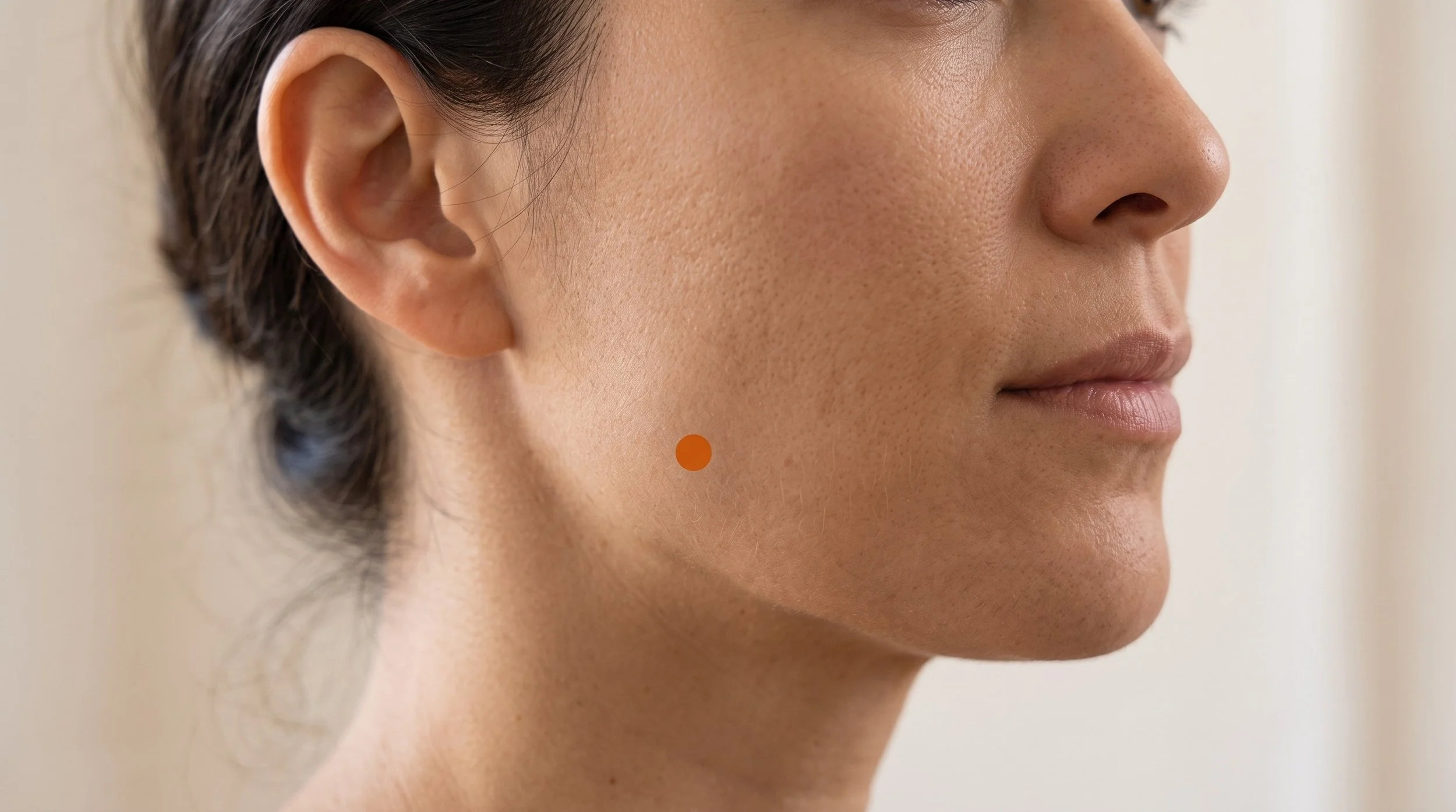
ST6 Acupuncture Point (Jiache)
The Jaw Bone Point on the Masseter: Anatomy, Mechanism, and Why ST6 Anchors Modern TMJ, Clenching, and Facial Pain Treatment
ST6 (Jiache, often translated as Jaw Bone or Jaw Chariot) sits in the thick belly of the masseter, roughly one finger-breadth forward and up from the angle of the jaw, right where the muscle bunches up when you bite down. It's the single most direct needling access to the masseter, the muscle that does most of the work in clenching, grinding, and chewing, which is why the st6 acupuncture point shows up in nearly every modern jaw protocol.
Classical texts list Stomach 6 for toothache, gum problems, lockjaw, difficulty chewing, and deviation of the mouth (Deadman et al., 2007), and contemporary clinics use the same location as a masseter trigger point target for TMJ pain, jaw tension, and tension-type headache that starts at the side of the face.
- Location and layers: ST6 is found by asking the patient to clench, then needling the peak of the masseter bulge anterosuperior to the mandibular angle (Deadman et al., 2007). The needle passes skin and thin subcutaneous fascia into the superficial head of the masseter as it overlies the ramus of the mandible.
- Traditional categories, translated: classical sources credit Jiache with dispersing wind, benefiting the jaw and teeth, and freeing the channel to relieve pain (Deadman et al., 2007). In modern terms that maps onto local muscle relaxation, altered nociceptive input from a hyperalgesic masticatory muscle, and improved regional blood flow rather than any literal movement of energy.
- Mechanism: sensory afferents from the masseter and overlying skin converge in the trigeminal spinal nucleus, which also receives upper cervical input, so needling here can influence pain referred to the teeth, ear, and temple. Needling recruits segmental inhibition plus descending pain-modulating pathways involving endogenous opioids and monoamines (Zhao, 2008).
- Research picture: reviews of acupuncture for temporomandibular disorders report short-term pain reduction with jaw protocols that regularly include local masseter and joint points, though the evidence base is small and at risk of bias (La Touche et al., 2010; Di Francesco et al., 2024). Dry needling of masseter trigger points has been studied separately with comparable short-term results (García-de-la-Banda-García et al., 2023).
- Clinical framing: in practice ST6 is rarely used alone. It's typically paired with ST7 at the joint, temporalis needling, upper cervical work, and the distal point LI4, since chronic pain protocols in the largest patient-level analyses combine local and distal points across multiple sessions (Vickers et al., 2018).
- De qi here is distinctive: a deep, heavy, spreading ache inside the jaw that can travel toward the back teeth or the ear, sometimes with a brief muscle twitch if a taut band is engaged (Simons et al., 1999). It's a strong sensation in a small muscle, so shallow depth and gentle technique matter.
Waking Up With a Tight, Aching Jaw?
Morning jaw tightness, clicking, and headaches at the temples usually trace back to overloaded masticatory muscles rather than the joint itself. At Morningside Acupuncture we needle ST6 in the masseter belly alongside ST7, temporalis, and upper neck points, then add manual release and simple jaw retraining you can do at home. Most patients notice easier opening and less soreness within a few sessions. Schedule a visit and let's assess what's actually driving the clenching.
Schedule NowAnatomy of ST6: Why the Masseter Belly Is Such an Important Location
From the surface inward, ST6 passes through facial skin, a thin layer of subcutaneous fat and superficial fascia, and then into the superficial head of the masseter where it lies against the ramus of the mandible. The masseter is short, dense, and mechanically powerful: it elevates the mandible and generates a large share of bite force, and it works constantly during chewing, speaking, and any sustained clenching.
Daytime bracing at a desk, nighttime grinding, gum chewing, and stress-driven jaw holding all load this exact tissue, which is why the muscle belly is frequently tender to palpation in people with temporomandibular disorders. The tail of the parotid gland sits just behind and below the point, so precise palpation of the muscle bulge with the teeth lightly clenched keeps the needle in muscle rather than glandular tissue.
The nerve geography around ST6 explains most of its clinical reach. The masseter is supplied motorically by the masseteric branch of the mandibular division of the trigeminal nerve, the overlying skin is served by trigeminal and cervical plexus branches, and buccal and marginal mandibular branches of the facial nerve travel superficially across this region.
Sensory input from all of these masticatory structures converges in the trigeminal spinal nucleus, which also receives afferents from the upper cervical segments, and that shared relay is why jaw muscle pain so often gets felt as toothache, ear fullness, or a temple headache (Simons et al., 1999). Needling into a tender masseter band produces a strong afferent barrage that engages segmental inhibitory circuits and descending pain-modulating pathways involving endogenous opioids and monoaminergic systems (Zhao, 2008).
A crossover trial using near-infrared spectroscopy also found that trigger point needling of the masseter raised local tissue oxygen saturation immediately afterward, which suggests a measurable vascular component to what patients describe as the muscle letting go (Macedo et al., 2023).
Deep to the point, the mandibular ramus provides a bony floor, and the transverse facial vessels run in the region while the facial artery and vein cross the mandible closer to the anterior border of the masseter near ST5. Because facial tissue is vascular and thin, the standard convention is a perpendicular insertion of about 0.5 cun, or a transverse insertion threaded toward ST4, ST5, or ST7, with angled needling toward the upper or lower jaw when treating dental pain (Deadman et al., 2007). Fine needles, careful depth control, and post-needle pressure reduce the main practical risk, which is a visible bruise rather than anything serious.
Related Masseter Muscle Pain Treatment Related Masseter Trigger PointsST6 at a Glance: Classification, Location, and Clinical Use
| Category | Detail |
|---|---|
| Traditional Name | Jiache, translated as Jaw Bone or Jaw Chariot; also recorded under the alternative name Guichuang (Ghost's Bed) |
| Channel Classification | Sixth point of the Stomach channel of Foot Yangming, located where the channel winds along the angle of the jaw before ascending in front of the ear |
| Point Categories | One of Sun Si-miao's thirteen ghost points, listed as Guichuang in the Supplement to the Thousand Ducat Formulas; no five-shu, meeting, or extraordinary vessel designation is attributed to this point in the classical sources referenced here |
| Precise Location | Approximately one finger-breadth anterior and superior to the angle of the mandible, at the prominence of the masseter that appears when the patient clenches the teeth |
| Tissue Stimulated | Superficial head of the masseter over the mandibular ramus, a frequent site of masseter trigger points that refer pain to the teeth, ear, and temple |
| Needle Depth / Direction | Perpendicular insertion around 0.5 cun into the muscle belly; transverse threading toward ST4, ST5, or ST7; angled toward the upper or lower jaw for dental pain (Deadman et al., 2007) |
| De Qi Sensation | Deep, heavy, expanding ache within the jaw, often spreading toward the molars or the ear; a brief involuntary twitch may occur when a taut masseter band is engaged |
| Primary Clinical Uses | TMJ pain, jaw tension and clenching, difficulty opening or chewing, toothache and gum discomfort of the lower jaw, facial paralysis with deviation of the mouth, cheek swelling, and temple-area headache |
| Common Point Combinations |
|
Deadman and colleagues present Jiache as the principal local point for a cluster of jaw complaints: inability to chew, inability to open the mouth after windstroke, lockjaw, and tension, pain or paralysis of the jaw, with its influence described as extending upward along the Stomach channel for deviation of the mouth and eye and swelling of the cheek, and downward for mumps and neck stiffness (Deadman et al., 2007). It's also presented as a leading choice for disorders of the lower teeth and gums.
In traditional terms the unifying pathogen across those presentations was said to be wind, whether arriving from outside or generated internally, which is why the point's traditional action is phrased as eliminating wind and benefiting the jaw and teeth. What makes the classical record striking is the point's inclusion, under the alternative name Ghost's Bed, among Sun Si-miao's thirteen ghost points used for mania and epilepsy, a designation that sits oddly alongside a list of indications containing nothing psychiatric at all.
Why ST6 Is Used for Toothaches, Ear Pressure, and Headaches That Have Nothing Wrong With the Tooth or the Ear
Patients are often surprised that a point on the cheek can change how a molar feels. The explanation is convergence. Sensory fibers from the masseter, the temporomandibular joint, the teeth, the ear region, and the upper neck all funnel into the trigeminal spinal nucleus, where second-order neurons receive input from more than one source. When the masseter carries taut, irritable bands, the brain can misattribute that input to a tooth or the ear, which is the classic referred pain map for this muscle (Simons et al., 1999).
Needling ST6 puts a precise, strong signal into the tissue that's actually generating the input, and that's often what shifts the perceived location of the pain.
Beyond the local segment, needling recruits broader pain-modulating machinery. Experimental work on acupuncture analgesia describes activation of descending inhibitory pathways from the midbrain and brainstem, with endogenous opioid, serotonergic, and noradrenergic mediation reducing transmission at the dorsal horn and its trigeminal equivalent (Zhao, 2008). That's a systemic effect layered on top of the local one, and it may explain why patients sometimes report the whole side of the head feeling quieter, not just the muscle that was needled.
There's also a straightforward tissue-level story. A randomized crossover trial measured masseter oxygenation before and after trigger point needling in people with temporomandibular disorder and found higher tissue oxygen saturation immediately after real needling compared with sham, alongside a transient rise in soreness from the procedure itself (Macedo et al., 2023). Small studies like this don't prove clinical outcomes, but they support what practitioners observe: local perfusion changes, the muscle softens, and jaw movement usually gets easier before the soreness fully resolves.
What the Research Shows for ST6
A fair reading of the evidence starts with a caveat: trials of acupuncture for jaw pain test whole protocols, not single points, so no study isolates what ST6 contributes on its own. What the literature does tell us is that needling protocols targeting the masticatory muscles and joint region produce short-term pain reduction in temporomandibular disorders, that the trials are generally small and methodologically uneven, and that dry needling of the masseter, which reaches the same tissue ST6 sits in, has been studied with broadly similar findings.
Expect meaningful short-term relief as a reasonable goal, delivered as part of a plan that also addresses clenching habits, sleep, and neck mechanics.
| Study | Type | Focus | Key Finding |
|---|---|---|---|
| La Touche et al., 2010 | Systematic review and meta-analysis of RCTs | Acupuncture for pain in temporomandibular disorders | Concluded that acupuncture may be a reasonable adjunct for short-term analgesia in painful TMD, while noting that substantial bias limited confidence in the pooled result. |
| Fernandes et al., 2017 | Systematic review | Acupuncture in myofascial pain of temporomandibular origin | Reported that acupuncture appeared to reduce myofascial TMD pain in the included trials, with study quality and follow-up duration identified as ongoing weaknesses. |
| Di Francesco et al., 2024 | Systematic review and meta-analysis of RCTs | Manual and laser acupuncture for TMD pain | Found short-term benefit for pain of muscular origin compared with placebo, while the authors described the overall evidence base as limited and called for more rigorous trials. |
| García-de-la-Banda-García et al., 2023 | Single-blind randomized controlled trial | Dry needling versus manual therapy for myofascial TMD | Both interventions improved pain, mouth opening, and pressure pain thresholds in masticatory muscles, with no significant difference between groups. |
| Macedo et al., 2023 | Randomized double-blind crossover trial | Masseter trigger point needling and tissue oxygenation | Measured a greater increase in masseter tissue oxygen saturation after real needling than after sham, with a short-lived rise in soreness from the procedure. |
| Chen et al., 2010 | Cochrane systematic review | Acupuncture for Bell's palsy, a traditional indication for ST6 | Found the quality of the available trials insufficient to draw conclusions about efficacy, with no reported harms across the included studies. |
| Vickers et al., 2018 | Individual patient data meta-analysis | Acupuncture for chronic pain conditions | Found acupuncture superior to both sham and no-acupuncture controls for chronic pain, with effects persisting over time, supporting multi-session local plus distal protocols. |
Facial Pain, Toothache, or Clicking That Dentistry Hasn't Solved?
When your dentist has ruled out decay or infection but the ache persists, referred pain from the masseter and temporalis is a common culprit. We use ST6 as a precise entry into that muscle, combined with the classical face-and-mouth pairing of LI4, to change how the jaw feels and moves. Treatment is targeted, brief, and coordinated with any night guard or dental care you're already using. Book an evaluation to get a clear plan.
Schedule NowST6 in the Context of Trigger Point Work
ST6 and the classic superficial masseter trigger points occupy essentially the same real estate, which makes this one of the cleanest examples of channel-based and myofascial mapping landing on the same spot. Taut bands in the superficial masseter refer pain into the lower molars, the jaw, the eyebrow region, and occasionally deep into the ear, and deeper fibers near the joint can produce a sense of ear fullness or tinnitus-like pressure (Simons et al., 1999).
At Morningside we palpate the muscle with the jaw lightly clenched, then relaxed, and needle where the band and the tenderness actually are, which usually corresponds to ST6 with minor adjustment up or down the belly.
In a typical jaw session we'll combine ST6 and ST7 with dry needling of the temporalis, attention to the sternocleidomastoid and suboccipital muscles when headache is part of the picture, and LI4 as a distal point. Needling is shallow and fine-gauge in the face, sessions are kept short, and we expect a day of mild soreness after strong masseter work, consistent with what trial data on masseter needling report (Macedo et al., 2023). The needling is one piece: we also address daytime clenching awareness, chewing load, sleep position, and coordination with your dentist if a night guard is part of your care.
ST6 TMJ and Jaw Pain Treatment at NYC's Highest-Rated Acupuncture Clinic
Morningside Acupuncture is the highest-rated acupuncture and dry needling clinic in New York City with over 500 five-star Google reviews, and jaw pain is one of the conditions we see most. Our practitioners combine ST6 and ST7 needling with masseter and temporalis dry needling, cervical assessment, and practical daytime habit changes. You'll leave each visit knowing exactly what we treated and why. Schedule your appointment and let's get your jaw comfortable again.
Schedule NowFrequently Asked Questions
What does ST6 feel like when needled?
Most people feel a firm pinch at the skin followed by a deep, heavy, spreading ache inside the jaw. That ache can travel toward the back teeth, the ear, or up to the temple, which is normal and reflects how masseter pain refers. If a taut band is engaged, you may feel a quick involuntary twitch of the muscle. The strong sensation typically fades within seconds to a minute, and mild soreness for a day afterward is common.
Why needle the cheek when my pain feels like it's in the joint or my teeth?
Because the masseter is often the tissue actually generating the signal. Sensory input from the muscle, the joint, the teeth, and the upper neck converges in the trigeminal spinal nucleus, so a chronically overloaded masseter can produce pain that you experience as a toothache or joint pain (Simons et al., 1999). Treating the joint alone frequently misses the muscular driver. We usually needle both, using ST6 for the muscle and ST7 for the joint.
Can I press ST6 myself between sessions?
Yes, and it's one of the easier points to self-treat. Clench lightly to find the bulge of the masseter about a finger-breadth up and forward from the angle of your jaw, then unclench and rest a fingertip or knuckle on the tender spot. Apply steady, moderate pressure at roughly a 5 or 6 out of 10 discomfort level for 30 to 60 seconds, breathing slowly, then release and repeat two or three times per side. You can also make small slow circles for a minute, or place your thumb inside the cheek and fingers outside for a gentle pincer hold. Doing this two or three times a day, especially in the evening and after long stretches of desk work, may reduce clenching-related soreness. Stop if it sharply increases pain, causes numbness, or leaves lasting bruising.
Is ST6 safe to needle?
In trained hands, yes. It's a shallow point, needled around 0.5 cun perpendicular or threaded transversely toward neighboring points (Deadman et al., 2007). The main practical consideration is that facial tissue bruises easily, so fine needles, accurate depth, and brief post-needle pressure are standard. Practitioners stay in the muscle belly and away from the parotid region behind it, and they take extra care with patients on blood thinners, with active facial infection, or with recent facial surgery or injectables. Tell your practitioner about any of those before treatment.
Where exactly is ST6 located?
Put a finger on the bony angle of your jaw, then move about one finger-breadth forward and slightly up. Clench your teeth and you'll feel a firm rounded bulge push out against your finger: that's the belly of the masseter, and ST6 is at its most prominent part (Deadman et al., 2007). Relax the jaw and the spot stays where your finger is. In people with clenching or TMJ pain, that exact place is usually noticeably tender compared with the surrounding cheek.
References
- Deadman, P., Al-Khafaji, M., & Baker, K. (2009). A manual of acupuncture. Journal of Chinese Medicine Publications.
- Simons, D. G., Travell, J. G., & Simons, L. S. (1999). Travell & Simons' myofascial pain and dysfunction: The trigger point manual, Vol. 1: Upper half of body (2nd ed.). Williams & Wilkins.
- Maciocia, G. (2006). The channels of acupuncture: Clinical use of the secondary channels and eight extraordinary vessels. Churchill Livingstone Elsevier.
- Zhao, Z. Q. (2008). Neural mechanism underlying acupuncture analgesia. Progress in Neurobiology, 85(4), 355-375. https://doi.org/10.1016/j.pneurobio.2008.05.004
- Vickers, A. J., Vertosick, E. A., Lewith, G., MacPherson, H., Foster, N. E., Sherman, K. J., Irnich, D., Witt, C. M., & Linde, K. (2018). Acupuncture for chronic pain: Update of an individual patient data meta-analysis. Journal of Pain, 19(5), 455-474. https://doi.org/10.1016/j.jpain.2017.11.005
- La Touche, R., Goddard, G., De-la-Hoz, J. L., Wang, K., Paris-Alemany, A., Angulo-Diaz-Parreno, S., Mesa, J., & Hernandez, M. (2010). Acupuncture in the treatment of pain in temporomandibular disorders: A systematic review and meta-analysis of randomized controlled trials. The Clinical Journal of Pain, 26(6), 541-550. https://doi.org/10.1097/AJP.0b013e3181e2697e
- Fernandes, A. C., Duarte Moura, D. M., Da Silva, L. G. D., De Almeida, E. O., & Barbosa, G. A. S. (2017). Acupuncture in temporomandibular disorder myofascial pain treatment: A systematic review. Journal of Oral & Facial Pain and Headache, 31(3), 225-232. https://doi.org/10.11607/ofph.1719
- Di Francesco, F., Minervini, G., Siurkel, Y., Cicciu, M., & Lanza, A. (2024). Efficacy of acupuncture and laser acupuncture in temporomandibular disorders: A systematic review and meta-analysis of randomized controlled trials. BMC Oral Health, 24(1), 174. https://doi.org/10.1186/s12903-023-03806-1
- Garcia-de la-Banda-Garcia, R., Cortes-Perez, I., Ibancos-Losada, M. del R., Lopez-Ruiz, M. del C., Obrero-Gaitan, E., & Osuna-Perez, M. C. (2023). Effectiveness of dry needling versus manual therapy in myofascial temporomandibular disorders: A single-blind randomized controlled trial. Journal of Personalized Medicine, 13(9), 1415. https://doi.org/10.3390/jpm13091415
- Macedo, C. F., Sonza, A., Puel, A. N., & Santos, A. R. D. (2023). Trigger point dry needling increases masseter muscle oxygenation in patients with temporomandibular disorder. Journal of Applied Oral Science, 31, e20230099. https://doi.org/10.1590/1678-7757-2023-0099
- Chen, N., Zhou, M., He, L., Zhou, D., & Li, N. (2010). Acupuncture for Bell's palsy. Cochrane Database of Systematic Reviews, 2010(8), CD002914. https://doi.org/10.1002/14651858.CD002914.pub5
Disclaimer: This web site is intended for educational and informational purposes only. Reading this website does not constitute providing medical advice or any professional services. This information should not be used for diagnosing or treating any health issue or disease. Those seeking medical advice should consult with a licensed physician. Seek the advice of a medical doctor or other qualified health professional for any medical condition. If you think you have a medical emergency, call 911 or go to the emergency room. No acupuncturist-patient relationship is created by reading this website or using the information. Morningside Acupuncture PLLC and its employees and contributors do not make any express or implied representations with respect to the information on this site or its use. For any legal interpretation of scope of practice in your state, consult a licensed attorney or regulatory authority.
Read more from our blog



