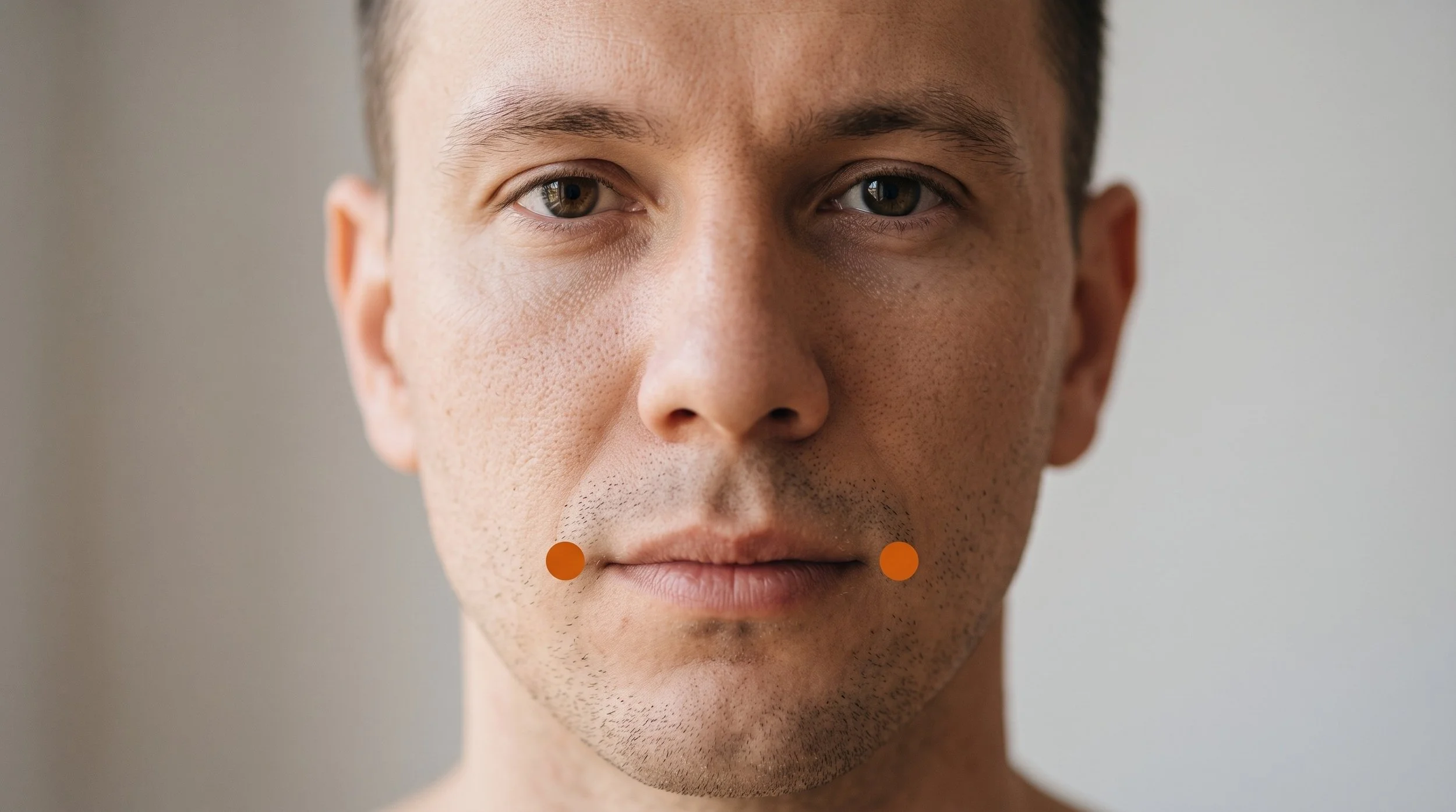
ST4 Acupuncture Point (Dicang)
The Earth Granary Beside the Mouth: Anatomy, Mechanism, and Why This Mouth Corner Point Anchors Facial Paralysis and Facial Pain Treatment
ST4, known in Chinese as Dicang and usually translated as Earth Granary, sits just off the corner of the mouth, roughly 0.4 cun lateral to the lip commissure along the line the nasolabial groove would take if you extended it downward. The name points to the mouth as the doorway where food, the produce of the earth, enters the body, and the Stomach channel is the pathway that runs right past it.
In plain terms, this is the point at the outer edge of the smile line, sitting over the small fibrous knot where four or five facial muscles braid together. That anatomy is exactly why the st4 acupuncture point matters clinically: almost every complaint involving the mouth corner, whether that's the drooping and drooling of facial palsy, the electric jolts of trigeminal pain, numb lips, or a twitching cheek, has its mechanical and neural business happening within a centimeter of this spot.
- Location and layers: ST4 lies about 0.4 cun lateral to the corner of the mouth, in the continuation of the nasolabial groove, and asking a patient to smile makes the groove visible when it's faint (Deadman & Al-Khafaji, 2000). The needle passes through thin skin and a shallow fat layer into the modiolus, the fibromuscular hub where orbicularis oris, zygomaticus major, risorius, buccinator and depressor anguli oris interlace.
- Traditional categories, translated: classical sources describe Dicang as a meeting point of the Stomach and Large Intestine channels with the Yang Motility and Conception vessels, and its listed actions are to expel wind from the face and free the channel to relieve pain (Deadman & Al-Khafaji, 2000). Read through a modern lens, those attributions describe a spot where several muscle sheets and nerve territories converge in one small area.
- The nerve story: the muscles here are driven by the buccal branch of the facial nerve, while sensation comes from branches of the trigeminal nerve. Trigeminal afferents terminate in the spinal trigeminal nucleus, which extends down to meet the upper cervical dorsal horn, so needling near the mouth feeds into a relay that also modulates descending pain control pathways (Zhao, 2008).
- The research picture is mixed and honest: a Cochrane review of acupuncture for Bell's palsy couldn't reach firm conclusions because of trial quality problems (Chen et al., 2010), while later pooled analyses suggest possible benefit at low certainty (Li et al., 2015). Reviews of acupuncture for trigeminal neuralgia report favorable pain outcomes compared with carbamazepine but grade the evidence as low quality (Ang et al., 2023).
- Clinical practice framing: ST4 is almost never used alone. In published facial paralysis protocols it appears alongside ST6, GB14, SI18, LI20 and LI4, frequently with electrical stimulation running between the mouth corner and the jaw (Yin et al., 2022), and broader chronic pain data suggest acupuncture's effects are modest but real when protocols are delivered adequately (Vickers et al., 2018).
- De qi here is distinctive: patients usually report a spreading, slightly heavy tug along the lip line rather than the deep ache typical of limb points, and a brief visible twitch of the mouth corner is common when the needle engages the modiolus. Facial skin is richly innervated, so entry is felt more sharply than at body points, and fine needles with a quick insertion make a real difference to comfort.
Struggling With Facial Weakness, Drooping, or a Mouth That Won't Cooperate?
Facial palsy is disorienting in a way few other conditions are, because it changes how you eat, speak, and look at yourself. At Morningside Acupuncture we use ST4 as the anchor of a threaded facial protocol, joining it toward ST6 and LI20 so a single needle covers the whole lower quadrant of the affected side, and we pair it with distal points and graded facial retraining between visits. Treatment plans are built around where you are in recovery, since early inflammatory presentations and long standing sequelae call for different needle intensity. Schedule a consultation to have your case assessed and a course of care mapped out.
Schedule NowAnatomy of ST4: Why the Modiolus at the Mouth Corner Is Such an Important Location
Slide a fingertip just lateral to the corner of your mouth and press gently while you smile, then purse your lips. You'll feel a small, dense knot shift under the skin. That's the modiolus, a fibromuscular junction where orbicularis oris, zygomaticus major, risorius, buccinator, levator anguli oris and depressor anguli oris all converge and anchor to each other. ST4 sits directly over it, under nothing more than thin facial skin and a shallow subcutaneous layer.
Because this knot is the mechanical hinge for smiling, speaking, whistling, and holding food in the mouth, it takes load from every direction, and it stiffens or slackens visibly when facial nerve function is compromised. In facial palsy the modiolus on the affected side drifts downward and medially, which is precisely the drooping and mouth deviation that classical texts described. The same structure can develop myofascial taut bands and referred pain when chewing muscles and buccinator are chronically overworked (Simons et al., 1999).
The nerve geography around ST4 is unusually rich. Motor supply to the muscles here comes from the buccal branch of the facial nerve, which is the branch most often targeted in facial paralysis protocols. Sensation is trigeminal: the upper lip and adjacent skin fall in the maxillary division's territory via the infraorbital nerve, while the lower lip and chin belong to the mandibular division via the mental nerve, and the two fields meet right around the mouth corner.
Trigeminal sensory fibers project to the spinal trigeminal nucleus, whose caudal portion is continuous with the dorsal horn of the upper cervical cord, so facial input, upper neck input, and jaw input all share processing real estate. Needling here generates a strong, well localized afferent barrage into that convergence zone, which is thought to recruit segmental inhibitory interneurons and engage descending modulation from the brainstem, including serotonergic and noradrenergic pathways associated with acupuncture analgesia (Zhao, 2008).
This is also the plausible basis for the electroacupuncture setups used in facial palsy research, where a current is run between ST4 and ST6 to deliver rhythmic low frequency input across the affected muscle field (Yin et al., 2022).
The structure that governs safety here is vascular. The facial artery courses upward across the mandible and passes near the mouth corner before continuing toward the nose, giving off the superior and inferior labial arteries along the way, and the surrounding tissue is highly vascular with essentially no protective padding. Bruising is therefore the most common adverse event at ST4, and it's cosmetically noticeable in a way a bruise on the leg isn't.
Standard practice is transverse, subcutaneous insertion rather than perpendicular depth: the needle is laid almost flat and threaded along the tissue plane toward ST6, LI20, SI18 or CV24, depending on which region of the face needs coverage (Deadman & Al-Khafaji, 2000). Threaded needling is the conventional technique in facial paralysis work because one needle stimulates a long segment of the muscle field, and it keeps the tip in a superficial plane. Clinicians typically warn patients about bruising in advance, use fine gauge needles, and apply firm pressure for a full 30 seconds after withdrawal.
Related Buccinator Trigger Points Related Zygomaticus Trigger PointsST4 at a Glance: Classification, Location, and Clinical Use
| Category | Detail |
|---|---|
| Traditional Name | Dicang (Earth Granary), ST-4 in the Deadman numbering |
| Channel Classification | Stomach channel of Foot Yangming, fourth point, in the facial group of the channel |
| Point Categories | Meeting (crossing) point of the Stomach and Large Intestine channels with the Yang Motility Vessel (Yang Qiao Mai) and the Conception Vessel (Ren Mai). Not a five-shu, yuan-source, luo-connecting, xi-cleft, or hui-meeting point. |
| Precise Location | On the face, approximately 0.4 cun lateral to the corner of the mouth, on the downward continuation of the nasolabial groove. Some texts locate it as the intersection of the pupil line and the level of the mouth corner when the eyes look straight ahead. Asking the patient to smile brings out the groove when it isn't obvious at rest. |
| Tissue Stimulated | Facial skin and a thin subcutaneous layer over the modiolus, where orbicularis oris, zygomaticus major, risorius, depressor anguli oris and buccinator interlace; buccal branch of the facial nerve for motor supply, infraorbital and mental branches of the trigeminal nerve for sensation. |
| Needle Depth / Direction | Transverse subcutaneous threading is standard, roughly 0.5 to 1.5 cun, directed toward ST6 for the cheek and jaw, LI20 for the nasolabial fold, SI18 for the malar region, or CV24 for the chin and lower lip. Shallow oblique insertion is used when threading isn't required. Deep perpendicular needling is avoided. Moxibustion is described as applicable in several standard texts. |
| De Qi Sensation | A spreading, slightly heavy tug or fullness along the lip line and toward the cheek, often with a brief involuntary twitch of the mouth corner as the needle engages the muscle knot. Entry is felt more sharply than at limb points because facial skin is densely innervated, and the sensation typically settles within seconds. |
| Primary Clinical Uses | Facial paralysis with mouth deviation, drooling, and food or drink escaping the mouth; facial pain in trigeminal territory; numbness of the lips and face; contraction, tightness, and twitching of the facial muscles; post-stroke facial asymmetry; difficulty articulating words because of lip weakness. |
| Common Point Combinations |
|
Deadman and Al-Khafaji's Manual of Acupuncture traces Dicang's reputation to the twelfth century Secret Writings of Bian Que, which recommended it broadly for cases where pathogenic wind was thought to enter the ear, mouth, and eye and produce deviation.
In that traditional framework, ST4 is a local point for clearing wind from the face and freeing the channel, and it's described as appropriate whether facial pain is attributed to wind cold in the channels, to Stomach and Liver fire flaring upward, or to heat arising from yin deficiency, since its usefulness is understood to come from where it sits rather than from which pattern is present.
The same source notes that the Great Compendium of Acupuncture and Moxibustion advised needling the left Dicang for right-sided facial disease and the right for the left, a contralateral principle echoed in the Spiritual Pivot and Essential Questions, and one that practitioners have traditionally reserved for chronic or markedly depleted cases where treating the stronger side is thought to be safer. What's genuinely odd, and worth sitting with, is the classical use of this mouth corner point for atrophy disorder, leg swelling, and inability to walk.
That inversion of the usual logic, treating something low by needling something high, is rare enough in the classical literature that ST4 stands out as one of a small handful of examples.
Why ST4 Is Used for Pain and Numbness That Patients Feel Nowhere Near the Mouth
Patients are often puzzled when a needle placed beside the lip changes symptoms they feel in the cheekbone, the temple, or along the jaw. The explanation is convergence. Sensory fibers from the whole face funnel into the spinal trigeminal nucleus in the brainstem, and the lower portion of that nucleus blends into the dorsal horn of the upper cervical spinal cord. Inputs from the lip, the cheek, the jaw joint, the teeth, and the upper neck all arrive at overlapping pools of second order neurons.
Because the brain has to work out where a signal came from based on a shared relay, strong input from one part of that field can alter how the whole field is processed. Needling at ST4 delivers a clean, sustained afferent signal into a densely innervated corner of that map, and the response isn't confined to the millimeters around the needle.
The second half of the mechanism is top down. Sustained needle stimulation activates brainstem structures involved in descending inhibition, including the periaqueductal gray and the rostral ventromedial medulla, which release serotonin and noradrenaline onto the very dorsal horn neurons receiving the incoming pain signal, alongside local opioid mediated effects (Zhao, 2008).
This is a general analgesic mechanism rather than something unique to ST4, and it's part of why acupuncture produces measurable effects across a range of chronic pain conditions in the largest pooled patient level analysis available (Vickers et al., 2018). Practically, it means the point doesn't have to be placed on top of the pain to influence it, though at ST4 you get both local and central contributions at once.
There's also a vascular and autonomic component worth mentioning cautiously. Needling has been shown to change regional skin perfusion, and one controlled study using laser speckle imaging found that manual needling at LI4 on the hand shifted blood perfusion in several facial regions, though the change over the mouth area specifically didn't reach significance (Tian et al., 2011).
That's a modest finding from a small healthy-volunteer study rather than proof of a treatment effect, but it does give a plausible physiological account of why classical practice paired distal hand points with local face points, and why we still combine ST4 with LI4 rather than needling the face in isolation.
What the Research Shows for ST4
One caveat frames everything below. No trial has isolated ST4 as a standalone intervention, and none realistically will. Every study that includes Dicang uses it inside a multi-point facial protocol, usually threaded to ST6 with electrical stimulation running between them, and combined with points on the forehead, cheek, and hand. So the evidence tells us something about whether that kind of protocol helps, not about what this one needle contributes on its own.
It's also worth saying plainly that trial quality in this literature is uneven, with small samples, weak blinding, and a heavy concentration of studies from a small number of research settings, which is exactly why the most rigorous reviews have declined to state firm conclusions. Read the table below as a map of where the uncertainty sits, not as a verdict.
| Study | Type | Focus | Key Finding |
|---|---|---|---|
| Chen et al., 2010 | Cochrane systematic review | Acupuncture for Bell's palsy, examining recovery speed and long-term morbidity | The reviewers concluded that the available trials were too flawed in design and reporting to support any reliable conclusion about effectiveness. |
| Li et al., 2015 | Systematic review and meta-analysis (14 RCTs, 1,541 participants) | Acupuncture compared with other therapies for Bell's palsy in adults and children | Pooled results favored acupuncture on response measures, but the authors flagged substantial methodological limitations that temper how much weight the estimate should carry. |
| Ang et al., 2023 | Systematic review and meta-analysis (30 RCTs, 2,295 patients) | Acupuncture for trigeminal neuralgia, with pain intensity and attack frequency as outcomes | Acupuncture appeared to reduce pain and attack frequency relative to carbamazepine with a comparable or better safety profile, though the authors rated the certainty of evidence as low. |
| Yin et al., 2022 | Systematic review and network meta-analysis | Comparing manual acupuncture, electroacupuncture, and related methods for primary trigeminal neuralgia | Different acupuncture methods were ranked against each other rather than against a single comparator, and the analysis suggests method choice may matter, while cautioning that the underlying trials limit confidence. |
| Tian et al., 2011 | Controlled physiological crossover study (20 healthy volunteers) | Facial blood perfusion measured by laser speckle imaging during needling at LI4 | Manual needling produced measurable increases in perfusion over several facial regions, though the change over the mouth area itself was not statistically significant. |
| Vickers et al., 2018 | Individual patient data meta-analysis (approximately 20,800 patients) | Acupuncture across chronic pain conditions compared with sham and with usual care | Effects exceeded sham by a modest but statistically robust margin and persisted over 12 months, supporting acupuncture as a reasonable option within a broader pain plan. |
| Zhao, 2008 | Mechanistic review | Neural pathways underlying acupuncture analgesia | Describes segmental spinal inhibition plus supraspinal descending control involving opioid, serotonergic, and noradrenergic systems as the best-supported account of how needling reduces pain. |
Sharp, Electric, or Burning Pain Across Your Cheek and Jaw?
Facial pain in trigeminal territory rarely responds to a single approach, and most patients arrive having already tried medication with side effects they don't love. Our clinicians use ST4 as a local access point in the lower trigeminal distribution, combined with LI4, jaw region points, and careful dry needling of the muscles that layer over the same nerve field when muscular involvement is part of the picture. We work alongside your neurologist or dentist rather than around them, and we track symptom frequency and intensity session to session so progress is measurable. Book an evaluation to see whether this fits your case.
Schedule NowST4 in the Context of Trigger Point Work
Acupuncture is defined by the tool, an acupuncture needle, and that same needle covers hundreds of styles including dry needling. At Morningside we don't treat classical point work and myofascial work as separate systems, because at the mouth corner they land on the same tissue. ST4 sits over the modiolus, and the muscles that anchor there are muscles with well documented referral patterns: buccinator can refer discomfort through the cheek and toward the upper teeth, and zygomaticus major refers along the side of the nose and up toward the eye (Simons et al., 1999).
When a patient's facial pain has a dull, aching, pressure-like quality that worsens with chewing or talking, rather than the lancinating quality of true neuralgia, muscular involvement is usually part of the story, and the needle placement barely changes. What changes is intent: threading superficially along a muscle sheet for neuromuscular input versus targeting a specific taut band.
In practice, most facial cases at our clinic get a hybrid approach. The mouth corner is threaded from ST4 toward ST6 or LI20 to cover the lower facial field, then attention moves outward to the chewing muscles that share the same trigeminal territory, most often masseter and lateral pterygoid, which are common contributors when facial pain overlaps with jaw clenching or TMJ symptoms. Facial needling is done with the finest needles we stock, minimal manipulation, and firm post-needling pressure, because the tissue here is highly vascular and patients understandably don't want a bruise on their face.
If a case is primarily neurological, such as an evolving Bell's palsy, we keep stimulation gentle and avoid aggressive trigger point technique on denervated muscle, favoring light threaded needling and letting the facial nerve's own recovery timeline lead.
ST4 Facial Pain Treatment at NYC's Highest-Rated Acupuncture Clinic
Morningside Acupuncture is the highest-rated acupuncture and dry needling clinic in New York City with over 500 five-star Google reviews, and facial conditions are one of the areas our clinicians treat most often. Every session is one on one, needling is precise and gentle, and we explain what we're doing at the mouth corner and why before a single needle goes in. Whether you're dealing with post-palsy asymmetry, trigeminal pain, or facial tension tied to jaw clenching, we'll give you a straight answer about what acupuncture can and can't offer. Schedule your first visit and let's get started.
Schedule NowFrequently Asked Questions
What does ST4 feel like when needled?
Most people notice the entry more than they expect, since facial skin has a high density of sensory nerve endings, but it's brief. Once the needle is in, the typical sensation is a spreading tug or heaviness along the lip line and out toward the cheek, sometimes with a light buzzing quality. Because the needle engages the muscle knot at the mouth corner, a small involuntary twitch of the lip is common and completely normal. If electrical stimulation is added between ST4 and ST6, you'll feel a rhythmic pulling that makes the mouth corner move slightly, and the intensity is dialed to what's comfortable, never to what's tolerable. Threading feels different from perpendicular needling elsewhere on the body: more of a gliding pressure under the skin than a deep ache.
Why needle right at the mouth corner instead of somewhere less sensitive?
Because this specific location is where the anatomy concentrates. The modiolus is the single structure where the muscles responsible for smiling, pursing, and holding the mouth closed all attach to each other, and the buccal branch of the facial nerve, the branch most often affected in facial palsy, supplies them. It's also the meeting line between two trigeminal sensory territories. There isn't a comfortable substitute a centimeter away that reaches the same tissue. That said, ST4 is essentially never the only point used. Facial protocols in both classical texts and modern trials pair it with distal points such as LI4 on the hand, which is traditionally called the command point of the face, so a portion of the treatment happens well away from the sensitive area.
Can I press ST4 myself between sessions?
Yes, and it's one of the easier points to self-treat because you can see it in a mirror. Find the corner of your mouth, move roughly a fingertip's width outward along the line your smile line would take, and you should feel a slightly firmer knot under the skin. Use the pad of your index or middle finger, press to a comfortable pressure that feels like a firm massage rather than a jab, and hold for 30 to 60 seconds. You can also make small circles for a minute or two, or gently stretch the tissue outward and upward if you're working on facial asymmetry. Two or three rounds per side, once or twice daily, is plenty. Keep in mind that this area bruises easily, so ease off if the skin reddens or feels tender afterward. If you have active trigeminal neuralgia, be cautious, since pressure near a trigger zone can provoke an attack. Acupressure is a reasonable between-session supplement, not a substitute for treatment.
Is ST4 safe to needle?
In trained hands it's a safe point, but it deserves respect. The main consideration is vascular: the facial artery and its labial branches run near the mouth corner in tissue with almost no protective padding, so bruising is the most common adverse effect and it's visible. Practitioners reduce that risk by using fine needles, inserting transversely along a shallow tissue plane rather than perpendicularly, and applying firm pressure for at least half a minute after withdrawal. Patients on blood thinners should tell their clinician in advance so the technique can be adjusted or the point substituted. People prone to fainting should always be treated lying down. Anyone with new, sudden facial weakness needs medical evaluation first, since facial palsy has several causes and some require urgent treatment. Acupuncture works alongside that care, not in place of it.
Where exactly is ST4 located?
ST4 sits on the face, approximately 0.4 cun lateral to the corner of the mouth, on the downward continuation of the nasolabial groove. A cun is a proportional unit based on the individual's own body, so 0.4 cun is a small distance, roughly the width of a fingertip just outside the lip commissure. If the groove isn't visible when the face is relaxed, asking the person to smile brings it out and the point falls on that line. An alternative landmark used in some texts places it at the intersection of a vertical line dropped from the pupil, with the eyes looking straight ahead, and the horizontal level of the mouth corner. Palpation confirms it: press gently and you should feel the small firm hub of tissue where the mouth corner muscles converge, and it should shift under your finger when the person smiles or purses their lips. That's the dicang point location clinicians use in practice.
References
- Deadman, P., Al-Khafaji, M., & Baker, K. (2009). A manual of acupuncture. Journal of Chinese Medicine Publications.
- Kim, H. (2008). Handbook of Oriental medicine (3rd ed.). Harmony & Balance Press.
- Simons, D. G., Travell, J. G., & Simons, L. S. (1999). Travell & Simons' myofascial pain and dysfunction: The trigger point manual, Vol. 1: Upper half of body (2nd ed.). Williams & Wilkins.
- Chen, N., Zhou, M., He, L., Zhou, D., & Li, N. (2010). Acupuncture for Bell's palsy. Cochrane Database of Systematic Reviews, 2010(8), CD002914. https://doi.org/10.1002/14651858.CD002914.pub5
- Li, P., Qiu, T., & Qin, C. (2015). Efficacy of acupuncture for Bell's palsy: A systematic review and meta-analysis of randomized controlled trials. PLoS ONE, 10(5), e0121880. https://doi.org/10.1371/journal.pone.0121880
- Ang, L., Kim, H. J., Heo, J. W., Choi, T. Y., Lee, H. W., & Kim, J. I. (2023). Acupuncture for the treatment of trigeminal neuralgia: A systematic review and meta-analysis. Complementary Therapies in Clinical Practice, 52, 101763. https://doi.org/10.1016/j.ctcp.2023.101763
- Yin, Z., Wang, F., Sun, M., Zhao, L., & Liang, F. (2022). Acupuncture methods for primary trigeminal neuralgia: A systematic review and network meta-analysis of randomized controlled trials. Evidence-Based Complementary and Alternative Medicine, 2022, 3178154. https://doi.org/10.1155/2022/3178154
- Tian, Y., Huang, T., Litscher, G., Wang, L., Wang, G., Jia, S., Zhang, Y., & Zhang, W. (2011). Comparison of acupuncturing Hegu (LI4) by metal or laser needle on facial blood perfusion using laser speckle technique. Journal of Acupuncture and Meridian Studies, 4(3), 187-192. https://doi.org/10.1016/j.jams.2011.09.007
- Zhao, Z. Q. (2008). Neural mechanism underlying acupuncture analgesia. Progress in Neurobiology, 85(4), 355-375. https://doi.org/10.1016/j.pneurobio.2008.05.004
- Vickers, A. J., Vertosick, E. A., Lewith, G., MacPherson, H., Foster, N. E., Sherman, K. J., Irnich, D., Witt, C. M., & Linde, K. (2018). Acupuncture for chronic pain: Update of an individual patient data meta-analysis. Journal of Pain, 19(5), 455-474. https://doi.org/10.1016/j.jpain.2017.11.005
Disclaimer: This web site is intended for educational and informational purposes only. Reading this website does not constitute providing medical advice or any professional services. This information should not be used for diagnosing or treating any health issue or disease. Those seeking medical advice should consult with a licensed physician. Seek the advice of a medical doctor or other qualified health professional for any medical condition. If you think you have a medical emergency, call 911 or go to the emergency room. No acupuncturist-patient relationship is created by reading this website or using the information. Morningside Acupuncture PLLC and its employees and contributors do not make any express or implied representations with respect to the information on this site or its use. For any legal interpretation of scope of practice in your state, consult a licensed attorney or regulatory authority.
Read more from our blog



