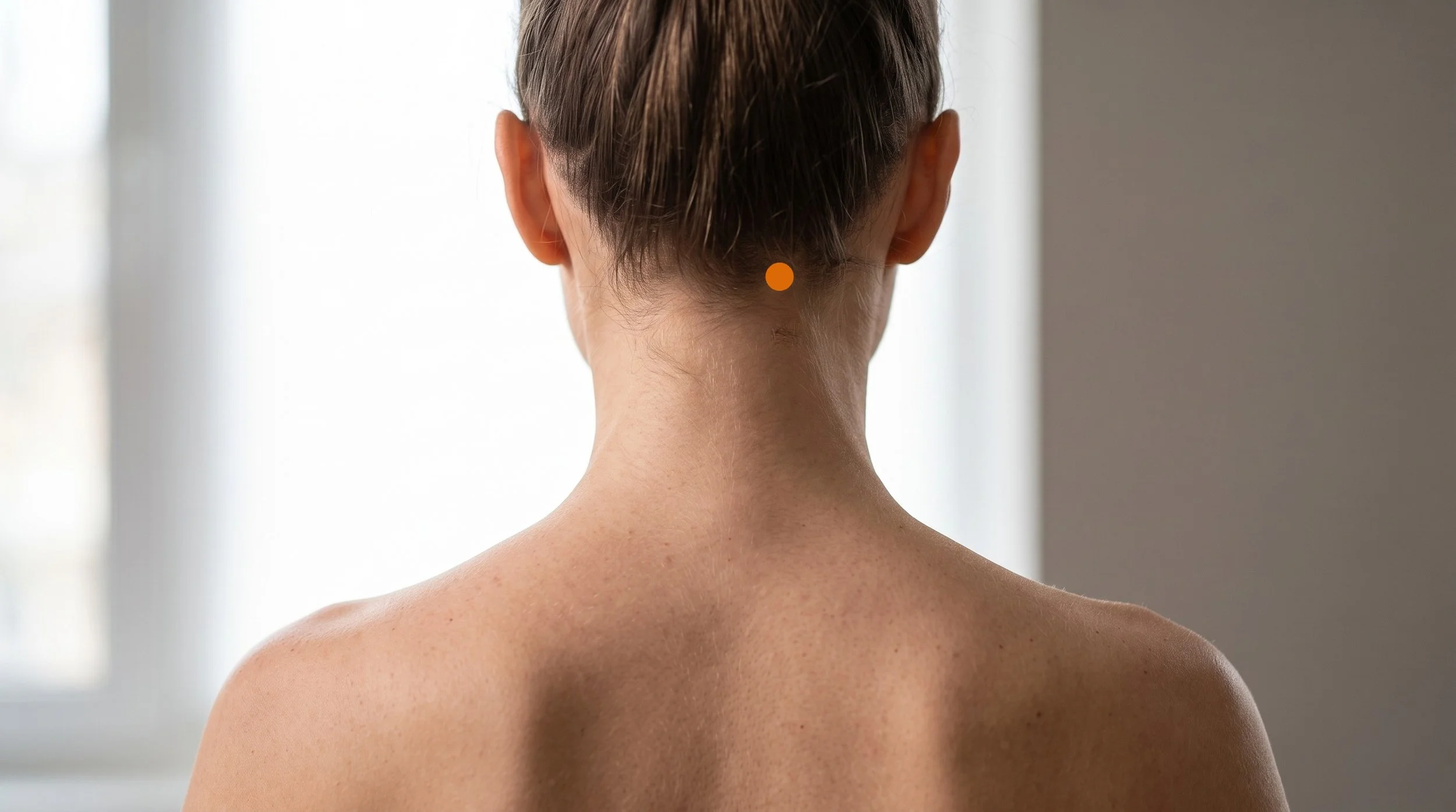
BL10 Acupuncture Point (Tianzhu)
The Celestial Pillar Below the Occiput: Anatomy, Mechanism, and Why This Suboccipital Point Anchors Neck Pain and Headache Treatment
BL10 (Tianzhu, often translated as Celestial Pillar) is the tenth point of the Bladder channel and sits at the back of the neck just below the skull, on the outer edge of the upper trapezius roughly 1.3 cun to either side of the midline.
In plain terms, it is the thick, ropey band you find when you slide your thumbs up the back of your neck until they stop against the bony rim of the occiput. That small patch of tissue is one of the busiest crossroads in the body: cervical extensor muscles anchor there, the greater occipital nerve travels through the same neighborhood, and sensory input from the upper neck converges with input from the head and face in the brainstem.
Clinically, the bl10 acupuncture point is one of the highest-yield locations in modern neck and headache practice, and it is used for stiff necks that will not rotate, for headaches that wrap over the head or settle behind the eyes, and for the shoulder and upper back tension that so often travels with them.
- BL10 is located at the suboccipital margin on the lateral border of the upper trapezius, about 1.3 cun lateral to GV15, with semispinalis capitis directly underneath and the small suboccipital muscles deeper still; the conventional technique is perpendicular insertion of roughly 0.5 to 0.8 cun (Deadman et al., 2007).
- Classical texts list Tianzhu as a Window of Heaven point and traditionally credit it with pacifying wind, benefiting the head and sensory orifices, calming the spirit, and freeing the channel, with indications clustering around head heaviness, stiff neck, eye pain, dizziness and nasal symptoms (Deadman et al., 2007). We present those categories as traditional attributions rather than physiology.
- Neurophysiologically, the point sits in C1 to C3 dorsal ramus territory, close to the course of the greater occipital nerve. Experimental work shows that upper cervical afferents and dural or trigeminal afferents converge on the same second-order neurons in the trigeminocervical complex, which is why neck input can be felt as head pain (Bartsch & Goadsby, 2002).
- Needling appears to work through segmental inhibition at the dorsal horn plus descending pain-modulating pathways and endogenous opioid mechanisms, not through anything mystical (Zhao, 2008). Reviews of acupuncture for chronic pain, including neck pain, report modest but persisting benefits over sham and usual care (Vickers et al., 2018).
- For headache specifically, Cochrane reviews suggest acupuncture may reduce the frequency of tension-type headache and episodic migraine when added to usual care, with a smaller advantage over sham needling (Linde et al., 2016a; Linde et al., 2016b). Suboccipital protocols are nearly always multi-point, so BL10 is one contributor rather than the whole treatment.
- De qi at BL10 is typically a deep, heavy, slightly spreading ache under the rim of the skull that some patients feel climb toward the crown or behind the eye. When a taut band in semispinalis or upper trapezius is engaged, a brief twitch and a familiar referral pattern are common (Simons et al., 1999).
Stiff Neck That Will Not Turn or Headaches That Start at the Base of Your Skull?
BL10 is one of the first places we palpate when a patient walks in with an upper neck that feels locked and a headache creeping over the scalp. At Morningside Acupuncture, we combine gentle needling of the suboccipital border with dry needling of the trapezius, splenius and semispinalis when those muscles are involved, then add distal points to broaden the response. Most people notice easier rotation and less pressure behind the eyes within the first few visits. Schedule a session and let's map where your neck is actually driving the pain.
Schedule NowAnatomy of BL10: Why the Suboccipital Trapezius Border Is Such an Important Location
Working from the surface inward, a needle at BL10 passes through skin and subcutaneous tissue into the lateral edge of the upper trapezius, then into splenius capitis and semispinalis capitis, the thick vertical column that fills the back of the neck. Deeper and slightly more medial sit the small suboccipital muscles, including rectus capitis posterior major and obliquus capitis superior, which fine-tune the position of the head on the top two vertebrae. These are postural muscles that never fully switch off.
Sustained screen work, phone use, driving, heavy bags on one shoulder and reading in bed all keep them in a low-level isometric hold, and that chronic loading is exactly what makes this area tender in so many patients.
The nerve geography here matters more than at almost any other point on the neck. The tissue at BL10 is supplied by the dorsal rami of the upper cervical nerves, and the greater occipital nerve, a branch of the C2 dorsal ramus, travels through this same region on its way to the back of the scalp. In animal recordings, stimulation of the greater occipital nerve, especially of muscle afferents rather than skin, facilitates responses in neurons that also receive dural input, demonstrating a functional continuum between upper cervical segments and the trigeminal system (Bartsch & Goadsby, 2002).
That convergence gives a mechanical explanation for something patients describe constantly: pressure at the base of the skull that is felt as pain over the head or behind the eye. Needling into this segment introduces a strong, controlled afferent volley that may reduce dorsal horn excitability and recruit descending inhibitory pathways along with endogenous opioid mechanisms (Zhao, 2008).
Deep to the suboccipital region lie structures that demand respect: the vertebral artery as it loops through the suboccipital triangle, and, medially, the gap between the occiput and the atlas leading toward the foramen magnum. BL10 itself sits lateral to the midline over a substantial cushion of muscle, which is one reason it is a comparatively forgiving point, but conventional practice is deliberately conservative: perpendicular insertion of about 0.5 to 0.8 cun, with no deep needling angled upward and inward toward the midline (Deadman et al., 2007).
In our clinic, depth is matched to body type and tissue tension, the needle is directed into the muscle mass rather than toward bone or midline, and the patient's head is supported in neutral or slight flexion throughout.
Related Acupuncture For Neck Pain Related Best Acupuncture Points For HeadachesBL10 at a Glance: Classification, Location, and Clinical Use
| Category | Detail |
|---|---|
| Traditional Name | Tianzhu (Celestial Pillar), Bladder 10 |
| Channel Classification | Tenth point of the Foot Taiyang Bladder channel, in the cervical portion of the channel as it ascends to the head (BL10, also written UB10; also called the Urinary Bladder channel) |
| Point Categories | Point of the Window of Heaven, one of five such points named in Chapter 21 of the Spiritual Pivot; no five-shu, back-shu or extraordinary vessel designation is attributed to this point in the classical sources consulted |
| Precise Location | At the back of the neck just below the skull, on the lateral edge of the trapezius, 1.3 cun lateral to GV15. Locate GV16 directly below the occipital protuberance, drop 0.5 cun to GV15 within the hairline, then measure 1.3 cun laterally |
| Tissue Stimulated | Lateral upper trapezius, splenius capitis and semispinalis capitis at the occipital margin, with the suboccipital group lying deeper and slightly medial; greater occipital nerve territory |
| Needle Depth / Direction | Perpendicular insertion 0.5 to 0.8 cun into the muscle mass, needle kept lateral to the midline and never angled deeply upward and inward toward the foramen magnum |
| De Qi Sensation | Deep, heavy, spreading ache under the rim of the skull, often travelling toward the vertex or behind the eye; a brief local twitch is common when a taut band is engaged |
| Primary Clinical Uses | Neck stiffness with restricted rotation, headache including occipital and retro-orbital patterns, shoulder and upper back pain, and dizziness in classical use |
| Common Point Combinations |
|
In Deadman's A Manual of Acupuncture, Tianzhu is presented as a Window of Heaven point and is traditionally said to regulate qi and pacify wind, benefit the head and sensory orifices, calm the spirit, and free the channel to relieve pain.
The classical indication lists group into four recognizable clusters: head and neck complaints such as heaviness of the head, headache and a neck too stiff to turn; sensory orifice problems involving the eyes, nose and throat; disorders of the lower body, including legs that cannot support the weight; and severe mental-emotional presentations described in the old texts in the idiom of their time.
The commentary explains these through the idea of chaotic qi surging upward to the head while the lower body is left unsupported, and notes that Tianzhu was chosen when symptoms crowded the head and the legs weakened at the same time. It also observes that although Tianzhu and the nearby GB20 share many indications, tradition assigned GB20 the broader role with exterior wind while confining Tianzhu mainly to interior wind.
What makes the classical pattern striking is how neatly the head-and-neck cluster maps onto what clinicians still see today: upper cervical tissue that refers into the skull, behind the eyes and down into the shoulder.
Why BL10 Is Used for Headaches That Settle Behind the Eyes
Patients are often surprised that a point at the base of the skull can change pain felt at the forehead, temple or behind the eye. The explanation is anatomical rather than mysterious. Sensory fibers from the upper neck, including the greater occipital nerve from the C2 root, terminate in the same brainstem and upper cervical region that receives input from the trigeminal nerve, which supplies the front of the head and the pain-sensitive coverings of the brain.
Recordings from these neurons show convergent input from both territories, and stimulating the occipital nerve increases their responsiveness to dural input (Bartsch & Goadsby, 2002). When the tissue around BL10 is irritable, that segment is already primed, and the brain can misattribute the source of the signal to the front of the head.
Needling at BL10 gives that same convergent segment a strong, brief, controlled input. Current models of acupuncture analgesia describe how such stimulation may dampen transmission at the dorsal horn, activate descending inhibitory pathways from the brainstem, and release endogenous opioid peptides, producing effects that outlast the needle by hours to days (Zhao, 2008). Alongside that, needling reduces local muscle tone and improves blood flow in the treated tissue, which matters when the extensors have been in a low-grade hold all day.
There is also preliminary point-specific physiological work. In a clinical study of patients with cerebrovascular symptoms including headache and dizziness, transcranial Doppler measures showed changes in cerebral vessel indices that differed by point, with needling at BL10 associated with a reduction in posterior cerebral artery resistance (Kim et al., 2016).
That study was small in per-point terms and not designed to prove clinical benefit, so it is best read as a hint that stimulation here can influence vascular tone in the back of the head rather than as evidence that BL10 treats any specific vascular condition.
What the Research Shows for BL10
One honest caveat before the table: almost no trial isolates a single acupuncture point. Studies test multi-point protocols delivered over several weeks, and BL10 typically appears inside neck and headache prescriptions alongside GB20, GB21, BL11, SI3, LI4 and local tender points. The evidence below therefore speaks to the treatment approach that BL10 belongs to, not to the point in isolation.
Read together, the literature suggests acupuncture and dry needling may offer meaningful relief for chronic neck pain and for headache prevention, with effects that are moderate rather than dramatic and that tend to hold up better against usual care than against sham needling.
| Study | Type | Focus | Key Finding |
|---|---|---|---|
| Linde et al., 2016a | Cochrane systematic review | Acupuncture for the prevention of tension-type headache | Adding acupuncture to usual care was associated with a substantially larger proportion of participants whose headache frequency at least halved, with a smaller advantage over sham needling. |
| Linde et al., 2016b | Cochrane systematic review | Acupuncture for the prevention of episodic migraine | Acupuncture may reduce migraine frequency compared with usual care and sham, and participants reported fewer adverse effects than those on prophylactic drugs. |
| Vickers et al., 2018 | Individual patient data meta-analysis | Chronic pain conditions including neck and shoulder pain and headache | Acupuncture was more effective than both sham and no-acupuncture control, with benefits persisting over roughly a year rather than fading immediately. |
| Fang et al., 2024 | Systematic review and meta-analysis | Durability of acupuncture effects in chronic neck pain | Across 18 randomized trials, acupuncture used as an adjunct therapy was associated with sustained pain relief at three and six months after treatment ended. |
| Mousavi-Khatir et al., 2022 | Randomized controlled trial | Dry needling of cervical muscles added to physical therapy for cervicogenic headache | Adding real dry needling to conventional physiotherapy was compared with sham needling and physiotherapy alone, supporting needling of the cervical muscles as a reasonable adjunct. |
| Dunning et al., 2021 | Multicenter randomized clinical trial | Spinal manipulation plus electrical dry needling of the suboccipital region and occipital nerves in cervicogenic headache | The manipulation plus needling group showed greater improvement in headache intensity, frequency, duration and disability than mobilization with exercise over four weeks. |
| Kim et al., 2016 | Clinical physiological study using transcranial Doppler | Cerebral blood flow indices after needling of individual Bladder and Gall Bladder channel points, including BL10 | Needling at BL10 was associated with reduced posterior cerebral artery resistance, a preliminary finding that suggests vascular effects without establishing clinical benefit. |
Desk Posture, Screen Time, and the Pillar at the Back of Your Neck
Hours at a laptop keep the cervical extensors in a constant low-grade hold, and the tissue around BL10 is where that load tends to concentrate. We use this point as part of a broader plan that addresses the upper traps, the scapular stabilizers and the way your head sits over your shoulders. Treatment is paired with practical between-session advice so the relief holds longer than the appointment. Book a visit and we'll build the plan around your actual workday.
Schedule NowBL10 in the Context of Trigger Point Work
BL10 sits directly over tissue that trigger point clinicians treat constantly. Semispinalis capitis harbors tender bands whose referral wraps around the side of the head like a band or cap, splenius capitis can send pain to the vertex, and the upper trapezius classically refers up the back of the neck toward the temple and behind the eye (Simons et al., 1999). Because the classical location and the myofascial targets overlap so closely, needling BL10 in a patient with an irritable cervical extensor group often reproduces the very headache they came in describing, which is diagnostically useful in itself.
At Morningside Acupuncture, BL10 is rarely used alone. A typical upper neck and headache session might combine needling at BL10 and GB20 with dry needling of the upper trapezius, splenius capitis, semispinalis and, when indicated and appropriate, the deeper suboccipital group, followed by distal points such as SI3 or LI4 to broaden the analgesic response. Trial evidence from cervicogenic headache supports needling of the cervical musculature as an adjunct to manual therapy and exercise (Mousavi-Khatir et al., 2022; Dunning et al., 2021).
We match needle depth and stimulation to tissue tone and patient sensitivity, since this region responds well to modest input and does not need aggressive technique.
BL10 Neck and Headache Treatment at NYC's Highest-Rated Acupuncture Clinic
Morningside Acupuncture is the highest-rated acupuncture and dry needling clinic in New York City with over 500 five-star Google reviews, and upper neck and headache cases are among the most common reasons patients come to us. Our licensed acupuncturists use BL10 alongside orthopedic assessment, trigger point dry needling and clear home guidance rather than a one-size-fits-all point recipe. Sessions are calm, precise and built around how your symptoms actually behave. Schedule your appointment and get the base of your skull working again.
Schedule NowFrequently Asked Questions
What does BL10 feel like when needled?
Most people feel a brief pinch at the skin, then a deep, heavy, spreading ache under the rim of the skull as the needle settles into the muscle band. The sensation often travels a short distance toward the top of the head or behind the eye, which mirrors the referral patterns this region produces, and a quick local twitch is common when the needle engages a taut band. The ache eases within a few moments of the needle being retained, and most patients describe the after effect as a looser, lighter feeling at the base of the skull.
Why does needling the back of my neck help a headache I feel behind my eyes?
Sensory nerves from the upper neck, including the greater occipital nerve, feed into the same brainstem relay that receives input from the trigeminal nerve supplying the forehead, temple, and eye region. Because these inputs converge on shared neurons, irritation in the upper neck can be felt in front of the head, and calming the neck side of that shared circuit can change what is felt behind the eye. This convergence is why occipital and retro orbital headache patterns respond so often to work at BL10 and its neighbors.
Can I press BL10 myself between sessions?
Yes, acupressure here is easy and safe. Slide your thumbs up the back of your neck until they stop against the bony rim of the skull, then let them settle into the thick, ropey band of muscle about a thumb's width out from the midline on each side. Press into the muscle with slow, steady pressure or small circles for 30 to 60 seconds while breathing slowly, and keep the pressure directed into the muscle rather than digging deeply upward under the skull. Moderate, comfortable pressure works better than force.
Is BL10 safe to needle?
In trained hands, yes. The needle is placed perpendicularly into the muscle mass to a depth of 0.5 to 0.8 cun, kept lateral to the midline, and never angled deeply upward and inward toward the foramen magnum, a rule every licensed acupuncturist learns for this region. Within those limits the point sits in thick, forgiving muscle. The common minor effects are the same as at other neck points: brief soreness, a small bruise, or a short lived feeling of heaviness at the base of the skull.
Where exactly is BL10 located?
BL10 is at the back of the neck just below the skull, on the lateral edge of the upper trapezius, 1.3 cun lateral to GV15. To find it, locate GV16 in the hollow directly below the external occipital protuberance, drop 0.5 cun to GV15 within the posterior hairline, then measure 1.3 cun to the side. In practice it is the spot where your thumbs naturally stop against the occipital rim when you slide them up the ropey bands of the neck.
References
- Deadman, P., Al-Khafaji, M., & Baker, K. (2009). A manual of acupuncture. Journal of Chinese Medicine Publications.
- Cheng, X. (Ed.). (1999). Chinese acupuncture and moxibustion (Rev. ed.). Foreign Languages Press.
- Simons, D. G., Travell, J. G., & Simons, L. S. (1999). Travell & Simons' myofascial pain and dysfunction: The trigger point manual, Vol. 1: Upper half of body (2nd ed.). Williams & Wilkins.
- Bartsch, T., & Goadsby, P. J. (2002). Stimulation of the greater occipital nerve induces increased central excitability of dural afferent input. Brain, 125(7), 1496-1509. https://doi.org/10.1093/brain/awf166
- Zhao, Z. Q. (2008). Neural mechanism underlying acupuncture analgesia. Progress in Neurobiology, 85(4), 355-375. https://doi.org/10.1016/j.pneurobio.2008.05.004
- Vickers, A. J., Vertosick, E. A., Lewith, G., MacPherson, H., Foster, N. E., Sherman, K. J., Irnich, D., Witt, C. M., & Linde, K. (2018). Acupuncture for chronic pain: Update of an individual patient data meta-analysis. Journal of Pain, 19(5), 455-474. https://doi.org/10.1016/j.jpain.2017.11.005
- Linde, K., Allais, G., Brinkhaus, B., Fei, Y., Mehring, M., Shin, B. C., Vickers, A., & White, A. R. (2016a). Acupuncture for the prevention of tension-type headache. Cochrane Database of Systematic Reviews, 2016(4), CD007587. https://doi.org/10.1002/14651858.CD007587.pub2
- Linde, K., Allais, G., Brinkhaus, B., Fei, Y., Mehring, M., Vertosick, E. A., Vickers, A., & White, A. R. (2016b). Acupuncture for the prevention of episodic migraine. Cochrane Database of Systematic Reviews, 2016(6), CD001218. https://doi.org/10.1002/14651858.CD001218.pub3
- Fang, J., Shi, H., Wang, W., Chen, H., Yang, M., Gao, S., Yao, H., Zhu, L., Yan, Y., & Liu, Z. (2024). Durable effect of acupuncture for chronic neck pain: A systematic review and meta-analysis. Current Pain and Headache Reports, 28(9), 957-969. https://doi.org/10.1007/s11916-024-01267-x
- Mousavi-Khatir, S. R., Fernandez-de-las-Penas, C., Saadat, P., Javanshir, K., & Zohrevand, A. (2022). The effect of adding dry needling to physical therapy in the treatment of cervicogenic headache: A randomized controlled trial. Pain Medicine, 23(3), 579-589. https://doi.org/10.1093/pm/pnab312
- Dunning, J., Butts, R., Zacharko, N., Fandry, K., Young, I., Wheeler, K., Day, J., & Fernandez-de-las-Penas, C. (2021). Spinal manipulation and perineural electrical dry needling in patients with cervicogenic headache: A multicenter randomized clinical trial. The Spine Journal, 21(2), 284-295. https://doi.org/10.1016/j.spinee.2020.10.008
- Kim, S., Kim, Y. I., Sin, R. S., Rim, K. S., Pu, Y. J., Ri, K. I., Ri, G., & Kim, H. S. (2016). Study on cerebral blood flow regulatory features of acupuncture stimulation at various acupoints. Medical Acupuncture, 28(5). https://doi.org/10.1089/acu.2016.1175
Disclaimer: This web site is intended for educational and informational purposes only. Reading this website does not constitute providing medical advice or any professional services. This information should not be used for diagnosing or treating any health issue or disease. Those seeking medical advice should consult with a licensed physician. Seek the advice of a medical doctor or other qualified health professional for any medical condition. If you think you have a medical emergency, call 911 or go to the emergency room. No acupuncturist-patient relationship is created by reading this website or using the information. Morningside Acupuncture PLLC and its employees and contributors do not make any express or implied representations with respect to the information on this site or its use. For any legal interpretation of scope of practice in your state, consult a licensed attorney or regulatory authority.
Read more from our blog



