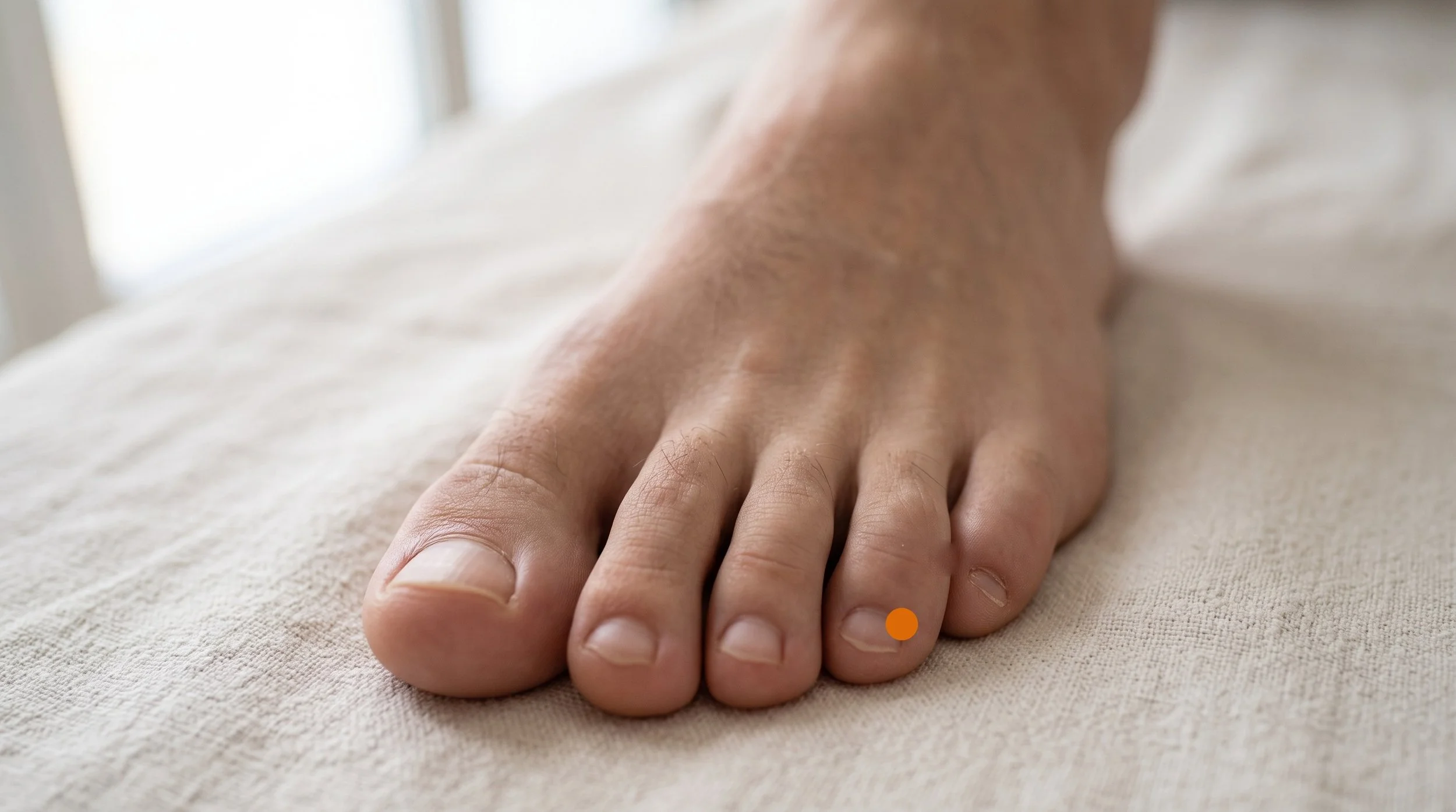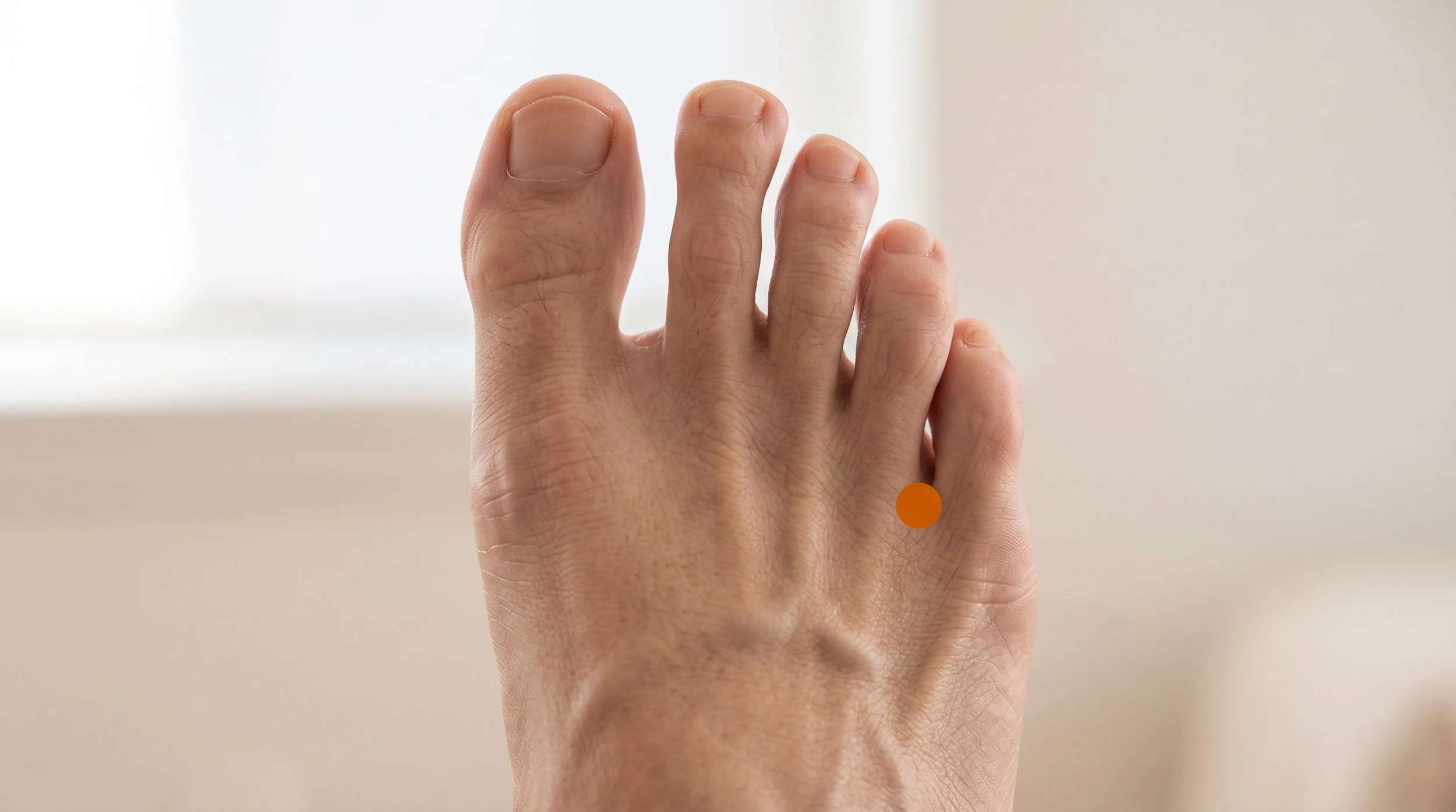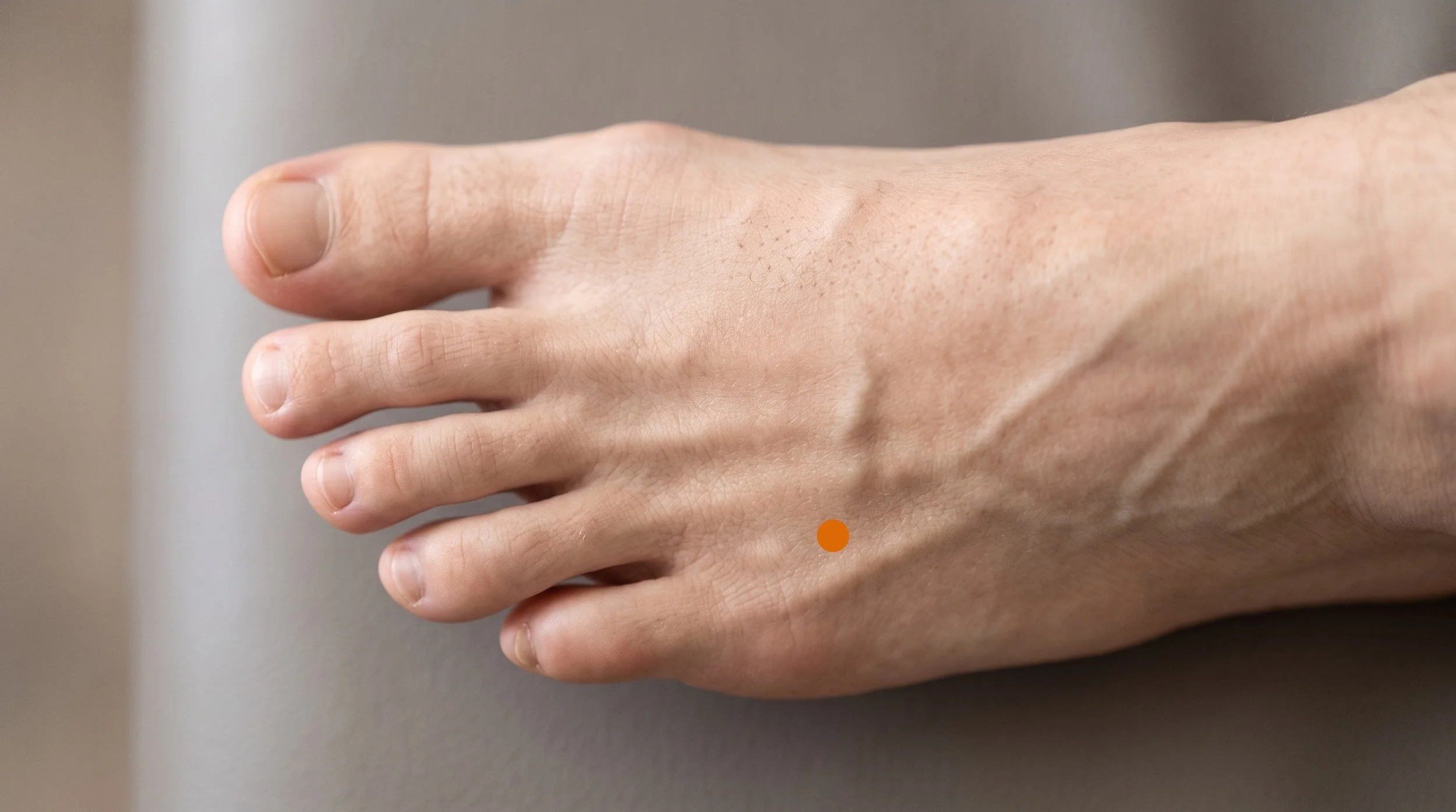
BL7 Acupuncture Point (Tongtian)
The Heavenly Connection at the Crown: Anatomy, Mechanism, and Why the Bladder Channel's Highest Point Is Used for the Nose and the Top of the Head
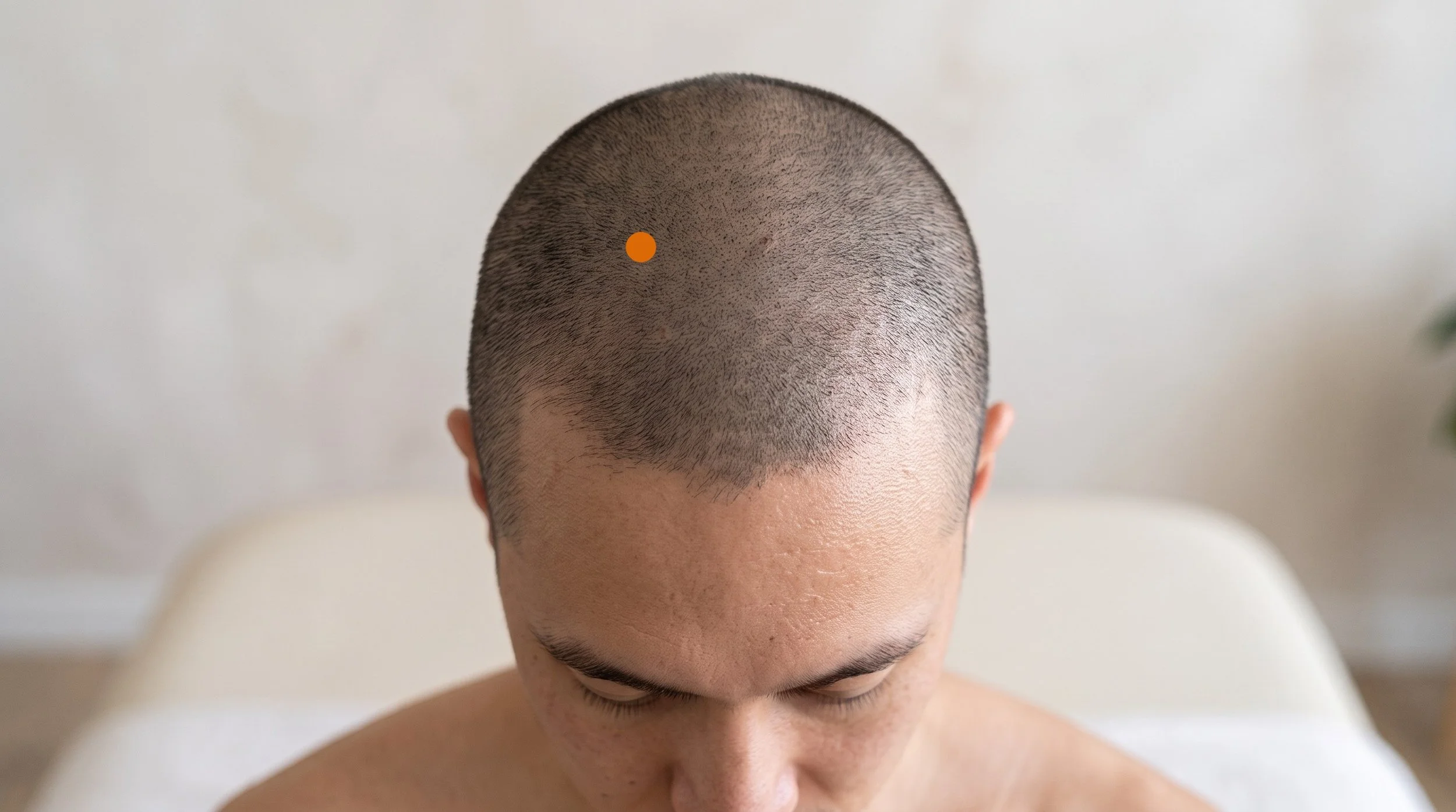
BL7 (Tongtian, often translated as Heavenly Connection or Reaching Heaven) sits on the top of the scalp just in front of and to the side of the crown, 4 cun behind the front hairline and 1.5 cun off the midline. In practical terms, if you find GV20 at the vertex, BL7 is roughly a thumb's width forward and a thumb-and-a-half out to either side.
It is the highest point on the Bladder channel and, in the classical literature, that channel's principal point for the nose, which is why a point on top of the head shows up again and again in treatments for congestion, thick or watery discharge, and a dulled sense of smell (Deadman et al., 2007). Clinically it also earns its place as a local point for vertex headache and for that heavy, pressurized, hard-to-think-through feeling across the top of the head that patients with sinus trouble describe so consistently.
- Location and layers: BL7 lies on the parietal scalp, 1 cun anterior and 1.5 cun lateral to GV20, and is needled transversely through skin, the vascular subcutaneous layer, and into or just above the galea aponeurotica rather than perpendicular into bone (Deadman et al., 2007).
- Traditional attributions translated: classical sources credit BL7 with benefiting the nose and clearing the head, language that maps onto modern accounts of trigeminal and autonomic influence over the nasal mucosa and of descending pain modulation for head pain (Deadman et al., 2007; Zhao, 2008).
- Nerve story: the point sits in a transition zone where terminal branches of the supraorbital nerve (trigeminal V1) meet the territory of the greater occipital nerve, the same convergence at the trigeminocervical complex that lets scalp stimulation influence frontal, facial, and vertex symptoms (Zhao, 2008).
- Research picture: Cochrane reviews support acupuncture as an option for preventing tension-type headache and episodic migraine, and reviews of acupuncture for allergic rhinitis report improvements in nasal symptoms and quality of life with modest effect sizes (Linde et al., 2016a; Linde et al., 2016b; He et al., 2022).
- Mechanism signal for the nose: a randomized study of needling near the sphenopalatine ganglion found improved nasal ventilation, lower nasal airway resistance, and increased neuropeptide Y, which the authors interpreted as increased sympathetic activity, a plausible model for how needling may reduce mucosal swelling (Wang et al., 2016).
- De qi and practice framing: scalp points give a distinctive tight, pulling, spreading pressure rather than a deep muscular ache, and BL7 is usually one element of a protocol combining local nasal points, distal points, and dry needling of neck and jaw muscles (Vickers et al., 2018; Simons et al., 1999).
Stuffed Up, Foggy, and Tired of Reaching for Another Decongestant?
Chronic congestion is rarely just a nose problem, and we treat it that way. At Morningside Acupuncture, BL7 is often paired with points beside the nostrils and on the forehead, plus needling of the neck and jaw muscles that feed head pressure and facial ache. Our licensed acupuncturists build a plan around your pattern, your season, and your triggers. Schedule a visit and let's see how your nose and head respond over a short series.
Schedule NowAnatomy of BL7: Why the Parietal Scalp Beside the Vertex Is Such an Important Location
The scalp at BL7 is a layered structure, and each layer matters for needling. Under the hair is thin skin, then a dense subcutaneous layer packed with small arteries, veins, and sensory nerve endings that are anchored in fibrous septa, then the galea aponeurotica, the tough tendinous sheet that links the frontal and occipital bellies of the occipitofrontalis. Beneath the galea is a loose areolar plane that lets the scalp glide, and below that the pericranium and parietal bone.
Because the galea is continuous with the frontalis in front and the occipitalis behind, sustained tension in the neck and forehead is transmitted across the crown, which is one reason patients describe head pressure as a helmet rather than a single spot. Reference texts place BL7 in this galeal plane and specify transverse needling along the scalp, forward or backward, rather than any attempt at depth (Deadman et al., 2007).
The nerve geography here is the interesting part. The front of the scalp is supplied by branches of the supraorbital and supratrochlear nerves from the ophthalmic division of the trigeminal nerve, the back by the greater occipital nerve from the C2 spinal root, and the side by the auriculotemporal nerve. BL7 sits close to where those territories meet. Trigeminal and upper cervical afferents converge on shared second-order neurons in the trigeminocervical complex, which is why input from the scalp can influence how the brain reads sensation coming from the forehead, the sinuses, and the upper neck.
Needle stimulation of these afferents also recruits descending inhibitory pathways from the midbrain and brainstem that dampen nociceptive transmission through endogenous opioid and monoamine mechanisms, the best-characterized mechanism for acupuncture analgesia (Zhao, 2008). Alongside this, needling can produce measurable autonomic and vascular changes, which is relevant when the target symptom is a swollen, congested mucosa rather than pain (Wang et al., 2016).
Vascular anatomy explains the practical cautions. The subcutaneous layer of the scalp contains an anastomotic network fed by the superficial temporal artery in front and the occipital artery behind, and these vessels are held open by the fibrous septa around them, so scalp bleeding is brisk and bruising is common if a vessel is nicked. That is a cosmetic and comfort issue, not a dangerous one, but it is why we press firmly on removal.
The parietal bone underneath is solid in adults, and transverse insertion of 0.5 to 1 cun keeps the needle in the superficial planes well away from anything deep (Deadman et al., 2007). Several modern texts list BL7 as contraindicated to moxibustion, so we do not use moxa here, and we screen for scalp lesions, recent craniotomy, cranial hardware, and anticoagulant use before needling any point on the head.
Related Bladder Channel Related Best Acupuncture Points For HeadachesBL7 at a Glance: Classification, Location, and Clinical Use
| Category | Detail |
|---|---|
| Traditional Name | Tongtian (BL7), rendered as Heavenly Connection, Reaching Heaven, or Opening Heaven |
| Channel Classification | Foot Taiyang Bladder channel, seventh point, the highest point of the channel on the head (BL7, also written UB7; also called the Urinary Bladder channel) |
| Point Categories | Not a five-shu point, command point, or hui-meeting point, and classical texts do not list it as a formal intersection point, though one commentary describes an internal branch running from BL7 to GV20 at the vertex. Its standing comes from function rather than category: it is the Bladder channel's chief point for the nose and a principal local point for the crown of the head (Deadman et al., 2007). |
| Precise Location | On the scalp, 4 cun behind the anterior hairline and 1.5 cun lateral to the midline, 1.5 cun posterior to BL6. Easiest landmark: locate GV20 at the vertex, then move 1 cun forward and 1.5 cun lateral. |
| Tissue Stimulated | Scalp skin, the vascular subcutaneous layer, and the galea aponeurotica linking the frontal and occipital bellies of occipitofrontalis, with sensory input from terminal supraorbital (V1) and greater occipital branches. Frequently combined in the same session with jaw and neck myofascial targets such as the lateral pterygoid. |
| Needle Depth / Direction | Transverse (subcutaneous) insertion 0.5 to 1 cun, angled forward toward BL6 or backward toward BL8 along the plane of the scalp. Some texts use a shallower 0.3 to 0.5 cun subcutaneous technique. Several modern sources contraindicate moxibustion at this point. |
| De Qi Sensation | A tight, pulling, slightly stretching feeling under the scalp that spreads a few centimeters around the needle, often with dull pressure or warmth. Some patients report a sensation of the nose or forehead loosening. It is a lighter, more diffuse sensation than the deep ache of a limb or muscle point. |
| Primary Clinical Uses | Nasal congestion, thick or watery discharge, rhinitis, reduced sense of smell, and nosebleed in classical use; vertex headache; heaviness, fullness, or pressure across the top of the head; facial and sinus pressure as part of a broader protocol. |
| Common Point Combinations |
|
The commentary in Deadman, Al-Khafaji, and Baker's A Manual of Acupuncture explains the point's name through two classical statements, one linking heavenly qi to the Lung and the other linking Lung qi to the nose, so that the nose becomes the gateway through which the qi of the air is taken in.
Read as traditional attribution rather than physiology, Tongtian means the point that keeps that gateway open, and the tradition treats it as one of the foremost points on the head for disorders of the nose, including rhinitis, loss of smell, nosebleed, and sores inside the nostrils, often noting tenderness on palpation in these cases. The same source describes its use where phlegm is said to obstruct the upper body, producing profuse discharge, a heavy head, facial puffiness, and labored breathing, and adds that Wu Qian's Golden Mirror text pairs it with GV23 for congestion, discharge, and polyps.
Its second role, as a local point for vertex headache of any cause, is the one most familiar to modern practitioners. What is striking is the coherence of the classical pattern: a point at the very top of the head, described as the channel's connection with heaven, used almost exclusively for two things, breathing freely through the nose and clearing pressure from the crown.
Why BL7 Is Used for a Blocked Nose When It Sits on Top of the Head
The short answer is convergence. Sensation from the nasal cavity, the sinuses, the forehead, and the front of the scalp all travels in the trigeminal system, and BL7 sits at the back edge of that territory where it meets the greater occipital nerve's supply from the C2 root. Those inputs share second-order neurons in the trigeminocervical complex in the upper spinal cord and brainstem. Stimulating one part of that shared pool can change how the whole region is processed, which is why a needle at the crown can alter symptoms felt behind the nose and eyes. It is the same neuroanatomy that explains why neck problems can produce frontal headache and why sinus pressure so often comes with a heavy scalp.
The second mechanism is descending inhibition. Needle stimulation that produces de qi recruits pathways from the periaqueductal gray and rostral ventromedial medulla that release endogenous opioids, serotonin, and norepinephrine at the spinal level and reduce nociceptive transmission, a process documented across animal and human studies (Zhao, 2008). This is the general engine behind acupuncture analgesia, and it fits the classical description of BL7 as a point that clears heaviness and pain from the head.
There is also an autonomic and vascular story that is specific to the nose. Nasal patency depends on how much blood is held in the venous sinusoids of the mucosa, which is under sympathetic control, so anything that shifts sympathetic tone can change how open the nose feels. A randomized controlled study of acupuncture directed at the sphenopalatine ganglion in healthy volunteers found improved self-reported nasal ventilation, reduced nasal airway resistance, and a rise in neuropeptide Y, a marker the authors linked to increased sympathetic activity (Wang et al., 2016).
That study used a different point and a different technique, so it does not prove anything about BL7 specifically. What it does show is that needling can produce measurable changes in nasal physiology, which makes the traditional use of scalp and face points for congestion biologically plausible rather than merely symbolic.
What the Research Shows for BL7
No trial has tested BL7 on its own, and it is unlikely one ever will. Acupuncture research evaluates whole protocols, usually six to twelve points chosen by pattern, so the honest way to read the evidence is that BL7 belongs to families of protocols that have been studied for headache and for nasal symptoms, and that the reviews of those protocols are cautiously encouraging with real limitations. Effect sizes over sham are often modest, blinding is difficult, and heterogeneity between trials is high. Below is the evidence that most directly frames how we use this point, along with what it does and does not establish.
| Study | Type | Focus | Key Finding |
|---|---|---|---|
| Linde et al., 2016a | Cochrane systematic review | Acupuncture for the prevention of tension-type headache | The review concluded acupuncture may be a useful non-pharmacological option for frequent episodic or chronic tension-type headache, with benefit over usual care and a smaller advantage over sham. |
| Linde et al., 2016b | Cochrane systematic review | Acupuncture for the prevention of episodic migraine | Acupuncture reduced headache frequency compared with no prophylaxis and sham, and was at least as effective as prophylactic drugs with fewer reported adverse effects, on moderate quality evidence. |
| He et al., 2022 | Systematic review and meta-analysis with trial sequential analysis | Acupuncture for allergic rhinitis across 30 trials and 4,413 participants | Acupuncture improved nasal symptom scores and rhinitis-related quality of life compared with no intervention and with sham, though effect sizes were modest and robustness varied by outcome. |
| Brinkhaus et al., 2013 | Multicenter randomized controlled trial (422 participants) | Acupuncture plus rescue medication versus sham plus rescue medication versus rescue medication alone in seasonal allergic rhinitis | Acupuncture produced statistically significant improvements in quality of life and medication use compared with both controls, but the authors judged the clinical significance of the difference over sham to be uncertain. |
| Wang et al., 2016 | Randomized controlled mechanistic study in healthy volunteers | Nasal ventilation, nasal airway resistance, and neuropeptides after sphenopalatine ganglion acupuncture | Active needling improved reported nasal ventilation and reduced nasal airway resistance with a rise in neuropeptide Y, suggesting a sympathetically mediated reduction in mucosal congestion. |
| Vickers et al., 2018 | Individual patient data meta-analysis (about 20,800 patients) | Acupuncture for chronic pain, including chronic headache | Acupuncture was superior to both sham and no-acupuncture control for chronic pain conditions, with effects that persisted over twelve months and were only modestly reduced over time. |
| Zhao, 2008 | Narrative review of neurophysiology | Neural mechanisms of acupuncture analgesia | Reviews evidence that needle stimulation activates afferent fibers and engages descending inhibitory pathways using endogenous opioids and monoamines to reduce nociceptive transmission. |
Is the Pressure Sitting Right on Top of Your Head?
Vertex headache, heaviness, and that band of tightness across the crown respond well to careful local work, and BL7 is one of our go-to points for it. We combine crown and occipital points with dry needling of the suboccipitals, upper trapezius, and temporalis when exam findings call for it. Most patients feel a change in head pressure within the first few sessions. Book an evaluation and we will map your headache pattern before we needle a thing.
Schedule NowBL7 in the Context of Trigger Point Work
Acupuncture at Morningside means the use of an acupuncture needle, and that includes dry needling of myofascial trigger points. BL7 itself is not a muscle target: the scalp here is skin, fascia, and the galea, so the needling is superficial and the intent is neuromodulatory. What makes it useful in a trigger point session is what surrounds it.
Trigger points in the suboccipitals, upper trapezius, sternocleidomastoid, temporalis, and splenius capitis are well described as sources of referred pain into the vertex, forehead, and behind the eye, and several of these patterns include facial or maxillary referral that patients interpret as sinus pain (Simons et al., 1999). When palpation reproduces a patient's familiar headache from one of those muscles, we treat the muscle and use BL7 as a local scalp point in the same visit.
A typical session for congestion with head pressure might combine BL7 and GV23 or GV20 on the scalp, LI20 beside the nostril, LI4 distally, then dry needling of the suboccipitals and upper trapezius, with the [lateral pterygoid](https://www.morningsideacupuncturenyc.com/lateral-pterygoid-trigger-points) added when jaw clenching and maxillary-region pressure are part of the picture. The order matters less than the reasoning: local points address the region, myofascial work addresses the mechanical drivers, and distal points support the systemic response. Scalp needles are usually retained while the deeper work is performed, and they tend to be the most comfortable needles in the treatment.
BL7 Nasal Congestion and Headache Treatment at NYC's Highest-Rated Acupuncture Clinic
Morningside Acupuncture is the highest-rated acupuncture and dry needling clinic in New York City with over 500 five-star Google reviews, and our team blends classical point selection with modern pain science. For nasal congestion, sinus pressure, and vertex headache we use BL7 alongside targeted facial, distal, and myofascial work in a single focused session. Everything is explained as we go, so you know why each needle is placed. Schedule your appointment and start with a full head and neck assessment.
Schedule NowFrequently Asked Questions
What does BL7 feel like when needled?
Because BL7 is needled transversely just under the scalp, the sensation is different from a limb point. Most people feel a brief pinch as the needle passes the skin, then a tight, pulling, slightly stretching feeling that spreads a short distance around the needle. Some describe dull pressure, warmth, or a sense that the forehead or nose has loosened. It should not be sharply painful, and if it is, the needle angle is adjusted. Scalp points can occasionally bleed a drop or two on removal because the subcutaneous layer is richly vascular, so we apply firm pressure afterward.
Why treat the top of my head for a problem in my nose?
Sensation from the nose, sinuses, forehead, and front of the scalp all runs in the trigeminal system, and these inputs converge with upper cervical inputs on shared neurons in the brainstem and upper spinal cord. Stimulating one part of that shared territory can change how the whole region is processed, which is the neurophysiological version of what classical texts described when they called BL7 the channel's point for keeping the nose open (Deadman et al., 2007; Zhao, 2008). Needling can also produce measurable autonomic changes in nasal blood flow and airway resistance, which is directly relevant to congestion (Wang et al., 2016). In practice we rarely use BL7 alone; it works within a protocol that usually includes points beside the nose and on the hands.
Can I press BL7 myself between sessions?
Yes, acupressure at BL7 is safe and easy to self-administer. Find the crown of your head by tracing a line up from the tops of your ears to the midline, then move about a thumb's width forward and a thumb-and-a-half out to one side; you are usually within range when you find a spot that feels tender, tight, or slightly boggy. Use the pad of your index or middle finger and apply steady, moderate pressure with small circles for 30 to 60 seconds per side, breathing slowly through your nose if you can. Repeat two or three rounds, two or three times a day during a congested stretch, and pair it with 30 seconds of pressure at LI20 beside each nostril for a fuller effect. Stop if you feel lightheaded or if pressure sharpens the headache instead of easing it, and skip it entirely over any cut, rash, or recent scalp surgery.
Is BL7 safe to needle?
In trained hands, yes. The needle is inserted transversely into the superficial scalp layers, so there is no risk to deeper structures, and the adult parietal bone lies safely beneath. The main practical issues are minor bleeding or a small bruise from the vascular subcutaneous plexus, which we minimize with firm post-needle pressure. Several modern texts list BL7 as contraindicated to moxibustion, so we do not apply moxa here (Deadman et al., 2007). We avoid needling over open scalp lesions, active infection, recent cranial surgery, or implanted cranial hardware, and we take extra care with patients on anticoagulants or with bleeding disorders. Always have scalp points needled by a licensed acupuncturist rather than attempting it yourself.
Where exactly is BL7 located?
BL7 is on the scalp, 4 cun behind the anterior hairline and 1.5 cun lateral to the midline, which places it 1.5 cun behind BL6 on the same line. The simplest clinical landmark is GV20 at the vertex, the point where a line drawn between the ear apexes crosses the midline: from there, BL7 is 1 cun anterior and 1.5 cun lateral, on both the left and right. Another method measures the midline from the glabella to the lower border of the occipital protuberance as 14 cun and places BL7 1.5 cun lateral to the midpoint of that line (Deadman et al., 2007). Because it is a bilateral point, it is usually needled on both sides, and palpation often finds one side noticeably more tender.
References
- Deadman, P., Al-Khafaji, M., & Baker, K. (2009). A manual of acupuncture. Journal of Chinese Medicine Publications.
- O'Connor, J., & Bensky, D. (Eds. & Trans.). (1981). Acupuncture: A comprehensive text. Shanghai College of Traditional Medicine. Eastland Press.
- Kim, H. (2008). Handbook of Oriental medicine (3rd ed.). Harmony & Balance Press.
- Cunningham, P. M. (2000). Acupuncture points: A practical guide to classical and modern usage. Odyssey Press.
- Simons, D. G., Travell, J. G., & Simons, L. S. (1999). Travell & Simons' myofascial pain and dysfunction: The trigger point manual, Vol. 1: Upper half of body (2nd ed.). Williams & Wilkins.
- Linde, K., Allais, G., Brinkhaus, B., Fei, Y., Mehring, M., Shin, B.-C., Vickers, A., & White, A. R. (2016a). Acupuncture for the prevention of tension-type headache. Cochrane Database of Systematic Reviews, 2016(4), CD007587. https://doi.org/10.1002/14651858.CD007587.pub2
- Linde, K., Allais, G., Brinkhaus, B., Fei, Y., Mehring, M., Vertosick, E. A., Vickers, A., & White, A. R. (2016b). Acupuncture for the prevention of episodic migraine. Cochrane Database of Systematic Reviews, 2016(6), CD001218. https://doi.org/10.1002/14651858.CD001218.pub3
- He, M., Qin, W., Qin, Z., & Zhao, C. (2022). Acupuncture for allergic rhinitis: A systematic review and meta-analysis. European Journal of Medical Research, 27(1), 58. https://doi.org/10.1186/s40001-022-00682-3
- Brinkhaus, B., Ortiz, M., Witt, C. M., Roll, S., Linde, K., Pfab, F., Niggemann, B., Hummelsberger, J., Treszl, A., Ring, J., Zuberbier, T., Wegscheider, K., & Willich, S. N. (2013). Acupuncture in patients with seasonal allergic rhinitis: A randomized trial. Annals of Internal Medicine, 158(4), 225-234. https://doi.org/10.7326/0003-4819-158-4-201302190-00002
- Wang, K., Chen, L., Wang, Y., Wang, C., & Zhang, L. (2016). Sphenopalatine ganglion acupuncture improves nasal ventilation and modulates autonomic nervous activity in healthy volunteers: A randomized controlled study. Scientific Reports, 6, 29947. https://doi.org/10.1038/srep29947
- Vickers, A. J., Vertosick, E. A., Lewith, G., MacPherson, H., Foster, N. E., Sherman, K. J., Irnich, D., Witt, C. M., & Linde, K. (2018). Acupuncture for chronic pain: Update of an individual patient data meta-analysis. Journal of Pain, 19(5), 455-474. https://doi.org/10.1016/j.jpain.2017.11.005
- Zhao, Z. Q. (2008). Neural mechanism underlying acupuncture analgesia. Progress in Neurobiology, 85(4), 355-375. https://doi.org/10.1016/j.pneurobio.2008.05.004
Disclaimer: This web site is intended for educational and informational purposes only. Reading this website does not constitute providing medical advice or any professional services. This information should not be used for diagnosing or treating any health issue or disease. Those seeking medical advice should consult with a licensed physician. Seek the advice of a medical doctor or other qualified health professional for any medical condition. If you think you have a medical emergency, call 911 or go to the emergency room. No acupuncturist-patient relationship is created by reading this website or using the information. Morningside Acupuncture PLLC and its employees and contributors do not make any express or implied representations with respect to the information on this site or its use. For any legal interpretation of scope of practice in your state, consult a licensed attorney or regulatory authority.
Read more from our blog