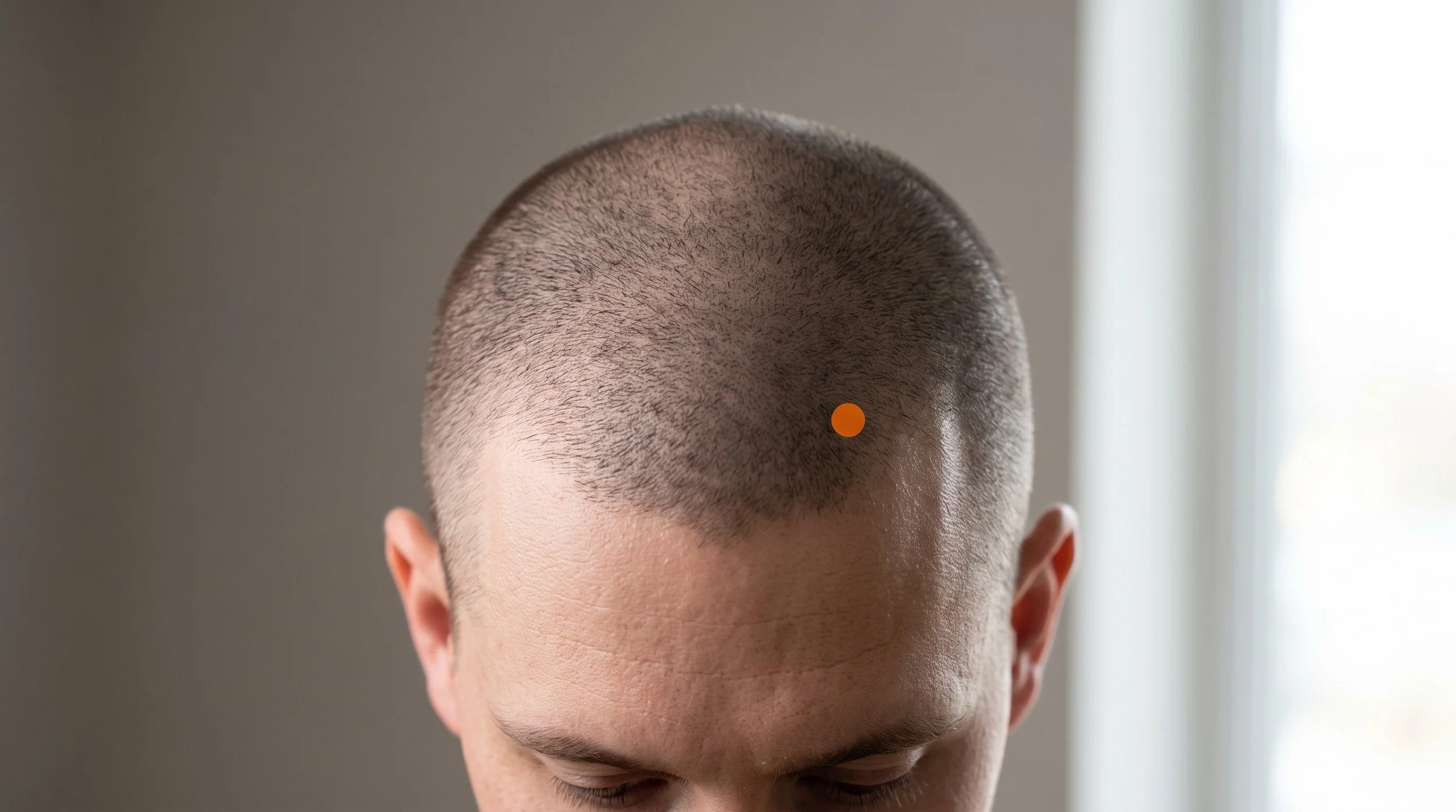
BL5 Acupuncture Point (Wuchu)
The Fifth Place on the Front Scalp: Anatomy, Mechanism, and Why This Hairline Point Supports Frontal Headache and Nasal Congestion Care
BL5, known in Chinese as Wuchu and usually translated as Fifth Place (Maciocia renders the name as Five Places), is the fifth point of the Bladder channel and the second of the four Bladder points that march back across the top of the head. It sits on the scalp just inside the front hairline, half a cun behind BL4 and a cun and a half out to the side of the midline, which in practical terms puts it roughly two finger widths above the eyebrow line and off to the side of the forehead's center.
Because it lies in skin supplied by the first division of the trigeminal nerve and directly over the galea, the fibrous sheet that the forehead and occiput pull against, the bl5 acupuncture point is used clinically for frontal headache, pressure behind the eye, a heavy or foggy head, and blocked nasal breathing. It is rarely the star of a prescription, but as part of the anterior hairline group it gives clinicians a way to put gentle, tangential needle input right into the territory where forehead pain is felt.
- Location and layers: BL5 sits 0.5 cun behind BL4, 1 cun inside the anterior hairline and 1.5 cun lateral to GV23, so the needle passes through thin scalp skin, dense subcutaneous tissue, and the edge of the galea aponeurotica rather than into muscle bulk (Deadman et al., 2007).
- Traditional categories, translated: classical sources credit BL5 with dispelling wind, drawing yang downward, clearing heat, and opening the head and nose (Deadman et al., 2007), which maps onto a modern reading of reduced trigeminal sensitization, altered scalp and mucosal blood flow, and a calmer autonomic tone rather than any literal flow of energy.
- Nerve story: the point lies in the overlap zone of the supratrochlear and supraorbital branches of the ophthalmic division of the trigeminal nerve, whose central terminals converge with upper cervical afferents in the trigeminocervical complex, a convergence that helps explain why forehead points may influence pain felt behind the eye and at the back of the head (Zhao, 2008).
- Research picture: no trial has isolated BL5, so its support is indirect. Cochrane reviews report that acupuncture protocols may reduce headache days in episodic migraine and tension-type headache (Linde et al., 2016a; Linde et al., 2016b), and individual patient data pooling suggests modest but persistent effects for chronic pain conditions (Vickers et al., 2018).
- Clinical framing: BL5 works best as a local partner to BL4, GV23 and LI20 for frontal head and sinus complaints, and studies of supraorbital nerve stimulation give a plausible reason why input to this same nerve territory may matter in headache management (Schoenen et al., 2013).
- De qi and technique: because the skull sits immediately beneath, BL5 is needled transversely 0.5 to 1 cun along the scalp, and patients usually describe a tight, spreading, slightly achy pull under the skin rather than the deep heaviness felt at limb points (Deadman et al., 2007).
Struggling With Frontal Headaches That Sit Behind Your Eyes?
At Morningside Acupuncture we treat forehead and eye-region headaches by combining scalp points like BL5 and BL4 with distal points and targeted dry needling of the neck and jaw muscles that refer pain forward. Your first visit includes a full history, palpation of the head, neck and shoulders, and a plan built around your headache pattern rather than a template. Many patients notice changes in headache frequency and intensity within a handful of sessions. Schedule a visit and let's map out what's driving your headaches.
Schedule NowAnatomy of BL5: Why the Front Hairline Is Such an Important Location
BL5 lies on the frontal scalp, one cun behind the front hairline and one and a half cun off the midline, which places it just lateral and posterior to GV23 and half a cun behind BL4 (Deadman et al., 2007). The tissue here is unusual. Scalp skin is thick and tethered by dense fibrous septa to the underlying galea aponeurotica, the broad tendinous sheet that connects the frontal belly of occipitofrontalis in front to the occipital belly behind. Beneath the galea is a loose areolar layer that slides over the periosteum of the frontal bone.
What loads this region is not weight bearing but sustained tone: chronic frowning and squinting, screen work under bright light, jaw clenching, and forward head posture all pull on the galea from one end or the other, and patients often describe the resulting sensation as a band or a cap rather than a discrete point of pain.
The sensory supply at BL5 comes from the terminal branches of the supratrochlear and supraorbital nerves, both branches of the ophthalmic division of the trigeminal nerve, which fan back over the forehead onto the front scalp. This matters for pain science. Trigeminal afferents from the forehead and the upper cervical afferents from the neck synapse on shared second-order neurons in the trigeminocervical complex, so input from one region can influence how the nervous system reads the other.
Needling in this territory recruits small-diameter afferents that engage spinal and brainstem circuits and activate descending inhibitory pathways using endogenous opioid, serotonergic, and noradrenergic signaling (Zhao, 2008). Trials of transcutaneous supraorbital nerve stimulation, which drives the same supratrochlear and supraorbital nerves electrically, found reduced migraine days compared with sham, which lends biological plausibility to the idea that structured input to this nerve field can influence headache processing (Schoenen et al., 2013).
Needling and electrical stimulation are not the same intervention, and that comparison should be read as mechanistic context rather than evidence for the point itself.
Vascular structures at BL5 are superficial: terminal branches of the supraorbital and superficial temporal vessels run in the subcutaneous layer, and because scalp vessels are held open by fibrous attachments, small bleeds and short-lived bruising are the most common side effects of needling here. The frontal bone lies directly beneath, which is precisely why the standard technique is transverse insertion of 0.5 to 1 cun along the surface of the scalp rather than perpendicular needling (Deadman et al., 2007).
Several classical and modern texts list this point as contraindicated to moxibustion, though not all sources agree, with at least one modern manual describing moxibustion as permissible (Kim, 2013). Practitioners who follow the more cautious tradition simply use needles here and place any heat elsewhere.
Related Best Acupuncture Points For Headaches Related Bladder ChannelBL5 at a Glance: Classification, Location, and Clinical Use
| Category | Detail |
|---|---|
| Traditional Name | Wuchu (Fifth Place, also translated as Five Places) |
| Channel Classification | Fifth point of the Bladder channel of Foot Taiyang, in the anterior hairline group of scalp points (BL5, also written UB5; also called the Urinary Bladder channel) |
| Point Categories | No five-shu, luo-connecting, xi-cleft, or hui-meeting designation is recorded for this point in the standard references. It is described as a local Bladder channel scalp point, grouped with BL3, BL4, BL6 and BL7 along the front of the head, with traditional actions of dispelling wind, descending yang, clearing heat, and clearing the head and nose (Deadman et al., 2007). |
| Precise Location | On the scalp, 0.5 cun directly behind BL4, 1 cun inside the anterior hairline and 1.5 cun lateral to GV23. Where the hairline is indistinct, measure from the midline landmark, remembering that the distance from the anterior hairline to GV20 is 5 cun. |
| Tissue Stimulated | Scalp skin, dense subcutaneous fibrofatty layer, and the anterior edge of the galea aponeurotica over the frontal bone, in supratrochlear and supraorbital nerve territory. Clinically it is often paired with needling of the muscles that refer pain to the forehead, including temporalis and the lateral pterygoid. |
| Needle Depth / Direction | Transverse (subcutaneous) insertion 0.5 to 1 cun along the scalp, typically directed posteriorly or toward the target region. Perpendicular deep needling is not used because of the underlying bone. Several classical and modern texts contraindicate moxibustion at this point. |
| De Qi Sensation | A tight, tugging, spreading pressure under the skin, sometimes with a dull ache traveling across the forehead or toward the eyebrow. Scalp points can be briefly sharp on insertion, then settle. |
| Primary Clinical Uses | Frontal headache and pain around the eye, heaviness or fogginess of the head, nasal congestion, and dizziness in classical use |
| Common Point Combinations |
|
Deadman, Al-Khafaji and Baker's A Manual of Acupuncture presents BL5 as a point that traditionally dispels wind, sends yang downward, clears heat, and opens the head and nose, and the indication list that follows is broader than the location might suggest. Alongside the expected complaints of headache, pain in the head and eye, a heavy head, and nasal blockage, the classical record attaches BL5 to spinal rigidity, backward arching of the body, upward staring eyes, tetany and clonic spasm, epilepsy, mania, dizziness, and dimming vision (Deadman et al., 2007).
That grouping reflects a traditional logic in which a small scalp point on the yang channel of the back could be used to draw excessive upward pressure downward, and the pairings preserved in the Thousand Ducat Formulas and the Great Compendium point the same way, matching BL5 with distal Bladder channel points and with governing vessel and Large Intestine points for spasm, sneezing, and loss of smell. What makes the pattern striking is the distance between those dramatic neurological indications and the modest, gentle technique the point actually requires.
Why BL5 Is Used for Nasal Congestion and a Heavy, Foggy Head
Patients are often surprised that a point above the hairline is chosen for a stuffy nose. The link is neurological rather than mechanical. The forehead and front scalp are supplied by the ophthalmic division of the trigeminal nerve, and the nasal mucosa is supplied by branches of the same nerve. Their central terminals converge on shared neurons in the brainstem, alongside upper cervical input, which means stimulation applied to the forehead enters the same processing pool that carries sensation from the nose and the region around the eye (Zhao, 2008). This convergence is the modern reading of what classical texts described as a single point clearing both the head and the nose.
There is a second layer to the story. Trigeminal afferent activity influences reflex control of the parasympathetic supply to the nasal mucosa, which governs mucosal swelling and secretion, so sensory input in this territory may shift the vascular state of the nose rather than acting on inflammation directly. That is a plausible mechanism, not a proven one for this specific point.
The broader evidence for acupuncture in nasal conditions comes from pooled trials in allergic rhinitis, where reviews report improvements in nasal symptom scores compared with control, with meaningful limitations in trial quality (Feng et al., 2015).
For the heavy, foggy head that patients describe with frontal headache, the mechanism most likely involves reduced excitability in sensitized trigeminal pathways and recruitment of descending inhibition from the brainstem (Zhao, 2008). Work with supraorbital nerve stimulators, which target the same nerve field noninvasively, showed fewer migraine days than sham stimulation over three months, supporting the idea that this region is a useful access point for headache circuitry (Schoenen et al., 2013). BL5 is one small contributor to that input, used alongside neck, jaw, and distal points rather than on its own.
What the Research Shows for BL5
It is worth being direct about the evidence: there are no randomized trials that test BL5 in isolation, and there almost certainly never will be, since acupuncture research examines whole protocols rather than single points. What the literature can tell us is whether the multi-point treatments that typically include front scalp points such as BL5 outperform sham needling and usual care for the conditions this point is traditionally used for.
The studies below test those protocols, and BL5 should be understood as one local component within them, chosen for its nerve territory and its position relative to where the patient feels pain or pressure.
| Study | Type | Focus | Key Finding |
|---|---|---|---|
| Linde et al., 2016a | Cochrane systematic review | Acupuncture for prevention of episodic migraine | Acupuncture protocols were associated with fewer migraine days than no prophylaxis, with a small additional benefit over sham and results at least comparable to prophylactic drugs, though the quality of evidence was rated moderate to low. |
| Linde et al., 2016b | Cochrane systematic review | Acupuncture for prevention of tension-type headache | Across 12 trials with 2,349 adults, acupuncture added to usual care may reduce headache frequency, with a modest advantage over sham needling. |
| Vickers et al., 2018 | Individual patient data meta-analysis | Acupuncture for chronic pain, including headache | Effects were superior to both sham and no-acupuncture controls and persisted over roughly a year, with the authors describing the differences as modest but not explained by placebo alone. |
| Feng et al., 2015 | Systematic review and meta-analysis | Acupuncture for allergic rhinitis | Pooled results suggested improvement in nasal symptom scores and quality of life relative to controls, with heterogeneity and trial quality limiting confidence. |
| Schoenen et al., 2013 | Randomized sham-controlled trial | Supraorbital transcutaneous nerve stimulation for migraine prevention | Stimulation of the supratrochlear and supraorbital nerve field reduced migraine days compared with sham, offering mechanistic context for needling in the same territory. |
| Zhao, 2008 | Narrative review of mechanisms | Neural basis of acupuncture analgesia | Needle stimulation activates spinal and supraspinal circuits and descending inhibitory pathways involving opioid, serotonergic, and noradrenergic transmission. |
Blocked Nose, Facial Pressure, and a Heavy Head?
Congestion that never fully clears often responds to a combination of local facial and scalp needling with distal points, and BL5 has been used for exactly this pattern for centuries. We pair it with LI20 and GV23 for nasal work while addressing the neck and jaw tension that so often travels with sinus pressure. Treatment is gentle, and scalp needles are inserted along the surface, not into the bone. Book a session and see how your head feels afterward.
Schedule NowBL5 in the Context of Trigger Point Work
Forehead pain is frequently referred pain. The clavicular division of sternocleidomastoid can project sensation into the forehead and behind the eye, the upper trapezius refers up the side of the neck toward the temple, the suboccipital muscles produce a deep cap-like head pain, and temporalis and masseter contribute pressure that patients describe as sinus-like (Simons et al., 1999). BL5 sits squarely in the receiving zone for several of these patterns, which is one reason the classical indication list emphasizes head heaviness and eye pain. Needling the spot where pain is felt can help in the moment, but it rarely resolves the pattern by itself.
At Morningside Acupuncture we generally treat BL5 as the local half of a two-part plan. The needle at BL5 goes in transversely along the scalp with minimal stimulation, and the same session includes dry needling of the muscles that are actually generating the referral, commonly upper trapezius, the suboccipital group, sternocleidomastoid, temporalis, and when jaw symptoms are present the [lateral pterygoid](https://www.morningsideacupuncturenyc.com/lateral-pterygoid-trigger-points).
Since acupuncture is defined by the use of an acupuncture needle, and dry needling is one style among hundreds, we move between channel-based and myofascial reasoning within a single treatment rather than treating them as separate systems.
BL5 Headache and Sinus Treatment at NYC's Highest-Rated Acupuncture Clinic
Morningside Acupuncture is the highest-rated acupuncture and dry needling clinic in New York City with over 500 five-star Google reviews, and head and neck complaints are among the conditions we see most often. We use BL5 within broader protocols that combine channel-based point selection, trigger point dry needling, and practical self-care between visits. Our Manhattan clinic keeps sessions unhurried so nothing about your presentation gets missed. Schedule your appointment today.
Schedule NowFrequently Asked Questions
What does BL5 feel like when needled?
Because the needle travels sideways under the scalp rather than straight down, BL5 usually feels like a tight, tugging pressure spreading across the forehead, sometimes with a dull ache toward the eyebrow or a brief sharp pinch on insertion. Scalp skin is well supplied with nerve endings, so the first second can be more noticeable than at points on the arms or legs, and then the sensation typically fades into a heavy warmth. Many patients report the forehead feels looser or lighter within a few minutes. If anything feels sharp and persistent, tell your acupuncturist so the needle can be adjusted.
Why needle a point on the scalp instead of directly on the sinuses or nose?
BL5 sits in tissue supplied by the supratrochlear and supraorbital nerves, branches of the same trigeminal division that supplies the nasal cavity and the region around the eye, and those nerves converge on shared neurons in the brainstem (Zhao, 2008). Input at the front scalp therefore enters the same processing pool as sensation from the nose and eye, which is the modern explanation for why classical sources listed one point as clearing both the head and nose. Practically, the scalp is also easier and more comfortable to needle than the nose itself, and it is usually combined with local facial points such as LI20 for congestion.
Can I press BL5 myself between sessions?
Yes, and it is a reasonable self-care habit for frontal headaches and sinus pressure. Find the front hairline, move about one thumb width behind it, then shift roughly two finger widths out from the midline, staying on the same side as your symptoms if they are one sided. Use a fingertip or thumb pad and apply steady, moderate pressure with small circular movements for 30 to 60 seconds per side, repeating two or three times, and add BL4 just in front of it and BL2 at the inner eyebrow for a short forehead sequence totaling three to five minutes. Keep the pressure firm enough to feel a dull ache but never painful, stop if it aggravates a migraine (some people are sensitive to touch during attacks), and see a clinician for any sudden, severe, or unusual headache rather than treating it yourself.
Is BL5 safe to needle?
In trained hands it is a low-risk point. The frontal bone lies immediately beneath, so the needle is inserted transversely along the scalp at 0.5 to 1 cun rather than perpendicularly, and there are no deep vessels or organs at risk (Deadman et al., 2007). The most common side effects are a small bleed or short-lived bruising on withdrawal, since scalp vessels are held open by fibrous tissue, and pressure with a clean cotton ball for a few seconds usually settles it. Several classical and modern texts contraindicate moxibustion at this point, so heat is generally applied elsewhere.
Where exactly is BL5 located?
BL5 is on the scalp, one cun inside the anterior hairline, 1.5 cun lateral to the midline point GV23, and half a cun directly behind BL4 (Deadman et al., 2007). If your hairline is receded or indistinct, use the midline measurements instead: the distance from the anterior hairline at the midline to GV20 at the vertex is 5 cun, which lets you reconstruct the hairline position and then measure back and out from there. In everyday terms, it is on the front of the head just above where the hair begins, off to one side of center, in line with roughly the middle of the eyebrow.
References
- Deadman, P., Al-Khafaji, M., & Baker, K. (2009). A manual of acupuncture. Journal of Chinese Medicine Publications.
- Maciocia, G. (2005). The foundations of Chinese medicine: A comprehensive text for acupuncturists and herbalists (2nd ed.). Elsevier Churchill Livingstone.
- Kim, H. (2008). Handbook of Oriental medicine (3rd ed.). Harmony & Balance Press.
- Simons, D. G., Travell, J. G., & Simons, L. S. (1999). Travell & Simons' myofascial pain and dysfunction: The trigger point manual, Vol. 1: Upper half of body (2nd ed.). Williams & Wilkins.
- Linde, K., Allais, G., Brinkhaus, B., Fei, Y., Mehring, M., Vertosick, E. A., Vickers, A., & White, A. R. (2016a). Acupuncture for the prevention of episodic migraine. Cochrane Database of Systematic Reviews, 2016(6), CD001218. https://doi.org/10.1002/14651858.CD001218.pub3
- Linde, K., Allais, G., Brinkhaus, B., Fei, Y., Mehring, M., Shin, B.-C., Vickers, A., & White, A. R. (2016b). Acupuncture for the prevention of tension-type headache. Cochrane Database of Systematic Reviews, 2016(4), CD007587. https://doi.org/10.1002/14651858.CD007587.pub2
- Vickers, A. J., Vertosick, E. A., Lewith, G., MacPherson, H., Foster, N. E., Sherman, K. J., Irnich, D., Witt, C. M., & Linde, K. (2018). Acupuncture for chronic pain: Update of an individual patient data meta-analysis. Journal of Pain, 19(5), 455-474. https://doi.org/10.1016/j.jpain.2017.11.005
- Feng, S., Han, M., Fan, Y., Yang, G., Liao, Z., Liao, W., & Li, H. (2015). Acupuncture for the treatment of allergic rhinitis: A systematic review and meta-analysis. American Journal of Rhinology & Allergy, 29(1), 57-62. https://doi.org/10.2500/ajra.2015.29.4116
- Schoenen, J., Vandersmissen, B., Jeangette, S., Herroelen, L., Vandenheede, M., Gerard, P., & Magis, D. (2013). Migraine prevention with a supraorbital transcutaneous stimulator: A randomized controlled trial. Neurology, 80(8), 697-704. https://doi.org/10.1212/WNL.0b013e3182825055
- Zhao, Z. Q. (2008). Neural mechanism underlying acupuncture analgesia. Progress in Neurobiology, 85(4), 355-375. https://doi.org/10.1016/j.pneurobio.2008.05.004
Disclaimer: This web site is intended for educational and informational purposes only. Reading this website does not constitute providing medical advice or any professional services. This information should not be used for diagnosing or treating any health issue or disease. Those seeking medical advice should consult with a licensed physician. Seek the advice of a medical doctor or other qualified health professional for any medical condition. If you think you have a medical emergency, call 911 or go to the emergency room. No acupuncturist-patient relationship is created by reading this website or using the information. Morningside Acupuncture PLLC and its employees and contributors do not make any express or implied representations with respect to the information on this site or its use. For any legal interpretation of scope of practice in your state, consult a licensed attorney or regulatory authority.
Read more from our blog



