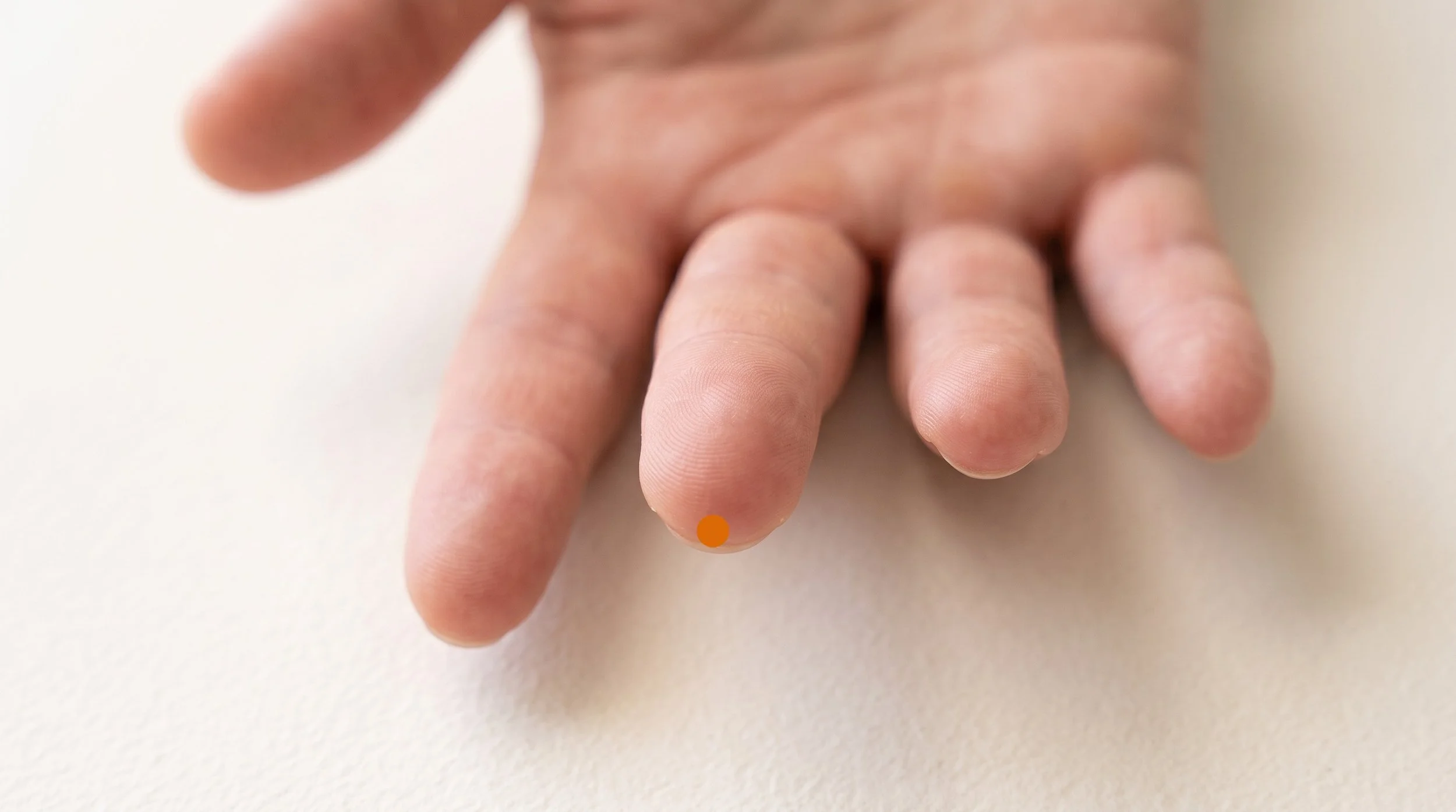
PC9 Acupuncture Point (Zhongchong)
The Jing-Well Point at the Tip of the Middle Finger: Anatomy, Nerve Density, and Why PC9 Sits at the Center of Classical First Aid
PC9 (Zhongchong, often translated as Middle Rushing) is the final point of the Pericardium channel, sitting in the center of the tip of the middle finger. It's the jing-well and wood point of that channel, and it holds an unusual place in the point map: it's the most distal of all the jing-well points and the only one located at the middle of a fingertip rather than beside a nail corner (Deadman et al., 2001).
Classically, the pc9 acupuncture point belongs to the small group of revival points reached for in collapse, high fever with agitation, and sudden loss of speech. In a modern clinic it's used sparingly and briefly, because the fingertip is one of the most densely innervated pieces of skin on the body, and that density is exactly what makes this point interesting.
- Location and layers: Zhongchong sits in the center of the middle fingertip pulp, in thick glabrous skin over fat-filled compartments tethered by fibrous septa to the distal phalanx; a common alternate location places it about 0.1 cun from the radial corner of the middle fingernail (Deadman et al., 2001).
- Traditional categories, translated: as the jing-well and wood point of the Pericardium channel, PC9 was described as clearing heat from the Pericardium, reviving consciousness, benefiting the tongue and clearing summer-heat (Deadman et al., 2001). Read neurophysiologically, these describe a brief, intense afferent volley from a densely innervated fingertip with strong arousal and autonomic effects.
- The nerve story: fingertip pulp is supplied by terminal branches of the palmar digital nerves and carries an extremely high density of mechanoreceptors and free nerve endings, so small stimuli generate large ascending signals that engage spinal and brainstem circuits, including descending inhibitory pathways using endogenous opioid, serotonergic and noradrenergic mediation (Zhao, 2008).
- The research picture: most published work on this point comes from animal studies of bloodletting at the hand twelve jing-well points (a set that includes PC9), where the technique has been reported to improve neurological scores and reduce brain edema after experimental injury (Yu et al., 2017; Li et al., 2020; Liu et al., 2021). Human evidence for acupuncture in acute stroke remains uncertain (Xu et al., 2018).
- Clinical framing: in modern practice pericardium 9 is a short-contact point, not a retained-needle point. It's typically pricked shallowly, or simply pressed, and it usually appears as one member of a distal set rather than as a stand-alone treatment.
- De qi at pc 9 finger points is different from what patients expect elsewhere: a bright, sharp, stinging flash that fades within seconds, sometimes with a line of sensation running back toward the palm, rather than the dull heavy ache typical of muscle-bellied points.
Feeling Wired, Overheated, and Unable to Settle?
Agitation with a hot, restless quality is one of the oldest patterns associated with the Pericardium channel, and it's still one of the most common reasons people walk into our office. At Morningside Acupuncture we combine short-contact distal points like PC9 with PC6, HT7 and calming autonomic work to help downshift arousal. Treatment is paced to what your nervous system can actually absorb, not to a script. Schedule a visit and we'll build a plan around how you're actually feeling.
Schedule NowAnatomy of PC9: Why the Center of the Middle Fingertip Is Such an Important Location
The needle at PC9 passes through very little tissue. First there's thick, ridged, hairless fingertip skin with a heavy stratum corneum, then the pulp itself: small fat-filled compartments held in place by fibrous septa running from the skin down to the tuft of the distal phalanx. That architecture exists to resist shear during pinching and gripping, which is also why the fingertip tolerates constant mechanical load from typing, phone use, instruments and tools without complaint, yet responds dramatically to a single pinprick.
If the alternate radial nail-corner location is used, the needle sits just beside the nail fold instead, another small, tightly bound, highly sensitive zone (Deadman et al., 2001).
The nerve geography here is the real story. The pulp of the middle finger is supplied by terminal branches of the palmar digital nerves, and this skin carries one of the highest densities of sensory endings anywhere on the body, including Merkel cells, Meissner corpuscles and abundant free nerve endings feeding thin myelinated and unmyelinated fibers. Fingertips also occupy an outsized share of somatosensory cortex.
A brief noxious stimulus at this site therefore produces a large, well-localized afferent volley that reaches spinal, brainstem and cortical levels quickly, and stimulation of that kind can recruit descending inhibitory control through opioid, serotonergic and noradrenergic mechanisms (Zhao, 2008). It also produces a short-lived sympathetic response, which is one plausible reason the classical literature grouped fingertip points with sudden faintness and collapse.
Deeper structures are minimal at this depth. The digital arteries terminate in a dense network that includes numerous arteriovenous anastomoses used for thermoregulation, so fingertips bleed briskly and briefly when pricked. Standard technique is perpendicular or oblique insertion directed proximally, 0.1 to 0.2 cun, or pricking to bleed with a sterile single-use lancet (Deadman et al., 2001).
There's no deep organ or neurovascular corridor at risk, but the practical cautions matter: the point is genuinely sharp, the nail bed should be avoided, bleeding techniques call for extra care in people on anticoagulants or with clotting disorders, and no fingertip point is ever a substitute for emergency medical care. In a true collapse, call 911.
Related Pericardium Channel Related PC6 Acupuncture PointPC9 at a Glance: Classification, Location, and Clinical Use
| Category | Detail |
|---|---|
| Traditional Name | Zhongchong (Middle Rushing), PC9, also written P-9 or Pericardium 9 |
| Channel Classification | Pericardium channel of Hand Jueyin, terminal point of the channel (PC9, also written P9; also called the Heart Protector channel) |
| Point Categories | Jing-well point of the Pericardium channel; wood point in the five-shu sequence; noted as the most distal of all jing-well points and the only one located at the center of a fingertip rather than at a nail corner (Deadman et al., 2001) |
| Precise Location | In the center of the tip of the middle finger. An alternate convention places it at the radial side of the middle finger, roughly 0.1 cun from the corner of the nail, where lines along the radial nail border and the nail base would meet. |
| Tissue Stimulated | Glabrous fingertip pulp skin, subcutaneous fat compartments and fibrous septa over the distal phalanx, terminal branches of the palmar digital nerves, and a dense terminal vascular bed. Related hand and forearm myofascial work often includes the adductor pollicis. |
| Needle Depth / Direction | Perpendicular or oblique insertion angled proximally, 0.1 to 0.2 cun, or pricked to bleed with a sterile single-use lancet. Short contact only, rarely retained. |
| De Qi Sensation | A sharp, bright, stinging sensation that peaks immediately and fades within seconds, sometimes with a brief radiating line toward the palm. Not the dull, heavy, spreading ache of larger muscle points. |
| Primary Clinical Uses | Traditionally used for loss of consciousness and windstroke collapse, fever with agitation and summer-heat collapse, stiffness of the tongue with inability to speak, heat sensations in the palms, and night-time crying in children (Deadman et al., 2001). In modern practice, an occasional adjunct for agitation, heat-type headache and speech or tongue symptoms. |
| Common Point Combinations |
|
Deadman, Al-Khafaji and Baker's A Manual of Acupuncture presents Zhongchong as the jing-well point where the Pericardium channel ends, and attributes to it the traditional actions of clearing heat from the Pericardium and reviving consciousness, clearing the Heart and benefiting the tongue, and clearing summer-heat.
The classical indication lists cluster into four groups: sudden collapse and windstroke, febrile states with agitation and burning sensations, tongue and speech problems such as stiffness, pain at the tongue root and loss of speech, and middle-burner complaints including vomiting, diarrhea and epigastric pain, along with pediatric entries like night-time crying.
The commentary explains the tongue connection through the traditional pairing of the Pericardium with the Heart, since it's the Heart that was said to flower into the tongue, and the digestive indications through the Pericardium channel's described passage through all three burners. What's striking is the internal consistency of the classical pattern: a single fingertip point was assigned to the states where consciousness, speech and body heat all destabilize at once, which is a reasonable pre-modern description of acute cerebral and febrile emergencies.
Why PC9 Is Used for Faintness, Overheating, and Speech Symptoms Instead of Finger Pain
Patients are often surprised that a point on the middle fingertip has nothing to do with finger problems. The logic is convergence. Sensory fibers from the hand enter the cervical cord and feed into wide-dynamic-range neurons and brainstem nuclei that also receive input from the head, neck and viscera, so a strong, brief input from the fingertip is not a local event. It's a system-level event. This is the same principle behind using distal hand points for head symptoms, and it's why classical sources kept placing fingertip points in first aid lists rather than in hand-pain lists.
The second mechanism is descending modulation. Noxious or near-noxious stimulation at high-density sites can activate periaqueductal gray and rostral ventromedial medulla circuits that dampen incoming signals at the spinal cord, using endogenous opioids, serotonin and norepinephrine (Zhao, 2008). Alongside this, a sharp fingertip stimulus produces a brief sympathetic response with transient changes in arousal and peripheral vascular tone, which may reduce the fogginess and heaviness patients describe during faint or overheated states, though this is a plausible mechanism rather than a proven clinical effect.
Point-specific research exists, but mostly in animals and mostly on the whole jing-well cluster rather than PC9 alone. Bloodletting at the hand twelve jing-well points, a set that includes Zhongchong, has been reported to improve neurological recovery after experimental traumatic brain injury in mice, with the authors proposing peripheral nerve activation plus circulatory effects as the pathway (Li et al., 2020). Related rodent work reports reduced cerebral edema and better blood-brain barrier integrity (Yu et al., 2017; Liu et al., 2021).
These findings are interesting and consistent with the classical use, but they don't translate directly into human clinical claims, and the Cochrane assessment of acupuncture in acute stroke found the evidence insufficient to draw firm conclusions (Xu et al., 2018).
What the Research Shows for PC9
It's worth being clear about what the evidence can and can't say. Clinical trials almost never test a single point, and PC9 is rarely tested at all in isolation, so the honest picture is a small animal literature on jing-well bloodletting, an uncertain human literature on acupuncture in acute neurological events, and a broader body of work showing that multi-point acupuncture protocols may help with chronic pain and anxiety symptoms. None of that establishes what one fingertip prick does on its own, and none of it makes acupuncture an emergency intervention.
| Study | Type | Focus | Key Finding |
|---|---|---|---|
| Xu, Li & Zhang, 2018 | Cochrane systematic review | Acupuncture started within 30 days of stroke onset | The review concluded that the available trials were too limited and too heterogeneous to establish benefit or harm in acute stroke. |
| Li et al., 2020 | Controlled animal experiment | Bloodletting at the hand twelve jing-well points, including PC9, after experimental traumatic brain injury in mice | Treated animals showed better neurological recovery, which the authors linked to circulatory and coagulation changes plus peripheral nerve activation. |
| Yu et al., 2017 | Controlled animal experiment | Jing-well bloodletting and cerebral edema after permanent middle cerebral artery occlusion in rats | The intervention was associated with less cerebral edema and better preserved blood-brain barrier tight junctions, in an animal model only. |
| Liu et al., 2021 | Controlled animal experiment | Jing-well bloodletting and brain edema after severe traumatic brain injury in rats | Reduced edema was reported alongside changes in MAPK signaling, again in rodents rather than patients. |
| Yang et al., 2021 | Systematic review and meta-analysis | Acupuncture for anxiety disorders | Pooled results favored acupuncture over control conditions, though study quality was mixed and the authors urged caution. |
| Vickers et al., 2018 | Individual patient data meta-analysis | Acupuncture for chronic pain, including headache | Acupuncture was modestly superior to sham and to no-acupuncture control, with effects that persisted over time. |
| Zhao, 2008 | Narrative mechanism review | Neural mechanisms of acupuncture analgesia | Needle stimulation engages spinal and supraspinal pathways with opioid, serotonergic and noradrenergic mediation. |
Headaches That Come With Heat, Pressure, and Tension?
Classical sources paired PC9 with heat-type headaches, and modern treatment often uses distal hand points alongside targeted needling of the neck, jaw and upper back muscles that drive head pain. We map your pattern first, then decide whether hand points, dry needling, or both make sense. Most patients notice changes across a short series rather than in one visit. Book an evaluation and let's find the drivers of your headaches.
Schedule NowPC9 in the Context of Trigger Point Work
PC9 sits in fingertip pulp, so it isn't a muscle target and it has no trigger point of its own. Where it fits in a dry needling visit is as a short, high-intensity distal input at the start or end of a session, while the mechanical work happens elsewhere.
For patients whose hand and forearm symptoms come from grip-heavy work, we look at the intrinsic hand muscles and the forearm flexors and extensors, since taut bands in those tissues can refer pain into the fingers and mimic joint or nerve complaints (Simons et al., 1999). The adductor pollicis is a frequent contributor in people who pinch, type and grip all day.
For the head and neck complaints that classical texts linked to Zhongchong, our treatment usually centers on the muscles that actually generate the symptoms: upper trapezius, suboccipitals, sternocleidomastoid, temporalis and masseter for headache patterns, plus breathing and posture work for the arousal side of the picture. PC9 can be added briefly when a patient presents with heat, agitation and a wired quality, but the durable change tends to come from the myofascial and autonomic work, with the fingertip point playing a supporting role rather than carrying the treatment.
PC9 Anxiety and Headache Treatment at NYC's Highest-Rated Acupuncture Clinic
Morningside Acupuncture is the highest-rated acupuncture and dry needling clinic in New York City with over 500 five-star Google reviews, and our approach blends classical point selection with orthopedic and neurophysiologic reasoning. Points like Zhongchong are used thoughtfully and briefly, always inside a plan that includes the muscles, breathing patterns and habits feeding your symptoms. You'll get clear explanations, no mysticism, and a treatment plan with a timeline. Schedule your appointment today.
Schedule NowFrequently Asked Questions
What does PC9 feel like when needled?
Sharp and bright, and honestly more intense per second than most points. The fingertip has an unusually high density of sensory endings, so even a shallow 0.1 to 0.2 cun insertion produces an immediate sting that often fades within a few seconds, sometimes with a brief line of sensation running toward the palm. Because the stimulus is so strong, this point is used with short contact rather than retained needles, and your acupuncturist should tell you before it's needled.
Why would an acupuncturist needle my fingertip for symptoms in my head or chest?
Because fingertip input doesn't stay local. Sensory fibers from the hand converge with input from the head, neck and viscera in the cervical spinal cord and brainstem, and strong brief stimulation can recruit descending inhibitory pathways that dampen signaling more broadly (Zhao, 2008). Classical texts arrived at a similar conclusion by observation, listing PC9 for collapse, fever, agitation and speech problems rather than for finger complaints (Deadman et al., 2001).
Can I press PC9 myself between sessions?
Yes, and acupressure is the sensible home version of this point since there's no needling involved. Use your opposite thumbnail or thumb tip on the center of the middle fingertip, press firmly enough to feel a clear sharp sensation without causing lasting pain, and hold for 10 to 20 seconds. Release, breathe out slowly, then repeat 3 to 5 times per hand, and do the whole sequence 2 or 3 times a day when you feel agitated, overheated or mentally scattered. Stop if the finger stays sore, and don't do this on skin that's broken, infected or numb.
Is PC9 safe to needle?
In trained hands, yes, with a few practical cautions. The depth is minimal and there's no deep structure at risk, but the point is painful, it bleeds readily because of the dense terminal vascular bed, and bleeding techniques need clean technique with a sterile single-use lancet. We take extra care in people on blood thinners, with clotting disorders, with diabetes or poor circulation in the hands, or with any skin infection or nail-fold inflammation nearby. Most importantly, the classical use of this point in collapse doesn't make it an emergency treatment. If someone loses consciousness, call 911.
Where exactly is PC9 located?
In the center of the tip of the middle finger, on the pad rather than the nail. Some traditions and texts instead place the zhongchong jing well point at the radial corner of the middle fingernail, about 0.1 cun from the corner, where a line along the radial nail border meets a line along the nail base (Deadman et al., 2001). Both conventions are in use, and practitioners generally pick one based on their training and the technique being used.
References
- Deadman, P., Al-Khafaji, M., & Baker, K. (2009). A manual of acupuncture. Journal of Chinese Medicine Publications.
- Simons, D. G., Travell, J. G., & Simons, L. S. (1999). Travell & Simons' myofascial pain and dysfunction: The trigger point manual, Vol. 1: Upper half of body (2nd ed.). Williams & Wilkins.
- Zhao, Z. Q. (2008). Neural mechanism underlying acupuncture analgesia. Progress in Neurobiology, 85(4), 355-375. https://doi.org/10.1016/j.pneurobio.2008.05.004
- Vickers, A. J., Vertosick, E. A., Lewith, G., MacPherson, H., Foster, N. E., Sherman, K. J., Irnich, D., Witt, C. M., & Linde, K. (2018). Acupuncture for chronic pain: Update of an individual patient data meta-analysis. Journal of Pain, 19(5), 455-474. https://doi.org/10.1016/j.jpain.2017.11.005
- Xu, M., Li, D., & Zhang, S. (2018). Acupuncture for acute stroke. Cochrane Database of Systematic Reviews, 2018(3), CD003317. https://doi.org/10.1002/14651858.CD003317.pub3
- Li, B., Zhou, X., Yi, T. L., Xu, Z. W., Peng, D. W., Guo, Y., Guo, Y. M., Cao, Y. L., Zhu, L., Zhang, S., & Cheng, S. X. (2020). Bloodletting puncture at hand twelve Jing-well points improves neurological recovery by ameliorating acute traumatic brain injury-induced coagulopathy in mice. Frontiers in Neuroscience, 14, 403. https://doi.org/10.3389/fnins.2020.00403
- Yu, N., Wang, Z., Chen, Y., Yang, J., Lu, X., Guo, Y., Chen, Z., & Xu, Z. (2017). The ameliorative effect of bloodletting puncture at hand twelve Jing-well points on cerebral edema induced by permanent middle cerebral ischemia via protecting the tight junctions of the blood-brain barrier. BMC Complementary and Alternative Medicine, 17(1), 470. https://doi.org/10.1186/s12906-017-1979-6
- Liu, B. H., Zhou, D., Guo, Y., Zhang, S., Guo, Y. M., Guo, T. T., Chen, X. Y., Gong, Y. N., Tang, H. L., & Xu, Z. F. (2021). Bloodletting puncture at hand twelve Jing-well points relieves brain edema after severe traumatic brain injury in rats via inhibiting MAPK signaling pathway. Chinese Journal of Integrative Medicine, 27(4), 291-299. https://doi.org/10.1007/s11655-021-3326-5
- Yang, X. Y., Yang, N. B., Huang, F. F., Ren, S., & Li, Z. J. (2021). Effectiveness of acupuncture on anxiety disorder: A systematic review and meta-analysis of randomised controlled trials. Annals of General Psychiatry, 20(1), 9. https://doi.org/10.1186/s12991-021-00327-5
Disclaimer: This web site is intended for educational and informational purposes only. Reading this website does not constitute providing medical advice or any professional services. This information should not be used for diagnosing or treating any health issue or disease. Those seeking medical advice should consult with a licensed physician. Seek the advice of a medical doctor or other qualified health professional for any medical condition. If you think you have a medical emergency, call 911 or go to the emergency room. No acupuncturist-patient relationship is created by reading this website or using the information. Morningside Acupuncture PLLC and its employees and contributors do not make any express or implied representations with respect to the information on this site or its use. For any legal interpretation of scope of practice in your state, consult a licensed attorney or regulatory authority.
Read more from our blog



