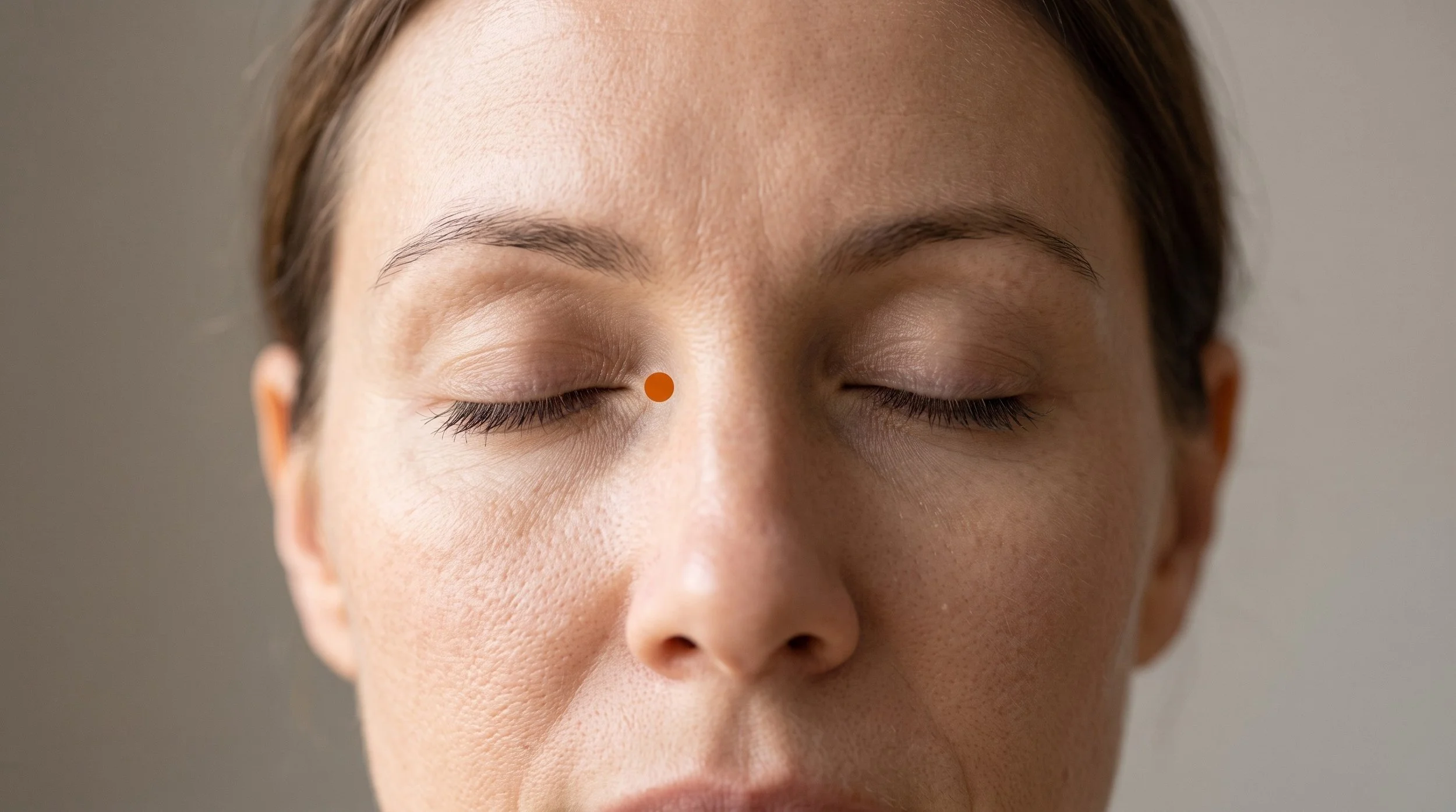
BL1 Acupuncture Point (Jingming)
Bright Eyes at the Inner Corner of the Orbit: Anatomy, Trigeminal Mechanisms, and Why the Most Guarded Point in the Repertoire Is Also the Classical Master Point for the Eyes
BL1 (Jingming, translated as Bright Eyes) is the first point of the Bladder channel, and it sits in a remarkably small piece of real estate: roughly 0.1 cun above and slightly medial to the inner corner of the eye, tucked against the medial rim of the orbit beside the tear apparatus. Almost every yang channel on the face converges here in classical descriptions, which is why the bl1 acupuncture point has been treated for centuries as the local point for eye complaints of nearly any kind, from red, aching, watering eyes to dim or blurred vision.
It is also, in modern anatomical terms, one of the most cautious needling sites on the body: shallow insertion, no vigorous manipulation, firm pressure afterward, and no moxibustion. Understood through nerve anatomy rather than metaphor, jingming is a dense trigeminal and autonomic access point for the surface of the eye and the tissues that keep it lubricated.
- Location and layers: BL1 lies just above and medial to the inner canthus, against the bony medial orbital rim, where the needle meets thin eyelid skin and the palpebral fibers of orbicularis oculi with the lacrimal apparatus, the angular vessels, and the orbital contents close by (Deadman et al., 2007).
- Traditional categories, read anatomically: classical texts describe bladder 1 as a meeting point of the Bladder, Small Intestine, Stomach, Gallbladder and Triple Burner channels with the Governing vessel and both Motility vessels (Deadman et al., 2007). In neurophysiological terms, that convergence maps neatly onto a small patch of skin supplied by the first division of the trigeminal nerve, an area with unusually rich sensory and autonomic connections.
- Mechanism: stimulating trigeminal afferents around the medial orbit engages brainstem circuits that regulate tear production and orbital blood flow, and imaging studies using color Doppler have documented measurable changes in retrobulbar and peripheral blood flow with acupuncture (Takayama et al., 2012). Segmental input at this level also feeds descending inhibitory pathways involved in acupuncture analgesia (Zhao, 2008).
- Research picture: a randomized trial needling BL1 alone reported greater improvement in tear secretion and ocular symptoms than artificial tears in moderate to severe dry eye disease (Zhang et al., 2022), while meta-analyses of acupuncture for dry eye report improvements in tear film measures alongside notable methodological limitations (Na et al., 2021).
- Clinical practice framing: standard technique is a shallow perpendicular insertion of 0.2 to 0.3 cun, with deeper orbital needling reserved for supervised specialist practice; moxibustion is contraindicated and firm pressure after withdrawal is routine because bruising is common (Deadman et al., 2007). Many clinicians reach for BL2, taiyang, or ST2 first and add jingming only when it clearly adds value.
- De qi: patients usually describe a small, dull ache or a sense of pressure at the inner corner of the eye, often with immediate watering of that eye, rather than the spreading, radiating heaviness typical of limb points.
Tired, Dry, Aching Eyes After a Day of Screens?
Digital eye strain rarely lives in the eyes alone: it usually travels with brow tension, neck stiffness, and a low band of head pressure. At Morningside Acupuncture, we treat the jingming eye point as one part of a periocular and upper cervical plan that may include BL2, taiyang, GB20, and careful work on the muscles that refer pain into the orbit. Every needle around the eye is placed shallowly, gently, and with pressure applied afterward. Schedule a visit and let us build a plan around how your eyes actually feel at 4 p.m.
Schedule NowAnatomy of BL1: Why the Inner Corner of the Eye Is Such an Important Location
The tissue at BL1 is thin and layered in a very small space. Directly under the needle is some of the thinnest skin on the body, then the palpebral portion of orbicularis oculi, the small circular muscle that closes the eyelids and pumps tears toward the drainage system at the inner corner. Just beneath and medial sits the medial palpebral ligament and the lacrimal sac, and immediately lateral is the globe itself.
What loads this area in modern life is repetitive: hours of near focus, reduced blink rate at screens, squinting in bright light or wind, and chronic low-grade dryness that keeps the lid margins irritated. Nothing here is thick or muscular, which is exactly why the point is needled shallowly and why the classical instruction is to press firmly on withdrawal.
The nerve geography is what makes jingming interesting. The skin and deeper structures at the medial canthus are supplied mainly by the infratrochlear and supratrochlear nerves, both branches of the ophthalmic division of the trigeminal nerve. That division also carries sensation from the cornea and the frontal region, so input from a needle at this site enters the same brainstem pool that handles ocular surface signaling and much of frontal head pain.
Those trigeminal afferents connect in the brainstem to autonomic outflow that governs tear secretion and to the descending pathways that modulate incoming pain signals, mechanisms studied extensively in acupuncture analgesia research (Zhao, 2008). Doppler studies of acupuncture have also documented changes in ocular and peripheral blood flow parameters, consistent with a somato-autonomic reflex rather than anything mysterious (Takayama et al., 2012).
The safety story sits in the same square centimeter. The angular artery and vein run superficially near the medial canthus, which is why bruising at BL1 is common even with good technique, and the orbital contents (medial rectus, orbital fat, and the vessels of the orbit) lie deep. Standard practice is perpendicular insertion of 0.2 to 0.3 cun.
The deeper orbital approach described in classical and modern texts belongs only to supervised specialist practice: the eye is guarded laterally with the fingertip, the needle advances slowly along the orbital wall with no lifting, thrusting, or rotating, and firm pressure is applied for about a minute after withdrawal to limit hematoma (Deadman et al., 2007; Kim). Moxibustion is contraindicated at this point, and anyone on anticoagulants, with recent orbital surgery, or with active eye infection should be needled elsewhere.
Related Bladder Channel Related Best Acupuncture Points For HeadachesBL1 at a Glance: Classification, Location, and Clinical Use
| Category | Detail |
|---|---|
| Traditional Name | Jingming (Bright Eyes), BL-1 |
| Channel Classification | First point of the Bladder channel of Foot Taiyang, at the inner canthus (BL1, also written UB1; also called the Urinary Bladder channel) |
| Point Categories | Meeting point of the Bladder, Small Intestine, Stomach, Gallbladder and Triple Burner channels with the Governing vessel and the Yin and Yang Motility vessels; classically the principal local point for the eyes |
| Precise Location | 0.1 cun above and slightly medial to the inner corner of the eye, close against the medial border of the orbit |
| Tissue Stimulated | Thin eyelid skin, palpebral fibers of orbicularis oculi and the medial palpebral ligament region, with the lacrimal apparatus and angular vessels adjacent; adjacent myofascial work often targets the temporalis and upper cervical muscles rather than the orbit itself |
| Needle Depth / Direction | Perpendicular, 0.2 to 0.3 cun by standard technique; deeper orbital needling only in supervised specialist practice, advanced slowly with no lifting, thrusting, or rotation, with firm pressure on withdrawal. Moxibustion is contraindicated |
| De Qi Sensation | A small, dull ache or pressure at the inner corner of the eye, frequently with immediate watering of that eye; radiating sensation is unusual |
| Primary Clinical Uses | Eye strain with redness, aching, and tearing; wind-induced tearing and itching at the inner canthus; blurred or dim vision in classical use; supportive care within modern dry eye and eye fatigue protocols |
| Common Point Combinations |
|
In the Manual of Acupuncture, Deadman and colleagues frame BL1 as the meeting place of essentially all the yang channels of the face together with the Governing vessel and both Motility vessels, and they use that convergence to explain its traditional role: because yang was said to govern the exterior, a point where so many yang channels gather was considered the natural local choice for eye problems attributed to external wind and heat, and equally for eye problems attributed to internal disharmony.
The traditional actions attributed to jingming are simply stated: benefit the eyes, expel wind, and clear heat. The classical indication list compresses into a few recognizable clusters: inflammatory surface complaints (redness, swelling, pain, itching at the inner corner), tearing provoked by wind, and disturbances of visual clarity (blurring, dimness, night blindness, light sensitivity, visual dizziness). Modern Chinese texts extended those attributions to a range of ophthalmic diagnoses that clearly belong in an ophthalmologist's hands, which is worth stating plainly.
What makes the classical pattern striking is the tension inside it: the point credited with the widest channel convergence and the broadest ocular indication list is also the one that every text hedges with the most conservative technique instructions.
Why BL1 Is Used for Dry, Tired Eyes and Screen Fatigue
The most useful way to understand BL1 is segmental. The skin and tissues at the inner canthus share their nerve supply, through the ophthalmic division of the trigeminal nerve, with the cornea, the conjunctiva, and the frontal region of the head. Signals from all of these converge on the same brainstem territory, which is why eye strain so rarely stays confined to the eyes and instead shows up as brow tension, forehead pressure, and a heavy, gritty feeling behind the lids. Needling into that shared territory gives a clinician direct access to the input side of the loop rather than a distant proxy.
That same trigeminal input connects to autonomic outflow controlling the lacrimal gland and the small vessels of the orbit, which is the plausible route by which a needle at the inner canthus could influence tearing and ocular surface comfort. Doppler work on acupuncture has shown measurable shifts in retrobulbar and peripheral vascular parameters, consistent with a reflex effect on blood flow rather than a local mechanical one (Takayama et al., 2012).
At the same time, needle stimulation recruits descending inhibitory pathways that dampen pain signaling more broadly, a mechanism that has been mapped in considerable detail (Zhao, 2008) and that helps explain why patients often report the aching quality of eye strain easing before anything measurable changes in the tear film.
Clinically, this is why we treat jingming as a precision addition rather than a default. If the presentation is dryness, burning, and reflex tearing, the periocular points including BL1 make sense. If the presentation is mostly ache, brow tension, and neck stiffness after long screen hours, cervical and cranial muscle work usually carries more of the load, and the eye point becomes a finishing touch (Vickers et al., 2018).
What the Research Shows for BL1
A caution before the table: most acupuncture research on eye complaints tests multi-point protocols delivered over weeks, so it is usually impossible to isolate what any single point contributed. BL1 is a partial exception, because at least one randomized trial deliberately tested it on its own. Even so, the studies below vary considerably in quality, most were conducted in China, blinding around the eyes is difficult, and the honest summary is that acupuncture may offer supportive benefit for dry eye and eye fatigue alongside standard ophthalmic care rather than in place of it.
| Study | Type | Focus | Key Finding |
|---|---|---|---|
| Zhang et al., 2022 | Randomized controlled trial (n = 120) | Acupuncture at BL1 alone versus artificial tears in moderate to severe dry eye disease over 8 weeks | Needling the single BL1 point was associated with greater improvement in tear secretion and ocular symptom scores than artificial tears, though the unblinded design means results should be interpreted cautiously. |
| Na et al., 2021 | Systematic review and meta-analysis | Acupuncture compared with artificial tears in typical dry eye syndrome, pooling 21 randomized trials | Pooled results favored acupuncture on tear film break-up time and Schirmer scores, but the authors flagged heterogeneity and risk of bias across the included trials. |
| Wei et al., 2020 | Systematic review and meta-analysis of acupoint selection | Whether periocular points, with or without body points, outperform artificial tears for dry eye | Protocols using periocular points appeared beneficial relative to artificial tears, suggesting that local point selection around the orbit matters, though evidence quality was limited. |
| Singh et al., 2022 | Systematic review and meta-analysis | Interventions for computer vision syndrome and digital eye strain | No intervention reviewed reached high-certainty evidence, a useful reminder that expectations for any single treatment of screen-related eye strain should stay modest. |
| Takayama et al., 2012 | Physiological study using ultrasound color Doppler imaging | Blood flow changes in peripheral, mesenteric, and retrobulbar arteries during acupuncture | Acupuncture produced measurable changes in vascular resistance and flow, including in retrobulbar vessels, supporting an autonomic reflex mechanism for ocular effects. |
| Zhao, 2008 | Narrative review of mechanisms | Neural pathways underlying acupuncture analgesia | Needle stimulation activates spinal and supraspinal inhibitory circuits and endogenous opioid systems, the general framework applied to segmental points like BL1. |
| Vickers et al., 2018 | Individual patient data meta-analysis | Acupuncture across chronic pain conditions including headache | Acupuncture was better than sham and no-acupuncture controls for chronic pain, with effects persisting over time, which is relevant when eye strain travels with head and neck pain. |
Curious Whether Acupuncture Can Support Your Dry Eye Care?
Acupuncture is not a replacement for ophthalmology, and we say so plainly: drops, lid hygiene, and a proper eye exam come first. What the research suggests is that periocular needling, including bl 1 eye technique, may support tear film comfort as part of a broader plan (Zhang et al., 2022). Our licensed acupuncturists explain exactly what each point does, why the technique around the orbit is so conservative, and what a reasonable trial of care looks like. Book a consultation to talk it through.
Schedule NowBL1 in the Context of Trigger Point Work
BL1 is not a trigger point in any myofascial sense: there is no taut band at the inner canthus and no local twitch response to chase. What matters clinically is that several muscles refer pain straight into the region BL1 occupies. Trigger points in the sternocleidomastoid, the temporalis, the suboccipital group, and the upper trapezius are all documented sources of referred pain into the orbit, the brow, and behind the eye, and sternocleidomastoid involvement can also come with visual disturbance and tearing (Simons et al., 1999). A patient who reports deep eye ache with no ophthalmic findings is often describing a referral pattern, not an eye problem.
At Morningside, that distinction shapes the treatment plan. When periocular symptoms sit alongside neck stiffness, jaw clenching, and headache, we lead with dry needling of the cervical and cranial muscles, including temporalis and the suboccipitals, and reserve gentle periocular needling for the surface complaints that local points genuinely address. Dry needling and acupuncture both use an acupuncture needle, so the two approaches combine within one session without any conceptual conflict.
If BL1 is used at all, it goes in last, shallowly, with pressure applied immediately after withdrawal, and only after the patient understands that a small bruise is a realistic possibility.
BL1 Eye Strain Treatment at NYC's Highest-Rated Acupuncture Clinic
Morningside Acupuncture is the highest-rated acupuncture and dry needling clinic in New York City with over 500 five-star Google reviews, and patients come to us specifically for careful, well-explained facial and periocular work. We combine points like BL1 and BL2 with cervical and jaw treatment for people whose eye fatigue, brow tension, and headaches all show up together. You will always know where the needles are going and why before anything is placed. Schedule your appointment today.
Schedule NowFrequently Asked Questions
What does BL1 feel like when needled?
Most people feel a brief pinch as the needle passes the thin skin, then a small dull ache or a sense of pressure right at the inner corner of the eye. Watering of that eye is extremely common and is considered a normal response rather than a problem. Unlike limb points, BL1 rarely produces a spreading or radiating sensation, and the needle is usually left undisturbed because no lifting, thrusting, or rotating is performed here. A mild feeling of fullness around the eyelid for a few minutes after withdrawal is also typical.
Why needle right at the eye instead of using distal points for eye symptoms?
Both approaches have a rationale, and good treatment often uses them together. Local points like BL1 sit in tissue supplied by the ophthalmic division of the trigeminal nerve, which shares brainstem territory with the cornea and conjunctiva, so they provide direct segmental input to the circuits that govern tear production and ocular surface sensation (Takayama et al., 2012). Distal points like LI4 and GB37 were classically added when local needling alone was not enough, an instruction preserved in the Ode of Xi-hong (Deadman et al., 2007). In practice, we choose based on the presentation: dryness and surface irritation favor local work, while ache that travels with head and neck tension usually responds better to cervical and distal treatment.
Can I press BL1 myself between sessions?
Gentle self-acupressure near this point is reasonable if you are careful, and it should never involve pressing on the eyeball. Close your eyes, place a clean fingertip just above and slightly inside the inner corner of the eye so that it rests against the bony rim of the orbit, and apply light, steady pressure directed toward the bone rather than toward the globe. Hold for 20 to 30 seconds, release, and repeat two or three times per side, once or twice a day. Many people prefer to combine this with the brow point BL2, sweeping outward along the upper orbital rim for another 30 seconds. Stop if you notice pain, light sensitivity, or any change in vision, and skip it entirely if you have an eye infection, recent eye surgery, or a bleeding disorder.
Is BL1 safe to needle?
In trained hands with standard shallow technique it is safe, but it demands more care than almost any other point. Bruising is the main risk because the angular vessels run superficially at the medial canthus, so firm pressure is applied for about a minute immediately after withdrawal (Deadman et al., 2007). Standard insertion is only 0.2 to 0.3 cun perpendicular; the deeper orbital technique belongs to supervised specialist practice and involves guarding the globe laterally and advancing slowly without manipulation. Moxibustion is contraindicated at this point. We avoid needling BL1 in patients on anticoagulants, with recent orbital or ocular surgery, active eye infection, or significant bleeding tendency, and we always discuss the bruising possibility before treating.
Where exactly is BL1 located?
Close your eye and find the inner corner where the upper and lower lids meet, near the small pink caruncle. BL1 sits about 0.1 cun above that corner and slightly toward the nose, in the small depression between the inner canthus and the bony medial wall of the orbit. Sliding a fingertip gently upward and inward from the corner until it meets bone brings you to the right area. It is a genuinely tiny target, and the surrounding structures (the tear drainage system below and medially, the globe laterally) are the reason both classical and modern texts describe it with such precision.
References
- Deadman, P., Al-Khafaji, M., & Baker, K. (2009). A manual of acupuncture. Journal of Chinese Medicine Publications.
- Kim, H. (2008). Handbook of Oriental medicine (3rd ed.). Harmony & Balance Press.
- O'Connor, J., & Bensky, D. (Eds. & Trans.). (1981). Acupuncture: A comprehensive text. Shanghai College of Traditional Medicine. Eastland Press.
- Simons, D. G., Travell, J. G., & Simons, L. S. (1999). Travell & Simons' myofascial pain and dysfunction: The trigger point manual, Vol. 1: Upper half of body (2nd ed.). Williams & Wilkins.
- Zhang, X., Zhang, B., Peng, S., Zhang, G., Ma, J., & Zhu, W. (2022). Effectiveness of acupuncture at acupoint BL1 (Jingming) in comparison with artificial tears for moderate to severe dry eye disease: A randomized controlled trial. Trials, 23, 605. https://doi.org/10.1186/s13063-022-06486-4
- Na, J. H., Jung, J. H., Park, J. G., Song, P. H., & Song, C. H. (2021). Therapeutic effects of acupuncture in typical dry eye: A systematic review and meta-analysis. Acta Ophthalmologica, 99(5), 489-498. https://doi.org/10.1111/aos.14651
- Wei, Q. B., Ding, N., Wang, J. J., Wang, W., & Gao, W. P. (2020). Acupoint selection for the treatment of dry eye: A systematic review and meta-analysis of randomized controlled trials. Experimental and Therapeutic Medicine, 19, 2851-2860. https://doi.org/10.3892/etm.2020.8561
- Singh, S., McGuinness, M. B., Anderson, A. J., & Downie, L. E. (2022). Interventions for the management of computer vision syndrome: A systematic review and meta-analysis. Ophthalmology, 129(10), 1192-1215. https://doi.org/10.1016/j.ophtha.2022.05.009
- Takayama, S., Watanabe, M., Kusuyama, H., Nagase, S., Seki, T., Nakazawa, T., & Yaegashi, N. (2012). Evaluation of the effects of acupuncture on blood flow in humans with ultrasound color Doppler imaging. Evidence-Based Complementary and Alternative Medicine, 2012, 513638. https://doi.org/10.1155/2012/513638
- Zhao, Z. Q. (2008). Neural mechanism underlying acupuncture analgesia. Progress in Neurobiology, 85(4), 355-375. https://doi.org/10.1016/j.pneurobio.2008.05.004
- Vickers, A. J., Vertosick, E. A., Lewith, G., MacPherson, H., Foster, N. E., Sherman, K. J., Irnich, D., Witt, C. M., & Linde, K. (2018). Acupuncture for chronic pain: Update of an individual patient data meta-analysis. Journal of Pain, 19(5), 455-474. https://doi.org/10.1016/j.jpain.2017.11.005
Disclaimer: This web site is intended for educational and informational purposes only. Reading this website does not constitute providing medical advice or any professional services. This information should not be used for diagnosing or treating any health issue or disease. Those seeking medical advice should consult with a licensed physician. Seek the advice of a medical doctor or other qualified health professional for any medical condition. If you think you have a medical emergency, call 911 or go to the emergency room. No acupuncturist-patient relationship is created by reading this website or using the information. Morningside Acupuncture PLLC and its employees and contributors do not make any express or implied representations with respect to the information on this site or its use. For any legal interpretation of scope of practice in your state, consult a licensed attorney or regulatory authority.
Read more from our blog



