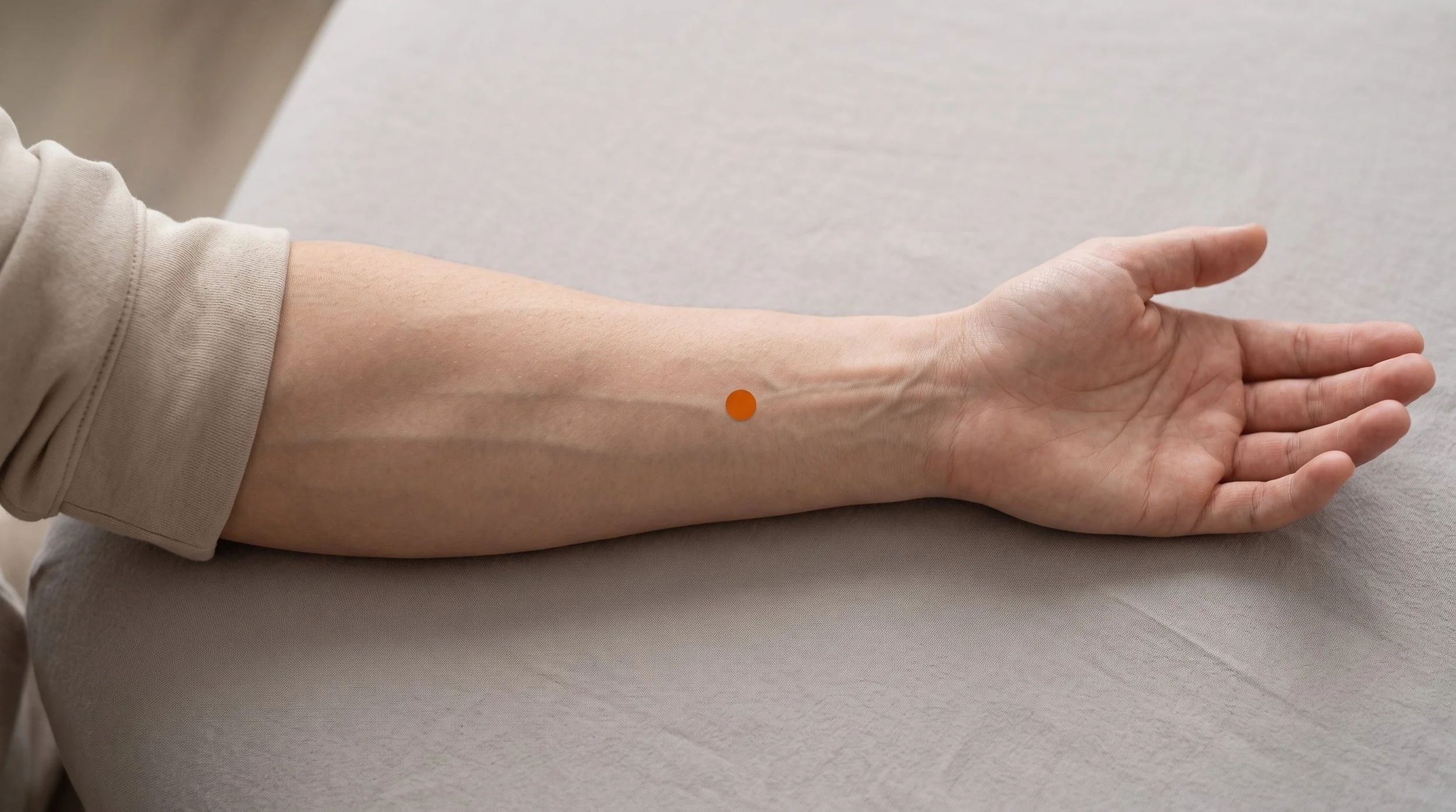
PC5 Acupuncture Point (Jianshi)
The Intermediate Messenger of the Inner Forearm: Anatomy, Mechanism, and Why This Median Nerve Point Anchors Treatment for Agitation, Nausea, and Throat Tightness
PC5, known as Jianshi or Intermediate Messenger, sits on the palm side of the forearm about four finger widths above the wrist crease, in the small valley between the tendons of palmaris longus and flexor carpi radialis. Pericardium 5 is the jing-river and metal point of the Pericardium channel, and classical texts treat it as one of the two principal points for what they called phlegm, particularly phlegm said to cloud the Heart and disturb the mind.
In modern terms the pc 5 forearm site sits directly over the median nerve corridor, one of the most densely studied somatic inputs in acupuncture physiology, which is why this quiet point turns up in protocols for agitation and restlessness, nausea and epigastric discomfort, and the lump-in-the-throat sensation the classics called plumstone qi.
- PC5 is located 3 cun proximal to PC7 on the flexor aspect of the forearm, between the palmaris longus and flexor carpi radialis tendons, and the needle passes through skin, antebrachial fascia, and the intertendinous gap toward flexor digitorum superficialis with the median nerve running deep to it (Deadman et al., 2007).
- Classical sources classify Jianshi as the jing-river and metal point of the Pericardium channel and attribute to it the actions of transforming phlegm, settling the mind, descending rebellious Stomach qi, and regulating menstruation, all of which we read today as autonomic and visceromotor modulation rather than movement of a substance (Deadman et al., 2007).
- The mechanism story is unusually well mapped for this location: electroacupuncture at the PC5 and PC6 pair over the median nerve reduces reflex increases in blood pressure and sympathetic outflow, and that inhibition is reversed by naloxone, implicating endogenous opioids (Chao et al., 1999; Zhao, 2008).
- Median nerve stimulation at this pair also reversed demand-induced myocardial ischemia in an experimental model, and microdialysis work shows electroacupuncture at PC5 to PC6 lowers GABA in the ventrolateral periaqueductal gray, a node in the descending inhibitory network (Li et al., 1998; Fu & Longhurst, 2009).
- Clinical research on the conditions PC5 traditionally addresses is mixed and mostly tests multi-point protocols: wrist point stimulation may reduce postoperative nausea and vomiting, reviews of acupuncture for anxiety disorder report benefit with methodological caveats, and Cochrane found the evidence for period pain insufficient (Lee et al., 2025; Yang et al., 2021; Smith et al., 2016).
- De qi at PC5 is usually a heavy, spreading ache between the tendons that may travel toward the palm or up the forearm; a brief electric tingle into the fingers signals the median nerve is close, and the needle should be withdrawn slightly and redirected.
Feeling Wired, Restless, or Constantly on Edge?
Agitation that will not settle, a racing chest, and a mind that startles easily are among the oldest listed uses of Jianshi, and they remain among the most common reasons we needle it today. At Morningside Acupuncture we pair PC5 with points on the Heart and Liver channels, adjust stimulation to a level your nervous system tolerates, and track sleep and reactivity session by session. Treatment is calm, quiet, and evidence-informed rather than dramatic. Schedule a visit and let's build a plan around how your system actually responds.
Schedule NowAnatomy of PC5: Why the Gap Between Palmaris Longus and Flexor Carpi Radialis Is Such an Important Location
PC5 sits three cun proximal to PC7, which is roughly four finger widths above the wrist crease, in the shallow trough between the tendons of palmaris longus and flexor carpi radialis. At this level the two structures are transitioning from muscle belly to tendon, so a needle entering the midline passes through thin skin and subcutaneous tissue, then the antebrachial fascia, then the intertendinous gap, and finally into or alongside flexor digitorum superficialis.
Everything that grips, types, carries, and stabilizes the wrist loads this compartment, which is why the tissue here is often tender in people who spend long days at a keyboard or a barbell even when their complaint has nothing to do with the forearm. Palmaris longus is absent in a meaningful minority of people, and in that case the point is located just to the ulnar side of the flexor carpi radialis tendon (Deadman et al., 2007).
The neurological story is what makes this location interesting. The median nerve runs deep to flexor digitorum superficialis directly beneath PC5, and its afferents enter the cord across roughly the C5 to T1 segments, the same neighborhood that receives sympathetic afferent traffic from the heart and upper digestive tract. That overlap gives a plausible route for somatic input at the forearm to influence visceral reflexes rather than only local tissue.
Experimental work using this exact pairing found that electroacupuncture at PC5 and PC6 over the median nerve blunted reflex increases in arterial pressure and reversed ischemic wall motion changes, and that naloxone abolished the effect, which points to opioid-dependent central inhibition rather than a purely local response (Li et al., 1998; Chao et al., 1999). Related microdialysis work showed reduced GABA release in the ventrolateral periaqueductal gray during stimulation at these points, a change that would disinhibit descending control pathways (Fu & Longhurst, 2009; Zhao, 2008).
Deeper and slightly radial to the point, the radial artery runs beneath the flexor carpi radialis tendon, and the median nerve itself lies within needling range at this depth, so this is a location that rewards precision. Standard practice is perpendicular insertion of 0.5 to 1 cun in the intertendinous gap, or an oblique proximally directed insertion of 1 to 1.5 cun when a longer tissue path is wanted (Deadman et al., 2007). Practitioners avoid heavy manipulation once a sharp radiating sensation appears, since that indicates direct nerve contact rather than the diffuse ache of de qi. Aspiration-free, slow insertion and attention to patient feedback keep this an easy point to needle safely.
Related Flexor Carpi Radialis Trigger Points Related Palmaris Longus Trigger PointsPC5 at a Glance: Classification, Location, and Clinical Use
| Category | Detail |
|---|---|
| Traditional Name | Jianshi (Intermediate Messenger), PC5 or P-5 |
| Channel Classification | Pericardium channel of the hand, jueyin (PC5, also written P5; also called the Heart Protector channel) |
| Point Categories | Jing-river point of the Pericardium channel; metal point of the Pericardium channel; described in classical commentary as one of the two principal phlegm-transforming points alongside ST40, and named by Sun Si-miao's Supplement to the Thousand Ducat Formulas as one of the thirteen ghost points |
| Precise Location | Flexor aspect of the forearm, 3 cun proximal to PC7, between the tendons of palmaris longus and flexor carpi radialis; when palmaris longus is absent, locate just ulnar to the flexor carpi radialis tendon |
| Tissue Stimulated | Skin and subcutaneous tissue, antebrachial fascia, the intertendinous gap between palmaris longus and flexor carpi radialis, flexor digitorum superficialis, and the median nerve corridor lying deep to the point |
| Needle Depth / Direction | Perpendicular 0.5 to 1 cun between the tendons, or oblique proximal insertion 1 to 1.5 cun; withdraw and redirect if a sharp electric sensation radiates into the fingers |
| De Qi Sensation | Heavy, dull spreading ache or fullness between the tendons, sometimes traveling toward the palm or proximally up the forearm; occasionally a warm, slightly numb quality that lingers after the needle is removed |
| Primary Clinical Uses | Agitation, restlessness and startle-prone anxiety; nausea, retching and epigastric discomfort; the sensation of something caught in the throat (plumstone qi); menstrual irregularity with clotted flow in classical listings; forearm and inner elbow pain |
| Common Point Combinations |
|
In Deadman, Al-Khafaji and Baker's A Manual of Acupuncture, Jianshi is presented above all as a point that transforms phlegm in the upper burner and settles the mind, and the commentary is worth reading as a description of pattern recognition rather than of substance. The traditional model held that intense or prolonged emotion stagnates qi, that stagnant qi condenses fluids, and that the resulting phlegm can obstruct the Heart and disturb the spirit, producing anything from mild jumpiness, poor memory, and being easily startled through to the severe presentations the classics listed as mania and epilepsy.
A related classical idea, quoted in the same commentary from Gong Juzhong, held that fright itself generates phlegm when the spirit vacates its residence. The text also credits Jianshi with descending rebellious Stomach qi for nausea, retching, and epigastric pain, with treating plumstone qi and other throat and neck presentations, and, unusually for a Pericardium point, with a gynecological action on irregular and clotted menstruation, justified by the classical statement that the uterine vessel connects to the Heart.
What is striking is the coherence of the pattern: one forearm point was expected to reach the chest, the stomach, the throat, and the pelvis, which is exactly the reach you would predict from a site sitting over a major mixed nerve with wide central connections.
Why PC5 Is Used for Agitation, Nausea, and a Lump in the Throat Rather Than Just Forearm Pain
Patients often ask how a point on the inner forearm could matter for the chest, stomach, or throat. The short answer is convergence. Median nerve afferents from the PC5 region enter the spinal cord across roughly the C5 to T1 segments, and those same segments receive sympathetic afferent input from the heart and upper digestive tract. When several inputs converge on shared spinal neurons, stimulating the accessible somatic one can change how the central nervous system processes the visceral one.
That is a mainstream neurophysiological explanation, and it is why so many nausea and cardiovascular experiments have used this specific stretch of forearm (Li et al., 1998).
Above the spinal cord, the effect appears to depend on descending inhibitory circuitry. Stimulation at the PC5 and PC6 pair engages a long-loop pathway through the hypothalamus, midbrain periaqueductal gray, and rostral ventrolateral medulla, and blocking opioid receptors with naloxone reverses the reduction in reflex pressor responses, which suggests endogenous opioids carry a meaningful part of the signal (Chao et al., 1999; Zhao, 2008).
Microdialysis studies at these same points found reduced GABA release in the ventrolateral periaqueductal gray, a change that would release descending inhibitory neurons from local restraint (Fu & Longhurst, 2009). Most of this work is animal physiology rather than clinical trial data, so it explains plausibility rather than proving outcomes.
Clinically, that mechanism maps reasonably well onto the classical picture. A treatment that lowers sympathetic reactivity and recruits descending inhibition would be expected to help with the state the classics described as agitation and propensity to fright, with stress-linked throat tightness, and with queasiness that flares under pressure. It does not make PC5 a treatment for a diagnosis, and we always want a medical workup for new chest symptoms, persistent throat sensations, or unexplained vomiting. Used alongside appropriate care, though, this is a sensible point to include when the nervous system seems stuck in a high-alert setting.
What the Research Shows for PC5
Almost no clinical trial isolates PC5. Reviews test whole protocols, and PC5 typically appears as one point among several, or as the partner of PC6 in laboratory work on the median nerve. That means the honest reading of the evidence is indirect: the physiological research at this location is unusually detailed, while the clinical research speaks to the conditions the point is traditionally used for rather than to the point itself. The table below separates those two layers so you can see what each type of study can and cannot tell us.
| Study | Type | Focus | Key Finding |
|---|---|---|---|
| Lee et al., 2025 | Cochrane systematic review and network meta-analysis | Wrist acupoint (PC6) stimulation for postoperative nausea and vomiting, the neighboring point on the same nerve corridor | Invasive and noninvasive stimulation of this wrist location may reduce postoperative nausea and vomiting, with no serious complications reported in the included studies. |
| Yang et al., 2021 | Systematic review and meta-analysis | Acupuncture for anxiety disorder, the symptom domain PC5 is classically associated with | Pooled results favored acupuncture over control conditions for anxiety symptoms, though the authors noted substantial methodological limitations across trials. |
| Smith et al., 2016 | Cochrane systematic review | Acupuncture and acupressure for primary dysmenorrhoea, relevant to the classical menstrual indications | The review concluded there was insufficient evidence to determine whether acupuncture or acupressure are effective for period pain. |
| Chao et al., 1999 | Controlled animal experiment | Electroacupuncture at PC5 and PC6 over the median nerve during a visceral sympathoexcitatory reflex | Stimulation reduced reflex increases in blood pressure and reversed the ischemic response, and naloxone eliminated the effect, suggesting opioid mediation. |
| Li et al., 1998 | Controlled animal experiment | Median nerve stimulation as a model of electroacupuncture at the Pericardium forearm points | Stimulation reversed reflex-induced myocardial ischemia in this model, supporting a somatic to visceral reflex pathway. |
| Fu & Longhurst, 2009 | Animal microdialysis study | Neurotransmitter release in the ventrolateral periaqueductal gray during electroacupuncture at PC5 and PC6 | Stimulation reduced local GABA release through a presynaptic cannabinoid CB1 mechanism, consistent with disinhibition of descending control. |
| Zhao, 2008 | Mechanistic review | Neural mechanisms of acupuncture analgesia and central modulation | Needling effects are attributed to afferent stimulation recruiting spinal and supraspinal inhibition, including endogenous opioid pathways. |
Nausea, Queasiness, or a Lump in Your Throat That Will Not Clear?
The jianshi phlegm point has been used for centuries for nausea, retching, epigastric pain, and the sensation of something caught in the throat that worsens with stress. We use PC5 alongside PC6 and abdominal or lower limb points, and we screen carefully so that anything requiring medical workup gets it first. Sessions are short, comfortable, and designed to fit a workday. Book an appointment and bring your symptom pattern with you.
Schedule NowPC5 in the Context of Trigger Point Work
Acupuncture, in our definition, is the use of an acupuncture needle, and that includes the hundreds of styles practiced worldwide as well as dry needling. At PC5 the two frameworks overlap neatly, because the point sits in the flexor compartment where palmaris longus, flexor carpi radialis, and the underlying flexor digitorum superficialis all live. Trigger points in these muscles can refer discomfort into the wrist, palm, and fingers and are common in people with heavy keyboard, instrument, or grip loads (Simons et al., 1999).
When a patient's forearm complaint is clearly myofascial, we needle those bands directly and use PC5 as a channel point in the same treatment rather than treating them as separate systems.
In practice the sequence is straightforward. We palpate the flexor group for taut bands and local tenderness, address the specific muscles that reproduce the patient's pattern, and then place PC5 in the intertendinous gap with light to moderate stimulation, respecting the median nerve beneath.
For patients who came in for anxiety, nausea, or throat tightness rather than pain, we often find incidental tenderness in this compartment anyway, and treating it tends to make the session more comfortable. If you want to explore which forearm muscle matches your referral pattern, our forearm and hand pain resources are a good starting point.
PC5 Anxiety and Nausea Treatment at NYC's Highest-Rated Acupuncture Clinic
Morningside Acupuncture is the highest-rated acupuncture and dry needling clinic in New York City with over 500 five-star Google reviews, and our approach blends classical point selection with current pain and autonomic science. We use PC5 as part of individualized protocols for anxiety, nausea, chest tightness, and forearm complaints, and we explain every needle we place. You will always know what we are treating and why. Schedule your first session and see how a modern, research-informed acupuncture visit feels.
Schedule NowFrequently Asked Questions
What does PC5 feel like when needled?
Most people describe a heavy, dull, spreading ache or fullness in the gap between the tendons, sometimes traveling toward the palm or up toward the elbow. That diffuse sensation is de qi and it usually settles within a few seconds. A brief electric tingle into the fingers can happen because the median nerve runs beneath the point, and it means the needle should be eased back and redirected rather than manipulated further. The area may feel slightly warm or heavy for a short time afterward.
Why treat the forearm for symptoms in the chest, stomach, or throat?
Because the nervous system does not organize itself the way body maps suggest. Afferents from the median nerve at PC5 enter spinal segments that also receive input from the heart and upper digestive tract, so somatic stimulation here can influence how those visceral signals are processed centrally (Li et al., 1998). Experimental work at this exact location has shown reduced reflex blood pressure responses and engagement of descending, opioid-sensitive pathways (Chao et al., 1999; Zhao, 2008). Classical texts arrived at similar clinical territory by pattern observation long before that physiology was described.
Can I press PC5 myself between sessions?
Yes, and it is one of the easier points for self-acupressure. Turn your palm up, find the wrist crease, and measure about four finger widths up the forearm, then feel for the soft valley between the two tendons that pop up when you flex your wrist against light resistance. Press straight in with your opposite thumb using firm but comfortable pressure, hold for 30 to 60 seconds or make small slow circles for one to two minutes, then switch arms. Two or three rounds a day is plenty, and pairing it with slow nasal breathing tends to make it more useful for tension and queasiness. Stop if you feel numbness, tingling, or shooting sensations into the hand, and skip the area entirely if you have a nerve condition, a recent injury, or broken skin there.
Is PC5 safe to needle?
In trained hands it is a routine and well tolerated point. The main structures to respect are the median nerve running deep to the point and the radial artery lying beneath the flexor carpi radialis tendon slightly to the thumb side, which is why practitioners insert in the midline gap, keep to conventional depths of 0.5 to 1 cun perpendicular or 1 to 1.5 cun obliquely, and adjust immediately if a sharp radiating sensation appears (Deadman et al., 2007). Transient soreness or a small bruise are the usual minor effects. Tell your acupuncturist if you take blood thinners, have carpal tunnel syndrome or another median nerve problem, or have had recent wrist or forearm surgery.
Where exactly is PC5 located?
PC5 lies on the palm side of the forearm, 3 cun proximal to PC7 at the wrist crease, in the depression between the tendons of palmaris longus and flexor carpi radialis. A practical way to find it is to divide the distance from the elbow crease to the wrist crease into quarters and take the junction of the proximal three quarters and the distal quarter, which lands you at the same spot. If you cannot see a palmaris longus tendon when you pinch your thumb and little finger together, you are among the people who do not have one, and the point is then located just to the little finger side of the flexor carpi radialis tendon (Deadman et al., 2007).
References
- Deadman, P., Al-Khafaji, M., & Baker, K. (2009). A manual of acupuncture. Journal of Chinese Medicine Publications.
- Simons, D. G., Travell, J. G., & Simons, L. S. (1999). Travell & Simons' myofascial pain and dysfunction: The trigger point manual, Vol. 1: Upper half of body (2nd ed.). Williams & Wilkins.
- Chao, D. M., Shen, L. L., Tjen-A-Looi, S., Pitsillides, K. F., Li, P., & Longhurst, J. C. (1999). Naloxone reverses inhibitory effect of electroacupuncture on sympathetic cardiovascular reflex responses. American Journal of Physiology-Heart and Circulatory Physiology, 276(6), H2127-H2134. https://doi.org/10.1152/ajpheart.1999.276.6.H2127
- Li, P., Pitsillides, K. F., Rendig, S. V., Pan, H. L., & Longhurst, J. C. (1998). Reversal of reflex-induced myocardial ischemia by median nerve stimulation: A feline model of electroacupuncture. Circulation, 97(12), 1186-1194. https://doi.org/10.1161/01.CIR.97.12.1186
- Fu, L. W., & Longhurst, J. C. (2009). Electroacupuncture modulates vlPAG release of GABA through presynaptic cannabinoid CB1 receptors. Journal of Applied Physiology, 106(6), 1800-1809. https://doi.org/10.1152/japplphysiol.91648.2008
- Lee, A., Zhang, J. Z., Xie, J., Cheng, V., Wong, M. K. H., & Yau, D. K. W. (2025). Stimulation of the wrist acupuncture point PC6 for preventing postoperative nausea and vomiting: A network meta-analysis. Cochrane Database of Systematic Reviews, 9(9), CD003281. https://doi.org/10.1002/14651858.CD003281.pub5
- Smith, C. A., Armour, M., Zhu, X., Li, X., Lu, Z. Y., & Song, J. (2016). Acupuncture for dysmenorrhoea. Cochrane Database of Systematic Reviews, 4(4), CD007854. https://doi.org/10.1002/14651858.CD007854.pub3
- Yang, X. Y., Yang, N. B., Huang, F. F., Ren, S., & Li, Z. J. (2021). Effectiveness of acupuncture on anxiety disorder: A systematic review and meta-analysis of randomised controlled trials. Annals of General Psychiatry, 20, 9. https://doi.org/10.1186/s12991-021-00327-5
- Zhao, Z. Q. (2008). Neural mechanism underlying acupuncture analgesia. Progress in Neurobiology, 85(4), 355-375. https://doi.org/10.1016/j.pneurobio.2008.05.004
Disclaimer: This web site is intended for educational and informational purposes only. Reading this website does not constitute providing medical advice or any professional services. This information should not be used for diagnosing or treating any health issue or disease. Those seeking medical advice should consult with a licensed physician. Seek the advice of a medical doctor or other qualified health professional for any medical condition. If you think you have a medical emergency, call 911 or go to the emergency room. No acupuncturist-patient relationship is created by reading this website or using the information. Morningside Acupuncture PLLC and its employees and contributors do not make any express or implied representations with respect to the information on this site or its use. For any legal interpretation of scope of practice in your state, consult a licensed attorney or regulatory authority.
Read more from our blog



