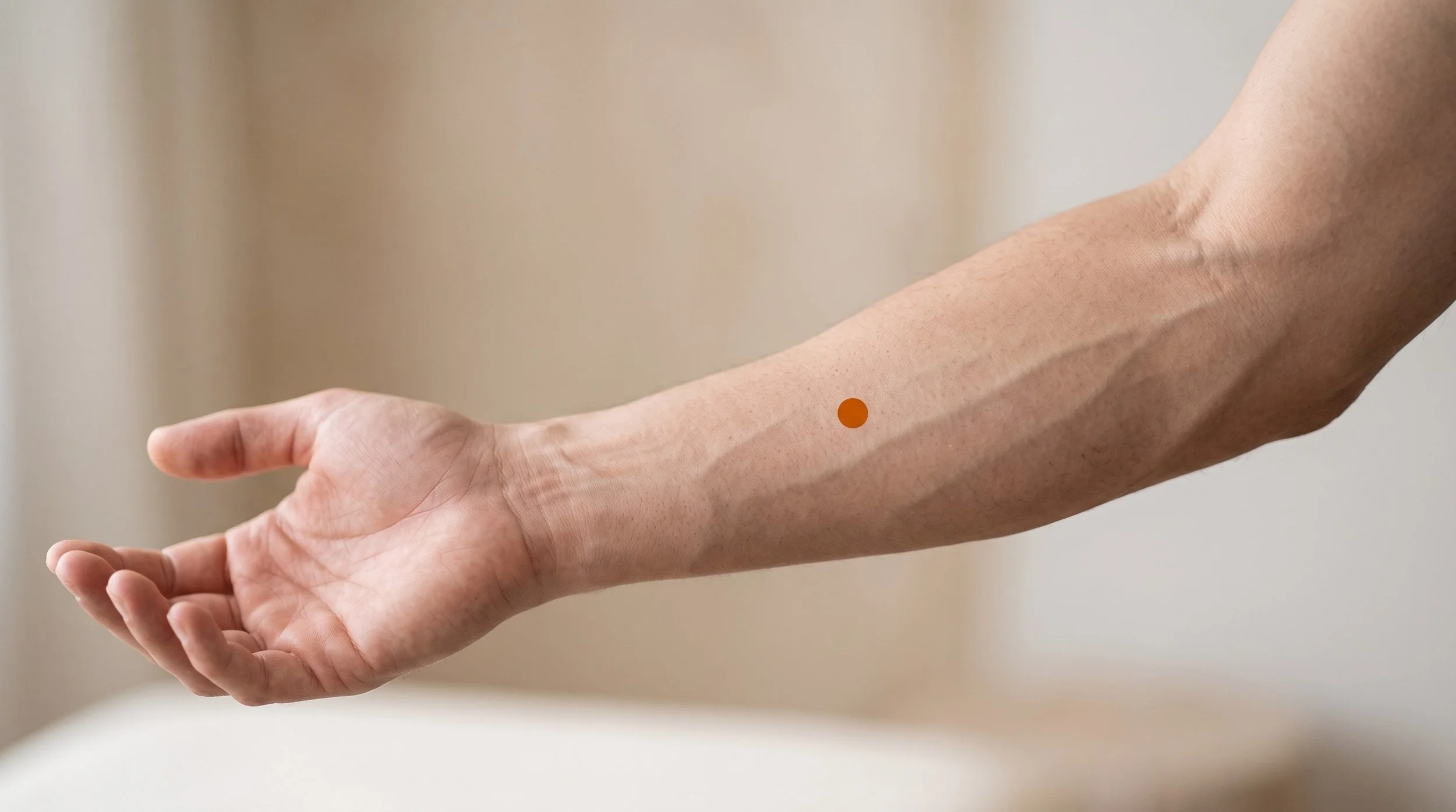
PC4 Acupuncture Point (Ximen)
The Cleft Gate of the Pericardium Channel: Anatomy, Median Nerve Mechanisms, and Why This Mid-Forearm Point Is Reserved for Acute Chest and Heart Symptoms
PC4 (Ximen), translated as Xi-Cleft Gate, sits in the middle of the inner forearm, five cun above the wrist crease in the groove between the palmaris longus and flexor carpi radialis tendons, roughly halfway between the wrist and the elbow crease. It's the xi-cleft point of the Pericardium channel, the category classical authors reserved for sudden, sharp and severe presentations, and in the Pericardium's case for acute chest and Heart symptoms in particular.
Modern interest in the pc4 acupuncture point comes from the same anatomy that made it useful historically: needling here engages the median nerve corridor of the forearm, a somatic input pathway with well-documented effects on autonomic cardiovascular reflexes. In our clinic, PC4 is a supportive point for chest tightness, palpitations, anxiety and forearm flexor pain, always as an adjunct to appropriate medical care rather than a substitute for it.
- Location and layers: PC4 (Ximen), sometimes written pericardium 4, lies 5 cun proximal to PC7 on the line to PC3, between the palmaris longus and flexor carpi radialis tendons. The needle passes skin and superficial fascia into the intertendinous interval and toward flexor digitorum superficialis, with the median nerve running deep to that interval.
- Traditional categories, translated: classical texts assign PC4 the actions of moving blood, cooling blood, calming the spirit and moderating acute conditions (Deadman et al., 2007). Read neurophysiologically, those descriptions map onto a forearm point that modulates autonomic tone, vascular reactivity and pain processing rather than onto any literal movement of blood.
- Mechanism: electroacupuncture over the median nerve territory has been shown in animal preparations to dampen sympathoexcitatory cardiovascular reflexes through brainstem circuits involving the medullary raphe and rostral ventrolateral medulla (Moazzami et al., 2010), and acupuncture analgesia more broadly depends on spinal and descending inhibitory pathways plus endogenous opioid signaling (Zhao, 2008).
- Research picture: PC4 shows up most often as one point within cardiac protocols, including electroacupuncture at PC6 with PC4 in patients with stable ischemic heart disease (Feng et al., 2023) and perioperative transcutaneous stimulation at the same two points (Liu et al., 2019), while the larger angina trials tested multi-point Pericardium and Heart channel prescriptions (Zhao et al., 2019).
- Clinical framing: we use the ximen xi cleft point for episodic chest tightness, palpitations with anxiety, sleep disruption in keyed-up patients and anterior forearm pain, alongside cardiology care when indicated. Chest pain is a medical emergency until proven otherwise, and acupuncture never replaces that evaluation.
- De qi at PC4: patients usually report a dull, heavy, slightly aching fullness that may spread toward the wrist or up the forearm. A sharp electric zing into the fingers means the needle is close to the median nerve, and the correct response is to withdraw and redirect rather than to keep stimulating.
Chest Tightness and Palpitations That Keep Coming Back?
Once cardiology has cleared you, recurrent chest tightness, fluttering and breath-holding often turn out to be an autonomic and musculoskeletal problem rather than a structural one. At Morningside Acupuncture we combine PC4 and PC6 with breath retraining and gentle needling of the chest wall and upper back to help settle that pattern. Treatment is graded to your tolerance and reviewed session by session. Schedule a visit and let's map out what's driving your symptoms.
Schedule NowAnatomy of PC4: Why the Mid-Forearm Median Nerve Corridor Is Such an Important Location
PC4 sits in the middle third of the anterior forearm, in the shallow furrow between the palmaris longus tendon and the flexor carpi radialis tendon. Under thin skin and superficial fascia, the needle enters the interval between those two muscle bellies and their tendons, with flexor digitorum superficialis lying just deeper. This whole compartment loads every time you grip, type, carry a bag, lift weights or spend hours at a keyboard, which is why the tissue here is so often tender in patients who have never thought about their forearms at all.
Palmaris longus is absent in a meaningful minority of people, and in that case the point is located just to the ulnar side of the flexor carpi radialis tendon.
The reason PC4 matters beyond local muscle work is nerve geography. The median nerve travels between the superficial and deep flexor layers through exactly this region, and its cutaneous and muscular branches supply the tissue the needle engages. Somatic afferents from this territory enter the cervical spinal cord at levels that also receive input from cardiac and thoracic structures, so stimulation here converges centrally with information from the chest.
Experimental work using stimulation over the median nerve area has shown reduced sympathoexcitatory cardiovascular reflex responses mediated through brainstem relays including the medullary raphe and rostral ventrolateral medulla (Moazzami et al., 2010), and the broader analgesic effects of needling involve segmental gating plus descending inhibition and endogenous opioid release (Zhao, 2008). That combination, a segmental link to the chest plus a general shift in autonomic and pain modulation, is the plausible modern account of a point classically reserved for acute chest and Heart symptoms.
Deeper still, the forearm compartment carries the anterior interosseous vessels and the median nerve itself, so depth discipline matters. Standard practice is perpendicular insertion of roughly 0.5 to 1 cun, or an oblique proximally angled insertion of 1 to 1.5 cun when a longer channel effect is wanted (Deadman et al., 2007). We needle into the intertendinous interval rather than through it, keep stimulation moderate, and reposition immediately if the patient reports a lightning-like sensation shooting into the thumb or index finger. Clean technique and appropriate angling make PC4 a comfortable, low-risk point in trained hands.
Related Flexor Carpi Radialis Trigger Points Related Palmaris Longus Trigger PointsPC4 at a Glance: Classification, Location, and Clinical Use
| Category | Detail |
|---|---|
| Traditional Name | Ximen (Xi-Cleft Gate), PC4, also written P-4 or pericardium 4 |
| Channel Classification | Pericardium channel of the hand jueyin, forearm segment (PC4, also written P4; also called the Heart Protector channel) |
| Point Categories | Xi-cleft (accumulation) point of the Pericardium channel. The reference sources list no five-shu, extraordinary vessel or hui-meeting designations for this point, and its xi-cleft status is the classification that drives its classical use in acute presentations and blood-level disorders of the yin channels. |
| Precise Location | Flexor aspect of the forearm, 5 cun proximal to PC7 on the line joining PC7 and PC3, between the tendons of palmaris longus and flexor carpi radialis. A practical check: find the midpoint between the elbow crease and PC7, then move 1 cun distal. When palmaris longus is absent, locate just ulnar to the flexor carpi radialis tendon. |
| Tissue Stimulated | Skin and superficial fascia of the anterior forearm, the intertendinous interval between palmaris longus and flexor carpi radialis, the underlying flexor digitorum superficialis, and the connective tissue corridor carrying the median nerve |
| Needle Depth / Direction | Perpendicular 0.5 to 1 cun, or oblique proximally directed 1 to 1.5 cun; moderate stimulation, avoid direct median nerve contact |
| De Qi Sensation | Dull, heavy, spreading ache in the mid-forearm that may travel toward the wrist or elbow; a sharp electrical sensation into the fingers indicates nerve proximity and calls for redirection |
| Primary Clinical Uses | Traditionally used for acute chest and Heart pain (alongside urgent medical care), palpitations with fear and fright, agitation, insomnia and melancholy, and for bleeding presentations in classical listings; used in modern practice for stress-related chest tightness, palpitations and anterior forearm pain |
| Common Point Combinations |
|
In the classical literature summarized by Deadman and colleagues, xi-cleft points are described as places where channel qi and blood gather and sink more deeply, which is why this category was traditionally reserved for acute, severe and painful presentations, with the yin channel xi-cleft points additionally attributed a role in blood disorders (Deadman et al., 2007). PC4 is given four traditional actions: invigorating blood and dispelling stasis, cooling blood and stopping bleeding, calming the spirit, and moderating acute conditions.
Its indication lists cluster into three groups: sudden chest and Heart pain, sometimes with vomiting; upper-body bleeding such as nosebleed and coughing or vomiting of blood; and disturbances of mood and sleep including agitation, insomnia, melancholy, and fear or fright around other people. Classical commentary explicitly links the last two groups, arguing that stagnant blood fails to nourish the Heart, which then cannot house the spirit, while emotional strain in turn congeals the blood.
What's striking is how coherent that loop looks from a modern vantage point: the same forearm point was chosen for cardiac distress and for the fear that accompanies it, which is precisely the overlap we see today in patients whose palpitations and anxiety feed each other.
Why PC4 Is Used for Panic-Like Chest Tightness and Palpitations
Patients often arrive after a full cardiac workup that found nothing wrong, still convinced something is. The sensation is real: a band across the chest, a skipped or thumping beat, shallow breathing, hands that feel electric. Much of that experience reflects an autonomic nervous system biased toward sympathetic output, layered on top of guarded chest wall and upper back muscles that make each breath feel restricted.
Needling the pc 4 forearm point engages median nerve territory whose afferents converge in the cervical and upper thoracic cord with input from thoracic structures, which is the segmental basis for treating chest sensations from the arm rather than the chest itself.
Beyond the segmental link, needling recruits descending inhibitory systems that use serotonin, noradrenaline and endogenous opioids to reduce the gain on incoming signals (Zhao, 2008). Experimental studies of stimulation over the median nerve region have traced a specific autonomic route, showing that sympathoexcitatory cardiovascular reflex responses can be dampened through serotonergic input from the medullary raphe to the rostral ventrolateral medulla, a key brainstem control point for sympathetic outflow (Moazzami et al., 2010).
Those studies are animal work, so they explain plausibility rather than prove clinical benefit, but they align with why forearm points were chosen for chest complaints in the first place.
Clinically, this shows up as patients relaxing within a few minutes of needle retention, breathing lower into the abdomen and reporting that the chest band loosens. We reinforce it with slow-exhale breathing practice between sessions and, where relevant, manual and dry needling work on the pectoral and scalene regions. The goal is a nervous system that recovers faster after stress, not a single dramatic session.
What the Research Shows for PC4
Very little research isolates PC4 on its own. Almost all of it tests multi-point protocols in which Ximen is one component, usually paired with PC6, so the honest framing is that PC4 has been included in reasonable-quality cardiac and autonomic research rather than validated as a standalone treatment. The angina trials also enroll patients who continue their standard medication, which is exactly how acupuncture should be positioned: adjunctive, not alternative.
Results below are promising in places and preliminary in others, and none of them change the rule that new or worsening chest pain needs emergency evaluation.
| Study | Type | Focus | Key Finding |
|---|---|---|---|
| Zhao et al., 2019 | Multicenter randomized clinical trial (JAMA Internal Medicine) | Acupuncture on disease-affected Heart and Pericardium channel points as adjunctive therapy for chronic stable angina, 398 participants analyzed | Adding channel-specific acupuncture to standard antianginal care reduced angina attack frequency more than nonaffected-meridian, sham and wait-list comparisons, though effect sizes were modest and the trial was conducted in a single country. |
| Feng et al., 2023 | Single-center randomized exploratory trial (American Journal of Cardiology) | Electroacupuncture at PC6 and PC4 bilaterally in 232 patients with stable ischemic heart disease, 12-month follow-up | Fewer major adverse cardiovascular events were recorded in the stimulation group (8.4% versus 19.3%), a signal that needs multicenter replication before it can guide practice. |
| Liu et al., 2019 | Randomized controlled clinical trial (Clinical Interventions in Aging) | Transcutaneous electrical stimulation at PC6 and PC4 during surgery in 122 older patients with coronary heart disease, using heart rate variability and cardiac biomarkers as outcomes | The authors reported perioperative differences in autonomic indices and injury markers favoring stimulation, but the single-center design and modest sample mean this is hypothesis-generating. |
| Moazzami et al., 2010 | Experimental animal physiology study | Brainstem circuitry underlying cardiovascular reflex modulation during acupuncture over the median nerve region | Serotonergic projections from the nucleus raphe pallidus to the rostral ventrolateral medulla contributed to reduced sympathoexcitatory responses, offering a mechanism for forearm points influencing cardiovascular reflexes. |
| Yang et al., 2021 | Systematic review and meta-analysis | Acupuncture for anxiety disorder across 20 randomized controlled trials | Pooled results favored acupuncture over control conditions for anxiety symptoms, with the authors noting methodological limitations across included trials. |
| Vickers et al., 2018 | Individual patient data meta-analysis | Acupuncture for chronic pain conditions across nearly 21,000 patients | Acupuncture outperformed both sham and no-acupuncture controls with effects persisting over 12 months, supporting needling as a durable option for persistent musculoskeletal pain. |
| Zhao, 2008 | Narrative review of neurophysiology | Neural mechanisms of acupuncture analgesia | Needle stimulation of somatic afferents engages spinal, brainstem and cortical pathways with endogenous opioid involvement, which frames how distal forearm points may influence distant symptoms. |
Anxiety, Poor Sleep and a Nervous System Stuck On?
The Pericardium channel points have been used for agitation, fear and restless sleep for centuries, and we use them today for patients whose bodies stay switched on long after the stressor has passed. PC4 pairs well with distal leg points and a calm, low-stimulation treatment style aimed at shifting autonomic balance. Most patients notice the shift during the session itself. Book an appointment and see how your system responds.
Schedule NowPC4 in the Context of Trigger Point Work
The PC4 location sits directly over tissue that dry needling addresses routinely. Palmaris longus and flexor carpi radialis both develop taut bands in people who grip, type or train hard, and flexor digitorum superficialis lies just deeper in the same corridor. Trigger points in the forearm flexors can refer discomfort into the wrist and palm and are described in the myofascial literature as a common source of vague forearm aching that gets misattributed to nerve entrapment (Simons et al., 1999).
When a patient with mid-forearm tenderness also has chest tightness or anxiety, PC4 becomes an efficient shared target: one needle placement addresses local myofascial irritability while engaging the median nerve corridor that channel theory has always emphasized.
In practice we palpate before we needle. If the interval between the tendons feels boggy or ropey and reproduces the patient's symptoms on compression, we treat it as a myofascial target with a short, precise technique. If the goal is autonomic and channel-based, we needle more shallowly with gentle stimulation and longer retention. Both approaches are acupuncture in the sense we use the word, meaning the use of an acupuncture needle, and the choice between them is a clinical decision made session by session rather than a fixed protocol. Forearm work is usually combined with upper back, scalene and pectoral treatment when posture and breathing are part of the picture.
PC4 Chest Tightness and Anxiety Treatment at NYC's Highest-Rated Acupuncture Clinic
Morningside Acupuncture is the highest-rated acupuncture and dry needling clinic in New York City with over 500 five-star Google reviews, and we treat stress-driven chest tightness, palpitations and forearm pain every week. Our licensed acupuncturists integrate classical point selection like PC4 with orthopedic assessment and trigger point dry needling of the forearm flexors. You'll get a clear plan, honest expectations and coordination with your other providers. Schedule your first session today.
Schedule NowFrequently Asked Questions
What does PC4 feel like when needled?
Most people feel a deep, dull heaviness or spreading ache in the middle of the forearm that may travel toward the wrist or up toward the elbow. Some describe warmth or a mild pulling sensation as the needle is stimulated. It shouldn't feel sharp or burning. If you feel an electric shock into the thumb, index or middle finger, tell your acupuncturist right away, because that means the needle is near the median nerve and it will be withdrawn and redirected. Patients who are anxious or highly reactive often do better here with gentler stimulation and a shorter retention time.
Why treat chest tightness from a point in the forearm instead of the chest itself?
Two reasons. Anatomically, sensory input from the forearm's median nerve territory enters the spinal cord at levels that also receive input from thoracic structures, so needling here converges centrally with signals from the chest and can influence how those signals are processed (Zhao, 2008). Physiologically, stimulation over the median nerve region has been shown in experimental studies to reduce sympathoexcitatory cardiovascular reflexes through brainstem pathways (Moazzami et al., 2010). Practically, the forearm is also easy to access, comfortable to treat and safe, which is one reason cardiac research protocols keep choosing PC6 and PC4 rather than points on the chest wall.
Can I press PC4 myself between sessions?
Yes, acupressure at PC4 is straightforward and safe for most people. Turn your palm up and find the two tendons that stand out in the middle of your wrist when you cup your hand and flex the wrist slightly. Trace up the groove between them to a point roughly midway between your wrist crease and elbow crease, then a thumb's width closer to the wrist. Press with your opposite thumb at moderate, tolerable pressure, enough to feel a dull ache but never sharp pain, and hold for 30 to 60 seconds. Repeat two or three times per arm, and pair it with slow breathing where the exhale is longer than the inhale. Twice a day is plenty. Stop if you get tingling or electrical sensations into the fingers, and stop if pressure reproduces or worsens chest symptoms.
Is PC4 safe to needle?
In trained hands, yes. The main consideration is the median nerve running deep to the intertendinous interval, so practitioners keep insertion to about 0.5 to 1 cun perpendicular, or angle obliquely along the forearm for a longer insertion, and reposition immediately if the patient reports an electric sensation into the hand (Deadman et al., 2007). Minor bruising is the most common side effect, and patients on anticoagulants should mention it so pressure can be applied afterward. The far more important safety point is contextual: PC4's classical reputation is for acute chest and Heart pain, but chest pain, pressure, jaw or arm pain, sweating and shortness of breath require emergency medical care immediately. Acupuncture is adjunctive support for stable, medically managed conditions.
Where exactly is PC4 located?
PC4 is on the palm side of the forearm, 5 cun above the wrist crease at PC7, on the line running up toward PC3 at the elbow crease, in the interval between the palmaris longus and flexor carpi radialis tendons. Since the distance from the elbow crease to the wrist crease is treated as 12 cun, an easy way to find it is to locate the midpoint of that span and then move one cun toward the wrist. If your palmaris longus tendon is absent, which is normal anatomical variation, the point is located just to the ulnar side of the flexor carpi radialis tendon. For orientation, PC6 sits much lower on the same line, only 2 cun above the wrist crease.
References
- Deadman, P., Al-Khafaji, M., & Baker, K. (2009). A manual of acupuncture. Journal of Chinese Medicine Publications.
- Cheng, X. (Ed.). (1999). Chinese acupuncture and moxibustion (Rev. ed.). Foreign Languages Press.
- Simons, D. G., Travell, J. G., & Simons, L. S. (1999). Travell & Simons' myofascial pain and dysfunction: The trigger point manual, Vol. 1: Upper half of body (2nd ed.). Williams & Wilkins.
- Zhao, L., Li, D., Zheng, H., Chang, X., Cui, J., Wang, R., Shi, J., Fan, H., Li, Y., Sun, X., Zhang, F., Wu, X., & Liang, F. (2019). Acupuncture as adjunctive therapy for chronic stable angina: A randomized clinical trial. JAMA Internal Medicine, 179(10), 1388-1397. https://doi.org/10.1001/jamainternmed.2019.2407
- Feng, B., Sun, Y., Liu, L., Chen, L., & Wang, Y. (2023). Transcutaneous electrical acupuncture point stimulation is cardioprotective for patients with stable ischemic heart disease. American Journal of Cardiology, 206, 202-209. https://doi.org/10.1016/j.amjcard.2023.08.062
- Liu, Y., Meng, H. Y., Khurwolah, M. R., Liu, J. B., Tang, H., & Aa, N. (2019). Cardioprotective effect of transcutaneous electrical acupuncture point stimulation on perioperative elderly patients with coronary heart disease: A prospective, randomized, controlled clinical trial. Clinical Interventions in Aging, 14, 1607-1614. https://doi.org/10.2147/CIA.S210751
- Moazzami, A., Tjen-A-Looi, S. C., Guo, Z. L., & Longhurst, J. C. (2010). Serotonergic projection from nucleus raphe pallidus to rostral ventrolateral medulla modulates cardiovascular reflex responses during acupuncture. Journal of Applied Physiology, 108(5), 1336-1346. https://doi.org/10.1152/japplphysiol.00477.2009
- Yang, X. Y., Yang, N. B., Huang, F. F., Ren, S., & Li, Z. J. (2021). Effectiveness of acupuncture on anxiety disorder: A systematic review and meta-analysis of randomised controlled trials. Annals of General Psychiatry, 20, 9. https://doi.org/10.1186/s12991-021-00327-5
- Vickers, A. J., Vertosick, E. A., Lewith, G., MacPherson, H., Foster, N. E., Sherman, K. J., Irnich, D., Witt, C. M., & Linde, K. (2018). Acupuncture for chronic pain: Update of an individual patient data meta-analysis. Journal of Pain, 19(5), 455-474. https://doi.org/10.1016/j.jpain.2017.11.005
- Zhao, Z. Q. (2008). Neural mechanism underlying acupuncture analgesia. Progress in Neurobiology, 85(4), 355-375. https://doi.org/10.1016/j.pneurobio.2008.05.004
Disclaimer: This web site is intended for educational and informational purposes only. Reading this website does not constitute providing medical advice or any professional services. This information should not be used for diagnosing or treating any health issue or disease. Those seeking medical advice should consult with a licensed physician. Seek the advice of a medical doctor or other qualified health professional for any medical condition. If you think you have a medical emergency, call 911 or go to the emergency room. No acupuncturist-patient relationship is created by reading this website or using the information. Morningside Acupuncture PLLC and its employees and contributors do not make any express or implied representations with respect to the information on this site or its use. For any legal interpretation of scope of practice in your state, consult a licensed attorney or regulatory authority.
Read more from our blog



