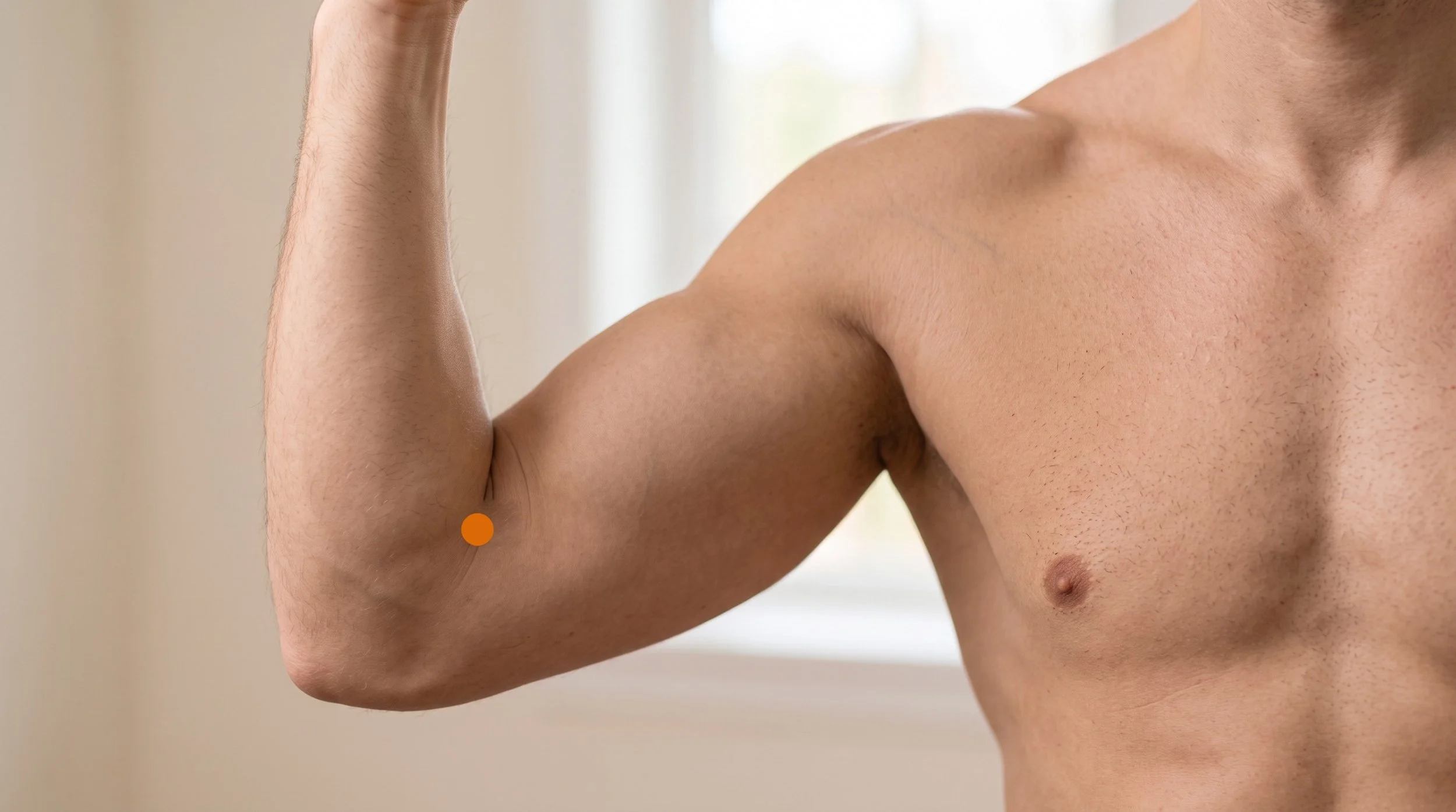
PC3 Acupuncture Point (Quze)
The Marsh at the Crook of the Elbow: Anatomy, Mechanism, and Why This He-Sea Point Sits at the Crossroads of Arm Pain, Nausea, and Autonomic Calm
PC3, known as Quze or "Marsh at the Crook," is the he-sea and water point of the Pericardium channel, and it sits right where the arm folds: on the transverse cubital crease, in the soft depression just to the ulnar (little finger) side of the biceps tendon. Anyone who has had blood drawn has been touched within a centimeter of this spot, because the same shallow hollow that classical texts call a marsh is the cubital fossa, a basin where superficial veins, the bicipital aponeurosis, the median nerve, and the brachial artery are all packed into a small space.
That anatomy is exactly why the pc3 acupuncture point matters clinically. It gives access to a dense sensory field at the elbow for pain and tendon problems, it lies on a channel whose points are studied for autonomic and antiemetic effects, and its traditional role as a heat-clearing point that could be needled or bled made it one of the most used points in classical descriptions of fever, vomiting, and summer-heat collapse (Deadman & Al-Khafaji, 2001).
- Location and layers: pericardium 3 lies on the elbow crease immediately ulnar to the biceps brachii tendon, and it should be located and needled with the elbow slightly flexed so the tendon stands out and the fossa opens (Deadman & Al-Khafaji, 2001). The needle passes through skin, superficial fascia carrying cubital veins, the edge of the bicipital aponeurosis, and into brachialis.
- Traditional categories translated: classical sources treat PC3 as the he-sea point (where channel qi was said to enter deeply) and the water point of a fire channel, which is why it was chosen to drain heat rather than to warm (Deadman & Al-Khafaji, 2001). In modern terms, these categories describe a point selected for strong, deep, distal stimulation at a major joint crease.
- Nerve geography: the skin here is supplied by medial and lateral antebrachial cutaneous nerves, while the median nerve and musculocutaneous branches run deeper, so needling recruits A-delta and C fibers at cervical and upper thoracic segmental levels that also receive visceral input from the chest (Zhao, 2008).
- Research picture: no trial has isolated Quze itself, so the honest evidence base is indirect. Meta-analyses of acupuncture for lateral elbow pain report short-term improvement with low-quality primary studies (Tang et al., 2015; Zhou et al., 2020), individual patient data show durable effects for chronic musculoskeletal pain (Vickers et al., 2018), and Pericardium channel research on nausea and heart rate variability centers on PC6 rather than PC3 (Lee et al., 2025; Hamvas et al., 2023).
- Clinical framing: at Morningside we use pc 3 elbow needling as part of a plan for medial elbow and forearm pain, biceps tendon irritation, and forearm tremor or cramping, and as a supporting point when someone presents with chest tightness, queasiness, and a rattled nervous system.
- De qi and safety: expect a heavy, spreading ache rather than a sharp jolt. Perpendicular insertion is kept to roughly 0.5 to 1 cun because the brachial artery and its accompanying veins run deeply just medial to the point (Deadman & Al-Khafaji, 2001).
Elbow, Forearm, or Grip Pain That Will Not Settle?
Elbow pain rarely lives only at the elbow, and treating one tender spot usually is not enough. We combine PC3 with local needling of the wrist flexors, biceps tendon, and forearm extensors, then add distal points to help modulate the whole segment. Most patients notice changes in grip comfort and elbow loading within a few visits. Schedule an evaluation and we will map exactly which tissues are driving your pain.
Schedule NowAnatomy of PC3: Why the Cubital Fossa Is Such an Important Location
Bend your elbow slightly and the biceps tendon jumps forward as a firm cord in the middle of the crease. PC3 sits in the give just medial to that cord. Under the skin lies loose superficial fascia carrying the cubital veins, then the fan of the bicipital aponeurosis, and beneath that the brachialis muscle with the pronator teres origin nearby on the medial side.
This is a mechanically busy corner: repeated gripping, lifting with the palm up, carrying bags, climbing, and long hours of typing or mousing all load the biceps and brachialis at their distal insertions and the flexor pronator mass that anchors just medial to the point. Patients often describe a deep, hard-to-localize ache here that they cannot reach with a thumb, which is precisely the kind of complaint that responds to accurate needling rather than surface massage.
Sensory supply to the skin at PC3 comes from the medial antebrachial cutaneous nerve on the ulnar side and the lateral antebrachial cutaneous nerve (the terminal sensory branch of the musculocutaneous nerve) laterally, while the median nerve travels deeper and slightly medial in the fossa. Needling this territory recruits small myelinated and unmyelinated afferents whose signals enter the dorsal horn at lower cervical and upper thoracic segments, the same neighborhood where afferents from the heart and upper gut terminate.
Convergence of somatic and visceral input at shared spinal segments is one of the standard explanations for why stimulating the medial arm can influence sensations felt in the chest and stomach, and needling also engages descending inhibitory pathways involving the periaqueductal gray, raphe nuclei, and endogenous opioid systems (Zhao, 2008). That combination, local segmental modulation plus a broader descending brake on pain transmission, is the modern reading of what classical writers described as a powerful he-sea point.
The safety story is straightforward and non-negotiable. The brachial artery and its venae comitantes run deeply just medial to PC3, with the median nerve alongside, so needling is kept perpendicular and shallow, generally 0.5 to 1 cun, with the elbow slightly flexed and the artery palpated first (Deadman & Al-Khafaji, 2001).
Classical practice also included pricking the visible cubital veins here to release a few drops of blood, a technique described repeatedly for fever and summer-heat patterns; when any superficial bleeding technique is used today it is done at the skin surface only, with single-use lancets and full clean-field precautions. If a patient reports a sharp electrical sensation shooting into the hand, the needle is withdrawn and redirected, since that signals contact with a nerve rather than useful de qi.
Related Pericardium Channel Related Biceps Brachii Trigger PointsPC3 at a Glance: Classification, Location, and Clinical Use
| Category | Detail |
|---|---|
| Traditional Name | Quze (Marsh at the Crook), Pericardium 3 |
| Channel Classification | Third point of the Pericardium channel of Hand Jueyin (PC3, also written P3; also called the Heart Protector channel) |
| Point Categories | He-sea point of the Pericardium channel; water point in the five-shu sequence of a fire channel; classically paired with BL40, the he-sea point at the knee crease, as its lower-limb counterpart (Deadman & Al-Khafaji, 2001) |
| Precise Location | On the transverse cubital crease, in the depression immediately to the ulnar side of the biceps brachii tendon and its aponeurosis; located and needled with the elbow slightly bent |
| Tissue Stimulated | Skin and superficial fascia of the cubital fossa, the medial border of the biceps brachii tendon and bicipital aponeurosis, and underlying brachialis fibers near the flexor pronator origin |
| Needle Depth / Direction | Perpendicular insertion 0.5 to 1 cun with the elbow slightly flexed, or superficial pricking of a visible cubital vein to bleed; never angle deep and medial toward the brachial artery |
| De Qi Sensation | A heavy, dull, distending ache in the crease that may spread down the medial forearm toward the wrist; sharp electrical sensations into the hand are not de qi and mean the needle should be repositioned |
| Primary Clinical Uses | Elbow, forearm, and biceps tendon pain; forearm cramping and tremor; supportive use for nausea, vomiting, chest tightness, palpitations, and heat-type presentations in classical practice |
| Common Point Combinations |
|
In the Manual of Acupuncture, Deadman and Al-Khafaji present Quze as a heat-clearing point of unusual reach, and the reasoning behind that traditional attribution is worth following. Later warm disease theorists sorted febrile illness into four levels of depth, and PC3 was considered useful across several of them: as the water point of a fire channel it was said to drain heat at the qi level with high fever, agitation and thirst, and when heat was thought to have reached the nutritive and blood levels with restlessness, parched mouth, and bleeding, the point could be pricked to bleed rather than simply needled.
The classical he-sea theory added a second function, since the Classic of Difficulties assigned he-sea points to counterflow qi and diarrhea and the Spiritual Pivot recommended them for disorders of eating and drinking, so Quze was traditionally used for acute vomiting, diarrhea, and the collapse-like presentations attributed to summer-heat. Its third and most concrete role was local: pain, contraction, and tremor of the elbow, arm, and hand.
What is striking is how coherent this cluster looks once you set the terminology aside, because a single point at the elbow crease was asked to handle a fever pattern, a gut pattern, and a limb pattern, and every one of those uses maps onto tissue that shares segmental and autonomic wiring with the chest and upper abdomen.
Why PC3 Is Used for Nausea, Palpitations, and Chest Tightness, Not Just Elbow Pain
Patients are often surprised that a point at the elbow gets used when the complaint is queasiness or a fluttering, tight feeling in the chest. The segmental explanation is the most useful one. Sensory nerves from the medial arm and forearm enter the spinal cord at lower cervical and upper thoracic levels, and afferents from the heart and upper digestive tract converge on overlapping populations of dorsal horn neurons in that same region.
Stimulating a dense somatic field where those inputs meet can change how the central nervous system weights the visceral signal, which is one mechanism proposed for why upper limb points have measurable effects on nausea and cardiac symptoms (Zhao, 2008). It is the same convergence principle that explains why cardiac pain is felt in the left arm, running in the opposite direction.
The second layer is descending modulation and autonomic tone. Needle stimulation that produces genuine de qi activates brainstem circuitry including the periaqueductal gray and raphe nuclei, releasing endogenous opioids and serotonin that dampen pain transmission at the spinal level (Zhao, 2008). Alongside that analgesic effect, a meta-analysis of randomized trials comparing real with placebo needling found changes in heart rate variability consistent with increased parasympathetic activity, although the authors urged caution given heterogeneity and study quality (Hamvas et al., 2023).
Antiemetic research on this channel has concentrated almost entirely on PC6 rather than PC3, and the most recent Cochrane network meta-analysis found that PC6 stimulation combined with antiemetic drugs may reduce postoperative nausea and vomiting compared with sham (Lee et al., 2025).
So the fair clinical statement is this: PC3 is not a substitute for medical care for chest symptoms or persistent vomiting, and any new or unexplained chest pain needs evaluation by a physician first. What PC3 offers is a well-located, anatomically sensible point on a channel with a plausible autonomic story, used as one component of a treatment aimed at the whole segment rather than a single spot.
What the Research Shows for PC3
There is no clinical trial of Quze on its own, and it would be misleading to imply otherwise. Acupuncture research almost always tests multi-point protocols against sham needling or usual care, so the sensible question is not whether PC3 works in isolation but whether the protocols it belongs to produce measurable benefit and whether its proposed mechanisms hold up physiologically. For elbow and forearm pain, that means reading the lateral epicondylitis literature with its acknowledged methodological limits.
For the antiemetic and autonomic claims, it means being explicit that most of the data come from PC6 on the same channel, not from PC3. The table below summarizes the reviews we lean on and what each one can and cannot support.
| Study | Type | Focus | Key Finding |
|---|---|---|---|
| Lee et al., 2025 | Cochrane systematic review and network meta-analysis | PC6 acupoint stimulation for postoperative nausea and vomiting | Invasive and noninvasive PC6 stimulation added to antiemetics may reduce postoperative nausea and vomiting compared with sham, with likely reductions in rescue antiemetic use. |
| Zhou et al., 2020 | Systematic review and meta-analysis of RCTs | Acupuncture for lateral epicondylitis (tennis elbow) | Pooled results across ten trials favored acupuncture on efficacy measures, though the authors flagged limited randomization reporting and risk of bias. |
| Tang et al., 2015 | Systematic review with GRADE assessment | Effectiveness and safety of acupuncture for lateral epicondylitis | Four small trials suggested improvement in elbow function and strength, but the evidence was judged of poor methodological quality and no definitive conclusion was drawn. |
| Vickers et al., 2018 | Individual patient data meta-analysis | Acupuncture for chronic musculoskeletal, headache, and osteoarthritis pain | Acupuncture was superior to sham and to no-acupuncture control for chronic pain, with effects persisting over about a year. |
| Hamvas et al., 2023 | Systematic review and meta-analysis of RCTs | Effect of manual acupuncture on heart rate variability versus placebo needling | Real acupuncture was associated with shifts in HRV indices suggesting increased parasympathetic tone, with results the authors advise interpreting cautiously. |
| Zhao, 2008 | Narrative review of experimental neurophysiology | Mechanisms of acupuncture analgesia | Needling with de qi engages A-delta and C fiber afferents and recruits opioid-dependent descending inhibitory pathways, providing a mechanistic basis for point-based analgesia. |
Nausea, Chest Tightness, and a Nervous System Stuck in Overdrive?
The Pericardium channel points have long been used when digestive upset and anxious, pounding sensations in the chest travel together. We may use quze acupuncture alongside PC6, HT7, and ST36 in a calm, unhurried treatment designed to shift you toward parasympathetic tone. Studies suggest acupuncture may modestly increase parasympathetic measures on heart rate variability, though effects vary between people (Hamvas et al., 2023). Book a session and we will build the protocol around your specific pattern.
Schedule NowPC3 in the Context of Trigger Point Work
Acupuncture is defined by the tool, an acupuncture needle, and that single tool covers hundreds of styles including dry needling. At Morningside, PC3 frequently ends up on the same treatment map as myofascial targets around the elbow, because the point sits at the junction of the distal biceps tendon, brachialis, and the flexor pronator origin. Trigger points in biceps brachii can refer pain into the front of the shoulder and down toward the elbow crease, and brachialis harbors trigger points that refer into the thumb base, a pattern that patients often mistake for a wrist problem (Simons et al., 1999). When someone points to the crease of the elbow and says the ache is inside, we assess those muscles before assuming tendon pathology.
A typical session might involve needling PC3 with the elbow slightly flexed, then treating taut bands in the wrist flexors, pronator teres, brachialis, and the extensor carpi radialis group depending on the pain map, with attention to grip mechanics and load management between visits. The local twitch responses generated during dry needling and the deep ache generated at PC3 recruit similar afferent populations, and both are thought to work through segmental and descending inhibition rather than anything specific to the tissue type (Zhao, 2008).
Needling around the cubital fossa always respects the same rule as above: palpate the brachial pulse, stay lateral to it, and keep depth conservative.
PC3 Elbow and Forearm Pain Treatment at NYC's Highest-Rated Acupuncture Clinic
Morningside Acupuncture is the highest-rated acupuncture and dry needling clinic in New York City with over 500 five-star Google reviews, and our practitioners treat elbow, forearm, and wrist problems every single day. We combine classical point selection like PC3 with orthopedic assessment and precise dry needling of the muscles that actually load your elbow. Every plan is explained clearly, with realistic timelines and no upselling. Schedule your first visit on the Upper West Side and get a straight answer about what is driving your symptoms.
Schedule NowFrequently Asked Questions
What does PC3 feel like when needled?
Most people feel a heavy, dull, slightly distending ache right in the elbow crease, sometimes spreading a few inches down the medial forearm. That spreading heaviness is de qi and it usually fades within a minute or two into a warm, released sensation. What you should not feel is a sharp electrical zing into the hand or fingers. If that happens, tell your acupuncturist immediately; the needle is simply withdrawn and repositioned, and the sensation resolves right away.
Why treat the elbow crease when my symptoms are in my chest or stomach?
Because of how the nervous system is wired rather than anything mystical. Sensory nerves from the medial arm enter the spinal cord at the same lower cervical and upper thoracic segments that receive input from the heart and upper digestive tract, so somatic stimulation at the elbow can influence how those visceral signals are processed centrally (Zhao, 2008). It is the same convergence that makes cardiac pain radiate down the left arm. That said, chest symptoms and persistent vomiting need medical evaluation first, and acupuncture is used as a complement rather than a replacement.
Can I press PC3 myself between sessions?
Yes, with one important caveat: never press hard on a pulse. Bend your elbow slightly, find the biceps tendon as a firm cord in the middle of the crease, then slide your thumb toward the little finger side into the soft hollow. Feel for the brachial pulse; if you feel it, move your thumb slightly toward the tendon and away from the pulse. Apply steady, moderate pressure for 30 to 60 seconds, release for 10 seconds, and repeat for two to three rounds per arm, once or twice daily. Aim for a satisfying dull ache, not sharp pain, and stop if you get any tingling into the hand. Many patients find it works best combined with gentle wrist flexor and extensor stretches.
Is PC3 safe to needle?
In trained hands, yes, and it is used routinely, but it is a point that demands respect for the anatomy. The brachial artery, its accompanying veins, and the median nerve all run deeply just medial to the point, so insertion is perpendicular, conservative in depth (roughly 0.5 to 1 cun), and always done with the artery palpated first (Deadman & Al-Khafaji, 2001). Patients on anticoagulants, with bleeding disorders, with a fistula or graft in that arm, or with lymphedema after axillary surgery should tell their practitioner, since those situations change the plan. Any classical bleeding technique at the cubital veins is superficial only and performed with single-use lancets under clean-field conditions.
Where exactly is PC3 located?
On the transverse cubital crease, in the depression immediately to the ulnar side of the biceps brachii tendon and its aponeurosis (Deadman & Al-Khafaji, 2001). To find it, bend your elbow to about 30 degrees so the tendon stands out in the middle of the crease, then move directly toward the little finger side until your finger drops into a soft hollow. PC3 sits at the same crease level as LU5, which lies on the other side of the tendon toward the thumb, and HT3, which is further medial near the inner end of the crease. Both the point and the needling are done with the elbow slightly bent, since a fully straight arm closes the depression.
References
- Deadman, P., Al-Khafaji, M., & Baker, K. (2009). A manual of acupuncture. Journal of Chinese Medicine Publications.
- Kim, H. (2008). Handbook of Oriental medicine (3rd ed.). Harmony & Balance Press.
- Simons, D. G., Travell, J. G., & Simons, L. S. (1999). Travell & Simons' myofascial pain and dysfunction: The trigger point manual, Vol. 1: Upper half of body (2nd ed.). Williams & Wilkins.
- Lee, A., Zhang, J. Z., Xie, J., Cheng, V., Wong, M. K. H., & Yau, D. K. W. (2025). Stimulation of the wrist acupuncture point PC6 for preventing postoperative nausea and vomiting: A network meta-analysis. Cochrane Database of Systematic Reviews, 9(9), CD003281. https://doi.org/10.1002/14651858.CD003281.pub5
- Zhou, Y., Guo, Y., Zhou, R., Wu, P., Liang, F., & Yang, Z. (2020). Effectiveness of acupuncture for lateral epicondylitis: A systematic review and meta-analysis of randomized controlled trials. Pain Research and Management, 2020, 8506591. https://doi.org/10.1155/2020/8506591
- Tang, H., Fan, H., Chen, J., Yang, M., Yi, X., Dai, G., Chen, J., Tang, L., Rong, H., Wu, J., & Liang, F. (2015). Acupuncture for lateral epicondylitis: A systematic review. Evidence-Based Complementary and Alternative Medicine, 2015, 861849. https://doi.org/10.1155/2015/861849
- Vickers, A. J., Vertosick, E. A., Lewith, G., MacPherson, H., Foster, N. E., Sherman, K. J., Irnich, D., Witt, C. M., & Linde, K. (2018). Acupuncture for chronic pain: Update of an individual patient data meta-analysis. Journal of Pain, 19(5), 455-474. https://doi.org/10.1016/j.jpain.2017.11.005
- Hamvas, S., Hegyi, P., Kiss, S., Lohner, S., McQueen, D., & Havasi, M. (2023). Acupuncture increases parasympathetic tone, modulating HRV: Systematic review and meta-analysis. Complementary Therapies in Medicine, 72, 102905. https://doi.org/10.1016/j.ctim.2022.102905
- Zhao, Z. Q. (2008). Neural mechanism underlying acupuncture analgesia. Progress in Neurobiology, 85(4), 355-375. https://doi.org/10.1016/j.pneurobio.2008.05.004
Disclaimer: This web site is intended for educational and informational purposes only. Reading this website does not constitute providing medical advice or any professional services. This information should not be used for diagnosing or treating any health issue or disease. Those seeking medical advice should consult with a licensed physician. Seek the advice of a medical doctor or other qualified health professional for any medical condition. If you think you have a medical emergency, call 911 or go to the emergency room. No acupuncturist-patient relationship is created by reading this website or using the information. Morningside Acupuncture PLLC and its employees and contributors do not make any express or implied representations with respect to the information on this site or its use. For any legal interpretation of scope of practice in your state, consult a licensed attorney or regulatory authority.
Read more from our blog



