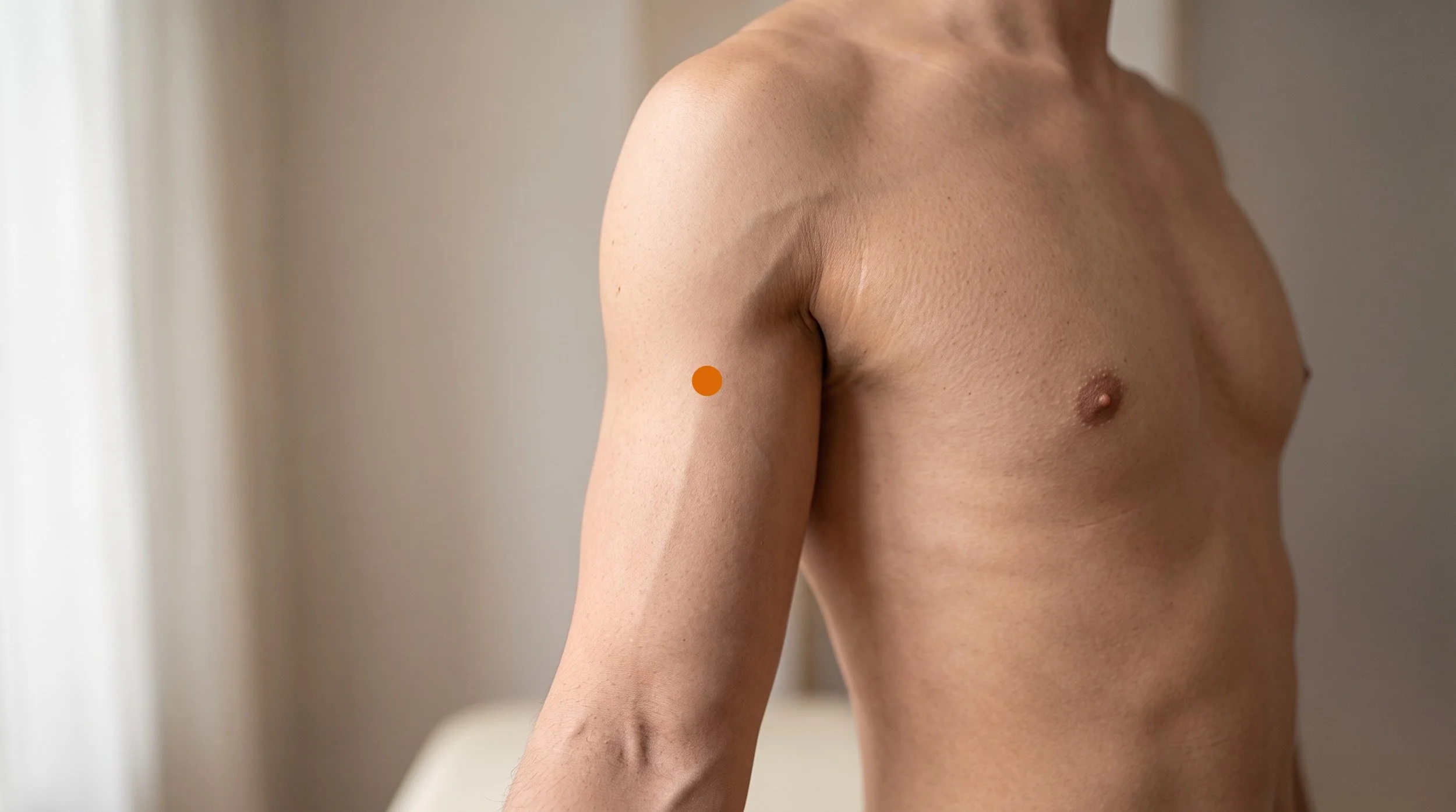
PC2 Acupuncture Point (Tianquan)
The Heavenly Spring in the Biceps Groove: Anatomy, Mechanism, and Why This Upper Arm Point Bridges Shoulder Pain and Chest Tightness
PC2 (Tianquan, often translated as Heavenly Spring) is the second point of the Pericardium channel and one of only two Pericardium points located above the elbow. You'll find it high on the front of the upper arm, roughly two cun (about two thumb widths) below the front crease of the armpit, sitting in the soft groove between the two heads of the biceps brachii.
That location is what makes the pc2 acupuncture point clinically interesting: it sits in muscle tissue that refers pain straight into the front of the shoulder, it lies along the neurovascular corridor of the medial arm, and it carries a classical reputation for chest and heart-region complaints that most patients would never associate with a spot on the arm. In modern practice, PC2 is used far more often for anterior shoulder and biceps-region pain than for anything internal, but the classical pattern is worth understanding because it explains why the point keeps showing up in chest-related formulas.
- Location and layers: PC2 sits 2 cun below the anterior axillary fold in the groove between the long and short heads of biceps brachii, with brachialis deeper and the medial neurovascular bundle nearby (Deadman et al., 2007). Needle contact is with muscle and fascia, not with joint structures.
- Traditional categories: classical sources attribute to PC2 the actions of unbinding the chest, moving blood, and relieving pain, with indications covering chest, back, shoulder blade and medial arm pain (Deadman et al., 2007; Kim, 2016). Read neurophysiologically, that is a description of a somatic point used for regional myofascial pain plus referred chest-wall discomfort.
- Mechanism: needling here recruits A-delta and C fibers in the C5 to C6 myotome, engaging spinal segmental inhibition and brainstem descending pain control pathways that have been mapped in mechanistic reviews of acupuncture analgesia (Zhao, 2008).
- Research picture: no trial has isolated PC2, so evidence comes from multi-point protocols. A Cochrane review of acupuncture for shoulder pain found the literature too small and varied to be conclusive, with possible short-term pain and function benefit (Green et al., 2005), while individual patient data pooling across chronic pain conditions shows modest but consistent effects over sham and usual care (Vickers et al., 2018).
- Clinical framing: at Morningside we usually reach for PC2 when the front of the shoulder and the upper biceps are the pain generator, or when a patient describes a band of tightness across the chest and arm that palpates as taut, tender muscle. Trigger points in biceps brachii refer to the anterior shoulder in a pattern that overlaps this point closely (Simons et al., 1999).
- De qi: expect a deep, heavy, slightly spreading ache in the biceps groove, sometimes traveling toward the front of the shoulder or down the arm. A sharp electrical zing is not de qi and means the needle is near a nerve, so the practitioner adjusts immediately.
Front-of-Shoulder Pain That Won't Settle With Stretching?
Anterior shoulder pain frequently comes from the biceps and brachialis rather than the joint itself, which is why stretching alone often disappoints. At Morningside Acupuncture we palpate the biceps groove where PC2 sits, needle the taut bands we find there, and pair the point with channel and shoulder-girdle points to calm the whole region. Treatment is combined with simple loading advice so the arm gets stronger, not just quieter. Schedule a visit and let's map where your shoulder pain is actually coming from.
Schedule NowAnatomy of PC2: Why the Groove Between the Biceps Heads Is Such an Important Location
Slide your fingers down from the front fold of the armpit about two thumb widths and you land in a soft valley between the long head of biceps brachii laterally and the short head medially, with brachialis lying underneath. This is a working corridor: the biceps flexes the elbow and supinates the forearm, and its long head tendon travels up through the bicipital groove into the shoulder joint itself.
Overhead lifting, heavy pulling, carrying bags on one side, and hours of forward-rounded desk posture all load this tissue, and the result is often a diffuse ache at the front of the shoulder that patients point to rather than pinpoint. Trigger points in the biceps belly are known to refer pain upward into the anterior shoulder and down over the front of the arm (Simons et al., 1999), which is precisely the territory the classical texts assign to this point.
Neurologically, the region is supplied by the musculocutaneous nerve, which runs between biceps and brachialis, drawing on the C5 and C6 roots. Needling PC2 generates afferent traffic from muscle and fascia into those upper cervical cord segments, where it can dampen transmission from other structures sharing the same segmental input, including the shoulder capsule, rotator cuff, and cervical spine. That convergence is the practical reason a point on the arm can change how the shoulder feels.
Beyond the segment, needle stimulation activates brainstem-mediated descending inhibition and endogenous opioid signaling, mechanisms described in detail across experimental reviews of acupuncture analgesia (Zhao, 2008). Adding a local mechanical effect on taut muscle bands, the point works on two levels at once: it treats tissue you can feel and modulates a circuit you cannot.
Just medial to PC2 runs the neurovascular bundle of the arm, where the median nerve and brachial vessels descend toward the elbow, so this is not a location for casual deep or medially angled needling. The conventional technique is oblique insertion angled up or down along the channel line, typically 1 to 1.5 cun, which keeps the needle in the muscular plane and away from the bundle (Deadman et al., 2007); other texts describe a shallower perpendicular approach and explicitly caution against deep insertion, with moxibustion considered acceptable (Kim, 2016).
In practice this means angling the needle along the arm rather than straight in toward the midline of the limb, and stopping immediately if the patient reports a sharp radiating sensation.
Related Pericardium Channel Related Biceps Brachii Trigger PointsPC2 at a Glance: Classification, Location, and Clinical Use
| Category | Detail |
|---|---|
| Traditional Name | Tianquan (Heavenly Spring), Pericardium 2, also written P-2 or PC 2 arm point |
| Channel Classification | Second point of the Pericardium channel of Hand Jueyin, one of two Pericardium points above the elbow (PC2, also written P2; also called the Heart Protector channel) |
| Point Categories | No five-shu, luo-connecting, xi-cleft, or hui-meeting designation and no listed extraordinary vessel intersection in the standard references; PC2 is a regular channel point, grouped with the shoulder-region points of the arm channels (Deadman et al., 2007; Maciocia, 2015) |
| Precise Location | On the front of the upper arm, 2 cun below the anterior axillary fold, in the groove between the long and short heads of biceps brachii |
| Tissue Stimulated | Biceps brachii between its two heads, with brachialis deeper, in a zone that overlaps classic myofascial referral patterns. See our Biceps Brachii Trigger Points and Brachialis Trigger Points pages. |
| Needle Depth / Direction | Oblique insertion angled proximally or distally along the channel, 1 to 1.5 cun; shallower perpendicular technique also described, with deep insertion discouraged because of the adjacent neurovascular bundle |
| De Qi Sensation | Deep heaviness and spreading ache in the biceps groove, sometimes traveling toward the front of the shoulder or down the arm; sharp electrical sensation is a signal to reposition, not a treatment goal |
| Primary Clinical Uses | Anterior shoulder and upper arm pain, biceps-region strain and overuse, pain across the chest, upper back and shoulder blade in classical use, chest oppression and tightness in classical use |
| Common Point Combinations |
|
In the classical literature summarized by Deadman and colleagues, PC2 is credited with unbinding the chest, invigorating blood, and relieving pain, and its indication list ranges widely: heart pain and heart disorders, pain across the chest, back, shoulder, shoulder blade and arm, fullness in the chest and flanks, palpitations, cough, and pain along the inner upper arm, with older sources also mentioning aversion to wind and cold and blurred vision (Deadman et al., 2007).
Other point references keep the same core, listing cardiac pain, hypochondriac distension, cough, and pain of the chest, back and medial arm (Kim, 2016). These are traditional attributions rather than modern diagnostic claims, and it's worth being explicit that acupuncture is not a treatment for cardiac disease. What's striking is the geography of the list: a single spot in the biceps groove was linked to a corridor of complaints running from the inner arm across the chest and around to the shoulder blade, which is a remarkably good description of the referral territory that clinicians still map today.
Why PC2 Is Used for Chest Tightness and Not Just Arm Pain
The short answer is convergence. Sensory input from the chest wall, the shoulder girdle, and the inner arm feeds into overlapping levels of the spinal cord, and the nervous system is not precise about where a deep ache originates. That is why heart-related discomfort can be felt in the left arm and jaw, and it is also why chronically tight pectoral, subscapularis, and biceps tissue can generate a sensation patients describe as pressure or banding across the chest.
Needling PC2 puts a controlled stimulus into that shared neighborhood, and the segmental inhibition and descending pain control it recruits can turn down the volume of the whole region rather than one muscle (Zhao, 2008).
There is a second, autonomic layer. Needling produces measurable shifts in cardiac autonomic balance, and systematic reviews of acupuncture and heart rate variability report changes in parasympathetic and sympathetic indices, though the studies are heterogeneous and the clinical meaning is still being worked out (Lee et al., 2010; Chung et al., 2014). For a patient whose chest feels tight when stressed and whose shoulders sit up around their ears, that combination of muscular and autonomic effect is a reasonable explanation for why an arm point can make breathing feel easier, without invoking anything mystical.
An important caveat: chest pain, pressure, shortness of breath, or pain radiating into the arm and jaw needs urgent medical evaluation, not acupuncture. We use PC2 for musculoskeletal chest wall and shoulder complaints and for tension-related tightness after cardiac causes have been ruled out by a physician.
What the Research Shows for PC2
There is no clinical trial that isolates PC2, and it would be misleading to suggest otherwise. What we have instead is evidence about acupuncture and dry needling for the conditions this point is used within: shoulder pain, myofascial pain of the shoulder girdle and arm, and chronic pain generally. In those trials PC2 is one point among several in a protocol, so the honest framing is that the point contributes to treatments with measurable but generally modest effects, and that the strongest support is short term.
| Study | Type | Focus | Key Finding |
|---|---|---|---|
| Green et al., 2005 | Cochrane systematic review | Acupuncture for shoulder pain in adults | Trials were few and methodologically varied, so the review could neither support nor refute acupuncture, while noting possible short-term benefit for pain and function. |
| Vickers et al., 2018 | Individual patient data meta-analysis | Acupuncture for chronic musculoskeletal pain including shoulder pain | Acupuncture outperformed both sham and no-acupuncture controls by modest margins, with effects that persisted over time. |
| Navarro-Santana et al., 2021 | Systematic review and meta-analysis | Trigger point dry needling for nontraumatic shoulder pain | Dry needling produced small to moderate reductions in shoulder pain and related disability, with the clearest effects in the short term. |
| Liu et al., 2015 | Systematic review and meta-analysis | Dry needling of myofascial trigger points in the neck and shoulder region | Needling of active trigger points reduced pain in the short and medium term, supporting the myofascial component of treatment at points like PC2. |
| Zhao, 2008 | Mechanistic review | Neural pathways of acupuncture analgesia | Analgesic effects are attributed to segmental spinal inhibition, descending control from the brainstem, and endogenous opioid release rather than local tissue change alone. |
| Lee et al., 2010 | Systematic review | Acupuncture and heart rate variability | Studies report shifts in autonomic indices after needling, but methodological variation means the findings should be read as suggestive rather than settled. |
Chest Tightness and Upper Body Tension in a High-Stress City?
Desk posture, shallow breathing, and stress hold the chest and front of the shoulders in a shortened, guarded position, and PC2 sits right in that pattern. We use it alongside midline chest and forearm points in treatments designed to reduce muscular guarding and support a calmer autonomic state (Lee et al., 2010). Every plan includes breathing and mobility work you can do between sessions. Book an appointment to get started.
Schedule NowPC2 in the Context of Trigger Point Work
Because PC2 sits in the belly of biceps brachii, the point and the myofascial target are frequently the same piece of tissue approached with different reasoning. When a patient presents with front-of-shoulder pain that worsens with overhead reaching or curling motions, we palpate the biceps groove for taut bands and tender nodules, and the spot that reproduces the patient's familiar ache is usually within a fingerbreadth of the textbook tianquan point location.
Needling there is acupuncture whether we describe it in channel terms or in trigger point terms, since both use an acupuncture needle placed into a specific tissue target; the classical referral list and the myofascial referral map for this muscle overlap substantially (Simons et al., 1999).
In a typical Morningside session, PC2-level needling of biceps brachii is combined with brachialis for deep front-of-arm ache, with subscapularis and pectoralis work when the shoulder is internally rotated and guarded, and with distal channel points when the pain pattern extends into the forearm. Dry needling of shoulder region trigger points has meta-analytic support for short-term pain reduction (Navarro-Santana et al., 2021; Liu et al., 2015), so we treat the needling as the input that reduces guarding and creates a window for the loading and mobility work that produces durable change.
PC2 Shoulder and Arm Pain Treatment at NYC's Highest-Rated Acupuncture Clinic
Morningside Acupuncture is the highest-rated acupuncture and dry needling clinic in New York City with over 500 five-star Google reviews. Our licensed acupuncturists treat anterior shoulder pain, biceps strain, and upper arm tension using precise point selection, trigger point dry needling, and rehab-informed follow-up. You get a clear explanation of what we found and why we needled where we did. Schedule your appointment today.
Schedule NowFrequently Asked Questions
What does PC2 feel like when needled?
Most people feel a dull, heavy, expanding ache in the groove between the biceps heads, sometimes spreading up toward the front of the shoulder or down the arm. If there's an active trigger point in the muscle, you may feel a brief twitch and a familiar wave of your usual pain, which typically settles within seconds. Sharp, electric, or shooting sensations are not the goal here given the nearby nerves, and your acupuncturist will reposition the needle right away if you report one.
Why needle the upper arm for shoulder or chest symptoms rather than the painful spot itself?
Often we do both. But the front of the shoulder is frequently a referral zone rather than the source, with the biceps and nearby muscles projecting pain into it, so treating the arm addresses the generator instead of the destination. There's also a segmental logic: input from the upper arm enters the same C5 and C6 spinal levels that serve the shoulder, allowing needling to modulate that whole neighborhood through segmental inhibition and descending pain control (Zhao, 2008).
Can I press PC2 myself between sessions?
Yes, acupressure at pericardium 2 is straightforward and low risk. Find the front crease of your armpit, move about two thumb widths down the front of the arm, and feel for the soft valley between the two heads of the biceps. Press with your opposite thumb using steady, moderate pressure that feels like a satisfying ache rather than a sharp pain, and hold for 30 to 60 seconds. Repeat two or three times per arm, once or twice daily, and you can add slow shoulder rolls or a gentle doorway pec stretch afterward. Stop and check with a clinician if pressing produces numbness, tingling, or radiating sensations down the arm.
Is PC2 safe to needle?
In trained hands, yes. The main consideration is the neurovascular bundle running along the medial arm, which is why the standard approach is oblique insertion along the channel line rather than deep or medially angled needling, and why some texts specifically caution against deep insertion (Deadman et al., 2007; Kim, 2016). Minor bruising is the most common side effect since the arm has plenty of superficial vessels. Anyone on blood thinners, with a lymphedema risk on that side after axillary surgery, or with an unexplained chest symptom should tell their acupuncturist before treatment, and chest pain always needs medical evaluation first.
Where exactly is PC2 located?
PC2 lies on the front of the upper arm, 2 cun below the anterior axillary fold, in the groove between the long and short heads of the biceps brachii. A practical way to find it: let your arm hang relaxed, locate the front crease where the arm meets the chest, drop about two thumb widths straight down, and press into the soft channel between the two visible biceps bellies. Gently flexing the elbow makes the two heads easier to distinguish, and the point usually feels slightly tender or indented compared with the muscle on either side.
References
- Deadman, P., Al-Khafaji, M., & Baker, K. (2009). A manual of acupuncture. Journal of Chinese Medicine Publications.
- Kim, H. (2008). Handbook of Oriental medicine (3rd ed.). Harmony & Balance Press.
- Maciocia, G. (2005). The foundations of Chinese medicine: A comprehensive text for acupuncturists and herbalists (2nd ed.). Elsevier Churchill Livingstone.
- Simons, D. G., Travell, J. G., & Simons, L. S. (1999). Travell & Simons' myofascial pain and dysfunction: The trigger point manual, Vol. 1: Upper half of body (2nd ed.). Williams & Wilkins.
- Green, S., Buchbinder, R., & Hetrick, S. (2005). Acupuncture for shoulder pain. Cochrane Database of Systematic Reviews, 2005(2), CD005319. https://doi.org/10.1002/14651858.CD005319
- Vickers, A. J., Vertosick, E. A., Lewith, G., MacPherson, H., Foster, N. E., Sherman, K. J., Irnich, D., Witt, C. M., & Linde, K. (2018). Acupuncture for chronic pain: Update of an individual patient data meta-analysis. Journal of Pain, 19(5), 455-474. https://doi.org/10.1016/j.jpain.2017.11.005
- Navarro-Santana, M. J., Gomez-Chiguano, G. F., Cleland, J. A., Arias-Buria, J. L., Fernandez-de-Las-Penas, C., & Plaza-Manzano, G. (2021). Effects of trigger point dry needling for nontraumatic shoulder pain of musculoskeletal origin: A systematic review and meta-analysis. Physical Therapy, 101(2), pzaa216. https://doi.org/10.1093/ptj/pzaa216
- Liu, L., Huang, Q. M., Liu, Q. G., Ye, G., Bo, C. Z., Chen, M. J., & Li, P. (2015). Effectiveness of dry needling for myofascial trigger points associated with neck and shoulder pain: A systematic review and meta-analysis. Archives of Physical Medicine and Rehabilitation, 96(5), 944-955. https://doi.org/10.1016/j.apmr.2014.12.015
- Zhao, Z. Q. (2008). Neural mechanism underlying acupuncture analgesia. Progress in Neurobiology, 85(4), 355-375. https://doi.org/10.1016/j.pneurobio.2008.05.004
- Lee, S., Lee, M. S., Choi, J. Y., Lee, S. W., Jeong, S. Y., & Ernst, E. (2010). Acupuncture and heart rate variability: A systematic review. Autonomic Neuroscience, 155(1-2), 5-13. https://doi.org/10.1016/j.autneu.2010.02.003
- Chung, J. W. Y., Yan, V. C. M., & Zhang, H. (2014). Effect of acupuncture on heart rate variability: A systematic review. Evidence-Based Complementary and Alternative Medicine, 2014, 819871. https://doi.org/10.1155/2014/819871
Disclaimer: This web site is intended for educational and informational purposes only. Reading this website does not constitute providing medical advice or any professional services. This information should not be used for diagnosing or treating any health issue or disease. Those seeking medical advice should consult with a licensed physician. Seek the advice of a medical doctor or other qualified health professional for any medical condition. If you think you have a medical emergency, call 911 or go to the emergency room. No acupuncturist-patient relationship is created by reading this website or using the information. Morningside Acupuncture PLLC and its employees and contributors do not make any express or implied representations with respect to the information on this site or its use. For any legal interpretation of scope of practice in your state, consult a licensed attorney or regulatory authority.
Read more from our blog



