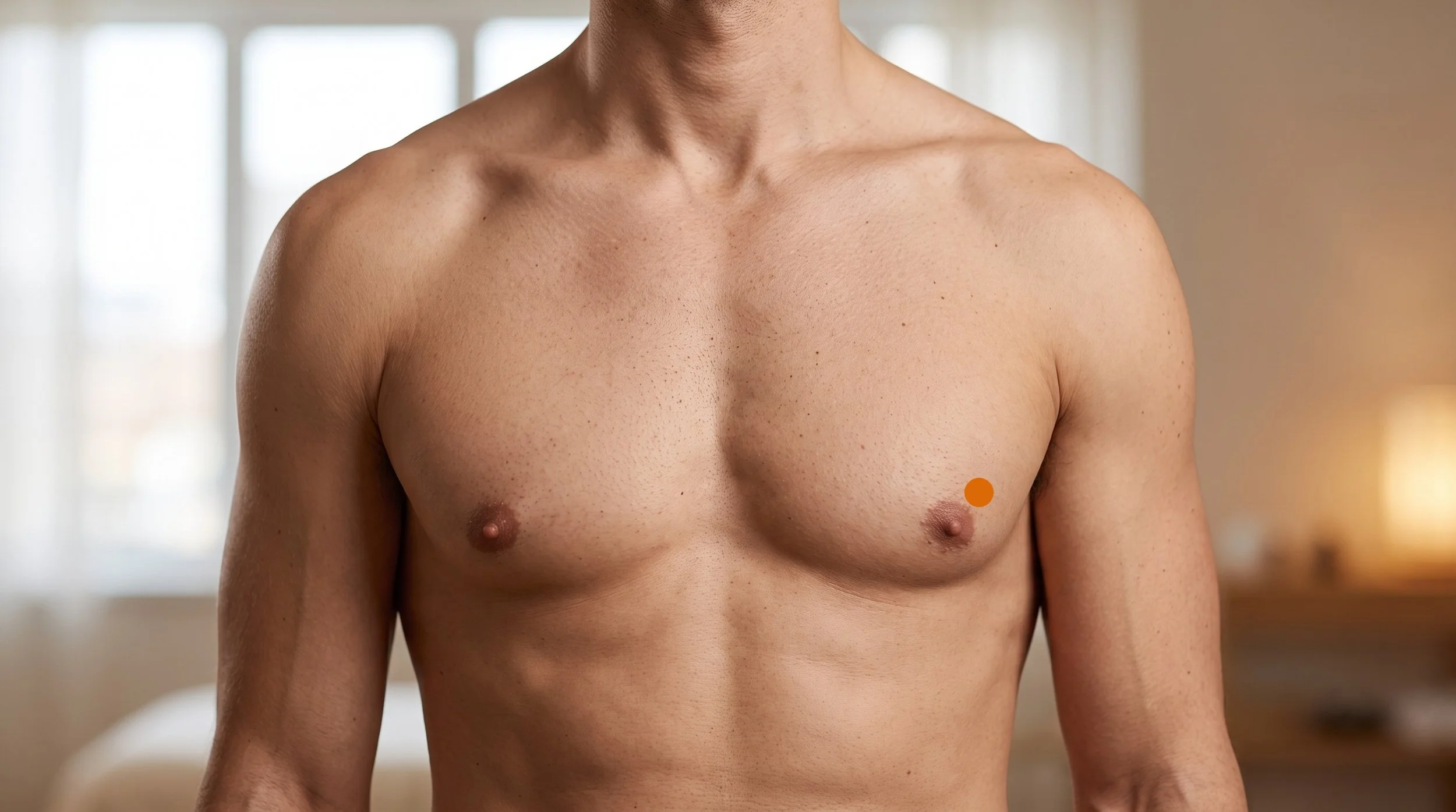
PC1 Acupuncture Point (Tianchi)
The Heavenly Pool Beside the Nipple: Anatomy, Segmental Mechanism, and Why the First Pericardium Point Belongs to the Chest Rather Than the Arm
PC1 (Tianchi, translated as Heavenly Pool) is the first point of the Pericardium channel and one of the few classical points located directly on the anterior chest wall. It sits 1 cun lateral and slightly superior to the nipple, in the fourth intercostal space, which places it over the fibers of pectoralis major with the intercostal muscles, pleura, and lung directly beneath (Deadman et al., 2007).
Because the pericardium 1 location overlaps the T4 segment, the same spinal level that carries sensation from the nipple, the chest wall, and much of the thoracic viscera, the pc 1 chest point has traditionally been used for cough with heavy phlegm, a bound or full feeling in the chest, pain along the ribs, swelling in the armpit, and, in modern practice, breast tenderness and low milk supply. It is also a genuinely high-caution point: this is a location where needle angle matters more than needle depth, and where a careless perpendicular insertion carries real risk.
- PC1 lies in the fourth intercostal space, roughly 1 cun lateral and a little above the nipple, and the needle passes through skin, subcutaneous tissue, and pectoralis major before reaching the intercostal muscles, with pleura and lung immediately deeper (Deadman et al., 2007). It is the surface emergence of the Pericardium channel's chest pathway rather than a limb point.
- Classical texts list PC1 as a meeting point of the Pericardium, Gallbladder, Liver and Triple Burner channels and as one of the ten Window of Heaven points, and it is one of only two points in that group that is not on the neck (Deadman et al., 2007). Traditional indications cluster around chest fullness, phlegm-heavy cough, rib-side pain, and axillary or neck swelling.
- The needling field is supplied by the fourth intercostal nerve and by branches of the pectoral nerves, so stimulation here enters the spinal cord at the same segments (roughly T2 to T5) that receive afferent traffic from the chest wall and thoracic viscera. Segmental convergence of this kind is one of the better characterized routes by which needling may modulate pain and reflex muscle tone (Zhao, 2008).
- Needling also recruits descending inhibitory pathways and measurable autonomic shifts: a meta-analysis of randomized trials reported greater increases in parasympathetic heart rate variability markers after real needling than after placebo needling, although the authors urged caution given study quality (Hamvas et al., 2023; Zhao, 2008).
- Point-specific evidence for PC1 is thin, and the honest framing is that reviews test whole protocols. Trials in COPD have reported reduced exertional breathlessness with acupuncture added to standard care (Suzuki et al., 2012), and reviews of acupoint stimulation for low milk supply and of treatments for breast engorgement both describe uncertain, low-certainty evidence (Chang et al., 2025; Zakarija-Grkovic & Stewart, 2020).
- De qi at PC1 is usually a soft, spreading fullness or dull ache that travels along the rib space rather than a strong grabbing sensation. Because pneumothorax remains the most frequently reported serious adverse event in the acupuncture safety literature, insertion is kept transverse-oblique along the intercostal space, never perpendicular (Deadman et al., 2007; He et al., 2012).
Chest Tightness, Rib Pain, or a Cough That Will Not Settle?
Persistent chest wall pain, a tight band across the front of the ribs, or a cough that leaves the chest sore rarely comes from one tissue alone. At Morningside Acupuncture we assess the pectoral and intercostal muscles, the thoracic segments that feed them, and your breathing pattern before choosing points, and PC1 is used sparingly and shallowly as part of that picture rather than as a stand-alone fix. Distal Pericardium points and careful chest wall needling often do most of the work. Book a visit and we'll map out where your chest symptoms are actually coming from.
Schedule NowAnatomy of PC1: Why the Fourth Intercostal Space Is Such an Important Location
Working from the surface inward, PC1 sits under skin and subcutaneous fat that may include breast tissue depending on body type, then the fibers of pectoralis major running from the sternum and clavicle toward the humerus, then the external and internal intercostal muscles bridging the fourth and fifth ribs. This is loaded tissue in daily life. Desk work, driving, phone use, bench pressing, carrying a baby, and long stretches of shallow upper chest breathing all shorten pectoralis major and pectoralis minor and keep the intercostals working in a narrowed range.
Referred pain from pectoralis trigger points can spread across the front of the chest and down the inner arm in a pattern patients often describe as deep and cardiac-like, which is one reason a careful history and appropriate medical workup come before any needle (Simons et al., 1999).
The nerve geography here is what makes PC1 clinically interesting. The point lies in the T4 segment, the same dermatome that carries sensation from the nipple and areola, and it is supplied by the lateral cutaneous branch of the fourth intercostal nerve along with pectoral nerve branches to the muscle. Afferents from the thoracic viscera enter the cord across roughly T1 to T5, so somatic input from this rib space converges on the same dorsal horn neurons that process visceral traffic from the chest.
Needling that converged region may change how those segments summate and gate incoming signals, and it also engages the descending inhibitory systems that release endogenous opioids and monoamines at the spinal level (Zhao, 2008). Across chronic pain conditions, individual patient data meta-analysis supports effects of acupuncture that are larger than sham needling and persist over time, which is the general frame we apply to chest wall and musculoskeletal presentations (Vickers et al., 2018).
Deep to the intercostal muscles are the parietal pleura and lung, and the intercostal vessels and nerve run in the costal groove along the inferior border of the rib above. Both facts drive the needling convention. PC1 is inserted transverse-oblique, directed posteriorly along the rib space, to a depth of roughly 0.5 to 1 cun, and deep or perpendicular insertion carries a substantial pneumothorax risk (Deadman et al., 2007).
Safety reviews consistently identify pneumothorax as among the most commonly reported serious adverse events associated with acupuncture, and it is essentially preventable through angle discipline and anatomical awareness (He et al., 2012; White et al., 2008). Practically, that means a nearly flat needle, no lifting and thrusting, no deep manipulation, and clear communication with the patient about draping and consent before any chest point is used.
Related Pericardium Channel Related Pectoralis Major Trigger PointsPC1 at a Glance: Classification, Location, and Clinical Use
| Category | Detail |
|---|---|
| Traditional Name | Tianchi (Heavenly Pool), P-1 in Deadman's numbering |
| Channel Classification | Pericardium channel (Hand Jueyin), first point of the channel and the surface emergence of its chest pathway (PC1, also written P1; also called the Heart Protector channel) |
| Point Categories | Meeting point of the Pericardium, Gallbladder, Liver and Triple Burner channels; Window of Heaven point (one of only two not located on the neck) |
| Precise Location | On the chest, 1 cun lateral and slightly superior to the nipple, in the fourth intercostal space; the level corresponds closely to where the fourth intercostal space meets the sternum |
| Tissue Stimulated | Skin and subcutaneous tissue, fibers of pectoralis major, the underlying intercostal muscles, and nearby pectoralis minor when the anterior chest is treated as a region |
| Needle Depth / Direction | Transverse-oblique insertion directed posteriorly along the intercostal space, 0.5 to 1 cun; never perpendicular, since deep needling carries a substantial risk of pneumothorax |
| De Qi Sensation | A soft, spreading fullness or dull ache that follows the rib space laterally, sometimes with a mild sense of warmth or release across the front of the chest; sharp pain, a catch in the breath, or coughing means the needle should come out |
| Primary Clinical Uses | Cough with copious phlegm and a bound, full sensation in the chest; pain of the lateral costal region; breast disorders and insufficient lactation in modern practice; swelling of the axilla in classical listings |
| Common Point Combinations |
|
Deadman, Al-Khafaji and Baker's A Manual of Acupuncture describes PC1 as a point that unbinds the chest, transforms phlegm and directs rebellious qi downward, regulates qi to disperse nodules, and benefits the breasts, and these are presented here as traditional attributions rather than physiological claims.
The classical indication list is heavily weighted toward excess patterns of the chest: cough with abundant sputum, a rattling sound in the chest and throat, a stifled or agitated feeling behind the sternum, shortness of breath, uprising qi, and pain along the ribs, together with swelling of the axilla and neck nodules, which the commentary links to the Pericardium channel arching over the axilla and its sinew channel passing beneath it.
The manual also notes that breast abscess and insufficient lactation are modern rather than classical additions, understood traditionally as consequences of stagnant qi and the heat that follows it. What is striking about the classical pattern is that PC1 is grouped with the Window of Heaven points, a set otherwise concentrated on the neck, and is credited with addressing chaotic or counterflow qi affecting not only the lungs but also the head and sense organs, which is an unusually wide reach for a point defined so tightly by its location on the rib cage.
Why PC1 Is Used for Cough, Breathlessness, and Breast Complaints Rather Than Only Local Rib Pain
The short answer is segmental overlap. The chest wall at the fourth rib space and much of the thoracic viscera share spinal cord entry levels, so a needle placed in the T4 dermatome feeds into the same dorsal horn neighborhoods that process input from the airways, the mediastinum, and the breast. When those segments are sensitized by weeks of coughing, guarded breathing, or postural loading, the muscles that share the segment tend to hold tone and the whole region starts reporting discomfort out of proportion to any single tissue.
Needling into that converged zone may reduce the summed input reaching the cord and change local blood flow and muscle tone, which is a plausible route to the classical description of a chest that feels less bound (Zhao, 2008).
The second layer is descending and autonomic. Needle stimulation activates brainstem systems that damp nociceptive transmission at the spinal level and shifts autonomic balance, and pooled trial data suggest real needling produces greater parasympathetic change on heart rate variability measures than placebo needling, with the usual caveats about heterogeneity and study quality (Hamvas et al., 2023; Zhao, 2008). That matters for chest complaints because the sensation of tightness is partly a breathing pattern problem: when accessory chest breathing dominates, the pectorals and intercostals never fully offload.
In COPD, adding acupuncture to standard medication reduced dyspnea on exertion compared with placebo needling in a randomized trial, an effect the investigators linked in part to chest wall mechanics and respiratory muscle function (Suzuki et al., 2012).
For breast and lactation complaints the reasoning is similar and the evidence is weaker. The nipple and areola are supplied by the fourth intercostal nerve, the same segment PC1 occupies, and milk ejection depends on a neuroendocrine reflex triggered by that sensory input, so local segmental stimulation is at least mechanistically coherent.
Reviews of acupoint stimulation for postpartum low milk supply and Cochrane's review of engorgement treatments both conclude that the current evidence is uncertain and low in certainty, so we frame this as a supportive adjunct used alongside lactation support rather than a primary treatment (Chang et al., 2025; Zakarija-Grkovic & Stewart, 2020).
What the Research Shows for PC1
It is worth being clear about what the research can and cannot say about a single point. Almost no trial isolates PC1; reviews test multi-point protocols delivered over several weeks, and PC1 is one candidate among many for chest and breast presentations. The table below summarizes the evidence that is relevant to the conditions PC1 is traditionally used for, plus the safety literature that shapes how it is needled. Where results are promising they are also preliminary, and where results are uncertain we say so.
| Study | Type | Focus | Key Finding |
|---|---|---|---|
| Suzuki et al., 2012 | Randomized placebo-controlled trial | Dyspnea on exertion in COPD, acupuncture added to standard medication | Real acupuncture was associated with greater improvement in exertional breathlessness than placebo needling, suggesting a possible adjunctive role in chest and breathing complaints. |
| Chang et al., 2025 | Systematic review and meta-analysis | Acupoint stimulation for postpartum breastfeeding insufficiency | Pooled results were limited by trial quality and heterogeneity, and the authors describe the effect of acupoint stimulation on milk volume and prolactin as still uncertain. |
| Zakarija-Grkovic & Stewart, 2020 | Cochrane systematic review | Treatments for breast engorgement during lactation | Evidence across all studied interventions, including acupuncture-related approaches, was low certainty, with no clearly superior treatment identified. |
| Hamvas et al., 2023 | Systematic review and meta-analysis | Effect of manual acupuncture on heart rate variability versus placebo | Real needling produced greater shifts toward parasympathetic dominance than sham, though the authors advise cautious interpretation given the small number of trials. |
| Vickers et al., 2018 | Individual patient data meta-analysis | Acupuncture for chronic musculoskeletal, headache and osteoarthritis pain | Acupuncture outperformed both sham and no-acupuncture controls with effects that were largely maintained over twelve months, supporting its use for chronic pain generally. |
| He et al., 2012 | Systematic review of adverse event reports | Acupuncture-related adverse events reported in the Chinese literature | Pneumothorax was among the most frequently reported serious events, reinforcing that chest points must be needled obliquely and shallowly by trained practitioners. |
Breast Tenderness, Engorgement, or Low Milk Supply While Breastfeeding?
Postpartum breast discomfort and supply concerns deserve coordinated care, and acupuncture is best used alongside a lactation consultant and your OB or midwife, not instead of them. Morningside clinicians treat gently in this population, favoring local chest points such as PC1 combined with CV17 and distal points, with clear draping, consent, and shallow technique. We are candid that the research here is limited and we will tell you if we do not think needling is the right tool. Reach out to schedule a postpartum-appropriate session.
Schedule NowPC1 in the Context of Trigger Point Work
The PC1 location sits squarely within the territory that myofascial practitioners treat for anterior chest pain. Pectoralis major trigger points in the sternal and clavicular divisions refer across the front of the chest, into the anterior shoulder, and down the medial arm, and pectoralis minor trigger points can produce a deep anterior chest ache with symptoms extending into the forearm and fingers (Simons et al., 1999). Intercostal trigger points add a sharper, band-like pain along a single rib space that worsens with a deep breath or a twist.
At Morningside, when a patient's exam points to these muscles, we treat them directly with dry needling using flat, tangential angles over the rib cage, and PC1 often falls inside that treatment field rather than being selected as a separate classical point.
The practical rule on the anterior chest is that technique is dictated by anatomy, not by whether we are calling the intervention acupuncture or dry needling. Both use an acupuncture needle, and both demand the same angle discipline over the thorax: needles stay parallel to the chest wall, depth is conservative, and needling is done over rib rather than into an intercostal space whenever the muscle target allows it (White et al., 2008; He et al., 2012).
We frequently pair local chest work with distal points such as PC6 to reduce the amount of stimulation the chest wall itself needs to receive, and for many patients the majority of the treatment happens away from the ribs entirely.
PC1 Chest and Breast Treatment at NYC's Highest-Rated Acupuncture Clinic
Morningside Acupuncture is the highest-rated acupuncture and dry needling clinic in New York City with over 500 five-star Google reviews, and our clinicians are trained in the anatomy that makes chest points both useful and demanding. We combine classical point selection with orthopedic assessment and dry needling of the pectoralis and intercostal muscles when that is what the exam suggests. Every chest treatment is explained in advance so you know exactly what we are doing and why. Schedule your appointment and let's build a plan around your symptoms.
Schedule NowFrequently Asked Questions
What does PC1 feel like when needled?
Because the needle is laid almost flat along the rib space, PC1 usually feels mild. Most patients report a soft, spreading fullness or a dull heavy ache that travels laterally under the skin, sometimes with a sense of warmth or of the chest loosening. It should not feel sharp, and it should never cause a catch in your breath, a cough, or a stabbing sensation. If it does, the practitioner should remove the needle and reassess. Sensation at PC1 is typically less intense than at distal points such as PC6 or LI4.
Why needle a point on the chest for a cough instead of a point on the arm?
Both approaches are used, and in practice distal points do a great deal of the work. The rationale for a local point like PC1 is segmental: the fourth intercostal space shares spinal cord entry levels with the airways and much of the thoracic viscera, so stimulation there feeds into the same dorsal horn circuits handling chest sensation, and it also directly addresses the pectoral and intercostal muscles that stay guarded after weeks of coughing (Zhao, 2008). Classical sources framed the same idea differently, describing PC1 as unbinding the chest and directing counterflow downward (Deadman et al., 2007). When a patient is anxious about chest needling, or when anatomy makes it inadvisable, we simply use distal points instead.
Can I press PC1 myself between sessions?
Yes, with care and a light touch. Find the fourth intercostal space just lateral to and slightly above the nipple, then use one fingertip to press into the soft rib space rather than onto breast tissue. Apply gentle, steady pressure at about a 3 to 4 out of 10 intensity for 30 to 60 seconds, release, and repeat two or three times per side, breathing slowly through the nose the whole time. Small circular massage along the pectoral fibers toward the armpit often feels more useful than static pressure. Skip it entirely if the area is inflamed, if you have a breast lump, infection, or unexplained breast pain, or if you are recovering from chest surgery, and see a clinician instead. For self-care aimed at chest tightness and anxiety, PC6 at the inner wrist is easier to find and more forgiving.
Is PC1 safe to needle?
It is safe in trained hands and genuinely risky in untrained ones. The lung sits directly beneath this point, and pneumothorax is repeatedly identified as one of the most frequently reported serious adverse events in the acupuncture safety literature (He et al., 2012). Safe practice means transverse-oblique insertion along the intercostal space to about 0.5 to 1 cun, no perpendicular angles, no aggressive lifting and thrusting, and extra caution in very slim patients and in anyone with emphysema or prior chest surgery (Deadman et al., 2007; White et al., 2008). Consent and draping matter too, given the proximity to breast tissue. Warning signs after any chest needling include sudden shortness of breath, sharp one-sided chest pain, or a new dry cough, and these warrant urgent medical assessment. This is not a point for self-needling under any circumstances.
Where exactly is PC1 located?
PC1 is on the anterior chest, 1 cun lateral and slightly superior to the nipple, in the fourth intercostal space (Deadman et al., 2007). One cun is roughly the width of your thumb at the knuckle. A helpful cross-check is that this level lines up closely with where the fourth intercostal space meets the sternum, which is also the level of CV17 between the nipples. Older channel descriptions locate the Pericardium channel's emergence in the costal region a few inches below the anterior axillary fold, which places it in the same general region. Because breast anatomy varies, clinicians palpate the rib spaces to confirm rather than relying on the nipple alone as a landmark.
References
- Deadman, P., Al-Khafaji, M., & Baker, K. (2009). A manual of acupuncture. Journal of Chinese Medicine Publications.
- White, A., Cummings, M., & Filshie, J. (2008). An introduction to Western medical acupuncture. Churchill Livingstone Elsevier.
- Simons, D. G., Travell, J. G., & Simons, L. S. (1999). Travell & Simons' myofascial pain and dysfunction: The trigger point manual, Vol. 1: Upper half of body (2nd ed.). Williams & Wilkins.
- Zhao, Z. Q. (2008). Neural mechanism underlying acupuncture analgesia. Progress in Neurobiology, 85(4), 355-375. https://doi.org/10.1016/j.pneurobio.2008.05.004
- Vickers, A. J., Vertosick, E. A., Lewith, G., MacPherson, H., Foster, N. E., Sherman, K. J., Irnich, D., Witt, C. M., & Linde, K. (2018). Acupuncture for chronic pain: Update of an individual patient data meta-analysis. Journal of Pain, 19(5), 455-474. https://doi.org/10.1016/j.jpain.2017.11.005
- Suzuki, M., Muro, S., Ando, Y., Omori, T., Shiota, T., Endo, K., Sato, S., Aihara, K., Matsumoto, M., Suzuki, S., Itotani, R., Ishitoko, M., Hara, Y., Takemura, M., Ueda, T., Kagioka, H., Hirabayashi, M., Fukui, M., & Mishima, M. (2012). A randomized, placebo-controlled trial of acupuncture in patients with chronic obstructive pulmonary disease (COPD): The COPD-acupuncture trial (CAT). Archives of Internal Medicine, 172(11), 878-886. https://doi.org/10.1001/archinternmed.2012.1233
- Chang, Y. S., et al. (2025). Acupoint stimulation for postpartum breastfeeding insufficiency: A systematic review and meta-analysis. Systematic Reviews, 14, 32. https://doi.org/10.1186/s13643-025-02773-8
- Zakarija-Grkovic, I., & Stewart, F. (2020). Treatments for breast engorgement during lactation. Cochrane Database of Systematic Reviews, 9(9), CD006946. https://doi.org/10.1002/14651858.CD006946.pub4
- Hamvas, S., Hegyi, P., Kiss, S., Lohner, S., McQueen, D., & Havasi, M. (2023). Acupuncture increases parasympathetic tone, modulating HRV: Systematic review and meta-analysis. Complementary Therapies in Medicine, 72, 102905. https://doi.org/10.1016/j.ctim.2022.102905
- He, W., Zhao, X., Li, Y., Xi, Q., & Guo, Y. (2012). Adverse events following acupuncture: A systematic review of the Chinese literature for the years 1956-2010. Journal of Alternative and Complementary Medicine, 18(10), 892-901. https://doi.org/10.1089/acm.2011.0825
Disclaimer: This web site is intended for educational and informational purposes only. Reading this website does not constitute providing medical advice or any professional services. This information should not be used for diagnosing or treating any health issue or disease. Those seeking medical advice should consult with a licensed physician. Seek the advice of a medical doctor or other qualified health professional for any medical condition. If you think you have a medical emergency, call 911 or go to the emergency room. No acupuncturist-patient relationship is created by reading this website or using the information. Morningside Acupuncture PLLC and its employees and contributors do not make any express or implied representations with respect to the information on this site or its use. For any legal interpretation of scope of practice in your state, consult a licensed attorney or regulatory authority.
Read more from our blog



