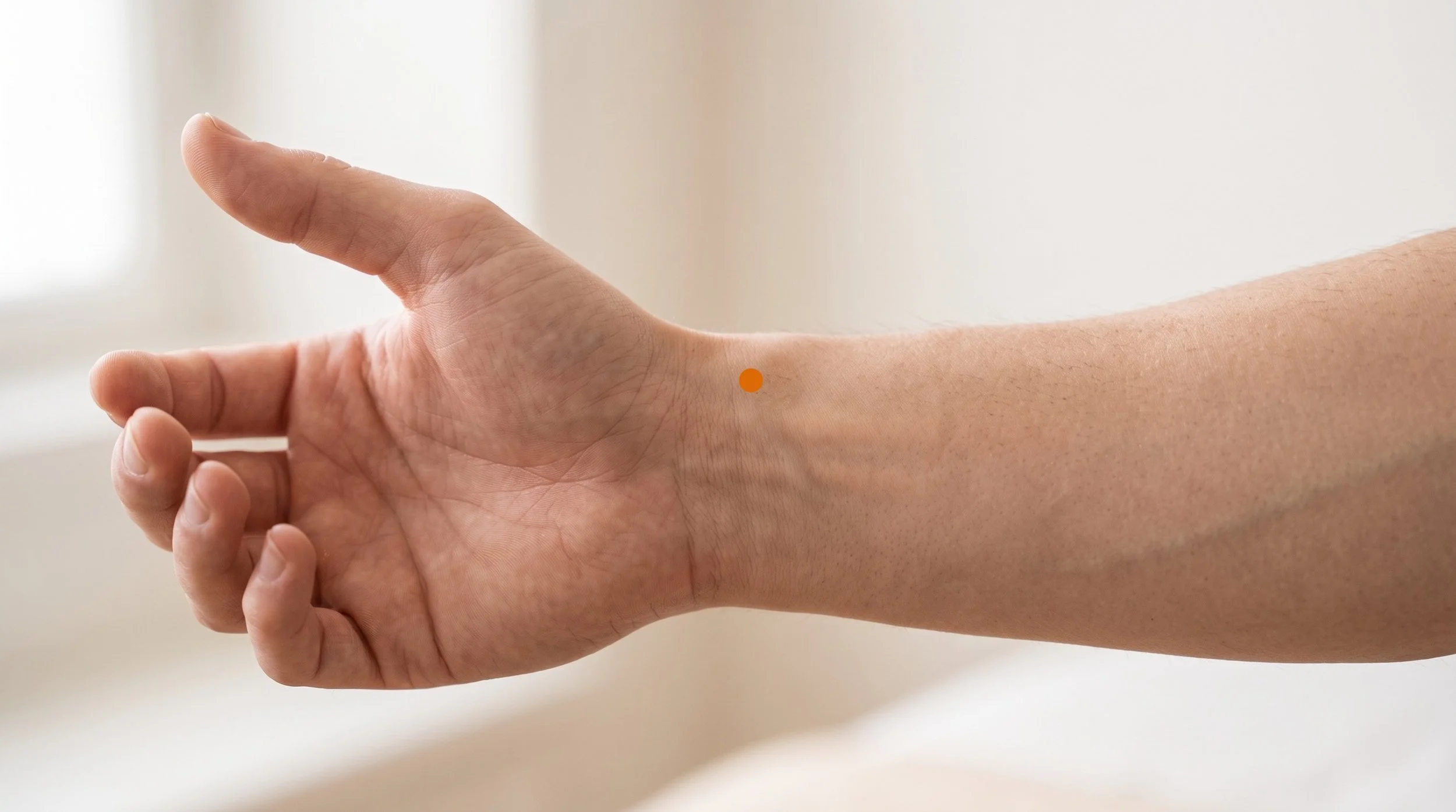
LU8 Acupuncture Point (Jingqu)
The Channel Gutter Beside the Radial Pulse: Anatomy, Mechanism, and Why This Quiet Wrist Point Still Earns a Place in Cough and Thumb-Side Wrist Pain Treatment
LU8 (Jingqu, often translated as Channel Gutter) is the jing-river and Metal point of the Lung channel, and it sits in one of the most familiar spots on the whole body: the groove where a clinician takes your radial pulse. To find it, put a fingertip on LU9 at the wrist crease and slide up the arm about a thumb's width; as your finger passes over the bony bump of the radial styloid it drops into a small hollow on the thumb side of the pulsing artery. That hollow is the lu 8 wrist location.
Classically it was reserved for full, loud, excess-type breathing problems (cough, wheeze, a tight and distended chest and upper back) along with sore throat and fever without sweating, and modern clinicians also use it as a local point for pain at the radial side of the wrist, the same region involved in de Quervain's style thumb pain.
- Location and layers: LU8 lies 1 cun proximal to LU9 at the base of the radial styloid, on the thumb side of the radial artery, with thin skin, subcutaneous tissue, the brachioradialis insertion and the abductor pollicis longus and extensor pollicis brevis tendons all within a few millimeters of the needle tip.
- Traditional categories, read through a modern lens: the classical texts list LU8 as the jing-river (Metal) point of the Lung channel and credit it with descending Lung qi to settle cough and wheeze. We treat that as a traditional attribution and describe the plausible physiology instead: cutaneous and deep somatic afferent input, spinal dorsal horn processing, and autonomic modulation (Zhao, 2008).
- Nerve story: the point sits in superficial radial nerve territory, a densely innervated cutaneous field, which is why needling here is felt vividly and why input from it converges on the same segments that serve the thumb-side wrist and forearm (Zhao, 2008).
- Research picture: there is no trial isolating LU8 itself. The nearest useful evidence is acupuncture for radial-sided wrist pain, where a randomized trial and a later meta-analysis reported pain and function improvements with important design limits (Leung et al., 2022; Qin et al., 2024), and respiratory research, where a Cochrane review found the asthma evidence insufficient (McCarney et al., 2004).
- Clinical framing: even standard reference texts note that LU8 is used less often than its neighbors LU7 and LU9, so we tend to add it for a reason, either radial wrist and thumb-base pain or a chesty, tight, non-productive cough pattern, rather than including it by default.
- De qi here is usually a quick, bright ache or a spreading heaviness toward the thumb rather than a deep dull grip, since the needle is shallow (0.3 to 0.5 cun) and sits close to skin nerves. A brief electric flicker can occur and should fade when the needle is repositioned.
Thumb-Side Wrist Pain That Flares Every Time You Grip?
Pain at the base of the thumb and the radial side of the wrist is one of the most common complaints we see in typists, new parents, climbers, and anyone who lives on a phone. At Morningside Acupuncture we use LU8 with nearby channel points and precise dry needling of the thumb and forearm muscles that load that styloid, then pair the session with grip and tendon-loading advice you can actually keep up. Most people notice changes in how the wrist tolerates gripping within a few visits. Book a visit and let us assess the wrist properly.
Schedule NowAnatomy of LU8: Why the Base of the Radial Styloid Is Such an Important Location
LU8 sits at a crowded architectural corner of the wrist. Under the thin skin and a shallow layer of subcutaneous tissue is the flared base of the radial styloid, with the brachioradialis tendon anchoring onto it and the abductor pollicis longus and extensor pollicis brevis tendons sweeping across the radial border toward the thumb. Everything that loads the thumb loads this corner: pinching, lifting a toddler, scrolling, mousing, racquet and climbing grips, and long stretches of typing with the wrist deviated.
That is why the tissue here so often becomes tender, thickened and reactive, and why a point described in classical texts as a pulse-side hollow doubles as a practical local target for radial wrist pain.
The neurology of this spot is what makes it useful. Branches of the superficial radial nerve fan out across the area, giving it a rich cutaneous supply, with the lateral antebrachial cutaneous nerve contributing nearby. A needle placed here recruits small-diameter afferents in skin, fascia and peritendinous tissue, and that input feeds the dorsal horn segments that also receive signals from the painful tendon sheath and forearm muscles.
Convergence at those segments allows needle input to compete with nociceptive traffic, while ascending signals engage brainstem circuits that release descending inhibition through serotonergic, noradrenergic and endogenous opioid pathways (Zhao, 2008). Large individual patient data analyses of chronic pain trials suggest that needling produces effects beyond sham and no-acupuncture comparisons, though the difference from sham is modest (Vickers et al., 2018).
Safety at LU8 is mostly about one structure: the radial artery, which runs immediately on the ulnar side of the point. Standard needling conventions are oblique insertion angled up the arm or a shallow perpendicular insertion, 0.3 to 0.5 cun, deliberately placed on the thumb side so the needle track stays away from the vessel, as described in Deadman's A Manual of Acupuncture. Some texts recommend an even shallower depth.
In practice we palpate the pulse first, mark the hollow lateral to it, use a fine needle, avoid vigorous manipulation if a sharp electric sensation appears (a sign of contact with a skin nerve branch), and apply firm pressure after withdrawal, with extra care in patients on blood thinners.
Related Lung Channel Related Extensor Pollicis Longus Brevis Trigger PointsLU8 at a Glance: Classification, Location, and Clinical Use
| Category | Detail |
|---|---|
| Traditional Name | Jingqu (Channel Gutter, also translated Channel Ditch or River Point Ditch) |
| Channel Classification | Eighth point of the Lung channel of hand taiyin |
| Point Categories | Jing-river point of the Lung channel and its Metal point among the five shu points; located at the classical radial pulse position |
| Precise Location | On the anterolateral forearm, 1 cun proximal to LU9 on the line toward LU6, in the depression at the base of the radial styloid process, on the radial (thumb) side of the radial artery |
| Tissue Stimulated | Skin and subcutaneous fascia in superficial radial nerve territory over the radial styloid, adjacent to the brachioradialis insertion and the abductor pollicis longus and extensor pollicis brevis tendon complex, with the brachioradialis and flexor pollicis longus as related myofascial targets |
| Needle Depth / Direction | Oblique insertion angled proximally up the forearm, or shallow perpendicular insertion, 0.3 to 0.5 cun, always placed lateral to and angled away from the radial artery; moxibustion is described in some texts |
| De Qi Sensation | A bright, quick ache or spreading heaviness that may travel toward the thumb or up the forearm; occasionally a brief tingling flicker from superficial radial nerve branches, which should settle with slight repositioning |
| Primary Clinical Uses | Traditionally used for excess-type cough, wheezing and breathlessness, chest and upper back distention, sore throat, and febrile illness without sweating; in modern clinics most often used locally for thumb-side wrist and radial styloid pain |
| Common Point Combinations |
|
Deadman's A Manual of Acupuncture frames LU8 through the Classic of Difficulties, which grouped the jing-river points as points for cough, breathlessness, and alternating chills and fever. As the jing-river point of the Lung channel, LU8 was traditionally directed at the loud, full end of that spectrum: forceful coughing and wheezing with a sense of fullness and pain through the chest and upper back, sore throat, and febrile illness in which the patient cannot sweat.
The same text records an odd outlier from the Classic of Supplementing Life with Acupuncture and Moxibustion, an indication for pain in the sole of the foot near KID1, a pattern classically read as Kidney weakness or damp and phlegm settling downward.
Deadman is also candid that LU8 is not much used today. What makes the classical picture striking is its coherence: a point at the pulse, on the Metal channel, aimed at the moment when breathing turns tight and heat is trapped without an outlet, which is a very specific clinical portrait rather than a catch-all.
Why LU8 Is Used for Both Wheezing and Thumb-Side Wrist Pain
The wrist half of that pairing is straightforward. LU8 sits directly over the tissue that hurts in radial styloid pain: the tendon sheath at the first dorsal compartment, the brachioradialis insertion, and the skin field of the superficial radial nerve. Needling there recruits afferents that share spinal segments with the painful structures, and that convergence lets non-noxious needle input dampen nociceptive signaling locally while triggering brainstem descending inhibition that lowers sensitivity more broadly (Zhao, 2008). Patients often notice the tenderness threshold change first, before range of motion does.
The breathing half needs a more careful explanation. The airway and the wrist do not share spinal segments, so a segmental story does not apply. Any respiratory effect from a forearm point would have to travel through supraspinal routes: needle input reaching brainstem and hypothalamic centers that adjust autonomic balance, breathing pattern, muscle tone in the neck and chest wall, and the affective load that makes breathlessness feel worse. That is a plausible mechanism, not a proven one for this individual point, and we say so directly.
In practice, when patients with a tight chest improve, we suspect the change comes largely from reduced accessory muscle tension and a calmer autonomic state rather than from anything happening in the bronchi.
That distinction shapes how we use LU8. For wrist and thumb-base complaints it is a genuinely local, mechanically sensible point. For cough and wheeze it is a traditional selection that we include as one element within a fuller protocol, alongside chest, upper back and lower limb points, and always alongside appropriate medical care.
What the Research Shows for LU8
Acupuncture research almost never isolates a single point, and LU8 is no exception: there is no trial in which Jingqu was needled alone against a credible control. What the literature offers instead are studies of multi-point protocols for the conditions LU8 is traditionally chosen for, plus mechanistic work explaining how needle input at the forearm modulates pain processing. The table below sets cautious expectations: the wrist pain evidence is the most directly relevant to how the point is used today, and the respiratory evidence remains limited and inconsistent.
| Study | Type | Focus | Key Finding |
|---|---|---|---|
| Qin et al., 2024 | Systematic review and meta-analysis | Acupuncture for de Quervain's tenosynovitis at the radial styloid, the region occupied by LU8 | Pooled data from 14 trials suggested improvements in pain and wrist function compared with topical analgesics and no clear difference from corticosteroid injection, though the authors judged the overall evidence quality to be limited. |
| Leung et al., 2022 | Randomized controlled trial | Five acupuncture sessions over two weeks versus waitlist for radial-sided wrist pain | The acupuncture group reported greater pain reduction and improved grip and function with no serious adverse events, but a waitlist control cannot separate specific needling effects from expectation and attention. |
| McCarney et al., 2004 | Cochrane systematic review | Acupuncture for chronic asthma, the classical indication territory for jing-river points | The review concluded that trial quality and consistency were insufficient to support recommendations about acupuncture for asthma. |
| Brinkhaus et al., 2017 | Pragmatic randomized trial | Acupuncture added to routine care in patients with allergic asthma | Patients receiving added acupuncture reported better disease-specific and general quality of life at three months, although the unblinded pragmatic design limits conclusions about point-specific effects. |
| Vickers et al., 2018 | Individual patient data meta-analysis | Acupuncture across chronic pain conditions including musculoskeletal pain | Acupuncture outperformed both sham and no-acupuncture controls with effects persisting over time, while the difference from sham remained modest. |
| Zhao, 2008 | Mechanistic review | Neural pathways underlying acupuncture analgesia | Needle stimulation activates peripheral afferents that engage spinal and supraspinal circuits, including descending serotonergic, noradrenergic and opioid-mediated inhibition. |
Tight Chest, Nagging Cough, Shallow Breathing?
When breathing feels effortful and the upper back and chest feel braced, treatment has to address the mechanics as well as the nervous system. We combine Lung channel points such as LU8, LU7 and LU9 with needling of the muscles that restrict rib and thoracic movement, plus breathing retraining that supports parasympathetic tone. Acupuncture is not a replacement for inhalers or medical evaluation, and we will tell you plainly when to see your physician first. Schedule a session to see how your breathing responds.
Schedule NowLU8 in the Context of Trigger Point Work
Acupuncture means treatment with an acupuncture needle, and that single tool covers hundreds of styles, including dry needling of myofascial trigger points. At LU8 the two frameworks overlap almost perfectly, because the point sits at the radial styloid where the thumb and wrist muscles converge. When a patient presents with pain in this area, we palpate the brachioradialis, abductor pollicis longus, extensor pollicis brevis, extensor pollicis longus and flexor pollicis longus for taut bands and reproducible tenderness.
Trigger points in these muscles refer pain into the radial wrist, the web space and the base of the thumb, patterns mapped in the Travell and Simons manual (Simons et al., 1999), and those referral zones can mimic or accompany tendon sheath irritation.
A typical session at Morningside might use LU8 and neighboring channel points superficially at the styloid, then shift to needling of the forearm and thumb muscles at their tender bands, with attention kept away from the radial artery and the superficial radial nerve trunk. We finish with loading strategies, because tendon-related pain responds better when needling is paired with graded grip and wrist work rather than used on its own.
Patients on anticoagulants, with local infection, or with sensory changes in the thumb are assessed before any needling in this region, and we refer out when the presentation suggests a fracture, arthritis of the thumb base, or a nerve entrapment needing imaging.
LU8 Wrist and Breathing Treatment at NYC's Highest-Rated Acupuncture Clinic
Morningside Acupuncture is the highest-rated acupuncture and dry needling clinic in New York City with over 500 five-star Google reviews, and our treatments blend classical point selection with orthopedic assessment. LU8 rarely works alone, so we build a plan around it: channel points at the wrist, trigger point work in the forearm and thumb muscles, and home strategies between sessions. Every plan is explained in plain language before a single needle goes in. Schedule your first appointment and we will map out the treatment together.
Schedule NowFrequently Asked Questions
What does LU8 feel like when needled?
Most people feel a quick, bright ache or a spreading heaviness right at the bony ridge above the wrist, sometimes traveling toward the thumb. Because the point is shallow and sits in a nerve-rich patch of skin, the initial sensation can be sharper than at fleshier points, and it usually settles within seconds. A brief tingling or electric flicker means the needle brushed a small skin nerve branch, and your practitioner will adjust it. The needle depth is only about 0.3 to 0.5 cun, so the whole experience tends to be short and superficial rather than deep and heavy.
Why would a point at the wrist be used for coughing and chest tightness?
That use comes from classical theory, where LU8 is the jing-river point of the Lung channel and jing-river points were traditionally grouped for cough, breathlessness, and chills and fever. We present that as a traditional attribution rather than a proven mechanism. The airway and the wrist do not share spinal segments, so any effect on breathing would work through broader routes such as autonomic modulation, reduced tension in accessory breathing muscles, and changes in how effortful breathing feels (Zhao, 2008). The trial evidence for acupuncture in asthma remains limited (McCarney et al., 2004), so LU8 is used as one part of a wider plan and never as a substitute for prescribed respiratory care.
Can I press LU8 myself between sessions?
Yes, with one important caution: find the pulse first, then move to the thumb side of it so you are not compressing the artery. Rest your forearm on a table with the thumb pointing up, place a fingertip on LU9 at the wrist crease, slide up about a thumb's width over the bony bump, and settle into the hollow just beyond it. Apply steady, moderate pressure for 30 to 60 seconds, release, and repeat three to five times, optionally adding small circular motions. Two or three rounds a day is plenty, and you can combine it with gentle thumb and wrist range of motion. Stop if you feel numbness, tingling into the thumb, or lightheadedness, and never press firmly over a pulsing vessel.
Is LU8 safe to needle?
In trained hands, yes. The main consideration is the radial artery lying immediately on the ulnar side of the point, which is why standard technique is a shallow oblique or perpendicular insertion of 0.3 to 0.5 cun placed and angled away from the vessel. Practitioners palpate the pulse before insertion, use fine needles, avoid deep or aggressive manipulation, and apply firm post-needle pressure. Bruising is the most common minor effect, and it is more likely in patients taking anticoagulants or antiplatelet medication, so tell your clinician about those. Needling is avoided over broken, infected or inflamed skin, and any sharp radiating sensation should prompt repositioning.
Where exactly is LU8 located?
LU8 is on the thumb side of the front of the forearm, 1 cun (about one thumb width) above LU9 at the wrist crease, on the line running toward LU6. It sits in the depression at the base of the radial styloid process, on the radial side of the radial artery, between the brachioradialis insertion and the abductor pollicis longus tendon. The simplest way to locate it is to place a fingertip on LU9, then slide upward along the arm; as your finger crosses the palpable styloid it will drop naturally into the small hollow that is LU8. If your finger is on the pulse itself, you have gone too far toward the little finger side.
References
- Deadman, P., Al-Khafaji, M., & Baker, K. (2009). A manual of acupuncture. Journal of Chinese Medicine Publications.
- Kim, H. (2008). Handbook of Oriental medicine (3rd ed.). Harmony & Balance Press.
- Maciocia, G. (2006). The channels of acupuncture: Clinical use of the secondary channels and eight extraordinary vessels. Churchill Livingstone Elsevier.
- O'Connor, J., & Bensky, D. (Eds. & Trans.). (1981). Acupuncture: A comprehensive text. Shanghai College of Traditional Medicine. Eastland Press.
- Simons, D. G., Travell, J. G., & Simons, L. S. (1999). Travell & Simons' myofascial pain and dysfunction: The trigger point manual, Vol. 1: Upper half of body (2nd ed.). Williams & Wilkins.
- Zhao, Z. Q. (2008). Neural mechanism underlying acupuncture analgesia. Progress in Neurobiology, 85(4), 355-375. https://doi.org/10.1016/j.pneurobio.2008.05.004
- Vickers, A. J., Vertosick, E. A., Lewith, G., MacPherson, H., Foster, N. E., Sherman, K. J., Irnich, D., Witt, C. M., & Linde, K. (2018). Acupuncture for chronic pain: Update of an individual patient data meta-analysis. Journal of Pain, 19(5), 455-474. https://doi.org/10.1016/j.jpain.2017.11.005
- McCarney, R. W., Brinkhaus, B., Lasserson, T. J., & Linde, K. (2004). Acupuncture for chronic asthma. Cochrane Database of Systematic Reviews, 2004(1), CD000008. https://doi.org/10.1002/14651858.CD000008.pub2
- Brinkhaus, B., Roll, S., Jena, S., Icke, K., Adam, D., Binting, S., Lotz, F., Willich, S. N., & Witt, C. M. (2017). Acupuncture in patients with allergic asthma: A randomized pragmatic trial. Journal of Alternative and Complementary Medicine, 23(4), 268-277. https://doi.org/10.1089/acm.2016.0357
- Leung, K., Ma, O. C., Qin, Z., Ting, H., Lau, A. H., Lun, K. K., Chan, H. Y., Wen, G. Y., Ng, J. T., Chow, L., Chu, C. Y., Ho, T. S., Tsang, K., Ng, B. F. L., Fok, M. W. M., Fang, C. X. S., Lao, L., & Chen, H. (2022). Acupuncture for de Quervain's tenosynovitis: A randomized controlled trial. Phytomedicine, 104, 154254. https://doi.org/10.1016/j.phymed.2022.154254
- Qin, Y., Luo, D., Qiu, H., Zhang, J., Yong, H., & Yu, S. (2024). A systematic review and meta-analysis of acupuncture for De Quervain's tenosynovitis treatment. Postgraduate Medical Journal, 100(1188), 709-720. https://doi.org/10.1093/postmj/qgae057
Disclaimer: This web site is intended for educational and informational purposes only. Reading this website does not constitute providing medical advice or any professional services. This information should not be used for diagnosing or treating any health issue or disease. Those seeking medical advice should consult with a licensed physician. Seek the advice of a medical doctor or other qualified health professional for any medical condition. If you think you have a medical emergency, call 911 or go to the emergency room. No acupuncturist-patient relationship is created by reading this website or using the information. Morningside Acupuncture PLLC and its employees and contributors do not make any express or implied representations with respect to the information on this site or its use. For any legal interpretation of scope of practice in your state, consult a licensed attorney or regulatory authority.
Read more from our blog



