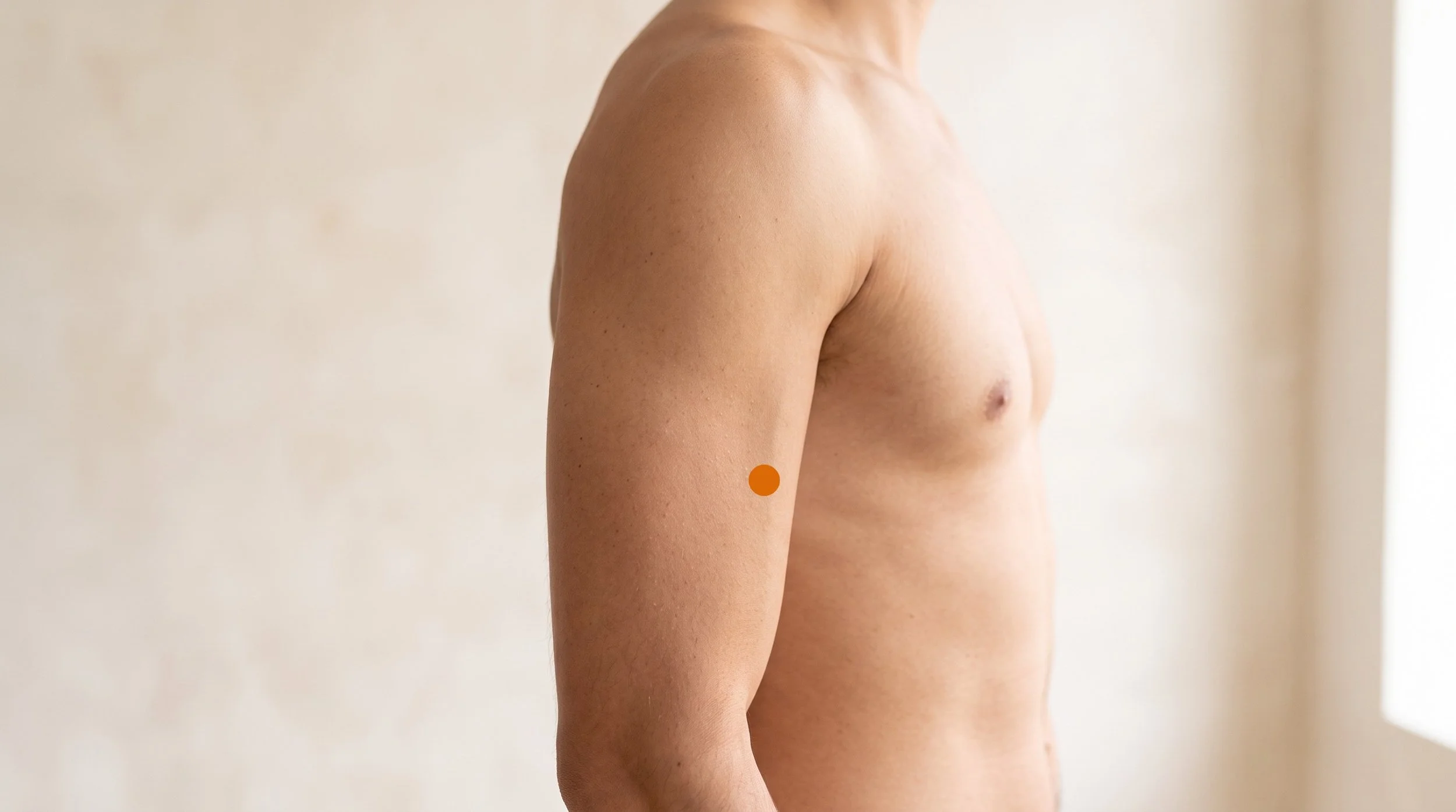
LU4 Acupuncture Point (Xiabai)
Clasping the White on the Upper Arm: Anatomy, Mechanism, and Why This Quiet Lung Channel Point Links Biceps Tension to Chest Breathing
LU4 (Xiabai, often translated as Clasping the White or Protect White) sits on the front-outer upper arm, in the soft groove between the lateral edge of the biceps brachii and the shaft of the humerus, four cun below the front of the armpit fold and one cun below LU3. It is one of the least talked about points on the Lung channel, and that is a shame, because the lu4 acupuncture point sits exactly where the arm presses against the chest wall when we hold ourselves guarded, hunched, or short of breath.
Classical texts assign it two jobs: settling upward-driving Lung symptoms such as cough and breathlessness, and moving stuck qi and blood in the chest and arm (Deadman et al., 2001). In modern clinic terms, lung 4 is a useful arm point for biceps-line tension, anterior shoulder and upper arm pain, and for patients whose chest tightness and breathing pattern travel together with a tight, protective upper limb.
- Location and layers: LU4 lies four cun below the anterior axillary fold and five cun above LU5 at the elbow crease, in the depression between the lateral border of biceps brachii and the humerus, one cun below LU3 (Deadman et al., 2001). The needle passes skin and subcutaneous fascia into the muscular border, close to the periosteal surface of the humeral shaft.
- Traditional categories, translated: the classical attributions for Xiabai are descending Lung qi and regulating qi and blood in the chest, with indications spanning cough, breathlessness, chest fullness, palpitations, and pain along the upper arm (Deadman et al., 2001). We read those as symptom clusters that share a common thread of guarded breathing and protective upper-limb tension rather than as a literal flow of energy.
- Nerve geography: the point sits in C5 to C6 territory served by the musculocutaneous nerve and the lateral cutaneous nerve of the forearm, so needling here recruits muscle and cutaneous afferents whose signals ascend to the same dorsal horn segments that receive input from the shoulder girdle (Zhao, 2008).
- Mechanism: needle stimulation at points like LU4 may reduce pain through segmental inhibition at the spinal level and through descending pathways from the midbrain and brainstem that damp nociceptive traffic more broadly (Zhao, 2008), while needling has also been associated with measurable shifts in autonomic balance on heart rate variability measures (Lee et al., 2010).
- Research picture: no trial has isolated LU4 on its own. The best supported claims come from large pooled data showing modest but persistent benefits of acupuncture for chronic musculoskeletal pain (Vickers et al., 2018), cautious shoulder pain conclusions from Cochrane (Green et al., 2005), and respiratory work in which Lung channel arm and chest points appeared inside multi-point protocols (Suzuki et al., 2012).
- Clinical framing and de qi: at Morningside we tend to use lu 4 arm needling as a channel-line adjunct rather than a headline point, often alongside dry needling of biceps brachii when the anterior arm is the pain generator (Kietrys et al., 2013). Patients usually describe a dull, spreading heaviness in the groove beside the biceps, sometimes traveling toward the elbow or the thumb side of the forearm.
Anterior Arm Pain That Follows You Into Every Push and Pull?
Pain along the front of the upper arm often gets blamed on the shoulder joint when the real driver is the biceps line, the anterior fascia, and a breathing pattern that keeps the chest braced. We palpate the groove beside biceps brachii where LU4 sits, check the whole channel from the axilla down to the elbow, and needle what actually reproduces your symptoms. Treatment usually combines channel points with trigger point dry needling and simple loading work you can repeat at home. Book a visit and let us map where your arm pain is really coming from.
Schedule NowAnatomy of LU4: Why the Groove Beside Biceps Brachii Is Such an Important Location
Run a thumb down the outer edge of the biceps from the armpit toward the elbow and you will find a soft channel between the muscle belly and the bone underneath. LU4 lives in that channel, roughly four cun below the front of the armpit fold and five cun above the elbow crease, one cun distal to LU3 (Deadman et al., 2001). Under the fingertip there is thin skin, loose subcutaneous fascia, the lateral border of biceps brachii, and then brachialis wrapping the humeral shaft beneath.
This tissue gets loaded by anything that keeps the elbow flexed and the arm held close to the ribs: carrying bags, holding a phone, climbing and pulling sports, guarded posture after a shoulder injury, and long hours at a keyboard with the arms pinned in. When the anterior arm stays short, the whole front line from the pec to the biceps tends to tighten together.
The neural address matters. This part of the arm falls largely in C5 to C6 territory, with the musculocutaneous nerve running deep between biceps and brachialis before continuing as the lateral cutaneous nerve of the forearm. Needling here activates muscle and skin afferents that project into the same spinal segments that serve the shoulder and lateral forearm, which is one reason a point on the mid arm can change sensation and tolerance further along the limb.
Experimental work describes two layers to this: local and segmental inhibition in the dorsal horn, and descending control from the periaqueductal gray and rostral ventromedial medulla that turns down nociceptive processing more widely (Zhao, 2008). Needling has also been linked to shifts in autonomic indices such as heart rate variability, which may be part of why patients report a general settling rather than only local relief (Lee et al., 2010).
Deeper and slightly medial to LU4 sit the brachial artery and vein and the neurovascular bundle of the medial arm, and Maciocia notes that the axillary artery pulse can be traced along this stretch of the channel from LU1 down toward LU4 (Maciocia, 2006). For that reason the point is needled from the lateral side, perpendicular, 0.5 to 1 cun, with the needle staying in the muscular groove rather than driving medially (Deadman et al., 2001). Cunningham lists the same depth range (Cunningham, 2000).
If a patient reports a sharp electric sensation shooting down the forearm, the needle is withdrawn and redirected. Moxibustion is traditionally considered applicable here, and gentler technique is appropriate in thin, deconditioned, or highly sensitive arms.
Related Lung Channel Related Biceps Brachii Trigger PointsLU4 at a Glance: Classification, Location, and Clinical Use
| Category | Detail |
|---|---|
| Traditional Name | Xiabai, commonly rendered Clasping the White, also translated Guarding White or Protect White; bai (white) is the color traditionally paired with the Lung |
| Channel Classification | Fourth point of the Lung primary channel (Hand Taiyin), on the upper arm between LU3 and LU5 |
| Point Categories | Not a five-shu point, not a yuan-source, luo, xi-cleft, or hui-meeting point, and not listed as a meeting or crossing point of other channels. Traditional actions given are descending Lung qi and regulating qi and blood in the chest (Deadman et al., 2001). In some Luo channel systems LU4 is designated a harmonizing point, the point one position proximal to the he-sea point, needled with even technique to normalize blood (Sterman, 2017). The stretch of channel from LU1 to LU4 is also used as a palpation and diagnostic area (Maciocia, 2006). |
| Precise Location | Front-outer upper arm, 4 cun inferior to the anterior axillary fold and 5 cun superior to LU5 at the cubital crease, in the depression between the lateral border of biceps brachii and the shaft of the humerus, 1 cun below LU3. A practical shortcut: the axillary fold to cubital crease distance is 9 cun, so find the midpoint and move 0.5 cun proximally into the groove (Kim, 2013). |
| Tissue Stimulated | Skin and subcutaneous fascia, lateral border of biceps brachii, underlying brachialis, and the fascial interface against the humeral shaft; musculocutaneous nerve territory at depth |
| Needle Depth / Direction | Perpendicular insertion 0.5 to 1 cun into the groove lateral to biceps, angled away from the medial neurovascular bundle; moxibustion is traditionally applicable (Deadman et al., 2001) |
| De Qi Sensation | A dull, heavy, spreading ache in the biceps groove, sometimes with warmth or a mild traveling sensation toward the elbow or radial forearm; sharp electric shooting is not the goal and calls for repositioning |
| Primary Clinical Uses | Pain along the front and inner upper arm, biceps-line tension and anterior shoulder complaints, and classically cough, breathlessness, chest fullness, palpitations, and agitation with a held, oppressed chest (Deadman et al., 2001) |
| Common Point Combinations |
|
Deadman, Al-Khafaji and Baker place Xiabai on the Lung channel with two stated actions, descending Lung qi and regulating qi and blood in the chest, and an indication list that is unusually mixed for an arm point: cough, wheezing and shortness of breath sit next to heart pain, palpitations, agitation and fullness, retching, pain along the medial arm, and a skin presentation the classics called purple-white wind blotches (Deadman et al., 2001). These are traditional attributions rather than diagnoses, and they should be read in the language of their own era.
The combinations recorded for the point follow the same pattern. The Thousand Ducat Formulas grouped LU4 with LIV14, GV1, CV22 and PC9 for pain in the heart region accompanied by breathlessness, while Investigation Into Points Along the Channels paired it simply with its neighbor LU3, one cun above. What makes the classical picture striking is its coherence: a point on the part of the arm that clamps against the ribs was given responsibility for the chest that the arm clamps over, and the name itself carries that image.
Why LU4 Is Used for Chest Tightness and Breathlessness, Not Just Local Arm Pain
The straightforward part is local. LU4 sits in the groove beside biceps brachii, so needling it puts input into the exact tissue that hurts in anterior arm pain, biceps overload, and the guarded upper limb that follows a shoulder problem. Those afferents feed C5 and C6 segments shared with the shoulder girdle, which is why relief can spread beyond the needle site rather than staying under it (Zhao, 2008).
The chest indications need a more careful explanation. Sensory traffic from the lungs and chest wall enters the cord at upper thoracic levels, not at C5 to C6, so we do not think LU4 works on the chest through tight segmental overlap the way a paraspinal point might.
A more plausible account combines three things: mechanical, because the anterior arm, pectoral fascia, and accessory breathing muscles work as one guarded unit and releasing part of it changes how the ribcage moves; central, because needling engages descending inhibitory systems that lower overall nociceptive gain and reduce the sense of bracing (Zhao, 2008); and autonomic, because needle stimulation has been associated with measurable changes in heart rate variability consistent with a shift toward parasympathetic dominance (Lee et al., 2010).
That framing keeps expectations honest. LU4 is not a treatment for asthma, COPD, or cardiac disease, and chest pain or new breathlessness always needs medical evaluation first. What acupuncture may offer, as an adjunct alongside standard care, is a reduction in the muscular and autonomic bracing that makes breathing feel harder. A placebo-controlled trial in patients with COPD reported improvement in exertional breathlessness with a multi-point protocol that included Lung channel points, though the study drew criticism about blinding and has not been widely replicated (Suzuki et al., 2012).
What the Research Shows for LU4
Two caveats belong at the front of this section. First, there is no clinical trial of LU4 as a standalone intervention, and there almost certainly never will be, because researchers study protocols rather than individual points.
Second, the trials that do include Lung channel points combine them with several others, so any single point's contribution is impossible to isolate. What the literature supports is a general statement: needling protocols that contain points like LU4 have shown modest benefits for chronic musculoskeletal pain and, in a smaller and less certain body of work, for symptoms of breathlessness. Reading the evidence this way keeps the point in its proper role, as one component of a treatment plan rather than a switch that does one thing.
| Study | Type | Focus | Key Finding |
|---|---|---|---|
| Vickers et al., 2018 | Individual patient data meta-analysis | Acupuncture for chronic musculoskeletal, headache, and osteoarthritis pain across roughly 21,000 patients | Acupuncture outperformed both sham and no-acupuncture controls with effects that persisted over time, though differences from sham were modest. |
| Green et al., 2005 | Cochrane systematic review | Acupuncture for shoulder pain in adults | The reviewers found too little good quality evidence to draw firm conclusions, with some suggestion of short-term improvement in pain and function at two to four weeks. |
| Kietrys et al., 2013 | Systematic review and meta-analysis | Dry needling for upper quarter myofascial pain, including shoulder and arm musculature | Dry needling was recommended over sham or placebo for reducing pain immediately after treatment and at four weeks, with the authors noting a small pool of high quality trials. |
| Suzuki et al., 2012 | Randomized placebo-controlled trial | Acupuncture for dyspnea on exertion in patients with COPD receiving standard medication | The acupuncture group showed greater improvement in exertional breathlessness than placebo needling, though methodological critiques about blinding limit how much weight the result can carry. |
| Lee et al., 2010 | Systematic review of randomized trials | Effects of acupuncture on heart rate variability as a marker of autonomic activity | Several trials reported autonomic changes after needling, but the authors judged the overall evidence inconsistent and limited by study quality. |
| Zhao, 2008 | Narrative mechanism review | Neural pathways underlying acupuncture analgesia | Analgesic effects are attributed to segmental spinal inhibition plus descending control involving endogenous opioid and monoaminergic systems. |
Chest Tightness, Shallow Breathing, and a Body That Will Not Unclench?
Some patients arrive with no lung disease at all, just a chest that feels held and shoulders that never fully release. Classical practice put LU4 in that conversation for chest oppression and shortness of breath, and modern practice adds accessory muscle work, autonomic downregulation, and breath retraining. Sessions are quiet, precise, and paced so your nervous system has time to settle. Schedule an appointment to see how your breathing pattern and your upper body tension interact.
Schedule NowLU4 in the Context of Trigger Point Work
The location of LU4 is convenient for anyone who needles myofascially, because it sits directly on the lateral border of biceps brachii. Trigger points in the biceps typically refer pain up over the front of the shoulder and down toward the elbow crease, a distribution patients often describe as deep, aching, and hard to pin down (Simons et al., 1999). When we palpate that border and find a taut band with a familiar referral, the classical point and the myofascial target are essentially the same piece of tissue approached with different reasoning.
In practice we treat what the exam finds: channel-based needling at LU4 and LU3 if the whole anterior line is tender, trigger point technique into biceps if a discrete band reproduces the complaint, and often both in the same session.
Because most anterior arm complaints are part of a larger pattern, we rarely stop at the biceps. Depending on presentation we add dry needling of triceps brachii for the posterior counterbalance, the anterior deltoid and pectoral region for shoulder guarding, and scalene or subscapular work when the referral pattern points upstream. Systematic review evidence supports dry needling for upper quarter myofascial pain in the short term, with the authors clear that the trial base is still small (Kietrys et al., 2013).
We pair the needling with loading and range of motion work, since needle input tends to open a window of reduced pain and better movement rather than deliver a permanent change on its own.
LU4 Upper Arm and Chest Tension Treatment at NYC's Highest-Rated Acupuncture Clinic
Morningside Acupuncture is the highest-rated acupuncture and dry needling clinic in New York City with over 500 five-star Google reviews, and our clinicians treat upper limb and chest wall complaints every day. We combine classical channel points such as LU4 and LU3 with targeted dry needling of biceps brachii, triceps brachii, and the anterior shoulder, then layer in mobility and breathing work. Every plan is built around your exam findings, not a template. Schedule your visit today and get a clear, honest read on what needling can and cannot do for you.
Schedule NowFrequently Asked Questions
What does LU4 feel like when needled?
Most people feel a brief pinch at the skin, then a dull heaviness or spreading ache in the groove beside the biceps. Some notice warmth or a mild traveling sensation toward the elbow or the thumb side of the forearm, which is expected given the musculocutaneous nerve territory here. If the biceps is genuinely irritable, you may feel a small twitch or a short cramp-like grab as the needle contacts a taut band. Sharp, electric, shooting sensations are not the target, and your acupuncturist will withdraw and redirect if you report one.
Why needle a point on the upper arm for chest tightness rather than the chest itself?
Often we do both, but there are good reasons to include an arm point. The anterior arm, chest wall fascia, and accessory breathing muscles behave as a linked, guarded unit, so changing tone in one part can change how the ribcage moves. Needling also engages descending inhibitory pathways that reduce overall nociceptive gain rather than acting only at the needle site (Zhao, 2008), and it has been associated with autonomic shifts on heart rate variability measures (Lee et al., 2010). Classically, LU4 was given chest indications alongside its arm indications for exactly this kind of paired presentation (Deadman et al., 2001). New or unexplained chest symptoms should always be assessed medically first.
Can I press LU4 myself between sessions?
Yes, and it is easy to reach. Sit with your arm relaxed, find the front edge of your armpit fold, then slide about four finger-widths down the arm and roll your thumb off the outer edge of the biceps into the soft groove against the bone. Press with your thumb at a firmness that feels like a satisfying ache rather than a wince, roughly a five or six out of ten, and hold steady for 30 to 60 seconds. You can add small circles or slow up and down strokes along the groove for another minute, then repeat on the other arm. Two or three rounds a day is plenty, ideally paired with a few slow nasal breaths and a gentle doorway pec stretch. Stop if you get numbness, tingling, or pain traveling into the hand, and do not press hard over the inner arm where the artery and nerve bundle sits.
Is LU4 safe to needle?
In trained hands, yes. The point is needled perpendicular 0.5 to 1 cun into the groove lateral to the biceps, angled away from the medial side of the arm where the brachial vessels and nerve bundle run (Deadman et al., 2001). Common effects are the usual minor ones: brief soreness, a small bruise, or a heavy feeling in the arm for a few hours. Clinicians take extra care with patients on anticoagulants, with thin or deconditioned arms, or with prior nerve injury in the limb, and they reposition immediately if an electric sensation shoots into the forearm or hand. Single-use sterile needles and clean technique are standard.
Where exactly is LU4 located?
On the front-outer upper arm, four cun below the front of the armpit fold and five cun above LU5 at the elbow crease, in the depression between the outer border of biceps brachii and the shaft of the humerus, one cun below LU3 (Deadman et al., 2001). A quick way to find it: the distance from the axillary fold to the elbow crease is nine cun, so locate the midpoint of the upper arm and move about half a cun up into the groove beside the biceps (Kim, 2013). You should feel your thumb settle into a soft channel with muscle on one side and bone underneath.
References
- Deadman, P., Al-Khafaji, M., & Baker, K. (2009). A manual of acupuncture. Journal of Chinese Medicine Publications.
- Cunningham, P. M. (2000). Acupuncture points: A practical guide to classical and modern usage. Odyssey Press.
- Kim, H. (2008). Handbook of Oriental medicine (3rd ed.). Harmony & Balance Press.
- Maciocia, G. (2006). The channels of acupuncture: Clinical use of the secondary channels and eight extraordinary vessels. Churchill Livingstone Elsevier.
- Cecil-Sterman, A. (2012). Advanced acupuncture: A clinic manual. Classical Wellness Press.
- Simons, D. G., Travell, J. G., & Simons, L. S. (1999). Travell & Simons' myofascial pain and dysfunction: The trigger point manual, Vol. 1: Upper half of body (2nd ed.). Williams & Wilkins.
- Zhao, Z. Q. (2008). Neural mechanism underlying acupuncture analgesia. Progress in Neurobiology, 85(4), 355-375. https://doi.org/10.1016/j.pneurobio.2008.05.004
- Vickers, A. J., Vertosick, E. A., Lewith, G., MacPherson, H., Foster, N. E., Sherman, K. J., Irnich, D., Witt, C. M., & Linde, K. (2018). Acupuncture for chronic pain: Update of an individual patient data meta-analysis. Journal of Pain, 19(5), 455-474. https://doi.org/10.1016/j.jpain.2017.11.005
- Green, S., Buchbinder, R., & Hetrick, S. (2005). Acupuncture for shoulder pain. Cochrane Database of Systematic Reviews, 2005(2), CD005319. https://doi.org/10.1002/14651858.CD005319
- Kietrys, D. M., Palombaro, K. M., Azzaretto, E., Hubler, R., Schaller, B., Schlussel, J. M., & Tucker, M. (2013). Effectiveness of dry needling for upper-quarter myofascial pain: A systematic review and meta-analysis. Journal of Orthopaedic & Sports Physical Therapy, 43(9), 620-634. https://doi.org/10.2519/jospt.2013.4668
- Suzuki, M., Muro, S., Ando, Y., Omori, T., Shiota, T., Endo, K., Sato, S., Aihara, K., Matsumoto, M., Suzuki, S., Itotani, R., Ishitoko, M., Hara, Y., Takemura, M., Ueda, T., Kagioka, H., Hirabayashi, M., Fukui, M., & Mishima, M. (2012). A randomized, placebo-controlled trial of acupuncture in patients with chronic obstructive pulmonary disease (COPD): The COPD-acupuncture trial (CAT). Archives of Internal Medicine, 172(11), 878-886. https://doi.org/10.1001/archinternmed.2012.1233
- Lee, S., Lee, M. S., Choi, J. Y., Lee, S. W., Jeong, S. Y., & Ernst, E. (2010). Acupuncture and heart rate variability: A systematic review. Autonomic Neuroscience, 155(1-2), 5-13. https://doi.org/10.1016/j.autneu.2010.02.003
Disclaimer: This web site is intended for educational and informational purposes only. Reading this website does not constitute providing medical advice or any professional services. This information should not be used for diagnosing or treating any health issue or disease. Those seeking medical advice should consult with a licensed physician. Seek the advice of a medical doctor or other qualified health professional for any medical condition. If you think you have a medical emergency, call 911 or go to the emergency room. No acupuncturist-patient relationship is created by reading this website or using the information. Morningside Acupuncture PLLC and its employees and contributors do not make any express or implied representations with respect to the information on this site or its use. For any legal interpretation of scope of practice in your state, consult a licensed attorney or regulatory authority.
Read more from our blog



