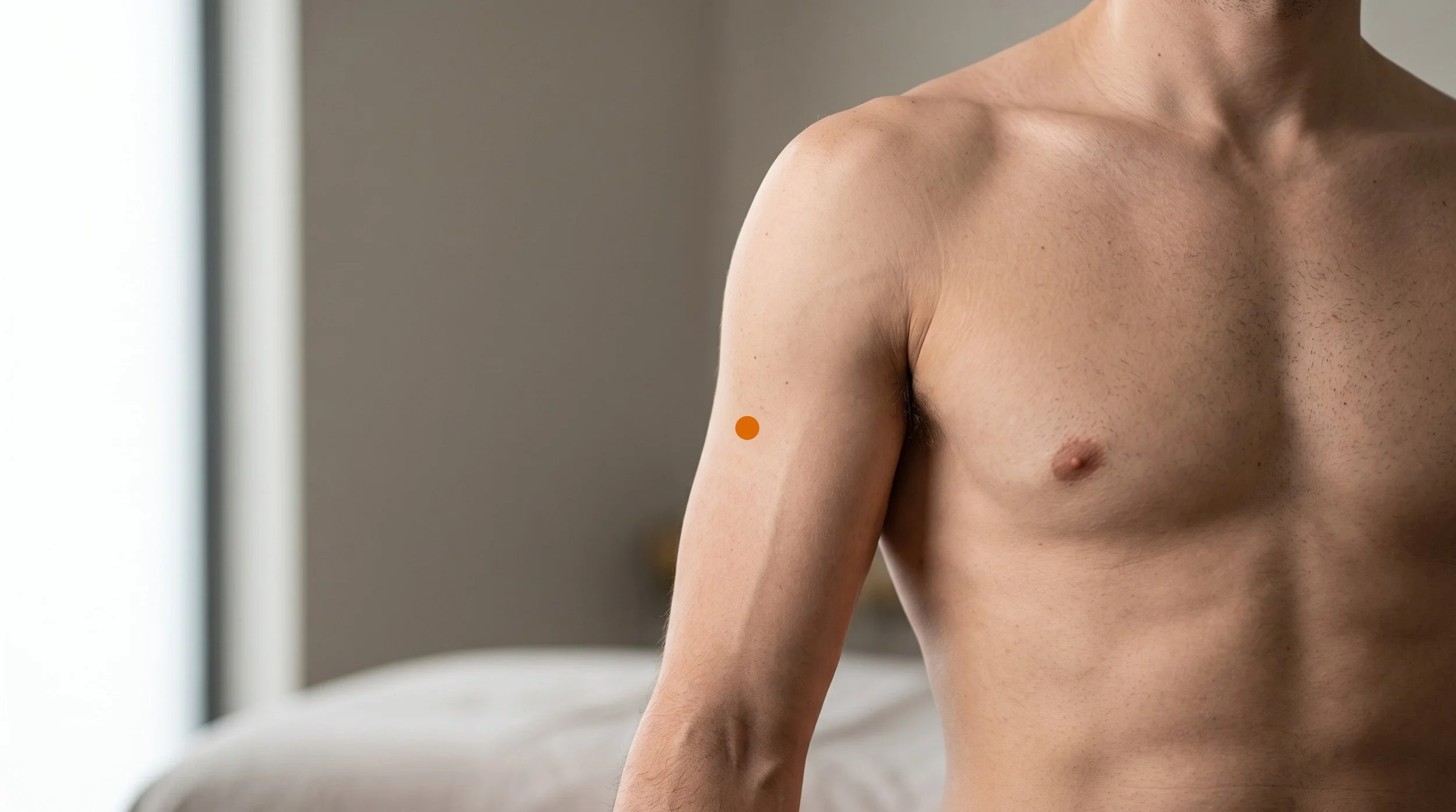
LU3 Acupuncture Point (Tianfu)
The Palace of Heaven on the Upper Arm: Anatomy, Mechanism, and Why the Only Limb-Based Window of Heaven Point Sits Where Arm Pain, Breath, and Sleep Overlap
LU3 (Tianfu, often translated as Palace of Heaven or Heavenly Palace) is the third point of the Lung channel, and it sits high on the front-outer upper arm rather than near the chest or the wrist where most Lung points cluster. To find it, drop about three cun below the front of the armpit crease and settle into the soft groove between the outer edge of the biceps and the shaft of the humerus, roughly at the junction of the upper and middle thirds of the line between armpit and elbow crease (Deadman et al., 2000).
What makes the lu3 acupuncture point interesting is the mismatch between where it lives and what it was classically asked to do: it is the only point in the Window of Heaven group placed on a limb, it was listed in the Spiritual Pivot for bleeding from the mouth and nose, and it was traditionally used for grief, disturbed sleep, and breathlessness (Maciocia, 2015). For modern clinicians, lung 3 earns its place mostly as a precise soft tissue target at the lateral biceps border, with the classical respiratory and emotional indications treated as historical framing rather than physiological claims.
- Location and layers: the lu 3 arm point lies three cun under the anterior axillary fold in the depression between the lateral border of biceps brachii and the humerus, so the needle passes skin, subcutaneous fat, and the outer edge of the biceps toward brachialis and the bone (Deadman et al., 2000; Kim, 2016).
- Traditional categories, translated: classical sources credit Tianfu with clearing Lung heat, descending Lung qi, cooling blood, and calming the corporeal soul (po), which in modern language maps onto a point used for upper arm pain, breath-holding and chest tightness patterns, and states of grief with disrupted sleep (Deadman et al., 2000).
- Nerve geography: the region is supplied by the lateral cutaneous nerve of the forearm as the musculocutaneous nerve travels between biceps and brachialis, giving LU3 a C5 to C6 segmental identity rather than any direct link to the lungs (Beijing College of Traditional Chinese Medicine et al., 1980).
- Mechanism: needling here recruits A-delta and C fibers whose input engages spinal segmental inhibition and descending pain control involving endogenous opioid and monoaminergic pathways, which is the best supported account of why arm points reduce local and regional pain (Zhao, 2008).
- Research picture: individual patient data pooling supports acupuncture for chronic musculoskeletal pain with modest, durable effects (Vickers et al., 2018), while Cochrane reviews of shoulder pain and chronic asthma found the evidence too limited to draw firm conclusions (Green et al., 2005; McCarney et al., 2004).
- De qi and practice framing: patients usually report a dull, spreading ache or heaviness that travels toward the elbow; a sharp electrical line down the forearm suggests the musculocutaneous or cutaneous nerve is being contacted and the needle should be withdrawn and redirected.
Aching Upper Arm That Physical Therapy Has Not Solved?
Pain along the front of the upper arm often gets labeled biceps tendinopathy when the driver is actually irritable tissue at the lateral biceps border and brachialis underneath. At Morningside Acupuncture we use LU3 as a precise needling target in that groove, combined with shoulder and neck assessment so we are treating the source and not just the sore spot. Sessions blend acupuncture, dry needling, and movement guidance you can carry into the gym or the desk. Schedule a visit and let us map where your arm pain is actually coming from.
Schedule NowAnatomy of LU3: Why the Lateral Biceps Border Is Such an Important Location
Standing with the arm relaxed at the side, LU3 sits on the front-outer aspect of the upper arm, about three cun below the front of the armpit crease and six cun above LU5 at the elbow crease, in the small valley formed where the outer edge of biceps brachii meets the shaft of the humerus (Deadman et al., 2000). A quick way to locate it is to divide the distance from armpit fold to elbow crease into thirds and mark the first junction (Kim, 2016).
From the surface inward, the needle meets thin skin, a variable layer of subcutaneous fat, the fascia and lateral fibers of biceps brachii, and then brachialis lying against the humerus. This tissue gets loaded by heavy pulling and carrying, by repetitive elbow flexion under load, by long hours of forward-reaching desk posture, and by protective guarding after shoulder injury, which is why the groove is so often tender in patients who never think of the upper arm as a pain source.
The nerve story here is unusually tidy. The skin over the point is served by the lateral brachial cutaneous nerve in the region where the musculocutaneous nerve courses between biceps and brachialis before continuing as the lateral cutaneous nerve of the forearm (Beijing College of Traditional Chinese Medicine et al., 1980). That places LU3 in a C5 to C6 neurological neighborhood shared with the shoulder, the biceps, and the upper trapezius region, which matters clinically: sensory input from this site converges in the same cervical cord segments that receive input from the shoulder joint and rotator cuff.
Needling generates a burst of small-fiber afferent traffic that can dampen dorsal horn excitability at those segments and recruit descending inhibitory pathways from the midbrain and brainstem, mechanisms mapped in detail in animal and human work on acupuncture analgesia (Zhao, 2008). In plain terms, a needle in the arm can turn down the volume on a noisy shoulder-arm circuit rather than simply numbing the skin where it enters.
Deeper and more medially sit the brachial artery and vein and the median and ulnar nerves, which is why LU3 is approached from the lateral groove and not from the inner arm. The cephalic vein runs superficially nearby, and the musculocutaneous nerve lies deep between the two flexor muscles, so aggressive deep needling has no advantage. Standard conventions are a perpendicular insertion of about 0.5 to 1 cun, with some texts allowing slightly deeper needling in larger patients (Deadman et al., 2000; Beijing College of Traditional Chinese Medicine et al., 1980).
Several classical texts specifically discourage moxibustion at this point, a caution worth noting even though the reasoning given is traditional rather than physiological (Deadman et al., 2000). Practitioners should avoid needling directly into a visible vein, respond to any electric sensation by repositioning, and use clean needle technique throughout.
Related Lung Channel Related Biceps Brachii Trigger PointsLU3 at a Glance: Classification, Location, and Clinical Use
| Category | Detail |
|---|---|
| Traditional Name | Tianfu, commonly rendered as Palace of Heaven, Heavenly Palace, or Celestial Storehouse |
| Channel Classification | Third point of the Lung channel (Hand Taiyin), located on the upper arm |
| Point Categories | Window of Heaven point, one of the original five named in the Spiritual Pivot alongside ST9, LI18, TE16, and BL10; the only member of the group placed on a limb rather than the head, neck, or chest; no five-shu, luo-connecting, xi-cleft, or extraordinary vessel designation is attributed to it in the classical sources |
| Precise Location | Front-outer upper arm, 3 cun below the anterior axillary fold and 6 cun above LU5, in the depression between the lateral border of biceps brachii and the shaft of the humerus; at the junction of the upper and middle thirds of the armpit-to-elbow line |
| Tissue Stimulated | Skin and subcutaneous tissue of the lateral upper arm, fascia and lateral fibers of biceps brachii, and the deeper brachialis overlying the humerus, within the cutaneous territory associated with the musculocutaneous nerve |
| Needle Depth / Direction | Perpendicular insertion 0.5 to 1 cun into the groove lateral to biceps, angled along the muscle border rather than medially toward the neurovascular bundle; several classical texts contraindicate moxibustion at this point |
| De Qi Sensation | A dull, heavy ache or pressure that often spreads toward the elbow or up into the shoulder; a brief twitch is common when the biceps border is engaged, while a sharp electrical streak down the forearm signals nerve contact and calls for repositioning |
| Primary Clinical Uses | Pain along the front-outer upper arm and biceps border, arm pain associated with shoulder problems, difficulty extending or using the arm, and traditionally cough, wheezing, nosebleed, throat swelling, and grief with disturbed sleep |
| Common Point Combinations |
|
Deadman's point commentary presents Tianfu as a point traditionally credited with clearing heat from the Lung, directing Lung qi downward, cooling blood to stop bleeding, and settling the corporeal soul (po), the aspect of spirit said in Chinese medicine to be housed by the Lung (Deadman et al., 2000).
Its earliest surviving indication comes from the Spiritual Pivot, where it appears in a description of sudden severe thirst with Liver and Lung in conflict and blood spilling from mouth and nose, a passage later read as the pattern of Liver fire scorching the Lung, typically with spasmodic coughing, a flushed face, and breathlessness provoked by anger or frustration (Deadman et al., 2000; Maciocia, 2015).
The same passage places Tianfu among the first five Window of Heaven points, a group associated with neck swellings, descending Lung qi, and benefiting the sensory orifices, which is how visual dizziness and short-sightedness entered its indication list (Cunningham, 2008). Classical records also assign it a strikingly psychological range, from sadness and weeping to forgetfulness, excessive sleepiness, insomnia, and the old category of ghost-talk, which later commentators linked either to the delirium of advanced pulmonary tuberculosis or to culturally framed accounts of disordered speech (Deadman et al., 2000).
What stands out is the coherence of the picture: a single arm point gathered grief, sleep, breath, and bleeding into one clinical portrait long before anyone described a nervous system.
Why LU3 Is Used for Grief, Restless Sleep, and Breathlessness
The straightforward part is the arm. LU3 sits in the C5 to C6 sensory field, the same segmental territory that carries input from the shoulder capsule, rotator cuff, and biceps. When those structures are irritable, the dorsal horn neurons receiving their signals become easier to fire, and pain gets reported over a wider zone than the injured tissue itself. Needling into the lateral biceps groove feeds strong, well-localized afferent input into those same segments, which can reduce that amplified state and improve tolerance to movement (Zhao, 2008).
This is why a point on the upper arm can help a shoulder that hurts when reaching overhead, and why pooled trial data show modest but persistent benefits for chronic musculoskeletal pain (Vickers et al., 2018).
The breathing and mood indications need a more honest explanation. There is no segmental nerve connection between the upper arm and the lungs, since sympathetic supply to the airways arises from upper thoracic levels. Any effect on breathing would have to come through broader routes: needling stimulates brainstem and hypothalamic circuits, shifts autonomic balance toward parasympathetic activity, and releases endogenous opioids and monoamines that influence arousal, muscle tone, and perceived effort (Zhao, 2008).
In practice, patients who breathe shallowly under stress often carry protective tension through the chest, shoulder, and upper arm, so relaxing that chain can make breathing feel easier without changing lung function.
The sleep and grief associations follow a similar logic. Acupuncture appears to reduce arousal and improve subjective sleep quality in insomnia trials, though those studies used multi-point protocols, and effect sizes vary with comparison group and study quality (Kim et al., 2021). LU3 is rarely a primary sleep point in modern practice, but it earns a place in treatments for patients whose sleep disturbance is bound up with loss, chest tightness, and a physically held-in quality, which is exactly the presentation classical authors described under the heading of calming the corporeal soul.
What the Research Shows for LU3
Almost no clinical trial isolates a single acupuncture point, and LU3 is no exception: it has not been studied on its own in any published randomized trial we are aware of. What the research can tell us is how the broader interventions that sometimes include this point perform, namely acupuncture for musculoskeletal shoulder and arm pain, acupuncture for respiratory conditions, dry needling of upper limb trigger points, and acupuncture for insomnia.
Read the table below as context for the treatment approach rather than as evidence for this particular location, and note that the respiratory literature in particular remains mixed and generally low in certainty.
| Study | Type | Focus | Key Finding |
|---|---|---|---|
| Vickers et al., 2018 | Individual patient data meta-analysis | Chronic musculoskeletal, headache, and osteoarthritis pain across nearly 21,000 patients | Acupuncture outperformed both sham and no-acupuncture controls for chronic pain, with effects that persisted over about a year. |
| Green et al., 2005 | Cochrane systematic review | Acupuncture for shoulder pain in adults | The available trials were too few and too small to draw firm conclusions, with only limited signals of short-term benefit. |
| Hall et al., 2018 | Systematic review with meta-analysis | Trigger point dry needling in the shoulder region for upper extremity pain and dysfunction | Evidence quality was very low, though short-term reductions in pain and improvements in function were reported. |
| McCarney et al., 2004 | Cochrane systematic review | Acupuncture for chronic asthma | The reviewers found insufficient evidence that short courses of acupuncture change the course of asthma. |
| Suzuki et al., 2012 | Randomized placebo-controlled trial | Acupuncture for dyspnea on exertion in COPD alongside standard medication | Real acupuncture was associated with greater improvement in breathlessness scores than placebo needling, though the trial has been debated on blinding grounds. |
| Kim et al., 2021 | Systematic review and meta-analysis | Acupuncture for insomnia compared with medication or sham | Acupuncture was associated with improved sleep quality scores, though study quality and protocols varied considerably. |
| Zhao, 2008 | Narrative mechanism review | Neural mechanisms of acupuncture analgesia | Needling effects are attributed to peripheral afferent activation, spinal segmental inhibition, and descending opioid and monoaminergic control. |
Tight Chest, Shallow Breathing, and Sleep That Will Not Settle?
Many patients arrive describing a held breath, a heavy chest, and nights spent staring at the ceiling after a hard season of stress or loss. Tianfu was traditionally used in exactly that territory, and we pair it with points and breathing work aimed at downshifting a revved-up nervous system. We are clear about what acupuncture may and may not do here, and we track your sleep and symptoms session to session. Book a consultation to talk through a realistic plan.
Schedule NowLU3 in the Context of Trigger Point Work
The groove that holds LU3 is also prime myofascial territory. Trigger points in biceps brachii commonly refer pain up over the front of the shoulder and down toward the elbow crease, while brachialis points can refer into the thumb and the front of the elbow, patterns that patients frequently describe as tendon pain even when the tendon itself is fine (Simons et al., 1999). Because the point sits at the lateral border of biceps with brachialis directly beneath, a needle placed at LU3 can reach either muscle depending on angle and depth, which makes it a convenient anchor when treating anterior arm pain.
At Morningside Acupuncture, we treat the location rather than the label. If assessment shows taut bands and reproducible referral, we needle biceps brachii and brachialis with trigger point technique, often adding triceps brachii for the opposing side of the arm and shoulder girdle work when scapular mechanics are involved. Acupuncture and dry needling both use an acupuncture needle, so combining a classical point like Tianfu with myofascial targets in the same session is a matter of reasoning, not of switching systems.
Reviews of upper limb dry needling report short-term pain and function gains with low certainty evidence, so we pair needling with loading exercise and posture change rather than relying on needles alone (Hall et al., 2018).
LU3 Arm Pain and Breathing Treatment at NYC's Highest-Rated Acupuncture Clinic
Morningside Acupuncture is the highest-rated acupuncture and dry needling clinic in New York City with over 500 five-star Google reviews, and that reputation comes from careful, anatomy-first treatment rather than one-size-fits-all protocols. We use the palace of heaven point as part of a full upper limb and respiratory-pattern assessment, integrating trigger point dry needling of biceps brachii and brachialis where indicated. Every plan includes clear expectations, a reassessment schedule, and self-care between visits. Schedule your appointment and get started this week.
Schedule NowFrequently Asked Questions
What does LU3 feel like when needled?
Most people feel a dull, spreading heaviness or ache in the upper arm that may travel toward the elbow or upward into the shoulder. If the biceps border is holding tension, you may notice a brief involuntary twitch, which is normal and usually followed by a sense of the arm softening. Sharp, electrical sensation shooting into the forearm is not the goal and means the needle is near a cutaneous or motor nerve, so tell your practitioner and it will be repositioned. The sensation typically fades within a minute of the needle settling, and mild next-day tenderness in the muscle is common after dry needling.
Why needle a point on the upper arm for shoulder pain or breathing complaints?
For shoulder and arm pain the answer is segmental: LU3 shares C5 to C6 innervation with the shoulder joint and biceps, so needling here feeds input into the same spinal levels that are processing the painful signals, which can reduce their amplification and improve movement tolerance (Zhao, 2008). For breathing complaints the explanation is different and more modest. There is no direct nerve link from the upper arm to the lungs, so any effect likely comes through general autonomic and descending modulation plus reduced guarding in the chest and shoulder girdle. Classical texts assigned Tianfu a strong respiratory role, and we present that as traditional attribution rather than as a proven mechanism.
Can I press LU3 myself between sessions?
Yes, and it is easy to reach. Let one arm hang relaxed, then use the opposite thumb to find the soft groove on the front-outer upper arm just outside the biceps bulge, about a hand's width below the armpit crease. Press inward and slightly toward the bone with steady, moderate pressure until you feel a satisfying ache rather than sharp pain, hold for 30 to 60 seconds, then release. Repeat two or three times per side, once or twice a day, and add slow elbow bending and straightening while you hold pressure if the arm feels stiff. Stop immediately if you get tingling, numbness, or shooting sensations into the forearm or hand, and skip the area entirely if there is bruising, swelling, or a recent injury.
Is LU3 safe to needle?
In trained hands, yes. Standard practice is a perpendicular insertion of about 0.5 to 1 cun into the groove lateral to the biceps, angled along the muscle border rather than medially, which keeps the needle well away from the brachial artery, brachial vein, and median nerve on the inner arm (Deadman et al., 2000). The cephalic vein runs superficially in the region, so visible veins are avoided, and the musculocutaneous nerve runs deep between biceps and brachialis, which is one reason deep or vigorous needling offers no benefit here. Several classical texts also list this point as one where moxibustion should not be used. Expected side effects are limited to brief soreness or occasional small bruising, and anyone on anticoagulants or with local skin infection should tell their practitioner in advance.
Where exactly is LU3 located?
Stand with your arm hanging at your side. LU3 is on the front-outer upper arm, three cun below the front edge of the armpit crease and six cun above LU5 at the elbow crease, in the depression between the outer border of biceps brachii and the shaft of the humerus (Deadman et al., 2000). The simplest method is proportional: divide the distance from the armpit crease to the elbow crease into three equal parts, and the point sits at the first dividing line, in the groove you can feel just outside the biceps (Kim, 2016). Its neighbor LU4 sits one cun below it along the same line.
References
- Deadman, P., Al-Khafaji, M., & Baker, K. (2009). A manual of acupuncture. Journal of Chinese Medicine Publications.
- Maciocia, G. (2005). The foundations of Chinese medicine: A comprehensive text for acupuncturists and herbalists (2nd ed.). Elsevier Churchill Livingstone.
- Cheng, X. (Ed.). (1999). Chinese acupuncture and moxibustion (Rev. ed.). Foreign Languages Press.
- Kim, H. (2008). Handbook of Oriental medicine (3rd ed.). Harmony & Balance Press.
- Cunningham, P. M. (2000). Acupuncture points: A practical guide to classical and modern usage. Odyssey Press.
- Simons, D. G., Travell, J. G., & Simons, L. S. (1999). Travell & Simons' myofascial pain and dysfunction: The trigger point manual, Vol. 1: Upper half of body (2nd ed.). Williams & Wilkins.
- Zhao, Z. Q. (2008). Neural mechanism underlying acupuncture analgesia. Progress in Neurobiology, 85(4), 355-375. https://doi.org/10.1016/j.pneurobio.2008.05.004
- Vickers, A. J., Vertosick, E. A., Lewith, G., MacPherson, H., Foster, N. E., Sherman, K. J., Irnich, D., Witt, C. M., & Linde, K. (2018). Acupuncture for chronic pain: Update of an individual patient data meta-analysis. Journal of Pain, 19(5), 455-474. https://doi.org/10.1016/j.jpain.2017.11.005
- Green, S., Buchbinder, R., & Hetrick, S. (2005). Acupuncture for shoulder pain. Cochrane Database of Systematic Reviews, 2005(2), CD005319. https://doi.org/10.1002/14651858.CD005319
- Hall, M. L., Mackie, A. C., & Ribeiro, D. C. (2018). Effects of dry needling trigger point therapy in the shoulder region on patients with upper extremity pain and dysfunction: A systematic review with meta-analysis. Physiotherapy, 104(2), 167-177. https://doi.org/10.1016/j.physio.2017.08.001
- McCarney, R. W., Brinkhaus, B., Lasserson, T. J., & Linde, K. (2004). Acupuncture for chronic asthma. Cochrane Database of Systematic Reviews, 2004(1), CD000008. https://doi.org/10.1002/14651858.CD000008.pub2
- Suzuki, M., Muro, S., Ando, Y., Omori, T., Shiota, T., Endo, K., Sato, S., Aihara, K., Matsumoto, M., Suzuki, S., Itotani, R., Ishitoko, M., Hara, Y., Takemura, M., Ueda, T., Kagioka, H., Hirabayashi, M., Fukui, M., & Mishima, M. (2012). A randomized, placebo-controlled trial of acupuncture in patients with chronic obstructive pulmonary disease (COPD): The COPD-acupuncture trial (CAT). Archives of Internal Medicine, 172(11), 878-886. https://doi.org/10.1001/archinternmed.2012.1233
- Kim, S. A., Lee, S. H., Kim, J. H., van den Noort, M., Bosch, P., Won, T., Yeo, S., & Lim, S. (2021). Efficacy of acupuncture for insomnia: A systematic review and meta-analysis. American Journal of Chinese Medicine, 49(5), 1135-1150. https://doi.org/10.1142/S0192415X21500543
Disclaimer: This web site is intended for educational and informational purposes only. Reading this website does not constitute providing medical advice or any professional services. This information should not be used for diagnosing or treating any health issue or disease. Those seeking medical advice should consult with a licensed physician. Seek the advice of a medical doctor or other qualified health professional for any medical condition. If you think you have a medical emergency, call 911 or go to the emergency room. No acupuncturist-patient relationship is created by reading this website or using the information. Morningside Acupuncture PLLC and its employees and contributors do not make any express or implied representations with respect to the information on this site or its use. For any legal interpretation of scope of practice in your state, consult a licensed attorney or regulatory authority.
Read more from our blog



