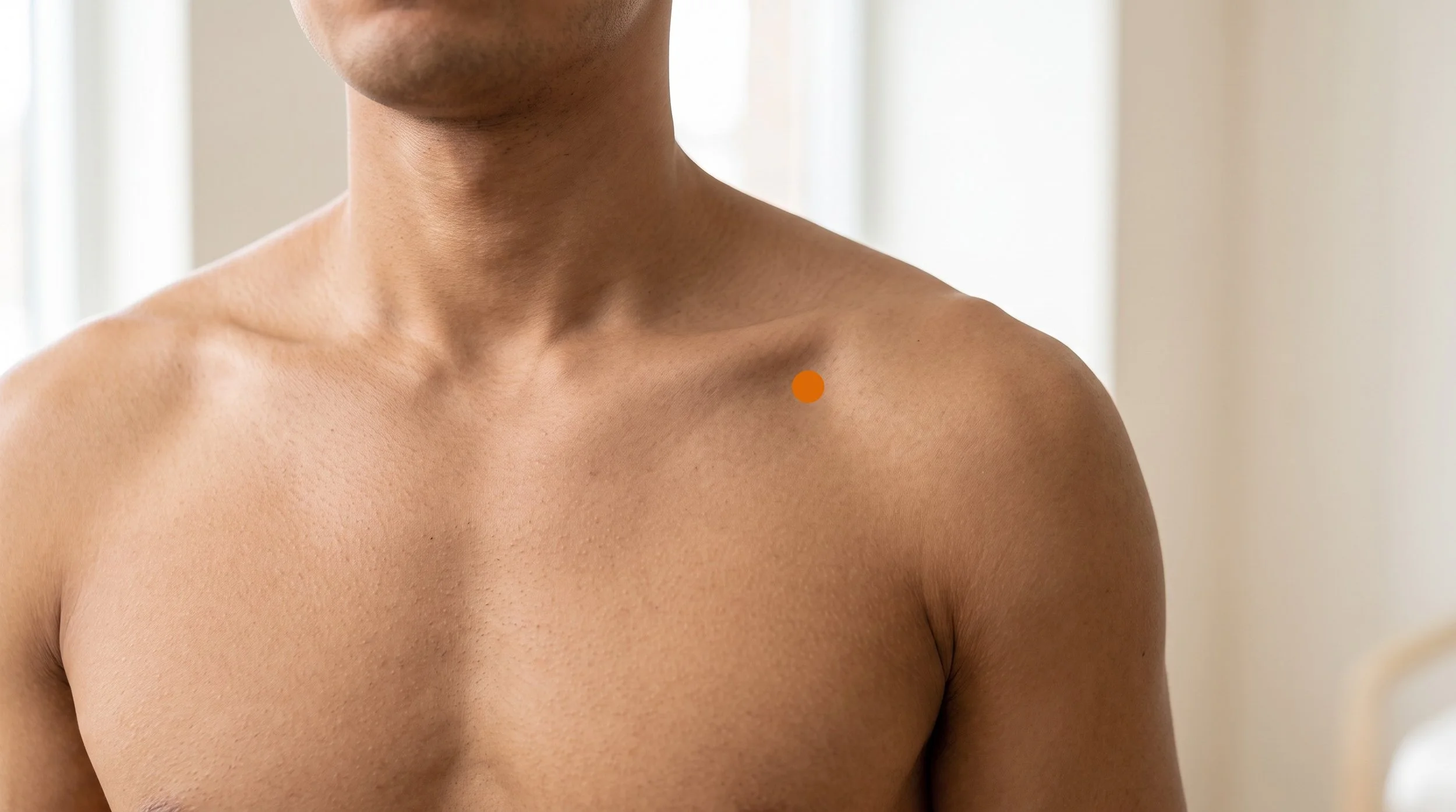
LU2 Acupuncture Point (Yunmen)
The Cloud Gate Below the Collarbone: Anatomy, Mechanism, and Why This Shallow Chest Point Belongs in Front-of-Shoulder Treatment
LU2 (Yunmen, translated as Cloud Gate or Cloud Door) is the second point of the Lung channel, sitting in the soft hollow of the deltopectoral triangle just below the outer end of the collarbone, about 6 cun lateral to the midline and one cun above LU1. It is the point patients often find on themselves without being told, because the dip between the front of the shoulder muscle and the chest muscle is exactly where anterior shoulder pain, overhead reaching restriction, and desk-posture tightness tend to concentrate.
Classically the cloud gate point was used for cough, wheezing, and a hot, oppressive feeling in the chest, while in modern musculoskeletal practice the lu 2 chest location is valued mostly as a precise, shallow local point for the front of the shoulder. It is also one of the points where anatomy dictates technique: the lung apex is close, so the needle stays flat against the chest wall.
- LU2 sits in the deltopectoral hollow between the clavicular head of pectoralis major and the anterior fibers of deltoid, one cun above LU1, and the triangle becomes obvious when the patient pushes the hand forward against your resistance (Deadman & Al-Khafaji, 2007).
- Traditional sources attribute to LU2 the actions of clearing heat from the Lung, encouraging Lung qi to spread and descend, and relieving fullness and agitation in the chest; read anatomically, those descriptions map onto the upper chest wall, the anterior shoulder, and the muscles of accessory breathing (Deadman & Al-Khafaji, 2007).
- The tissues here are supplied by the supraclavicular nerves above and by the lateral pectoral and axillary nerves below, so LU2 shares spinal segments with the glenohumeral joint and rotator cuff, which is the basic convergence argument for using a chest point to influence shoulder pain (Zhao, 2008).
- Needling anywhere on the body recruits descending pain-modulating pathways from the brainstem and releases endogenous opioids, which helps explain why local needling can change pain that feels larger than the needled area (Zhao, 2008); pooled individual patient data show acupuncture outperforming sham and no-acupuncture controls for chronic musculoskeletal pain, with modest effect sizes (Vickers et al., 2018).
- The research picture for shoulder complaints is mixed rather than settled: an older Cochrane review found the trial evidence too limited to draw firm conclusions (Green et al., 2005), while more recent syntheses of acupuncture for impingement and of dry needling for subacromial pain report short-term pain and function gains from small, variable trials (An et al., 2024; Griswold et al., 2023).
- Safety governs technique at LU2: pneumothorax remains the most reported serious acupuncture complication in case-report reviews (Xu et al., 2013), and safe depths over the chest vary with body size and sex (Chou et al., 2011), so the point is needled transverse-oblique, 0.5 to 1 cun, never deep or angled medially (Deadman & Al-Khafaji, 2007). De qi here is usually a dull spreading fullness under the collarbone rather than a sharp sensation.
Struggling to Lift Your Arm Overhead Without Front-of-Shoulder Pain?
Anterior shoulder pain rarely comes from one structure, which is why we assess the joint, the rotator cuff, and the chest wall together before choosing points. LU2 gives us safe, shallow access to the deltopectoral interval where pectoralis major and anterior deltoid meet, and we typically pair it with local shoulder points and graded loading advice. Most patients notice easier reaching within a few sessions when the plan combines needling with movement. Schedule an evaluation and we will map out what is actually limiting your arm.
Schedule NowAnatomy of LU2: Why the Deltopectoral Triangle Is Such an Important Location
Run your fingers along the collarbone toward the shoulder and you will drop into a small hollow just before the bony point of the shoulder. That hollow is the deltopectoral triangle, bordered by the clavicle above, the clavicular head of pectoralis major medially, and the anterior fibers of deltoid laterally, and LU2 sits in its center (Deadman & Al-Khafaji, 2007). The layers under the fingertip are thin: skin, a variable pad of subcutaneous fat, then fascia and the muscle borders themselves.
This is a high-traffic region mechanically. Pectoralis major pulls the arm forward and across the body, anterior deltoid flexes it, and both work overtime in desk posture, pressing, carrying, and pushing. Pectoralis major and pectoralis minor are also classic sources of referred pain into the front of the chest and shoulder, which is one reason patients point here when describing shoulder pain (Simons et al., 1999).
The nerve geography explains why a chest point can influence a shoulder complaint. The skin over the infraclavicular fossa is supplied largely by the supraclavicular nerves arising from the upper cervical roots, while the muscles that form the triangle are supplied by the lateral pectoral nerve and the axillary nerve, both carrying fibers from the C5 and C6 region. The glenohumeral joint capsule, rotator cuff, and subacromial tissues draw on those same segments.
When afferent input from needling and from painful joint tissue converges on the same dorsal horn neurons, the segmental input from the needle can modulate how that pool of neurons processes ongoing nociception, and this local mechanism sits alongside longer-range brainstem pathways that release endogenous opioids and dampen transmission more broadly (Zhao, 2008). In plain terms, needling LU2 speaks to the shoulder's own neurological neighborhood rather than to a distant one.
Deep to the triangle, the anatomy turns serious. The cephalic vein dives through this interval to join the axillary vein, branches of the thoracoacromial artery cross the region, and the cords of the brachial plexus with the axillary vessels pass deeper and slightly lateral. Most importantly, the apex of the lung lies close beneath the upper chest wall, which is why LU2 is needled transverse to oblique, 0.5 to 1 cun, angled along the chest wall, and why deep perpendicular or medially directed insertion is specifically cautioned against (Deadman & Al-Khafaji, 2007).
Reviews of acupuncture adverse events consistently identify pneumothorax as the most commonly reported serious complication (Xu et al., 2013), and imaging studies show that safe depth over the chest varies with body size and sex rather than being a fixed number (Chou et al., 2011). Competent practice at this point is defined by angle discipline, not by depth.
Related Pectoralis Major Trigger Points Related Acupuncture For Deltoid PainLU2 at a Glance: Classification, Location, and Clinical Use
| Category | Detail |
|---|---|
| Traditional Name | Yunmen, translated as Cloud Gate or Cloud Door |
| Channel Classification | Second point of the Lung channel (Hand Taiyin), on the antero-lateral chest |
| Point Categories | No five-shu, mu, or extraordinary vessel designation of its own. The Essential Questions counts LU2 among the points used to drain heat from the extremities, grouped with LI15, BL40, and GV2 (Deadman & Al-Khafaji, 2007). Some classical descriptions of the Heart connecting vessel place its trajectory through this region. |
| Precise Location | On the upper outer chest below the lateral end of the clavicle, 6 cun lateral to the anterior midline, in the center of the deltopectoral hollow, one cun above LU1. Ask the patient to press the hand forward against your resistance and the triangle becomes visible. |
| Tissue Stimulated | Skin and subcutaneous fascia of the infraclavicular fossa, the clavicular head of pectoralis major, the anterior fibers of the deltoid, and the fascial interval between them; pectoralis minor lies deeper and more medial |
| Needle Depth / Direction | Transverse-oblique insertion 0.5 to 1 cun, angled along the chest wall and away from the lung. Deep perpendicular or medially angled needling carries a substantial pneumothorax risk and is avoided (Deadman & Al-Khafaji, 2007). |
| De Qi Sensation | A dull, spreading fullness or heaviness under the collarbone, sometimes tracking into the front of the shoulder or the upper arm. With flat transverse technique the sensation is often mild and stretching rather than deep and aching, and a tender pectoral or deltoid band may reproduce familiar shoulder pain. |
| Primary Clinical Uses | Front-of-shoulder pain with difficulty raising the arm, deltopectoral and chest wall tension in posture-related presentations, and, in classical use, cough, wheezing, and an oppressive or agitated feeling in the chest |
| Common Point Combinations |
|
The classical record for Yunmen, as gathered in Deadman and Al-Khafaji's Manual of Acupuncture, is unusually two-sided. Traditional attributions give the point the functions of clearing heat from the Lung, helping Lung qi spread and descend, and dispersing fullness and agitation in the chest, with indications spanning cough, wheezing, breathlessness that prevents lying flat, and a hot, pressured, restless sensation behind the breastbone.
Alongside those respiratory and chest patterns sit an equally long list of structural complaints: pain of the chest and flanks, pain of the back and shoulders, shoulder pain with inability to raise the arm, and tenderness in the hollow above the collarbone. A few entries are stranger to modern ears, including throat obstruction, goiter, an interrupted pulse that cannot be felt at the wrist, and lingering heat in the limbs after an invasion of cold.
The Essential Questions also lists LU2 among the points used to drain heat from the extremities, and the same idea reappears in the Great Compendium of Acupuncture and Moxibustion. What makes the pattern striking is that a single small hollow below the collarbone carried responsibility for both how a person breathes and how a person reaches, which is precisely the anatomical territory the point occupies.
Why LU2 Is Used for Front-of-Shoulder Pain That Limits Overhead Reaching
Patients with anterior shoulder pain usually point to two places: the front of the joint, and the soft dip beside it. That dip is LU2. The muscles bordering it, the clavicular head of pectoralis major and the anterior deltoid, are among the tissues that stay short in prolonged sitting, pressing, and carrying, and they are common sources of referred pain into the chest and shoulder (Simons et al., 1999).
Needling into that interval delivers input from the same spinal segments that supply the shoulder joint and cuff, so signals from the needle and signals from the painful structures arrive at overlapping populations of dorsal horn neurons. Convergence of this kind is the standard segmental explanation for why local needling can change how a region hurts, and it works alongside brainstem-driven descending inhibition and opioid-mediated modulation that operate more broadly (Zhao, 2008).
There is also a mechanical layer that patients feel quickly. When the front of the chest and shoulder is guarded, the shoulder blade tends to sit forward and the arm loses a little of the arc it needs to clear overhead. Reducing tone and tenderness in the deltopectoral region often makes the first thirty degrees of elevation feel less restricted, which then makes the strengthening work more tolerable. We frame this as a window rather than a fix.
Individual patient data pooled across chronic pain trials show acupuncture producing real but moderate benefits over sham and usual care, with effects that persist reasonably well over time when treatment is adequately delivered (Vickers et al., 2018).
The classical respiratory indications deserve an honest translation. LU2 sits over accessory breathing muscles and the upper chest wall, and patients who breathe shallowly through the upper chest are often tight exactly here. Loosening that region, combined with breathing retraining, may make fuller diaphragmatic breathing feel easier and more comfortable. That is a comfort and mechanics claim, not a claim about treating asthma or any lung disease, and anyone with a respiratory diagnosis should stay under the care of their physician.
What the Research Shows for LU2
Almost no clinical trial isolates a single acupuncture point, and LU2 is no exception. What the literature offers instead is evidence about multi-point protocols for shoulder and musculoskeletal pain, mechanistic work on how needling modulates pain processing, and safety data that directly shapes how this particular point is needled. Read the table below as context for a technique rather than as proof about one location, and expect words like modest, short-term, and low certainty to appear often, because that is what the better reviews actually report.
| Study | Type | Focus | Key Finding |
|---|---|---|---|
| Green et al., 2005 | Cochrane systematic review | Acupuncture for shoulder pain in adults | The available trials were too few and too small for firm conclusions, with only limited evidence of short-term benefit over placebo. |
| An et al., 2024 | Systematic review and meta-analysis | Acupuncture for shoulder impingement syndrome | Pooled results suggested improvements in pain and function compared with control interventions, though the included trials were variable in quality. |
| Griswold et al., 2023 | Systematic review with meta-analysis | Dry needling for subacromial pain syndrome | Dry needling was associated with short-term reductions in pain and disability, with effects that appear to diminish over longer follow-up. |
| Vickers et al., 2018 | Individual patient data meta-analysis | Acupuncture for chronic musculoskeletal, headache, and osteoarthritis pain | Acupuncture was superior to both sham and no-acupuncture controls, with modest effect sizes that were largely maintained over twelve months. |
| Zhao, 2008 | Narrative review of neurophysiology | Mechanisms of acupuncture analgesia | Needling activates peripheral afferents that engage segmental inhibition and descending opioid-mediated pathways, offering a plausible mechanism for local points. |
| Chou et al., 2011 | Systematic review of imaging and cadaver studies | Safe needling depth at acupuncture points | Reported safe depths differ considerably by measurement method, body size, and sex, supporting conservative angling over fixed depth rules at chest points. |
| Xu et al., 2013 | Systematic review of case reports | Adverse events associated with acupuncture | Serious events were uncommon overall, but pneumothorax was the most frequently reported organ injury, nearly all cases resolving with treatment. |
Tight Chest and Rounded Shoulders From Long Days at a Desk?
Hours at a keyboard load the front of the chest and shoulder in a shortened position, and patients often describe a band of tension right where the cloud gate point sits. We use LU2 with careful, flat-angled needling alongside dry needling of pectoralis major and pectoralis minor, plus breathing and postural work you can repeat at home. The goal is a chest wall that lets the ribs and shoulder blade move again. Book a session and let us take a look at how you are loading your upper body.
Schedule NowLU2 in the Context of Trigger Point Work
Acupuncture means the use of an acupuncture needle, and that includes dry needling, so at Morningside the question is never which system to use but which tissue needs input. LU2 happens to sit at the junction of two muscles that frequently harbor tender, taut bands: the clavicular head of pectoralis major and the anterior deltoid. Trigger points in pectoralis major are described as referring pain across the front of the chest and down the inner arm, and pectoralis minor, lying deeper and slightly medial, contributes its own anterior shoulder and arm referral (Simons et al., 1999).
When palpation at or near LU2 reproduces a patient's familiar pain, that overlap is clinically useful information rather than a coincidence of point location.
In practice we may needle LU2 with a shallow, flat angle for the point's traditional and segmental effects, then treat surrounding myofascial targets with technique appropriate to each muscle: pectoralis major along the muscle belly with the tissue lifted away from the chest wall where possible, anterior and middle deltoid perpendicular over safe bulk, and pectoralis minor only with careful positioning and a tangential angle.
Reviews of dry needling for subacromial pain report short-term pain and disability gains when needling is combined with exercise (Griswold et al., 2023), which matches how we sequence care: reduce the mechanical and neurological irritation, then load the shoulder so the change lasts. Every needle placed over the rib cage follows the same rule, angled along the chest wall and never driven toward the lung.
LU2 Shoulder and Chest Tension Treatment at NYC's Highest-Rated Acupuncture Clinic
Morningside Acupuncture is the highest-rated acupuncture and dry needling clinic in New York City with over 500 five-star Google reviews, and our practitioners treat shoulder and chest wall pain every day. We use LU2 as one part of a full plan that may include distal points, trigger point dry needling, cupping, and specific rehab exercises. Every chest-area needle is placed with a shallow, angled technique and a clear explanation of what we are doing and why. Schedule your visit and start with a proper assessment rather than a guess.
Schedule NowFrequently Asked Questions
What does LU2 feel like when needled?
Most people feel a brief pinch at the skin, then a dull, spreading fullness under the collarbone that may drift toward the front of the shoulder or the upper arm. Because LU2 is needled transverse to oblique rather than straight in, the sensation tends to be a stretching or heavy quality rather than a deep ache. If the needle enters a taut band in pectoralis major or anterior deltoid, you may feel a quick twitch or a wave of familiar shoulder pain that fades within seconds. Sharp, electrical, or radiating pain down the arm is not the goal, and you should tell your practitioner right away so the needle can be adjusted or removed.
Why needle a chest point for shoulder pain instead of the shoulder joint itself?
LU2 is a local point for the shoulder, not a distant one. The tissues at the deltopectoral triangle share spinal segments with the glenohumeral joint, the rotator cuff, and the subacromial structures, so needle input arrives at the same dorsal horn neurons that are processing pain from those tissues (Zhao, 2008). It also reaches the front-of-chest muscles that hold the shoulder in a protracted position, which is a mechanical contributor many treatment plans skip. In most sessions LU2 is used alongside points directly over the joint and cuff rather than instead of them.
Can I press LU2 myself between sessions?
Yes, and it is one of the easier points to self-treat. Find the outer end of your collarbone, slide your fingertips just below it and slightly toward the shoulder until you drop into the soft hollow, then press your other hand forward against a wall to make the triangle stand out. Apply steady, moderate pressure with two fingertips for 30 to 60 seconds, breathing slowly, then release and repeat two or three times per side, once or twice a day. You can add small circular motion or hold the pressure while slowly raising and lowering the arm. Pressure should register as a satisfying ache, not a sharp pain, and you should avoid pressing hard into the hollow if you feel pulsing under your fingers, since blood vessels pass nearby. Acupressure carries none of the pneumothorax concern that needling does, but stop if you feel numbness or tingling into the arm.
Is LU2 safe to needle?
It is safe in trained hands and unforgiving of sloppy technique. The apex of the lung lies close beneath the upper chest wall, so LU2 is needled transverse to oblique at 0.5 to 1 cun with the needle angled along the chest wall, and deep perpendicular or medially directed insertion is specifically cautioned against (Deadman & Al-Khafaji, 2007). Reviews of adverse event case reports identify pneumothorax as the most commonly reported serious organ injury after acupuncture, though it remains rare and nearly all reported cases resolved with treatment (Xu et al., 2013), and imaging research shows safe depth over the chest varies with body size and sex rather than following a single number (Chou et al., 2011). Practical implications: choose a licensed practitioner, mention if you are very lean or have any lung condition, and seek urgent medical care for new shortness of breath or sharp chest pain after any chest-area needling.
Where exactly is LU2 located?
LU2 is on the upper outer chest, below the lateral end of the clavicle, 6 cun lateral to the anterior midline, in the center of the deltopectoral hollow, one cun above LU1 (Deadman & Al-Khafaji, 2007). The most reliable way to find it is to have the person extend the hand forward while you resist the movement, which makes the triangle between pectoralis major and deltoid stand out clearly. Landmark checkpoints are the collarbone above, the coracoid process just lateral, and the ribs medially. If you are pressing on bone, you are off the point.
References
- Deadman, P., Al-Khafaji, M., & Baker, K. (2009). A manual of acupuncture. Journal of Chinese Medicine Publications.
- Kim, H. (2008). Handbook of Oriental medicine (3rd ed.). Harmony & Balance Press.
- Cunningham, P. M. (2000). Acupuncture points: A practical guide to classical and modern usage. Odyssey Press.
- Simons, D. G., Travell, J. G., & Simons, L. S. (1999). Travell & Simons' myofascial pain and dysfunction: The trigger point manual, Vol. 1: Upper half of body (2nd ed.). Williams & Wilkins.
- Green, S., Buchbinder, R., & Hetrick, S. (2005). Acupuncture for shoulder pain. Cochrane Database of Systematic Reviews, 2005(2), CD005319. https://doi.org/10.1002/14651858.CD005319
- An, S. J., Shin, W. C., Joo, S., Cho, J. H., Chung, W. S., Song, M. Y., & Kim, H. (2024). Effects of acupuncture on shoulder impingement syndrome: A systematic review and meta-analysis. Medicine, 103(37), e39696. https://doi.org/10.1097/MD.0000000000039696
- Griswold, D., Learman, K., Ickert, E., Tapp, A., & Ross, O. (2023). Dry needling for subacromial pain syndrome: A systematic review with meta-analysis. Pain Medicine, 24(3), 285-299. https://doi.org/10.1093/pm/pnac131
- Vickers, A. J., Vertosick, E. A., Lewith, G., MacPherson, H., Foster, N. E., Sherman, K. J., Irnich, D., Witt, C. M., & Linde, K. (2018). Acupuncture for chronic pain: Update of an individual patient data meta-analysis. Journal of Pain, 19(5), 455-474. https://doi.org/10.1016/j.jpain.2017.11.005
- Zhao, Z. Q. (2008). Neural mechanism underlying acupuncture analgesia. Progress in Neurobiology, 85(4), 355-375. https://doi.org/10.1016/j.pneurobio.2008.05.004
- Chou, P. C., Chu, H. Y., & Lin, J. G. (2011). Safe needling depth of acupuncture points. Journal of Alternative and Complementary Medicine, 17(3), 199-206. https://doi.org/10.1089/acm.2010.0192
- Xu, S., Wang, L., Cooper, E., Zhang, M., Manheimer, E., Berman, B., Shen, X., & Lao, L. (2013). Adverse events of acupuncture: A systematic review of case reports. Evidence-Based Complementary and Alternative Medicine, 2013, 581203. https://doi.org/10.1155/2013/581203
Disclaimer: This web site is intended for educational and informational purposes only. Reading this website does not constitute providing medical advice or any professional services. This information should not be used for diagnosing or treating any health issue or disease. Those seeking medical advice should consult with a licensed physician. Seek the advice of a medical doctor or other qualified health professional for any medical condition. If you think you have a medical emergency, call 911 or go to the emergency room. No acupuncturist-patient relationship is created by reading this website or using the information. Morningside Acupuncture PLLC and its employees and contributors do not make any express or implied representations with respect to the information on this site or its use. For any legal interpretation of scope of practice in your state, consult a licensed attorney or regulatory authority.
Read more from our blog



