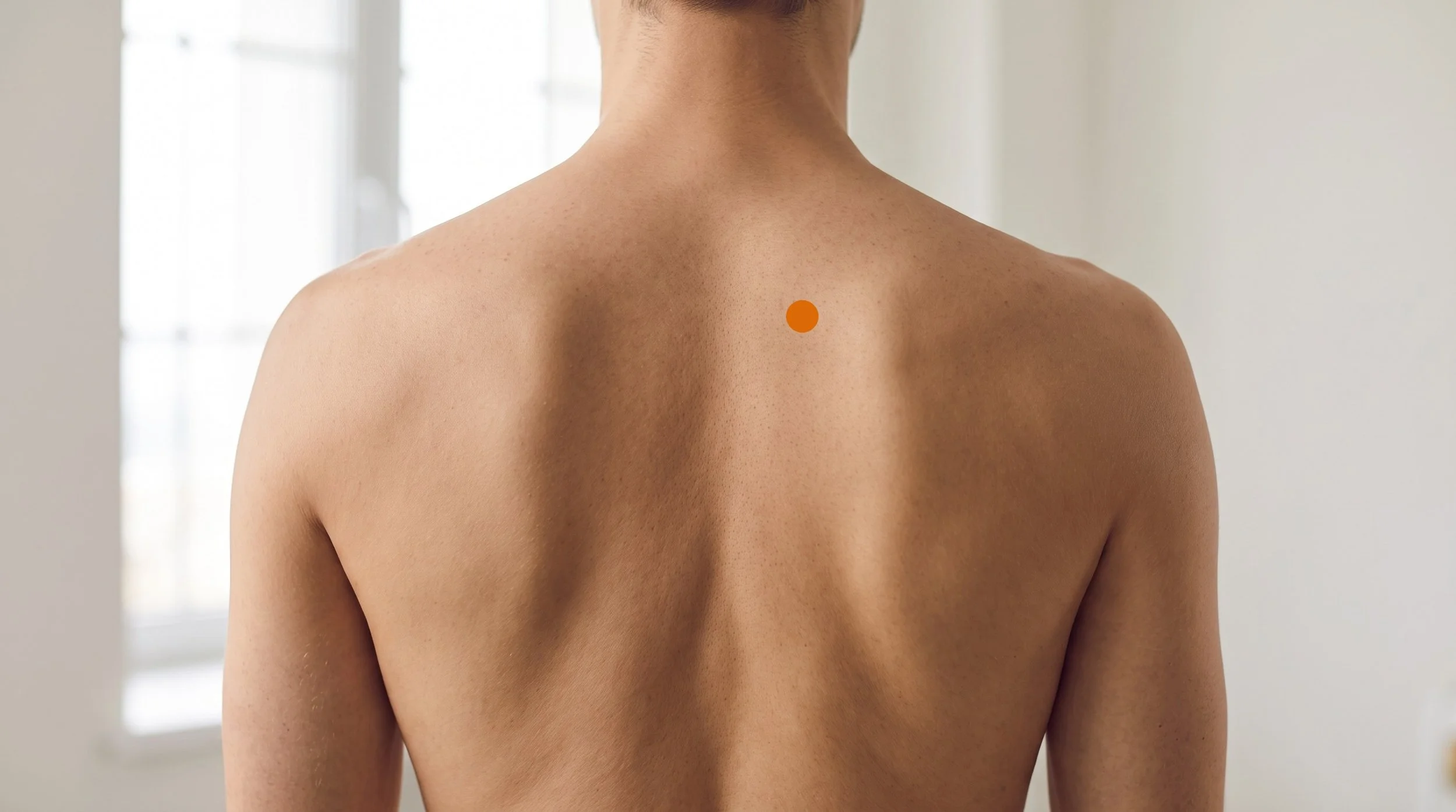
BL12 Acupuncture Point (Fengmen)
The Wind Gate at the Second Thoracic Vertebra: Anatomy, Segmental Mechanism, and Why This Upper Back Point Anchors Cold, Cough, and Interscapular Tension Treatment
BL12 (Fengmen, translated as Wind Gate or Wind Door) sits on the upper back about 1.5 cun to either side of the spine, level with the bottom edge of the second thoracic spinous process, right on the visible ridge of the paraspinal muscles that stands up when you draw your shoulder blades together. It's the twelfth point of the Bladder channel and is classically described as a meeting point of that channel with the Governing vessel, which is one reason older texts gave it such a prominent role in early stage colds and wind aversion patterns (Deadman et al., 2007).
For a modern clinic, BL12 matters for two overlapping reasons: it lands in the middle of the tissue that carries most desk related interscapular tension, and it sits at a spinal level whose autonomic and sensory wiring connects to the upper airway, which gives the old wind gate reputation a coherent neurophysiological reading. It also sits over the lung apex region, so needle angle and depth are not optional details here.
- BL12 is located 1.5 cun lateral to the lower border of the T2 spinous process, on the highest visible point of the paraspinal mass, and the needle passes through skin, superficial fascia, trapezius, rhomboid, and the erector spinae column before reaching the deeper transversospinalis layer (Deadman et al., 2007).
- Traditional sources classify it as a meeting point of the Bladder channel with the Governing vessel and attribute to it actions of releasing the exterior, firming the defensive layer, and freeing the descent of Lung qi, which we translate here as segmental influence over a spinal level tied to thoracic sympathetic outflow and paraspinal muscle tone (Deadman et al., 2007).
- The point sits in T2 and T3 dorsal ramus territory, and this segment shares dorsal horn real estate with visceral afferents from the upper airway and thoracic viscera, which is the plausible route by which a back point affects nasal stuffiness and cough rather than any literal flow of energy (Zhao, 2008).
- The research picture is indirect but reasonable: acupuncture protocols that include upper thoracic and nasal points have shown modest symptom and quality of life improvements in allergic rhinitis, though the pooled results were not confirmed on trial sequential analysis (He et al., 2022), and acupuncture for chronic neck pain has shown relief that persisted at three and six months in an adjunct role (Fang et al., 2024).
- Clinically, BL12 is almost always used inside a group rather than alone: paired with BL13 for cough that follows a cold, with GB20 at the first scratchy throat, and with trigger point needling of rhomboids and upper trapezius when the presentation is mechanical interscapular tension (Simons et al., 1999).
- De qi at BL12 is usually a heavy, dull, spreading ache between the shoulder blades that can travel toward the medial scapular border or up into the neck. Sharp or electric sensations are a signal to withdraw and redirect, and the needle should always be angled toward the spine or laid nearly flat, never driven perpendicular or angled outward (Deadman et al., 2007; McCutcheon & Yelland, 2011).
Stiff Upper Back and a Cold That Won't Clear?
At Morningside Acupuncture we use BL12 as part of a broader upper back protocol, combining shallow oblique needling at the T2 paraspinal level with dry needling of the rhomboids, upper trapezius, and levator scapulae when those muscles test tender.
For patients who arrive with post cold cough, tight shoulders, and a head that feels congested, this region often does double duty. Every treatment starts with an exam so the plan matches what your tissue and history actually show. Schedule a visit and we'll build the point selection around your presentation.
Schedule NowAnatomy of BL12: Why the T2 Paraspinal Ridge Is Such an Important Location
Working from the surface inward at BL12, the needle meets thin skin, superficial fascia, then the middle fibers of trapezius, then rhomboid minor or the upper edge of rhomboid major, and finally the erector spinae column (longissimus and iliocostalis thoracis) with the deeper transversospinalis and multifidus fibers closest to the lamina.
Classical texts tell you to find the point on the visible highest point of the paraspinal muscles, which is a practical instruction, since that bulge is exactly where the erector mass is thickest at this level (Deadman et al., 2007). This is loaded tissue in modern life. Hours of forward reaching at a keyboard hold the scapulae protracted and keep the rhomboids and mid trapezius working at long, eccentric lengths, while the deeper segmental extensors work overtime to stop the upper thoracic spine from collapsing into flexion.
Palpable taut bands and referred interscapular ache from rhomboid and trapezius trigger points frequently sit within a fingerbreadth of the textbook BL12 location (Simons et al., 1999).
The nerve geography here is straightforward and it explains a lot. BL12 sits in the cutaneous and muscular distribution of the medial branches of the T2 and T3 dorsal rami, which supply the paraspinal muscles, the local facet joints, and the overlying skin.
Needling stimulates A delta and group III afferents in muscle and fascia, and those signals enter the dorsal horn at upper thoracic segments where they converge with afferent traffic from deep structures sharing the same segmental supply, a convergence that underlies why local paraspinal input can change how pain and irritation are perceived over a whole region (Zhao, 2008). Needle stimulation also recruits supraspinal descending inhibitory pathways, which is one of the better characterized contributors to acupuncture analgesia and helps explain effects that outlast the session itself (Zhao, 2008).
Add to that the upper thoracic sympathetic chain, which lies just anterior to the costovertebral region at these levels and sends postganglionic fibers to the head, neck, and airway, and you have a credible route by which a T2 back point influences nasal and bronchial vascular tone rather than pain alone.
Deep to the interspaces at this level lie the pleura and the apex of the lung, and this is the single most important fact about BL12. The classical needling conventions exist for that reason: oblique insertion angled toward the spine at roughly 0.5 to 1 cun, or a transverse-oblique insertion of 1 to 1.5 cun laid along the muscle, with perpendicular needling or oblique needling angled away from the spine explicitly flagged as carrying substantial pneumothorax risk (Deadman et al., 2007).
Reviews of needling in the thoracic region make the same point in modern language: the anatomy is unforgiving of casual angle and depth, and technique modification is what keeps the region safe (McCutcheon & Yelland, 2011). Vascular structures here are small (dorsal branches of the posterior intercostal vessels), so bleeding risk is minor compared with the pleural consideration. In large prospective safety data, acupuncture adverse effects were mostly minor, with serious events rare, but competence with regional anatomy is what keeps those numbers where they are (Witt et al., 2009).
Related Bladder Channel Related Back Shu PointsBL12 at a Glance: Classification, Location, and Clinical Use
| Category | Detail |
|---|---|
| Traditional Name | Fengmen (Wind Gate, also translated Wind Door) |
| Channel Classification | BL12, the twelfth point of the Bladder channel (foot taiyang), on the upper back at T2 (BL12, also written UB12; also called the Urinary Bladder channel) |
| Point Categories | Meeting point of the Bladder channel with the Governing vessel (Deadman et al., 2007). Not a five-shu point, not a back-shu point, and no hui-meeting or extraordinary vessel confluent role beyond the Governing vessel intersection. |
| Precise Location | On the upper back, 1.5 cun lateral to the lower border of the T2 spinous process, at the visible highest point of the paraspinal muscles |
| Tissue Stimulated | Skin and superficial fascia, middle trapezius, rhomboid minor and upper rhomboid major, erector spinae (longissimus and iliocostalis thoracis), deeper transversospinalis and multifidus; T2 and T3 dorsal ramus territory |
| Needle Depth / Direction | Oblique insertion angled toward the spine, 0.5 to 1 cun, or transverse-oblique insertion 1 to 1.5 cun. Perpendicular needling, and oblique needling angled away from the spine, carry a substantial pneumothorax risk and are avoided. |
| De Qi Sensation | Heavy, dull, spreading ache between the shoulder blades, often traveling toward the medial scapular border or up the neck; a warm or heavy sensation is common after cupping or moxibustion over the same area |
| Primary Clinical Uses | Traditionally used at the first signs of a cold with chills, stiff neck, and aversion to drafts; cough with copious clear nasal discharge; nasal congestion and sneezing; upper back and interscapular tension; and, in classical preventive practice, recurrent susceptibility to colds treated with moxibustion |
| Common Point Combinations |
|
Deadman, Al-Khafaji and Baker's textbook gathers a striking body of traditional attribution around this point.
In classical theory, BL12 was said to expel wind and release the exterior, to strengthen and firm the defensive layer, to restore the dispersing and descending movement of Lung qi, and to benefit the nose, and three reasons were offered for that reputation: the Bladder channel is taiyang, considered the most superficial of the six channels and therefore the first to be struck by an exterior pathogen; the point overlies the upper portion of the lung, an organ described as delicate and easily injured from outside; and it meets the Governing vessel, which was held to govern all the yang channels.
The classical indication lists cluster neatly into four groups: acute wind patterns with chills, fever, headache and neck rigidity; respiratory complaints such as cough, breathlessness, and chest and back pain with coughing; nasal complaints including congestion, copious discharge, sneezing and nosebleed; and local or systemic issues such as stiff neck, shoulder pain, hives and back sores.
Two Qing and Ming era sources quoted in that commentary, the Song of the Jade Dragon and the Golden Mirror of Medicine, both point at loose interstices, meaning a body surface that lets pathogens in easily, and recommend the point for people who catch cold repeatedly, which is why moxibustion here became a preventive practice rather than only an acute one. What's striking is the consistency: across many centuries and separate texts, the same T2 paraspinal spot keeps getting assigned to the interface between the outside world and the airway.
Why BL12 Is Used for Stuffy Noses and Sneezing, Not Just Upper Back Tension
Patients often find it odd that a point between the shoulder blades gets used for a runny nose. The segmental story makes it less odd. Sensory input from a needle at the T2 paraspinal level enters the spinal cord at upper thoracic segments, where somatic afferents from muscle and fascia converge with afferent traffic from deeper structures in the chest and upper airway that share overlapping segmental innervation.
Convergence of that kind is a well described feature of dorsal horn organization and is a large part of why stimulating one tissue can change the perceived state of another in the same neurological neighborhood (Zhao, 2008). On top of that, the upper thoracic segments are the origin of sympathetic outflow that eventually reaches the head and neck, including the vascular beds of the nasal mucosa. Nasal congestion is largely a vascular event, so a point that may nudge sympathetic tone at the segment of origin has a plausible route of action that has nothing to do with energy moving along a line.
The second mechanism is the general one that applies to most needling: repeated stimulation recruits descending inhibitory systems from the periaqueductal gray and rostral ventromedial medulla, and involves endogenous opioid and monoaminergic signaling, which is the best supported explanation for why acupuncture analgesia builds over a course of treatment instead of appearing and vanishing with each needle (Zhao, 2008).
Clinically that matters for the interscapular ache that brings most people to this region in the first place, and the individual patient data meta-analysis in chronic pain found effects that were modest but persistent and not fully explained by placebo response (Vickers et al., 2018).
There's also an emerging autonomic and immune angle that deserves careful, non overstated framing. Experimental work in animals has shown that electroacupuncture can dampen systemic inflammatory signaling through defined neural circuits involving vagal and adrenal pathways, which establishes that needling can influence immune activity through the nervous system (Torres-Rosas et al., 2014). That's a mechanism in rodents under laboratory conditions, not evidence that BL12 prevents human colds.
It does, however, suggest that the classical framing of this point as reinforcing the body's outer defenses isn't an unreasonable place to look, and it's a good reason to keep the language here at may and might rather than does.
What the Research Shows for BL12
Almost no trial has tested BL12 on its own, which is true of nearly every classical point. Reviews evaluate whole protocols that include several points chosen by pattern, so the honest framing is that BL12 is a common ingredient in upper airway and upper back protocols whose overall results are modest and mixed. The evidence below should be read that way: it tells you something about the treatment approaches this point belongs to, not about the point in isolation.
Where mechanistic findings are cited, they come from laboratory work and describe how needling can act, not what it reliably achieves for a given complaint.
| Study | Type | Focus | Key Finding |
|---|---|---|---|
| He et al., 2022 | Systematic review and meta-analysis (30 RCTs, 4,413 participants) | Acupuncture protocols for allergic rhinitis, including upper back and nasal point groupings | Nasal symptom and quality of life scores improved compared with no treatment and with sham, but trial sequential analysis did not confirm the robustness of those pooled results. |
| Fang et al., 2024 | Systematic review and meta-analysis (18 RCTs) | Durability of acupuncture effects in chronic neck pain | Acupuncture used as an adjunct was associated with pain relief that persisted at three and six months after treatment ended, with heterogeneity across trials. |
| Vickers et al., 2018 | Individual patient data meta-analysis | Acupuncture for chronic musculoskeletal, headache and osteoarthritis pain | Effects were modest but statistically superior to both sham and no-acupuncture controls, and persisted over roughly a year with only a small decline. |
| Zhao, 2008 | Narrative review of neurophysiology | Neural mechanisms underlying acupuncture analgesia | Analgesic effects are attributed to afferent stimulation, segmental dorsal horn processing, and descending inhibitory control involving opioid and monoaminergic systems. |
| Torres-Rosas et al., 2014 | Experimental animal study | Neural control of systemic inflammation by electroacupuncture | Needle stimulation modulated inflammatory signaling through vagal and adrenal dopaminergic pathways in mice, establishing a neural route for immune effects that has not been shown to translate directly to human respiratory infection. |
| Witt et al., 2009 | Prospective observational safety study (229,230 patients) | Adverse effects of acupuncture in routine care | About 8.6 percent of patients reported at least one adverse effect, most commonly minor bleeding or bruising, with serious events rare. |
| McCutcheon & Yelland, 2011 | Narrative safety review | Iatrogenic pneumothorax with acupuncture and dry needling in the thoracic region | Pneumothorax is uncommon but is the most consequential regional risk, and the authors emphasize anatomical knowledge and technique modification as the main safeguards. |
Seasonal Congestion, Sneezing, and Upper Back Tightness?
BL12 is traditionally the first point reached for at the earliest signs of a cold, and modern clinics still use the T2 paraspinal region for patients whose sinus symptoms travel with neck and upper back tension. We combine it with LI20, LI4, and LU7 in rhinitis focused sessions and add cupping over the upper back when it's appropriate. Our licensed acupuncturists needle this area conservatively, with angle and depth chosen for safety. Book an appointment and we'll map out a seasonal plan.
Schedule NowBL12 in the Context of Trigger Point Work
At Morningside, BL12 rarely gets treated as an isolated classical point. When a patient presents with burning interscapular tension, we palpate the region first and usually find taut bands in rhomboid minor and major, the middle and upper fibers of trapezius, and often levator scapulae and the thoracic iliocostalis a little further lateral.
Rhomboid trigger points refer a superficial ache along the medial scapular border, upper trapezius refers up the side of the neck toward the temple, and levator scapulae produces the classic stiff neck that won't turn, so identifying which tissue reproduces the patient's complaint matters more than reaching a coordinate on a chart (Simons et al., 1999). Because BL12 sits directly over rhomboid and mid trapezius fibers, the classical point and the myofascial target frequently coincide, and one shallow oblique insertion can address both frames of reference at once.
The technique constraints don't change when we call it dry needling instead of acupuncture. Both use an acupuncture needle, and both are subject to the same anatomy: at T2 the pleura and lung apex sit deep to the interspaces, so needles are angled medially toward the lamina or laid nearly flat along the muscle, and are never driven perpendicular or angled laterally (Deadman et al., 2007; McCutcheon & Yelland, 2011).
We commonly follow needling of this region with cupping or gentle soft tissue work across the upper back, then add scapular retraction and thoracic extension exercises, since tissue that keeps getting reloaded in a protracted posture will keep producing the same taut bands. For patients whose upper back tension travels with neck pain, we treat the two regions together rather than chasing one at a time.
BL12 Upper Back and Sinus Treatment at NYC's Highest-Rated Acupuncture Clinic
Morningside Acupuncture is the highest-rated acupuncture and dry needling clinic in New York City with over 500 five-star Google reviews, and our approach blends classical point selection with orthopedic assessment and myofascial trigger point work. BL12 sits in an anatomically sensitive zone, so it should be needled by a clinician who knows the local anatomy cold and adjusts angle for body type. We'll explain what we're doing and why before a single needle goes in. Schedule your first session and see how the upper back responds.
Schedule NowFrequently Asked Questions
What does BL12 feel like when needled?
Most people describe a heavy, dull, slightly spreading ache between the shoulder blades that may travel toward the inner edge of the scapula or up into the neck. That sensation is de qi, and it usually settles into a warm, released feeling within a minute or two. Because BL12 sits over muscle that's often chronically loaded, an initial twitch or a brief cramp-like grab is common when a taut band is engaged. What shouldn't happen is a sharp, electric, or breath-catching sensation, and any of those means the practitioner should withdraw and redirect immediately.
Why treat a point on the upper back for a runny nose or a cough?
Two reasons, one traditional and one physiological. Traditionally, BL12 was called the Wind Gate because exterior wind was said to enter the body here, making it the first point reached for at the earliest signs of a cold (Deadman et al., 2007). Physiologically, the point sits at a spinal level whose afferent input converges in the dorsal horn with signals from thoracic and upper airway structures, and whose sympathetic outflow eventually reaches the vascular beds of the nose and neck (Zhao, 2008). Nasal congestion is largely a vascular event, so influencing tone at the segment of origin is a plausible route. That said, protocols including this region have shown only modest and inconsistent effects for nasal symptoms in review (He et al., 2022), so it's best positioned as one part of a plan rather than a standalone answer.
Can I press BL12 myself between sessions?
Yes, and acupressure carries none of the pneumothorax concern that needling does, since you're not penetrating tissue. The trouble is reach: BL12 sits between the shoulder blades where your own hands can't get useful leverage. The practical approach is a tennis ball or lacrosse ball against a wall. Stand with the ball between the wall and the muscle ridge just beside your spine at the level of the top of your shoulder blades, lean back with moderate pressure, and hold on a tender spot for 30 to 60 seconds while you breathe slowly. Do two or three spots per side, once or twice a day. If someone can help you, steady thumb pressure on the muscle ridge for 30 to 60 seconds per side works equally well. Pressure should register as a satisfying ache, not a sharp pain, and you should stay on the muscle ridge rather than pressing directly on the bony spine.
Is BL12 safe to needle?
It's safe in trained hands and genuinely risky in untrained ones. The pleura and the apex of the lung lie deep to the interspaces at T2, which is why classical texts and modern safety reviews agree that the needle must be angled toward the spine or laid nearly flat, at conservative depth, and never inserted perpendicular or angled away from the midline (Deadman et al., 2007; McCutcheon & Yelland, 2011). Large prospective data show that acupuncture adverse effects overall are mostly minor, such as small bruises or brief soreness, with serious events rare (Witt et al., 2009). Depth judgment also has to account for body type, since a thin patient has far less tissue between skin and pleura. Tell your practitioner if you have a lung condition, a history of pneumothorax, if you're on anticoagulants, or if you have any implanted device in the region. And if you ever develop sudden chest pain or shortness of breath after needling in this area, seek medical care right away.
Where exactly is BL12 located?
Find the bony bump at the base of your neck that sticks out most when you drop your chin, which is usually C7. Count down two spinous processes to T2. BL12 is 1.5 cun lateral to the lower border of that T2 spinous process, on both sides. One cun is measured proportionally on the individual, but a useful reference on the back is that the distance from the midline to the medial border of the scapula is roughly 3 cun, so BL12 sits about halfway between the spine and the scapular edge. The classical location note is more practical than counting: look for the visible highest point of the paraspinal muscle ridge at that level, which is exactly where the point sits (Deadman et al., 2007). It's directly above BL13, the Lung back-shu point at T3, and the two are frequently needled together.
References
- Deadman, P., Al-Khafaji, M., & Baker, K. (2009). A manual of acupuncture. Journal of Chinese Medicine Publications.
- Cunningham, P. M. (2000). Acupuncture points: A practical guide to classical and modern usage. Odyssey Press.
- Simons, D. G., Travell, J. G., & Simons, L. S. (1999). Travell & Simons' myofascial pain and dysfunction: The trigger point manual, Vol. 1: Upper half of body (2nd ed.). Williams & Wilkins.
- He, M., Qin, W., Qin, Z., & Zhao, C. (2022). Acupuncture for allergic rhinitis: A systematic review and meta-analysis. European Journal of Medical Research, 27(1), 58. https://doi.org/10.1186/s40001-022-00682-3
- Fang, J., Shi, H., Wang, W., Chen, H., Yang, M., Gao, S., Yao, H., Zhu, L., Yan, Y., & Liu, Z. (2024). Durable effect of acupuncture for chronic neck pain: A systematic review and meta-analysis. Current Pain and Headache Reports, 28(9), 957-969. https://doi.org/10.1007/s11916-024-01267-x
- Vickers, A. J., Vertosick, E. A., Lewith, G., MacPherson, H., Foster, N. E., Sherman, K. J., Irnich, D., Witt, C. M., & Linde, K. (2018). Acupuncture for chronic pain: Update of an individual patient data meta-analysis. Journal of Pain, 19(5), 455-474. https://doi.org/10.1016/j.jpain.2017.11.005
- Zhao, Z. Q. (2008). Neural mechanism underlying acupuncture analgesia. Progress in Neurobiology, 85(4), 355-375. https://doi.org/10.1016/j.pneurobio.2008.05.004
- Torres-Rosas, R., Yehia, G., Peña, G., Mishra, P., del Rocio Thompson-Bonilla, M., Moreno-Eutimio, M. A., Arriaga-Pizano, L. A., Isibasi, A., & Ulloa, L. (2014). Dopamine mediates vagal modulation of the immune system by electroacupuncture. Nature Medicine, 20(3), 291-295. https://doi.org/10.1038/nm.3479
- Witt, C. M., Pach, D., Brinkhaus, B., Wruck, K., Tag, B., Mank, S., & Willich, S. N. (2009). Safety of acupuncture: Results of a prospective observational study with 229,230 patients and introduction of a medical information and consent form. Forschende Komplementärmedizin, 16(2), 91-97. https://doi.org/10.1159/000209315
- McCutcheon, L., & Yelland, M. (2011). Iatrogenic pneumothorax: Safety concerns when using acupuncture or dry needling in the thoracic region. Physical Therapy Reviews, 16(2), 126-132. https://doi.org/10.1179/1743288X11Y.0000000012
Disclaimer: This web site is intended for educational and informational purposes only. Reading this website does not constitute providing medical advice or any professional services. This information should not be used for diagnosing or treating any health issue or disease. Those seeking medical advice should consult with a licensed physician. Seek the advice of a medical doctor or other qualified health professional for any medical condition. If you think you have a medical emergency, call 911 or go to the emergency room. No acupuncturist-patient relationship is created by reading this website or using the information. Morningside Acupuncture PLLC and its employees and contributors do not make any express or implied representations with respect to the information on this site or its use. For any legal interpretation of scope of practice in your state, consult a licensed attorney or regulatory authority.
Read more from our blog



