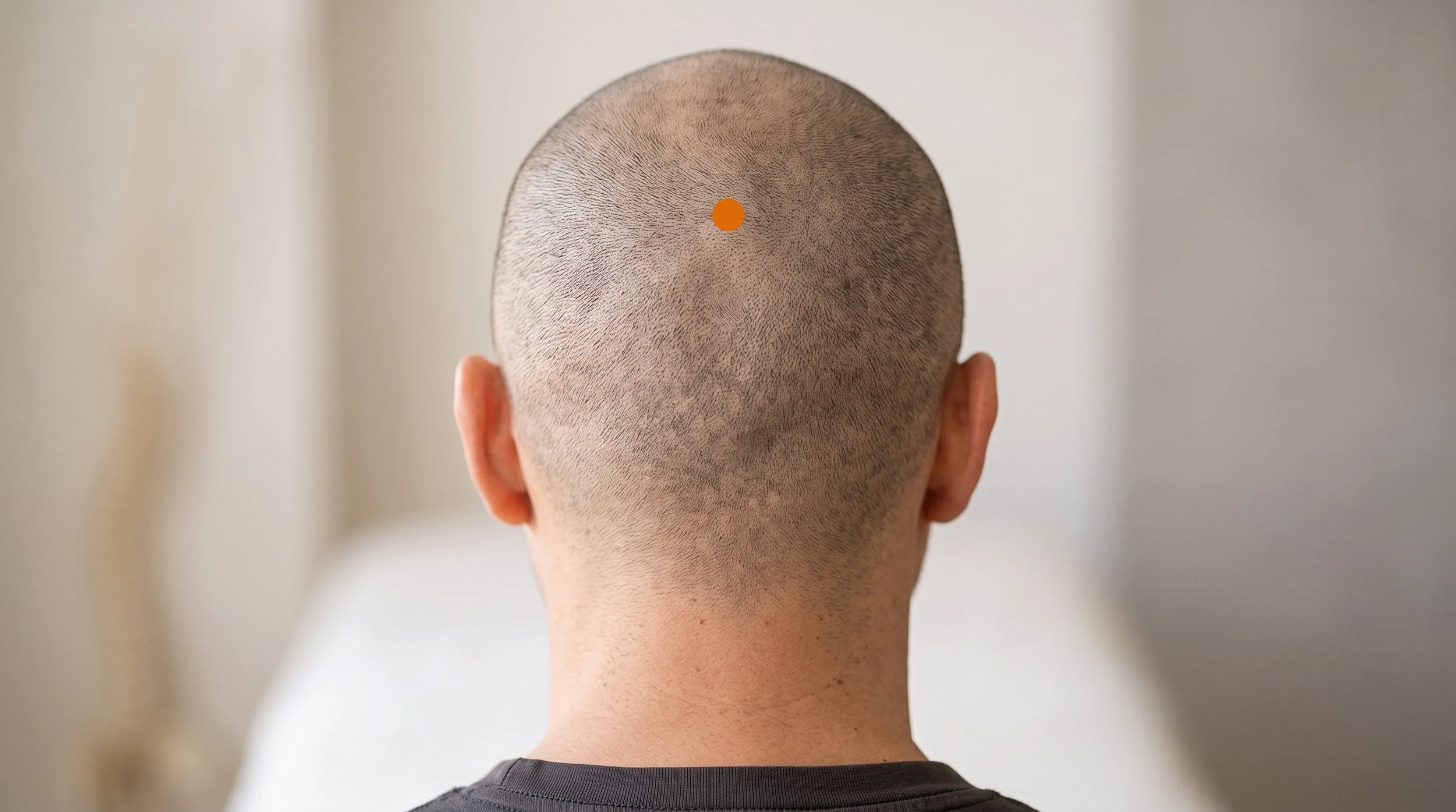
DU19 Acupuncture Point (Houding)
Behind the Crown of the Head: Anatomy, Mechanism, and Why This Midline Governing Vessel Point Is Used for Vertex Headache, Neck Stiffness, and Restless Sleep
DU19 (Houding, often translated as Behind the Crown or Posterior Vertex), also written GV19, sits on the midline of the skull just behind the highest point of the head, one finger-width and a half behind DU20 and the same distance above DU18. It's a scalp point, which means the needle never goes deep: it slides flat between skin and the tough tendinous sheet that caps the skull.
Clinically, the GV19 acupuncture point earns its place in headache and neck protocols because it lies in territory supplied by upper cervical nerves that also carry the referral patterns from tight suboccipital muscles, so a point at the crown can be relevant to pain that starts at the base of the skull.
Classical texts add a second theme that modern practitioners still use, describing Houding as a point for restlessness and disturbed sleep as well as for pain of the head and neck.
- Location and layers: governing vessel 19 lies on the midline 1.5 cun behind DU20 and 1.5 cun above DU18, or at the junction of the upper quarter and lower three quarters of the line from DU16 to DU20; the needle stays in skin, subcutaneous tissue, and the galea aponeurotica over the parietal bones (Deadman et al., 2009).
- Traditional attributions, translated: classical sources credit Houding with dispelling wind and easing pain and with settling the mind, which in modern terms maps onto its use for headache patterns aggravated by cold and wind exposure, and for the agitated, poor-sleep presentations that often accompany chronic head pain (Deadman et al., 2009).
- Mechanism: the scalp here sits in greater occipital nerve (C2) territory, and upper cervical afferents converge with trigeminal input in the trigeminocervical complex, one reason neck-driven pain is often felt at the vertex; needling recruits segmental and descending pain-modulating pathways rather than moving anything through the tissue (Zhao, 2008).
- Research picture: no trial isolates DU 19 head needling by itself, but Cochrane reviews support acupuncture as a preventive option for tension-type headache and episodic migraine, and individual patient data analyses show effects that persist beyond the treatment course for chronic pain (Linde et al., 2016a; Linde et al., 2016b; Vickers et al., 2018).
- Clinical framing: at Morningside we use DU19 as a supporting midline point in headache and neck protocols, usually alongside suboccipital and upper trapezius work rather than as a stand-alone treatment, since scalp points may reduce symptom intensity while the muscular drivers are addressed directly (Simons et al., 1999).
- De qi at a scalp point is subtle: most people report a dull spreading pressure, a slight tugging along the scalp, or a warm heaviness across the top of the head, not the deep aching grab typical of limb points.
Headaches That Sit at the Top of Your Head?
Vertex and one-sided headaches often track back to tension at the base of the skull, and treating only the painful spot tends to disappoint. Our licensed acupuncturists combine midline scalp points like DU19 with careful assessment of the upper cervical spine, jaw, and shoulder girdle. Treatment plans usually pair needling with posture, sleep, and workload adjustments so relief has a chance to hold. Schedule a visit and we'll map your headache pattern before a single needle goes in.
Schedule NowAnatomy of DU19: Why the Midline Just Behind the Crown Is Such an Important Location
The scalp at DU19 is built in layers, and each one matters when a needle goes in. Beneath thin, hair-bearing skin sits a dense subcutaneous layer packed with small arteries, veins, and sensory nerves, and below that lies the galea aponeurotica, the tough tendinous sheet that connects the frontal and occipital bellies of the occipitofrontalis muscle. Under the galea is a loose areolar plane, then periosteum, then the parietal bones themselves.
Because the galea is continuous from the eyebrows to the occiput, sustained pulling from the neck and the brow, whether from jaw clenching, screen posture, or chronically tight suboccipital muscles, is transmitted across the top of the head. That's why patients so often describe a band-like tightness or a hat-too-small sensation right where the Houding point location falls.
The nerve geography explains the clinical reach of this point. The scalp behind the vertex is served largely by the greater occipital nerve, a branch of the C2 dorsal ramus that pierces the upper neck muscles and fascia and travels forward over the occiput toward the crown, with contributions from the lesser occipital nerve laterally. Upper cervical afferents (C1 to C3) and trigeminal afferents converge on shared second-order neurons in the trigeminocervical complex, so irritation arising in the suboccipital region can be perceived in the vertex, temple, or behind the eye.
Needling into that same receptive territory generates afferent traffic that engages segmental inhibition in the dorsal horn and recruits descending modulatory pathways from the brainstem, along with local release of vasoactive and analgesic mediators (Zhao, 2008). None of this requires energy moving through the tissue; it's ordinary neurophysiology applied at an unusually accessible site.
Safety at DU19 is largely a matter of respecting the skull and the vascular scalp. The superior sagittal sinus runs deep to the midline, but it's shielded by bone in a normal adult skull, which is why standard texts specify transverse insertion of 0.5 to 1 cun along the scalp rather than any perpendicular technique (Deadman et al., 2009). Some modern texts describe an even shallower subcutaneous insertion of about 0.3 to 0.5 cun, and moxibustion is traditionally considered applicable at this point (Cheng, 1999).
The needle is typically angled toward DU20 or back toward DU18 depending on the symptom picture. Practical cautions include skull defects, craniotomy hardware, unfused fontanelles in infants, scalp lesions or infection, and the fact that the scalp bleeds and bruises readily, so brief compression after needle removal is routine.
Related Best Acupuncture Points For Headaches Related Acupuncture Tension Headache ResearchDU19 (GV19) at a Glance: Classification, Location, and Clinical Use
| Category | Detail |
|---|---|
| Traditional Name | Houding (Behind the Crown, also translated as Posterior Vertex) |
| Channel Classification | Governing Vessel (Du Mai), point 19, on the midline of the head behind the vertex (DU19, also written GV19) |
| Point Categories | No five-shu, luo-connecting, or hui-meeting designation and no classical crossing-point status is recorded for this point in the standard references; it's listed simply as a Governing vessel scalp point, with traditional actions given as eliminating wind and alleviating pain and calming the spirit (Deadman et al., 2009) |
| Precise Location | On the midline at the back of the head, 1.5 cun posterior to DU20 (Baihui) at the crown and 1.5 cun superior to DU18 (Qiangjian); alternatively located at the junction of the lower three quarters and upper quarter of the line joining DU16 (Fengfu) to DU20 |
| Tissue Stimulated | Scalp skin, vascular subcutaneous layer, and the galea aponeurotica over the parietal bones, within greater occipital nerve (C2) territory; commonly treated alongside suboccipital trigger points that refer pain toward the vertex |
| Needle Depth / Direction | Transverse (subcutaneous) insertion 0.5 to 1 cun along the scalp, angled forward toward DU20 or backward toward DU18; never perpendicular or deep, and moxibustion is traditionally permitted |
| De Qi Sensation | A dull spreading pressure, gentle tugging, or warm heaviness across the crown; scalp points typically feel milder and more diffuse than limb points, and a brief pinch on entry is normal |
| Primary Clinical Uses | Vertex and one-sided headache, stiffness and pain of the head and neck, dizziness aggravated by wind and cold in classical use, and restlessness or poor sleep in classical use |
| Common Point Combinations |
|
In Deadman, Al-Khafaji, and Baker's A Manual of Acupuncture, Houding is presented with two traditional actions: eliminating wind and alleviating pain, and calming the spirit. The classical indication list, presented here as traditional attribution rather than as diagnosis, groups into three themes: pain and stiffness of the head and neck, including one-sided headache and pain at the vertex; dizziness described as wind dizziness with aversion to wind and cold, along with painful obstruction accompanied by sweating; and disturbances of the mind such as insomnia, agitated behavior, and convulsive episodes.
Classical formula collections repeat those themes, combining DU19 with nearby vertex and lateral head points for dizziness and one-sided headache, and with distal points such as LI4, HT5, and GB36 for pain of the head, eyes, and neck. What's striking is the pairing itself: a single point at the crown credited both with easing head pain and with settling an agitated mind, an association modern clinicians recognize in patients whose headaches and sleep problems rise and fall together.
Why DU19 Is Used for Headaches That Start in the Neck but Are Felt at the Top of the Head
Patients are often puzzled when a headache that feels like it's sitting on the crown of the skull turns out to be driven by the neck. The anatomy explains it. Sensory fibers from the upper cervical spine and the suboccipital muscles enter the cord at C1 to C3, where they share second-order neurons with trigeminal fibers from the face and forehead. When those neurons become sensitized by sustained muscular strain, joint irritation, or poor sleep, the brain's read on where the trouble is coming from blurs, and pain gets referred upward and forward.
Because DU19 sits in the scalp territory of the greater occipital nerve, needling there delivers input into the same neural neighborhood that's generating the complaint.
Two mechanisms are usually described for what follows. Locally and segmentally, needle stimulation activates small-diameter afferents that reduce transmission at the dorsal horn level, while a broader effect involves brainstem structures that send descending inhibitory signals back down the cord, along with endogenous opioid and monoamine systems (Zhao, 2008). Practically, that means a point on the scalp can influence how strongly neck-derived signals reach conscious awareness, and it may make the accompanying muscle work more comfortable and more effective.
The calming side of this point has a plausible autonomic reading as well. Chronic head pain, guarded neck posture, and shallow sleep tend to travel together, and treatments that quiet sympathetic arousal often improve all three at once. Systematic review evidence suggests acupuncture may improve sleep quality in insomnia, though trials use multi-point protocols and the quality of the underlying studies varies (Kim et al., 2021). We frame DU19's classical calming role in that context: a supporting contribution to a plan, not a sedative in its own right.
What the Research Shows for DU19 (GV19)
One note on naming before the evidence: in the research literature this point is almost always listed as GV19, the WHO standard code, so GV19 is the term to search if you want to read the studies below in full.
It's worth being clear about what the evidence can and can't say. No randomized trial has tested DU19 in isolation, and it's unlikely one ever will, since headache trials evaluate multi-point protocols in which midline scalp points appear alongside distal and local selections. The reasonable conclusion is that DU19 is a component of protocols with reasonable supporting evidence for headache prevention and chronic pain, not that this individual point has been proven to do anything on its own. The studies below reflect that framing.
| Study | Type | Focus | Key Finding |
|---|---|---|---|
| Linde et al., 2016a | Cochrane systematic review | Acupuncture for prevention of episodic and chronic tension-type headache (12 trials, 2,349 adults) | Reviewers concluded that acupuncture may be a worthwhile option for frequent tension-type headache, with small effects over sham and evidence limited by trial quality. |
| Linde et al., 2016b | Cochrane systematic review | Acupuncture for prevention of episodic migraine, including comparisons with sham and prophylactic drugs | Moderate quality evidence suggested acupuncture reduced migraine frequency at least as much as prophylactic drug treatment, with fewer dropouts from adverse effects. |
| Vickers et al., 2018 | Individual patient data meta-analysis | Nearly 21,000 patients across chronic pain conditions including headache and neck pain | Acupuncture outperformed both sham and no-acupuncture controls, and treatment effects persisted over about a year with only modest decline. |
| Kim et al., 2021 | Systematic review and meta-analysis | Acupuncture for insomnia across 24 randomized trials | Pooled results favored acupuncture on sleep quality scores, though heterogeneity and risk of bias mean the findings should be read cautiously. |
| Wang et al., 2014 | Preclinical systematic review and meta-analysis | DU20-based scalp acupuncture in animal models of focal cerebral ischemia | Scalp needling at the adjacent vertex point was associated with improved outcomes in animal models, though study quality and publication bias limit how far this can be extended to people. |
| Zhao, 2008 | Narrative review of mechanisms | Neural pathways underlying acupuncture analgesia | Analgesic effects are attributed to afferent-driven segmental inhibition, descending control from brainstem centers, and endogenous opioid and monoamine signaling. |
Stiff Neck, Tight Scalp, and Poor Sleep Together?
Neck stiffness, scalp tension, and restless sleep frequently show up as one cluster rather than three separate problems. DU19 is one of the points we use when a patient's head pain comes with that wound-up, hard-to-settle quality, combined with dry needling of the suboccipitals and upper trapezius. Sessions are calm, precise, and built around what your exam actually shows. Book an appointment and let's address the whole pattern instead of chasing symptoms.
Schedule NowDU19 in the Context of Trigger Point Work
Acupuncture, defined by the tool rather than the tradition, covers hundreds of styles including dry needling, and DU19 sits at a useful intersection between them. The scalp over the crown is a referral destination rather than a muscle belly, and several cervical muscles project pain into exactly this zone. Trigger points in the suboccipital group are classically described as producing a deep, cap-like head pain, and the upper trapezius and semispinalis capitis send referral up the back of the head toward the vertex and temple (Simons et al., 1999).
When a patient points to the top of the head but the tenderness on exam is at the base of the skull, that mismatch is the clue that both layers need attention.
In practice we treat the driver and the destination together. A typical session might include dry needling of the suboccipitals, upper trapezius, and semispinalis capitis, then a shallow transverse needle at DU19 with DU20 and GB20 to work the scalp and segmental level. Manual therapy, breathing retraining, and simple cervical mobility work usually round out the plan, since needling changes symptoms faster than it changes habits. Patients whose headaches are clearly postural often notice that the crown tightness eases as neck rotation improves, which is a good sign the treatment is aimed at the right structures.
DU19 Headache and Neck Pain Treatment at NYC's Highest-Rated Acupuncture Clinic
Morningside Acupuncture is the highest-rated acupuncture and dry needling clinic in New York City with over 500 five-star Google reviews, and headache and neck pain are among the most common reasons patients come to us. We use DU19 as part of a structured plan that blends classical point selection with trigger point needling and clear, measurable goals. You'll get an explanation of what we're treating and why at every step. Schedule your first session and start working on the pattern behind your headaches.
Schedule NowFrequently Asked Questions
Is DU19 the same point as GV19?
Yes. DU19 and GV19 are two codes for the same point, Houding. DU comes from Du Mai, the Chinese name of the Governing Vessel, and it is the code used in most Chinese texts and many acupuncture schools. GV is the WHO standard abbreviation and the one you will see in most Western textbooks and research papers. You will also come across it written as Du 19, GV-19, or Governing Vessel 19. Whichever code is used, the location and the uses are the same.
What does DU19 feel like when needled?
Most people feel a quick pinch as the needle passes through the scalp, then a mild spreading pressure or a subtle tugging sensation across the top of the head. Because the insertion is transverse and shallow, the sensation is usually gentler and more diffuse than at points on the arms or legs, and it often fades into a warm heaviness within a minute or two. Some patients report a pleasant loosening across the scalp, similar to the relief of taking off a tight hat. Sharp or radiating pain isn't expected, and your acupuncturist should adjust the needle if it occurs.
Why treat a point at the crown when my pain starts at the base of my skull?
Because the scalp behind the vertex is supplied by the greater occipital nerve, which comes from the C2 nerve root in the upper neck, DU19 sits in the same neural territory that generates many neck-driven headaches. Upper cervical and trigeminal fibers converge on shared neurons in the brainstem and upper cord, which is why suboccipital tension is so often felt at the top of the head or behind the eye. Needling the referral zone provides input into that shared circuitry and may reduce how loudly the signal registers (Zhao, 2008). That said, we rarely treat DU19 alone: we usually pair it with direct work on the neck muscles and joints that are driving the pattern.
Can I press DU19 myself between sessions?
Yes, and it's easy to find. Locate the highest point of your head roughly on a line between the tops of your ears, then slide back about two finger-widths along the midline; the slight tender or tight spot you find there is the region of DU19. Use a fingertip or thumb pad and apply steady, moderate pressure with small circular movements for 30 to 60 seconds, breathing slowly, then rest and repeat two or three times. Two or three sessions a day is plenty during a headache-prone stretch. Combine it with gentle pressure at the base of the skull for a minute or so on each side, and stop if pressure sharpens your headache, makes you dizzy, or feels painful rather than firmly tender. Acupressure is a reasonable self-care adjunct, not a substitute for evaluation of new, severe, or changing headaches.
Is DU19 safe to needle?
In trained hands, yes. The technique is a shallow transverse insertion of roughly 0.5 to 1 cun along the scalp, which keeps the needle in skin and the galea and well away from anything deeper (Deadman et al., 2009). The main practical issues are that the scalp is vascular, so small bruises or a drop of bleeding after removal are common and easily managed with brief pressure. Practitioners avoid or modify the point over skull defects, surgical hardware, unfused fontanelles in infants, and any area of scalp infection or skin breakdown, and they take extra care with patients on anticoagulants. Tell your acupuncturist about head surgery, head injury, or bleeding disorders before scalp points are used.
Where exactly is DU19 located?
DU19 lies on the midline of the head, 1.5 cun behind DU20 at the crown and 1.5 cun above DU18. A second classical method places it at the junction of the lower three quarters and the upper quarter of the line running from DU16, in the hollow below the external occipital protuberance, up to DU20 (Deadman et al., 2009). In plain terms, find the top of the head near the level of the ear apexes, then move back about two finger-widths along the center line. The bone is directly beneath, so the point is confirmed by feel and landmark measurement rather than by depth.
References
- Deadman, P., Al-Khafaji, M., & Baker, K. (2009). A manual of acupuncture. Journal of Chinese Medicine Publications.
- Cheng, X. (Ed.). (1999). Chinese acupuncture and moxibustion (Rev. ed.). Foreign Languages Press.
- Simons, D. G., Travell, J. G., & Simons, L. S. (1999). Travell & Simons' myofascial pain and dysfunction: The trigger point manual, Vol. 1: Upper half of body (2nd ed.). Williams & Wilkins.
- Linde, K., Allais, G., Brinkhaus, B., Fei, Y., Mehring, M., Shin, B.-C., Vickers, A., & White, A. R. (2016a). Acupuncture for the prevention of tension-type headache. Cochrane Database of Systematic Reviews, 2016(4), CD007587. https://doi.org/10.1002/14651858.CD007587.pub2
- Linde, K., Allais, G., Brinkhaus, B., Fei, Y., Mehring, M., Vertosick, E. A., Vickers, A., & White, A. R. (2016b). Acupuncture for the prevention of episodic migraine. Cochrane Database of Systematic Reviews, 2016(6), CD001218. https://doi.org/10.1002/14651858.CD001218.pub3
- Vickers, A. J., Vertosick, E. A., Lewith, G., MacPherson, H., Foster, N. E., Sherman, K. J., Irnich, D., Witt, C. M., & Linde, K. (2018). Acupuncture for chronic pain: Update of an individual patient data meta-analysis. Journal of Pain, 19(5), 455-474. https://doi.org/10.1016/j.jpain.2017.11.005
- Kim, S.-A., Lee, S.-H., Kim, J.-H., van den Noort, M., Bosch, P., Won, T., Yeo, S., & Lim, S. (2021). Efficacy of acupuncture for insomnia: A systematic review and meta-analysis. American Journal of Chinese Medicine, 49(5), 1135-1150. https://doi.org/10.1142/S0192415X21500543
- Wang, W.-W., Xie, C.-L., Lu, L., & Zheng, G.-Q. (2014). A systematic review and meta-analysis of Baihui (GV20)-based scalp acupuncture in experimental ischemic stroke. Scientific Reports, 4, 3981. https://doi.org/10.1038/srep03981
- Zhao, Z. Q. (2008). Neural mechanism underlying acupuncture analgesia. Progress in Neurobiology, 85(4), 355-375. https://doi.org/10.1016/j.pneurobio.2008.05.004
Disclaimer: This web site is intended for educational and informational purposes only. Reading this website does not constitute providing medical advice or any professional services. This information should not be used for diagnosing or treating any health issue or disease. Those seeking medical advice should consult with a licensed physician. Seek the advice of a medical doctor or other qualified health professional for any medical condition. If you think you have a medical emergency, call 911 or go to the emergency room. No acupuncturist-patient relationship is created by reading this website or using the information. Morningside Acupuncture PLLC and its employees and contributors do not make any express or implied representations with respect to the information on this site or its use. For any legal interpretation of scope of practice in your state, consult a licensed attorney or regulatory authority.
Read more from our blog



