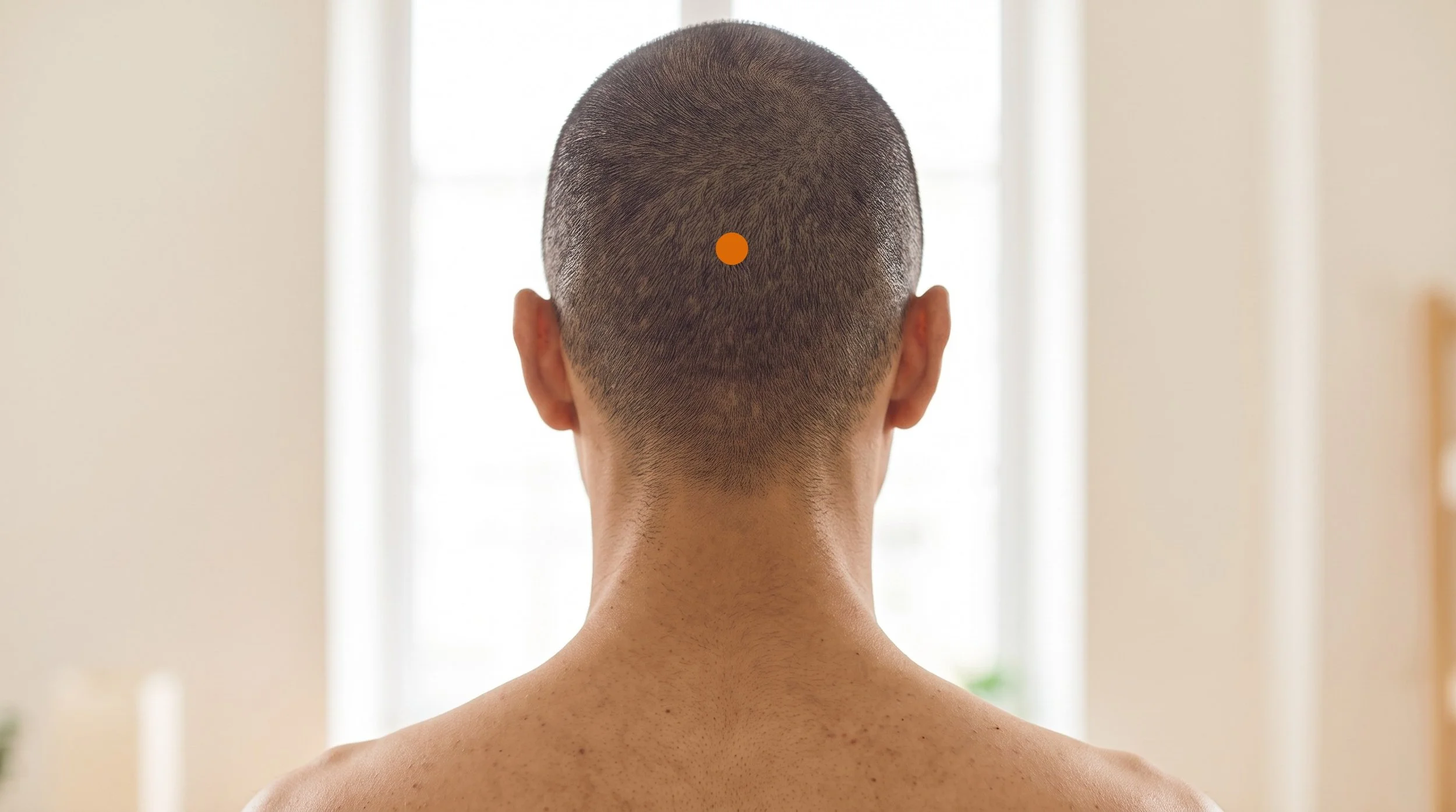
DU18 Acupuncture Point (Qiangjian)
Unyielding Space Between the Occiput and the Crown: Anatomy, Mechanism, and Why This Midline Scalp Point Was Reserved for Headaches That Would Not Let Go
DU18 (Qiangjian), also written GV18, often translated as Unyielding Space, sits on the midline at the back of the head, 1.5 cun above DU17 and about halfway between DU16 at the base of the skull and DU20 at the crown. If you run a finger up the center of the back of your head from the bony bump of the occiput toward the top, DU18 falls in that stretch of scalp where the occipital bone meets the two parietal bones.
Modern practice tends to reach for busier neighbors, but the classical record treats this GV18 acupuncture point as a specialist location: the place chosen when head pain was described as stabbing, fixed, and hard to tolerate, often with a stiff neck and a restless, agitated mind alongside it. Its clinical logic is straightforward once you look at the nerve map, because governing vessel 18 sits squarely in greater occipital nerve territory, an input stream that converges with trigeminal fibers on the same second-order neurons that generate most head pain.
- DU18 is a midline scalp point 1.5 cun above DU17, midway between DU16 and DU20, lying over the region where the occipital and parietal bones meet (Deadman et al., 2009). The tissue beneath the needle is skin, dense subcutaneous fascia, and the galea aponeurotica, not muscle belly, which is why insertion is transverse rather than perpendicular.
- Classical sources attribute to this point the traditional actions of settling interior wind, easing pain, and calming the spirit, and its lead indication was stabbing head pain too severe to endure (Deadman et al., 2009). Translated into modern terms, that reads as a point selected for high-intensity, sensitized head pain rather than for mild everyday aches.
- The mechanism story is a convergence story. Cervical afferents traveling in the greater occipital nerve and trigeminal afferents from the dura synapse on shared neurons in the trigeminocervical complex, which is why occipital input can amplify or modulate pain felt at the front of the head (Bartsch & Goadsby, 2002).
- Needling generates A-delta and C fiber input that recruits segmental inhibition and descending pain control through opioid and monoaminergic pathways, the best-characterized account of acupuncture analgesia (Zhao, 2008). Scalp needling may also shift autonomic tone, since manual needling at the nearby vertex point DU20 lowered heart rate in a small crossover study (Litscher et al., 2013).
- Research does not test DU18 alone. Cochrane reviews of acupuncture for tension-type headache and episodic migraine prevention support acupuncture as a reasonable option within multi-point protocols (Linde et al., 2016a; Linde et al., 2016b), and individual patient data pooling shows effects on chronic pain that persist beyond the treatment course (Vickers et al., 2018).
- De qi at DU18 is unlike a limb point. Most people report a dull spreading pressure, a mild tugging as the needle threads under the aponeurosis, and sometimes a warm heaviness across the back of the head, with sharpness being uncommon and brief.
Stuck With Headaches That Start at the Back of Your Head?
Occipital and vertex headaches rarely come from one structure, which is why we map the whole chain from the upper cervical joints to the scalp before we needle. DU18 is one of the midline scalp points we may use alongside GB20, BL10, and precise dry needling of the suboccipital and upper trapezius muscles. Our acupuncturists treat headache patterns week after week and adjust the plan based on how your pain behaves between visits. Schedule a visit and let's find out what is actually driving your head pain.
Schedule NowAnatomy of DU18: Why the Midline Above the Occiput Is Such an Important Location
DU18 sits on hair-bearing scalp over the back of the skull, close to the point where the occipital bone meets both parietal bones. Working from the surface inward, the needle passes through skin, a dense subcutaneous layer packed with fibrous septa, small vessels, and nerve endings, and then reaches the galea aponeurotica, the tough sheet that links the occipitalis muscle behind to the frontalis in front. Below the galea is a loose areolar plane, then pericranium and bone.
This is a tension-transmitting region rather than a contractile one: what loads it is sustained pull from the cervical extensors and occipitalis during long hours of forward head posture, screen work, jaw clenching, and poor sleep. Patients with frequent headaches often describe the scalp here as sore to brush or tender against a pillow, which reflects sensitization rather than local tissue damage.
The nerve geography is what makes this location clinically interesting. The greater occipital nerve, formed from the C2 dorsal ramus, pierces the fascia near the occiput and fans upward across the back of the scalp toward the vertex, so the tissue under DU18 receives cervical, not cranial, innervation. Experimental work shows that this cervical input and trigeminal input from the dura converge on the same nociceptive neurons in the upper cervical dorsal horn, and that stimulating the greater occipital nerve changes the excitability of those neurons to dural input (Bartsch & Goadsby, 2002).
That shared relay is the reason a point on the back of the head can plausibly influence pain felt behind the eye or across the temple. Needling in this territory recruits small-diameter afferents that engage segmental inhibition and descending control from the brainstem, with opioid and monoaminergic transmitters doing much of the work (Zhao, 2008).
The deeper structures are reassuring. Branches of the occipital arteries and veins run in the subcutaneous layer, so the most common minor event with scalp needling is a small bleed or a bruise, easily managed with brief pressure on withdrawal. The skull itself lies immediately beneath, which protects deeper structures provided the technique respects the tissue. Standard practice is transverse or subcutaneous insertion of roughly 0.5 to 1 cun, angled along the midline either toward or away from the crown, with the needle threaded in the plane above the bone rather than pushed at it (Deadman et al., 2009).
Sensible cautions apply: avoid needling over unclosed fontanelles in infants, over craniotomy sites, skull defects, or shunts, and keep clean technique on a hair-bearing surface.
Related Best Acupuncture Points For Headaches Related Governing VesselDU18 (GV18) at a Glance: Classification, Location, and Clinical Use
| Category | Detail |
|---|---|
| Traditional Name | Qiangjian (Unyielding Space), also rendered as Strong Space or Between Strength |
| Channel Classification | Governing vessel (Du mai), point 18, on the midline of the occipito-parietal scalp (DU18, also written GV18) |
| Point Categories | A regular point of the Governing vessel. The texts consulted list no five-shu status, no hui-meeting role, and no extraordinary vessel intersection for this point. Deadman's Manual of Acupuncture gives its traditional actions as pacifying wind and alleviating pain and calming the spirit, grouping it with its Governing vessel neighbors DU17 and DU19. |
| Precise Location | On the midline at the back of the head, 1.5 cun directly above DU17, midway between DU16 at the base of the occiput and DU20 at the crown |
| Tissue Stimulated | Scalp skin, subcutaneous fibrofatty layer, and the galea aponeurotica overlying the occipito-parietal skull, in greater occipital nerve territory; clinically paired with the cervical extensors described in Muscles That Cause Neck Pain |
| Needle Depth / Direction | Transverse (subcutaneous) insertion 0.5 to 1 cun along the midline, threaded above the bone; many texts use a shallower 0.3 to 0.5 cun slanted approach |
| De Qi Sensation | Dull spreading pressure, a tugging or grabbing feeling as the needle threads under the aponeurosis, and sometimes warmth or heaviness across the back of the head |
| Primary Clinical Uses | Severe stabbing headache in classical listings, dizziness with agitation and nausea, stiffness of the neck with difficulty turning the head, and insomnia with restlessness in classical listings |
| Common Point Combinations |
|
Deadman's Manual of Acupuncture makes an observation about DU18 that is easy to miss: a point modern practitioners treat as minor carried real weight in the older literature, judging by how often it turns up in classical formulas.
Traditionally it is credited, like its Governing vessel neighbors DU17 and DU19, with settling interior wind and quieting the spirit, and the indications recorded for it cluster into three groups: violent head pain, dizziness with agitation and vomiting of watery saliva, and neck stiffness with an inability to turn the head, alongside listings for insomnia, restless walking, seizure activity, and manic-depressive states. Above all else, though, the classical texts reached for it for stabbing head pain that could not be tolerated.
What is striking is the internal consistency of that picture: severe fixed head pain, a locked neck, nausea, and an agitated mind describe a recognizable clinical presentation, and the older writers grouped those features together at a single midline location long before anyone could explain why cervical and cranial pain pathways share a relay.
Why DU18 Is Used for Headaches That Feel Deep, Fixed, and Unbearable
The classical emphasis on stabbing, intolerable head pain makes more sense once you follow the wiring. The scalp at DU18 is supplied by branches of the greater occipital nerve, which arises from the second cervical nerve root rather than from the cranial nerves. Those cervical fibers and the trigeminal fibers that carry pain from the dura terminate on the same second-order neurons in the upper cervical dorsal horn, and stimulating the greater occipital nerve measurably changes how those neurons respond to dural input (Bartsch & Goadsby, 2002).
That is the neurological version of an old clinical observation: pressure or pain at the back of the head and pain behind the eye are not separate problems, they are two outputs of one relay.
Needling adds a second layer. Insertion and manipulation activate small-diameter afferents that trigger segmental inhibition at the dorsal horn and recruit descending inhibitory pathways from the midbrain and brainstem, with endogenous opioids, serotonin, and noradrenaline mediating much of the analgesic effect (Zhao, 2008). In a sensitized headache patient, that combination matters more than local tissue change, because the problem is usually an over-responsive relay rather than an injured scalp.
There may also be an autonomic component to scalp needling. In a small randomized crossover study, manual needling at the nearby vertex point DU20 produced a significant reduction in heart rate, consistent with a shift toward parasympathetic dominance (Litscher et al., 2013). The sample was tiny and the finding should be read as preliminary, but it aligns with what patients often report during a session with midline scalp points: a settling, drowsy quality that arrives before any change in pain. That subjective calming is probably the closest modern parallel to the traditional description of this point as one that quiets the spirit.
What the Research Shows for DU18 (GV18)
One note on naming before the evidence: in the research literature this point is almost always listed as GV18, the WHO standard code, so GV18 is the term to search if you want to read the studies below in full.
There is no clinical trial of DU18 on its own, and it would be misleading to suggest otherwise. What the literature offers is evidence for acupuncture protocols that include head, neck, and Governing vessel points among a handful of others, tested against sham needling, usual care, or drug prophylaxis. The reviews below tell us that acupuncture is a defensible option for recurrent headache and neck-related pain, with modest but durable effects and a favorable safety profile.
They do not tell us how much of that effect any single point contributes, so the honest framing is that DU18 is a reasonable component of a plan, chosen for its location in greater occipital nerve territory and for its classical track record, not a proven treatment in isolation.
| Study | Type | Focus | Key Finding |
|---|---|---|---|
| Linde et al., 2016a | Cochrane systematic review | Acupuncture for the prevention of tension-type headache, 12 trials and 2,349 adults | The review concluded that a course of at least six acupuncture sessions may be a worthwhile option for people with frequent tension-type headache, though the comparisons with sham needling showed only small differences. |
| Linde et al., 2016b | Cochrane systematic review | Acupuncture for the prevention of episodic migraine | At three months, headache frequency had at least halved in 57% of participants receiving acupuncture compared with 46% receiving prophylactic drugs, evidence the authors graded as moderate quality. |
| Vickers et al., 2018 | Individual patient data meta-analysis | Chronic pain conditions including headache and neck pain, roughly 21,000 patients | Acupuncture outperformed both sham and no-acupuncture controls, with effects that declined only modestly over about a year, suggesting benefit is not purely a placebo response. |
| Liu et al., 2024 | Meta-analysis of randomized trials | Acupuncture for cervicogenic headache, the pattern most relevant to a stiff neck with occipital pain | Pooled results favored acupuncture over comparison therapies for effectiveness, but the included trials were small and mostly of limited methodological quality, so the estimate should be treated cautiously. |
| Mousavi-Khatir et al., 2022 | Randomized controlled trial | Dry needling of cervical muscles added to physical therapy for cervicogenic headache | Headache intensity and neck disability improved more in the dry needling group than in sham and control groups, with differences maintained across follow-ups out to six months. |
| Litscher et al., 2013 | Randomized crossover study, healthy volunteers | Autonomic response to needling at the vertex point DU20 compared with PC6 | Manual needling at DU20 significantly lowered heart rate, a preliminary signal that midline scalp points may influence autonomic tone, limited by a sample of only 11 participants. |
| Zhao, 2008 | Mechanistic review | Neural mechanisms of acupuncture analgesia | Analgesic effects are attributed to activation of small-diameter afferents recruiting segmental and descending inhibitory systems mediated by opioid and monoaminergic transmitters. |
Neck Stiffness That Turns Into Head Pain by the Afternoon?
When rotation is restricted and the pain climbs from the base of the skull to the crown, treatment has to address both the joint and the muscle. We combine gentle upper cervical work with acupuncture at points including DU18, GB20, and BL10, plus dry needling of semispinalis capitis, splenius capitis, and the suboccipitals when trigger points are reproducing your symptoms. Most patients notice changes in range of motion within the first few sessions. Book an appointment and bring your worst-case day to the table.
Schedule NowDU18 in the Context of Trigger Point Work
DU18 does not sit on a muscle belly, so it is not itself a trigger point target. What it does sit on is the referral highway. Trigger points in semispinalis capitis, splenius capitis, the suboccipital group, upper trapezius, and sternocleidomastoid all refer pain into the back and top of the head, and several of those patterns wrap up over the occiput toward the vertex in a band that passes directly through this region (Simons et al., 1999). When a patient points to the midline above the occiput and calls it the epicenter of their headache, we usually find the generators lower down in the cervical extensors.
In practice we treat both ends of that chain. Dry needling addresses taut bands in the suboccipitals, semispinalis and splenius capitis, and upper trapezius, aiming to reduce the peripheral nociceptive drive feeding the trigeminocervical relay, while scalp points including DU18 and DU20 are needled transversely to work the sensitized surface territory itself. Trial evidence supports adding dry needling of cervical muscles to conventional care for cervicogenic headache, with benefits in headache intensity and neck disability sustained at follow-up (Mousavi-Khatir et al., 2022).
Since acupuncture is defined by the use of an acupuncture needle, these are not competing approaches, just different targets selected within one session.
DU18 Headache Treatment at NYC's Highest-Rated Acupuncture Clinic
Morningside Acupuncture is the highest-rated acupuncture and dry needling clinic in New York City with over 500 five-star Google reviews. We use the Qiangjian headache point as part of a considered plan that blends classical point selection with modern trigger point needling and orthopedic assessment. Every session is one-on-one, and we track headache frequency and intensity so you can see whether the plan is working. Schedule your appointment today and start with a real evaluation.
Schedule NowFrequently Asked Questions
Is DU18 the same point as GV18?
Yes. DU18 and GV18 are two codes for the same point, Qiangjian. DU comes from Du Mai, the Chinese name of the Governing Vessel, and it is the code used in most Chinese texts and many acupuncture schools. GV is the WHO standard abbreviation and the one you will see in most Western textbooks and research papers. You will also come across it written as Du 18, GV-18, or Governing Vessel 18. Whichever code is used, the location and the uses are the same.
What does DU18 feel like when needled?
Most people feel a brief pinch as the needle passes the scalp surface, then a dull, spreading pressure or a mild tugging as it threads horizontally under the tissue. Some describe warmth or a heavy, settled feeling across the back of the head, and a few notice a light drowsiness within a minute or two. Sharpness is uncommon and should fade quickly. Because the scalp is vascular, a small bruise is the most likely minor aftereffect, and brief pressure on withdrawal usually prevents it.
Why needle the back of the head when my pain is behind my eyes or in my temples?
Because the pathways share a destination. Cervical afferents from the greater occipital nerve and trigeminal afferents from the lining of the brain converge on the same neurons in the upper cervical dorsal horn, and experimental stimulation of the occipital nerve changes how those neurons respond to cranial input (Bartsch & Goadsby, 2002). Treating the occipital territory is therefore a way of reaching the relay that generates frontal and temporal head pain, not a roundabout choice. It also explains why so many headache patients have tender, restricted upper necks even when they only complain about the front of their head.
Can I press DU18 myself between sessions?
Yes, and it is easy to find. Sit or stand with your neck relaxed, run a finger up the midline from the bony bump at the base of your skull toward the crown, and stop roughly halfway. Use the pad of your middle finger to apply steady, moderate pressure straight into the scalp, or make small slow circles, for 30 to 60 seconds. Rest for 15 seconds and repeat two or three times, once or twice a day, or at the first hint of a headache building. Many people find it more useful when combined with a minute of pressure at the base of the skull just outside the midline and at LI4 in the web of the hand. Keep the pressure firm but comfortable, stop if it sharpens your headache, and treat it as a between-session tool rather than a substitute for evaluation.
Is DU18 safe to needle?
In trained hands it is a low-risk point. The skull lies directly beneath, and the standard transverse or subcutaneous technique keeps the needle in the scalp layer rather than directed at bone. The main considerations are bleeding or bruising from the small vessels in the subcutaneous tissue, and clean technique on a hair-bearing surface. This region is not needled in infants with an unclosed posterior fontanelle, and practitioners avoid needling over skull defects, craniotomy sites, or shunts. Tell your acupuncturist about blood thinners, recent head or neck surgery, or any implanted device before treatment.
Where exactly is DU18 located?
DU18 lies on the midline at the back of the head, 1.5 cun directly above DU17 and about midway between DU16 at the base of the occiput and DU20 at the crown (Deadman et al., 2009). In surface terms it overlies the region where the occipital bone meets the two parietal bones. A practical way to locate the DU 18 head position is to measure the midline distance between the depression below the external occipital protuberance and the vertex, then take the halfway mark.
References
- Deadman, P., Al-Khafaji, M., & Baker, K. (2009). A manual of acupuncture. Journal of Chinese Medicine Publications.
- Cunningham, P. M. (2000). Acupuncture points: A practical guide to classical and modern usage. Odyssey Press.
- Cheng, X. (Ed.). (1999). Chinese acupuncture and moxibustion (Rev. ed.). Foreign Languages Press.
- Simons, D. G., Travell, J. G., & Simons, L. S. (1999). Travell & Simons' myofascial pain and dysfunction: The trigger point manual, Vol. 1: Upper half of body (2nd ed.). Williams & Wilkins.
- Linde, K., Allais, G., Brinkhaus, B., Fei, Y., Mehring, M., Shin, B. C., Vickers, A., & White, A. R. (2016a). Acupuncture for the prevention of tension-type headache. Cochrane Database of Systematic Reviews, 2016(4), CD007587. https://doi.org/10.1002/14651858.CD007587.pub2
- Linde, K., Allais, G., Brinkhaus, B., Fei, Y., Mehring, M., Vertosick, E. A., Vickers, A., & White, A. R. (2016b). Acupuncture for the prevention of episodic migraine. Cochrane Database of Systematic Reviews, 2016(6), CD001218. https://doi.org/10.1002/14651858.CD001218.pub3
- Vickers, A. J., Vertosick, E. A., Lewith, G., MacPherson, H., Foster, N. E., Sherman, K. J., Irnich, D., Witt, C. M., & Linde, K. (2018). Acupuncture for chronic pain: Update of an individual patient data meta-analysis. Journal of Pain, 19(5), 455-474. https://doi.org/10.1016/j.jpain.2017.11.005
- Zhao, Z. Q. (2008). Neural mechanism underlying acupuncture analgesia. Progress in Neurobiology, 85(4), 355-375. https://doi.org/10.1016/j.pneurobio.2008.05.004
- Bartsch, T., & Goadsby, P. J. (2002). Stimulation of the greater occipital nerve induces increased central excitability of dural afferent input. Brain, 125(7), 1496-1509. https://doi.org/10.1093/brain/awf166
- Liu, Z., Gao, X., Zhang, X., & Qu, Y. (2024). Meta-analysis of acupuncture treatment for cervicogenic headache. World Neurosurgery, 189, 166-173. https://doi.org/10.1016/j.wneu.2024.05.084
- Mousavi-Khatir, S. R., Fernández-de-las-Peñas, C., Saadat, P., Javanshir, K., & Zohrevand, A. (2022). The effect of adding dry needling to physical therapy in the treatment of cervicogenic headache: A randomized controlled trial. Pain Medicine, 23(3), 579-589. https://doi.org/10.1093/pm/pnab312
- Litscher, G., Wang, L., Gaischek, I., & Gao, X. Y. (2013). Laser acupuncture: Two acupoints (Baihui, Neiguan) and two modalities of laser (658 nm, 405 nm) induce different effects in neurovegetative parameters. Evidence-Based Complementary and Alternative Medicine, 2013, 432764. https://doi.org/10.1155/2013/432764
Disclaimer: This web site is intended for educational and informational purposes only. Reading this website does not constitute providing medical advice or any professional services. This information should not be used for diagnosing or treating any health issue or disease. Those seeking medical advice should consult with a licensed physician. Seek the advice of a medical doctor or other qualified health professional for any medical condition. If you think you have a medical emergency, call 911 or go to the emergency room. No acupuncturist-patient relationship is created by reading this website or using the information. Morningside Acupuncture PLLC and its employees and contributors do not make any express or implied representations with respect to the information on this site or its use. For any legal interpretation of scope of practice in your state, consult a licensed attorney or regulatory authority.
Read more from our blog



