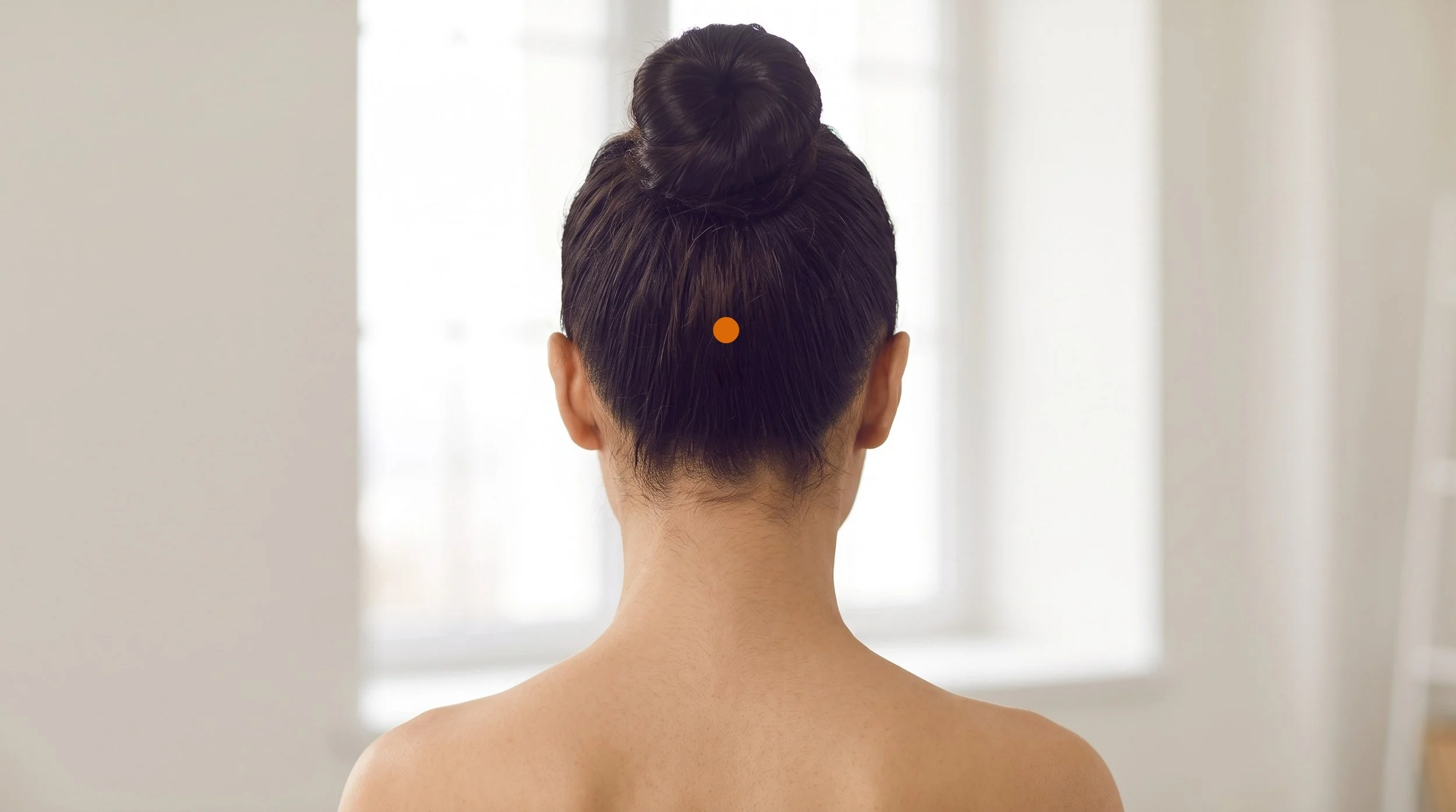
DU17 Acupuncture Point (Naohu)
The Brain's Door Above the Occipital Bone: Anatomy, Mechanism, and Why This Midline Point Sits at the Crossroads of Head and Neck Pain
DU17 (Naohu, often translated as Brain's Door or Brain's Household), also written GV17, is the Governing vessel point on the midline at the back of the head, sitting in the small depression just above the bony bump you can feel at the base of your skull, the external occipital protuberance. It's located 1.5 cun above DU16 (Fengfu), which places it at the junction of the lower quarter and upper three quarters of the line running from DU16 up to DU20 at the vertex (Deadman et al., 2009).
Classically it was described as a meeting point of the Governing vessel with the Bladder channel, and it marks the transition where the midline pathway leaves the nape and climbs onto the skull. Clinically that transition zone matters: this is the territory of the greater occipital nerve, the same C2 input that converges with trigeminal afferents in the upper spinal cord, which is why a point traditionally used for heavy, painful heads and stiff necks lines up so neatly with modern headache neuroanatomy.
- Location and layers: DU17 lies on the midline directly above the external occipital protuberance, over skin, subcutaneous tissue, the galea aponeurotica, the edge of the occipitalis muscle belly, and the periosteum of the occipital bone (Deadman et al., 2009). There's no muscle mass to needle through here, which is exactly why the technique is a shallow transverse thread rather than a perpendicular insertion.
- Traditional categories translated: classical sources group DU17 as a meeting point of the Governing vessel with the Bladder channel and credit it with dispelling wind, easing head pain, benefiting the eyes and settling the spirit (Deadman et al., 2009). In neurophysiological terms, that maps onto stimulation of occipital cutaneous and periosteal afferents in a region with dense convergence onto second-order neurons that also receive head and face input.
- The nerve story: the scalp here is supplied by the greater occipital nerve (C2), and experimental work shows that dural and greater occipital nerve afferents converge on the same C2 dorsal horn neurons, with occipital stimulation altering the excitability of dural input (Bartsch & Goadsby, 2002). Painful stimulation of the greater occipital nerve in humans can refer sensation into trigeminal territory, which helps explain why back-of-head input can influence front-of-head symptoms (Piovesan et al., 2001).
- The research picture: no trial has isolated DU17 by itself, so the honest framing is protocol-level. Cochrane reviews suggest acupuncture may reduce the frequency of tension-type headache and episodic migraine (Linde et al., 2016a; Linde et al., 2016b), and individual patient data pooling supports modest but persistent effects for chronic pain including headache and neck pain (Vickers et al., 2018).
- Clinical-practice framing: at Morningside, DU17 is typically a supporting midline point in a treatment built around the suboccipital region, not a stand-alone fix. Needling nearby soft tissue and occipital nerve territory sits alongside dry needling of the muscles that attach along the superior nuchal line, an approach reviewed for headache populations with cautious, small-to-moderate results (Pourahmadi et al., 2021; Simons et al., 1999).
- What it feels like: because the needle is threaded flat under the scalp, most people describe a brief pinch, then a tugging, spreading heaviness across the back of the head rather than a deep muscular ache. Many patients also notice a general settling or drowsiness during head and neck needling, consistent with reported shifts toward parasympathetic dominance during acupuncture (Hamvas et al., 2023).
Struggling With Headaches That Start at the Back of Your Head?
If your headaches begin in the occiput and then wrap forward toward the temples or behind the eyes, the upper cervical and occipital region is usually where we start. Our acupuncturists combine gentle midline points like DU17 with suboccipital and cervical work, plus dry needling of the muscles that attach along the base of the skull. Treatment is graded to your sensitivity, so the first session is usually lighter than you expect. Schedule a visit and we'll map where your headache pattern actually begins.
Schedule NowAnatomy of DU17: Why the Occipital Protuberance Is Such an Important Location
Run a finger up the midline from the nape and you'll meet a firm bony bump, the external occipital protuberance. DU17 sits in the shallow hollow immediately above it (Deadman et al., 2009). The tissue stack here is thin and simple: skin, a fatty subcutaneous layer rich in small vessels and nerves, the galea aponeurotica (the tough sheet that links the frontal and occipital bellies of occipitofrontalis), the edge of the occipitalis muscle, and then periosteum on hard bone.
Just below the point, the superior nuchal line serves as the attachment zone for trapezius, semispinalis capitis and splenius capitis, so mechanical load from desk posture, heavy phone use, jaw clenching and prolonged neck extension concentrates at this bony rim even though the point itself sits above the muscular attachments.
The nerve geography is what makes this location clinically interesting. Scalp sensation over and above the occipital protuberance comes largely from the greater occipital nerve, a branch of the C2 dorsal ramus, with contributions from the third occipital nerve near the midline. Those upper cervical afferents don't stay in the neck: they terminate in the trigeminocervical complex, the functional continuum between the caudal trigeminal nucleus and the upper cervical dorsal horn.
Electrophysiological recordings show single C2 neurons receiving convergent input from both the supratentorial dura and the greater occipital nerve, and stimulating the occipital nerve can change how those neurons respond to dural input (Bartsch & Goadsby, 2002). In humans, noxious stimulation of the greater occipital nerve can produce pain felt in trigeminal territory (Piovesan et al., 2001).
Needling in this region therefore delivers afferent input into a segment that is already integrating signals from the head, face and neck, and that convergence is the plausible basis for local needling influencing more widespread head symptoms, alongside the descending inhibitory and endogenous opioid pathways described in the broader acupuncture analgesia literature (Zhao, 2008).
Deep to the point, the occipital bone is thick and intact in adults, and behind that bone sits the confluence of the dural venous sinuses near the internal occipital protuberance. Nothing about a correctly performed insertion goes near those structures, but the anatomy explains the conservative technique: DU17 is needled transversely, threaded under the scalp either superiorly or inferiorly for roughly 0.5 to 1 cun, never perpendicularly toward the skull, and several classical texts list the point as contraindicated to both needling and moxibustion (Deadman et al., 2009).
Modern practice resolves this by keeping to gentle superficial threading. The occipital artery's terminal branches run through this subcutaneous layer, so scalp points can bleed or bruise a little more readily than points elsewhere, and brief pressure after needle removal is standard.
Related Best Acupuncture Points For Headaches Related Acupuncture For Neck PainDU17 (GV17) at a Glance: Classification, Location, and Clinical Use
| Category | Detail |
|---|---|
| Traditional Name | Naohu (Brain's Door, also rendered Brain's Household or Brain's Window) |
| Channel Classification | Governing Vessel, point 17 (Du 17), on the back of the head above the occiput (also called the Du Mai or Du channel) |
| Point Categories | Meeting point of the Governing vessel with the Bladder channel; a point of the Governing vessel above the occiput, listed in several classical texts as contraindicated to needling and moxibustion |
| Precise Location | Back of the head on the midline, 1.5 cun directly above DU16 (Fengfu), in the depression directly superior to the external occipital protuberance. It can also be found at the junction of the lower quarter and upper three quarters of the DU16 to DU20 line. |
| Tissue Stimulated | Scalp skin and subcutaneous tissue, galea aponeurotica, superior edge of the occipitalis muscle, and periosteum of the occipital bone, within greater occipital nerve (C2) territory just above the nuchal line attachments of trapezius and semispinalis capitis. See our Pain Finder Head Neck for related referral patterns. |
| Needle Depth / Direction | Transverse (subcutaneous) insertion directed superiorly or inferiorly, 0.5 to 1 cun. Perpendicular or deep insertion isn't used here, and classical sources restrict both needling and moxibustion at this point. |
| De Qi Sensation | A short pinch, then a tugging, dull, spreading heaviness across the back of the scalp; sometimes a warm or tingling wash toward the vertex. Sharp or electric sensations mean the needle should be adjusted. |
| Primary Clinical Uses | Traditionally used for heaviness, swelling and pain of the head, wind dizziness, eye pain and dim vision, and stiffness and pain of the neck; used today as a supporting midline point in occipital headache, cervicogenic headache and upper neck tension protocols |
| Common Point Combinations |
|
In Deadman, Al-Khafaji and Baker's A Manual of Acupuncture, DU17 is presented as a meeting point of the Governing vessel with the Bladder channel, with traditional actions given as eliminating wind and easing pain, benefiting the eyes and calming the spirit.
The classical indication lists it carries fall into three loose groups: head complaints (heaviness, swelling and pain of the head, head wind, aversion to wind, wind dizziness, facial pain and redness, neck stiffness), eye and vision complaints (dimness, short sightedness, eye pain, watering, yellow eyes), and a striking cluster of spirit and neurological disturbances (mania, epilepsy, spasm, lockjaw, loss of voice, bleeding at the root of the tongue), alongside goitre, chills and fever, sweating and bone pain.
These are traditional attributions, recorded within a pre-modern framework rather than tested indications. What's striking is that a point the classics considered risky enough to restrict from needling and moxibustion still accumulated such a broad list, and that its two strongest themes, head pain and vision, correspond to a location sitting over the occipital bone in the sensory territory that feeds the trigeminocervical complex.
Why DU17 Is Used for Eye Strain and Visual Fatigue, Not Just Headaches
Patients are often surprised that a point at the back of the skull was classically associated with eye pain, blurred or dim vision and watering eyes (Deadman et al., 2009). The segmental explanation is more satisfying than it first appears. The greater occipital nerve carries C2 input, and those upper cervical afferents terminate in the same pool of second-order neurons that receive trigeminal input from the forehead, orbit and dura (Bartsch & Goadsby, 2002). Stimulating occipital tissue in humans can produce sensations referred into that frontal and periorbital territory (Piovesan et al., 2001).
So the back of the head and the region around the eyes are functionally linked at the spinal level, and treating one can influence how the other is perceived.
There's a mechanical layer too. People with persistent eye strain often hold sustained upper cervical extension while looking at a screen, which loads semispinalis capitis, splenius capitis and the suboccipital group. Referred pain from these muscles commonly projects over the back and side of the head and toward the eye (Simons et al., 1999). Needling in this region may reduce that nociceptive drive, and broader mechanistic work links acupuncture stimulation to activation of descending inhibitory pathways and endogenous opioid systems that raise pain thresholds beyond the treated segment (Zhao, 2008).
None of this means DU17 treats eye disease. Vision changes, eye pain and new visual symptoms need an ophthalmologic or medical evaluation first. What acupuncture may reasonably offer is help with the muscular and neural components of head and neck tension that often accompany visual fatigue, and a general shift toward parasympathetic dominance has been reported during acupuncture sessions, though the underlying trials are small and heterogeneous (Hamvas et al., 2023).
What the Research Shows for DU17 (GV17)
One note on naming before the evidence: in the research literature this point is almost always listed as GV17, the WHO standard code, so GV17 is the term to search if you want to read the studies below in full.
It's worth being clear about what the evidence can and can't say. There are no randomized trials testing DU17 on its own, and there almost certainly never will be, because acupuncture is studied as multi-point protocols delivered over a course of sessions. What the literature can tell us is whether protocols that typically include occipital, cervical and midline head points help with the conditions DU17 is used for, and what the mechanistic work suggests about needling in greater occipital nerve territory. Read the table below as context for a point that plays a supporting role, not as evidence for this point specifically.
| Study | Type | Focus | Key Finding |
|---|---|---|---|
| Linde et al., 2016a | Cochrane systematic review | Acupuncture for prevention of tension-type headache (12 trials, 2,349 adults) | A course of at least six sessions may be a worthwhile option for people with frequent tension-type headache, though sham-controlled differences were modest. |
| Linde et al., 2016b | Cochrane systematic review | Acupuncture for prevention of episodic migraine | Adding acupuncture to usual care appeared to reduce migraine frequency, with effects at least comparable to prophylactic drug treatment in the included comparisons. |
| Trinh et al., 2016 | Cochrane systematic review (later withdrawn pending update) | Acupuncture for acute, subacute and chronic neck pain | Moderate-quality evidence suggested short-term pain relief compared with sham, though the review's withdrawal for updating means the conclusions should be treated cautiously. |
| Vickers et al., 2018 | Individual patient data meta-analysis | Chronic pain conditions including headache and neck pain (about 20,800 patients) | Acupuncture outperformed both sham and no-acupuncture controls, with effects that persisted over about a year rather than fading immediately. |
| Pourahmadi et al., 2021 | Systematic review and meta-analysis | Dry needling for tension-type, cervicogenic and migraine headache | Dry needling produced small to medium improvements in headache intensity and related disability, most consistently in cervicogenic headache. |
| Bartsch & Goadsby, 2002 | Experimental electrophysiology | Convergence of dural and greater occipital nerve input onto C2 dorsal horn neurons | Occipital nerve stimulation altered the central excitability of dural afferent input, supporting a functional continuum between cervical and trigeminal pain processing. |
| Hamvas et al., 2023 | Systematic review and meta-analysis | Effect of needle acupuncture on heart rate variability versus placebo | Verum acupuncture was associated with increases in parasympathetic indices that sham did not produce, though the authors urge caution given study quality and heterogeneity. |
Stiff Neck and a Heavy, Foggy Head After Long Desk Days?
Hours of screen time load the deep neck extensors and the occipital attachments, and that often shows up as neck stiffness with a dull, heavy head. DU17 and its neighbors give us a way to address the scalp and occipital tissues directly while we release the cervical muscles that keep feeding the pattern. We also send you out with posture and mobility cues so the relief holds between visits. Book an appointment and let's take the load off your neck.
Schedule NowDU17 in the Context of Trigger Point Work
DU17 itself sits above the muscular attachments, on bone, so it isn't a trigger point target. What sits just below it is: the superior nuchal line is where upper trapezius, semispinalis capitis and splenius capitis anchor, and the suboccipital group lies deeper still. Trigger points in semispinalis capitis classically refer a band of pain that wraps around the side of the head toward the eye, while upper trapezius and suboccipital referral commonly covers the occiput and temple (Simons et al., 1999).
When a patient points to the back of the skull and then traces forward, that referral map usually explains more of their experience than any single tender spot.
In practice we treat the region as a unit. A typical session at Morningside might use a shallow transverse thread at DU17 with DU16 and GB20 nearby, then dry needling of upper trapezius, splenius capitis, semispinalis capitis and the suboccipitals depending on palpation findings, all performed with careful attention to depth and angle in the suboccipital triangle. Reviews of dry needling for headache populations report small to medium improvements in pain intensity and disability, which is a realistic expectation to set (Pourahmadi et al., 2021).
Manual therapy, deep neck flexor training and workstation changes are usually part of the plan, since needling reduces the irritability of the tissue but doesn't change the loads that created it.
DU17 Headache and Neck Pain Treatment at NYC's Highest-Rated Acupuncture Clinic
Morningside Acupuncture is the highest-rated acupuncture and dry needling clinic in New York City with over 500 five-star Google reviews, and head and neck pain is one of the things we treat most. Every session is delivered by a licensed acupuncturist who explains the anatomy, the plan and the reasoning behind each point choice, including conservative ones like DU17. You'll get a treatment that blends classical point selection with trigger point and orthopedic needling. Schedule your visit today and get started.
Schedule NowFrequently Asked Questions
Is DU17 the same point as GV17?
Yes. DU17 and GV17 are two codes for the same point, Naohu. DU comes from Du Mai, the Chinese name of the Governing Vessel, and it is the code used in most Chinese texts and many acupuncture schools. GV is the WHO standard abbreviation and the one you will see in most Western textbooks and research papers. You will also come across it written as Du 17, GV-17, or Governing Vessel 17. Whichever code is used, the location and the uses are the same.
What does DU17 feel like when needled?
Because the needle is threaded flat beneath the scalp rather than pushed toward the bone, most people feel a brief pinch at insertion and then a tugging, dull heaviness that spreads across the back of the head. Some describe warmth or a light tingling drifting toward the crown. Scalp points can feel more surprising than body points simply because we're not used to sensation there, but the intensity is usually mild. Sharp, burning or electric sensations aren't the goal and mean the needle should be repositioned, so tell your acupuncturist right away.
Why needle the back of the head when my pain is behind my eyes?
Because the two regions share wiring. The greater occipital nerve carries C2 input that terminates in the same neuron pool receiving trigeminal signals from the forehead, orbit and dura, and experimental work shows occipital stimulation can change how those neurons respond and can even refer sensation into frontal territory (Bartsch & Goadsby, 2002; Piovesan et al., 2001). That's the same principle behind occipital nerve blocks for headache. Treating the occiput isn't a detour from your eye pain; it's often the more accessible end of the same circuit.
Can I press DU17 myself between sessions?
Yes, acupressure here is simple and safe. Find the bony bump at the base of the back of your skull on the midline, then slide your fingertip just above it into the shallow hollow. Use your thumb or the pads of two fingers with steady, moderate pressure, enough to feel a satisfying ache but not enough to make you tense your neck. Hold for 30 to 60 seconds, release, then repeat two or three times. Small circular motions work well too. A comfortable routine is once or twice a day, often paired with pressing the hollows on either side of the neck at GB20 and a few slow chin tucks. Stop if you get dizzy, if pressure sharply increases your headache, or if you notice numbness or tingling down an arm, and check in with a clinician instead.
Is DU17 safe to needle?
In trained hands, yes, with a specific caveat. Several classical texts list DU17 as contraindicated to needling and moxibustion, and modern practice honors that by using only gentle transverse insertion under the scalp, threaded superiorly or inferiorly about 0.5 to 1 cun, never deep or perpendicular (Deadman et al., 2009). The adult occipital bone is solid, so a correctly angled needle stays in the subcutaneous layer. The most common minor effects are small bruises or a bit of bleeding on withdrawal, since the scalp is well vascularized, which is why practitioners apply brief pressure afterward. Tell your acupuncturist about any bleeding disorders, blood thinners, recent head surgery, cranial hardware or scalp skin conditions, and let them know if you have a history of fainting so you can be treated lying down.
Where exactly is DU17 located?
DU17 is on the midline at the back of the head, in the depression directly above the external occipital protuberance, the bony prominence you can feel at the base of the skull. It's 1.5 cun above DU16 (Fengfu), which sits in the hollow below the occipital bone at the top of the nape. A useful cross-check is the line from DU16 up to DU20 at the vertex: DU17 falls at the junction of the lower quarter and the upper three quarters of that line (Deadman et al., 2009). GB19 sits at roughly the same level, lateral to DU17 and directly above GB20.
References
- Deadman, P., Al-Khafaji, M., & Baker, K. (2009). A manual of acupuncture. Journal of Chinese Medicine Publications.
- Simons, D. G., Travell, J. G., & Simons, L. S. (1999). Travell & Simons' myofascial pain and dysfunction: The trigger point manual, Vol. 1: Upper half of body (2nd ed.). Williams & Wilkins.
- Linde, K., Allais, G., Brinkhaus, B., Fei, Y., Mehring, M., Shin, B.-C., Vickers, A., & White, A. R. (2016a). Acupuncture for the prevention of tension-type headache. Cochrane Database of Systematic Reviews, 2016(4), CD007587. https://doi.org/10.1002/14651858.CD007587.pub2
- Linde, K., Allais, G., Brinkhaus, B., Fei, Y., Mehring, M., Vertosick, E. A., Vickers, A., & White, A. R. (2016b). Acupuncture for the prevention of episodic migraine. Cochrane Database of Systematic Reviews, 2016(6), CD001218. https://doi.org/10.1002/14651858.CD001218.pub3
- Trinh, K., Graham, N., Irnich, D., Cameron, I. D., & Forget, M. (2016). Acupuncture for neck disorders. Cochrane Database of Systematic Reviews, 2016(5), CD004870. https://doi.org/10.1002/14651858.CD004870.pub4
- Vickers, A. J., Vertosick, E. A., Lewith, G., MacPherson, H., Foster, N. E., Sherman, K. J., Irnich, D., Witt, C. M., & Linde, K. (2018). Acupuncture for chronic pain: Update of an individual patient data meta-analysis. Journal of Pain, 19(5), 455-474. https://doi.org/10.1016/j.jpain.2017.11.005
- Pourahmadi, M., Dommerholt, J., Fernández-de-las-Peñas, C., Koes, B. W., Mohseni-Bandpei, M. A., Mansournia, M. A., Delavari, S., Keshtkar, A., & Bahramian, M. (2021). Dry needling for the treatment of tension-type, cervicogenic, or migraine headaches: A systematic review and meta-analysis. Physical Therapy, 101(5), pzab068. https://doi.org/10.1093/ptj/pzab068
- Bartsch, T., & Goadsby, P. J. (2002). Stimulation of the greater occipital nerve induces increased central excitability of dural afferent input. Brain, 125(7), 1496-1509. https://doi.org/10.1093/brain/awf166
- Piovesan, E. J., Kowacs, P. A., Tatsui, C. E., Lange, M. C., Ribas, L. C., & Werneck, L. C. (2001). Referred pain after painful stimulation of the greater occipital nerve in humans: Evidence of convergence of cervical afferences on trigeminal nuclei. Cephalalgia, 21(2), 107-109. https://doi.org/10.1046/j.1468-2982.2001.00166.x
- Hamvas, S., Hegyi, P., Kiss, S., Lohner, S., McQueen, D., & Havasi, M. (2023). Acupuncture increases parasympathetic tone, modulating HRV: Systematic review and meta-analysis. Complementary Therapies in Medicine, 72, 102905. https://doi.org/10.1016/j.ctim.2022.102905
- Zhao, Z. Q. (2008). Neural mechanism underlying acupuncture analgesia. Progress in Neurobiology, 85(4), 355-375. https://doi.org/10.1016/j.pneurobio.2008.05.004
Disclaimer: This web site is intended for educational and informational purposes only. Reading this website does not constitute providing medical advice or any professional services. This information should not be used for diagnosing or treating any health issue or disease. Those seeking medical advice should consult with a licensed physician. Seek the advice of a medical doctor or other qualified health professional for any medical condition. If you think you have a medical emergency, call 911 or go to the emergency room. No acupuncturist-patient relationship is created by reading this website or using the information. Morningside Acupuncture PLLC and its employees and contributors do not make any express or implied representations with respect to the information on this site or its use. For any legal interpretation of scope of practice in your state, consult a licensed attorney or regulatory authority.
Read more from our blog



